Article Text
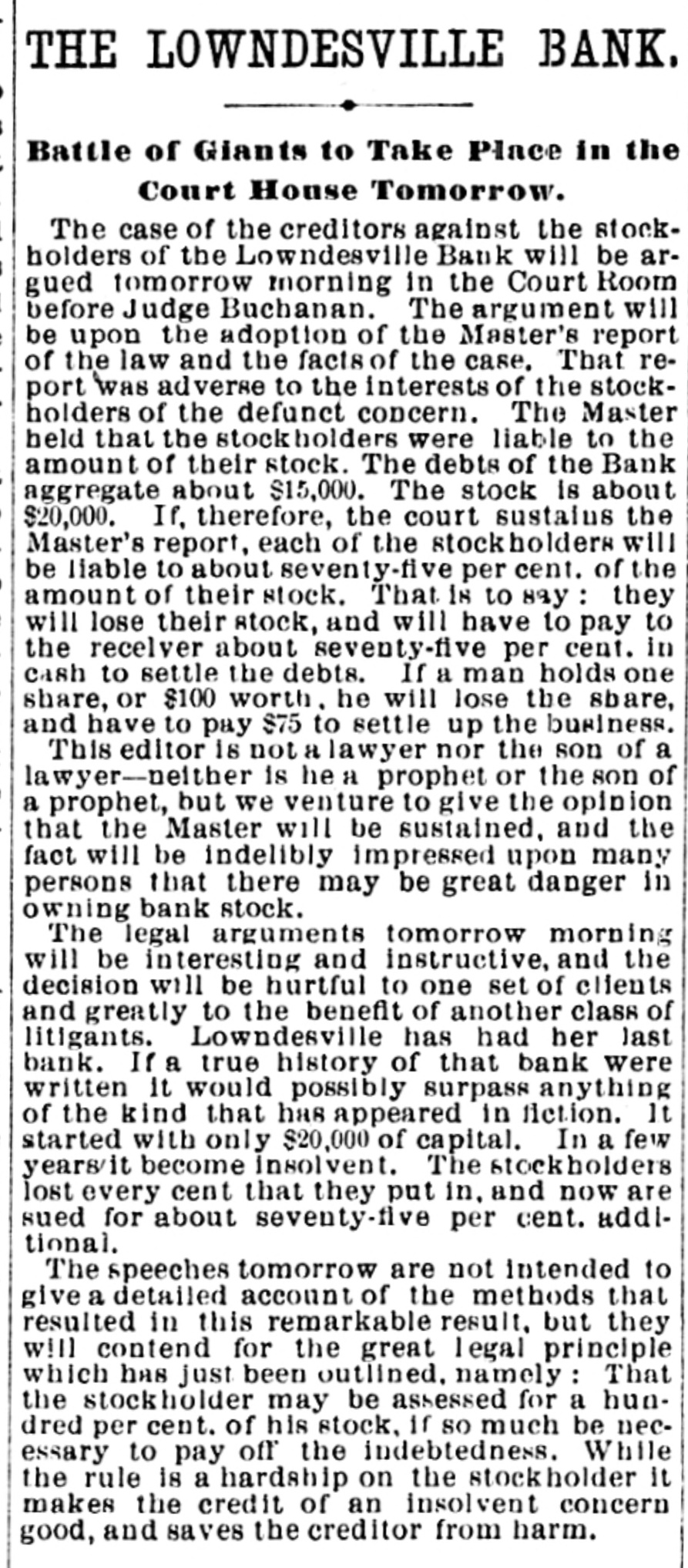
place, of blo id poison His death WAS due to scratch from a cuff button. He was buried at Little River yesterday.-Honea Path Chronicle. The Abbeville Baptist Association will hold its annual session at Lowndesville on the 17th, 18th and 19th inst. The P. R. & W.C. will sell round-trip tickets for the occasion on the 16th and 17th, good to return on any train until September 23rd, at rate of five cents per mile McCully & Cathcart want to sell you bagging and ties. They have bagging in all varieties. new and old, by the bale, by the roll and by the pattern, and the largest stock they have ever carried. Look out for their new advertisement next week, but in the meantime give them a call. At a meeting of the Board of County Commissioners yesterday Mr. C. B. Gilmer tender his resignation as Roadoverseer, which was accepted, and Mr. W. T. McGregor, the chain gang guard, was elected his successor. Mr. Claude Skelton was elected to succeed Mr. McGregor as guard. Rev. and Mrs. J. R Edwards, of Riovede, Mexico, arrived in Anderson last Saturday, and will spend a vacation of several months in this section with relatives. They were not expected until the first of November, but the serious illness of Mrs. Edwards' sister, Miss Flossie Brown, hastened their coming. A copy of Southern Progress, a neatly gotten up little magazine, containing a monthly review of manufacturers, mining, railroad construction, real estate, finance and insurance in the Southern States, has he been received at this office magazine the South 'f is published in Augusta, ern Progress Publishing Cor any. Our young friend, R W. Simpson, Jr of Pendleton, has gone to Columbia to accept position on the local staff of the Register. Mr. Simpson's first newspaper work was as Pendleton correspondent to the INTELLIGENCER. He is a bright, energetic young man, and wields a fluent pen. In his new field of labor we wish him much success. Sloan, the infant son of Mr. W. B Fisher, who lives near the southern suburbs of the city, died last Monday, aged 14 months. The little one met with a painfot accident by being severely burned on the face and breast a few weeks ago, and suffered intensely until death came to his relief. The remains were Interred in Silver Brook Cemetery yesterday. We ask your attention to U. E Seybt's new dvertisement on this page. Mr. Seybt is now in the northern markets buy. ing a big stock of fail and winter goods, and he wants you to call early and often at bis store. Mrs. T S. Crayton, who is also in the northern markets, will again have charge of his millinery department and will be thorough V posted in all the new styles when she returns in a few days. Newspapers in every part of the State and of all shades of politics seem to be dis posed to take up the fight begun by Spartanburg, Anderson, Laurens and Greenville to prevent the Southern Railway Company from swallowing the Port Royal & Western Carolina Railroad. If public sentiment has any effect on legislation and if legislation can interfere. it is reasonably certain that the process will never be com pleted. The creditors of the Lowndesville Bank have determined to sue the stockholders. The debts of the Bank are considerable, and the depositors and creditors proposeto hold the stockholders liable. The question is, as to the extent of their liability. A dividend of about twenty per cent. was ordered paid to creditors and depositors. Parker & McGowan, of Abbeville, and Col. J. N Brown, of this city, will represent the Bank in the suits. The Charleston Sunday News says 4: Mr. P. M. Ruff has gone to Anderson to take charge of the machinery of the cotton mill there. Mr. Ruff is skilful mechanic energetic and reliable. During the war he was member of the Richland Volunteer Rifle Company, attached to the 1st regiment South Carolina Volunteers, and was a splendid soldier, faithful and fearless and admired by his comrades. de has many friends in Charleston who wish him every success." Anderson received her first bale of new cotton last Friday, a few days later than the one of last year. It came from the plantation of that live, progressive farmer, Mr. P. B Allen, of Starr, and was bought by Messrs. Brown, Osborne & Co. at cents. The bale weighed 1,042 pounds, which is the largest that has been marketed in the State, and no other town in the State has paid such a price for its first bale Bring your cotton to Anderson and you will always get the best price for it. The citizens residing in Anderson, Pickens and Oconee Counties around Clemson College will petition the General Assembly at its next session to construct a new county with county seat at Pendleton The line of the proposed new county will run through Anderson County as follows: Starting at Saluda River about two miles above Pelzer Factory and from there in a direct line to Watkins' Mill on Six and Twenty Creek, thence down said creek and Deep Creek to Andersonville. Orangeburg Dispatch: "We publish elsewhere report of the mass meeting held at Anderson last week in the interest of building a cotton factory for that town Those who read it will note that this progressive little town is on the way to having a $250,000 mill This means more than one can estimate for that town. The example set by it should be followed by every other town in the State." We would say to the Dispatch that this is our second mill. We have had one big mill for several years, and know the benefit to be derived from such enterprises. Walhalla Courier: "Mr. J. J. Norton, Jr., left this (Thursday) morning for Anderson, where he goesto enter into partnership with Dean & Ratliffe, the wide awake merchants of that city. During the ootton season Mr. Norton will be the cotton buyer for the firm. We regret very much to give our young friend up, but trust in casting in his lot with the good people of Anderson, he may meet with great success, as we feel sure he will. Walhalla's loss will be Anderson's gain." The INTELLI GENCER extends cordial welcome to Mr. Norton to Anderson. Dr. Wm. Edwin Hall, editor International, New York, and a most popular lecturer, has been spending a few days in this section and is charmed with our coun try. Last Sunday afternoon in the Opera House he delivered a most eloquent and impressive sermon from the text Jesus Christ, the same yesterday, to day and forever. On Monday he went to Ciemson College and lectured there that evening. He returned to Anderson yesterday and last night delivered his famous lecture, "How to Get Married and stay 80. He was greeted by a very appreciative audience, and his lecture was most highly en joyed The Easley Messenger of the 29th ult. says: "A happy and charming event OC curred Wednesdav evening at the residence of Mr. and Mrs. Elias Day, the occasion being the marriage of their two oldest daughters, Misses Alice and Janie The