1743. Peoples Savings Bank (Pawcatuck, CT)

Bank Information

Episode Type
Suspension → Closure
Bank Type
savings bank
Start Date
March 29, 1904
Location
Pawcatuck, Connecticut (41.377, -71.834)

Metadata

Model
gpt-5-mini
Short Digest
005e9d03

Response Measures

None

Description

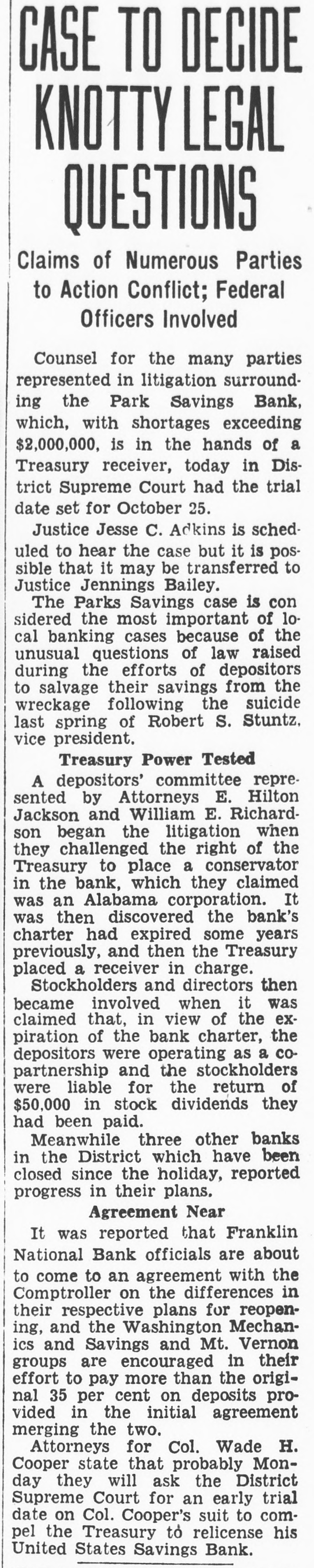
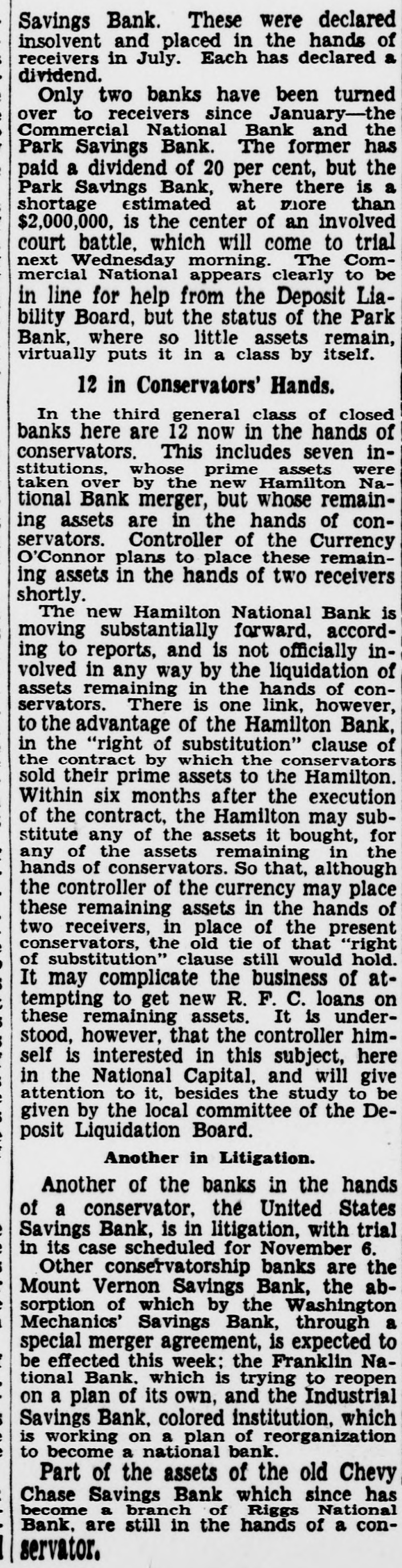
Articles report the People's/Peoples Savings Bank of Pawcatuck suspended by the Savings Bank Commissioner (ordered to pay no deposits for 60 days) and placed in liquidation after discovery of treasurer defalcation (~$20,000) and weak securities. There is no clear description of a depositor run; therefore classified as a suspension leading to closure/liquidation. OCR variants (People's/Peoples, Paweatuck) corrected to Peoples Savings Bank, Pawcatuck, CT.

Events (5)

1. March 29, 1904 Suspension
Cause
Bank Specific Adverse Info
Cause Details
Order followed investigation showing weak/poor securities and inability to meet a heavy run; treasurer later confessed a $20,000 defalcation was revealed; bank commissioner ordered suspension and 60-day stoppage of payments.
Newspaper Excerpt
The Peoples Savings Bank of Paweatuck near this city suspended by order of the Savings Bank Commissioner of Connecticut on March 29, last.
Source
newspapers
2. April 1, 1904 Other
Newspaper Excerpt
The People's Savings bank of Pawcatuck, Conn., has suspended payment and will go into liquidation.
Source
newspapers
3. April 20, 1904 Other
Newspaper Excerpt
The Savings Bank Commissioners of Rhode Island ordered the People's Savings Bank of Pawcatuck, in Stonington, to pay no deposits for sixty days. The bank accordingly suspended payment and its affairs will be placed in liquidation.
Source
newspapers
4. May 27, 1904 Other
Newspaper Excerpt
At the request of representatives of the People's Savings bank, of Pawcatuck, Judge Gager... granted an injunction restraining the bank from paying out any money. Treasurer J. A. Brown... had confessed that he was a defaulter to the extent of $20,000... asked for the appointment of a receiver.
Source
newspapers
5. May 28, 1904 Receivership
Newspaper Excerpt
President... asked that H. B. Agard of Westerly, R. I., be appointed receiver. Judge Gager issued the injunction. The matter of a receiver was taken under consideration.
Source
newspapers

Newspaper Articles (6)

Article from Middlebury Register, April 1, 1904

Click image to open full size in new tab

Article Text

CONDENSED DISPATCHES. Notable Events of the Week Briefly Chronicled. Rear Admiral Robley D. Evans has sailed from Hongkong on his way home. The bubonic plague caused 40,527 deaths in India in the week ending March 19. The Vatican authorities ridicule the report of a threat against the life of Pope Pius X. A trolley car was burned up in a New York suburb before the firemen could reach it. It is reported in Alexandria, Egypt, that the khedive may visit the St. Louis exposition. The People's Savings bank of Pawcatuck, Conn., has suspended payment and will go into liquidation. The soldiers on Governors island, New York, may appeal to Secretary of War Taft because of severe discipline. Dowager Queen Margherita of Italy met Emperor William at sea off Gaeta and had lunch with him on his yacht, the Hohenzollern. The United States district court at St. Louis did not pass sentence upon Senator Burton of Kansas, convicted of having made improper use of his influence as a senator. Motion for arrest of judgment filed. Tuesday, March 29. The ameer of Afghanistan, reported poisoned, is alive and well at Kabul. Four workmen were killed in a tunnel near Brownsville, Pa., by a dynamite explosion. The Smoot case will reopen April 12 at Washington, with Mormon church officials as witnesses. The Passion play was given in Chicago for the first time by members of the Roman Catholic church. The Macedonian situation is better, and the sultan is believed to be about to accept Austro-Russian reforms. Governor Murphy has signed the child labor bill, which passed both houses of the New Jersey legislature. Charles M. Schwab at New York swore off an assessment of $100,000 on his personalty, but agreed to pay on $5,000. Parker Dexter, aged eleven, mysteriously shot at his home. Randolph, Mass., died without regaining consciousness. The Jones & Laughlin Steel company has been enjoined from SO operating its Pittsburg plant as to injure surrounding property by ore dust. The steamer Alliance, which has arrived at Marshfield, Ore., reports picking up a large boat belonging to the British ship La Morna of Greenock which is supposed to have foundered during a recent storm. Bankers and business men of Baltimore control a company incorporated in Massachusetts for the unique pur pose of furnishing classic and ragtime music to New England homes just as gas and water are supplied. The mu sic will be sent over wires by the tele phone method. The manuscript of Milton's "Para dise Lost," which was offered for sale at public auction in London, but which was withdrawn because the reserve d price of £5,000 was not offered, has now been sold to an American collect or whose name and the amount paid are not disclosed. The president has granted a ful ir pardon to Servillano Aquino, the brig adier general in the Philippine insur il gent army who was sentenced by : n military commission to a long term o of imprisonment for having ordered the summary execution of five America prisoners during the insurrection in the Philippines. at Monday, March 28. A cyclone in the island of Mauritiu has killed ninetri and dene


Article from The Abbeville Press and Banner, April 20, 1904

Click image to open full size in new tab

Article Text

Savings Bank Closes. The Savings Bank Commissioners of Rhode Island ordered the People's Savings Bank of Pawcatuck, in Stonington, to pay no deposits for sixty days. The bank accordingly suspended payment and its affairs will be placed in liquidation.


Article from The Daily Morning Journal and Courier, May 28, 1904

Click image to open full size in new tab

Article Text

PAWCATUCK BANK ENJOINED RESTRAINED FROM PAYING OUT ANY MONEY. Treasurer J. A. Brown of the People's Savings Bank Confesses He is a Defaulter to the Extent of $20,000-Says He Gave the Money to Friends and Refuses Positively to Reveal Their Identity. Norwich, May 27.-At the request of repr..esentatives of the People's Savings bank, of Paweatuck, Judge Gager, of the superior court, to-day granted an injunction restraining the bank from paying out any money. Dr. E. H. Knowles, president of the bank, gave evidence that the treasurer, J. A. Brown, who is very sick at his home in Westerly, R. I., had confessed that he was a defaulter to the extent of $20,000. Dr. Knowles said he called at Mr. Brown's house one day this week and that at that time the treasurer made the alleged confession. Mr. Brown said he had not wasted the money in speculation or in extravagant living, but had given it to friends. He refused positively to reveal the identity of those friends, sayin gthat he meant to take the secret to his grave. Dr. Knowles added that Mr. Brown admitted that he had not added up his deposit book for several years, and that he was afraid to do so. Bank Commissioner Noble favored the application for stopping payments at the bank. President Knowles and other bank representatives asked for the appointment of a receiver and suggested that H. B. Agard, of Westerly, an attorney, be appointed to that position. The state attorney thought that it would be better o appoint some person outside of Westerly as receiver, and Judge Gager agreed with him, saying that while there was no individual objection to Mr. Agard, a receiver resident in Westerly might be embarrassed by friendships. Judge Gager therefore decided to postpone the appointment of a receiver until next week. The bank had deposits on January 1, 1904, of $109,956.36, with a surplus of $3,900. The institution is located in Pawcatuck, which is just across the Pawcatuck river from Westerly, and most of the depositors are Westerly men, one man having a deposit of $20,000.


Article from Daily Kennebec Journal, May 28, 1904

Click image to open full size in new tab

Article Text

Westerly, R. I., May 27.-The Peoples Savings Bank of Paweatuck near this city suspended by order of the Savings Bank Commissioner of Connecticut on March 29, last. At that time an investigation showed that the bank's securities were not of the best and that it would be impossible to meet a heavy run by depositors. No shortage in the accounts of the treasurer has been found. Today's proceedings at Norwich followed the expiration of the 60 days period. The institution has deposits of slightly less than $100,000. The bank is the third savings institution in this vicinity which has gone out of business within three years.


Article from Daily Kennebec Journal, May 28, 1904

Click image to open full size in new tab

Article Text

BANK'S DIFFICULTIES. Injunction Served Against One at Pawcatuck, Conn. Norwich, Conn., May 27.-At a hearing in Chambers, today, before Judge Gager, of the superior court, an injunction was asked for to restrain the Peoples Savings Bank at Pawcatuck, Conn., from paying out any money. President E. H. Knowles, of the Bank appeared and testified that Treasurer J. A. Brown. who is now ill, had confessed to him that he was a defaulter to the extent of about $20,000 and asked that H. B. Gard of Westerly, R. I., be appointed receiver. Judge Gager is. sued the injunction. The matter of a receiver was taken under consideration.


Article from Waterbury Evening Democrat, May 28, 1904

Click image to open full size in new tab

Article Text

NUTMEG GRATINGS. Interesting Items Boiled Down For the Benefit of our Busy Readers. At a hearing in chambers yesterday, before Judge Gager of the superior court, an injunction was asked for by Attorney Sweeney of Wetserly, R. I., to restrain the People's Savings bank of Pawcatuck from paying out any money. President EL H. Knowles of the bank appeared and testified that Treasurer J. A. Brown, who is now ill, had confessed to him that he was a defaulter to the extent of about $20,000. Mr Knowles asked that H. B. Agard of Westerly, R. I., be appointed receiver. Judge Gager issued the i injunction. The matter of a receiver was taken under consideration.