17315. Merchants Bank of South Carolina (Cheraw, SC)

Bank Information

Episode Type
Suspension โ†’ Closure
Bank Type
state
Start Date
January 1, 1860*
Location
Cheraw, South Carolina (34.698, -79.883)

Metadata

Model
gpt-5-mini
Short Digest
8b17934693166dd3

Response Measures

None

Description

Articles describe the Merchants' Bank of South Carolina (Cheraw) as a suspended bank with a receiver (Wm. Godfrey) handling creditors' claims by 1873 and later Supreme Court decisions (1878) stating the bank's failure occurred at the time of suspension of specie payments in 1860. No article describes a depositor run; the bank was suspended earlier (1860) and had a receiver by 1873, indicating permanent closure. OCR typos corrected (e.g., Merchants' Bank of H South Carolina -> Merchants' Bank of South Carolina).

Events (4)

1. January 1, 1860* Suspension
Cause
Macro News
Cause Details
Bank suspended specie payments in 1860 (national financial disruption related to the Civil War era), leading to its failure.
Newspaper Excerpt
The Supreme Court holds that the failure of the bank in question occurred at the time of the suspension of specie payments in 1860
Source
newspapers
2. April 4, 1873 Receivership
Newspaper Excerpt
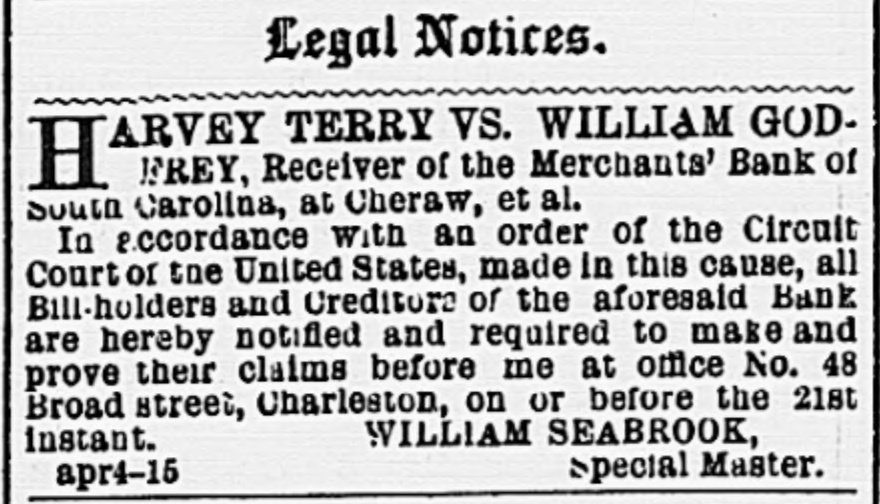
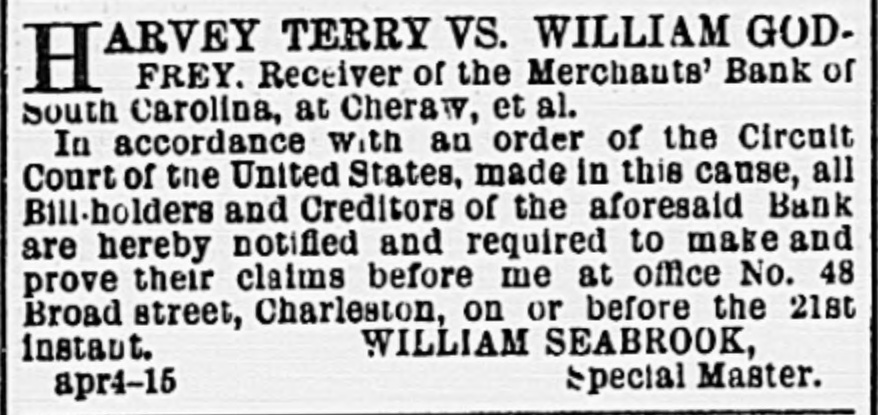
ARVEY TERRY VS. WILLIAM GODFREY, Receiver of the Merchants' Bank of South Carolina, at Cheraw... all bill-holders and creditors of the aforesaid Bank are hereby notified and required to make and prove their claims before me ... WILLIAM SEABROOK, Special Master. apr4-15
Source
newspapers
3. April 22, 1873 Other
Newspaper Excerpt
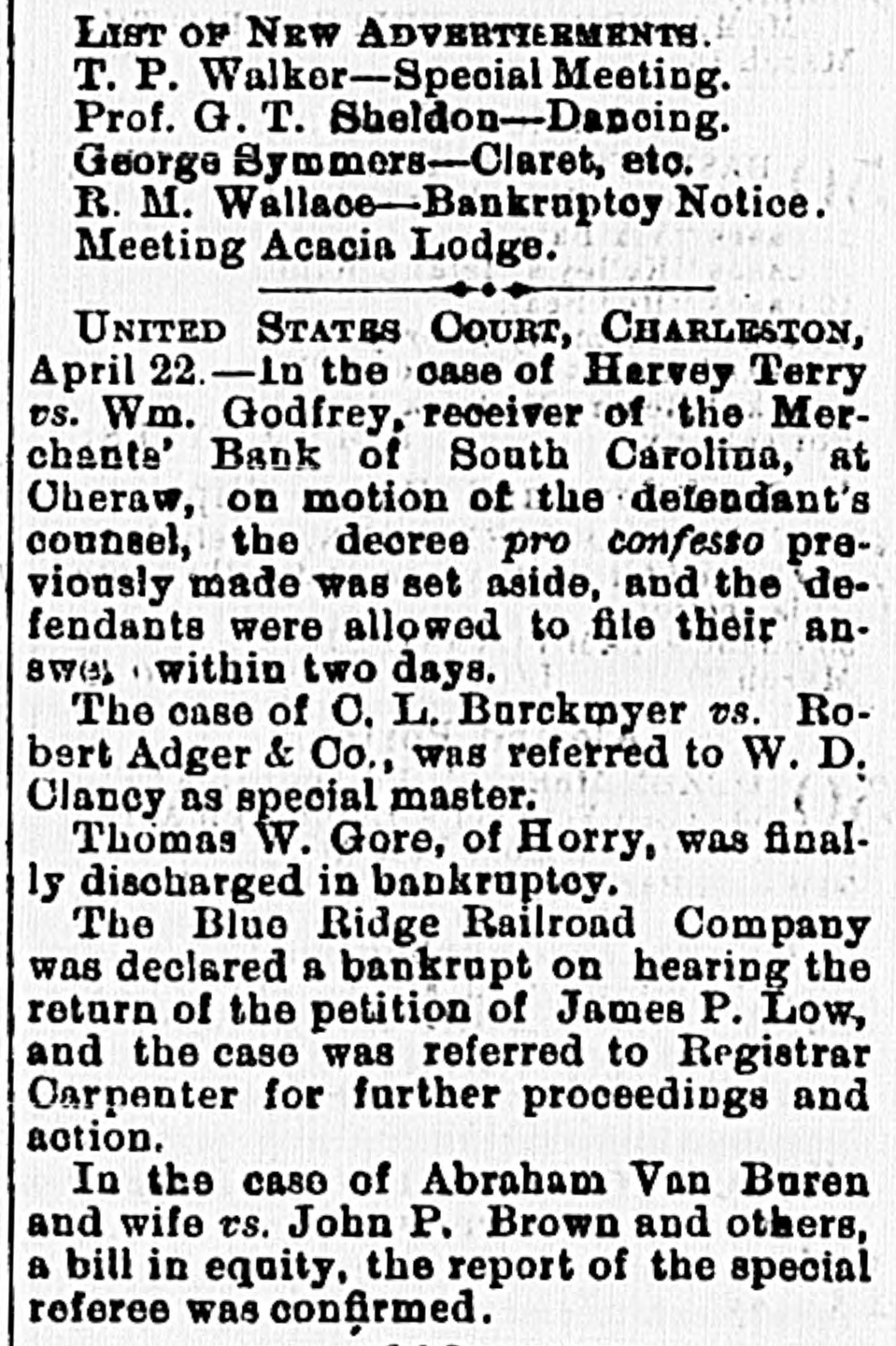
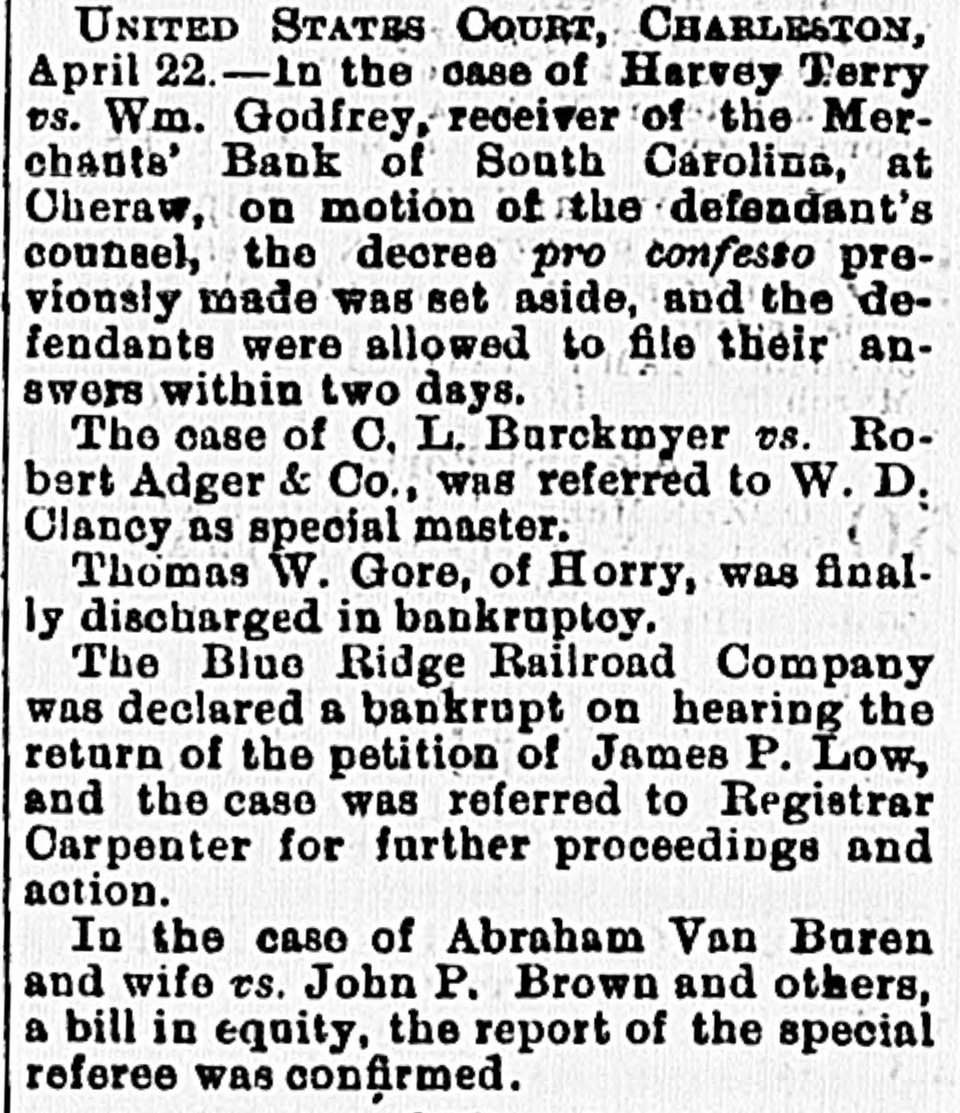
UNITED STATES COURT, CHARLESTON, April 22. - In the case of Harvey Terry vs. Wm. Godfrey, receiver of the Merchants' Bank of South Carolina, at Cheraw, on motion of the defendant's counsel, the decree pro confesso previously made was set aside, and the defendants were allowed to file their answers within two days.
Source
newspapers
4. March 28, 1878 Other
Newspaper Excerpt
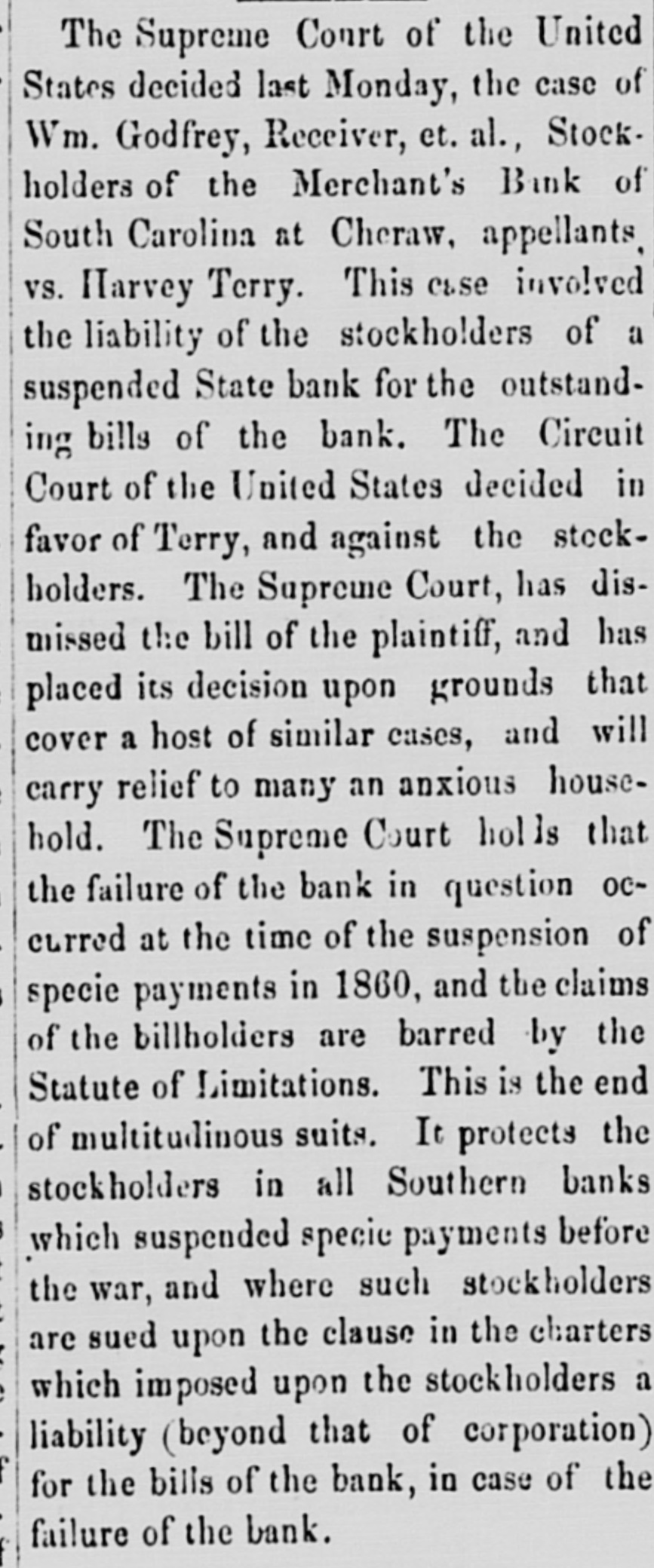
The Supreme Court of the United States decided... Wm. Godfrey, Receiver, et. al., Stockholders of the Merchant's Bank of South Carolina at Cheraw, appellants, vs. Harvey Terry... The Supreme Court holds that the failure of the bank in question occurred at the time of the suspension of specie payments in 1860...
Source
newspapers

Newspaper Articles (7)

Article from The Charleston Daily News, April 4, 1873

Click image to open full size in new tab

Article Text

Legal Notices. ARVEY TERRY VS. WILLIAM GOD. FREY, Receiver of the Merchants' Bank of H South Carolina, at Cheraw, et al. In accordance with an order of the Circuit Court or the United States, made in this cause, all Bill-holders and Creditore of the aforesaid Bank are hereby notified and required to make and prove their claims before me at office No. 48 Broad street, Charleston, on or before the 21st WILLIAM SEABROOK, instant. special Master. apr4-15


Article from The Charleston Daily News, April 5, 1873

Click image to open full size in new tab

Article Text

ARVEY TERRY VS. WILLIAM GODFREY. Receiver of the Merchants' Bank of H South Carolina, at Cheraw, et al. In accordance with an order of the Circuit Court of the United States, made in this cause, all Bill-holders and Creditors of the aforesaid Bank are hereby notified and required to make and prove their claims before me at office No. 48 Broad street, Charleston, on or before the 21st WILLIAM SEABROOK, instant. Special Master. apr4-15


Article from The Daily Phoenix, April 24, 1873

Click image to open full size in new tab

Article Text

UNITED STATES OQURT, CHARLESTON, April 22.-1n the case of Harvey Terry vs. Wm. Godfrey, receiver of the Merchants' Bank of South Carolina, at Cheraw, on motion of the defendant's counse), the decree pro confesso previously made was set aside, and the defendants were allowed to file their answers within two days. The case of C. L. Burckmyer vs. Robert Adger & Co., was referred to W. D. Clancy as special master. Thomas W. Gore, of Horry, was finally discharged in bankruptoy. The Blue Ridge Railroad Company was declared a bankrupt on hearing the return of the petition of James P. Low, and the case was referred to Registrar Carpenter for further proceedings and action. In the caso of Abraham Van Buren and wife cs. John P. Brown and others, a bill in equity, the report of the special referee was confirmed.


Article from The Daily Phoenix, April 24, 1873

Click image to open full size in new tab

Article Text

LIST OF NEW ADVERTIERMENTS T. P. Walker-Special Meeting. Prof. G. T. Sheldon-Dancing. George Symmers-Claret, etc. R. M. Wallace-Bankraptoy Notice. Meeting Acacia Lodge. UNITED STATES OQURT, CHARLESTON, April 22. -In the case of Harvey Terry vs. Wm. Godfrey, receiver of the Merchante' Bank of South Carolina, at Oheraw, on motion of the defendant's counsel, the decree pro confesso previously made was set aside, and the defendants were allowed to file their answe within two days. The case of C. L. Burckmyer vs. Robert Adger & Co., was referred to W. D. Clancy as special master. Thomas W. Gore, of Horry, was finally discharged in bankruptoy. The Blue Ridge Railroad Company was declared a bankrupt on hearing the return of the petition of James P. Low, and the case was referred to Registrar Carpenter for further proceedings and action. In the caso of Abraham Van Buren and wife vs. John P. Brown and others, a bill in equity, the report of the special referee was confirmed.


Article from The Daily Phoenix, April 15, 1874

Click image to open full size in new tab

Article Text

THE UNITED STATES CIRCUIT COURT. This court convened at 10 o'clock A. M., Monday, Judges H. L. Bond and Geo. S. Bryan present. W. Roland Murphy, for carrying on the business of a retail liquor dealer without paying the special tax, pleaded guilty, and was fined by the court $200 and sentenced to three months' imprisonment. The law docket was called, and the following cases set for trial Tuesday: Carrie B. Caldwell, executrix of Adolphns Caldwell, against the South-western Railroad Bank; Albert R. Homesley againt E. B. Stoddard and Caleb Froneberger; L J. Moses against the South Carolina Steam Packet Company; David Valentine & Co. against E. W. Moise; the Bank of Commerce, Richmond, Va., against H. J. Anthony, Thomas R. Price and Wm. Smith, County Commissioners of Pickens County, S. C.; E. L. Casey against Kindred Q. Whitmore. The following equity cases were set for trial during the term: The United States against Frank Murray and Stepben D. Heard; Henry Heyward against John B. Bissell and others; Harry Ferry against Wm. Godfrey, receiver of Merchants' Bank of South Carolina at Cheraw, and others; Charles Kerrison, assignee, egainst A. T. Stewart & Co., and others; the Greenville and Columbia Railroad Company against Hiram H. Kimpton; W. L. Bradley against the South Carolina Phosphate and Phosphatic River Mining Company and others; J. and T. Green against C. H. Baldwin, receiver of the Exchange Bank of Columbia, S. C. The cases of James T. Welsman and others against H. H. Kimpton, and of the Greenville and Columbia Railroad Company against H. H. Kimpton and others, were referred to J. E. Hagood, special master, to take the testimony and report to the court. It was ordered in the case of James Welsman against H. H. Kimpton and others that the complainants have leave to file their replication. The petition of T. Sealy, for homestead, was dismissed.


Article from Yorkville Enquirer, March 28, 1878

Click image to open full size in new tab

Article Text

EDITORIAL INKLINGS. Important Decision. - The Supreme Court of the United States decided last Monday, the case of Wm. Godfrey, Receiver, et. al., Stockholders of the Merchant's Bank of South Carolina at Cheraw, appellants, VS. Harvey Terry. This case involved the liability of the stockholders of a suspended State bank for the outstanding bills of the bank. The Circuit Court of the United States decided in favor of Terry, and against the stockholders. The Supreme Court, has dismissed the bill of the plaintiff, and has placed its decision upon grounds that cover a host of similar cases, and will carry relief to many an anxious household. The Supreme Court holds that the failure of the bank in question occurred at the time of the suspension of specie payments in 1860, and the claims of the billholders are barred by the Statute of Limitations. This is the end of multitudinous suits. It protects the stockholders in all Southern banks which suspended specie payments before the war, and where such stockholders are sued upon the clause in the charters which imposed upon the stockholders a liability (beyond that of corporation) for the bills of the bank, in case of the failure of the bank. The Outlaw Redmond. So far as is consistent with his duty, it is Governor Hampton's policy to aid the United States authorities in the capture of Redmond, the alleged illicit distiller and outlaw. The Governor has written a letter to Collector Brayton, in which he says: After full consultation with one of the members of the House from Pickens, I have come to the conclusion that the pursuit of Redmond just now, when he is on the alert, would not only be fruitless, but might result in bloodshed. I advise you, therefore, to let the matter rest for the present, and I feel sanguine that a plan can be devised to capture him in a short time. I shall write to the authorities in Washington on this matter, and suggest that you urge them to offer a reward of one thousand dollars for his capture. If you agree to my plan of operations, I will do everything in my power to have him brought to justice, and I think this can be done. I will write to Judge Mackey, who holds court at Pickens this week, giving him my views, and you can rely on his active co-operation. Subsequent to writing the above, the Governor received a lengthy communication from Judge Mackey, detailing the state of affairs as they now exist in Pickens. From Judge Mackey's letter it would appear that peaceable, law abiding citizens of Pickens are no less terrorized by Redmond and his followers than by revenue officers themselves, some of whom are reported to have acted in an outrageous manner, five of whom have been indicted for committing aggravating assaults and batteries upon unoffending citizens. A true bill has also been found against Redmond, by the grand jury of Pickens, charging him with grand larceny. Speights' Daily, of Greenville, of Tuesday's date, gives the following as the latest account of the operations of the revenue officials in Pickens and Oconee counties Deputy Collector G. P. Kirkland returned to Greenville on Sunday night, after a very successful raid on illicit distillers and moonshiners of Pickens and Oconee counties. He captured and destroyed ten distilleries, about 1500 gallons of sweet mash, 300 gallons of mountain dew, and twenty odd prisoners, among whom is the notorious Alex. Bryce, of postoffice notoriety at Walhalla, and who, it will be remembered, Judge Cooke sent to the penitentiary for holding the Auditor's duplicates. The revenue officers came near coming up with Redmond. He was hemmed in at Walhalla, but through the aid of numerous friends, he was spirited away. We understand that there is a rumor afloat that the Butler Guards, of this city, will be sent by Governor Hampton to capture Redmond.
Article from The Camden Journal, April 2, 1878

Click image to open full size in new tab

Article Text

The Supreme Court of the United States decided last Monday, the case of Wm. Godfrey, Receiver, et. al., Stockholders of the Merchant's Bank of South Carolina at Cheraw, appellants. vs. Harvey Terry. This case involved the liability of the stockholders of a suspended State bank for the outstanding bills of the bank. The Circuit Court of the United States decided in favor of Terry, and against the stockholders. The Supreme Court, has dismissed the bill of the plaintiff, and has placed its decision upon grounds that cover a host of similar cases, and will carry relief to many an anxious household. The Supreme Court hol is that the failure of the bank in question OCcurred at the time of the suspension of specie payments in 1860, and the claims of the billholders are barred by the Statute of Limitations. This is the end of multitudinous suits. It protects the stockholders in all Southern banks which suspended specie payments before the war, and where such stockholders are sued upon the clause in the charters which imposed upon the stockholders a liability (beyond that of corporation) for the bills of the bank, in case of the failure of the bank.