16319. Farmers Bank (Lancaster, PA)

Bank Information

Episode Type
Suspension โ†’ Closure
Bank Type
state
Start Date
January 1, 1860*
Location
Lancaster, Pennsylvania (40.038, -76.306)

Metadata

Model
gpt-5-mini
Short Digest
11782fc255cf0997

Response Measures

None

Description

1888 newspaper items quote an 1860 statement that the Farmers Bank of Lancaster, Pa. was in suspension when it made bids on a government loan. The articles report the suspension but give no information about reopening or resumption of business; because no reopening is mentioned in these texts, I classify this as a suspension that appears to have led to permanent closure (or at least the sources do not document reopening). Bank type is not specified by name; no clear 'State'/'National'/'Trust' markers in the name. OCR variants (Farmers' Bank, Farmer's Bank, Farmers Bank) are all the same institution referenced in Lancaster, PA.

Events (1)

1. January 1, 1860* Suspension
Cause Details
Article states the bank was in suspension in 1860 but does not give a specific cause for the suspension.
Newspaper Excerpt
the Farmers' Bank, of Lancaster, Pa., ... was in suspension
Source
newspapers

Newspaper Articles (3)

Article from Daily Kennebec Journal, February 18, 1888

Click image to open full size in new tab

Article Text

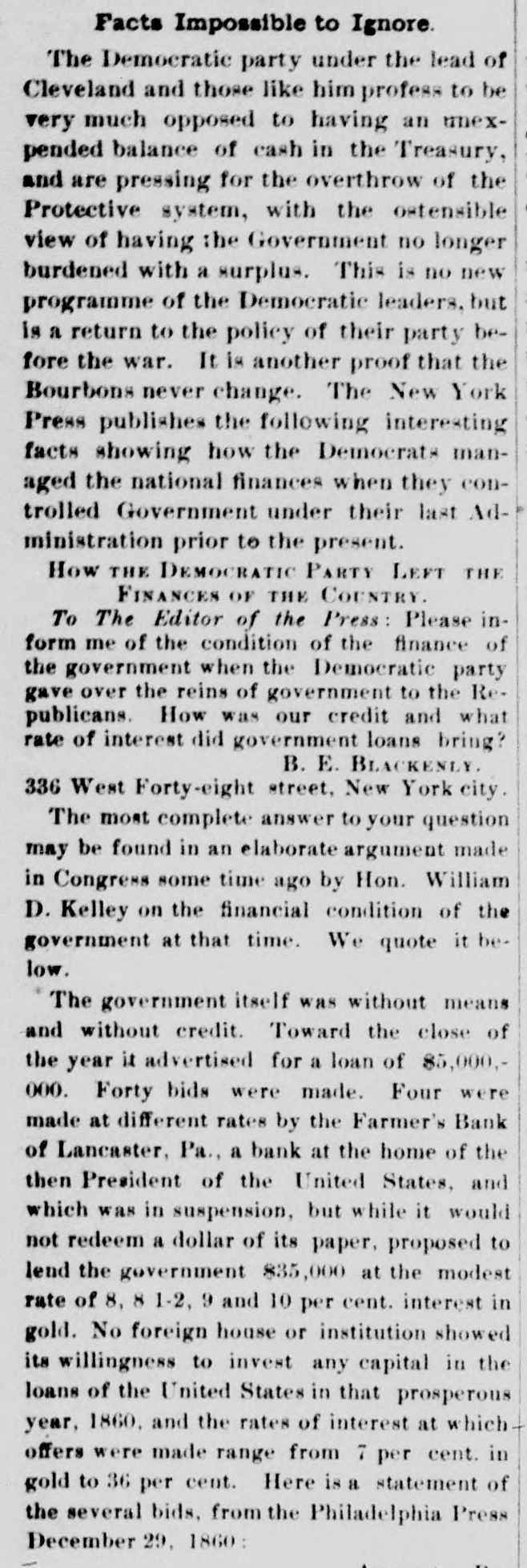
Facts Impossible to Ignore. The Democratic party under the lead of Cleveland and those like him profess to be very much opposed to having an treepended balance of cash in the Treasury, and are pressing for the overthrow of the Protective system, with the ostensible view of having the Government no longer burdened with a surplus. This is no new programme of the Democratic leaders, but is a return to the policy of their party before the war. It is another proof that the Bourbons never change. The New York Press publishes the following interesting facts showing how the Democrats managed the national finances when they controlled Government under their last Administration prior to the present. How THE DEMOCRATIC PARTY LEFT THE FINANCES OF THE COUNTRY. To The Editor of the Press: Please inform me of the condition of the finance of the government when the Democratic party gave over the reins of government to the Republicans. How was our credit and what rate of interest did government loans bring? B. E. BLACKENLY. 336 West Forty-eight street, New York city. The most complete answer to your question may be found in an elaborate argument made in Congress some time ago by Hon. William D. Kelley on the financial condition of the government at that time. We quote it below. The government itself was without means and without credit. Toward the close of the year it advertised for a loan of 85,000,000. Forty bids were made. Four were made at different rates by the Farmer's Bank of Lancaster, Pa., a bank at the home of the then President of the United States, and which was in suspension, but while it would not redeem a dollar of its paper, proposed to lend the government 835,000 at the modest rate of 8, 8 1-2, 9 and 10 per cent. interest in gold. No foreign house or institution showed its willingness to invest any capital in the loans of the United States in that prosperous year, 1860, and the rates of interest at which offers were made range from 7 per cent. in gold to 36 per cent. Here is a statement of the several bids, from the Philadelphia Press December 29, 1860:
Article from Devils Lake Inter-Ocean, February 25, 1888

Click image to open full size in new tab

Article Text

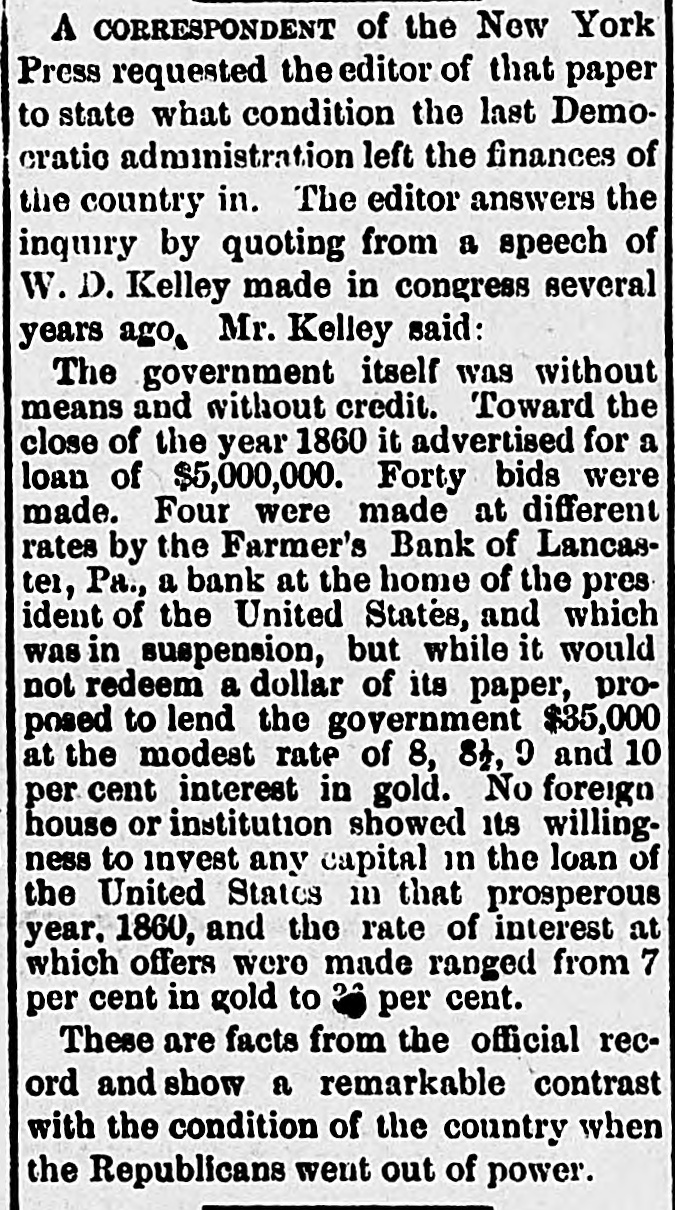
A CORRESPONDENT of the New York Press requested the editor of that paper to state what condition the last Democratic administration left the finances of the country in. The editor answers the inquiry by quoting from a speech of W. D. Kelley made in congress several years ago, Mr. Kelley said: The government itself was without means and without credit. Toward the close of the year 1860 it advertised for a loan of $5,000,000. Forty bids were made. Four were made at different rates by the Farmer's Bank of Lancastei, Pa., a bank at the home of the pres ident of the United States, and which was in suspension, but while it would not redeem a dollar of its paper, proposed to lend the government $35,000 at the modest rate of 8, 8}, 9 and 10 per cent interest in gold. No foreign house or institution showed its willingness to invest any capital in the loan of the United States m that prosperous year. 1860, and the rate of interest at which offers were made ranged from 7 per cent in gold to a per cent. These are facts from the official record and show a remarkable contrast with the condition of the country when the Republicans went out of power.


Article from Wichita Eagle, June 10, 1888

Click image to open full size in new tab

Article Text

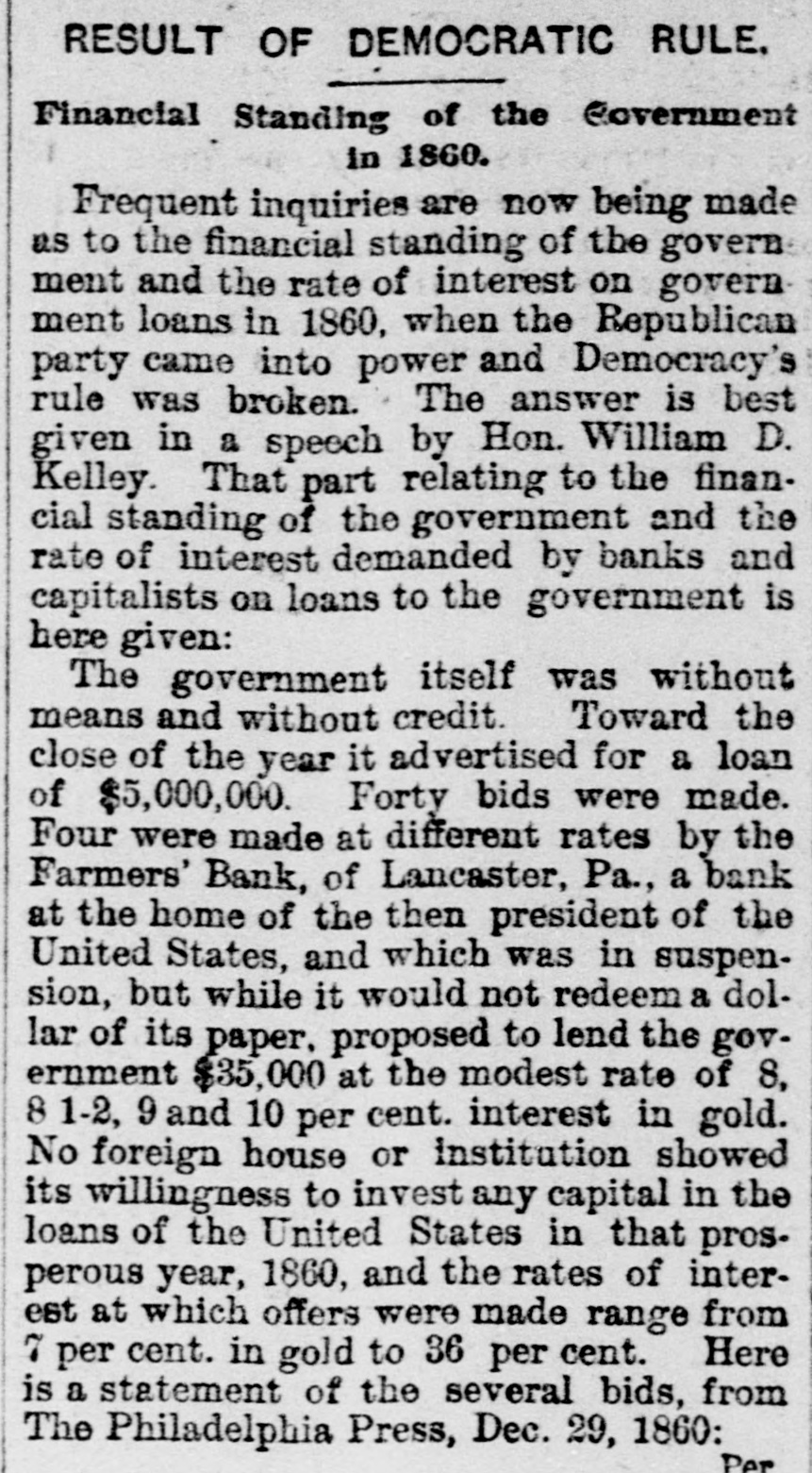
RESULT OF DEMOCRATIC RULE. Financial Standing of the Government in 1860. Frequent inquiries are now being made as to the financial standing of the govern ment and the rate of interest on govern ment loans in 1860, when the Republican party came into power and Democracy's rule was broken. The answer is best given in a speech by Hon. William D. Kelley. That part relating to the financial standing of the government and the rate of interest demanded by banks and capitalists on loans to the government is here given: The government itself was without means and without credit. Toward the close of the year it advertised for a loan of $5,000,000. Forty bids were made. Four were made at different rates by the Farmers' Bank, of Lancaster, Pa., a bank at the home of the then president of the United States, and which was in suspension, but while it would not redeem a dollar of its paper, proposed to lend the government $35,000 at the modest rate of 8, 8 1-2, 9 and 10 per cent. interest in gold. No foreign house or institution showed its willingness to invest any capital in the loans of the United States in that prosperous year, 1860, and the rates of interest at which offers were made range from 7 per cent. in gold to 36 per cent. Here is a statement of the several bids, from The Philadelphia Press, Dec. 29, 1860: Per