17233. Bank of Charleston (Charleston, SC)

Bank Information

Episode Type
Suspension โ†’ Reopening
Bank Type
state
Start Date
May 1, 1837*
Location
Charleston, South Carolina (32.777, -79.931)

Metadata

Model
gpt-5-mini
Short Digest
cdcebc80c87c7816

Response Measures

None

Description

Newspaper articles describe the Bank of Charleston participating in the general suspension of specie payments in May 1837 and later resuming specie payments (sources mention resumption in Sept 1839 and also reference Charleston banks resuming July 1840). No explicit bank run is described in these items; the suspension was part of the general nationwide suspension of 1837, so classified as macro_news. Dates vary across sources; both 1839 and 1840 resumption dates are reported in the articles โ€” I list the primary resumption reported (Sept 1839) and note the later report referencing July 1840 resumption of other Charleston banks.

Events (3)

1. May 1, 1837* Suspension
Cause
Macro News
Cause Details
Part of the nationwide/general suspension of specie payments that began in May 1837.
Newspaper Excerpt
In May, 1837, the general suspension took place, and the Bank of Charleston stopped in common with all others in the Union.
Source
newspapers
2. September 1, 1839* Reopening
Newspaper Excerpt
In September, 1839, this bank resumed, and has since maintained itself.
Source
newspapers
3. July 20, 1840 Other
Newspaper Excerpt
Well! the Banks of Charleston resume specie payments TO-DAY. ... The Bank of Charleston it is understood, gave a hint that such a course was desirable.
Source
newspapers

Newspaper Articles (5)

Article from The Rhode-Island Republican, October 30, 1839

Click image to open full size in new tab

Article Text

I E BESS. Improvement in blowing rocks.-I is said that Mr. Vavanagher. a German, in the Brazils, h the discovery made important that with sawdust, (particularly of soft wood.) mixed gunpowder, in equal parts, has thrice the strength of gunpowder alone. when used in blowing up rocks. The Multicaulis humbug begin to wane. Of 80.000 trees advertised to be sold last week. at Burlington, New Jersey, about 10,000 only were sold, at 7d cents for small trees, and 114 cents for four or five feet trees, the sale of the remainder being stopped. Lieut. Meade, of the U. brig Washington has instituted a suit for slander against Lewis The Tappan. and lays his damages at $50,000. ground of the suit is in Mr. Tappan's assertion that the Lieutenant secreted money found on board the Amistad. The Bank of Charleston, S. Carolina, and Bank at Charleston redeem their bills but do not pay specie in the specie. State for deposites. the same Several other Southern Banks take course. They are in general Banks which have but few bills out. is The Norwich and Worcester Railroad nearly completed. and will soon be in operation. will then be two continuous Railfrom Boston to Long Island road There lines Sound: of and when the link between Springfield and Hartford is supplied. there will be a third. David Dale Owen. Esq.. Geologist, charged the Government with the and Wisconsin Land by Du Buque examination Districts. of with the to the development of their died of congestive fever, some or sources. a view mineral 20 25 miles from Davenport, OD the 15th. Dr. Peck of Washington, (Ky.) who had bet ten thousand dollars upon the recent contest over the Oakland course per and Eagle, died in a fit the speed Grey between during Wagrace, produced by mental excitement. So much for gambling Sentence of" Gen. Van Rensselaer."-Rensselaer. convicted of setting on foot a military expedition in the United States. against a foreign power. has been sentenced to six months imprisonment in the county jail at Albany, and to pay a fine of $250. The Yellow Fever in New Orleans has nearly subsided. The deaths scarcely exceed tweny a week, and the interments in the week ending on the 14th show a diminution of fifty per cent, when compared with those of the week previous. Death.-We learn from the Pawthat Mr. Uriah that tucket Sudden Gazette, Gorton, Pawtucket of Detown, while speaking before the bating Club, last Thursday evening, broke The a blood vessel and very SOOD after expired. deceased was aged 65 years. Curious Historical Fact.-The New York that the importation of wheat. during 1837. exceeded all the of Star the year says importations the country. that grain since the settlement of The whole amount imported in 1837 was 3,931259 bushels. SPECULATION.-It is stated that so readily was money accumulated at Bangor, (Me.) during the land speculations of 1835-6, that on one occasion two paupers broke out of the almshouse, and before they could, be caught, had made, $5,000 each. Depredations Upon Letters.--Three indicthave been found against Hiram Whittelate assistant postmaster, at ments more, Exeter, office. (N. H.) for depredations upon letters in the He would not appear, and so forfeited his recognizance. An estimate of the losses by fires in the U. States has been made, by which it apthat since the beginning of nited pears the present four month. property to the amount of over millions of dollars has been destroyed. On the authority of the cashier of the Planters' and Merchants' Bank of Mobile, it is stated that its vault has been opened. and every thing. even the smallest paper, found entirely uninjured. The Quebec Gazette of the 17th announces the arrival of the frigate Pique, having on board his excellency the Rt. Hon. PouleIt Thomson, the new Governor of Canada, and General Sir : Richard Jaekson. Robert Miller. an Irishman, convicted at Utica of the murder of Barney Leddy. another Irishman, on the 29th of April last, has been sentenced to be hung on the 1st Monday in December next. STEAM SHIPS.-According to present appearances. there will be, in 1840. thirteen large and splendid steam ships running across the Atlantic ocean. all of which will be eight or nine hundred tons burthen. or upwards. M. DAGUERRE has been presented. by the Emperor of Austria, for his wonderful discovwith a medal of gold and a gold snuff box. diaery. with the initials of his majesty upon it in monds. The total Expenditures of the State of Vermont for the year ending 30th September were $71,665 55. The amount of the State School Fund Fund is $119,648 27 The Bank Safety amounts to $19,232 73. SAYAGE MURDER " perpetrated at New
Article from Edgefield Advertiser, July 30, 1840

Click image to open full size in new tab

Article Text

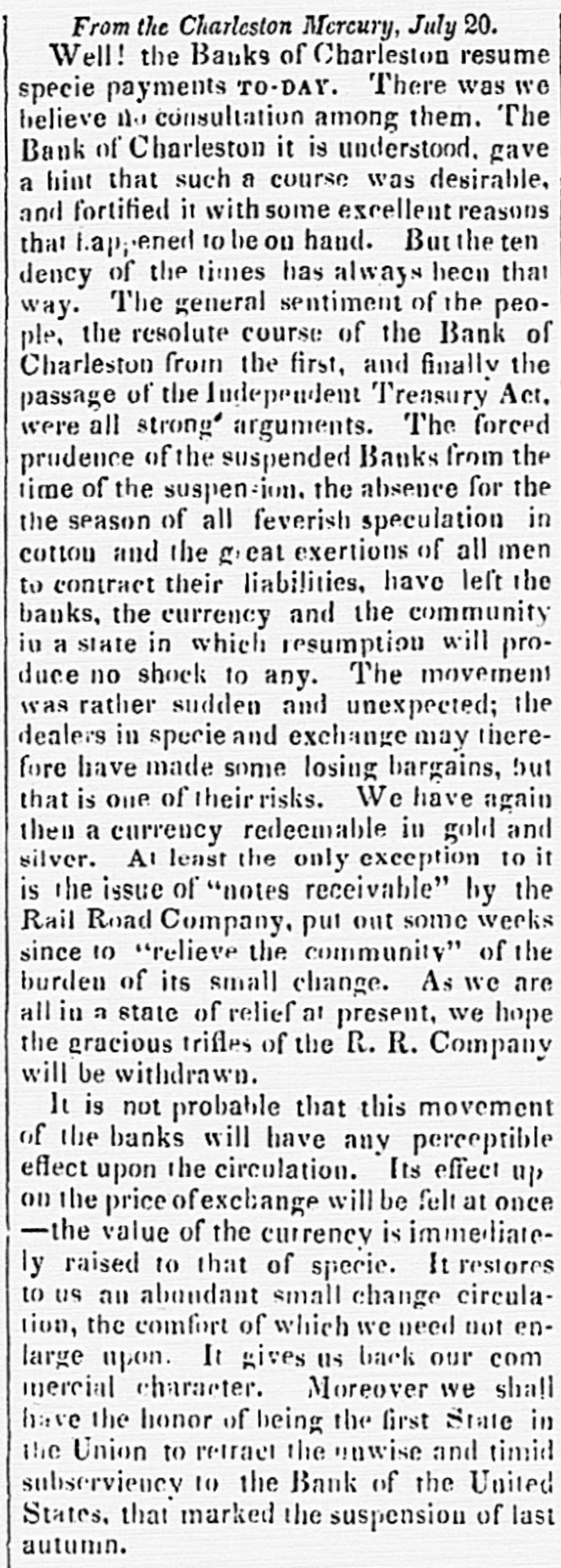
From the Charleston Mercury, July 20. Well! the Banks of Charleston resume specie payments TO-DAY. There was we believe no consultation among them. The Bank of Charleston it is understood, gave a hint that such a course was desirable, and fortified it with some excellent reasons that lappened to be on hand. Butthe ten dency of the times has always been that way. The general sentiment of the people. the resolute course of the Bank of Charleston from the first, and finally the passage of the Independent Treasury Act. were all strong arguments. The forced prudence of the suspended Banks from the time of the suspension. the absence for the the season of all feverish speculation in cotton and the g.eat exertions of all men to contract their liabilities, have left the banks, the currency and the community in a state in which resumption will produce no shock to any. The movement was rather sudden and unexpected; the dealers in specie and exchange may therefore have made some losing bargains, but that is one of theirrisks. We have again then a currency redeemable in gold and silver. AI least the only exception to it is the issue of "notes receivable" by the Rail Road Company, put out some weeks since to "relieve the community" of the burden of its small change. As we are all in a state of relief at present, we hope the gracious trifles of the R. R. Company will be withdrawn. It is not probable that this movement of the banks will have any perceptible effect upon the circulation. Its effect up on the price of exchange will be felt at once -the value of the currency is immediately raised to that of specie. It restores to us an abundant small change circulation, the comfort of which we need not enlarge upon. It gives us back our com mercial character. Moreover we shall have the honor of being the first State in the Union to l'etract the unwise and timid subserviency 10 the Bank of the United States. that marked the suspension of last autumn.


Article from Morning Herald, August 13, 1840

Click image to open full size in new tab

Article Text

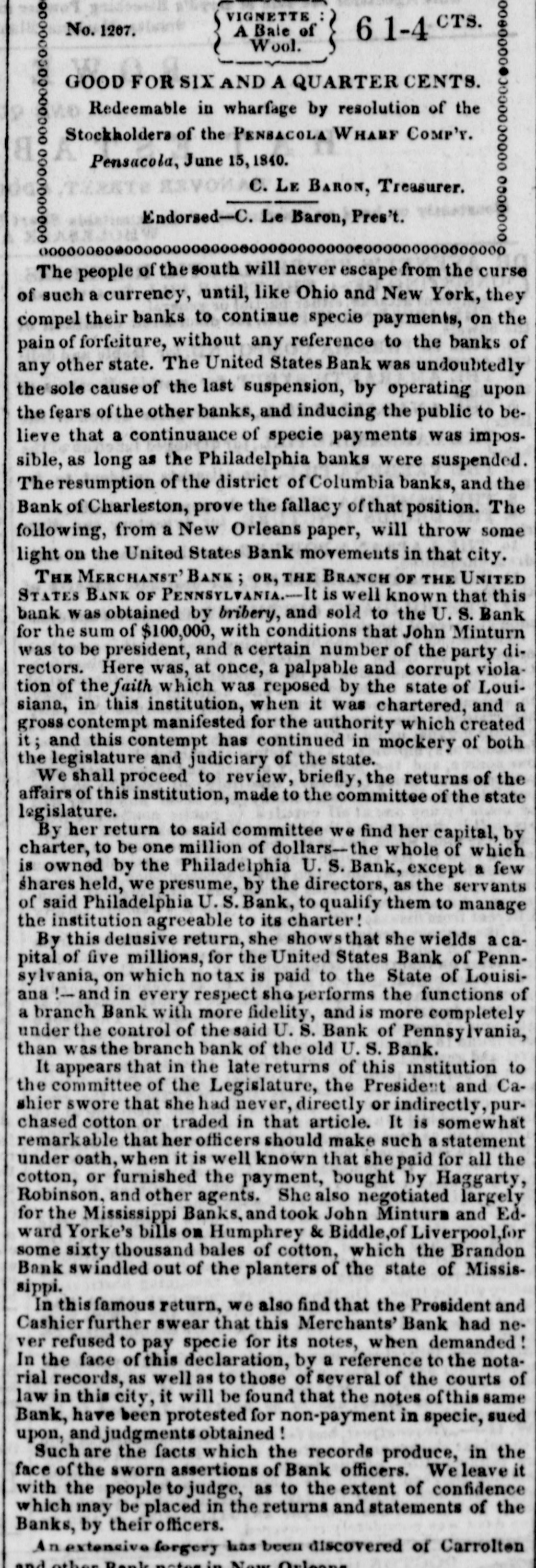
# GOOD FOR SIX AND A QUARTER CENTS. Redeemable in wharfage by resolution of the Stockholders of the PENBACOLA WHARF COMP'Y. Pensacola, June 15, 1840. C. LE BARON, Treasurer. Endorsed-C. Le Baron, Pres't. The people of the south will never escape from the curse of such a currency, until, like Ohio and New York, they compel their banks to continue specie payments, on the pain of forfeiture, without any reference to the banks of any other state. The United States Bank was undoubtedly the sole cause of the last suspension, by operating upon the fears of the other banks, and inducing the public to be- lieve that a continuance of specie payments was impos- sible, as long as the Philadelphia banks were suspended. The resumption of the district of Columbia banks, and the Bank of Charleston, prove the fallacy of that position. The following, from a New Orleans paper, will throw some light on the United States Bank movements in that city. # THE MERCHANST' BANK; OR, THE BRANCH OF THE UNITED STATES BANK OF PENNSYLVANIA. It is well known that this bank was obtained by bribery, and sold to the U. S. Bank for the sum of $100,000, with conditions that John Minturn was to be president, and a certain number of the party directors. Here was, at once, a palpable and corrupt violation of the faith which was reposed by the state of Louisiana, in this institution, when it was chartered, and a gross contempt manifested for the authority which created it; and this contempt has continued in mockery of both the legislature and judiciary of the state. We shall proceed to review, briefly, the returns of the affairs of this institution, made to the committee of the state legislature. By her return to said committee we find her capital, by charter, to be one million of dollars--the whole of which is owned by the Philadelphia U. S. Bank, except a few shares held, we presume, by the directors, as the servants of said Philadelphia U. S. Bank, to qualify them to manage the institution agreeable to its charter! By this delusive return, she shows that she wields a capital of five millions, for the United States Bank of Pennsylvania, on which no tax is paid to the State of Louisiana!--and in every respect she performs the functions of a branch Bank with more fidelity, and is more completely under the control of the said U. S. Bank of Pennsylvania, than was the branch bank of the old U. S. Bank. It appears that in the late returns of this institution to the committee of the Legislature, the President and Cashier swore that she had never, directly or indirectly, purchased cotton or traded in that article. It is somewhat remarkable that her officers should make such a statement under oath, when it is well known that she paid for all the cotton, or furnished the payment, bought by Haggarty, Robinson, and other agents. She also negotiated largely for the Mississippi Banks, and took John Minturn and Edward Yorke's bills on Humphrey & Biddle, of Liverpool, for some sixty thousand bales of cotton, which the Brandon Bank swindled out of the planters of the state of Mississippi. In this famous return, we also find that the President and Cashier further swear that this Merchants' Bank had never refused to pay specie for its notes, when demanded! In the face of this declaration, by a reference to the notarial records, as well as to those of several of the courts of law in this city, it will be found that the notes of this same Bank, have been protested for non-payment in specie, sued upon, and judgments obtained! Such are the facts which the records produce, in the face of the sworn assertions of Bank officers. We leave it with the people to judge, as to the extent of confidence which may be placed in the returns and statements of the Banks, by their officers. An extensive forgery has been discovered of Carrolten and other Bank notes in New Orleans


Article from Southport Telegraph, August 25, 1840

Click image to open full size in new tab

Article Text

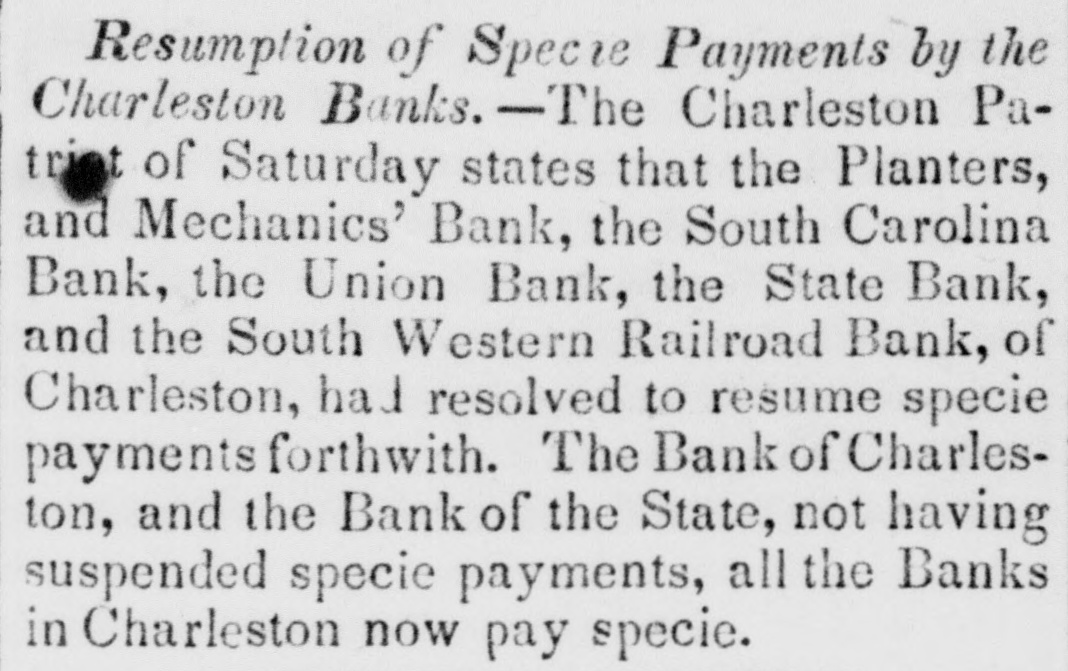
Resumption of Specre Payments by the Charleston Banks. - The Charleston Patrint of Saturday states that the Planters, and Mechanics' Bank, the South Carolina Bank, the Union Bank, the State Bank, and the South Western Railroad Bank, of Charleston, had resolved to resume specie payments forthwith. The Bank of Charleston, and the Bank of the State, not having suspended specie payments, all the Banks in Charleston now pay specie.


Article from The New York Herald, July 20, 1842

Click image to open full size in new tab

Article Text

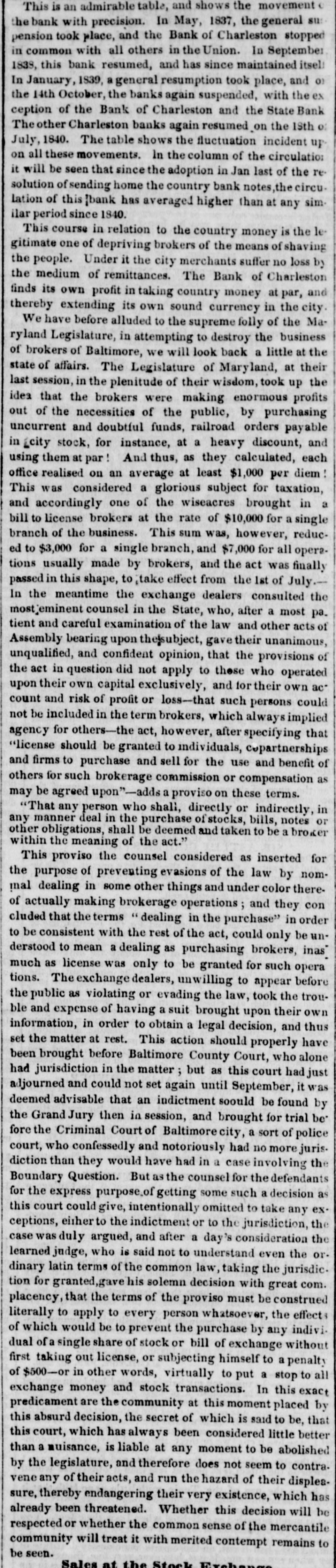
This is an admirable table, and shows the movement of the bank with precision. In May, 1837, the general suspension took place, and the Bank of Charleston stopped in common with all others in the Union. In September, 1839, this bank resumed, and has since maintained itself. In January, 1839, a general resumption took place, and on the 14th October, the banks again suspended, with the exception of the Bank of Charleston and the State Bank. The other Charleston banks again resumed on the 19th of July, 1840. The table shows the fluctuation incident upon all these movements. In the column of the circulation it will be seen that since the adoption in Jan last of the resolution of sending home the country bank notes, the circulation of this bank has averaged higher than at any similar period since 1940. This course in relation to the country money is the legitimate one of depriving brokers of the means of shaving the people. Under it the city merchants suffer no loss by the medium of remittances. The Bank of Charleston finds its own profit in taking country money at par, and thereby extending its own sound currency in the city. We have before alluded to the supreme folly of the Maryland Legislature, in attempting to destroy the business of brokers of Baltimore, we will look back a little at the state of affairs. The Legislature of Maryland, at their last session, in the plenitude of their wisdom, took up the idea that the brokers were making enormous profits out of the necessities of the public, by purchasing uncurrent and doubtful funds, railroad orders payable in city stock, for instance, at a heavy discount, and using them at par! And thus, as they calculated, each office realised on an average at least $1,000 per diem! This was considered a glorious subject for taxation, and accordingly one of the wiseacres brought in a bill to license brokers at the rate of $10,000 for a single branch of the business. This sum was, however, reduced to $3,000 for a single branch, and $7,000 for all operations usually made by brokers, and the act was finally passed in this shape, to take effect from the 1st of July. In the meantime the exchange dealers consulted the most eminent counsel in the State, who, after a most patient and careful examination of the law and other acts of Assembly bearing upon the subject, gave their unanimous, unqualified, and confident opinion, that the provisions of the act in question did not apply to those who operated upon their own capital exclusively, and for their own account and risk of profit or loss-that such persons could not be included in the term brokers, which always implied agency for others-the act, however, after specifying that "license should be granted to individuals, copartnerships and firms to purchase and sell for the use and benefit of others for such brokerage commission or compensation as may be agreed upon"-adds a proviso on these terms. "That any person who shall, directly or indirectly, in any manner deal in the purchase of stocks, bills, notes or other obligations, shall be deemed and taken to be a broker within the meaning of the act." This proviso the counsel considered as inserted for the purpose of preventing evasions of the law by nominal dealing in some other things and under color thereof actually making brokerage operations; and they concluded that the terms "dealing in the purchase" in order to be consistent with the rest of the act, could only be understood to mean a dealing as purchasing brokers, inasmuch as license was only to be granted for such operations. The exchange dealers, unwilling to appear before the public as violating or evading the law, took the trouble and expense of having a suit brought upon their own information, in order to obtain a legal decision, and thus set the matter at rest. This action should properly have been brought before Baltimore County Court, who alone had jurisdiction in the matter; but as this court had just adjourned and could not set again until September, it was deemed advisable that an indictment soould be found by the Grand Jury then in session, and brought for trial before the Criminal Court of Baltimore city, a sort of police court, who confessedly and notoriously had no more jurisdiction than they would have had in a case involving the Boundary Question. But as the counsel for the defendants for the express purpose of getting some such a decision as this court could give, intentionally omitted to take any exceptions, either to the indictment or to the jurisdiction, the case was duly argued, and after a day's consideration the learned judge, who is said not to understand even the ordinary latin terms of the common law, taking the jurisdiction for granted, gave his solemn decision with great complacency, that the terms of the proviso must be construed literally to apply to every person whatsoever, the effects of which would be to prevent the purchase by any individual of a single share of stock or bill of exchange without first taking out license, or subjecting himself to a penalty of $500-or in other words, virtually to put a stop to all exchange money and stock transactions. In this exact predicament are the community at this moment placed by this absurd decision, the secret of which is said to be, that this court, which has always been considered little better than a nuisance, is liable at any moment to be abolished by the legislature, and therefore does not seem to contravene any of their acts, and run the hazard of their displeasure, thereby endangering their very existence, which has already been threatened. Whether this decision will be respected or whether the common sense of the mercantile community will treat it with merited contempt remains to be seen. ### Sales at the Stock Exchang