14151. Mechanics Bank (New York, NY)

Bank Information

Episode Type
Run → Suspension → Reopening
Bank Type
state
Start Date
May 4, 1837
Location
New York, New York (40.714, -74.006)

Metadata

Model
gpt-5-mini
Short Digest
74bcc342be622f84

Response Measures

None

Description

Multiple contemporaneous 1837 newspaper articles report a run on the Mechanics' Bank in early May 1837 (triggered by revelations of large loans to brokers and the sudden death of President Fleming) followed within days by the general suspension of specie payments by New York banks (May 10, 1837). The bank was certified 'safe and sound' by a bank commissioner and continued operations under the statewide suspension; later historical pieces describe the bank surviving and later reductions to capital, consistent with suspension followed by continued operation/reopening. OCR errors in articles corrected (e.g., 'Mechaning' -> Mechanics; 'Flemming' -> Fleming).

Events (3)

1. May 4, 1837 Run
Cause
Bank Specific Adverse Info
Cause Details
Revelations that the President and Cashier had made imprudent large loans to a failed brokerage house (losses ~ $100,000-$400,000 reported) plus the sudden death of President Fleming which generated injurious surmises and rumors.
Measures
Bank officers announced extended opening hours to accommodate public; Bank Commissioner Davis issued a certificate declaring the institution 'safe and sound'; other banks sent specie to assist Mechanics Bank.
Newspaper Excerpt
A very amusing run took place ... false rumor that Mr. Flemming had cut his throat ... they accordingly ... drew out ...
Source
newspapers
2. May 10, 1837 Suspension
Cause
Government Action
Cause Details
Collective suspension of specie payments by New York banks on May 10, 1837; followed by legislative authorization for suspension by the State (banks ceased specie payments amid systemic panic).
Newspaper Excerpt
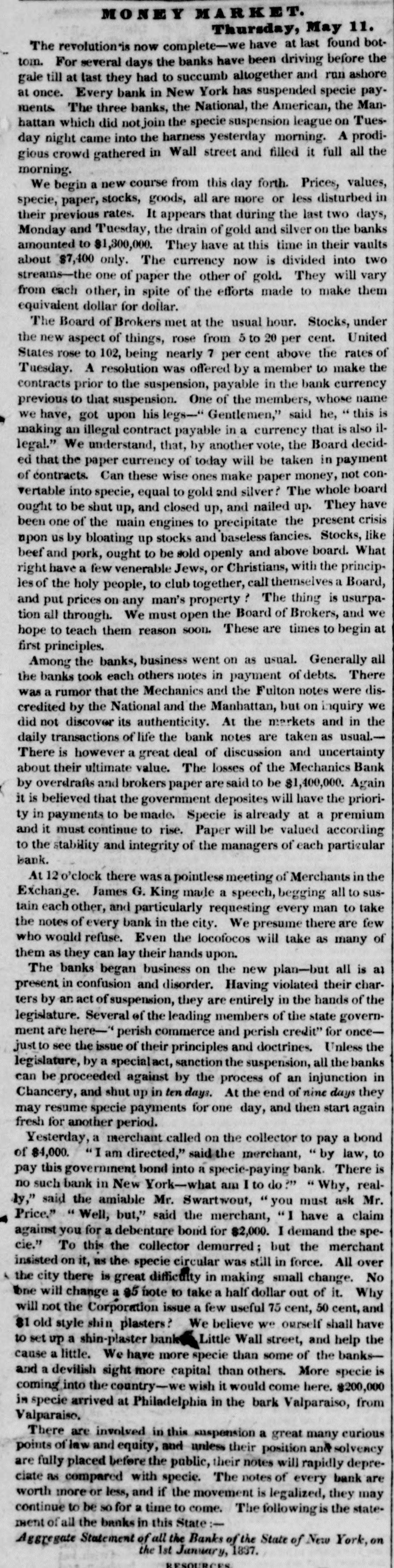
Every bank in New York has suspended specie payments ... The drain of gold and silver ... amounted to $1,300,000 ...
Source
newspapers
3. May 12, 1837 Reopening
Newspaper Excerpt
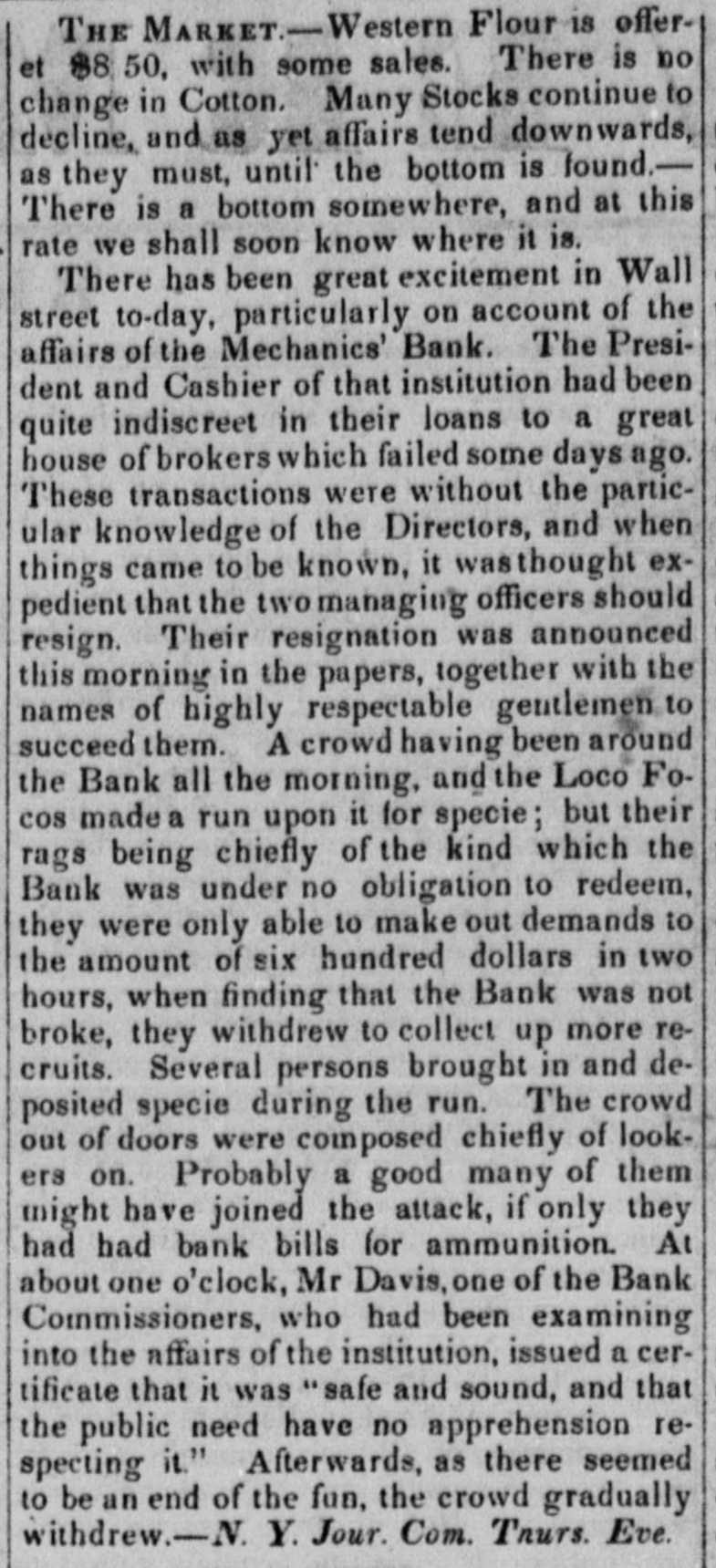
Mr Davis, one of the Bank Commissioners, ... issued a certificate that it was 'safe and sound, and that the public need have no apprehension respecting it.' Afterwards ... the crowd gradually withdrew. (run weathered the storm gallantly.) - reports May 11-12, 1837 articles indicating resumption of operations under suspension law and continued business activity under new terms.)
Source
newspapers

Newspaper Articles (16)

Article from The Herald, April 3, 1837

Click image to open full size in new tab

Article Text

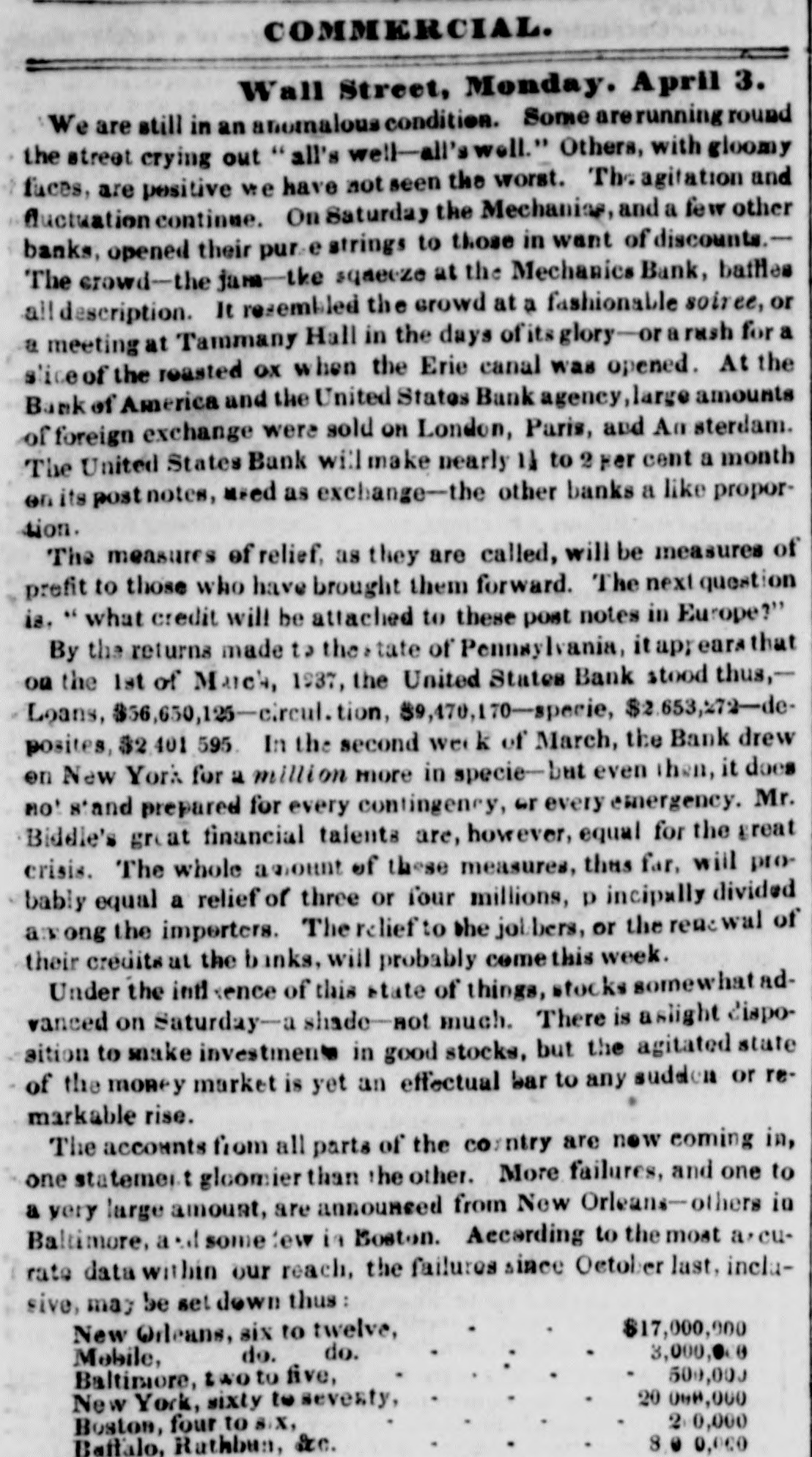
COMMERCIAL. Wa Street, Monday. April 3. We are still in an anomalous condition. Some arerunning round the street crying out all's well-all'swell." Others, with gloomy faces, are positive we have not seen the worst. Th. agitation and fluctuation continue. On Saturday the Mechaning, and a few other banks, opened their pur e strings to those in want of discounts.The crowd-the jam-like sqaeeze at the Mechanics Bank, baffles all description. It resembled the crowd at a fashionable soiree, or a a meeting at Tammany Hall in the days of its glory-or a rash for slice of the reasted ox when the Erie canal was opened. At the Bank of America and the United States Bank agency, large amounts of foreign exchange were sold on London, Paris, and Am sterdam. The United States Bank will make nearly 11 to 2 per cent a month on its post notes, used as exchange-the other banks a like proportion. The measures of relief, as they are called, will be measures of prefit to those who have brought them forward. The next question is. "what credit will be attached to these post notes in Europe?" By the returns made to thestate of Pennsylvania, it apr ears that on the 1st of March, 1937, the United States Bank stood thus,Loans, $56,650,125-circul.tion, $9,470,170-specie, $2.653,272-deposites, $2401595 In the second we k of March, the Bank drew en New York for a million more in specie-but even then, it does no! stand prepared for every contingency, or every emergency. Mr. Biddle's great financial talents are, however, equal for the great crisis. The whole amount of these measures, thus far, will probabiy equal a relief of three or four millions, p incipally divided among the importers. The relief to the jobbers, or the reue wal of their credits at the banks, will probably cometh week. Under the inti sence of this state of things, stocks somewhat advanced on Saturday-a shade-not much. There is aslight diapoaition to make investment in good stocks, but the agitated state of the money market is yet an effectual bar to any sudelen or remarkable rise. The accounts from all parts of the country are now coming in, one statement gloomier than the other. More failures, and one to a very large amount, are announced from New Orleans-others in Baltimore, a eit some lew in Boston. According to the most a.curate data within our reach, the failures since October last, inclasive, may be set down thus : $17,000,900 New Orleans, six to twelve, do. 3,000,000 do. Mobile, 500,00J Baltimore, two to five, 20 068,000 New York, sixty to seventy, 20,000 Boston, four to six, 8.00.000 Baffalo, Rathbun, ice.


Article from The Herald, May 5, 1837

Click image to open full size in new tab

Article Text

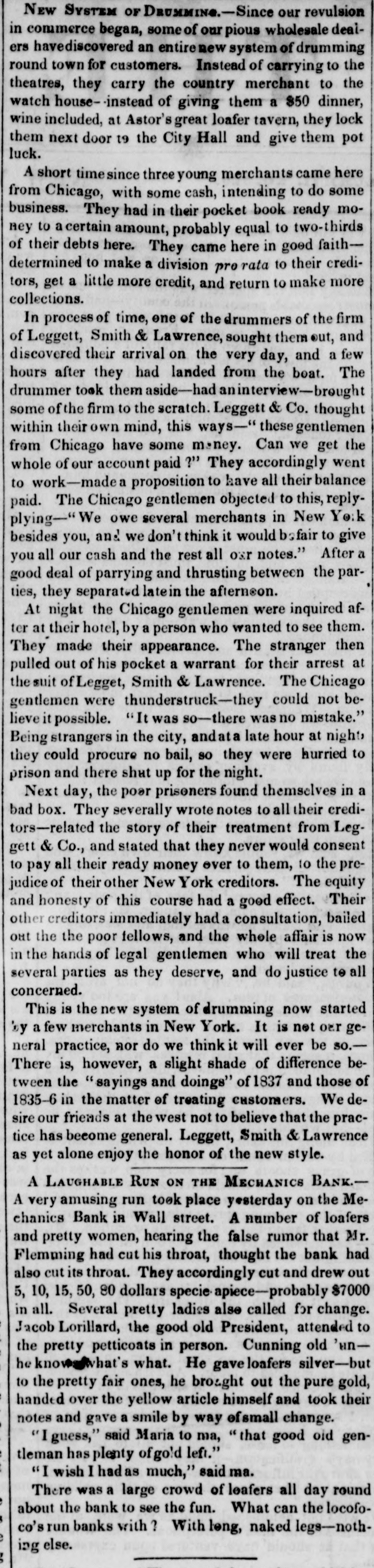
NEW SYSTEM OF DRUMMING.-Since our revulsion in commerce began, some of our pious wholesale dealers havediscovered an entirenew system of drumming round town for customers. Instead of carrying to the theatres, they carry the country merchant to the watch house-instead of giving them a $50 dinner, wine included, at Astor's great loafer tavern, they lock them next door to the City Hall and give them pot luck. A short timesince three young merchants came here from Chicago, with some cash, intending to do some business. They had in their pocket book ready money to a certain amount, probably equal to two-thirds of their debts here. They came here in good faithdetermined to make a division pro rata to their creditors, get a little more credit, and return to make more collections. In process of time, one of the drummers of the firm of Leggett, Smith & Lawrence, sought them out, and discovered their arrival on the very day, and a few hours after they had landed from the boat. The drummer took them aside-had aninterview-brought some of the firm to the scratch. Leggett & Co. thought within their own mind, this ways-" these gentlemen from Chicago have some money. Can we get the whole of our account paid ?" They accordingly went to work-made a proposition to have all their balance paid. The Chicago gentlemen objected to this, replyplying-"We owe several merchants in New Yo:k besides you, and we don't think it would befair to give you all our cash and the rest all our notes." After a good deal of parrying and thrusting between the parties, they separated latein the afternoon. At night the Chicago gentlemen were inquired after at their hotel, by a person who wanted to see them. They made their appearance. The stranger then pulled out of his pocket a warrant for their arrest at the suit of Legget, Smith & Lawrence. The Chicago gentlemen were thunderstruck-they could not believe it possible. "It was so-there was no mistake." Being strangers in the city, andata late hour at night, they could procure no bail, so they were hurried to prison and there shut up for the night. Next day, the poor prisoners found themselves in a bad box. They severally wrote notes to all their creditors-related the story of their treatment from Leggett & Co., and stated that they never would consent to pay all their ready money over to them, to the prejudice of their other New York creditors. The equity and honesty of this course had a good effect. Their other creditors immediately had a consultation, bailed out the the poor fellows, and the whole affair is now in the hands of legal gentlemen who will treat the several parties as they deserve, and do justice to all concerned. This is the new system of drumming now started by a few merchants in New York. It is not our general practice, nor do we think it will ever be so.There is, however, a slight shade of difference between the 'sayings and doings" of 1837 and those of 1835-6 in the matter of treating customers. We desire our friends at the west not to believe that the practice has become general. Leggett, Smith & Lawrence as yet alone enjoy the honor of the new style. A LAUGHABLE RUN ON THE MECHANICS BANK.A very amusing run took place yesterday on the Mechanics Bank in Wall street. A number of loafers and pretty women, hearing the false rumor that Mr. Flemming had cut his throat, thought the bank had also cut its throat. They accordingly cut and drew out 5, 10, 15, 50, 80 dollars specie apiece-probably $7000 in all. Several pretty ladies alse called for change. Jacob Lorillard, the good old President, attended to the pretty petticoats in person. Cunning old 'unhe knowswhat's what. He gave loafers silver-but to the pretty fair ones, he brought out the pure gold, handed over the yellow article himself and took their notes and gave a smile by way ofsmall change. guess," said Maria to ma, "that good old gentleman has plenty of go'd left." "I wish I had as much," said ma. There was a large crowd of leafers all day round about the bank to see the fun. What can the locofoco's run banks with With leng, naked legs-nothing else.


Article from Staunton Spectator, and General Advertiser, May 11, 1837

Click image to open full size in new tab

Article Text

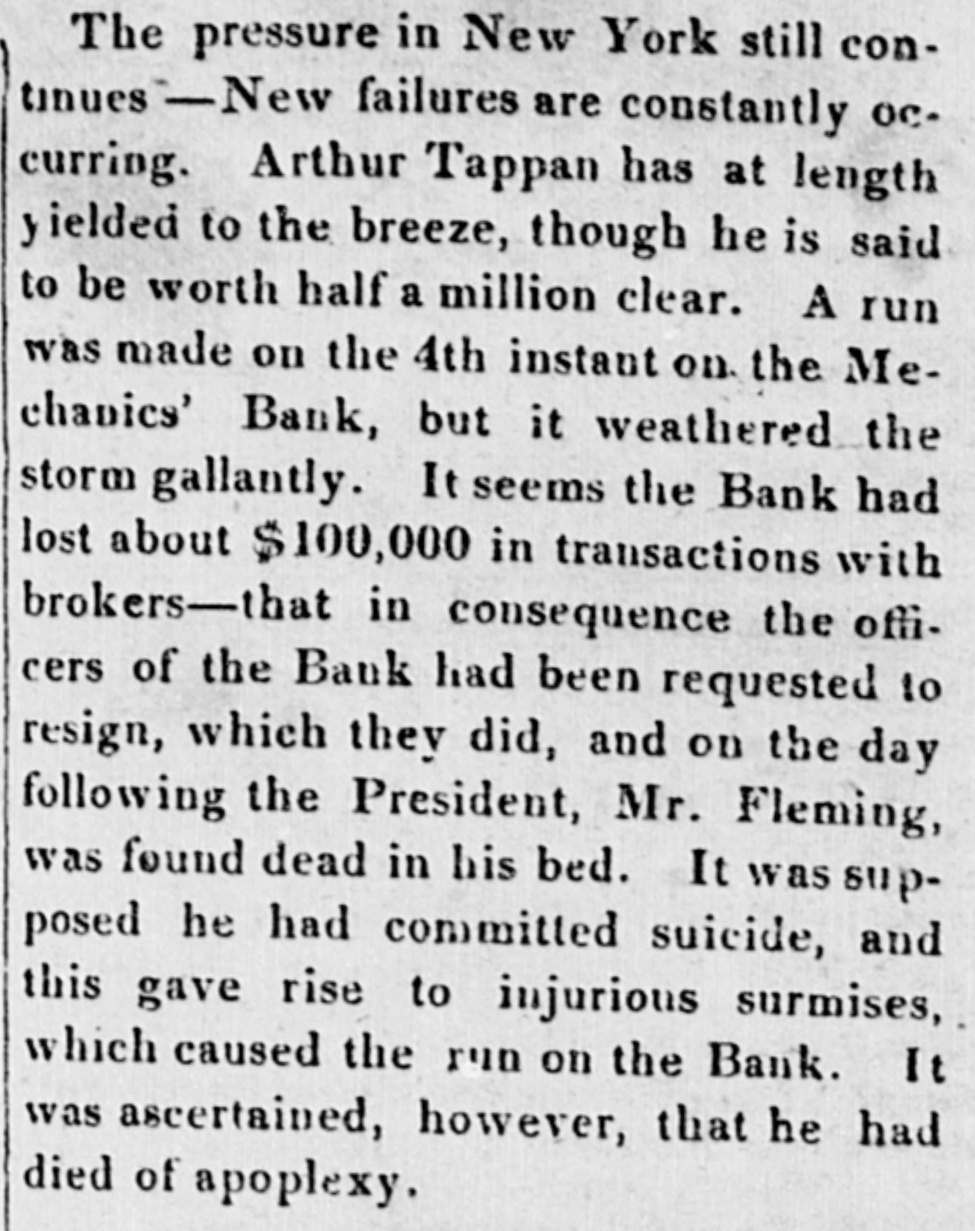
The pressure in New York still continues - New failures are constantly OCcurring. Arthur Tappan has at length yielded to the breeze, though he is said to be worth half a million clear. A run was made on the 4th instant on. the Mechanics' Bank, but it weathered the storm gallantly. It seems the Bank had lost about $100,000 in transactions with brokers-that in consequence the officers of the Bank had been requested to resign, which thev did, and on the day following the President, Mr. Fleming, was found dead in his bed. It was supposed he had committed suicide, and this gave rise to injurious surmises, which caused the run on the Bank. It was ascertained, however, that he had died of apoplexy.


Article from Virginia Free Press, May 11, 1837

Click image to open full size in new tab

Article Text

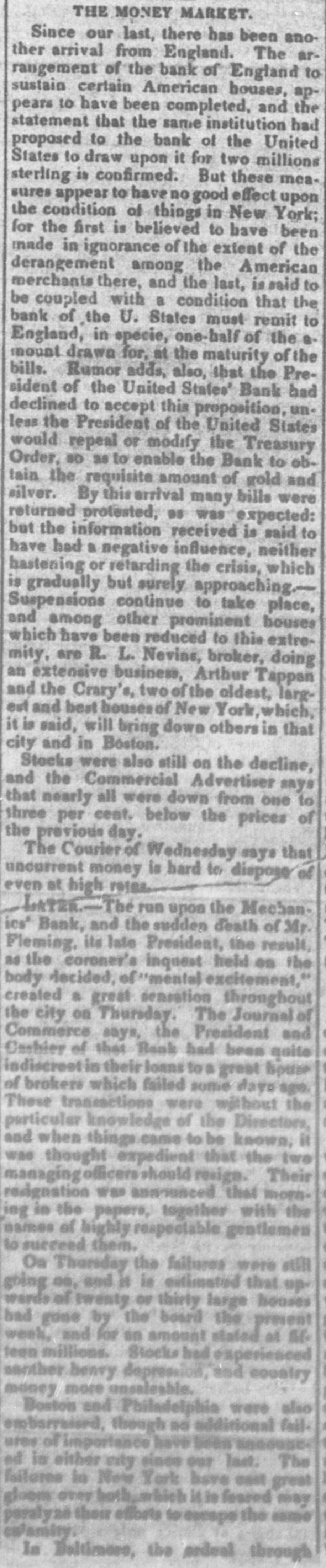
THE MONEY MARKET. Since our last, there has been another arrival from England. The arrangement of the bank of England to sustain certain American houses, appears to have been completed, and the statement that the same institution had proposed to the bank of the United States to draw upon it for two millions sterling is confirmed. But these measures appear to have no good effect upon the condition of things in New York; for the first is believed to have been made in ignorance of the extent of the derangement among the American merchants there, and the last, is said to be coupled with a condition that the bank of the U. States must remit to England, in specie, one-half of the 8mount drawa for, at the maturity of the bills. Rumor adds, also, that the President of the United States' Bank had declined to accept this proposition, unless the President of the United States would repeal or modify the Treasury Order, so as to enable the Bank to obtain the requisite amount of gold and silver. By this arrival many bills were returned protested, as was expected: but the information received is said to have had a negative influence, neither hastening or retarding the erisis, which is gradually but surely approaching.Suspensions continue to take place, and among other prominent houses which have been reduced to this extremity, are R. L. Nevins, broker, doing an extensive business, Arthur Tappan and the Crary's, two of the oldest, largeut and best houses of New York, which, it is said, will bring down others in that city and in Boston. Stocks were also still on the decline, and the Commercial Advertiser says that nearly all were down from one to three per cent. below the prices of the previous day. The Courier of Wednesday says that uncurrent money is hard to dispose of even of high reisa LATES.-The run upon the Mechan ics' Bank, and the sudden death of Mr. Fleming, its late President, the result, as the coroner's inquest held es the body decided, of 'mental excitement," created a great sensation throughout the city on Thursday. The Journal of Commerce says, the President and Cashier of that Beak had brea quite indiscreet in their loans to s great house of brokers which failed some days age. These Innactions were without the particular knowledge of the Directors, and when things came to be known, it was thought expedient that the two managing officers should resign. Their resignation was assuranced that mom ing in the papers, together with the names of highly respectable gentlemen to succeed them. On Thursday the failures were still going 00, and it is estimated that upwords of twenty or thirty large houses had gone by the bosril the present week, and for on amount stated all MC teen millions. Stocks had experienced senther benry depression, and country money more analeable. Boston and Philadelphia were also emborroised, though as additional fail. ures of importance have ed is either only since our last. The failures in New York have east great gloom over both which M is feared may paralyné their efforts to except the calamity la Deltimere, the medeal through


Article from The Herald, May 11, 1837

Click image to open full size in new tab

Article Text

MONEY K Thursday, May 11. The revolution's now complete-we have at last found bottom. For several days the banks have been driving before the gale till at last they had to succumb altogether and run ashore at once. Every bank in New York has suspended specie payments The three banks, the National, the American, the Manhattan which did not join the specie suspension league on Tuesday night came into the harness yesterday morning. A prodigious crowd gathered in Wall street and filled it full all the morning. We begin a new course from this day forth. Prices, values, specie, paper, stocks, goods, all are more or less disturbed in their previous rates. It appears that during the last two days, Monday and Tuesday, the drain of gold and silver on the banks amounted to $1,300,000. They have at this time in their vaults about $7,400 only. The currency now is divided into two streams-the one of paper the other of gold. They will vary from each other, in spite of the efforts made to make them equivalent dollar for dollar. The Board of Brokers met at the usual hour. Stocks, under the new aspect of things, rose from 5 to 20 per cent. United States rose to 102, being nearly 7 per cent above the rates of Tuesday. A resolution was offered by a member to make the contracts prior to the suspension, payable in the bank currency previous to that suspension. One of the members, whose name we have, got upon his legs-" Gentlemen," said he, " this is making an illegal contract payable in a currency that is also illegal." We understand, that, by another vote, the Board decided that the paper currency of today will be taken in payment of contracts. Can these wise ones make paper money, not convertable into specie, equal to gold and silver? The whole board ought to be shut up, and closed up, and nailed up. They have been one of the main engines to precipitate the present crisis upon us by bloating up stocks and baseless fancies. Stocks, like beef and pork, ought to be sold openly and above board. What right have a few venerable Jews, or Christians, with the principles of the holy people, to club together, call themselves a Board, and put prices on any man's property The thing is usurpation all through. We must open the Board of Brokers, and we hope to teach them reason soon. These are times to begin at first principles. Among the banks, business went on as usual. Generally all the banks took each others notes in payment of debts. There was a rumor that the Mechanics and the Fulton notes were discredited by the National and the Manhattan, but on inquiry we did not discover its authenticity. At the markets and in the daily transactions of life the bank notes are taken as usual.There is however a great deal of discussion and uncertainty about their ultimate value. The losses of the Mechanics Bank by overdrafts and brokers paper are said to be $1,400,000. Again it is believed that the government deposites will have the priority in payments to be made. Specie is already at a premium and it must continue to rise. Paper will be valued according to the stability and integrity of the managers of each particular bank. o'clock there was a pointless meeting of Merchants in the Exchange. James G. King made a speech, begging all to sustain each other, and particularly requesting every man to take the notes of every bank in the city. We presume there are few who would refuse. Even the locofocos will take as many of them as they can lay their hands upon. The banks began business on the new plan-but all is al present in confusion and disorder. Having violated their charters by an act of suspension, they are entirely in the hands of the legislature. Several of the leading members of the state government are here perish commerce and perish credit" for oncejust to see the issue of their principles and doctrines. Unless the legislature, by a specialact, sanction the suspension, all the banks can be proceeded against by the process of an injunction in Chancery, and shut up in ten days. At the end of nine days they may resume specie payments for one day, and then start again fresh for another period. Yesterday, a merchant called on the collector to pay a bond of $4,000. "I am directed," said the merchant, " by law, to pay this government bond into a specie-paying bank. There is no such bank in New York-what am I to do?" " Why, really," said the amiable Mr. Swartwout, " you must ask Mr. Price." " Well, but," said the merchant, "I have a claim against you for a debenture bond for $2,000. I demand the specie." To this the collector demurred; but the merchant insisted on it, as the specie circular was still in force. All over the city there is great difficulty in making small change. No Ibne will change a 85 note to take a half dollar out of it. Why will not the Corporation issue a few useful 75 cent, 50 cent, and 81 old style shin plasters? We believe we ourself shall have to set up a shin-plaster bank Little Wall street, and help the cause a little. We have more specie than some of the banksis and a devilish sight more capital than others. More specie coming into the country-we wish it would come here. $200,000 in specie arrived at Philadelphia in the bark Valparaiso, from Valparaiso. There are involved in this suspension a great many curious points of law and equity, and unless their position and solvency are fully placed before the public, their notes will rapidly depreciate as compared with specie. The notes of every bank are worth more or less, and if the movement is legalized, they may continue to be so for a time to come. The following is the statement of all the banks in this State: :Aggregate Statement of all the Banks of the State of New York, on the 1st January, 1837. RESOURCES


Article from Vermont Phœnix, May 12, 1837

Click image to open full size in new tab

Article Text

WALL STREET.-One o'clock.-This has been a dark day in the street. Stocks have again gone down-a natural consequence of the panic created by the run on the Mechanics' Bank, and the heavy failures of yesterday. The news by the Express mail yesterday, brought no tidings that would justify the belief that things are any better in the Southern cities.-N. Y. Com. Adv.


Article from Vermont Phœnix, May 12, 1837

Click image to open full size in new tab

Article Text

THE MARKET.-Western Flour is offeret $8.50, with some sales. There is DO change in Cotton. Many Stocks continue to decline, and as yet affairs tend downwards, as they must, until the bottom is found.There is a bottom somewhere, and at this rate we shall soon know where it is. There has been great excitement in Wall street to-day, particularly on account of the affairs of the Mechanics' Bank. The President and Cashier of that institution had been quite indiscreet in their loans to a great house of brokers which failed some days ago. These transactions were without the particular knowledge of the Directors, and when things came to be known, it wasthought expedient that the two managing officers should resign. Their resignation was announced this morning in the papers, together with the names of highly respectable gentlemen to succeed them. A crowd having been around the Bank all the morning, and the Loco Focos made run upon it for specie; but their rags being chiefly of the kind which the Bank was under no obligation to redeem, they were only able to make out demands to the amount of six hundred dollars in two hours, when finding that the Bank was not broke, they withdrew to collect up more recruits. Several persons brought in and deposited specie during the run. The crowd out of doors were composed chiefly of lookers on. Probably a good many of them might have joined the attack, if only they had had bank bills for ammunition. At about one o'clock, Mr Davis,one of the Bank Commissioners, who had been examining into the affairs of the institution, issued a certificate that it was "safe and sound, and that the public need have no apprehension respecting it." Afterwards, as there seemed to be an end of the fun, the crowd gradually withdrew.-N. Y. Jour. Com. Tnurs. Eve.


Article from Vermont Watchman and State Journal, May 16, 1837

Click image to open full size in new tab

Article Text

8 $8,50, to buy pork and corn for the remain. der. e From the Mobile Price Current of April 22. e But one feature, different from those noti. ced in our previous late numbers, can be remarked in our market this week-that of . increased embarrassment and inactivity. Holders of merchandise are unwilling to t dispose of their goods on any other terms . but cash; and for this, they are willing to sell at the lowest rates. But such is the difficulty experienced by buyers in procurs ing money equal to their wants, that o opI erations worthy of mention occur. n Money Market.-The past week has been n one of horrors in this devoted city. We cannot bear to dwell on it. Crash after crash of the staunchest houses in our city have astonished our community in rapid n succession, until nothing that is to come , can astonish us further. On Monday, the great silk house of Arthur Tappan & Co. a went by the board-liabilities $1,100,000. 11 exhibits assets to the amount of $1,600,000. On Tuesday, the heavest brokerage s establishment remaining in Wall street--that of R. L. Nevins & Co.-stopped payment, , owing millions. From that time all has been y one wild chaos of ruin, and nobody attempts 8 to keep an account of the failures. Stocks c and every thing else are down lower, and can hardly be sold at any price. OI course 3, , every thing is falling. Grain and flour hold a up better than any thing else, bnt flour has fallen more than a dollar this week. Wes8 tern superfine is nominally $9, but can be a bought much lower for cash. Other flour t is sold at all prices from $9,50 down to S $6. On Thursday morning, Mr. Fleming, for many years President of the Mechanics' o Bank, was found dead in his bed. He had k been involved in the failure of Nevins & 1. Co., and it seems he had allowed them to oe verdraw largely. Both the President and Cashier had in consequence been requested e 10 resign by Directors, which request was r immediately complied with, and Jacob Lord illard chosen President. Mr. Fleming went e. home, and never rose from his couch. A rumour spread through the city on e Thursday morning that Mr. F. had comer mitted sufcide. The Coroner's inquest and e the physicians who examined the body con, tradicted this, and assert that he died of apk oplexy, induced by mental anxiety and agr ony. He has leit a large family of orphan kchildren to lament his melancholly death. g t. In consequence of this trag vent, and the rumors connected with it. a run was y rs made upon the Mechanics' Bank, which 9, continued through the day. Mr. Bank r Commissioner Davis addressed the assemin blage at noon assuring them of the und doubted solvency of the institution, but to r no purpose. The Bank gave public notice in that, to accommodate the public, its doors r would ept open two hours later than user st al.--N. Yorker, May 6. y


Article from The Charlotte Journal, May 19, 1837

Click image to open full size in new tab

Article Text

NEW York, May 4, 1837. Half past three o'clock.-There is a great agitation in Wall street, and it is thronged with people. A run is making upon the Mechanics' (deposite) Bank, and the tellers are counting out specie as fast as they can; not in large amounts, however, but in fires and tens. Other banks are sending the Mechanics' Bank bags of specie. The attempt to break is thus is all nonsense. As long as the depositers keep cool, the attempt to break it with fires and tens is all moonshine. The Bank is as safe as any in the street, or in the world. It has probably lost about 100,000 dollars by transactions with brokers. But what is that to a great bank like the Mechanics'? It is all panic, and nothing else. The cause of this panic to-day was the sudden death of Mr. Fleming, who was found dead this morning in his bed. He, the President, and the Cashier of the bank had been requested to resign, and yesterday did resign, on account of the transactions to which I have alluded, which may be re putable-1 do not know-but which, if they were, created great suspicion in the community. Mr. Fleming has ever borne the highest character. He was wounded most keenly by this affair. In the agony of mental anguish he was seized by a fit (apoplectic, I believe--so say physicians after a post mortem examination) and carried off! It being rumored that he had killed himself holders of the bills were frightened, and run on the bank. The bank commissioner, General Davis, read a statement on the steps of the bank, that all was safe, and has ) pledged his word in the evening papers; but e that does not quiet the alarm. The bank h has placarded that it will be open till 5 o' clock, two hours later than usual. It cannot be broken by runs. We have two or three days later news from Furope. The New York packets n were expected on the fourth of April in Liv erpool with intense anxiety, but then they had not arrived. The cotton market is about the same. e The times here are as bad as ever. Gloom and despondency mark every face. There were eight or ten more failures yes. terday afternoon. Stocks have taken anoth er great fall to-day. United States Bank, the firmest of all, down to 108!! e ALBANY has gone for the Whigs by a S tremendous mojority. The famous fourth e ward and all! The Whigs crow lustily and the Albany Argus groans. The Regenof cy capital is taken, and next the Whigs of New York will try to take the State. Noth o ing new from Boston.


Article from Morning Herald, June 15, 1837

Click image to open full size in new tab

Article Text

# MONEY MARKET. Thursday, June 15. The operations of the stock market, in big Wall street, furnish as correct indications of the condition and movements of the money market, as the transactions of the faro banks in little Wall street. The stock market is merely a paper machine, without any induence or effect on real business. Rail Roads are somewhat firm-but bank stocks are getting more and more into difficulty. The United States Bank is holding up its head, although it is now generally believed to be in a very insolvent and bad condition, in spite of all the puffing and bolstering of certain cliques of speculators and newspapers. The true state of the money market is indicated by the trans-actions of the ballion brokers, such as our friends, T. S. Carpenter, Wood & Bogart, and Bebee & Co. During the last few days paper money has gradually depreciated, and yesterday City was quoted at 10 to 12 per cent discount-Safety Fund, 14 10 15-eastern, 14 to 16-and southern, 18 to 25 per cent discount, from the legal standard. A very remarkable business is now growing up, from the constantly depreciating character of paper money. It is also inquired what creates the demand for specie? Probably the supply for Europe, is for the present, nearly at a close. The banks and private individuals are actually coming into the market, and purchasing specie for hoarding or other purposes. We learn, on authority from several quarters, that the banks are purchasing specie through their private brokers, in exchange for their own bills. The business of discounting is very much diminished of late, and the paper money on hand is increasing. At the Merchants Bank, on the last discount day, only four small notes were offered for discount in addition to the renewals. These moversents in specie, are of a most remarkable character. Before the sailing of the packets, it is natural that the demand for bullion should increase-but the demand is widening and increasing all the time. The explanation, therefore, cannot be found altogether in the foreign demand. It must spring from other causes, growing out of the condition of the banks, and the opinions of their managers of the future. The general impression is that the state banking system will get more and more deranged-and that the suspension law, instead of being a benefit, will turn out to be a curse. The purpose of the blockheads who framed that unconstitutional law, was to make the safety fund notes at par, and, therefore, receivable all over the state. By this means, it was supposed the internal exchanges of this state would at least be preserved from utter prostration. From some cause, these exchanges are worse than the great southern exchanges are. The effects of the derangement are developing themselves every day. Money cannot be remitted from Buffalo to New York, or from one part of the state to the other, but by special messengers. There is no system-no sympath; no mode of transacting such business through the broken banks. The belief, therefore, of the financiers in Wall street is that Congress alene is corapetent to regulate the exchanges-and that all business will be so deranged before that body meet in September, as to compel them to act at once with reason and promptitude. This belief is, however, coupled with another imapression that the assets of the bank will never be able to pay over the depositors and the bill-holders, and that two-thirds of the stock will wind up a complete bubble. This impression causes the fall in bank stock. It is an impression, too, not without some reason. At this moment the banks are principally engaged in renewing paper, and not in cancelling engagements. The protested notes in their possession, and called available securities, are probably equal to five or ten millions at least.-Now this amount in a continued derangement of the currency will not pay ten cents on the dollars in the end. Another point bears heavily on the broken banks. It is in the power of any one to sue the banks on their notes, and to compel them to pay up the specie, or to have their property levied upon. The suspension law does not prohibit the usual legal remedy of a debtor or a creditor. During the last suspension of specie payments, the banks were insolent and over-bearing as they are now. A citizen brought an action against the Mechanics' Bank for $60,000, recovered in due process of law, the sheriff walked into the vaults of the bank, seized upon the specie to the amount of $60,000, and walked off with the property. Every breken bank in Wall street is liable to be prosecuted and recovered of in this manner. What is to prevent the depositors and bill holders from doing so now? The conduct of the banks and the commissioners is becoming outrageous. By the suspension law the Bank Commissioners are directed to publish statements of the condition and circulation of the banks -yet these faithless, foolish functionaries have not performed their duty. Such being the condition of the broken banks, it must not, however, be supposed that the country is gone to the devil. This is a wonderful land-and the present revulsion, caused by miserable politicians and miserable bankers, will not retard its progress over one year. In this city the retail and cash trade is very good, particularly in seasonable goods and groceries. From the constry we learn that the agricultural prospects were never better. The approaching summer and fall bids fair to make up all the lostes of the revulsion. All we want is a national exchange system to transmit funds from one end of the country to the other, and for this purpose it is time for the people to begin to teach congress its duty. Yesterday we saw more petticoats, petticoats, very pretty petticoats in Wall street than we ever did in one day for two years. What's the matter? Is that street coming to its senses?


Article from Martinsburg Gazette, August 2, 1837

Click image to open full size in new tab

Article Text

A PEEP BEHIND THE CURTAIN.-The New York Commercial gives out the following piece of information, in an editorial article, respecting the knowledge of the suspension of specie pay. ments, possessed by the officers of the Government long before the suspension took place. It has been the policy and concern of the office holders to induce the belief that the calamity came upon them like a clap of thunder in a cloudless sky-that the first intimation they had of the explosion of their lauded scheme was the annunciation that several of their pets had been prostrated and others were yielding to the necessities of the times and following the example thus set them. Upon a little reflection on the subject, it would seem strange, that men, with an ordinary quantum of foresight, and to whom the situation of the banks ought to have been, and probably was, known, should not have had some knowledge of the suspension before they found them. selves and the public involved in its difficulties. But to the article:Mr. Woodbury knows that the Me. chanics' bank had determined to stopon a treasury draft last autumn. And had it not been for the energy and the exer. tions of George Newbold, George Gris. wold, and Benjamin L. Swan, the Me chanics' bank would have stopped last autumn, carrying all other banks with it in the crash. Hence the visit of Messrs. Griswold and Swan, to Wash. ington, by express, last autumn. Mr. Woobury knows the sequel. He knows what was the state of trepidation into which he was thrown. He knows how humbly he was ready to come to any terms to defer the catastrophe. He knows how readily he countermanded the treasury draft, falling due on a certain Monday. And yet, knowing all this, he covered every thing nicely up in his annual report, and taught Con. gress to suppose that all was strong and safe, and every thing connected with the better currency system working ad. mirably." Was not this concealment and mis. to representation of the Congress, criminal by the mal. Sec. retary Treasury, a feasance in office? Political men felt and expressed astonishment at the expose of Messrs. Newbold Griswold, and Swan, when their Washington mission was first made known, We are now advised how little of the truth then came to light.-Cin, Gaz.


Article from Morning Herald, August 10, 1837

Click image to open full size in new tab

Article Text

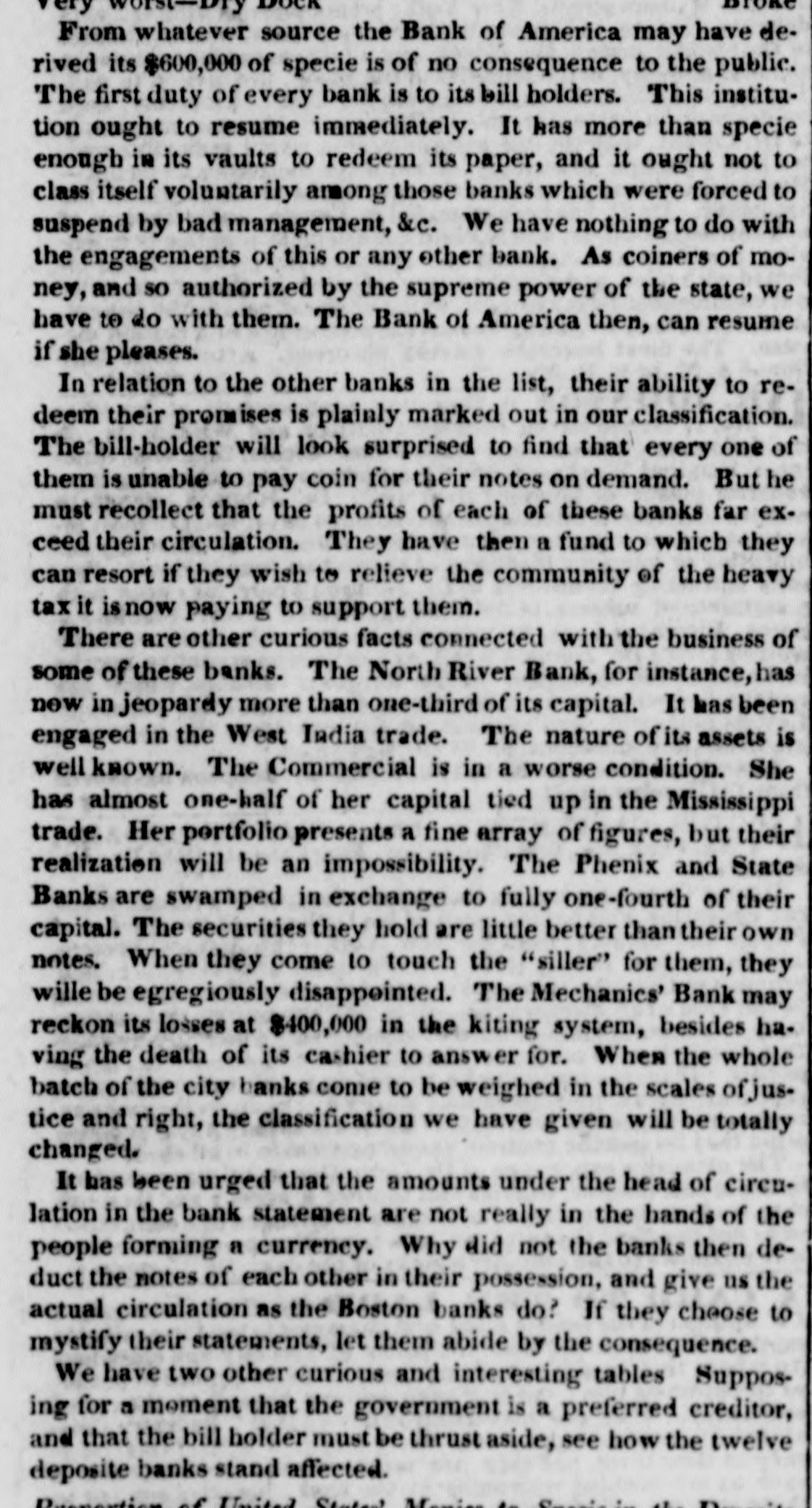
DIORC very DOCK From whatever source the Bank of America may have derived its $600,000 of specie is of no consequence to the public. The first duty of every bank is to its bill holders. This institution ought to resume immediately. It has more than specie enough in its vaults to redeem its paper, and it ought not to class itself voluntarily among those banks which were forced to suspend by bad management, &c. We have nothing to do with the engagements of this or any other bank. As coiners of money, and so authorized by the supreme power of the state, we have to do with them. The Bank of America then, can resume if she pleases. In relation to the other banks in the list, their ability to redeem their promises is plainly marked out in our classification. The bill-holder will look surprised to find that every one of them is unable to pay coin for their notes on demand. But he must recollect that the profits of each of these banks far exceed their circulation. They have then a fund to which they can resort if they wish to relieve the community of the heavy tax it is now paying to support them. There are other curious facts connected with the business of some of these banks. The North River Bank, for instance, has new in jeopardy more than one-third of its capital. It has been engaged in the West India trade. The nature of its assets is well known. The Commercial is in a worse condition. She has almost one-half of her capital tied up in the Mississippi trade. Her portfolio presents a fine array of figures, but their realization will be an impossibility. The Phenix and State Banks are swamped in exchange to fully one-fourth of their capital. The securities they hold are little better than their own notes. When they come to touch the "siller" for them, they wille be egregiously disappointed. The Mechanics' Bank may reckon its losses at $400,000 in the kiting system, besides having the death of its cashier to answer for. When the whole batch of the city banks come to be weighed in the scales of justice and right, the classification we have given will be totally changed. It has been urged that the amounts under the head of circulation in the bank statement are not really in the hands of the people forming a currency. Why did not the banks then deduct the notes of each other in their possession, and give us the actual circulation as the Boston banks do? If they cheose to mystify their statements, let them abide by the consequence. We have two other curious and interesting tables Supposing for a moment that the government is a preferred creditor, and that the bill holder must be thrust aside, see how the twelve deposite banks stand affected. of United Stated Manico - Servicio in


Article from Morning Herald, October 8, 1839

Click image to open full size in new tab

Article Text

44,000 Georgia, Fireman's, 50,000 Jeffersen, 16,000 Hortford, $835,500 Total insured. table is the most accurate that can be obtained at pre- in This The offices have from 30 to 60 days to settle, and the sent. a amount of securities will be thrown upon realise the means of payment ; of. $1,000.000 worth will be so market and that in time Philadelphia to large probably disposed both here will go a great way in increasing the embarrassment be of This affairs temporarily but the money will soon again come out into the hands of mercantile men, and bring into paid more general circulation. The operation will be to the securities now held by companies at nominal values, their down to their real values. The elements seem to lend aid in reducing paper securities. The new emission of U. Bank post notes dated October 4, selling at 8 months, have appeared in the market, and are which 1839, 2 per cent. Much anxiety prevails in Wall street, Banks at little enhanced by a demand for specie upon our on was a Philadelphia account, being the proceeds of the sales of sterling not be The amount to be drawn for could officers on with any precision. A meeting of the in one of the Bank pariors to finanascertained was bills heid Saturday. deliberate bank upon by The question is now frequently propounded commercial men: Will the sus- deThis event is not unmediately the matter. pend? eiers and Philadelphia probable, doubt banks that but pends upon contiugencies There is but little todoso. inclination of the banks both here and in Philadelphia IS to The movements of the United States Bank are such as lead to the inference that her policy is to force a suspension here. Some weeks since that institution supplied the exchange in market with bills, and drew the proceeds so frequently dis that our banks were seriously alarmed, and ceased from Mr. specie This movement brought an assurance she the United States Bank had all the and would not draw again for the present. we of confidence in our wanted, counting. Dun!op that institutions; This restor- specie but States Bank shipping specie to ed find some the little United degree packet, England she by en- a packet; and by the succeeding sailing of the Girard Bank, which sell under to induce buyers, and another specie draft rate, dorses steam the bills fortified is the that the market conse there The banks of this city are so well cause quence. but little danger of suspension, unless some powerful steam at is the South is called into action upon the arrival of the boat. state of things was apparent just previous to the The same in 1837; as now, failures had for weeks been taking depresuspension stocks falling; securities of all kinds becoming movementplace ; specie going from us with au accelerated the ciated; are apparent NOW. Then, however, caused was accelerated by local occurrences, The catastrophe all these symptoms few which days. that closeu the banks in a a on the 4th of May, a run disBank which had bardly 'ceased, death domestic Mechanics' of Mr. panic Fleming, created when caused the upon a the of the Dry Dock bills by the other banks, crediting suspension on the 11th of May. This domestic of panie the panic and to have been aggravated by the movements against was supposed whose complaints then, as now, were loud to stand merchants, banks-which are at this time in no condition the Two facts are much in favor of the circuls. present such an which are. the low state abundance of the crops which are now condition and occurence. of the things; of excitement. the just tion, to market. These tend to allay popular coining difficulties of the times are not a little enhanced their by specio the The with which the southern banks hold D to tenacity of paying their debts with it. The motive of for some so doing sort instead from the fear that reclamations be thrown back upon them by every and also from the sectional arises, from or another Europe doubtless, may ; jesiousies In Georgia, packet which between the banks of the different states. been arise this state of things exists, and a conflict has particularly, on between the specie paying and the non specie paying institutions, going which latter are as follows $1,600,000 Manroe Railroad Bank " Capital 2,000,000 Georgia " 500,000 Ocmulgee have availed " themselves of the four per cent law,' the These of which is a virtual suspension. operation of the debts due the north are sent to Savannah do and not Most for collection, and as the bills of banks which for this Augusta or specie for the bills, are not available Augusta banks refused to receive on resolu. purpose, notes. This called forth the pay exchange the of following them deposit or in of citizens of Mecan, on at That iu future, under such from Au we tion, payment s neeting mandates the circumstances, 23d Sept. Resolved, bound to =bey the bank notes gusta, to pay our paper, regard our credit fairly protectshall not feel direct ourselves but by shall specie or select favorite Bank Notes, as they may payment premiscuous current here at ed in tend-ring received in by the whole community our par. And that henceforth commercial and directly men its collection here, our but estimated regulating and property controlling way, paper, and not as usual, shall cease to receive in any on last of the authority of a through Augusta patronage stated and support. Friday meeting, letter dated that We Sept. 30, seven days subsequent to this deSavannah of Augusta and Savann had agreed to take on of the the Banks the bills of all the Banks with the exception which posite Hawkinsville and of Columbus, a resolution Bank the views of the meeting and reuder is of meet nugatory that this the would A subsequent date, however, states bethe Savannah Banks; consequently resolution. only of the war until true redeemables and the irredeemable will go on deprece tween the another suspension, an event much to be and this it results is Banks of that section have specific enough, allowed now to is ted. The ren er it useful. It should be the moment the course to of trade freely. There a is sudden DO domestic suspension panic follow which would force checked by or demand demand for gold is from abroad and this would be of The only of the crops before the drain reached the point good and ex. ill, exports The Banks are now wavering betwee on it as haustion. with their specie and afraid to operate some where afraid as a basis. to part An explosion must SOOD take place where, time will tell. Sales at the stock Exchange U. S. Bank 100, do 1001. 19 do 100, Dock 26 do 991 8 shares 100-80 Commerce 951 40 do Dry Ward alod. do Leather Manufacturres Bk Del & 78 30d-46 Bk 100-60 do Atlantic 58.15d,75.do Trust 531. 5 do 53) 533-50 do do 54, 25 do 54 nw, 25 do 64, 10 do 58-21 Had 90-20 do State do N. 195 68. do 584 b30d. 25 do 58.25do 10 do 25 do 54,25 324 do 54btw, Bk 30d. 25 do 32g. 18 do 324, do 16 do Canton R Vicksburg Co. Balt.30-44 do Bost. & Prov 101, do 1001. 214. Stonington 100-187 do New 214 Jersey 10 do Harlem R. R. 42, 100 do 421 do 42/tw. $20d, 22 b15d, 170 15 do 424, do 200 do 424 tw, 425, 100 do 42), 200 Cattle Maket. prices, There with was a the large exception supply of those of cattle for sheep in market and lambs, to-day, slight- and
Article from The New York Herald, July 31, 1854

Click image to open full size in new tab

Article Text

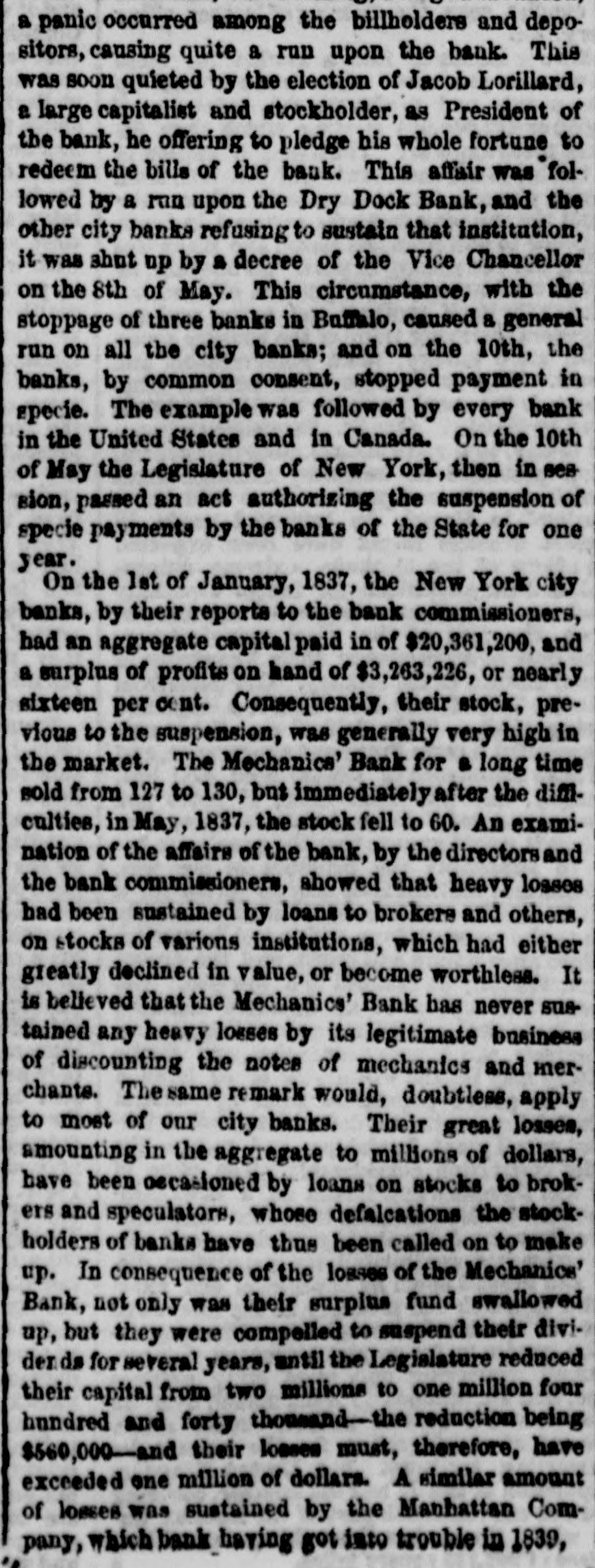
a panic occurred among the billholders and depositors, causing quite a run upon the bank. This was soon quieted by the election of Jacob Lorillard, a large capitalist and stockholder, as President of the bank, he offering to pledge his whole fortune to redeem the bills of the bank. This affair was followed by a run upon the Dry Dock Bank, and the other city banks refusing to sustain that institution, it was shut up by a decree of the Vice Chancellor on the 8th of May. This circumstance, with the stoppage of three banks in Buffalo, caused a general run on all the city banks; and on the 10th, the banks, by common consent, stopped payment in specie. The example was followed by every bank in the United States and in Canada. On the 10th of May the Legislature of New York, then in sea sion, passed an act authorizing the suspension of specie payments by the banks of the State for one year. On the 1st of January, 1837, the New York city banks, by their reports to the bank commissioners, had an aggregate capital paid in of $20,361,200, and a surplus of profits on hand of $3,263,226, or nearly sixteen per cent. Consequently, their stock, previous to the suspension, was generally very high in the market. The Mechanics' Bank for a long time sold from 127 to 130, but immediately after the difficulties, in May, 1837, the stock fell to 60. An examination of the affairs of the bank, by the directors and the bank commissioners, showed that heavy losses had been sustained by loans to brokers and others, on stocks of various institutions, which had either greatly declined in value, or become worthless. It is believed that the Mechanics' Bank has never sustained any heavy losses by its legitimate business of discounting the notes of mechanics and merchants. The same remark would, doubtless, apply to most of our city banks. Their great losses, amounting in the aggregate to millions of dollars, have been occasioned by loans on stocks to brokers and speculators, whose defalcations the stockholders of banks have thus been called on to make up. In consequence of the losses of the Mechanics' Bank, not only was their surplus fund swallowed up, but they were compelled to suspend their divider ds for several years, until the Legislature reduced their capital from two millions to one million four hundred and forty thousand-the reduction being $560,000-and their losses must, therefore, have exceeded one million of dollars. A similar amount of losses was sustained by the Manhattan Company, which bank having got into trouble in 1839,


Article from The Daily Union, October 19, 1854

Click image to open full size in new tab

Article Text

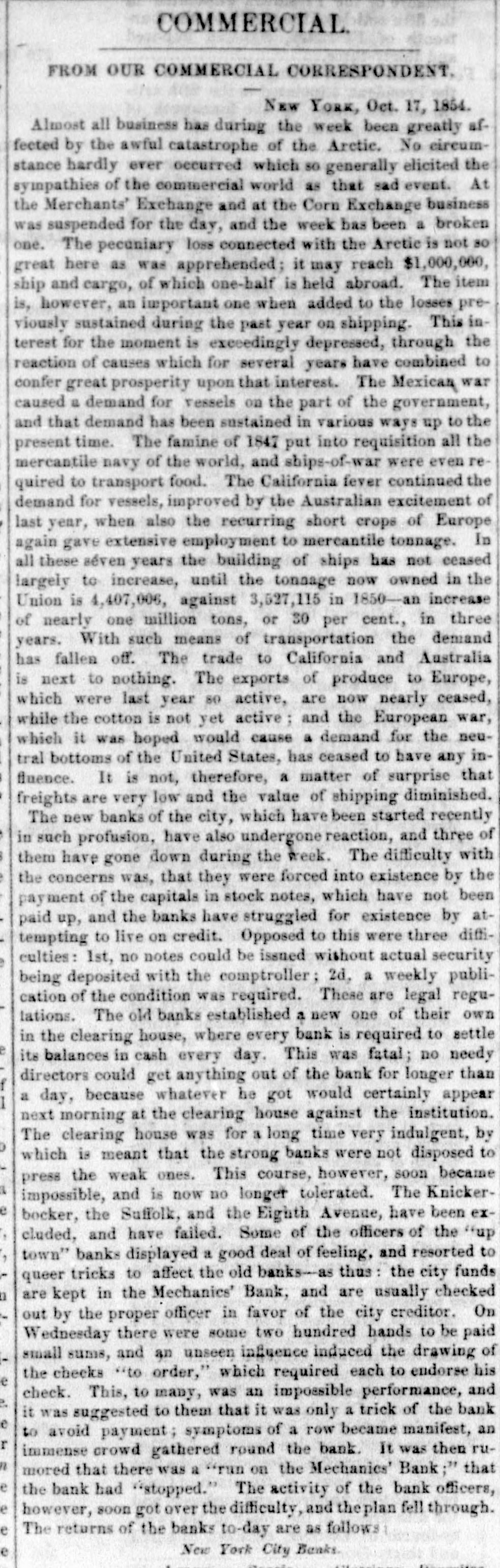
COMMERCIAL FROM OUR COMMERCIAL CORRESPONDENT NEW YORK, Oct. 17, 1854. Almost all business has during the week been greatly offeeted by the awful catastrophe of the Arctic. No cireumstance hardly ever occurred which so generally elicited the sympathies of the commercial world as that sad event. At the Merchants' Exchange and at the Corn Exchange business was suspended for the day, and the week has been a broken one. The pecaniary loss connected with the Aretie is not so great here as was apprehended; it may reach $1,000,000, ship and cargo, of which one-half is held abroad. The item is, however, an important one when added to the losses previously sustained during the past year on shipping. This interest for the moment is exceedingly depressed, through the reaction of causes which for several years have combined to confer great prosperity upon that interest. The Mexican war caused a demand for vessels on the part of the government, and that demand has been sustained in various ways up to the present time. The famine of 1847 put into requisition all the mercantile navy of the world, and ships-of-war were even required to transport food. The California fever continued the demand for vessels, improved by the Australian excitement of last year, when also the recurring short crops of Europe again gave extensive employment to mercantile tonnage. In all these séven years the building of ships has not ceased largely to increase, until the tonaage now owned in the Union is 4,407,006, against 3,527,115 in 1850 an increase of nearly one million tons, or 30 per cent., in three years. With such means of transportation the demand has fallen off. The trade to California and Australia is next to nothing. The exports of produce to Europe, which were last year so active, are now nearly ceased, while the cotton is not yet active: and the European war, which it was hoped would cause a demand for the neutral bottoms of the United States, has ceased to have any influence. It is not, therefore, a matter of surprise that freights are very low and the value of shipping diminished. The new banks of the city, which have been started recently in such profusion, have also undergone reaction, and three of them have gone down during the week. The difficulty with the concerns was, that they were forced into existence by the payment of the capitals in stock notes, which have not been paid up, and the banks have struggled for existence by attempting to live on credit. Opposed to this were three difficulties: 1st, no notes could be issued without actual security being deposited with the comptroller; 2d. a weekly publication of the condition was required. These are legal regulations. The old banks established a new one of their own in the clearing house, where every bank is required to settle its balances in cash every day. This was fatal; no needy directors could get anything out of the bank for longer than a day, because whatever he got would certainly appear next morning at the clearing house against the institution. The clearing house was for a long time very indulgent, by which is meant that the strong banks were not disposed to press the weak ones. This course, however, soon became impossible, and is now no longer tolerated. The Knickere bocker, the Suffolk, and the Eighth Avenue, have been excluded, and have failed. Some of the officers of the "up town" banks displayed a good deal of feeling, and resorted to queer tricks to affect the old banks-as thus : the city funds a are kept in the Mechanics' Bank, and are usually checked out by the proper officer in favor of the city creditor. On Wednesday there were some two hundred hands to be paid small sums, and an unseen influence induced the drawing of the checks "to order," which required each to endorse his e check. This, to many, was an impossible performance, and it was suggested to them that it was only a trick of the bank e to avoid payment; symptoms of a row became manifest, an r immense crowd gathered round the bank It was then run mored that there was a "run on the Mechanics' Bank that e the bank had "stopped." The activity of the bank officers, e however, soon got over the difficulty, and the plan fell through e The returns of the banks to-day are as follows e New York City Banks


Article from Daily American Organ, August 8, 1855

Click image to open full size in new tab

Article Text

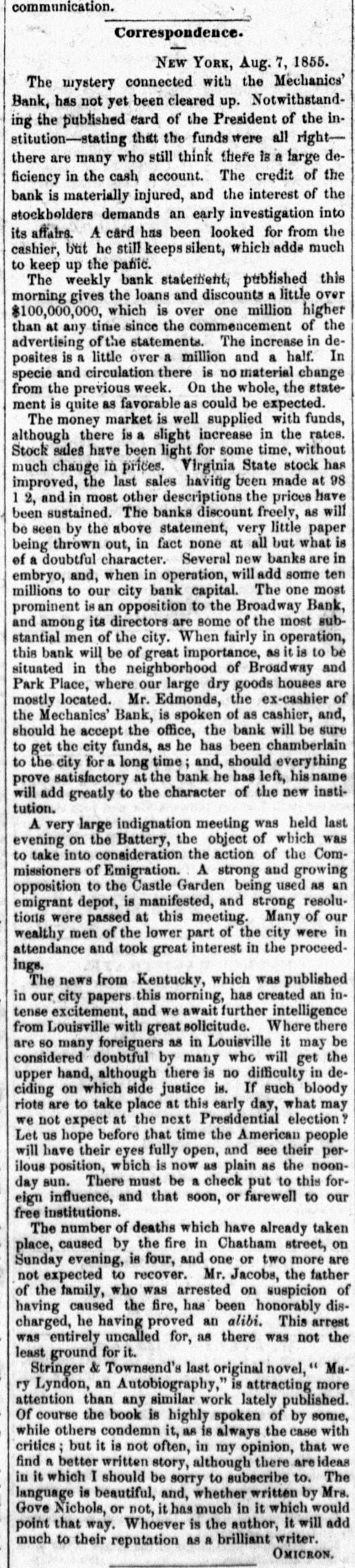
communication. Correspondence. NEW YORK, Aug. 7, 1855. The mystery connected with the Mechanics' Bank, has not yet been cleared up. Notwithstanding the published eard of the President of the institution-stating that the funds were all rightthere are many who still think there is a large deficiency in the cash account. The credit of the bank is materially injured, and the interest of the stockholders demands an early investigation into its affairs. A card has been looked for from the cashier, but he still keepssilent, which adds much to keep up the panic. The weekly bank statement, published this morning gives the loans and discounts a little over $100,000,000, which is over one million higher than at any time since the commencement of the advertising of the statements. The increase in deposites is a little over a million and a half. In specie and circulation there is no material change from the previous week. On the whole, the statement is quite as favorable as could be expected. The money market is well supplied with funds, although there is a slight increase in the rates. Stock sales have been light for some time, without much change in prices. Virginia State stock has improved, the last sales having been made at 98 1 2, and in most other descriptions the prices have been sustained. The banks discount freely, as will be seen by the above statement, very little paper being thrown out, in fact none at all but what is of a doubtful character. Several new banks are in embryo, and, when in operation, will add some ten millions to our city bank capital. The one most prominent is an opposition to the Broadway Bank, and among its directors are some of the most substantial men of the city. When fairly in operation, this bank will be of great importance, as it is to be situated in the neighborhood of Broadway and Park Place, where our large dry goods houses are mostly located. Mr. Edmonds, the ex-cashier of the Mechanics' Bank, is spoken of as cashier, and, should he accept the office, the bank will be sure to get the city funds, as he has been chamberlain to the city for a long time ; and, should everything prove satisfactory at the bank he has left, name will add greatly to the character of the new institution. A very large indignation meeting was held last evening on the Battery, the object of which was to take into consideration the action of the Commissioners of Emigration. A strong and growing opposition to the Castle Garden being used as an emigrant depot, is manifested, and strong resolutions were passed at this meeting. Many of our wealthy men of the lower part of the city were in attendance and took great interest in the proceedings. The news from Kentucky, which was published in our city papers this morning, has created an intense excitement, and we await further intelligence from Louisville with great solicitude. Where there are so many foreigners as in Louisville it may be considered doubtful by many who will get the upper hand, although there is no difficulty in deciding on which side justice is. If such bloody riots are to take place at this early day, what may we not expect at the next Presidential election Let us hope before that time the American people will have their eyes fully open, and see their perilous position, which is now as plain as the noonday sun. There must be a check put to this foreign influence, and that soon, or farewell to our free institutions. The number of deaths which have already taken place, caused by the fire in Chatham street, on Sunday evening, is four, and one or two more are not expected to recover. Mr. Jacobs, the father of the family, who was arrested on suspicion of having caused the fire, has been honorably discharged, he having proved an alibi. This arrest was entirely uncalled for, as there was not the least ground for it. Stringer & Townsend's last original novel, " Mary Lyndon, an Autobiography," is attracting more attention than any similar work lately published. Of course the book is highly spoken of by some, while others condemn it, as is always the case with critics but it is not often, in my opinion, that we find a better written story, although there are ideas in it which I should be sorry to subscribe to. The language is beautiful, and, whether written by Mrs. Gove Nichols, or not, it has much in it which would point that way. Whoever is the author, it will add much to their reputation as a brilliant writer. OMICRON.