1718. Freedman's Savings & Trust Company (Washington, DC)

Bank Information

Episode Type
Run โ†’ Suspension โ†’ Closure
Bank Type
federal
Start Date
September 20, 1873
Location
Washington, District of Columbia (38.895, -77.036)

Metadata

Model
gpt-5-mini
Short Digest
2fac6e9afbbb45d8

Response Measures

None

Description

Newspaper articles document heavy withdrawals (runs) on the Freedman's Bank during the Panic of 1873 (Sept 1873), the bank enforcing 30/60/60-day notice rules, then suspending payments (reported April 1874) and ultimately being wound up with receivers/commissioners and dividends paid in later years. Sequence: run -> suspension -> permanent closure/receivership (commissioners and dividends). Dates are taken from article publication dates and article references.

Events (5)

1. September 20, 1873 Run
Cause
Macro News
Cause Details
Part of the broader Panic of 1873 and related bank failures (reports mention Jay Cooke & Co. and general panic causing withdrawal pressure).
Measures
Paid out demands; later enforced 30/60/90 or 60 days' notice rules (requiring notice for withdrawals).
Newspaper Excerpt
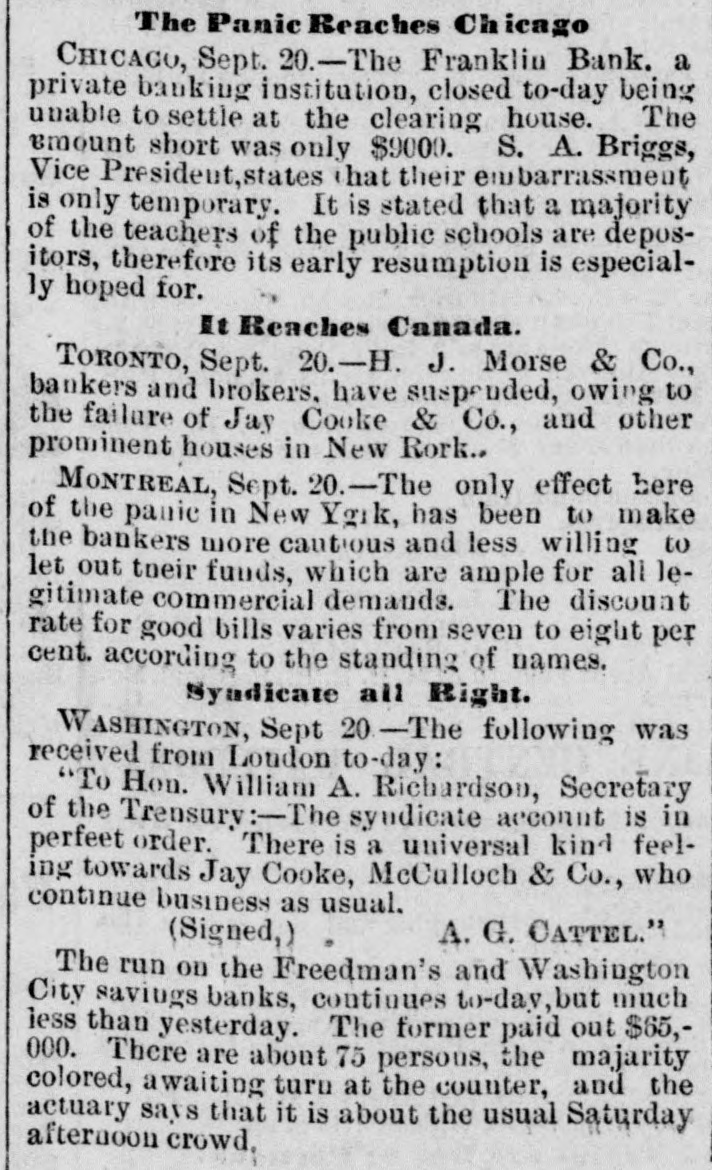
The run on the Freedman's and Washington City savings banks, continues to-day, but much less than yesterday. The former paid out $65,000.
Source
newspapers
2. September 24, 1873 Run
Cause
Macro News
Cause Details
Withdrawals driven by ongoing panic and loss of confidence from failures and suspensions elsewhere; articles explicitly link runs to the broader financial panic.
Measures
Bank and branches began enforcing 30/60/60-day notice; reports state Freedman's required 60 days' notice from depositors.
Newspaper Excerpt
The run on the Freedmen's Savings Bank has entirely ceased, and comparatively few depositors are at the door...
Source
newspapers
3. April 27, 1874 Suspension
Cause
Macro News
Cause Details
Suspension follows withdrawal pressure/financial distress traced in reporting to the earlier panic and reported deficiencies; articles tie the suspension to consequences of earlier runs and concerns over solvency after panic-era losses.
Newspaper Excerpt
The news that the Freedman's Bank in Washington had suspended payments and closed its doors yesterday ... Mr. Harris, the manager, said that we should probably be compelled to enforce from to-day the rule requiring sixty days' notice from depositors.
Source
newspapers
4. July 9, 1875 Receivership
Newspaper Excerpt
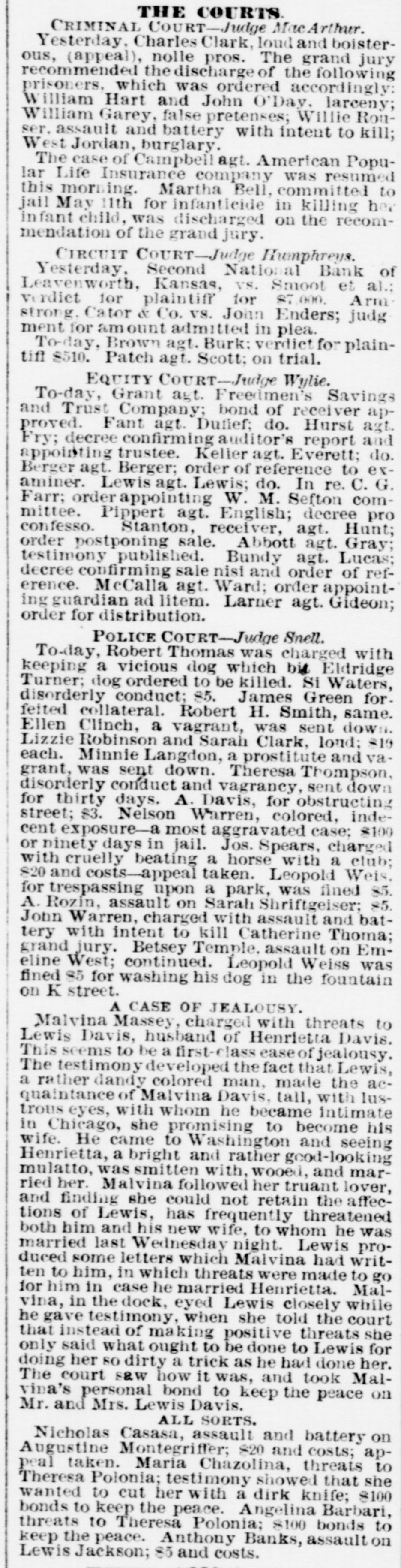
EQUITY COURT-Judge Wylie. To-day, Grant agt. Freedmen's Savings and Trust Company; bond of receiver approved. Fant agt. Dufief; do.... In re. C. G. Farr; order appointing W. M. Sefton committee.
Source
newspapers
5. September 6, 1875 Other
Newspaper Excerpt
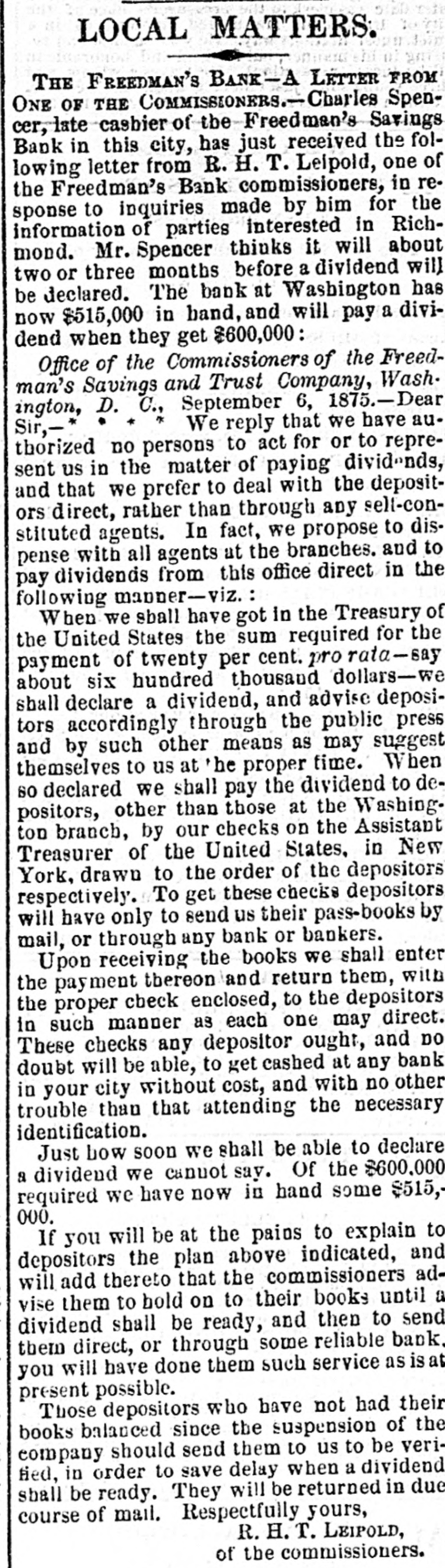
Office of the Commissioners of the Freedman's Savings and Trust Company, Washington, D. C., September 6, 1875... When we shall have got in the Treasury of the United States the sum required for the payment of twenty per cent. pro rata ... we shall declare a dividend ... and pay the dividend to depositors ... by checks ... drawn by the Assistant Treasurer of the United States in New York, drawn to the order of the depositors respectively.
Source
newspapers

Newspaper Articles (23)

Article from Alexandria Gazette, March 12, 1873

Click image to open full size in new tab

Article Text

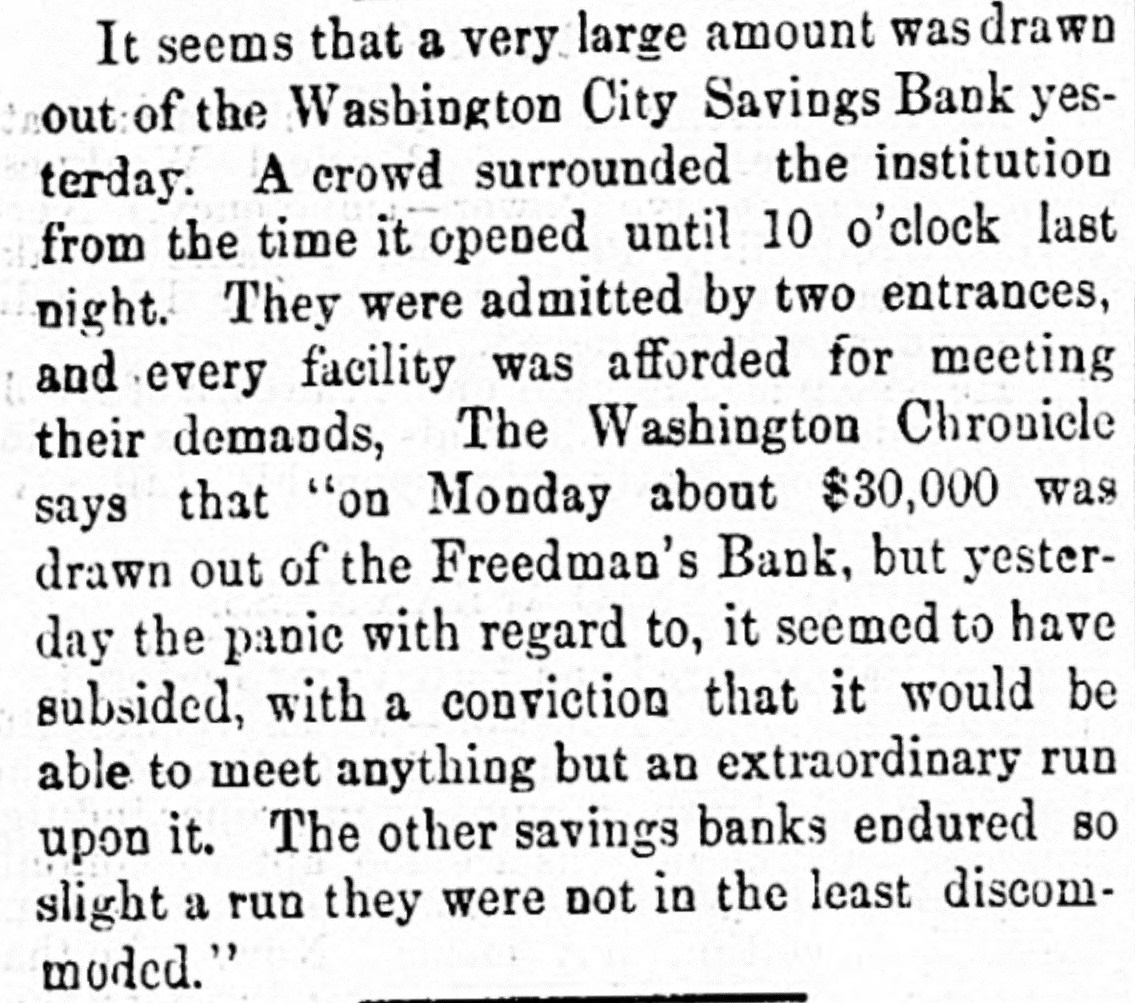
It seems that a very large amount was drawn out of the Wasbington City Savings Bank yesterday. A crowd surrounded the institution from the time it opened until 10 o'clock last night. They were admitted by two entrances, and every facility was afforded for meeting their demands, The Washington Chronicle says that "on Monday about $30,000 was drawn out of the Freedman's Bank, but yesterday the panic with regard to, it seemed to have subsided, with a conviction that it would be able to meet anything but an extraordinary run upon it. The other savings banks endured 80 slight a run they were not in the least discommoded."


Article from The Portland Daily Press, September 20, 1873

Click image to open full size in new tab

Article Text

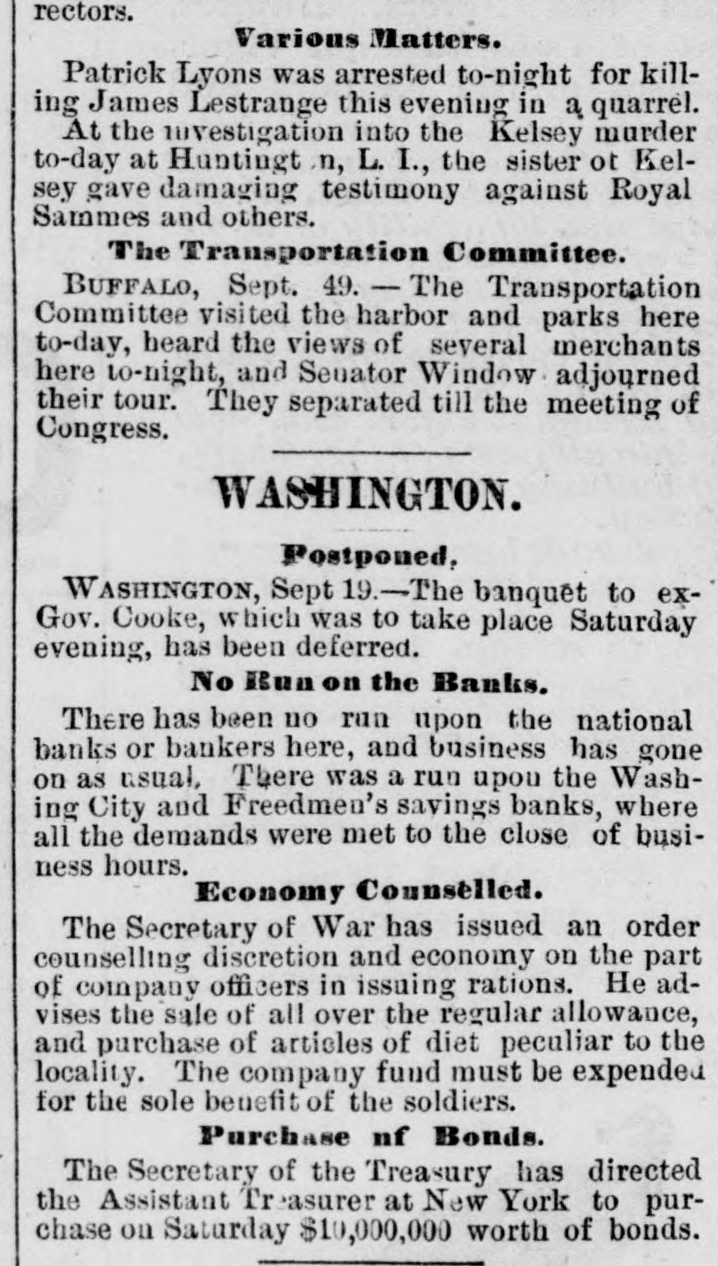
rectors. Various Matters. Patrick Lyons was arrested to-night for killing James Lestrange this evening in a quarrel. At the investigation into the Kelsey murder to-day at Huntingt n, L. I., the sister ot Kelsey gave damaging testimony against Royal Sammes and others. The Transportation Committee. BUFFALO, Sept. 49. - The Transportation Committee visited the harbor and parks here to-day, heard the views of several merchants here to-night, and Seuator Window adjourned their tour. They separated till the meeting of Congress. WASHINGTON. Postponed, WASHINGTON, Sept 19.-The banquet to exGov. Cooke, which was to take place Saturday evening, has been deferred. No Run on the Banks. There has been no run upon the national banks or bankers here, and business has gone on as usual, There was a run upon the Washing City and Freedmen's savings banks, where all the demands were met to the close of business hours. Economy Counselled. The Secretary of War has issued an order counselling discretion and economy on the part of company officers in issuing rations. He advises the sale of all over the regular allowance, and purchase of articles of diet peculiar to the locality. The company fund must be expended for the sole benefit of the soldiers. Purchase nf Bonds. The Secretary of the Treasury has directed the Assistant Tr easurer at New York to purchase on Saturday $10,000,000 worth of bonds.


Article from The Portland Daily Press, September 22, 1873

Click image to open full size in new tab

Article Text

The Panic Reaches Chicago CHICAGO, Sept. 20.-The Franklin Bank. a private bauking institution, closed to-day being unable to settle at the clearing house. The amount short was only $9000. S. A. Briggs, Vice President, states that their embarrassment is only temporary. It is stated that a majority of the teachers of the public schools are depositors, therefore its early resumption is especially hoped for. It Reaches Canada. TORONTO, Sept. 20.-H. J. Morse & Co., bankers and brokers, have suspended, owing to the failure of Jay Cooke & Co., and other prominent houses in New Rork. MONTREAL, Sept. 20.-The only effect here of the panic in New Ygik, has been to make the bankers more cautious and less willing to let out tneir funds, which are ample for all legitimate commercial demands. The discount rate for good bills varies from seven to eight per cent. according to the standing of names. Syndicate all Right. WASHINGTON, Sept 20 -The following was received from Loudon to-day: "To Hon. William A. Richardson, Secretary of the Trensury:-The - syudicate account is in perfeet order. There is a universal kind feeling towards Jay Cooke, McCulloch & Co., who continue business as usual. (Signed,) A. G. CATTEL." The run on the Freedman's and Washington City savings banks, continues to-day, but much less than yesterday. The former paid out $65,000. There are about 75 persons, the majarity colored, awaiting turu at the counter, and the actuary says that it is about the usual Saturday afternoon crowd.


Article from The Wheeling Daily Intelligencer, September 24, 1873

Click image to open full size in new tab

Article Text

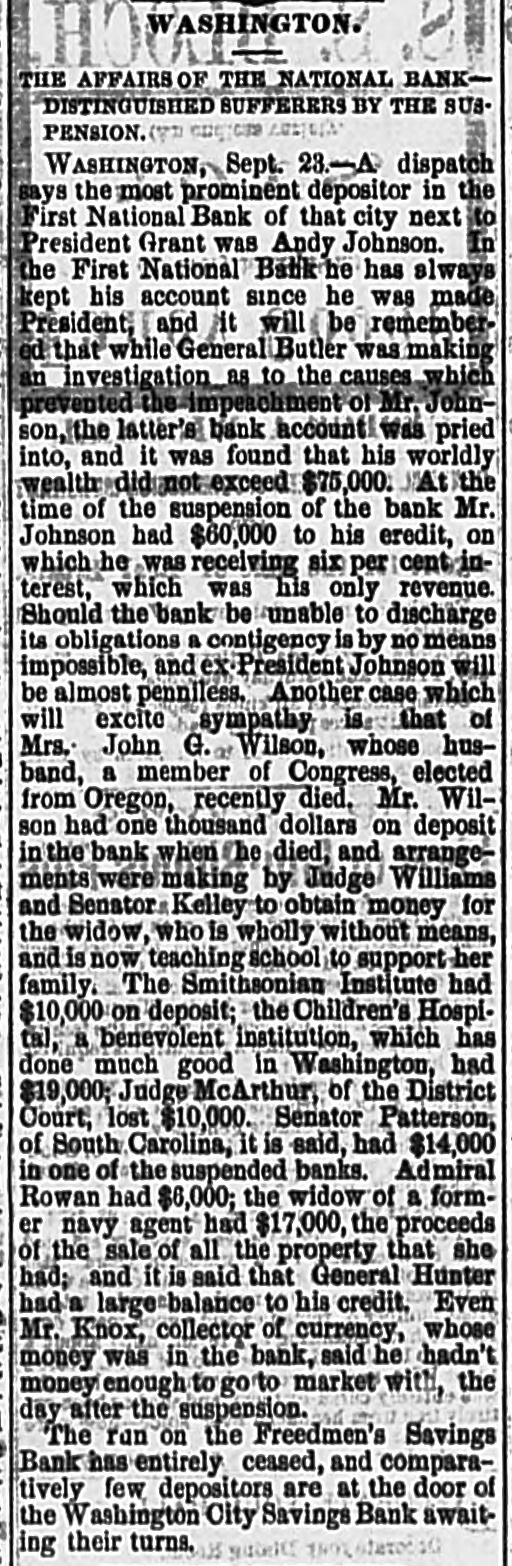
WASHINGTON. AFFAIRS OF THE NATIONAL BANKDISTINGUISHED SUFFERERS BY THE SUSPENSION. WASHINGTON, Sept. 23.-A dispatch ays the most prominent depositor in the first National Bank of that city next to In President Grant was Andy Johnson. the First National Balk he has always kept his account since he was made President, and it will be remember ed that while General Butler was making an in vestigation as to the causes which prevented the impeachment of Mr. Johnson, the latter's bank account was pried into, and it was found that his worldly wealth didnot exceed $75,000. At the time of the suspension of the bank Mr. Johnson had $60,000 to his eredit, on which he was receiving six per cent interest, which was his only revenue. Should the bank be unable to discharge its obligations a contigency is by no means impossible, and ex- President Johnson will be almost penniless. Another case which will excite sympathy is that of Mrs. John G. Wilson, whose husband, a member of Congress, elected from Oregon, recently died. Mr. Wilson had one thousand dollars on deposit in the bank when he died, and arrangements were making by Judge Williams and Senator Kelley to obtain money for the widow, who is wholly without means, and is now teaching school to support her family. The Smithsonian Institute had $10,000 on deposit; the Children's Hospital, a benevolent institution, which has done much good in Washington, had $19,000; Judge McArthur, of the District Court, lost $10,000. Senator Patterson, of South Carolina, it is said, had $14,000 in one of the suspended banks. Admiral Rowan had $6,000; the widow of a former navy agent had $17,000, the proceeds of the sale of all the property that she had; and it is said that General Hunter had large-balance to his credit. Even Mr. Knox, collector of currency, whose money was in the bank, said he hadn't money enough to gorto market with the day after the suspension. The run on the Freedmen's Savings Bank has entirely ceased, and comparatively few depositors are at the door of the W ashington City Savings Bank awaiting their turns.


Article from The Dallas Daily Herald, September 25, 1873

Click image to open full size in new tab

Article Text

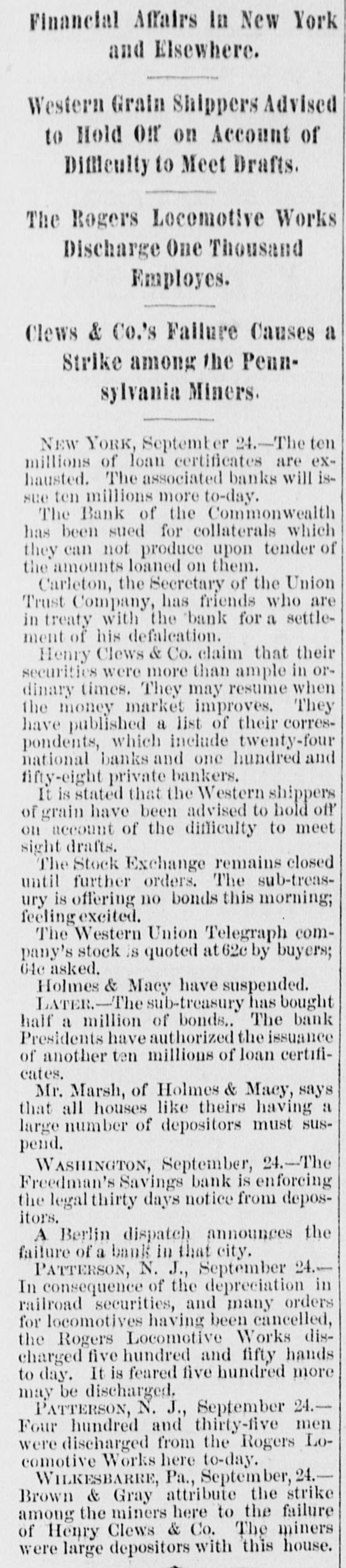
Financial Affairs In New York and Elsewhere. Western Grain Shippers Advised to Hold off on Account of Difficulty to Meet Drafts. The Rogers Locomotive Works Discharge One Thousand Employes. Clews & Co.'s Failure Causes a Strike among the Pennsylvania Miners. NEW YORK, Septemb er 24.-The ten millions of loan certificates are exhausted. The associated banks will issue ten millions more to-day. The Bank of the Commonwealth has been sued for collaterals which they can not produce upon tender of the amounts loaned on them. Carleton, the Secretary of the Union Trust Company, has friends who are in treaty with the bank for a settlement of his defalcation. Henry Clews & Co. claim that their securities were more than ample in ordinary times. They may resume when the money market improves. They have published a list of their correspondents, which include twenty-four national banks and one hundred and fifty-eight private bankers. It is stated that the Western shippers of grain have been advised to hold off on account of the difficulty to meet sight drafts. The Stock Exchange remains closed until further orders. The sub-treasury is offering no bonds this morning; feeling excited. The Western Union Telegraph company's stock is quoted at 62c by buyers; 64c asked. Holmes & Macy have suspended. LATER-The sub-treasury has bought half a million of bonds.. The bank Presidents have authorized the issuance of another ten millions of loan certificates. Mr. Marsh, of Holmes & Macy, says that all houses like theirs having a large number of depositors must suspend. WASHINGTON, September, 24.-The Freedman's Savings bank is enforcing the legal thirty days notice from depositors. A Berlin dispatch announces the failure of a bank in that city, PATTERSON, N. J., September 24. In consequence of the depreciation in railroad securities, and many orders for locomotives having been cancelled, the Rogers Locomotive Works discharged five hundred and fifty hands to day. It is feared five hundred more may be discharged. PATTERSON, N. J., September 24.Four hundred and thirty-five men were discharged from the Rogers Locomotive Works here to-day. WILKESBARRE, Pa., September, 24.Brown & Gray attribute the strike among the miners here to the failure of Henry Clews & Co. The miners itn with 'this house


Article from Nashville Union and American, September 25, 1873

Click image to open full size in new tab

Article Text

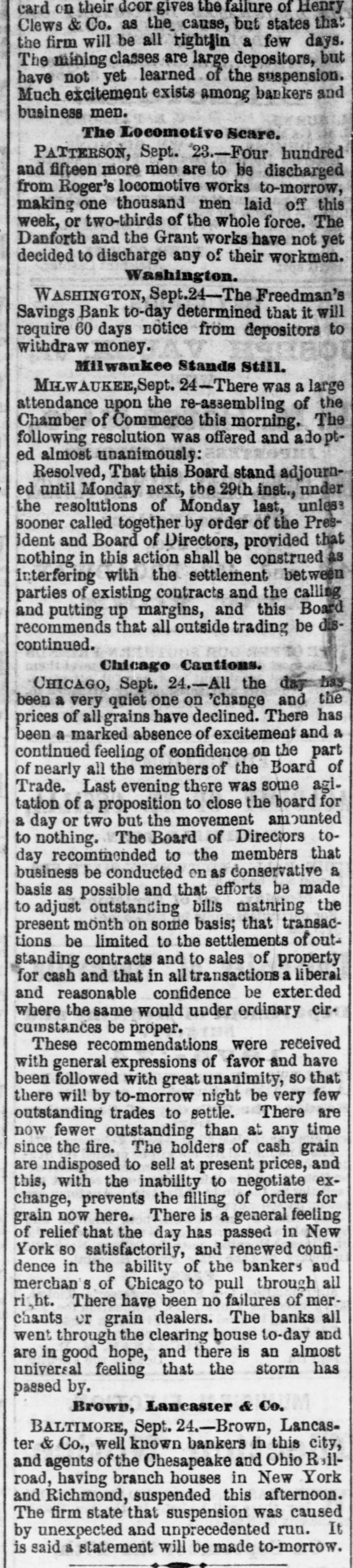
card on their door gives the failure of Henry Clews & Co. as the cause, but states that the firm will be all rightjin a few days. The mining classes are large depositors, but have not yet learned of the suspension. Much excitement exists among bankers and business men. The Locomotive Scare. PATTERSON, Sept. 23.-Four hundred and fifteen more men are to be discharged from Roger's locomotive works to-morrow, making one thousand men laid off this week, or two-thirds of the whole force. The Danforth and the Grant works have not yet decided to discharge any of their workmen. Washington. WASHINGTON, Sept.24-The Freedman's Savings Bank to-day determined that it will require 60 days notice from depositors to withdraw money. Milwaukee Stands Still. MILWAUKEE,Sept. 24-There was a large attendance upon the re-assembling of the Chamber of Commerce this morning. The following resolution was offered and adopted almost unanimously: Resolved, That this Board stand adjourned until Monday next, the 29th inst., under the resolutions of Monday last, unless sooner called together by order of the President and Board of Directors, provided that nothing in this action shall be construed as interfering with the settlement between parties of existing contracts and the calling and putting up margins, and this Board recommends that all outside trading be discontinued. Chicago Cautions. CHICAGO, Sept. 24.-All the day has been a very quiet one on 'change and the prices of all grains have declined. There has been a marked absence of excitement and a continued feeling of confidence on the part of nearly all the members of the Board of Trade. Last evening there was some agitation of a proposition to close the board for a day or two but the movement amounted to nothing. The Board of Directors today recommended to the members that business be conducted on as conservative a basis as possible and that efforts be made to adjust outstanding bills matnring the present month on some basis; that transactions be limited to the settlements of outstanding contracts and to sales of property for cash and that in all transactions a liberal and reasonable confidence be extended where the same would under ordinary circumstances be proper. These recommendations were received with general expressions of favor and have been followed with great unanimity, so that there will by to-morrow night be very few outstanding trades to settle. There are now fewer outstanding than at any time since the fire. The holders of cash grain are indisposed to sell at present prices, and this, with the inability to negotiate exchange, prevents the filling of orders for grain now here. There is a general feeling of relief that the day has passed in New York 80 satisfactorily, and renewed confidence in the ability of the bankers and merchan's of Chicago to pull through all right. There have been no failures of merchants or grain dealers. The banks all went through the clearing house to-day and are in good hope, and there is an almost universal feeling that the storm has passed by. Brown, Lancaster & Co. BALTIMORE, Sept. 24.-Brown, Lancaster & Co., well known bankers in this city, and agents of the Chesapeake and Ohio Roilroad, having branch houses in New York and Richmond, suspended this afternoon. The firm state that suspension was caused by unexpected and unprecedented run. It is said a statement will be made to-morrow.


Article from The New York Herald, April 28, 1874

Click image to open full size in new tab

Article Text

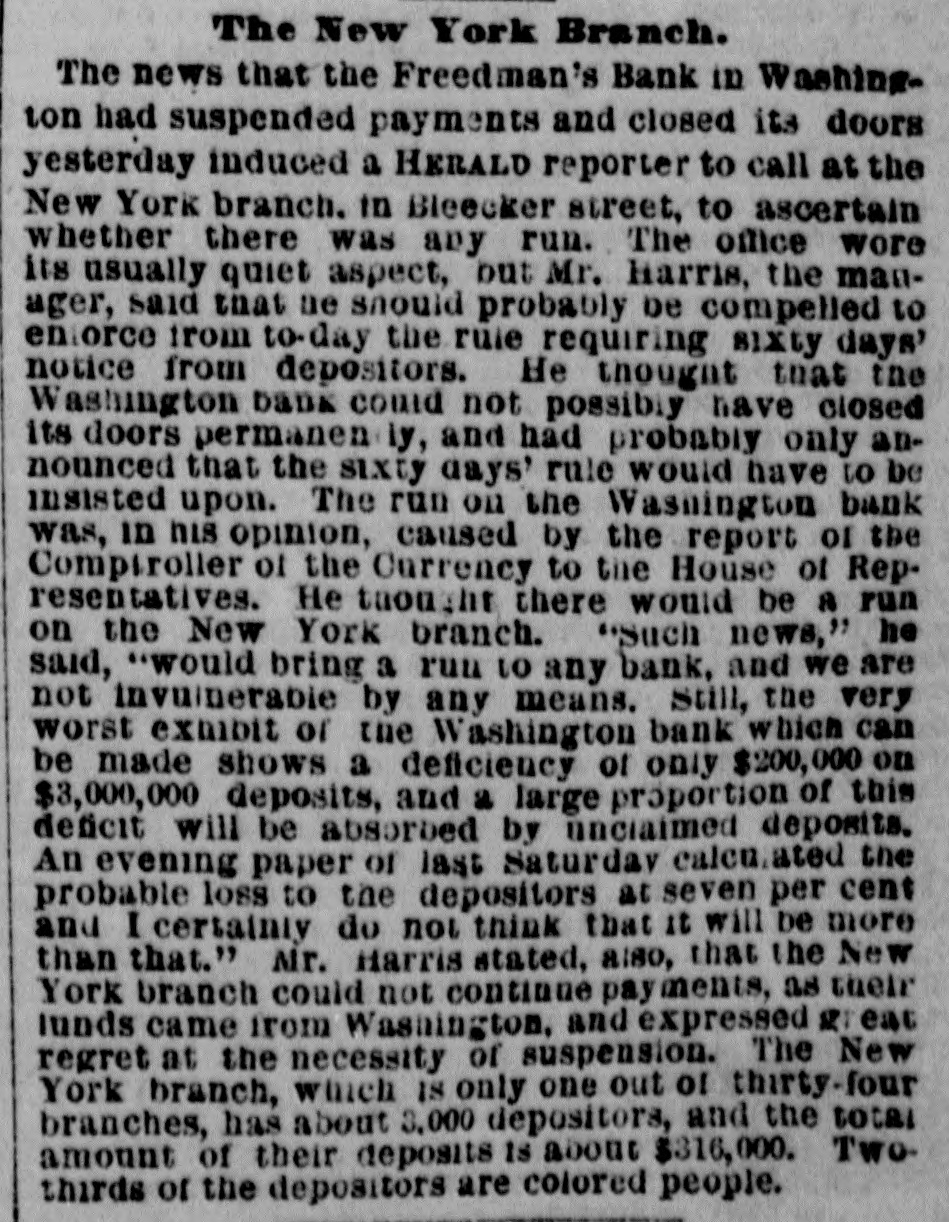
The New York Branch. The news that the Freedman's Bank in Washington had suspended payments and closed its doors yesterday induced a HERALD reporter to call at the New York branch. in Bleecker street, to ascertain whether there was any run. The office wore its usually quiet aspect, out Mr. Harris, the manager, said that ae snould probably be compelled to enforce from to-day the rule requiring sixty days' notice from depositors. He thought that the Washington bank could not possibly have closed its doors permanently, and had probably only announced that the sixty days' rule would have to be insisted upon. The run on the Washington bank was, in his opinion, caused by the report of the Comptroller of the Currency to the House of Rep. resentatives. He though there would be a run he on the New York branch. "Such news," said, "would bring a ruu to any bank, and we are not invulnerable by any means. Still, the very worst examin of the Washington bank which can be made shows a deficiency of only $200,000 on $3,000,000 deposits, and a large proportion of this deficit will be absorbed by unclaimed deposits. An evening paper of last Saturday calculate the probable loss to the depositors at seven per cent and I certainly do not think that it will be more than that." Mr. Harris stated, also, that the New York branch could not continue pay ments, as their funds came from Washington. and expressed g: eac regret at the necessity of suspension. The New York branch, which IS only one out of thirty-four branches, has about 3,000 depositors, and the total amount of their deposits IS about $316,000. Two thirds of the depositors are colored people.


Article from The Daily Phoenix, August 5, 1874

Click image to open full size in new tab

Article Text

COLUMBIA, D. C. ednesday Morning, August 5, 1874. The Lesson of the Freedmen's Bank. The Freedmen's Savings and Trust Company, at its inception, had about is some marks of interest and concern in the prosperity of the colored people. But these were either baits which were put in to allure and deceive from the first, or, being available for this purpose, were captured and turned against those whom they professed to protect. The institution soon took on $ party character, and was placed under the wing of the Government. Depositors were led to believe that the Government guaranteed the safety of their money. It became an engine for political purposes, and the funds which poured in freely from branches sll over the country were intended to the used, and were used, to promote objectswhich are foreign to the legitimate-business of a bank. What more natural than that the freedmen should Joek with confidence to an institution which sent forth circulars announcing that the company was "chartered by the Government of the United States on March 3, 1865?" The effect was to inspire the belief in their minds that the Government guaranteed the se. surity of the deposits. But it did not; itionly allowed its name to be used in this way. The bank sailed under Government colors, and the money came in freely. The branches were kept busy feeding the mother bank at Washington. Certain special allurements were devised to induce the money to flow thither with a rush. The bank promised to pay six per cent. interest on all sums deposited. Da some of the branch bank books, it was announced that deposits were payable on:demand-a promise which transact redeemed. But the use to smbich the deposits were put was worse, if anything, than the deceptions by which they were gained. A portion was invested in the bonds of the District of Columbia, and the remainder Zent 40 favored customers on doubtful security, and on mortgages of real estate not worth more than half of the Sean. The list which was published seme time ago looked like the seouridies on which the money of the Bank of the State has been lent here. It plainly had degenerated into, or developed into, a local machine, run by Shepherd and those connected with Inim in his disreputable government. Such a machine could not be wound up to run long, and the end came, and the colored depositors and supporters Hound out, too late, that something very like a swindle had been practiced sathem. The matter went before Congress, and the same disposition which had mained the bank manifested itself as to the mode of settling up its affairs. It was attempted to close it up by a slow and complicated method, which, taking it through the intricacies of courts, would afford a chance for further pickZags and spoils. Fortunately, the Seaste bill, which proposed to appoint a receiver, and would have distributed the property among the officers of the slaw and special commissioners, to the Retriment of the depositors, failed to pass the House. A bill was at last massed, which seeks to protect the remunt which is left of the colored man's money. It provides that all Auture deposits, until July 1, 1875, shall be held as special deposits, and repealed the dangerous feature of the sriginal charter, which required that the branches shall send all their money to Washington. This bill was devised and passed in the real interest of the freedmen, chiefly through the sagacity, Terseverance and love of right and fair play of two members of Congress from


Article from Evening Star, July 9, 1875

Click image to open full size in new tab

Article Text

ous, (appeal), nolle pros. The grand jury recommended the discharge of the following prisoners, which was ordered accordingly: William Hart and John O'Day. larceny; William Garey, false pretenses; Willie Rouser. assault and battery with intent to kill; West Jordan, burglary. The case of Campbell agt. American Popular Life Insurance company was resumed this morning. Martha Bell, committed to jail May 11th for infanticide in killing her infant child, was discharged on the recommendation of the grand jury. CIRCUIT COURT-Judge Humphreys. Yesterday, Second National Bank of Leavenworth, Kansas, vs. Smoot et al.; verdict for plaintiff for $7.000. Arm. strong. Cator & Co. vs. John Enders; judg ment for amount admitted in plea. To-day, Brown agt. Burk: verdict for plaintiff $510. Patch agt. Scott; on trial. EQUITY COURT-Judge Wylie. To-day, Grant agt. Freedmen's Savings and Trust Company; bond of receiver approved. Fant agt. Dufief; do. Hurst agt. Fry; decree confirming auditor's report and appointing trustee. Keller agt. Everett; do. Berger agt. Berger; order of reference to examiner. Lewis agt. Lewis; do. In re. C. G. Farr; order appointing W. M. Sefton committee. Pippert agt. English; decree pro confesso. Stanton, receiver, agt. Hunt; order postponing sale. Abbott agt. Gray; testimony published. Bundy agt. Lucas; decree confirming sale nisi and order of reference. McCalla agt. Ward; order appointing guardian ad litem. Larner agt. Gideon; order for distribution. POLICE COURT-Judge Snell. To-day, Robert Thomas was charged with keeping a vicious dog which bit Eldridge Turner; dog ordered to be killed. Si Waters, disorderly conduct; 85. James Green for. feited collateral. Robert H. Smith, same. Ellen Clinch, a vagrant, was sent down. Lizzie Robinson and Sarah Clark, loud; $10 each. Minnie Langdon, a prostitute and vagrant, was sent down. Theresa Thompson, disorderly conduct and vagrancy, sent down for thirty days. A. Davis, for obstructing street; $3. Nelson Warren, colored, indecent exposure-a most aggravated case; $100 or ninety days in jail. Jos. Spears, charged with cruelly beating a horse with a club; $20 and costs-appeal taken. Leopold Weis. for trespassing upon a park, was fined 85. A. Rozin, assault on Sarah Shriftgeiser; $5. John Warren, charged with assault and battery with intent to kill Catherine Thoma; grand jury. Betsey Temple. assault on Emeline West; continued. Leopold Weiss was fined $5 for washing his dog in the fountain on K street. A CASE OF JEALOUSY. Malvina Massey, charged with threats to Lewis Davis, husband of Henrietta Davis. This seems to be a first-class case of jealousy. The testimony developed the fact that Lewis, a rather dandy colored man, made the acquaintance of Malvina Davis, tall, with lustrous eyes, with whom he became intimate in Chicago, she promising to become his wife. He came to Washington and seeing Henrietta, a bright and rather geod-looking mulatto, was smitten with, wooed, and married her. Malvina followed her truant lover, and finding she could not retain the affections of Lewis, has frequently threatened both him and his new wife, to whom he was married last Wednesday night. Lewis produced some letters which Malvina had written to him, in which threats were made to go for him in case he married Henrietta. Malvina, in the dock, eyed Lewis closely while he gave testimony, when she told the court that instead of making positive threats she only said what ought to be done to Lewis for doing her so dirty a trick as he had done her. The court saw how it was, and took Malvina's personal bond to keep the peace on Mr. and Mrs. Lewis Davis. ALL SORTS. Nicholas Casaco, and


Article from The Daily Dispatch, September 10, 1875

Click image to open full size in new tab

Article Text

LOCAL MATTERS. THE FREEDMAN'S BANK-A LETTER FROM ONE OF THE COMMISSIONERS.-Charles Spencer, late cashier of-tbe-Freedman's Savings Bank in this city, has just received the following letter from R. H. T. Leipold, one of the Freedman's Bank commissioners, in response to inquiries made by him for the information of parties interested in Richmond. Mr. Spencer thinks it will about or three months before a dividend will two be declared. The bank at Washington has now $515,000 in band, and will pay a dividend when they get $600,000: Office of the Commissioners of the Freedman's Savings and Trust Company, Wash. ington, D. C., September 6, 1875.-Dear We reply that we have auSir,thorized no persons to act for or to represent us in the matter of paying dividends, and that we prefer to deal with the depositors direct, rather than through any self-constituted agents. In fact, we propose to dispense with all agents at the branches. and to pay dividends from this office direct in the following manner-viz.: When we sball have got in the Treasury of the United States the sum required for the payment of twenty per cent. pro rata-say about six hundred thousand dollars-we shall declare a dividend, and advise depositors accordingly through the public press such other means as may to us at the proper themselves and by time. suggest When so declared we shall pay the dividend to deother than those at our on ton positors, branch, by checks the the Assistant WashingTreasurer of the United States. in New York, drawn to the order of the depositors respectively. To get these checks depositors will have to send us by or any or the we enter mail, Upon through receiving only bank books their bankers. pass-books shall the payment thereon and return them, with the proper check enclosed, to the depositors in such manner as each one may direct. These checks any depositor ought, and DO doubt will be able, to get cashed at any bank in your city without cost, and with no other trouble than that attending the necessary identification. Just how soon we shall be able to declare a dividend we canuot say. Of the $600,000 required we have now in hand some $515, 000. If you will be at the paios to explain to depositors the plan above indicated, and will add thereto that the commissioners advise them to hold on to their books until a dividend shall be ready, and then to send them direct, or through some reliable bank. you will have done them such service as is at present possible. Those depositors who have not had their books balanced since the suspension of the company should send them to us to be verified, in order to save delay when a dividend shall be ready. They will be returned in due course of mail. Respectfully yours, R. H. T. LEIPOLD, of the commissioners.


Article from The Morning Star and Catholic Messenger, October 3, 1875

Click image to open full size in new tab

Article Text

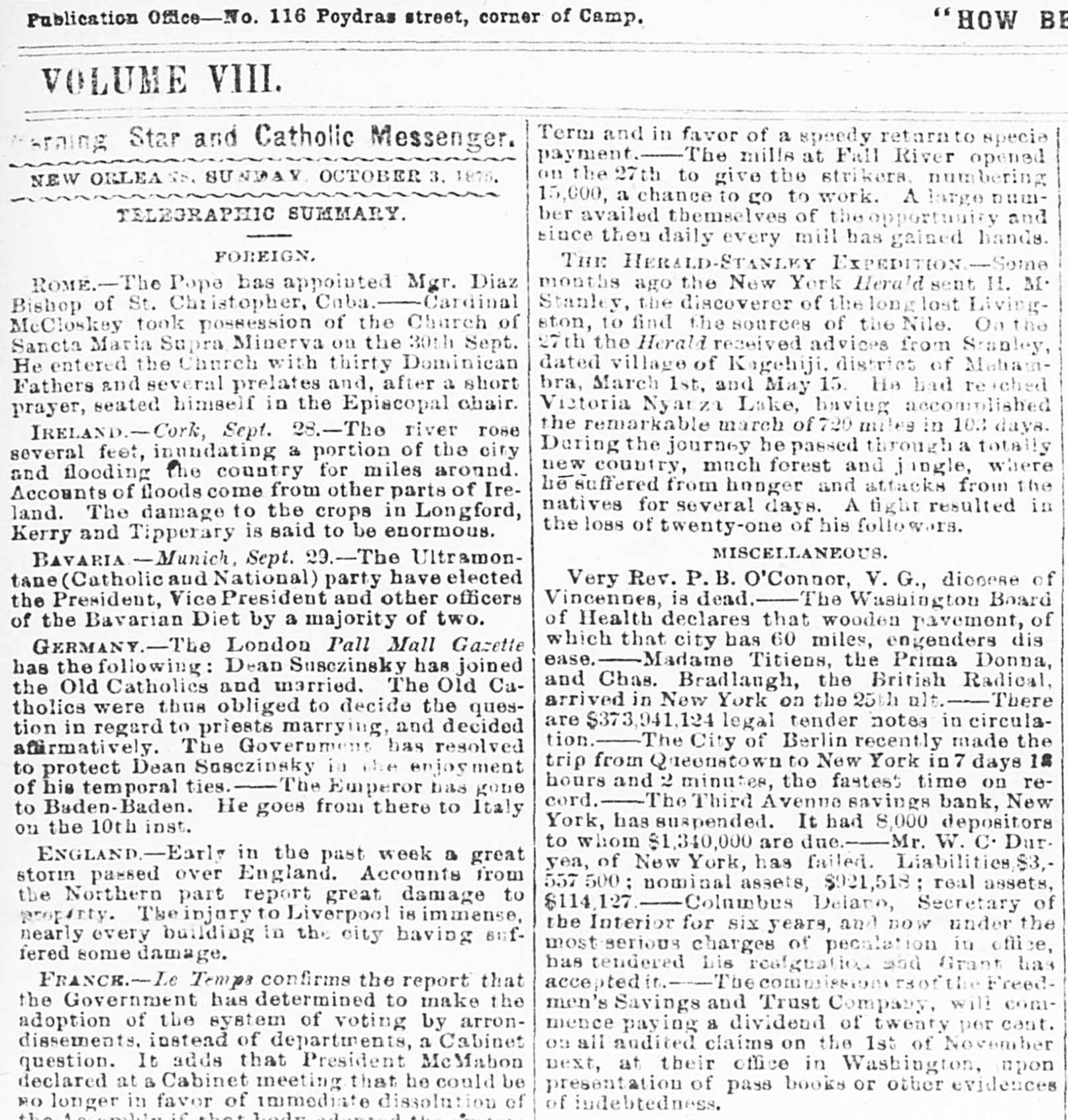
Publication Office-No. 116 Poydras street, corner of Camp. "HOW BE VOLUME VIII. Term and in favor of a speedy retarnto specie string Star and Catholic Messenger. payment The mills at Fall River opened on the 27th to give the strikers. numbering NEW ORLEA SS. SUNDAY OCTOBER 3. 1875. 15,000, a chance to go to work. A large oumTELEGRAPHIC SUMMARY. ber availed themselves of heapportunity and since then daily every mill has gained hands. FOREIGN. THE HERALD STANLEY EXPEDITION-Some months ago the New York Herald sent H. M. ROME.- The Pope has appointed Mgr. Diaz Bishop of St. Christopher, Caba. Cardinal Stanley, the discoverer of the longlost Livingston, to find the sources of the Nile. On the McCloskey took possession of the Church of Sancta Maria Supra Minerva on the 30th Sept. 27th the Herald received advices from Stanley, He entered the Church with thirty Dominican dated village of Kagehiji. district of MetramFathers and several prelates and, after a short bra, March 1st, and May 15. He had reached Victoria Nyarza Lake, having accomplished prayer, seated himself in the Episcopal chair. the remarkable march of 720 miles in 103 days. IRELAND.-Cor Sept. 28.-The river rose Dering the journey he passed through a totally several feet, inundating a portion of the city new country, much forest and jongle, where and flooding the country for miles around. he suffered from honger and attacks from the Accounts of floods come from other parts of Irenatives for several days. A fight resulted in land. The damage to the crops in Longford, the loss of twenty-one of his followers. Kerry and Tipperary is said to be enormous. MISCELLANEOUS. BAVARIA-Munich, Sept. 29.-The UltramonVery Rev. P.B. O'Connor, V. G., dicoese of tane (Catholic and National) party have elected the President, Vice President and other officers Vincennes, is dead. The Washington Board of the Bavarian Diet by a majority of two. of Health declares that wooden pavement, of which that city has 60 miles, engenders dis GERMANY.-The London Pall Mall Gazette ease. Madame Titiens, the Prima Donna, has the following: Dean Susezinsky has joined and Chas. Bradlaugh, the British Radical, the Old Catholics and married. The Old Caarrived in New York on the 25th alt. There tholics were thus obliged to decide the quesare $373,941,124 legal tender notes in circulation in regard to priests marrying, and decided tion. The City of Berlin recently made the affirmatively. The Government has resolved trip from Queenstown to New York in 7 days 12 to protect Dean Sasezinsky in the enjoyment hours and 2 minutes, the fastest time on reof his temporal ties. The Emperor has gone cord. The Third Avenue savings bank, New to Baden-Baden. He goes from there to Italy York, has suspended. It had 8,000 depositors on the 10t h inst. to whom $1,340,000 are due. Mr. W. C. DurENGLAND-Early in the past week a great yea, of New York, has failed. Liabilities $3,storm passed over England. Accounts from 557 500 nominal assets, $921,518; real assets, the Northern part report great damage to $114,127 Columbus Delano, Secretary of property. Theinjary to Liverpool is immense, the Interior for six years, and now under the nearly every building in the city having sufmost serious charges of peculation in office, fered some damage. has tendered Lis realguation and Grant has FRANCE.-Le Temps confirms the report that accepted it. The commissione rsofthe Freedthe Government has determined to make the men's Savings and Trust Company, will comadoption of the system of voting by arronmence paying a dividend of twenty per cant. dissements. instead of departments, a Cabinet on all audited claims on the 1st of November question. It adds that President McMabon next, at their office in Washington, upon declared at a Cabinet meeting that he could be presentation of pass books or other evidences RO longer in favor of immediate dissolution of of indebtedness.


Article from Alexandria Gazette, November 18, 1875

Click image to open full size in new tab

Article Text

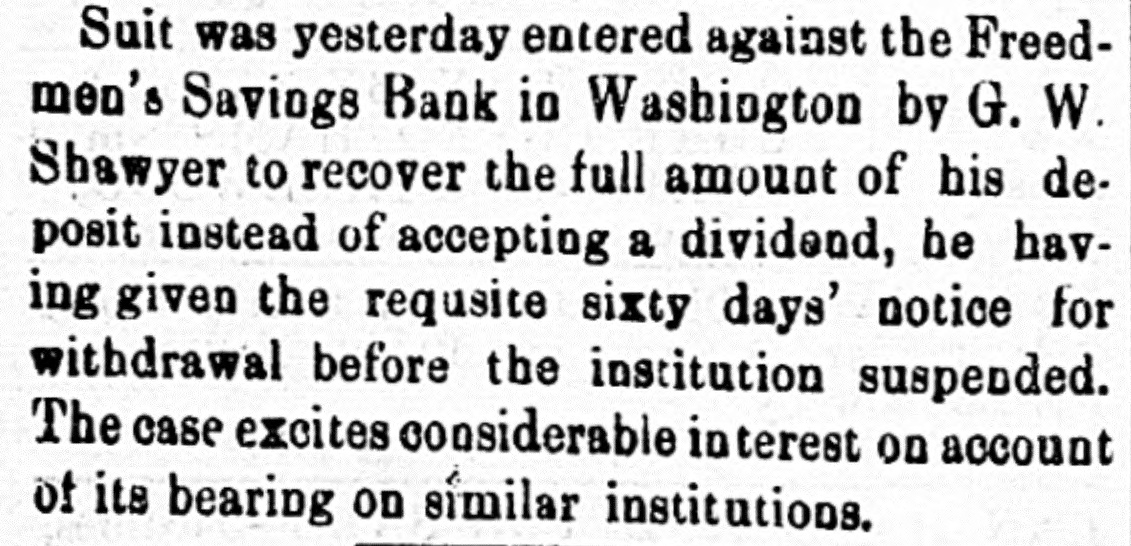
Suit was yesterday entered against the Freed-men's Savings Bank in Washington by G. W. Shawyer to recover the full amount of his deposit instead of accepting a dividend, he having given the requisite sixty days' notice for withdrawal before the institution suspended. The case excites considerable interest on account of its bearing on similar institutions.


Article from Evening Star, December 14, 1875

Click image to open full size in new tab

Article Text

EVENING STAR. Washington News and Gossip. THE U. S. SUPREME COURT will take recess from Friday next to January 3d GOVERNMENT RECEIPTS To-DAY.-Inter nal revenue, $213.577 38: customs, $431,453.25 THE AMOUNT of national bank note rency received at the Treasury to-day gated THE London Quarterly Review for October received from Warren Choate & Co., Co. reprint,) is a superior number. A MONG THE CALLER3 at the White House to-day were Senators Harvey, Mitchell Hitchcock, and Representatives Willard DeBolt, Rainey, Bradley and Hyman. MR. BENJAMIN DURFEE, recently of Treasury department, has been appointed clerk of the Senate Finance Committee, T. M. Rees, dec eased. MR. DAVID MURRAY, of New Jersey, written a letter to members of Congress vocating thereturn of heJapanese indemni ty fund to the Japanese government. LAFAYETTE IN BRONZE.-B. H. Kinney of Worcester, Mass., presents a petition Congress asking for $100,000 to erect a heroi statue of Lafayette in bronze, to be place in this city in some of the public grounds. THE FIRST EFFORT to restore the franking privilege comes from the democrats, a having been introduced in the House morning by Mr. Bright providing for free transmission through the mails of Congressional Record. PERSONAL-General Butler is in town *Senator Cameron is not sick. Speaker Blaine has prepared an elaborate speech on the currency question which will endeavor to deliver in the House Thursday. IT IS UNDERSTOOD that Frank Smythe, Va., has been appointed the doorkeeper the House reporters' gallery. It is under stood, further, that the occupants of the lery are in a state of mind concerning the pointment. MR. BLAINE'S SCHOOL AMENDMENTIn the House, this morning, Mr. Blaine troduced his school amendment to the stitution. It was ordered to be referred the Committee on the Judiciary when THE INCREASED POSTAL RATE.-Mr Starkweather, in the House this morning gave notice that on the first Monday House shall be in session he proposed toasi suspension of the rules to pass his bill pealing the increased postal rate on thire class matter and newspapers. SPECIAL MESSAGE ON SOUTHERN FAIRS-The President will send to Congress at an early day, a message on southern affairs with special reference to the troubles in Mississippi and the mode of ducting elections in that state, the inform tion having been gathered by persons nated for that purpose. THE STATUE of General Baker, who killed at Ball's Bluff, and for which gress appropriated $10,000, being the work of the late Dr. Stone, who died recent ly in Italy, was shipped at Leghorn on 19th ult. for this city, and on its arrival Hose em JO new PIO on of person eq IIIM Representatives. THE FREEDMEN'S BANK-The old bill last session, looking to the bringing of by the commissioners of the Freedmen's bank against the old trustees, and to them personally responsible for the losses sustained by depositors, was introduced the House this morning by Mr. Whitthorne of Tennessee. THERE WAS APPOINTED to-day by doorkeeper of the House a new incumbent raise the American flag over the chamber occupied by the assembled wisdom of people. His proportions are SO large cally that it is with difficulty he can through the trap leading to the roof. "the flag is still there." ONE TERM AMENDMENT.-Mr. Randall this morning, introduced a proposed amend ment to the Constitution providing after the beginning of the next Presidential term and after it shall have been ratified the several state legislatures the term of President and Vice-President in office shal not exceed six years, and making the incumbent of the office ineligible to re-election. A MONSTER PETITION.-Mr. Randall at the Speaker's desk to-day a mammoth petition praying for the repeal of the stamp check act. The petition was enclosed in a handsome walnut box. It is 706 feet about one-eight of a mile in length; it tains 30,219 names, representing 33 states five territorfes. It was gotten up under personal efforts of J.T. Heald, of Wilmington, Delaware. THE SENATE COMMITTEES on Finance


Article from The White Pine News, February 19, 1876

Click image to open full size in new tab

Article Text

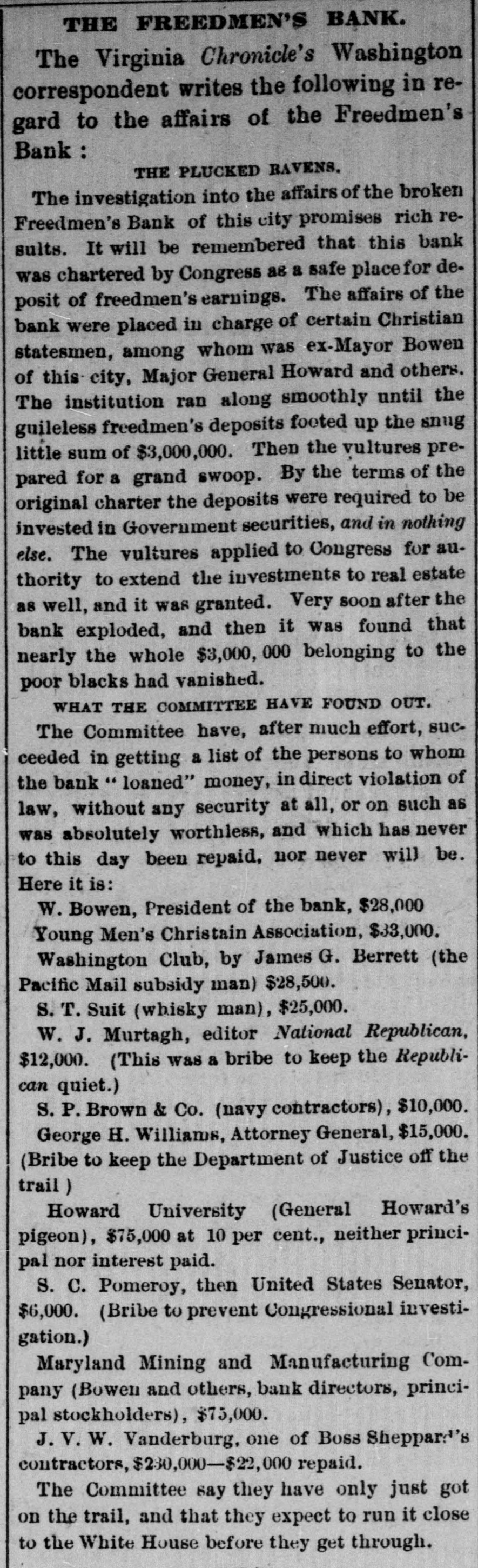
# THE FREEDMEN'S BANK. The Virginia Chronicle's Washington correspondent writes the following in regard to the affairs of the Freedmen's Bank : # THE PLUCKED RAVENS. The investigation into the affairs of the broken Freedmen's Bank of this city promises rich results. It will be remembered that this bank was chartered by Congress as a safe place for deposit of freedmen's earnings. The affairs of the bank were placed in charge of certain Christian statesmen, among whom was ex-Mayor Bowen of this city, Major General Howard and others. The institution ran along smoothly until the guileless freedmen's deposits footed up the snug little sum of $3,000,000. Then the vultures prepared for a grand swoop. By the terms of the original charter the deposits were required to be invested in Government securities, and in nothing else. The vultures applied to Congress for authority to extend the investments to real estate as well, and it was granted. Very soon after the bank exploded, and then it was found that nearly the whole $3,000,000 belonging to the poor blacks had vanished. # WHAT THE COMMITTEE HAVE FOUND OUT. The Committee have, after much effort, succeeded in getting a list of the persons to whom the bank "loaned" money, in direct violation of law, without any security at all, or on such as was absolutely worthless, and which has never to this day been repaid, nor never will be. Here it is: W. Bowen, President of the bank, $28,000 Young Men's Christain Association, $33,000. Washington Club, by James G. Berrett (the Pacific Mail subsidy man) $28,500. S. T. Suit (whisky man), $25,000. W. J. Murtagh, editor National Republican, $12,000. (This was a bribe to keep the Republican quiet.) S. P. Brown & Co. (navy contractors), $10,000. George H. Williams, Attorney General, $15,000. (Bribe to keep the Department of Justice off the trail) Howard University (General Howard's pigeon), $75,000 at 10 per cent., neither principal nor interest paid. S. C. Pomeroy, then United States Senator, $6,000. (Bribe to prevent Congressional investigation.) Maryland Mining and Manufacturing Company (Bowen and others, bank directors, principal stockholders), $75,000. J. V. W. Vanderburg, one of Boss Sheppard's contractors, $230,000-$22,000 repaid. The Committee say they have only just got on the trail, and that they expect to run it close to the White House before they get through.


Article from Puget Sound Weekly Argus, May 11, 1877

Click image to open full size in new tab

Article Text

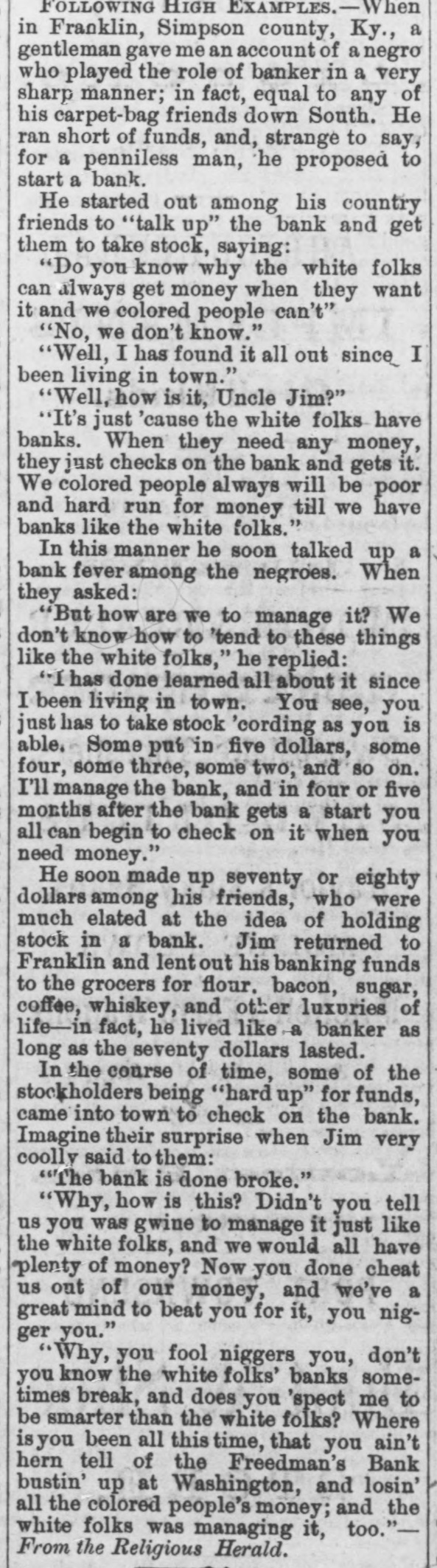
# FOLLOWING HIGH EXAMPLES. When in Franklin, Simpson county, Ky., a gentleman gave me an account of a negro who played the role of banker in a very sharp manner; in fact, equal to any of his carpet-bag friends down South. He ran short of funds, and, strange to say, for a penniless man, he proposed to start a bank. He started out among his country friends to "talk up" the bank and get them to take stock, saying: "Do you know why the white folks can always get money when they want it and we colored people can't" "No, we don't know." "Well, I has found it all out since I been living in town." "Well, how is it, Uncle Jim?" "It's just 'cause the white folks have banks. When they need any money, they just checks on the bank and gets it. We colored people always will be poor and hard run for money till we have banks like the white folks." In this manner he soon talked up a bank fever among the negroes. When they asked: "But how are we to manage it? We don't know how to 'tend to these things like the white folks," he replied: "I has done learned all about it since I been living in town. You see, you just has to take stock 'cording as you is able. Some put in five dollars, some four, some three, some two, and so on. I'll manage the bank, and in four or five months after the bank gets a start you all can begin to check on it when you need money." He soon made up seventy or eighty dollars among his friends, who were much elated at the idea of holding stock in a bank. Jim returned to Franklin and lent out his banking funds to the grocers for flour, bacon, sugar, coffee, whiskey, and other luxuries of life-in fact, he lived like a banker as long as the seventy dollars lasted. In the course of time, some of the stockholders being "hard up" for funds, came into town to check on the bank. Imagine their surprise when Jim very coolly said to them: "The bank is done broke." "Why, how is this? Didn't you tell us you was gwine to manage it just like the white folks, and we would all have plenty of money? Now you done cheat us out of our money, and we've a great mind to beat you for it, you nigger you." "Why, you fool niggers you, don't you know the white folks' banks sometimes break, and does you 'spect me to be smarter than the white folks? Where is you been all this time, that you ain't hern tell of the Freedman's Bank bustin' up at Washington, and losin' all the colored people's money; and the white folks was managing it, too." From the Religious Herald.


Article from The Daily Clarion, February 9, 1878

Click image to open full size in new tab

Article Text

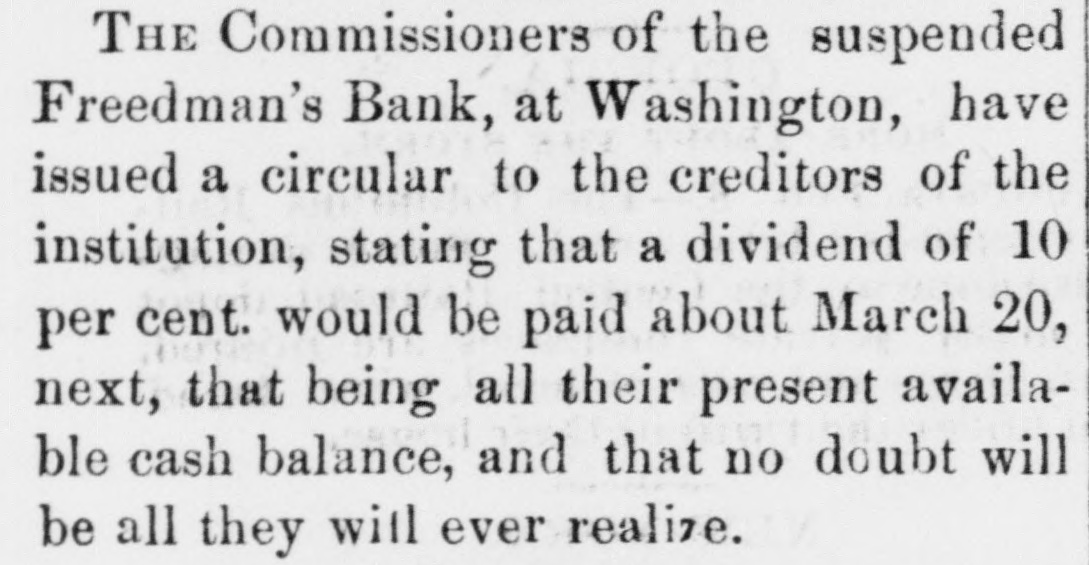
THE Commissioners of the suspended Freedman's Bank, at Washington, have issued a circular to the creditors of the institution, stating that a dividend of 10 per cent. would be paid about March 20, next, that being all their present available cash balance, and that no doubt will be all they will ever realize.


Article from National Republican, March 18, 1879

Click image to open full size in new tab

Article Text

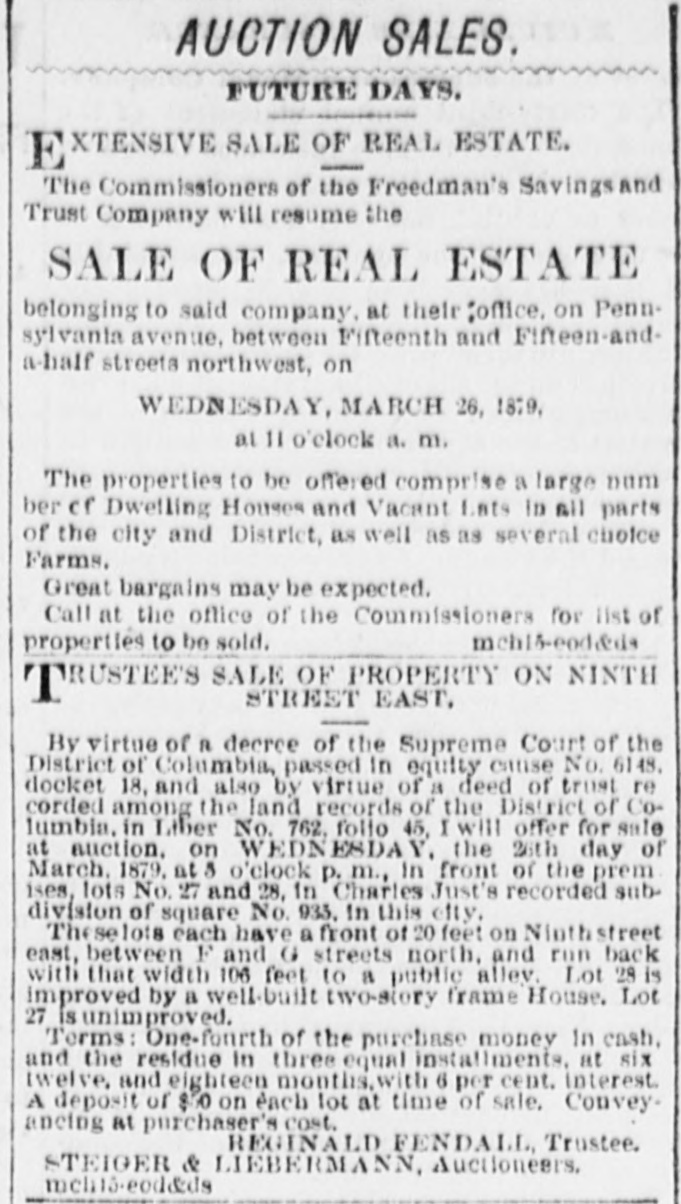
AUCTION SALES. FUTURE DAYS. XTENSIVE SALE OF REAL ESTATE. E The Commissioners of the Freedman's Savings and Trust Company will resume the SALE OF REAL ESTATE belonging to said company. at their :office. on Pennsylvanta avenue, between Fifteenth and Fifteen-anda-half streets northwest, on WEDNESDAY, MARCH 26, 1879, at 11 o'clock a. m. The properties to be offered comprise a large num ber of Dwelling Houses and Vacant Lats in all parts of the city and District, as well as as several choice Farms. Great bargains may be expected. Call at the office of the Commissioners for list of mchi5-eod&ds properties to be sold. TRUSTEE'S SALE OF PROPERTY ON NINTH STREET EAST, By virtue of R. decree of the Supreme Court of the District of Columbia, passed in equity cause No. 6148. docket 18, and also by virtue of a deed of trust re corded among the land records of the District of Columbia. in Liber No. 762, follo 45, I will offer for sale at auction. on WEDNESDAY, the 26th day of March. 1879, at 5 o'clock P: m., in front of the prem. ises, lots No. 27 and 28, in Charles Just's recorded subdivision of square No. 935, in this city, Theselots each have a front of 20 feet on Ninth street east, between F and G streets north, and run back with that width 106 feet to a public allev. Lot 28 is improved by a well-built two-story frame House. Lot 27 is unimproved. Terms: One-fourth of the purchase money in cash, and the residue in three equal installments, at six twelve, and eighteen months, with 6 per cent. interest. A deposit of $50 on each lot at time of sale, Conveyancing at purchaser's cost. REGINALD FENDALL, Trustee. STEIGER & LIEBERMANN, Auctioneers. mchis-eoddeds


Article from The Jasper Weekly Courier, June 6, 1879

Click image to open full size in new tab

Article Text

CURRENT NEWS. WASHINGTON. The Commissioners appointed under an act of Congress to wind up the affairs of the Freedmen's Savings and Trust Company report that, in addition to the 30 per cent. dividend heretofore paid, another dividend of 20 per cent. will probably be declared, making 50 per cent. in all. In order to enable them to do this, however, they ask Congress to purchase the Freedmen's Bank building in Washington, a large portion of which is now rented for Government offices, and a bill will soon be introduced for that purpose. The Commissioners have heretofore asked to be relieved from the duties imposed, and on submitting this bill, will reiterate that request. The President has nominated William J. Gilbraith of Iowa, Associate Justice of the Supreme Court of Montana; John F. Morgan of Illinois, Chief-Justice of the Supreme Court of Idaho; Norman Buck of Idaho, Associate Justice of the same court. A Washington dispatch of the 22d says: There is a decided disposition on the Republican side of the House to prevent the consideration of any general legislation after the disposal of the Warner Silver bill, and prominent members of the party said to-day there was no doubt but that all the Republicans would follow this course if an attempt should be made to take up any of the various other measures which have been reported by committees the present session other than those making appropriations for the Army and the Executive branch of the Government. To accomplish this, the Republicans will have to refrain from voting, which will leave the House without a quorum. The President has nominated Eugene Schuyler of New York, Consul General at Rome, and also the following Consuls: Judson A. Lewis, Sierre Leone, at that place; Wilson King, Pennsylvania, at Birmingham; Wm. F. Grinnell, New York, at Bremen; Alex. McLean, New Jersey, at Guayaquil. Supervising-Architect Hill, having been fully exonerated from the charges brought against him in connection with the construction of the Chicago Custom-house, has been reinstated in office. In reply to numerous inquiries, Secretary of Treasury Sherman states that the reason why he does not advance the price of refunding certificates is that the act of Congress makes it mandatory for him to exchange them at par for lawful money of the United States. If these securities, the Secretary says, could only be sold to actual investors in limited sums, it would be a wise disposition of them, and it is believed that a great majority do get into the hands of such people, but the Postmasters and other disbursing officers can not distinguish between real investors and those who buy to sell again. The Secretary of the Treasury on the 27th stopped the sale of $10 certificates in the large cities of the East. Up to this time $36,000,000 had been sold, and two-thirds of these east of the Alleghanies. The Secretary says he will try to get the remaining $4,000,000 into the hands of the people of the small Western towns until all are disposed of. Cincinnati, St. Louis and Chicago are to have but $40,000 worth a day. At a Cabinet meeting held on the 27th it was decided that Capt. Eads was entitled to the $500,000 payment for the depth of 25 feet in the Mississippi jetty, over which payment the authorities have been hesitating six weeks. The Cabinet has reached the conclusion that under the law the depth and width are secured, the payment is to be made and the only requirement as to the maintenance of depth and width is after 30 feet has been reached, for which $1,000,000 is to be held as security for a term of years. Holders of called bonds which mature before the first of July next, are requested by Secretary Sherman to send them to the Department for payment during the month of June. In this way holders of such bonds will receive payment for them with interest to maturity before the bonds mature. All United States bonds forwarded for redemption should be addressed to the Loan Division, Secretary's office, and all registered bonds should be assigned to the Secretary of the Treasury for redemption. WEST AND SOUTHWEST. The Iowa Democratic State Convention was held at Council Bluffs on the 21st. Judge H. H. Trimble was nominated by acclamation for Governor, the other nominees being J. V. Yeoman for Lieutenant-Governor, Reuben E. Noble, Supreme Judge, and Irvin Baker, Superintendent of Public Instruction. The resolutions indorse the action of Congress and denounce the President's vetoes; favor the substitution of Treasury notes for national bank notes and the abolition of national banks of issue; the reduction of the bonded debt as fast as possible.
Article from National Republican, February 2, 1880

Click image to open full size in new tab

Article Text

CURRENT CAPITAL TOPICS. The Forthcoming Report on the Freedman's Bank. Purchase of the Building to be Recommended - A Pension Asked by the Widow of Admiral Paulding Complimentary Letter to General Garfield - The Exodus Committee. The Freedmen's Bank Investigation. The Senate select committee on the Freedman's Bank are still taking testimony in regard to the affairs of that institution, and will examine additional witnesses at a series of meetings throughout the present week, but the investigation has now drawn nearly to a close. During the past few days the committee have examined George W. Stickney, the bank's actuary; John O. Evaus, one of its heavy borrowers; Dr. J. L. Kidwell, president of the Seneca Saudstoue Company; Dr. Charles B. Purvis, a trustee of the institution, and several of its depositors. Their testimony showed great looseness in the bookkeeping and a lack of proper care in scrutinizing the securities accepted on loans. Dr. Purvis testified that the failure of the bank was due solely to the panic, although he admitted that there were irregularities in the management. The committee, it is understood, will report that, in consequence of the deaths of some of the persons responsible for the bank's bad management, and the present impecuniosity of the remainder, nothing now can be done for the further relief of the depositors, except to consummate the proposed purchase of the Freedman's Bank building in this city by the United States Government, a bill for which purpose has heretofore been recommended by the Commissioners and once passed by the Senate. The building is now rented for the use of the Department of Justice and the Court of Claims, and the price asked for it is $275,000.


Article from Vermont Watchman and State Journal, April 7, 1880

Click image to open full size in new tab

Article Text

# A National Disgrace. Mississippi's colored senator, Bruce, as chairman of a special committee, has just made a report on the Freedmen's savings bank at Washington, which is endorsed by all the members of the committee who have examined the subject. The causes assigned for the failure are few, and they are stated with a degree of candor that deserves commendation. Instead of following the business for which the bank was established, a heavy discount business was undertaken. There was lack of responsible oversight, and the powers vested in the trustees were exercised by three members of the finance committee, and even by the actuary, acting alone. This downright robbery of more than seventy thousand poor, ignorant but innocent negroes amounts to a national disgrace. The institution was established at the close of the war, avowedly for the benefit of the freedmen as a safe depository of their hard and scanty earnings. The government had dealt generously with the emancipated slaves, and they in turn, regarding this as an act of benevolence toward them, poured their scanty earnings into its bottomless coffers with the utmost confidence. And when congress looked quietly on and saw a set of graceless villains rob these unsuspecting depositors of nearly or quite two millions of dollars, we say it not only amounts to a national disgrace, but it constitutes a claim upon the general government of the nation as equitable as any that ever existed. To make the outrage still more palpable, it seems by this report that more than ten per cent of the claims against the bank ($350,000) has been expended in liquidating its affairs. The report gives encouragement that in all about fifty per cent will be paid to depositors; but this leaves the loss at about $2,000,000.


Article from Daily Kennebec Journal, January 18, 1881

Click image to open full size in new tab

Article Text

FORTY-SIXTH CONGRESSSECOND SESSION. WASHINGTON, January 17. SENATE. Mr. Wallace, from the Committee on Appropriations, reported with an amendment en the appropriation bill. Mr. Pendleton, from the Committee on Census. reported bill on appropriation for completing, compiling and publishing returns with the census. Mr. Garland presented the report of the Congressional visitors to West Point, and a bill amending existing laws relating to the Military Academy at West Point: referred to the Committee on Military Affairs. Several bills were introduced and referred. On motion of Mr. Bruce, bill authorizing the purchase by the Secretary. for public use. of the freedmen's bank and eal (3 ate, on the Pennsylvania Avenue, Washington, was taken up, amended and passed. On motion of Mr. Burnside, by unanimous consent, orders were suspended for the Senate to take up the Senate bill for the relief of Gen. Ord. The bill passed without debate. The Freedman's bank bill appropriates $25,000. A joint resolution. creating a Yorktown, Va., Centennial Commission, was passed. The calendar occupied the remainder of the morning hour. Mr. Saulsbury moved to lay aside the regular order, the Ben Hailiday bill, and take up the Kellogg case. Negatived, yeas 20: nays 34. A motion that the Halliday bill be tabled in order to proceed with the Kellogg case was defeated. Discussion of the Halliday bill was resumed but without action. Senate adjourned until to-morrow. HOUSE. By Mr. Newbury, providing for a joint commission by the United States and Great Britain, to investigate the alleged false and fraudulent statistics used before the Halifax fishery; the commission to consist of three persons, one to be appointed by the United States, one by Great Britain and one by the two governments conjointly. Mr. Ford's resolution, declaring the opinion of the House that every interest demands immediate construction of telegraph lines by the government to protect the people from monopoly. The speaker ruled it was not in order under this call. and it was not admitted. At the conclusion of a call of States several resolutions were offered and referred. The speaker laid before the House a communication from the Secretary of the Interior transmitting the report of the superintendent of census returns, showing the population of the United States to be 50,152,866. Referred to census committee. The regular order was then announced to be a motion to suspend rules and pass the bill authorizing readjustment of salaries for postmasters in accordance with the act of June 8th. 1866. The House under a suspension of rules passed the bill granting titles of settlers on the Des Moines river lands in Iowa, after which, adjourned.


Article from Daily Globe, July 6, 1882

Click image to open full size in new tab

Article Text

General Capital News. FREEDMAN BANK PAYMENTS. WASHINGTON, July 5 -The comptroller of the currency says there is about $150,000 of the last dividend declared in favor of the depositors of the Freedman's bank still unpaid, and asks all unpaid depositors to present their books as soon as possible. CONFIRMATIONS, H. G. Wells, Michigan, presiding judge of the court of commissioners on Alabama claims; James Harlan, Iowa and Isa French, Massachusetts, judges of the court of commissioners on Alabama claims; Daniel Fessenden, Maine, clerk of the commissioners on Alabama claims; L. G. Wilcox, receiver of public moneys at Detroit. TREATIES RATIFIED. The senate also in executive session ratified the commercial and consular treaty with Servia, the commercial treaty with Ronmenia and the trade mark treaty with Spain.


Article from The Abilene Reflector, March 4, 1886

Click image to open full size in new tab

Article Text

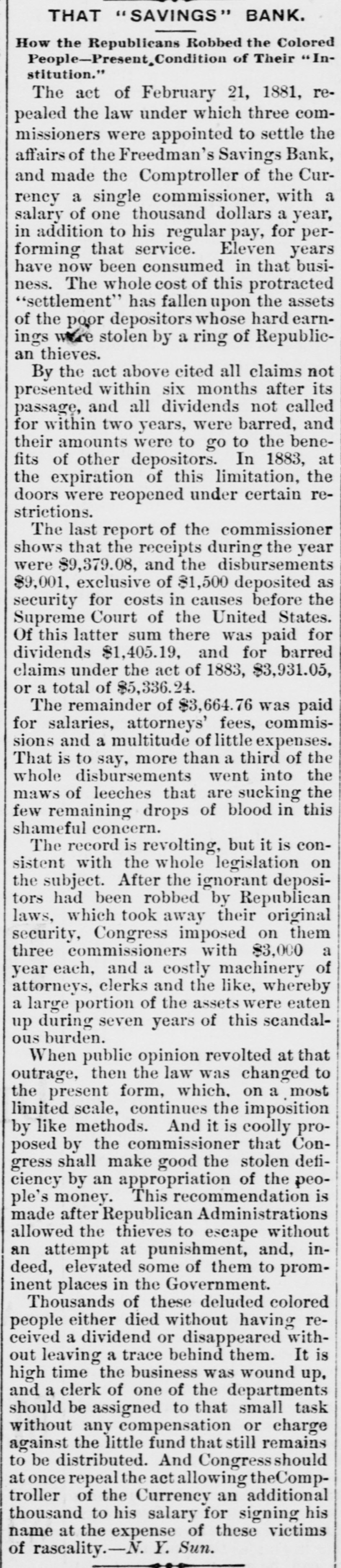
THAT "SAVINGS" BANK. How the Republicans Robbed the Colored People-Present, Condition of Their "Institution." The act of February 21, 1881, repealed the law under which three commissioners were appointed to settle the affairs of the Freedman's Savings Bank, and made the Comptroller of the Currency a single commissioner, with a salary of one thousand dollars a year, in addition to his regular pay, for performing that service. Eleven years have now been consumed in that business. The whole cost of this protracted "settlement" has fallen upon the assets of the poor depositors whose hard earnings we stolen by a ring of Republican thieves. By the act above cited all claims not presented within six months after its passage, and all dividends not called for within two years, were barred, and their amounts were to go to the benefits of other depositors. In 1883, at the expiration of this limitation, the doors were reopened under certain restrictions. The last report of the commissioner shows that the receipts during the year were $9,379.08, and the disbursements $9,001, exclusive of $1,500 deposited as security for costs in causes before the Supreme Court of the United States. Of this latter sum there was paid for dividends $1,405.19, and for barred claims under the act of 1883, $3,931.05, or a total of $5,336.24. The remainder of $3,664.76 was paid for salaries, attorneys' fees, commissions and a multitude of little expenses. That is to say, more than a third of the whole disbursements went into the maws of leeches that are sucking the few remaining drops of blood in this shameful concern. The record is revolting, but it is consistent with the whole legislation on the subject. After the ignorant depositors had been robbed by Republican laws, which took away their original security, Congress imposed on them three commissioners with $3,000 a year each, and a costly machinery of attorneys, clerks and the like, whereby a large portion of the assets were eaten up during seven years of this scandalous burden. When public opinion revolted at that outrage, then the law was changed to the present form, which. on a most limited scale, continues the imposition by like methods. And it is coolly proposed by the commissioner that Congress shall make good the stolen deficiency by an appropriation of the people's money. This recommendation is made after Republican Administrations allowed the thieves to escape without an attempt at punishment, and, indeed, elevated some of them to prominent places in the Government. Thousands of these deluded colored people either died without having received a dividend or disappeared without leaving a trace behind them. It is high time the business was wound up, and a clerk of one of the departments should be assigned to that small task without any compensation or charge against the little fund that still remains to be distributed. And Congress should at once repeal the act allowing theComptroller of the Currency an additional thousand to his salary for signing his name at the expense of these victims of rascality.-N. Y. Sun.