17018. Traders Bank (Newport, RI)

Bank Information

Episode Type
Run Only
Bank Type
state
Start Date
November 16, 1854
Location
Newport, Rhode Island (41.490, -71.313)

Metadata

Model
gpt-5-mini
Short Digest
75f5de42de89c705

Response Measures

None

Description

Two contemporaneous articles (Herald of the Times, 1854-11-16) describe a small, localized run on Traders Bank instigated by an individual (William A. Sweet) presenting the bank's bills for specie as a form of personal retaliation against the cashier. The bank promptly paid specie and was described as sound; no suspension or closure is mentioned.

Events (1)

1. November 16, 1854 Run
Cause Details
An individual (William A. Sweet) deliberately presented the bank's bills for specie to pressure the directors over a dispute with the cashier (personal revenge), causing a small, temporary curtailing of circulation.
Measures
Bank promptly paid specie on presented bills; staff continued to redeem bills, reassuring public of soundness.
Newspaper Excerpt
The Traders Bank can and w redeem all its bills, whenever they are presented ... the only cause for this small run is as we have stated.
Source
newspapers

Newspaper Articles (2)

Article from Herald of the Times, November 16, 1854

Click image to open full size in new tab

Article Text

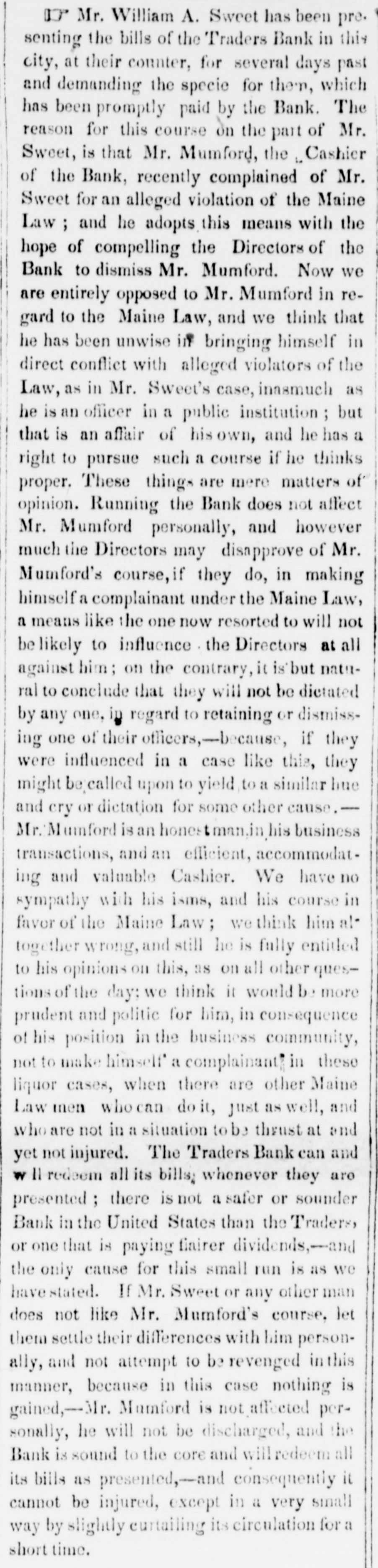
17" Mr. William A. Sweet has been pre. senting the bills of the Traders Bank in this city, at their counter, for several days past and demanding the specie for them, which has been promptly paid by the Bank. The reason for this course on the part of Mr. Sweet, is that Mr. Mumford, the Cashier of the Bank, recently complained of Mr. Sweet for an alleged violation of the Maine Law ; and he adopts this means with the hope of compelling the Directors of the Bank to dismiss Mr. Mumford. Now we are entirely opposed to Mr. Mumford in regard to the Maine Law, and we think that he has been unwise if bringing himself in direct conflict with alleged violators of the Law, as in Mr. Sweet's case, inasmuch as he is an officer in a public institution; but that is an affair of sown, and he has a right to pursue such a course if he thinks proper. These things are mere matters of opinion. Running the Bank does not affect Mr. Mumford personally, and however much the Directors may disapprove of Mr. Mumford's course, if they do, in making himself a complainant under the Maine Law, a means like the one now resorted to will not be likely to influence the Directors at all against him; on the contrary, it is but natiral to conclude that they will not be dietated by any one, in regard to retaining or dismissing one of their officers,-because, if they were influenced in a case like this, they might be called upon to yield to a similar hue and cry or dictation for some other cause. Mr. Mumford is an honestman. in his business transactions, and an efficient, accommodating and valuable Cashier. We have no sympathy with his isms, and his course in favor of the Maine Law; we think him at together wrong, and still he is fully entitled to his opinions on this, as on all other questions of the day; we think it would be more prudent and politic for him, in consequence of his position in the business community, not to make himself a complainant in these liquor cases, when there are other Maine Law men whocan do it, just as well, and whoare not in a situation to be thrust at and yet not injured. The Traders Bank can and w redeem all its bills, whenever they are presented ; there is not a safer or sounder Bank in the United States than the Traders, or one that is paying flairer dividends,-an the only cause for this small run is as we have stated. If Mr. Sweet or any other man does not like Mr. Mumford's course, let them settle their differences with him personally, and not attempt to be revenged in this manner, because in this case nothing is gained,--Mr. Mumford is not affected personally, he will not be discharged, and the Bank is sound to the core and will redeem all its bills as presented,-and consequently it cannot be injured, except in a very small way by slightly curtailing its circulation for a short time.

Article from Herald of the Times, November 16, 1854

Click image to open full size in new tab

Article Text

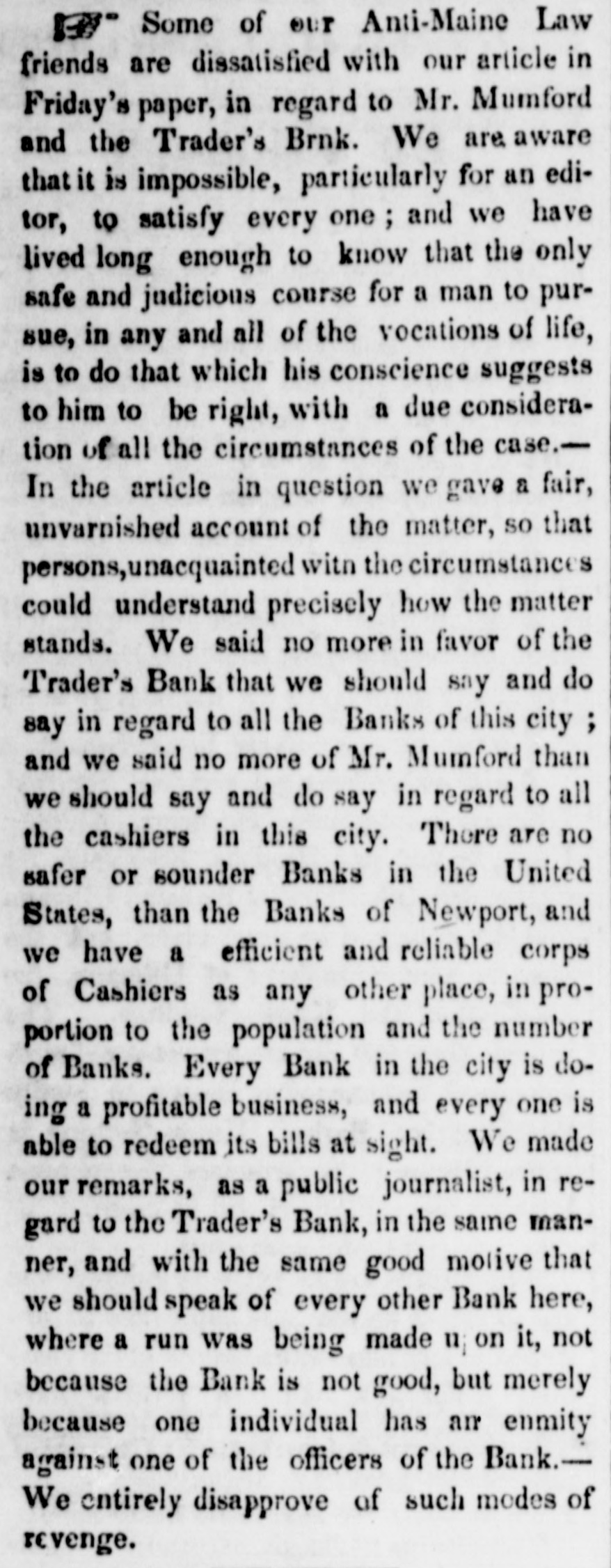
Some of our Anti-Maine Law friends are dissatisfied with our article in Friday's paper, in regard to Mr. Mumford and the Trader's Brnk. We are aware that it is impossible, particularly for an editor, to satisfy every one ; and we have lived long enough to know that the only safe and judicious course for a man to pursue, in any and all of the vocations of life, is to do that which his conscience suggests to him to be right, with a due consideration of all the circumstances of the case.In the article in question we gave a fair, unvarnished account of the matter, so that persons,unacquainted with the circumstances could understand precisely how the matter stands. We said no more in favor of the Trader's Bank that we should say and do say in regard to all the Banks of this city ; and we said no more of Mr. Mumford than we should say and do say in regard to all the cashiers in this city. There are no safer or sounder Banks in the United States, than the Banks of Newport, and we have a efficient and reliable corps of Cashiers as any other place, in proportion to the population and the number of Banks. Every Bank in the city is doing a profitable business, and every one is able to redeem its bills at sight. We made our remarks, as a public journalist, in regard to the Trader's Bank, in the same manner, and with the same good motive that we should speak of every other Bank here, where a run was being made n; on it, not because the Bank is not good, but merely because one individual has an enmity against one of the officers of the Bank.We entirely disapprove of such modes of revenge.