16762. banks of New York (New York, NY)

Bank Information

Episode Type
Suspension → Reopening
Bank Type
state
Start Date
May 10, 1837
Location
New York, New York (40.714, -74.006)

Metadata

Model
gpt-5-mini
Short Digest
45b6ba0b

Response Measures

None

Description

The articles collectively describe the collective suspension of specie payments by the banks of New York on May 10, 1837 and later efforts toward resumption (attempts in 1839 and more universal resumption by 1843–44). The item refers to the group of New York banks rather than a single named institution, so bank_name is plural and marked unsure. Cause is systemic/commercial pressure (national/local crisis and heavy withdrawals/remittances).

Events (2)

1. May 10, 1837 Suspension
Cause
Macro News
Cause Details
Collective suspension triggered by heavy withdrawals, necessity to remit coin abroad, widespread commercial distress and numerous merchant failures in spring 1837 (systemic panic/commerce shock).
Newspaper Excerpt
On the 10th of May, 1837, the banks of New York suspended specie payments
Source
newspapers
2. January 1, 1839* Reopening
Newspaper Excerpt
A general resumption of specie payments was attempted in 1839, but a large proportion of the banks did not succeed; universal resumption by 1843 and 1844 is reported elsewhere in the articles.
Source
newspapers

Newspaper Articles (12)

Article from The Herald, May 12, 1837

Click image to open full size in new tab

Article Text

To the Public. In consequence of the independence, fearlessness, and honesty with which I give, to this great and generous community, the truth, the whole truth, and nothing but the truth," respecting the deeply interesting events now passing before us, several perprincipally speculators and speciesent messages to my that if I to my in Wall street, I should pearance suspenders, sons Ann yesterday, street, stating, dared be office, attacked make at and No. ap- as- 21 sailed in my person, and disabled from hereafter conducting the New York Herald. In the hurry of business, but not from intention, I may frequently make mistakes, small and unimportant to the community, but mighty to the individuals concerned. When such errors happen, no one can more cheerfully correct and amend them, fully and amply to every body and every being than I myself will. But if there are any persons in New York, capable of supposing for one moment, that fear is a thing that I know, or that threats from any quarter can intimidate me, permit me to tell them they know not the temper, the principles, or the nature of the being who sets his signature to this paper.. I study to be right-to feel right-to act right; I leave the consequences to the Almighty. In this city there is yet sympathy, and integrity, and feeling enough in the great mass to support me, in spite of the utter prostration of all such qualities in those who have hurried the banks to a deep violation of all the great principles which hold society together. In consequence of these things, I went down to Wall street yesterday at my usual hour, armed and prepared to defend myself against any assault that I wickedness might dare to make upon my person. stayed my usual time-made my usual inquiries-and returned peaceably to my own dwelling. Aboutsix months ago a similar effort was made to make an attack upon my person in the Exchange, because I told too many truths in my Wall street report. In addition to these extraordinary marters, I learn that some person, in the list of failures published yesterday, has been persuaded by the fraudulent bank confederacy of Wall street, to have me arrested on some kind of a writ, for excessive and illegal damages, probably $20,000, in order, if possible, to shut me up in prison, and thus prevent me from awakening the generous and honest people of New York to the terrible scheme of fraud hidden under the suspension of specie payments. Whether the sheriff of this city be a party to the matter Iknow not-and care not. The damages are to be put high and excessive, in order to prevent me from procuring bail. If such should be the case-if the broken banks and fraudulent bankers of New York should dare to get up a scheme to put down or trample upon the liberty of the press, I would advise the cheated, the deluded, the deceived, the defrauded people to be quiet under the infliction. If I shall have to date my Wall street Seports, and my searching investigations into conduct, from prison, they not public shall their lose their Let edge-their truth-their spirit-or courage. the people be quiet, By all means observe public erder. Touch not-harm net-injure not-the bankers and their agents, by whom you have been defrauded of your property-of the very sweat of your brow. Let the socialedifice be undisturbed. The day of retribution will come, like swift destruction, upon the public robbers of the widow and theorphan, when they least expect it. Military tyranny, or bank tyranny, cannet stand before the withering truths of a free and moral press. Heaven is above-be cool-be patient -be orderly. I was not-and am not now-to be intimidated from fulfilling that destiny to which the Great Divinity has affixed to my brief existence. I will not be from the truth, now aver, before God and High lemnly deterred telling Heaven, and I that the sus- sopension of specie payments by the banks of New York is a most gross fraud upon the public-that it was done to permit the large monopolists and merchants to take the gold and ship it to England, or to send it to the United States Bank-that while the poor mechanic is denied the specie for his five dollar bill, the merchant is helped to his tens ef thousands of gold and silver. I know the fact from such authority as makes me believe it. I furthermore give notice to the great body of the of the cheated and deluded stockand holders, people, consisting depositors, bill holders of these banks, that in my honest opinion, the only remedy is the immediate creation of a SPECIE PAYING BANK, out of the ruins and remaining materials of the present insolvent institutions. Let the people be calm, quiet, orderly-but determined and decided. The great juggle and the jug glers are drawing to a close. The people will succeed, if discreet and orderly, in compelling the restoration of specie payments in less than one month. JAMES GORDON BENNETT. Correction--ListofHankruptcies for 1837.

Article from Cheraw Gazette, August 9, 1837

Click image to open full size in new tab

Article Text

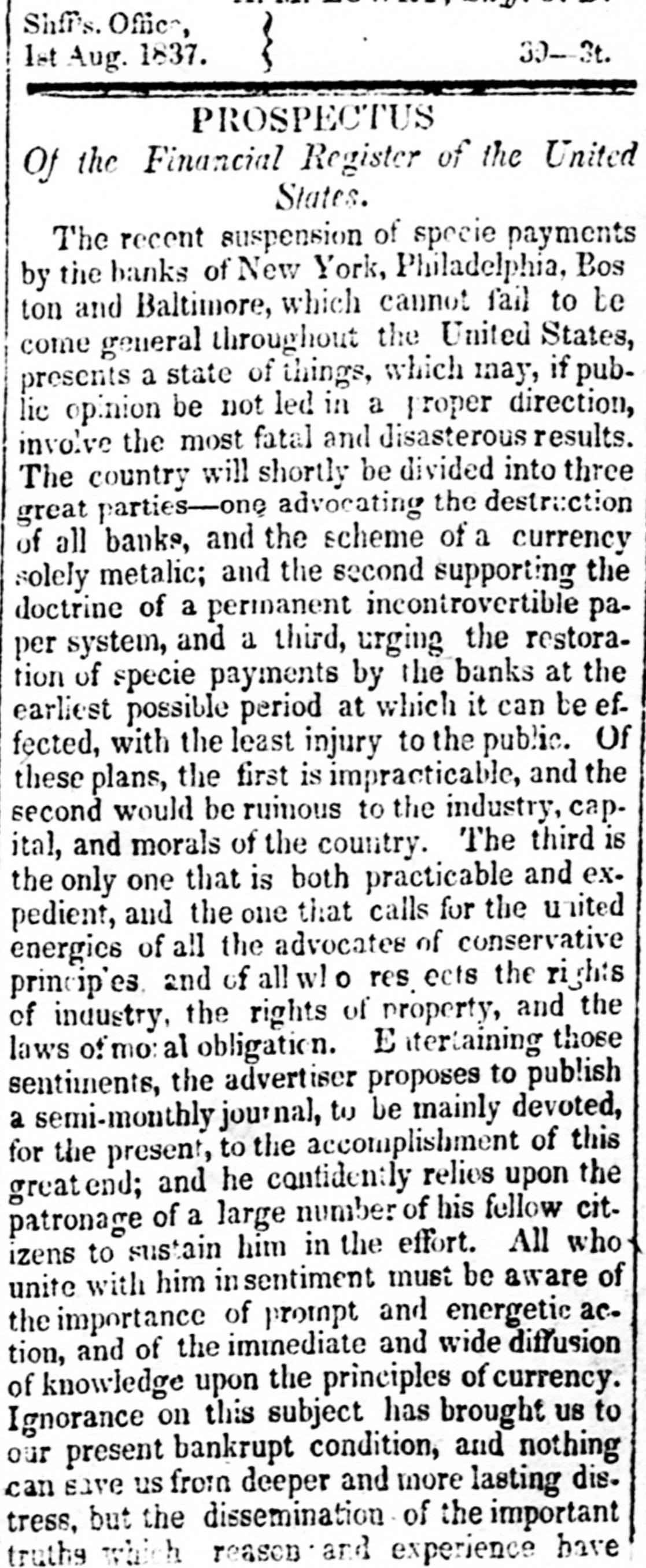
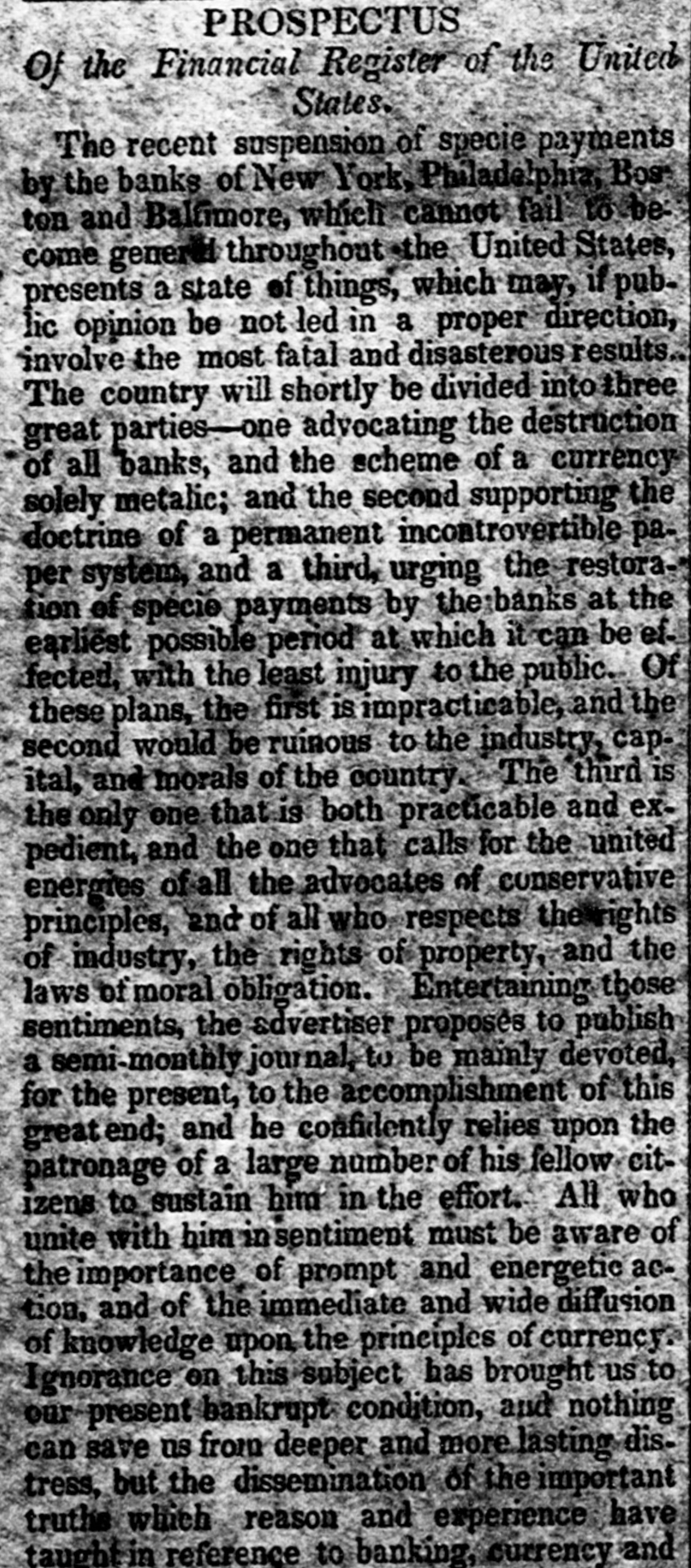
Shff's. Office, 30-3t. 1st Aug. 1837. PROSPECTUS Of the Financial Register of the United States. The recent suspension of specie payments by the banks of New York, Philadelphia, Bos ton and Baltimore, which cannot fail to be come general throughout the United States, presents a state of things, which may, if publie opinion be not led in a proper direction, involve the most fatal and disasterous results. The country will shortly be divided into three great parties-one advocating the destruction of all banks, and the scheme of a currency solely metalic; and the second supporting the doctrine of a permanent incontrovertible paper system, and a third, urging the restoration of specie payments by the banks at the earliest possible period at which it can be effected, with the least injury to the public. Of these plans, the first is impracticable, and the second would be ruinous to the industry, cap. ital, and morals of the country. The third is the only one that is both practicable and expedient, and the one that calls for the united energies of all the advocates of conservative princip'es and of all wlo res ects the rights of industry, the rights of property, and the laws of moral obligation. E intertaining those sentiments, the advertiser proposes to publish a semi-monthly journal, to be mainly devoted, for the present, to the accomplishment of this greatend; and he contidently relies upon the patronage of a large number of his fellow citizens to sustain him in the effort. All who unite with him in sentiment must be aware of the importance of prompt and energetic ac. tion, and of the immediate and wide diffusion of knowledge upon the principles of currency. Ignorance on this subject has brought us to our present bankrupt condition, and nothing can save us from deeper and more lasting dis. tress, but the dissemination of the important reason and experience have truths


Article from Cheraw Gazette, August 16, 1837

Click image to open full size in new tab

Article Text

PROSPECTUS of the Financial Register of the United States. The recent suspension of specie payments by the banks of New York, Philadelphia Bos ton and Baltimore, which cannot fail to be come general throughout the United States, presents a state of things, which may, if public opinion be not led in a proper direction, involve the most fatal and disasterous results.. The country will shortly be divided into three great parties-one advocating the destruction of all banks, and the scheme of a currency solely metalic; and the second supporting the doctrine of a permanent incontrovertible paper system, and a third, urging the restoration of specio payments by the banks at the earliest possible period at which it can be ef. Of fected, with the least injury to the public, these plans, the first is impracticable, and the second would be ruinous to the industry cap. ital, and morals of the country. The third is the only one that is both practicable and expedient, and the one that calls for the united energies of all the advocates of conservative principles, 2nd of all who respects the rights of industry, the rights of property, and the laws of moral obligation. Entertaining those sentiments, the advertiser proposés to publish a semi-monthly journal, to be mamly devoted, for the present, to the accomplishment of this great end; and he confidently relies upon the patronage of a large number of his fellow citizens to sustain him in the effort. All who unite with him in sentiment must be aware of the importance of prompt and energetic action, and of the immediate and wide diffusion of knowledge upon the principles of currency. Ignorance on this subject has brought us to our present bankrupt condition, and nothing can save us from deeper and more lasting distress, but the dissemination of the important truths which reason and experience have taught reference to banking, currency and


Article from Richmond Enquirer, April 20, 1838

Click image to open full size in new tab

Article Text

Our at the not and apex. we say may not in currency the the bases the increased base, of 1811 no but less and liule than 1832; eight increase our fold, apecie 1811, per thing, increased immeasurably fold since 1832 millions The whole more than the in fruits of 1811, and and of four that we have than 70 in 1832. Such which are we only have for a few years, silver as France gold is cie; and to General 60 millions Jackson's in more policy! and policy to have which our country and borrow Hul. bor- as land are; cent. per a month. amply persevere supplied that France with gold and annum, Holland while in we often be got rowed paper money at 3 per at 3 per specie. cent Not for a nine-pence a beggar; assertion; not to a but ten for But a piece servant there for is the no not post a Go picayune office. to the is Such banks, all too is and the true. present No of gold, their their far is their it counter, be and had there in if not bank notes gent po silver, how at no true copper to Metaphoricallen it the redemption of literally a kicks soleinn promises demand for specie applicant of the to pay. unfortunate at direction more demand; than to the brokers; and are thanked for counter your speaking go. might coppers. bring done; a to But gold the present cashed; change the you the bank springs note thus, forth there; the in any nosooner quan- cus the of said tity, than the notes to are return again; counter and of the bank, the becomes bank. The is invited and not the of the notes of to be told, of the is shaved off all the bank place the tom, broker, part for the redemption transaction which that remains And, Mr. whoever Presi- notes only the per submit centum to that shaving, carry can to bankers, them. have Yes, now redeem that pur- the cashed will dent, the which brokers, There he and can is not no the dearth to cash of all specie the the for Government notes of the bank notes. They have enough Treasury notes placards: of not a village, signbanks, pose. the and bargain. all the Look in at their the Union, the passenger, in which the inviting Treainto not a city, do not not salute a town exchange the eye of his And bank why notes, cannot and they the boards in and silver. Why can sury him to notes, come for as gold well and notes? as the brokers? Because because a octo a has political issued banks redeem redeein, their own Philadelphianium and the country, wickedness and not the city of effected by the folly and the reason, revolution from charging is to the be injury Administrations:- upon the This United is States, then the Republican sole reason. The and Bank its political of confederates, specie are the sole alone prevent the resumption and feel the and of its affiliated the They obstacles institutions, to lest the the resumption resumptionshall It is begin, they pay. utments. are now in terror we hear the real shout, so pathetically application 10 of the the Senator breach, from dear once more! real and (Mr. who tered Webster,)-0 on prevent this floor it, by more rallying to the cry, of the Massachusetts, resumption friends, the cause and undeniable. Yes, Mr. is now in a clear sky payments President, noon, plain may Notwo difof plain specie as the sun about at high it, how much is tongues known, and Gen. the opinions as can differ of not resuming known likewise. upon fer. The of suspension cause will soon charge be the the suspension misrule, and cause of the Opposition the insanil administration. the the outlandish which apply been call it; their tiemen misgoverning the folly. classically wickedness, of Administration expressions which have to policy sus. the people they who vilified, created and the who The have Opposition ganctioned charge acts- the to the 60 much elections. policy- their of 1833pension by repeated of 1832-the to them- removal of their 1836 of and the the deposites demand charge of for the specie the po the for veto the Treasury Federal and order of Treasury all denationalized who follow This is the Bank the should lead, of the and be U. potential, obey States the liticians. impulsion of the others whose voice question? What say But what say on this e suspension began, of BUS and and even omnipotent, banks, where for the the sole cause whose New York example city was alleged What say these banks, and whose say whose pension is by at all the the fountain rest? is head an answer of knowledge, for for all? I hold What in my answer position they? Listen, for themselves of and a committee you shall their of hear! these highest banks, officers, made 11 and un- C. hand a official report injunction, all by the city institutions. Newbold. der deliberately an approved Albert by Gallatin, Palmer, George Preserved and Fish, es signed by Messrs. C. Heyer, J. gentlemen J. of known out of the Lawrence, G. A. Worth ; seven and not more late than and one present is Administrations tablished seven and politically character, of the friendly Federal to Government. the thus compelled This their pay the report: "The immediate city of causes New York which to are suspend well known. specie The ments, on the 10th of the with the banks of the withdrawing of May credits, last, combined large public principal deposites, article great simultaneous foreign of the stuffs, such South and and of unexpected excessive with fall in an the import occurred, price of corn and and with bread the conseof our exports, before of the States, to and the same emporium quent western as inability had never of the make country, the usual particular commercial time, and fall principally struggle remit. tances, necessarily, did, at one on the a long greatest, and most altogether ardoous unsuc and After though not demand for during which the imperative deprived of a of cessfully, metals, were incidents of the Union. resisting the banks, gradually unfortunate foreign previous great a nature, portion the precious of their operating specie; some in distrust concert and with panic, other and no finally banks of those on of those was of one paper money it out of the power The example sist; and which sustain soon specie payments. the whole local that exciting issue causes, general runs produced put payable which, if demand, continued, can country. ever re- in this city to the banks throughout the news of the suspension an as much rapidity them, as without on the York if not from with followed New by principally, reached apprehended exclusively waiting for banks that alleged actual were BUSrun, grounds and of Thus, the effects whilst to the be New those York in other city places final pretastrophe." served pension. almost drained the amount of their which specie, they held before the (To be continued.) Monday, April 16. 1838.


Article from The Hillsborough Recorder, April 27, 1838

Click image to open full size in new tab

Article Text

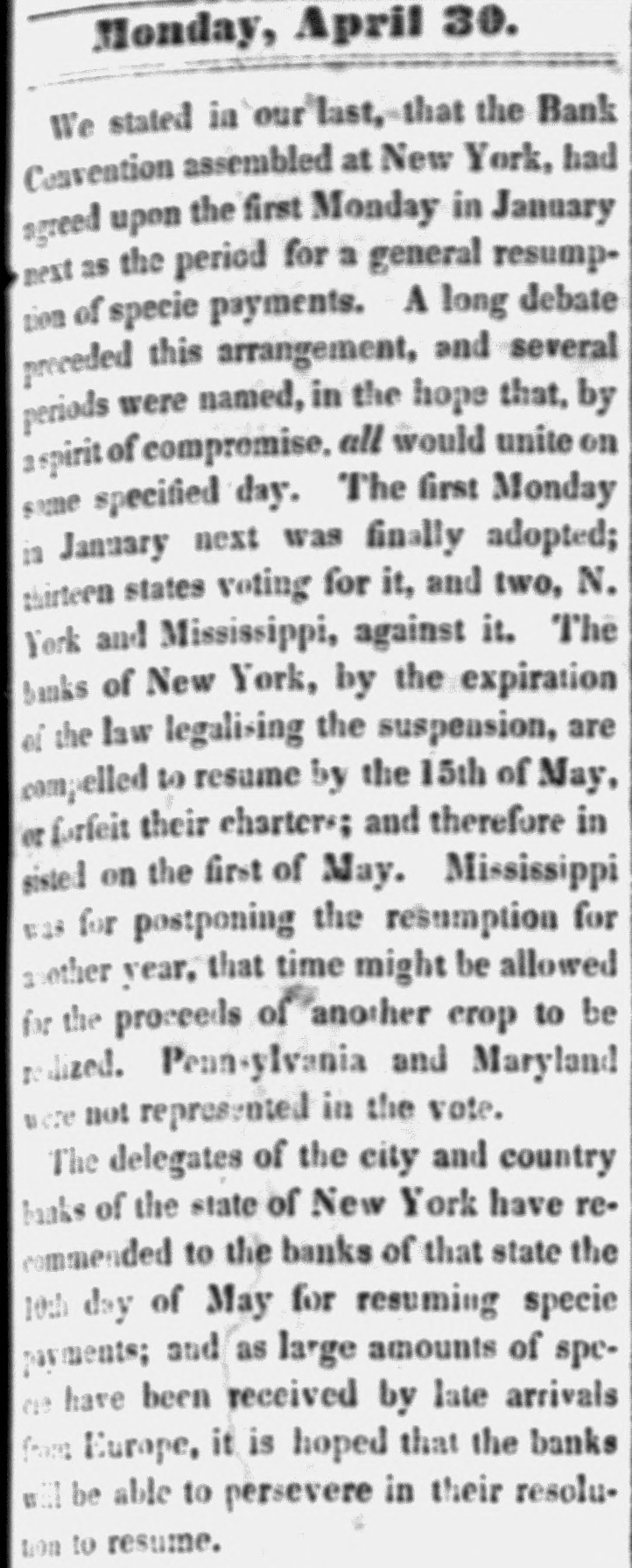
Monday, April 30. We stated in our last,-that the Bank Convention assembled at New York, had agreed upon the first Monday in January next 25 the period for a general resumpion of specie payments. A long debate preceded this arrangement, and several periods were named, in the hope that, by aspirit of compromise. all would unite on some specified day. The first Monday is January next was finally adopted; shirteen states voting for it, and two, N. York and Mississippi, against it. The banks of New York, by the expiration ei the law legalising the suspension, are compelled to resume by the 15th of May, of forfeit their charter and therefore in sisted on the first of May. Mississippi 528 for postponing the resumption for other year, that time might be allowed for the proceeds of another crop to be redized. Penn-ylvania and Maryland were not represented in the vote. The delegates of the city and country bake of the state of New York have recommended to the banks of that state the 10th day of May for resuming specie payments; and as large amounts of spca have been received by late arrivals for Eurape, it is hoped that the banks . be able to persevere in their resolution to resume.


Article from Cheraw Gazette and Pee Dee Farmer, January 2, 1839

Click image to open full size in new tab

Article Text

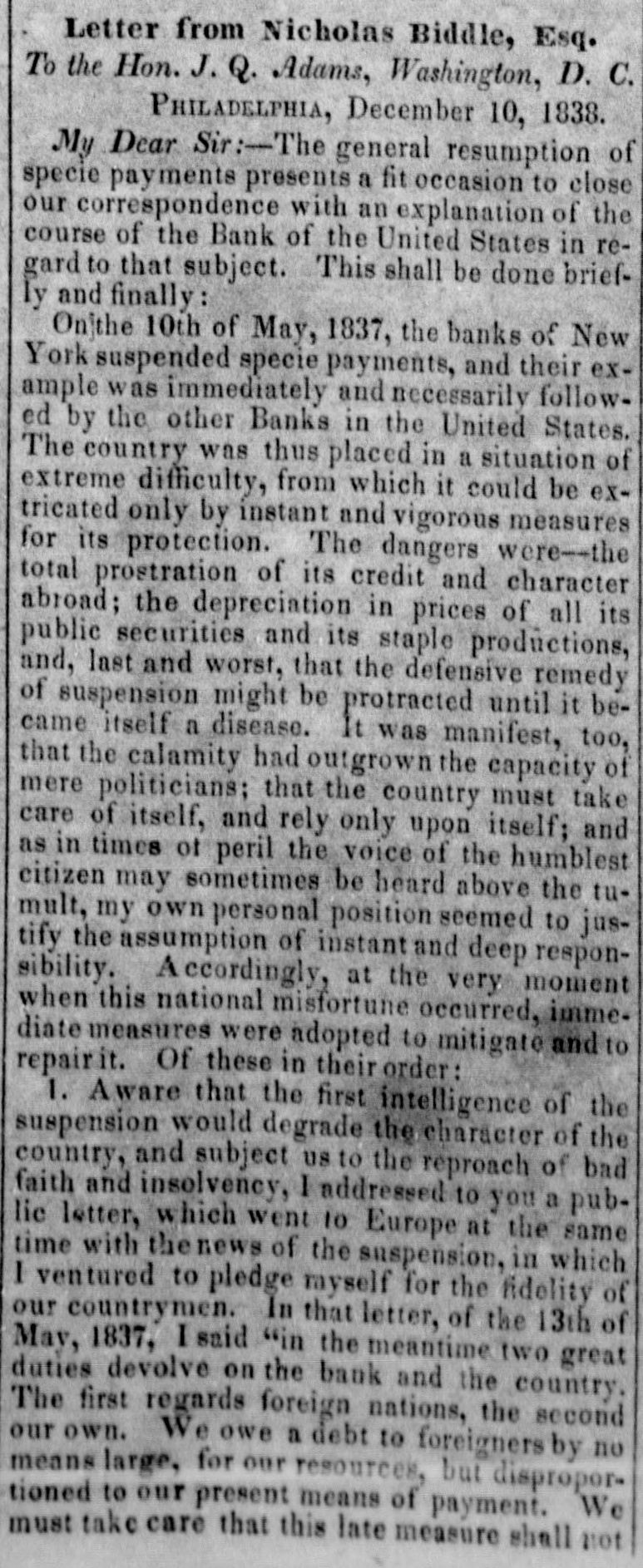
Philadelphia, D c. 10,1838. My DEAR SIR: The general.resumption of specie payments presents a fit occasion to close our correspondence with an ex. planation of the course of the Bank of the United States in regard to that subject. This shall be done brid fly and fin illy. On the 10th of May, 1837, the banks of New York suspended specie payments, and their example was immediately and necessarily followed by the other banks in the United States. The country was thus placed in a situation of extreme difficulty, from which it could be extricated only by ins ant and vigorous measures for its refection. The dangers were-total pros. tration of its credit and character abroad -the d depreciation in prices of all its public S carities and its staple productions-and, last and wors, that the defensive remedy of suspension might be protracted until it became itself a disease. It was manifest too that the calamity had outgrown the capacity of mere politicians-that the country must take care of itself, and raly only up. on itself; and as in times of peril, the voice of he humb'est citizen may sometimes be heard above the tumult, my own personal position seemed to justify the assumption of instant and deep responsibility. Accordingly at the very moment when this national misfortune occurred, immediate measures were adopted to mitigate and to repair it. Of these in their order. 1. Aware that the first intelligence of the suspension would degrade the character of the country, and subject us to the re. proach of bad faith and insolvency, I ad. dressed to you a published letter, which went Europe at the same time with the news of the suspension, in which I ventured to pledge myself for the fidelity of our c ountrymen. In that letter, of the 13.h of May, 1837, said: In the m an timetwo great duties devolve on the bank and the coun. try. The first regards foreign nations ; the second our own. We owe a debt to for. eigners, by no means large for our re sources, but disproportioned to our present means of payment. We must take care that this late measure shull not seem to be an effort to av the payment of our hon. est debts to them. We have worn, an I eaten and drunk the produce of their industry-00 much of all perhaps-but that is ur faul, not theirs. We may take less re after, but the country is disnonored unless we disciaig that debt to the uttermost farthing. For this purpose-the early and total dis. charge of our debt to foreigners-the whole power of the Bank of the United States was devoted. In such a crisis it was evident that if resort was had to rigid curtailments, the abliy to pay would be proportionally diminished; while the only true system was, to keep the country as much at easeas con. S S d with its s fety, so as to enable the debto:s to collect ar resources for the dia. charge of their delt For the same purpose the bank, though entirely out of its course of business, and in some degree of collision with its own exclusive interests, as. sumed an active agency in collecting the debts of the Bank of England, gave facility for the recovery of all debts, and stimulated our countrymen to this duty by earnest and constant appeals to their honor and their true interest. With what a generous emulation that appeal was an. swered you well know ; for it touched a chord which lies deep in all American hearts. If the un versal distress which pervaded ommunts could noi be witnessed without a paia ul syn p thy, its melancholy was redeemed by the high and manly spirit which it roused throughout the country of For never, on its most glorious fields of battle, was there displayed a more lofty


Article from Edgefield Advertiser, January 10, 1839

Click image to open full size in new tab

Article Text

# POLITICAL. From the National Gazette. LETTER FROM NICHOLAS BIDDLE. ESQ. TO THE HON, JOHN QUINCY ADAMS. To the Hon. John Q. Adams, Washington. D. C. PHILADELPHIA, Dec. 10, 1838. My Dear Sir-The general resumption of specie payments presents a fit occasion to close our correspondence, with an explanation of the course of the Bank of the United States in regard to that subject. On the 10th of May, 1837, the banks of New York suspended specie payments, and their example was immediately and necessarily followed by the other Banks in the U. S. The country, was then placed in a situation of extreme difficulty, from which it could be extricated only by instant and vigorous measures for its protection. The dangers were the total prostration of its credit and character abroad- the depreciation in prices of all its public securities and its staple productions; and, last and worst, that the defensive remedy of suspension might be protracted until it became itself a disease. It was manifest too, that the calamity had out grown the capacity of mere politicians-that the country must take care of itself, and rely only upon itself: and as, in times of peril, the voice of the humblest citizen may sometimes be heard above the tumult, my own personal position seemed to justify the assumption of instant and deep responsibility. Accordingly, at the very moment when the national misfortune occurred, immediate measures were adopted to mitigate and repair it. Of these in their order. 1. Aware that the first intelligence of the suspension would degrade the character of the country, and subject us to the eproach of bad faith and insolvency. I addressed to you a published letter, which went to Europe at the same time with the news of the suspension, in which I ventured to pledge myself for the fidelity of our countrymen. In that letter, of the 13th May, 1837, I said, "In the mean time, two great duties devolve on the bank and the country. The first regards foreign nations: the second our own. We owe a debt to foreigners, by no means large for our resources, but disproportioned to our present means of payment We must take care that this late measure shall not seem to an effort to avoid the payment of our honest debts to them, We have worn and drunk the produce of their industry-much of all perhaps-but that is our fault, not theirs. We may take less hereafter-but the country is dishonored, unless we discharge that debt to the uttermost farthing." For this purpose-the early and total discharge of our debt to foreigners-the whole power of the Bank of the United States was devoted. In such a crisis it was evident that if resort was had to rigid curtailments, the ability to pay would be proportionably diminished-while the only true system was to keep the country as much at ease as consisted with its safety, so as to enable the debtors to collect their resources for the discharge of their debts. For the same purpose the Bank, though entirely out its course of business, and in some degree of collision with its own exclusive interests, assumed an active agency in collecting the debts of the Bank of England-gave every facility for the recovery of all debts, and stimulated our countrymen to this duty by earnest and constant appeals to their honor and their true interest. With what a generous emulation that appeal was answered, you well know-for it touched a chord which lies deep in all American hearts. If the universai distress which pervade the community could not be witnessed without a painful sympathy-its melancholy was redeemed by the high and manly spirit which at roused throughout the country. For never, on its most glorious fields of battle, was there displayed a more lofty sentiment oi honor and courage than was then exhibited. The honest payment of debt-the homely duty of private life-was elevated by its universality into a sentiment of natural honor, as the whole country in mass pressed forward to its performance, as to some sacred and patriotic obligation Whatever could be paid, was paid instantly and cheerfully; what it was impossible to pay at once, was secured with ample interest for the delay, with an utter abandonment of mere selfishness, and a disregard of any pecuniary sacrifice necessary to fulfil their engagements: Accordingly, the manner in which the United States have settled their immense commercial debt to Europe is a lasting monument to their integrity. No country could have better performed its duty. Even in the calmest moments of prosperity, such settlement could scarcely be imagined as was accomplished amidst the general wreck and confusion of all its great interests with which the country was afflicted. The consequence is, that the general credit of the country never stood higher than at this moment; for it has now earned a distinction entirely exclusive and characteristic-that while the government of the United States is the only government on earth that has ever paid to the last cent, its national debt, the people of the United States have discharged their private engagements with an unexampled fidelity-a civil glory this, worth a thousand victories. In the midst of these troubles the character of our institutions was threatened by a combination of politicians in Pennsylvania who and


Article from Madison Whig Advocate, January 26, 1839

Click image to open full size in new tab

Article Text

Letter from Nicholas Biddle, Esq. To the Hon. J. Q. Adams, Washington, D.C. PHILADELPHIA, December 10, 1838. My Dear Sir:-The general resumption of specie payments presents a fit occasion to close our correspondence with an explanation of the course of the Bank of the United States in regard to that subject. This shall be done briefly and finally: On the 10th of May, 1837, the banks of New York suspended specie payments, and their example was immediately and necessarily followed by the other Banks in the United States. The country was thus placed in a situation of extreme difficulty, from which it could be extricated only by instant and vigorous measures for its protection. The dangers were--the total prostration of its credit and character abroad; the depreciation in prices of all its public securities and its staple productions, and, last and worst, that the defensive remedy of suspension might be protracted until it became itself a disease. It was manifest, too, that the calamity had outgrown the capacity of mere politicians; that the country must take care of itself, and rely only upon itself; and as in times of peril the voice of the humblest citizen may sometimes be heard above the tumult, my own personal position seemed to justify the assumption of instant and deep responsibility. A ccordingly, at the very moment when this national misfortune occurred, imme. diate measures were adopted to mitigate and to repairit. Of these in their order: 1. ware that the first intelligence of the suspension would degrade the character of the country, and subject us to the reproach of bad faith and insolvency, I addressed to you a publie letter, which went to Europe at the same time with thenews of the suspension, in which I ventured to pledge myself for the fidelity of our countrymen. In that letter, of the 13th of May, 1837, I said "in the meantime two great duties devolve on the bank and the country. The first regards foreign nations, the second our own. We owe a debt to foreigners by no means large, for our resources, but disproportioned to our present means of payment. We must take care that this late measure shall not


Article from Richmond Enquirer, November 22, 1844

Click image to open full size in new tab

Article Text

regarded MODERATION now be Presidential POLITICAL contest of may Mr. Polk termination, and Mr. The ended, and the election To reach this degree of ex as as certain. through a its political the Dallas country has scarcely passed a parallel partizans in have citement, Interested with and of violent calumny and been vituperat no and forgeries former and more falsehood numerously what has the than country in any waters thus ? hesitated riod. ation; annals. lished And for measure urbid have Magistrate, waded pub- pc- To be through these troubled its Chief and Executive period, should whether constitutional from all this the ! Judging man or another of our the fate of citement, those action would suppose on this decision decide one for ensuing ignorant political that organ- no the exthe ization country and depended the mutual entirely criminations suppose that of judging from they would would satisfy parties, revolution all should three millions as and partythat contending thing less than a be defeated. Butduring of voters, much and this the excitement among that women and twelve minors or more were millions not a considering as men, among fitteen years of age, human beings over destroyed, nor, of excited has been single riot occurred so been far single life learned, has a mentioned has three as The we utmost have disturbance battery yet among two affairs or of viassault of these occurred in and not twenty have with the Comparing wars that some persons, olence, probably and inconsiderable all this riots, have the insurrections, deluged rebellions the monarchies and desowhole Union. and with civil crime, of Europe that frequently defiled them destruction in blood, every variety dra very ferocity can the safety and so lated human them and with about inflict, we of improvement prosperity cheer- of ing conclusions country, the progressive for self-government blood, of our and their capacity ended in European awful termination American mankind, though such excitement frequency. has usually But of it is wrangling, continual- exdiminisbing in in discussion, and IV terminates calumny, will peaceful If Americans action, !Europe- talk, Europeans content fight; Americans if Americans rush to the polls, ans rush to the views of the case, vituperation, ropeans citement tual murder; it and good- arsenals. slander, let us Eu All reBut, leaving these less comprehensive. by the quesgard this excitement has or another be country "Shall it in some one aspects man been have produced said that the President?' tion, partisans not successAnd be ruined if their a remark made would excited This reminds us of party this were city, during by the a ful. old Frenchman of banks of New York 1838, when the would not the banks of our pressure shrewd resolved upon of resumption, gratily and uttering their city, prolong suspension young to merchants of the country, lamentations over business in this try he said, for more "I have than thirty a dozen years, times and within have that that its usual Hearing more some than transacted the the conclusion, ruin heard coun- pe- no as of riod: ruin and I have come much to ruin with impunity United States." with the shrewd always Fully agreeing old Frenchman is we man, philosophical and a sort of a of ruin as very these country can shrewd take so predictions personage, old French- country rather have a all these believed that the Millerite, fully and do survive not believe the election that as either President, could for neither, without the both date. would regarded if so We disposed: have good or evil, of either Legislature candi- could ruin COmove it. an inch, for branches of the could Congress operation do of not believe that years, any the Congression we in two in the ballot And ruin the country see disposed boxes life-time and we any Congress Polk ample Mr. Clay interest al an misrule. check Both upon slight and Mr. feel as in to would feel some would not President, and therefore, the opinion execration have emulous of of posterity, its either and, would granted. that the take for abilities to promote it a his and honor to Then as exerted we very prosperity utmost administration give coun- safe, Mr. we try's and dignified the election of honest not have lamented calamity, we shall utter Polk no should as a national the election of Mr. which such Clay rejoice lamentationselemination in the passions of the contest, in it of the harmony and in the return And we especially among Chief Magistrate the roused, will in We subsidence election parties. of a of angry social attainments, of long moderate respecta- rejoice expe- good ble good sense, irrethe abilities. in political respectable action. principles and rience amiable feelings, pure Polk is precisely character. country now President as such proachable views, the Mr. moderation, requires- love ele- of a and in whose love of character, justice, are the principal such a President, we may by modeHaving administration and expect an country needs It has peace man, ments. The characterized stability rationally repose passed ration. than reformation. ct, beginning more a long and severe of contl Gen. Jackson, the National Banks, Banks, Nullification, Sub-Treasurice High Tariffs, through much with which administration revulsions respective under State Free in Trade, Laws, have ruled uniting Bankrupt The expansions, Democratic party, for violent their and disclaiming can maintain regained their by avoiding extreme sures, hours only have Mr. by Polk, moderation, policy position, and idea: measures Tariff nea- that it A National extreme Bank is an is "obsolete among the things a inforce manafactures and great navies are war, large the safety and consistent with from office for to were: Removals armies among prosperity victors, opinion's of the are country. sake, ad distribution the dignity of of spoils any discrimination administration. for inci- A Tariff for revenue, and liberal protection a just a stable, dental beneath conciliatory dignified with tone, long rule economy, to conserva- the party and of a live policy, will and insure the a peace and prosperity the now county.- ascendant, Philadelphia Public Ledger.


Article from The Hillsborough Recorder, May 23, 1849

Click image to open full size in new tab

Article Text

turn cargo of coffee. The island of Cuba is rich, and we have no doubt its exports exceed its imports; we certainly import more from Cuba then we export to her. As to Great Britain, we all know that she employs her industry and regulates her revenue laws in such a manner as to make her exports exceed her imports. If England had not always acted wisely in this respect, London might not have been the pivot on which the great financial con- erns of the world revolve. But to come nearer home. Suppose we were to be guilty of the folly of im- porting in one year two hundred millions worth of foreign goods against exports to the amount of only one hundred millions of dollars, would there not be a balance against us of one hundred millions, which balance, if punctually paid, would require about all the coin in the country, and leave the subtreasury, the banks, and all hands with nothing but the bag to held? Such would be the result, if the banks, under the circumstances, were to continue spe- cie payments. The large imports under the tariff of 1846 would have been dis- astrous to us but for the famine in Ireland, which caused our exports to increase in one year about fifty millions of dollars; and this, turning the balance of the trade in our favor, gave us a large amount of foreign coin. We all remember that, for two or three years preceding the passage of the tariff of 1842, the business of the whole country was much depressed, nay, almost prostrate. That tariff, though not perfect, came with healing on its wings; all branches of business, industry, &e. gra- dually revived, and in one year we were rall prosperous and contented. During that year we imported nearly twenty-five mil- lions of coin, and of course the balance of trade was in our favor. These do certainly look like fixed facts;" but, lest" Doubt- er" may still doubt, let us take him back to 1837, a year memorable in the annals of commerce and finance. In the month of May in that year every bank from the ci- ty of New York to the city of New Or- leans suspended specie payments, causing "confusion worse confounded," an unex- ampled number of failures, among mer- chants and others, paralyzing the busi- ness in every section of the Union, and reducing materially the value of every thing except coin. Some estimated the depreciation in all descriptions of proper- ty at two or three hundred millions of dollars. Now, what was the cause of all this trouble, all this loss? We answer, unhesitatingly, the previous enormous im- ports of foreign goods; and to substan- tiate this we call to the witness-stand eve- ery practical native American mereliant in I all the cities from New York to New Or- leans. They will testify to the fact that the balance of trade was greatly against us; sterling advanced much above par, and then followed the ran on the banks of New York for coin to remit to Europe to pay importer's debts; and this run would have continued till their vaults were nearly exhausted if they had not prudent- ly suspended payment. Bul if our ex- ports for two or three years prior to 1837 had been more than our imports, or even equal," it must have followed as the night the day" that the terrible revulsión to which we allude would not have occurred. In connexion with this subject, we use the occasion to remark that the tables on record at Washington are not reliable For example: the returns of the custom- houses show simply the supposed value or cost of the exports, which, we know, frequently lose money, occasionally from filteen to thirty per cent. The truth is, the tables give only an outline: it is the price of sterling bills that indicates wheth- er the balance of trade is for or against us; if in our favor, sterling will be below par; it against us, sterling will be above par. In either case the coin will move sooner or later, by intiux or reffox, tull sterling gets to par value, which is about 8 per cent. premium. In conclusion, we beg leave to say that, in hastily penning the few lines which brought out Doubter," one important word was omitted in our axiom. It should have read: "It is a tixed fact that no country can ever become permanently prosperous, wealthy, and happy, unless its exports exceed its imports." We hope all doubt is now removed from the inind of" Doubter." À. B. C:


Article from Smyrna Times, October 28, 1857

Click image to open full size in new tab

Article Text

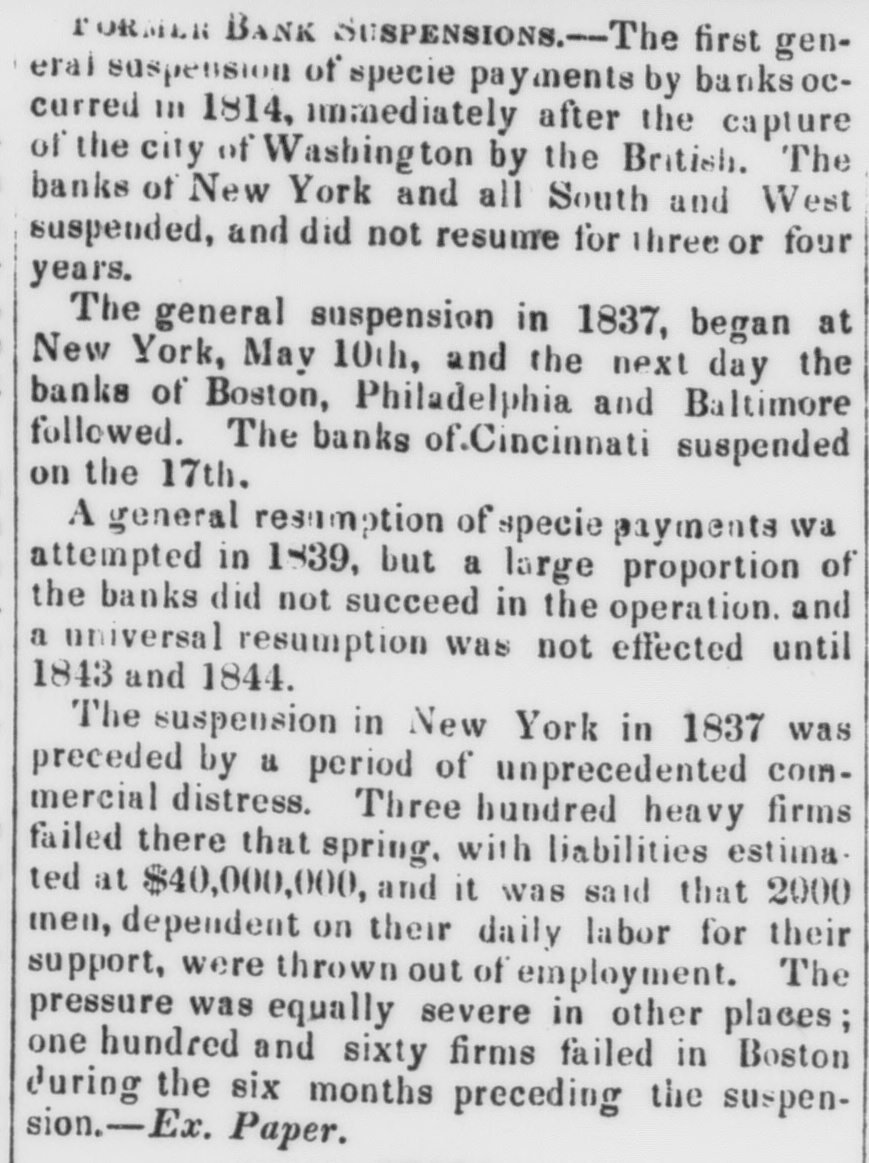
TORMER BANK SUSPENSIONS.--The - first general suspension of specie payments by banks occurred III 1814, immediately after the capture of the city of Washington by the British. The banks of New York and all South and West suspended, and did not resumre for three or four years. The general suspension in 1837, began at New York, May 10th, and the next day the banks of Boston, Philadelphia and Baltimore followed. The banks of.Cincinnati suspended on the 17th. A general resumption of specie payments Wa attempted in 1839, but a large proportion of the banks did not succeed in the operation. and a universal resumption was not effected until 1843 and 1844. The suspension in New York in 1837 was preceded by u period of unprecedented commercial distress. Three hundred heavy firms failed there that spring. with liabilities estima. ted at $40,000,000, and it was said that 2000 men, dependent on their daily labor for their support, were thrown out of employment. The pressure was equally severe in other places; one hundred and sixty firms failed in Boston during the six months preceding the suspension.-Ex. Paper.


Article from Evening Star, March 4, 1889

Click image to open full size in new tab

Article Text

Lieut.-Col. Wetmore was elected colonel, Major Stevens lieutenant-colonel, and Capt. John Telfair major. In April. 1827, Col. Wet- more resigned his commission, and Lieut.-Col. Stevens was elected his successor. Under Col. Stevens, a an officer greatly distinguished as a disciplinarian and military instructor, the regi- ment acquired the military reputation it has since maintained, and he long bore the title of "The Father of the Regiment." From that time down to the outbreak of the rebellion in 1861, when Col. Marshall Lefferts was in command, there were many changes in the officers of the "twenty-seventh." # PUBLIC CEREMONIALS. The regiment participated in many of the festive occasions in the state during that period, and was also a feature at the funeral of ex- President James Monroe. Two of its com- panies were detailed as President Andrew Jack- son's escort in June, 1833, when he was tendered a reception in New York city. In the "election riot" of 1834, the abolition riots of that period, and at the great fire in New York in December, 1835, the regiment did good work. The "steve- dore riot," and the "flour riot," in 1836 and 1837, respectively, also tested the discipline and soldierly qualities of the men. The sus- pension of specie payments by the banks of New York in 1837 threatened trouble, and the twenty-seventh was held in readiness for imme- diate service. A troop of cavalry was added to the regiment in 1838, and on July 2, 1839, the entire com- mand paraded at the military reception of President Martin Van Buren. The "Croton water riot" was suppressed by the twenty- seventh in April, 1840, and one year later, on the 10th of the month, the regiment paraded at the funeral of President William Henry Har- son. In June, 1843, it formed part of the mili- tary escort to President John Tyler, and in June, 1845, it paraded at the funeral obsequies of ex-President Andrew Jackson. In 1847, again in the month of June, it passed in re- view of President James K. Polk. # THE "SEVENTH." A new militia law was passed by the state legislature in 1847; by its provisions the New York city regiments were renumbered, and in the course of this operation the "Twenty- seventh" became the "Seventh" on July 27. In March. 1848, the "Seventh" acted as funeral escort for the remains of ex-President John Quincy Adams. An engineer corps was organ- ized and attached to the regiment in April, 1849, and the added strength did not come too soon, for on the 10th day of May the Astor place riot occurred. A mob had driven Mac- ready, the English tragedian, from the stage of the Astor Place Opera house, and was de- termined to prevent his reappearance at that place. The "seventh" was called out to disperse the mob, which had overpowered the police. The regiment was attacked by the rioters, and more than half of the rank and file were injured before the order was given to "fire." Two volleys ended the strife. About thirty persons were killed out- right, twice as many were seriously wounded and a large number received minor injuries. At the funeral of President Zachary Taylor, on July 23, 1850, the regiment paraded, and it turned out again in May, 1851, for the reception