16718. Washington Savings Bank (New York, NY)

Bank Information

Episode Type
Run → Suspension → Closure
Bank Type
savings bank
Start Date
December 28, 1910
Location
New York, New York (40.714, -74.006)

Metadata

Model
gpt-5-mini
Short Digest
50758bf6

Response Measures

Partial suspension, Books examined

Other: Bank later placed in hands of State Banking Department and receiver; dividends later ordered.

Description

A small run occurred Dec. 27–28, 1910 after the collapse/investigation of Joseph G. Robin and the Northern Bank. The Washington Savings Bank posted a 60-day withdrawal notice and shortly thereafter was taken into the custody of the State Banking Department and closed; it remained in liquidation/receivership with dividend proceedings in 1911. Cause is bank-specific (Robin's malfeasance/related Northern Bank failure).

Events (3)

1. December 28, 1910 Run
Cause
Bank Specific Adverse Info
Cause Details
Run followed investigation/closure of the Northern Bank and revelations about Joseph G. Robin's misappropriations; Robin was president and his conduct undermined confidence.
Measures
Bank posted sixty-day withdrawal notice and sealed safes/vaults; tellers remained but payments deferred.
Newspaper Excerpt
A small run took place at the bank yesterday after the Northern bank had closed.
Source
newspapers
2. December 29, 1910 Suspension
Cause
Bank Specific Adverse Info
Cause Details
State examination of Robin's operations and indictments linked to misappropriation; authorities took control and bank was closed/placed in hands of state department/receivering process began.
Newspaper Excerpt
The Washington Savings Bank ... put the sixty-day notice rule into effect to-day when confronted by a run. ... The bank passed into the hands of the State banking department to-day
Source
newspapers
3. January 17, 1911 Receivership
Newspaper Excerpt
The Washington Savings Bank, in liquidation; ... Superintendent of the State Banking Department joined issues yesterday with individual creditors ... petition for the appointment of a receiver of Robin's property ... The Washington Savings Bank has a claim for $400 on Robin's note. and ... Washington Savings Bank (in liquidation).
Source
newspapers

Newspaper Articles (21)

Article from The Topeka State Journal, December 28, 1910

Click image to open full size in new tab

Article Text

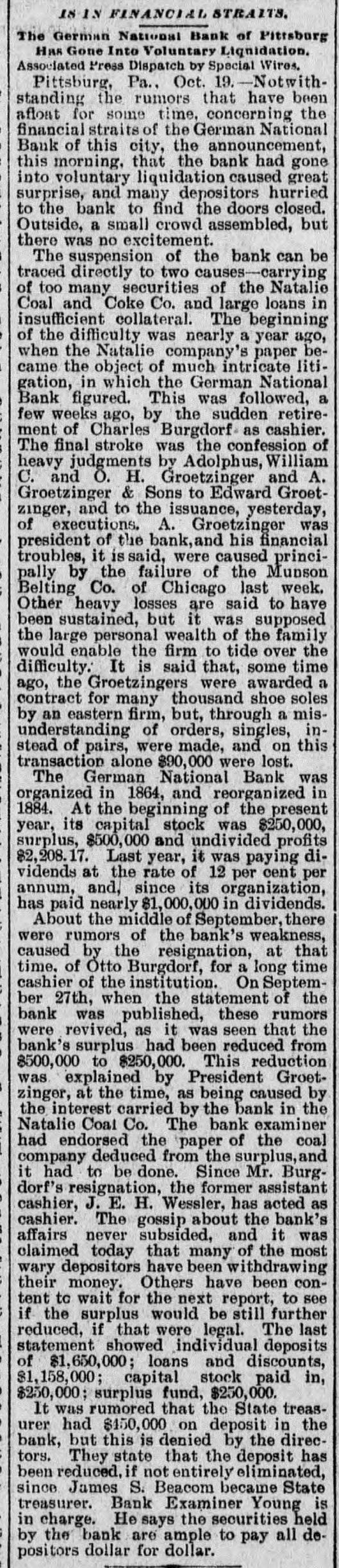
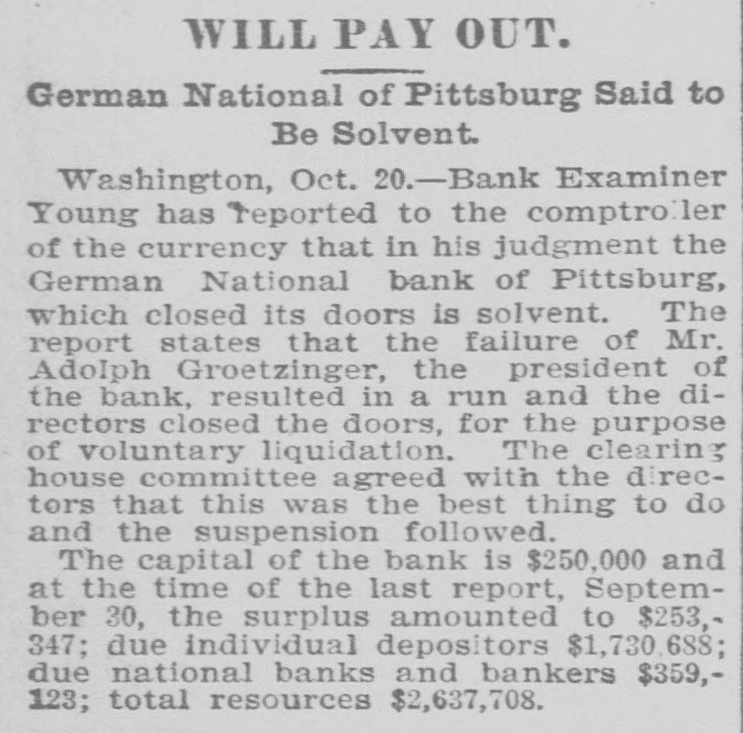
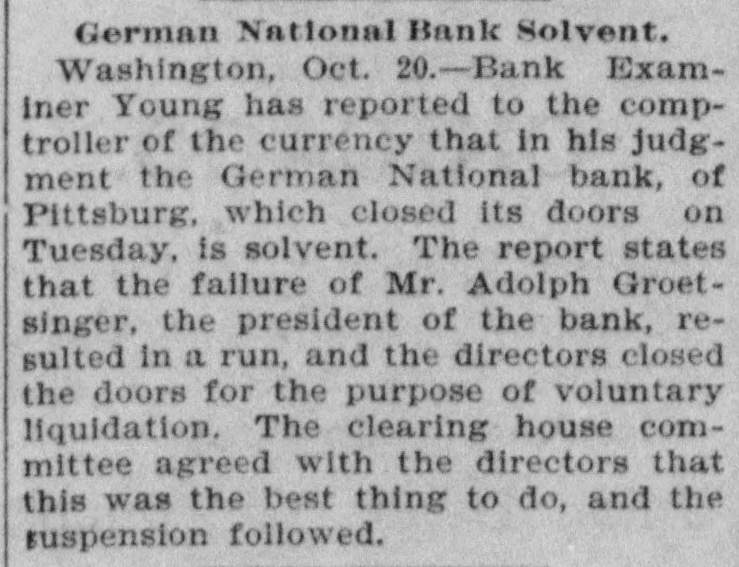
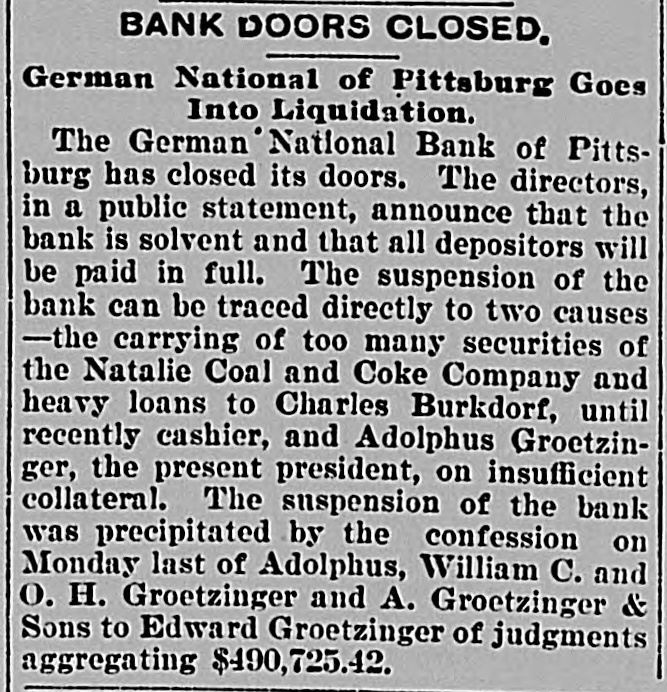
WOULD NOT KEEP HIM. Sanitarium Managers Refuse to Entertain Banker Robin. New York, Dec. 28.-A staff of experts under the direction of Bank Superintendent Cheney is investigating today the affairs of the Northern bank of New York, whose suspension yesterday brought to light the news that Joseph G. Robin, who held control of the bank, had been committed the night before to a sanitarium. Robin not only controlled the Northern bank but, according to State Superintendent of Insurance Hotchkiss, largely controlled several other companies. The real condition of the Northern bank probably will not be known for at least three weeks and in the mean time the state bank and insurance officials indicate they will insist that Robin undergo another examination as to his mental condition. Depositors of the Northern bank and its branches probably will be paid in full, but how the stockholders will fare can only be surmised. It was learned at the district attorney's office shortly before noon today that Robin had left the sanitarium at Central Valley, N. Y., to which he went early this week and was now said to be at his home in this city. The sanitarium authoarities it was said, refused to receive him as a patient. Sixty Day Notice Posted. New York, Dec. 28.-The sixty-day withdrawal notice was posted today at the Washington savings bank on West Fifty-ninth street, of which Robin is the president. This institution has deposits aggregating $1,410,205. A small s, run took place at the bank yesterday after the Northern bank had closed.


Article from The Evening World, December 28, 1910

Click image to open full size in new tab

Article Text

ous condition that his immediate com mitment was necessary. On her representations and the papers she had, all of which were in due legal form, : signed the commitment." The commitment of Robin as an Insane person put a temporary stop to the beginning of the usual legal steps to bring about his arrest on a charge of misappropriating funds of the bank. The Superintendent of Insurance, the Superintendent of Banks and the District-Attorney found no precedents to guide them in this case. About the only course open appears to be to submit the evidence to the Grand Jury and have Robin Indicted Then he can be brought into court and a commission can be appointed to examine him as to his mental condition after the manner prescribed by law. He Is Still Legally Insane. Although Robin has been removed from a private insane asylum, he is still legally Insane in the eyes of the law, for he has been committed by a Justice of the Supreme Court as an Insane person. If it is established that he is insane he cannot be sued individually and no lunatic can be thrown into bankruptey. However, his affairs are in a chaotic state, and his friends will find It necessary to have a commission appointed to take charge of his person and property. This commission can be sued. "The direct effect of the commitment of Robin D.S an insane person," said Superintendent of Insurance Hotchkiss today, "establishes remarkable ease for his defonse. It will be extremely dimcult to establish his responsibility for wrongdoing." "Just what has Robin done," Mr. Hotchkiss was asked, "in the way of violating the insurance laws of the State?" "He has been selling bad securities to Insurance companies and in their places taking good securities. These transactions, however, were all condueted through subordinates, and It to easy to see how, with Robin committed as insane. It will be very difficult to fasten responsibility upon him." Robin took $30.000 out of the Northerr. Bank last weel., at a time when the experts in the employ Superintendent Hotchkiss were looking into the affairs of his Insurance and indemnity and bonding enterprises. This sum was abstracted by a system of high finance so intricate that even the expert accountants have not been able to solve the Interior working of it. There are four other men besides Robin implicated in the wrecking of the Northern Bank and the Robin investment companies. Evidence against these men and against Robin will be submitted to the Grand Jury Jan. 2. Run on Washington Savings. The Washington Savings Bank, at Fifty-ninth street and Columbus Circle, of which Robin is president, and which is virtually owned by him, put the sixtyday notice rule into effect to-day when confronted by a run. Superintendent of Banks Cheney is investigating this concern. The safes and vaults were sealed yesterday In order to conserve the assets. Although a savings bank, the Washington had customers 'who had checking accounts. The law permitting savings banks to require depositors to give sixty days' notice of intent to withdraw their deposits was also enforced in respect to these checking accounts. There was a great deal of exitement around the bank. The doors were open and the tellers and clerks were in place at their windows. but not a cent was paid out. A few persons made deposits. His Examination by Experts. It was at his Gramercy Park apartments that Robin was examined by the allenists who certified that he was Insane. Four of them were called and, according to Dr. Valentine Wildman, they made four examinations. Superintendent of Insurance Hotchkiss, when informed of the action of Dr. MacDonald, said: "That would seem to be a very proper proceeding on the part of Dr. MacDonald. It certainly confirms the conclusions of throse familiar with the transactions of Robin within the past few weeks." Henderson M. Wolfe, chief auditor of accounts in the Finance Department, who until December a year ago was Vice-President and a director of the Northern Bank, said to-day that he sold his stock and severed all connection with the bank when he accepted a job under Comptroller Prendergast. Mr. Wolfe added: "I became Vice-President and director of the Northern Bank in May, 1909. I represented prominent downtown banking interests, who had acquired an option on a majority of the capital stock of the institution. I have taken no active interest in the Northern Bank since severing my connection on Dec. 31, 1909." Dr. Frederlek Ives, who has been mentioned as a vice-president of the Northern Bank, Issued to-day a statement declaring that he has no connection sald whatever with that institution. He


Article from Deseret Evening News, December 28, 1910

Click image to open full size in new tab

Article Text

NORTHERN BANK OF N. Y. AFFAIRS INVESTIGATION New York," Dec. 28.-A staff or experts under the direction of Bank Supt. Chency is Investigating today the affairs of the Northern Bank of New York, whose suspension yesterday brought to light the news that Joseph G. Robin, who held control of the bank, had been committed the night before to a sanitarium. Robin not only controlled the Northern bank, but according to State Supt. of Insurance Hotchkiss largely controlled several other companies. The real condition of the Northern bank will not probably be known for at least three weeks and in the meantime the state bank and insurance officials indicate that they will insist that Robin undergo another examination as to his mental condition. Depositors or the Northern bank and its branches probably will be paid in full. but how the stockholders will fare can only be surmised. It was learned at the district attorney's office shortly before noon today that Robin had left the sanitarium at Central Valley, N. Y., to which he went early this week and was now said to be at his home in this city. The sanitarium authorities, it was said, refused to receive him as a patient. The 60-day withdrawal notice was today posted at the Washington Savings bank on west Fifty-ninth street. of which Robin is president. The institution has deposits aggregating $1.410,000. A small run took place at the bank yesterday afternoon after the Northern bank had closed.


Article from Daily Kennebec Journal, December 29, 1910

Click image to open full size in new tab

Article Text

In event of an indictment being found against Robin, it was said he will immediately be arrested and arraigned, despite any contention by counsel that is of unsound mind. If a plea of insanity is entered, then a lunacy commission of two laymen and one insanity expert will be appointed to determine his state of mind. The 60-day withdrawal notice was today posted at the Washington Savings Bank on West 59th street. Joseph G. Robin is the president of the Washington Savings Bank. This institution. which is one of the smallest savings banks of the city, has deposits aggregating $1,410,205, according to the report made to the state banking department in July. A small sized run took place at the savings bank yesterday afternoon after the Northern Bank had closed. When Supreme Court Justice Amend was informed that the sanitarium at Central Valley, to which the justice committed Robin, had refused to accept the man as a patient, declaring him to be sane, and had insisted that the bank director leave the institution at once, Justice Amend said: "The requirements of the statute governing commitments to private institutions were complied with in every particular in this case. The petitioner, who is Robin's sister, I am informed, appeared at my home Monday night with a properly signed affidavit of two reputable physicians, setting forth that Rob. in was insane, had attempted to kill himself and that it was imperative that he be committed to an institution where he could not harm himself or anyone else. A prima facie case was made out clearly and there was nothing for me to di under the statute but sign the commitment, which I did. "The head of any private institution for the insane," continued the justice, "has a perfect right to refuse to receive a patient committed to that institution or to discharge such a patient when upon examination it is found that the patient is not insane and was mentally capable at the time of the commitment."


Article from The Clarksburg Telegram, December 29, 1910

Click image to open full size in new tab

Article Text

BANKER'S SANITY TO BE LOOKED INTO After Bank Breaks and He is Refused Admission to Sanitarium. RAIN FALLS NEW YORK, Dec. (28-A staff of experts under the direction of Superintendent Cheney today investiIN TORRENTS gated the affairs of the Northern Bank of New York whose suspension brought to light the news that Joseph G. Robin, who held control AT PRESENT of the bank, entered a sanitarium early this week. It is reported that Robin, after reIn the North Central States maining in the place a few hours, returned to his home in this city, the as the Snow is Melting sanitarium authorities refusing to accept him as a patient. Quickly. State bank and insurance officials indicate that they will insist that MESSAGE SERVICE Robin undergo an examination as to his mental condition. The depositors of the Northern Bank and Is Very Much Interfered with its branches will probably be paid in full, but how the stockholders will as Poles and Lines fare can only be surmised. Are Down. The sixty-day withdrawal notice was today posted at the Washington CHICAGO, Dec.-28-A storm of Savings Bank on West 59th street, wet and heavy snow melting in terof which Robin is president. This ritory to the south into a heavy institution has deposits of $1,410,downpour of rain swept over the 205. A -mall run took place yesterday afternoon. north central states early today. Telegraph and wires


Article from The Bennington Evening Banner, December 29, 1910

Click image to open full size in new tab

Article Text

HE WILL PRODUCE BANKER ROBIN WHEN WANTED Ex District Attorney Gives Such Assurance DEPOSITORS MAY NOT LOSE Counsel for Northern Bank Says Institution Should Pay Dollar for Dollar | New York, Dec. 29.-Joseph G. Robin, the financier and banker whose borrowings and manipulations of securities shut the doors of the Northern Bank of New York and its nine branches and drove the Washington Savings Bank in Columbus Circle to adopt extreme measures for preventing a run, is hiding in this city, with only his attorney William Travers Jerome and a few others knowing where he is. The Washington Savings Bank in Columbus Circle, of which Robin is president, enforced yesterday against its depositors the sixty-day notice rule on all withdrawals. The State Banking Department is examining the books, but this, it was explained, was merely the regular examination, and that the department had nothing to do with the curb placed on the depositors' anxiety to get their money. State Superintendent of Insurance Hotchkiss said yesterday that he believed the investigation now in progress into the affairs of the Northern - the would


Article from Evening Star, December 29, 1910

Click image to open full size in new tab

Article Text

JURY INDICTS ROBIN Charges Bank President With Larceny of $80,000. FROM EJECTED ASYLUM Financier Taken Away in Automobile by His Sister. AT APARTMENTS IN NEW YORK Engages Former District Attorney Jerome to Defend Him-Experts Go Over Books. NEW YORK, December 29.-The grand jury this afternoon handed down an indictment against Joseph G. Robin, whose financial transactions are alleged to be responsible for the closing of the Northern Bank of New York last Tuesday. The indictment specifically charges Robin with the larceny of $80,000 from the Northern Bank. Robin (formerly Robinowitz) was turned out of a private asylum yesterday, whither he was taken when officials closed the Bank of Northern New York, of which he was president. and started an investigation of a score of other concerns he is said to control. Millions of dollars of deposits are tied up by the actions of the state and city officials, and there is revealed a remarkable story of high finance of a man born in Russia thirty-five years ago, who had risen from a bootblack to an important interest in a chain of financial corporations. Changed His Name. Robin has been in America only twenty years, changing his name eighteen years ago. It has been claimed for him that he is related to Russian royalty. Officials at Dr. Carlos F. MacDonald's sanatorium, at Central Valley, N. Y., declined to discuss their refusal to give Robin a refuge, except to refer to misstatements, presumably as to his mental condition. Robin was whisked away at once in an automobile with his sister, Dr. Louise Robinovitch, and eluded pursuit. Last night he was reported to be in seclusion in New York. Detectives had watched his apartments and the home of his sister until District Attorney Whitman received word from William Travers Jerome, former district attorney, that Robin had retained him as counsel. "Robin is in this city,' said Mr. Whitman, after hearing from Mr. Jerome, "and Mr. Jerome has assured me that he will produce Robin when the district attorney wants him." It is rumored that Robin's attack of paranoia did not develop its alarmingly acute stage until Friday, when, coincidently, it is said, Robin's friends learned of the official investigation into the affairs of the Northern Bank. Started Inquiry December 14. The discovery of something new in the 1 way of what Supt. Hotchkiss calls endless-chain finance came as long ago as December 14, when he began an Investigation into the affairs of the Aetna Indemnity Company of Hartford, Conn. Robin owned 51 per cent of the stock of the Aetna Indemnity Company, and through that institution he had obtained control of the Rochester Title and Guarantee Company. He was interested in many other companies and banks, and as chairman of the executive committee of the Northern Bank of New York practically controlled that institution's policy. Among other concerns in which he was interested were the Fidelity Development Company, which owns the Morris Park race track property: the Bankers' Realty and Security Company, the South Shore Traction Company and the Babylon Railroad Company. He was also president and a trustee of the Washington Savings Bank in the city of New York. Financial Tangle. The whole case is extremely complicated by the tangle of relations between the various banks, companies and insurance institutions in which Robin was interested or which he controlled. Supt. Hotchkiss has taken possession of the assets of the Rochester Title and Guarantee Company, and Supt. Cheney has a large staff of expert accountants at work upon the books of the Northern Bank of New York and its nine branches, with deposits of nearly $7,000,000. When patrons of the Washington Save ings Bank entered the bank yesterday they found the following notice posted near the receiving teller's window: or "Depositors will be required to give sixty days' notice previous to making withdrawals from their accounts." Secretary Cheney's name was signed to the notice. "This notice," said the secretary, "is simply a precautionary measure. The losigned to avert


Article from The Washington Herald, December 29, 1910

Click image to open full size in new tab

Article Text

Thursday that proceedings against him were in order, and that the bank would be shut down. The district attorney was told of that fact. As to Dr. Macdonald's discharging him from the sanatorium, that is a matter between Dr. Macdonald and the Supreme Court, said Mr. Whitman. The banking department had no official statement to make concerning the finances of the Northern Bank of New York. The best information obtainable places the loss from Robin's operations at more than $800,000. Although Bank Supt. Cheney refused to discuss the situation, it was learned that in the opinion of his department it will probably be several weeks before a statement showing the depositors' fate can be made. May Close Concern. The department will decide to-day as to whether the Aetna Indemnity Company of Hartford, of which Robin is the controlling stockholder, will be allowed to continue in business. Theodore H. Macdonald, insurance commissioner of Connecticut, will be here to talk the situation over again with Supt. Hotchkiss. The Washington Savings Bank, at Fiftyninth street and Eighth avenue, of which Robin is president, forestalled the possibility of a serious run to-day by claiming its right to defer payments for sixty days. Examiners from the State banking department are conducting an examination of this bank. When the Washington opened its doors at 9 o'clock, there were only a few depositors on hand to withdraw their accounts. Three or four of these, whose accounts were less than $100, got their money, but when a man appeared with an account of over $1,000, which he wished to close and a woman who wanted to withdraw a deposit of over $3,000, they were informed that the bank would put in force its privilege of demanding sixty days' notice before payment. A minute later formal notice to that effect was posted in the bank. Frederick K. Morris, who was Joseph G. Robin's representative in many companies, and through whom he was able to operate sub rosa, was taken to the offices of the South Shore Traction Company, in the Times Building, to-day, by his wife and son to tell Chief Examiner Hughes, of Mr. Hotchkiss' office and to Assistant District Attorney John K. Clark, what he knew concerning Robin's transactions through the various companies where Morris had represented him. Endures Acute Suffering. The skepticism as to the seriousness of Mr. Morris' illness was dispelled to-day by the State and county representatives before whom he testified, when they described the picture of the man lying back upon a couch and enduring acute physical suffering as he filled in and straightened out the information which they had already at hand. It is said that Morris has been ill for many months and has continued at work against medical advice. His trouble is said to be heart disease, and the attack he had last Monday was very acute. Mr. Hughes said that, of course, he was not able to offer any immunity to Mr. Morris from criminal prosecution, nor could Mr. Clark so offer without consulting his chief, but this did not halt Mr. Morris from supplying them with whatever information he possessed. "We are not preventing him from saying what he chooses," said Mr. Hughes. It is believed that some sort of an immunity will be procured for him. During the examination, Mr. Clark reported to District Attorney Whitman that he was very well satisfied with the progress being made, and that, in his esti. mation, sufficient information would be at hand so that an application could be made to the grand jury next Tuesday for a criminal indictment against Robin. Mr. Morris' testimony will be largely instrumental in bringing this about.


Article from Keowee Courier, January 4, 1911

Click image to open full size in new tab

Article Text

INDICTED BY GRAND JURY. Must Give $25,000 or Go to Jail Pending Question, New York, Dec. 29.-It took the grand jury just an hour to-day to indict Jos. G. Robin on a charge of the larceny of $50,000 from the Washington Savings Bank, of which he was president. The bank passed into the hands of the State banking department to-day, there to keep company with the Northern Bank of New York, of whose executive committee he was chairman, and with which his name has hitherto been more prominently connected. The district attorney explained that out of a mass of evidence drawn from the records of both institutions he had chosen the charge that he thought could be presented most simply to a jury. Technically Robin is insane now. The order of commitment, signed by Justice Amend at the request of Dr. Robinovitch, and certification of three other physicians, still stands, although the private sanitarium to which Robin was taken refused to receive him. Banker Robin Collapses, New York, Dec. 30.-John R. Robin, indicted in connection with the recent suspension of the Northern Bank, completely collapsed a few minutes before the hour of his arraignment before Judge Crain in the General Sessions Court, and physicians were hurriedly summoned. It was feared that he had taken some sort of poison. Robin was guarded all last night and to-day by detectives at the home of his sister, Dr. Louise Robinovitch, 28 West 126th street. An exhaustive examination by two alienists to-day resulted in the declaration that Robin is a physical wreck. This was the announcement made by Dr. W. A. Mabon, superintendent of the Manhattan Hospital for the Insane, and Dr. A. Flint. Dr. Mabon's examination of Robin was made for District Attorney Whitman, while Dr. Flint acted in behalf of former District Attorney Jerome, counsel for the prisoner. Did Not Delay. District Attorney Whitman angrily denied to-day that he had delayed bringing action against Robin when notified that the Northern Bank had been wrecked. "I acted as soon as I could get enough evidence against the man to warrant my proceeding against him," he said. "I have acted promptly in this case, and I refuse to be drawn into any controversy with the newspapers or Superintendent Cheney. As for letting Robin leave the sanita rium and go away. he was a ward of the court, and I could not touch him until he was indicted and a warrant issued."


Article from New-York Tribune, January 17, 1911

Click image to open full size in new tab

Article Text

IN AS RECEIVER FOR ROBIN Banker Figures in Involuntary Petition for Bankruptcy. WANT TRANSFERS SET ASIDE Property at Stake, Mostly Bonds and Stocks, Said to Have Value of $1,000,000. The State Banking Department joined issues yesterday with individual creditors of Joseph G. Robin and began legal proceedings to secure for the creditors of the Northern Bank and the Washington Savings property to sent gross having Bank assets of $1,000,000 believed by represet aside transfers of this property made by Robin shortly before his financial collapse. An involuntary petition in bankruptcy filed against Robin yesterday morning in the United States District Court behalf the Savings Gerald a of the Bank Northern and Bank, H. Washington Chapin, on lawyer. as petitioning creditors, was followed in the afternoon by a petition for the appointment of a receiver of Robin's property which shed some new light on the transactions of the indicted banker during the last days of his freedom. The second application was made by A. K. Alford. Deputy Superintendent of Banking. and a Elmer in M. charge Kimbark, of the Northern creditor Bank. for $1,500. This petition stated that Robin was in the Tombs and that it had become necessary to have a receiver, as he was indebted to large the petition amounts. various asserted. banking Most had institutions of these loans, in very been secured by collateral, and as many of them had been called the securities were about to be disposed of at sacrifices. Continuing the petition stated: "That on or about December 24. 1910. said alleged bankrupt delivered and transferred to one Anthony Stumpf, Frederick D. Kilburn, the Atna Indemnity Company and the Northern Bank of New York the following property: "First mortgage bonds issued by the Bankers' Realty and Security Company of the par value of $3,800 and the following stocks 180 shares of the Northern Bank of New York, 999 shares of the Babylon 86 shares AEtna Railroad Indemnity Company, Company, certificates of the trust representing 3,590 shares of stock of the F1delity Development Company. 8.760 shares of common and 14 shares of preferred stock of the Fidelity Development Company, 110 shares of the preferred and 370 shares of the common stock of the Bankers' Realty and Security Company, 317 shares of the Babylon and Oak Island Ferry Company, 25 shares of the Anthony Stumpf Publishing Company, 173 shares of the Bankers' Money Order Association 10 shares of the Hungarian-American Bank, 5 shares of the Carnegie Trust Company 4 shares of the Merchants' Exchange National Bank, 10 shares of the Alexander Hospital, 100 shares of the Cobalt Coalition Mining Company, 100 shares of the Greene Consolidated Gold Mining Company, 5 shares of the First National Bank of Amityville, 100 shares of the Reed Lumber and Timber Company and 90 shares of the Bank of Discount of the City of New York Mr. Kimbark gave the assets at approximately $900,000. consisting of stocks and bonds, all of which were held by some of the creditors as collateral for loans amounting to $880,000. Judge Holt appointed Peter Alexander receiver, with a bond of $10,000. Mr. Alexander is also receiver for the Bankers' Realty and Security Company, of which Robin is a director. The securities enumerated in the petition for the appointment of a receiver are apparently those meant in the charge made in the bankruptcy petition. in which it is alleged that Robin while insolvent transferred. on December 24. 1910. to some of his creditors various securities for the purpose of preferring those creditors over others of his creditors. The claim of the Northern Bank is based on a promissory note for $100,000. made out to the Hamilton Bank on June 24. 1907. by David A. Sullivan. former president of the Merchants and Traders' Bank and an associate of E. R. Thomas. The note was delivered to the Northern Bank on June 12 1908 The petition states that for a valuable consideration Robin, in writing. guaranteed the bank against any loss on the $75,000 then due. Payment was demanded on January 7 and was refused The Northern Bank now holds securities of a total value of $51,500 for the payment of this note. The Washington Savings Bank has a claim for $400 on Robin's note. and H. Gerald Chapin claims $300 for legal services to Robin.


Article from New-York Tribune, January 23, 1911

Click image to open full size in new tab

Article Text

TIED UP IN ROBIN BANK Days After Washington's Failure Wadleigh Students Go to Put More Into It. HADN'T HEARD OF CLOSING Secret Society of High School Now Bemoans $1,000 It Had Collected for Dance at the Waldorf. For many months the girls of the Greek letter society. Phi Phi Mu, of the Wadleigh High School, have been saving their spare money for the purpose of indulging in a fraternity dance and reception at the Waldorf on February 3. The fund has been growing famously; every member of the secret order has been sparing of candy and ice cream sodas, so that the fund might approach to respectable proportions before the night of the dance. The custodians of the money have been secretly patting themselves on the back. Only a few weeks ago the girls had $1,000 in the bank. and visions of the glories of the night of February 3 kept running through their minds. They planned to far outdo all previous fraternity efforts On Saturday morning. at the home of Miss Helen Hankins, the treasurer of the society, the fraternity members held a meeting. at which final details for the dance were completed. To add to the gayety of the occasion. Miss Hankins turned over an extra 825 to Miss Aurele McLaughlin, the trustee of the fund, who lives at No. 606 Lexington avenue. When the girls had separately and individually congratulated Miss Hankins on her notable addition to the fund, the latter. accompanied by Miss Lottie Behning, of No. 2135 Seventh avenue: Miss Camilla Helmle, of Hamilton Terrace, and Miss Susan Lyons, of West 71st street, departed to place the latest contribution in the vaults of the bank with its thousand fellows They chatted airly and blissfully as they tripped along to the subway and when they got out at Columbus Circle Miss McLaughlin marched with confident step toward the bank. Found Bank was Closed. A look of vexation crossed her face as she neared the doors and saw that the bank was closed Instantly the thought occurred to all the girls that the half holiday was responsible for the closing. and they tried to get the man who showed his face behind the plate glass door to open in response to their knocking. The man smiled and pointed to a grepasted on the window. The girls glanced at the sign contemptuously for a moment, but only for a moment. Wild despair and disappointment shown in their faces when they finally grasped the full meaning of the fatal words. It was a notice that the Washington Savings Bank had been ordered closed by order of the state authorities: that it had failed: in other words. that the society's $1,000 was where they couldn't get it. Just then one of the students happened to glance at the heavy gold lettering on the opposite window. "Oh, girls," she said. "this is the Washington Bank, isn't it? Isn't that the bank that that horrid Robin was connected with?" and then all the other "Greeks" crowded closely about her and nodded their heads sadly. Now, with the approach of the proposed fraternity dance only a matter of days away, the fraternity is in a furore. A ways and means committee has been appointed to devise methods of getting around the difficulty. At first it was feared that the dance would have to be abandoned. but later the girls determined to raise the necessary amount. They will implore the financial aid of their parents and coax the elusive dollars as best they can. It is expected that many a father will be delightfully heedled and cajoled, and upon these hopes rest the fate of the fraternity


Article from The Times Dispatch, February 27, 1911

Click image to open full size in new tab

Article Text

New York, February 26.-Another chapter in the meteoric career of Joseph G. Robin, who, it is claimed, stole more than $1,000,000 from the depositors in his institutions, will open here to-morrow, when he is placed on trial on the specific charge of stealing $280,000 of the funds of the Washington Savings Bank. Few cases of frenzied finance have aroused such widespread interest as that of Robin's. The humble origin of the man, his rapid rise in the world of finance, the disastrous results of his skyrocket methods, and the numerous sensations since his arrest have all contributed to the publicity of the case. At present three large banking institutions are in the hands of the State Banking Department, while deposits aggregating nearly $20,000,000 are tied up. The several concerns which Robin personally launched are in the hands of receivers, and bankruptcy proceedings are being conducted against him, ### Plead Insanity. When the trial comes up to-morrow It is believed that Robin's counsel will endeavor to get a further postponement on the ground that the prisoner is insane and should be committed to an asylum. Robin's financial jugglery first came to the attention of the public on December 27, 1910, when the Northern Bank of New York and its nine branches closed their doors, following an investigation by the State Banking Department This institution carried 25,000 deposits, aggregating $7,000,000 and its failure was a severe blow to thousands of small investors. A thorough investigation by the State Banking Department, which had been going on for a couple of weeks, revealed the fact that Robin was the directing genius of the institution and practically controlled it, the officers and other directors being mere figureheads. When the authorities went to lay hands on him, however, they discovered that his sister, Dr. Louise Robinovitch, had stolen a march on them and had her brother installed in a sanatorium as an incurable paranoiac, on the judgment of two prominent alienists. This action was taken by Dr. Robinovitch the day before the closing of the bank, but when the story of Robin's irregularities became public, the owner of the private sanatorium, objecting to this unpleasant notoriety, turned Robin out of doors, and, in company with his sister, the ruined financier made his way to Jersey, returning to New York the following day. In the meantime the grand jury had been investigating Robin's peculations, and on December 23 handed down an indictment charging him with the specific theft of $90.000 from the Washington Savings Bank. This institution, of which Robin was president, and which had deposits of $1.400.000, closed its


Article from El Paso Herald, February 27, 1911

Click image to open full size in new tab

Article Text

enterprises, giving return except worthless collateral. The grand jury investigation showed that he had obtained thousands of dollars from his banks without depositing any collateral. Sensations in the Robin case, however, did not end with the arrest of financier. Makes Suicide Efforts. On December 30 he was taken to court to plead to the indictment which charged him with the theft of $90,000, and while in the courtroom, attempted suicide by swallowing poison. The dose however, was not sufficient to kill, and after a few days in the hospital he was taken to the Tombs prison, no worse for the attempt. It became evident at this time that his defence would be based on an insanity plea, and whether his attempt to take his life was the part of a clever ruse to bolster up this plea, or the act of a desperate man, is a question which is a difference of opinion. Denies His Parents. Another interesting incident in the Robin case, and one which increased the public resentment against the wrecked banker, occurred a few days later when be and his sister, Dr. Louise Rabinovitch, denied their parents. This pathetic scene occurred in the office of the district attorney, where Mr. and Mrs Herman Rabinovitch, aged couple, who lived in Brooklyn, presented evidence showing that they were the parents of the banker Robin, while admitting that they had brought him from the old country, said that they were no relation to him, and that his parents were in Siberia. The following days seven more indictments were returned against Robin charging him with the theft of $207,000 from the Washington Savings bank. In the meantime Robin's sister had requested the supreme court to appoint a commission to look after her brother's estate, stating that she was the only living relative. This request was denied on January 7, and three days later Dr. Rabinovitch was indicted on the charge of perjury. In making her application she claimed to be Robin's only relative, but the district attorney presented the testimony of the aged Brooklyn couple and an indictment followed. Her trial has not as yet come up. As an indirect result of Robin's methods the Carnegie Trust company closed its doors on January 7, and at present is in the hands of the state banking department. Arraigned, Refuses to Plead. Robin was arraigned on January 10 and as he would not enter any plea to the indictment, the court ordered that one of not guilty be presented. This caused another interesting fight. Former district attorney Jerome, counsel for Robin, had contended all along that his client was isane, and and should not be compelled to stand trial. On January 25, upon motion of district attorney Whittiman, judge Swaun appointed Dr. Charles L. Dana and Dr. Pearce Bailey as a commission to determine the prisoner's mental condition. The case came up on February 1 before a jury and evidence was presented by five noted alienists to the effect that Robin was insane and unable to confer rationally with his counsel. Tells Rambling Story. Robin was also placed on the stand and told a rambling story to the ef fect that he was the victim of the Standard Oil company and J. P. Morgan, and that someone was attempting to poison him in the Tombs. Despite this evidence, however, the jury returned a verdict to the effect that Robin was sane and should stand trial. Judge Swann complimented them on their verdict and as a result was severely criticised by Mr Jerome and the alienists who had figured in the trial. The jurors all said that they were of the opinion that Robin was feigning insanity and judge Swann backed them up. All of Robin's concerns are in the hands of receivers and bankruptcy proceedings against Robin are at present being conducted before a commissioner appointed by the United States commission court. As the result of Robin's thefts Dr. Harry James, Charles K. Lexell, William P. Youngs and Thomas F. Murphy, trustees of the Washington Savings bank, are under indictment on the charge of perjury, while William L. Browls, the vice president of the Northern bank, is also under indictment on the same charge, and Frank L. Grant, the former president of that institution, has been indicted for a misdemeanor. Summary of Robin Case. December 27, 1910-Northern Bank of New York closes its doors. revealing the daring financial methods of Joseph G. Robin, who is clapped into a private sanitarium before the crash comes. December 28, 1910-Robin is turned out of sanitarium. and, in company with his sister, Dr. Louise Ra oinovitch, goes to Jersey. December 29. 1910-Robin is indict ed on the charge of the theft of $90,000 from the Washington Savings bank. and is placed under arrest at his sister's home in New York. Washington Savings bank closes its doors December 30, 1910-Robin takes poison in the courtroom. as he is about to be arraigned, but the dose does not prove fatal. January 5, 1911-Robin and his sister deny aged parents. January 6, 1911-Seven more indictments returned against Robin, charging him with a theft of $207,000 from the Washington Savings bank. January 7, 1911-Sister's request for lunacy commission denied by New York supreme court. January 7-Carnegie Trust company closes as an indirect result of Robin's financial methods. January 10.-Dr. Louise Rabinovitch, Robin's sister, indicted on charge of perjury. A plea of not guilty to the grand larceny charge is entered for Robin. January 14-Several trustees of Washington Savings bank indicted on


Article from New-York Tribune, April 2, 1911

Click image to open full size in new tab

Article Text

MANY UNSECURED LOANS Inventory of Washington Savings Bank Shows Loose Methods. $77,250 ON TURRELL'S NOTE Carnegie Trust Company Investigation Again Reaches Out to Chamberlain Hyde. inventory of the Washington Savings one of the institutions G. Robin and which was Joseph Bank, The controlled compelled by reason of the financier, was convicted to close by high operations filed yester- of Orion the Clerk's office by H. day Cheney, in the County Superintendent of the much State the Banking Department. It presents of loose the inventories same was shown condition by management of the North- that with which Robin was Trust ern and Bank. of the Carnegie Company. associated, Bank The are the Washington Savings These are assets set forth of as $1,445,022 16. $833,810; divided as follows: Bonds and mortgages. stocks and bonds, $495,535.59 cash in bank, $58,754.73; other assets, $6,923 84. Theodore Werner $26,000 on but The two bank mortgages. lent Superintendent not appear Chethe mortgages do the The Northern showed that among they says Bank papers. schedules Werner of the obloan of $38,500. putting up as of the State tained lateral a 250 shares Savings In Bank col- the of Mont., a Heinze company. Werner had to pay 4 Northern Butte, Bank only 6 per per cent interest, while others paid cent. New York City Bonds Missing. No for a security appeared represented loan of $60,000 in a mortgage for $350,000. as running from the Fidelity Development Company to the Title and Guarantee Company of Rochester. and as covering certain premises in The Bronx for two loans for $27,000 and $30,000 respectively. to New York City worth the inventory In regard $60,000. said: bonds "The of 1960, last of New York City are carried on ing two to Items $60,000, bonds, the the books amount- months as been purchased during of October and having September November. were 1910. not but the securities themselves found among the assets." The cash due the Washington Savings Bank is distributed as. follows: Riverside Branch of the Northern Bank. $34,550 61; Plaza Bank, $3,864 14: Empire Trust ComCarnegie and Bank of $5,619.60, pany, $10.201 4 Suffoik, Trust Stony Company. Brook, Long Island, $4,515 95. the largest mortgagors the Fidelity Among Development of Com- the the Pelham Parkway the River bank pany. pany, are Wading Realty Realty Company. Company Comthe Bankers' Realty and Security and Theodore Werner and Clara L. Werner. Loan of $77,250 to Turrell. The inventory of the Carnegie Trust Comis still of pany prolific interesting attention transac- being tions, the latest to draw a of $77,250 to Herbert of the Oxzyn a time rell is loan treasurer Turrell. company, Turconcern which manufactures The company a Sixth a cold avenue cream. has negotiate capital of but Turrell was able to December 28, 1910, his $30,000, loan on closed. the day after perthe Northern Bank was on a sonal note, without indorsement and without collateral. came due on Tuesday, March 28, and W. Egbert, the The George note settlement. Carnegie He Trust receiver, requested a reit is said, from J. that ceived Cummins word, by telephone Cummins William had certain stocks in a vault in the safety deposit vaults of the Carnegie Trust Company whose proceeds might be applied to the payment of the Turrell note. The grand jury, which did not sit yesterset A. work day. Banking has Department's Joseph investigator, Broderick, the to Trust State the records of the Carnegie to see whether any searching Company Astor business Mortgage connection existed between the Company and the Carnegie Trust or the Cummins syndicate. The investment of City in held by the mortgages court moneys by Chamberlain Astor Mortgage Hyde Company is now the subject of an inquiry being conducted by the grievance committee of the Bar Association. Howard Townis District Attorney as send, with the its chairman, keeping in the will close investiga- report touch tion proceeds. The committee to the Appellate Division of the Supreme Court.


Article from Pine Bluff Daily Graphic, April 13, 1911

Click image to open full size in new tab

Article Text

Three Involuntary Petitions Which Aggregates $13,500,000 Filed in New York MERRILL IS RECEIVER Big Creditors Listed-Action Not Against Respondents as Directors of Carnegie Trust. New York, April 12.-Three involuntary petitions in bankruptcy aggregating $13,500,000 were filed here today against three officers of the failed Carnegie Trust Company, now la the hands of the State superintendent of basks The respondents are William J. Cummins, president of the trust company, and Charles Arthur Moore Jr, and Martin J. Condon, directors. Their financial status is given in the petition as: Cummins liabilities $5,000,000 and his assets are $400,oco; Moore liabilities $2,000,000 and assets $100,000 and Condon liabilities $6,500,000 and assets, $500,000. Payson Merrill was named receiver for all three under bonds of $100,000. Only three petitioning creditors ara named, which is all the law requires. Their lawyers said that nrany more are associated with them. The cred_ itors who appear are Herrmann C. Brewster, $30,000; Herbert Hatfield, $9,644, and Jas S. Watson, $80,000 all for money loaned. They allege in their petitions against Cummins that preferential payments have been made since he became insolvent and likewise there has been concealment of considerable property with intent to hinder and defraud creditors. The actions were not brought against the respondents as directors of the Carnegie Trust Company, but as individuals. The Carnegie Trust Company, long on the edge of failure, was thrust over I've precipice by the failure and indictment of Joseph G. Ro pan, president of the Washington Savings Bank, and an of. ficial closely connected with the Northern Bank of New York, which also failed. The publication of proceedings taken by the state banking department against those two banks showed that Robin, who had formerly been a director of the Carnegie Trust Company, had given it his paper for large amounts even fter his resigna tion, and the mere shadow of at and name was sufficient to oring run which the bank could not withstand.


Article from Daily Kennebec Journal, April 13, 1911

Click image to open full size in new tab

Article Text

Involuntary Bankruptcy Action in New York. Against Officers of the Failed Carnegie Trust Company. Many Associates of Men Named-Their Financial Status. New York, April 12.-Three involuntary petitions in bankruptcy aggregating $13,500,000 were filed here today against three officers of the failed Carnegie Trust Co.: now in the hands of the state superintendent of banks. The respondents are William J. Cummins, one of the leading directors of the Trust Co., Charles A. Moore, Jr., and Martin J. Condon. directors. Their financial status is given in the petition as 000 assets follows: and Cummins, $400,000: liabilities Moore, liabili- $5,000.ties, $2,000,000 and assets Condon, liabilities, $6,500,000 $100,000; and assets, $500,000. Payson Merrill was named receiver for all three under bonds of $100,000. But three petitioning creditors are named, which is all the law requires. but their lawyers said that more are who associated with them. The many creditors appear are: Hermann C. BrewHattie'd star, and James $30,000; S. Herbert Watson. 1.000, all $9644, for money allege their that Cummins loaned. in They petition against preferential payments have been made since he insolvent transfer and of has became been and concealment that there with to hinder, considerable delay property and defraud creditors. intent for the Samuel Koenig, The lawyers J. formerly creditors secretary are of state for New York, and Parsons. Closson & Mellvane. Mr. Koenig said today that the actions would not be brought against the respondents as di. rectors in the Carnegie Trust Co., but as individuals. "These claims have been presented for payment," he continued, "and not refused, nevertheless not been Because all three have though paid. they of were connected Trust whose with the the respondents Carnegie Co., condition we all know. it decided to to show put them into bankruptcy, was what their exact assets are and to protect all creditors. **The creditors are numerous and their $6,000,000 more. In order claims and probably will aggregate certainly to protect themselves fully, they have some claims. filed in which instances for the duplicate accounts larger aggregate amount appearing in the papers." Mr. Merrill, the receiver. said he knew absolutely nothing of the nature or the intent of the proceedings beyond the fact that he had been appointed receiver. Mr. Cummins is understood to in his home. ConNashville, Tenn., Mr. be don at his no statement. Mr. Moore unhave said offices that he is would derstood to be in Rome, where I so ill he his father is seriously Italy, that has not been informed of the complison has been enlangled cations in since which the his failure of the Carnegic Trust Co. a director Besides being of the Carnegie Trust Company Martin J. Congis president director of don and the American Snuff Co., one of the subsidiary companies of the American Tobacco Co. Charles A. Moore, Jr., is a son of the Maxwell & president of Manning Moore, one of the largest makers of in He machinery the country. was formerly secretary and a director of the company but resigned within the last two months. The Carnegie Trust Co., long on the I of failure, over edge was thrust the precipice by the failure and indictment of of the Joseph G. Robin, president Washington Savings Bank, and an officer closely connected with the Northern Savings Bank which also failed.


Article from The Evening World, May 15, 1911

Click image to open full size in new tab

Article Text

DEPOSITORS FIGHT DIVIDEND ORDER ON WRECKED BANK Led by Woman, They Demand Dollar for Dollar From Washington Savings. Led by a well dressed woman, about one hundred and fifty men and women depositors of the Washington Savings Bank, one of the institutions wrecked by Joseph G. Robin, crowded into Justice Giegerich's part of the Supreme Court to-day and opposed a motion to declare a 50 per cent. dividend to them unless security be given for the balance due. Justice Glegerich explained to the anxious depositors that the proposed dividend did not foreclose their right to the payment of an additional dividend, but they insisted on some esort of security binding the receiver of the defunct bank to pay them dollar for dollar every cent they had tied up in the Washington Bank. There was no argument on the motion. which was made by the receiver of the institution, and Justice Giegerich said he would reserve. his decision, so that he might look into the papers carefully. It was said that If the Court approves the papers checks will be forwarded to the depositors for 50 per cent. of their money probably within a few days. Many of the depositors brought their bank books to court with them, thinking they would receive some of the money in court. They appeared greatly disappointed when told that there was no money waiting for them. The woman who acted as spokesman for the depositors refused to give her name. She told Justice Giegerich she had been advised to oppose the motion for a 50 per cent. dividend. Justice Giegerich informed her that the motion was simply formal and legal way of straightening out the bank's affairs. and that as soon as the reveiver could whip the affairs of the wrecked insti-


Article from New-York Tribune, May 16, 1911

Click image to open full size in new tab

Article Text

CARNEGIE TRUST DIVIDEND Depositors Cited to Court Object in Cases to Its Payment. About two hundred men and women depositors of the Carnegie Trust Company and of the Washington Savings Bank, many of them represented by lawyers, were in the Supreme Court yesterday in answer to a notification that Orion H. Cheney, Superintendent of the State Banking Department, would ask permission to declare dividends for the depositors of 25 per cent from the Carnegie and 50 per cent from the Washington, one of the Robin institutions. The notification was that an order to show cause had been obtained why he should not grant the dividends. And, strange as It may seem, some of the depositors did try to show cause why the money should not be paid from the funds of the closed bank and trust company. One of the women depositors of the Washington Savings Bank wanted a guarantee that she would receive the other 50 per cent of her deposit. Justice Giegerich pointed out that such a thing was impossible. and on his advice she withdrew her objection to taking what she could get at this time. Some of the depositors expected to receive their money at once in the courtroom. Although the amount of money involved in the distribution of the Washington is not nearly as much as in the case of the Carnegie, the motion in connection with the former gave the court the more trouble because of the larger number of small depositors. Those who were there to talk for themselves and not through counsel wanted to talk at the same time, causing confusion. Justice Giegerich asked whether there was any one present who wanted to oppose the paying of the dividend. The aforementioned woman got the floor first, and the justice explained the situation, but ap parently not to her satisfaction. He said she would not relinquish any rights in the remainder of her money on deposit by accepting the preliminary dividend. but she did not like the appearance of the bank. "Your honor." she continued, "Robin is living in luxury." "Robin is a prisoner In the Tombs," replied Justice Giegerich. "Well, It is very hard," sobbed the objecting woman. Justice Glegerich later in the day signed the order permitting the superntendent to make the distribution on the 50 per cent basis. In the case of the Carnegie Trust Company dividend decision will be rendered later in the week. William Travers Jerome, who for a time acted as counsel for Joseph G. Robin, was ordered yesterday by Judge Hough, of the United States District Court, to surrender to the receiver in bankruptcy for Robin securities of a face value of $40,000, which he obtained from the indicted banker. The order also directed Anthony Stumpf, a director of the Northern Bank, to turn over twenty-five bonds of the South Shore Traction Company, of a par value of $1,000 each. The securities held by Jerome were obtained by him, according to his testimony in one of the bankruptcy hearings, at the time Robin was indicted. Jerome said he went to Robin's office and removed to his own safe all securities and papers of value he found there He added that he was ready to turn over these securities to the receiver at any time.


Article from El Paso Herald, October 23, 1911

Click image to open full size in new tab

Article Text

# TRIAL OF BANKER RECALLS STORY # OF FRENZIED NEW YORK FINANCE Institution Named For Carnegie, First Opposed by Him, Then Aided by Him, Had a Turbulent Career. New York, N. Y., Oct. 23. One of the most spectacular careers in Amer-ican financial annals is at its crisis, now that William J. Cummins, "master mind" of the Carnegie Trust company, now defunct, is on trial before the criminal division of the New York state supreme court, charged with grand larceny of $140,000, misappropriated, it is alleged, from the funds of the institu-tion. The trial is on one of 11 counts found against him in the indictment of the grand jury on March 21, the total al-leged defalcations amounting to $350,-000. The entire banking world is watching for the developments of the trial, which may be vital and far-reaching in their results. Not since the trial of Charles W. Morse have financial circles been so enwrapped in excitement. A politi-cal upheaval in the state is one possi-bility that may result from the ex-pected revelations. The star witness for the prosecution is Joseph G. Robin, former head of the wrecked Washington Savings bank and Northern bank, who was convicted for his "skyrocket" schemes and is awaiting sentence. Following the ver-dict of "guilty" last spring Robin de-cided to turn state's evidence and testi-fy in the trial of Cummins and of for-mer city chamberlain Charles H. Hyde, who is under indictment for alleged criminal action in depositing New York city funds with the Carnegie Trust company, when he was alleged to know of its unsound condition. Carnegie Fights Concern. The Carnegie Trust company, in which Cummins made his last opera-tions, produced sensations from the day it was founded by the late Charles C. Dickinson, former state bank exam-iner. It attracted public attention first through its dispute with Andrew Car-negie over the use of his name. Mr. Carnegie at first objected to having the institution named after him, and even went so far as to consult lawyers and authorities in Washington with a view of compeling the founder to re-christen it. Failing in that, after it had been alleged that the name had been taken from a town in Pennsylvania and not from him, he tolerated the institu-tion, and, after Charles M. Schwab, one of his friends, had been induced to be-come a director of it, he became quite friendly to it. Leslie M. Shaw, former secretary of the treasury, was made president of the institution immediately after he left the cabinet. It was during his regime that the company became connected with P. J. Kieran, of Fidelity Funding company fame. Kieran made dupes of almost every Catholic church and religious or-der of that church in the United States, and when the explosion came, the trust company had to carry more than $500,-000 of his seturities. Shaw Quits the Bank. Dickinson, who owned the stock con-trol in the institution, then broke with Shaw. The latter sold his holdings and retired from the presidency, which was secured by Dickinson, who set about seeking the business of country banks and sold much of the stock to small bankers all over the United States, but principally in the southwest. Cummins, who has since been so much in the public eye, then a commission merchant in Nashville, Tenn., and in-terested in the Fourth National bank of that city, was one of the men to whom Dickinson sold some stock. Dickinson having learned that Cummins was associated with the Cudahys and other men of money, flattered him by making him director of the Carnegie Trust company. Cummins soon after this came back to New York. About this time, the Van Nordens, who owned control in the Van Norden Trust company and the Nineteenth Ward and Twelfth Ward banks, desired to retire from the banking field. They offered their stock to a syndicate of Empire Trust company directors. While the latter were dickering over the price Dickinson and Cummins heard of the proposed deal and snapped up the stock, as they said, right under the noses of the Empire Trust people. Then they announced their plan to merge the four institutions, but the state banking department, then under the superintendence of Clark Williams, opposed them on the ground, as alleged, that the law would not permit the merging of banks and trust companies. Reichmann as President. Joseph B. Reichmann, the young head of the National Starch company, generally regarded as a Standard Oil affair, was selected by Cummins as the fitting president for the Carnegie Trust company. Although in delicate health, he accepted the post. The first trouble the company ex-perienced under the Reichmann regime came in connection with a loan the company had made through a broker to a man who turned out to be an ex-convict. The broker and his principal quarreled, with the result that the lat-ter rushed to the district attorney's office and said that he had been de-frauded out of $400,000 in bonds. This was distorted into the report that $400,-000 worth of bonds had been stolen from the vaults of the Carnegie Trust company. The name of the institution was linked with the crash in the Columbus Hocking Coal and Iron company stock pool, which had been under the man-agement of James R. Keen, and a run on the institution was the outcome. Subsequently president Sheldon, of the Phoenix Fire Insurance company, was exposed as an embezzler, as a result of stock market gambling, and some of the securities belonging to the com-pany which he had pledged, were found In the Carnegie. That started another run. Meanwhile a messenger boy had stolen a registered package containing $30,000 and had eloped with a Jersey City girl. This brought more unpleas-ant notoriety on the company. The boy was not prosecuted, however. He is the nephew of a well known New York politiciati. Carnegile Withdraws Aid. Finally Reichmann resigned as pres-ident and was succeeded by James Howell, of Cummins's Fourth National bank in Nashville. The selection of Howell was approved by Carnegie, whose attitude toward the institution had changed so much that he had helped it on the occasion when it had been hard pressed by the runs caused by the various unexpected happenings. This help had been extended at the re-quest of Mr. Schwab, and consisted of the loan of more than $2,000,000 of United States Steel company bonds. Finally he became tired of aiding the concern and, on the night of the crash, when appealed to once more for assistance, declined to extend it on the advice of banker friends. Cummins himself spent all that night, January 7, in the house of mayor Gay-nor, pleading with him in the absence of city chamberlain Hyde to direct the latter's deputy to put $500,000 more of the city's money on deposit with the it is his judgment that if there is any sectional feeling as to Mr. Underwood, it would be in the southerner's favor. HOLD RALLY AT PORTALES. Portales, N. M., Oct. 23. The Democrats held a rally here last week. Judge McClure, of Roswell. nominee for district judge, and Ed. S. Gibbany, of Roswell made encantos for Democ-racy


Article from New-York Tribune, January 8, 1912

Click image to open full size in new tab

Article Text

# REAL ESTATE TRANSFERS attorneys, Wentworth, Lowenstein & Stern, 350 Broadway. EAST BROADWAY, 101, 25x100; May 17, 1910: Hannah Solomon to Seymour Realty Co; $1.000; attorneys, Kurzman & Frankenheimer, 25 Broad st. EAST BROADWAY, 103, 25x100; July 6, 1906; same to Jullus Meyer: $6,000; attorney, Henry Meyer, 302 Broadway. GOERCK ST, e s. 96 ft n of Stanton st. 26x 100; July 29, 1887; Peter and Katherine Kehr to Broadway Savings Institution: $10,000; attorneys, Amend & Amend, 119 Nassau st. GOERCK ST, 139, 150.1 ft s of Houston st. 24.11x100; Dec 18, 1908; Isaac M and Yetta Schoenfeld to Yetta Schoenfeld; $1,000; attorney. N H Prager, 31 Liberty st. KING ST, ns, 84 ft w of Congress st, runs n 75.2x w 16.2x s 75x e 16 to beg: Jan 2. 1908; Filomena Mariani to Caterina Garibaldi: $4,880; attorney. Charles Zerbarini, 346 Broadway. LEXINGTON AVE, w s, 50.11 ft s of 97th st. 25x80; Nov 1, 1906; Mendel and Celia Cypress to Samuel L. Wolff, admr; $17,500; attorney, B H Arnold, 206 Broadway. MADISON AVE, s s, 50 ft e of Robin ave, at dividing 1 bet lots 575 and 576, map 1087. Tremont Terrace, property Bankers' Realty Security Co, 75x100; Aug 8, 1908; Jacob Klein to Washington Savings Bank (in liquidation); $7,300; address, 60 Broadway. MORTGAGE on lease; Jan 1, 1907; William Stein to Emmeline C Rickerson; $2,500; attorney, George H Hyde, 51 Chambers st. PLEASANT AVE, 367, 20x75; Sept 25, 1909; Gherardi Ferrante to Phillp H Smith: $6,000; attorneys, Ullo & Ruebsamen, 11 Broadway. PERRY ST, ns, 99.2 ft w of West 4th st, 50.3x95.2x50.1x94.10; Sept 3, 1908: Cesare and Mary F Asselta to Irene B Braman; $3,500; attorneys. Noble & Camp, 2 Wall st. ROSE ST. 57, 23x ½ blk: Feb 1, 1911: Frank B and Marguerite M Ogilvie to Charlotte E Ogilvie: $2.000; attorney, George N Brower, 44 Court st. Brooklyn. STRAIGHT FILAMENT LAMP CO to James McBrien; mtg on plant, patents, etc (Kenilworth, NJ); July 25, 1911: $25,000; attorney, Milton Mayer, 52 William st. 2D AVE, 1696. 25x75; Jan 10, 1906; Theresa Abelson to George Wolf; $8.000; attorney, George H. Hyde, 51 Chambers st. 9TH AVE, ws. 26 ft n of 16th st. 46x100; May 15. 1907: Margaret Fay et al to New York Savings Bank: $20,000: attorney, John Webber, 7 Beekman st. 11TH ST, sws. 329.6 ft n w of 2d ave, runs nw 43.6x ne 47x sw 0.6x ne 53x se 43 to beginning: Oct 11, 1910; Annie Hochstein to Emanuel A Jackson: $4,000; attorney, Henry J Goldsmith, 4: Park Row. 33D ST, 151 East, 20x98.9; Nov 20, 1906: Axel O and Susan M Ihlseng to Magnus C Ihlseng: $2,000; attorneys, Kellogg & Beckwith, 52 Broadway. SAME PROPERTY; Dec 30, 1910; same to same: $240. 33D ST, 151 East, 20x98; June 11, 1900; Axel O and Susan M Ihlsberg to Mutual Life Insurance Co: $8,000; address, 59 Cedar st. SAME PROPERTY; July 12, 1906; same to same; $2,000. 61ST ST, 242 West, 25x100.5; Nov 30, 1906; Fannie Goldstein to John W Angell; $19,500; attorneys, Smith & Simpson, 135 Broadway. 84TH ST, 111 West, 40x102.2; Sept 28, 1901; Theodore and Fanny Kilian and ano to Ludwig T E Ruprecht; $5,000; address, 111 West 84th st. 85TH ST, ns, 100 ft w of 2d ave, 27x102; July 19, 1906; Joseph and Eleonora Seiferd to John A Stewart, Charles H Marshall and ano, trustees; $14,000; attorneys, Philbin, Beekman & Menken, 52 William st. 94TH ST, 332 East, 25x100.8; Jan 5, 1909; Markus and Louise Eberhart to Josephine Eisenheuer: $5,000; attorneys, A & H Bloch, 93 Nassau st. 98TH ST. ss, 95 ft e of Lexington ave, 37.6x 100.11; Aug 16, 1909; Nevelson-Goldberg Realty Co to Edward Friedman et al: $4,000; attorneys, Arrstein & Levy, 128 Broadway. 119TH ST, 34 East 27.6x100.10; Nov 5. 1903; Charles Scheketer to Henry Bretscher, exr: $18,000; attorney, Wilson M Powell, 29 Wall st. 125TH ST, ns, 410 ft e of Lenox ave, 37.6x 99.11; April 24, 1905: Miskind Feinberg Realty Co to Yetta London: $6,750; attorneys, Eisman & Levy, 135 Broadway. ## THE BRONX. ARTHUR AVE, se cor 177th st. 09.3x51.7x 100.4x64.6; Jan 11, 1910; William C Bergen to Ellen Coughlin; $23,000; attorney, P W Pollock, 309 Broadway. BOSTON AVE. ses. 175 ft sw of Perot st, 25x97.4x25x97; Nov 1. 1901; John and Mary Barber to Mary C Crane; $3,000; address, 201 Montague st, Brooklyn. SAME PROPERTY; Jan 28, 1908; John Barber to Harriet P Graves; $2,000; address, same as above. BEGINNING at point 150 ft w of Church st (Kingsbridge ave), 113 ft s of 234th st, 50x100; Jan 28, 1905: Michael J and Mary A Comerford to Michael H Hyland; $1,700; attorneys, Hyland & Zabriskie. 45 Broadway. COURTLANDT AVE, sw cor 160th st, 23.6x 97.7: Nov 9. 1909; Osman F Kinloch to Henry and Katharine Bissmann; $1,700; attorney, James C Thomas, 89 West 134th st. DECATUR ST, e s. 88.4 ft s of 205th st. 25x 112.6: Jan 6, 1909: Mary Russhon to Harry M Elliott: $5,500; attorney, S S Terry, 66 Broadway. DECATUR AVE, 3090, 50x120; Dec 14, 1908; Imogene Ashe to William W Wilmot, trustee; $7,000; attorney, Title Guarantee and Trust Co. 160 Broadway. LOT 72. may (1,323) of part Trask estate: April 20, 1909; William J and Henrieka Ludwig to Katharine Maeder: $2.730; attorney, Title Guarantee and Trust Co. 176 Broadway. LOTS 54 to 57. map (1.158) of 63 lots of Herman Menaker, Clason's Point: April 22. 1907; Marie Hansen to Herman Menaker; $1,500; address, 3038 3d ave. LYON AVE, se cor Parker ave, 25x100; Jan 1. 1909: Martin and Elise Pletscher to Henry C Scheer: $4,500; attorney, Stephen Wray, 1995 Boston Road. SAME PROPERTY: May 7. 1909; same to Helen McDonnell; $1,000. LOT 595 to 598, amended map Section C. Vyse estate; Jan 6, 1909; Utility Realty Co to Edith R Lewis: $30,000; attorney, Lawyers Title Insurance and Trust Co, 160 Broadway. LOT 27, block 3,240, Kingsbridge Realty Co's auction sale, May 28, 1907, map 1,187; June 22. 1911; Arndt H and Annie C Olsen to Manhattan Mortgage Co; $4,000; address, 200 Broadway. VALENTINE AVE, e s. 94.6 ft n of 180th st, 18.11x84.11x15x12.6x97.7; Sept 9, 1907; Paul and Johanna Schaffner to Nellie and Gertrude Quattlander: $3,500; attorney, W T Matthies, 475 Tremont ave. VYSE AVE, 1147, 20x100; Aug 12, 1910: Ida Hillmann to August Doering: $2,000; attorneys, A & H Bloch, 93 Nassau st. 138TH ST, ss. 281.6 ft e of Alexander ave. 25x100; Dec 17, 1906; Richard P and Anna M Poschmann to Frederick Wertz, jr, and Minnie Torkler, exrs: $16,000; attorneys, Amend & Amend, 119 Nassau st. 181ST ST. s s. 41.1 ft w of Clinton ave, 100x 25; Nov 1, 1908; Amalie Pirk to Central Mortgage Co: $5.250; attorneys, Otis & Otis, 60 Wall st. # ASSIGNMENTS OF MORTGAGES.


Article from New-York Tribune, July 10, 1913

Click image to open full size in new tab

Article Text

turney, Title Guarantee and Trust Co, 176 ROAD Westchester (Main st), ave, at e and S 96.5 to Westn 64 Sept 30, 1898; runs ave X n 132.4 to beg; Harlem Sav$11,000; attorney, Georger Bank: Barbara Keller to Edward S ings PROPERTY: Clinch. SAME April 27, '1899; same to same; (Railroad) $9,000. AVE, at W farm, cor of Cen- lot PARK lot 27, Bathgate Jan 5, 1910; Angelo 26. Willian. G Wood tral to 320 Broadway; and and trus, e S, runs e 139.5x 19.5x W W 100 F Holding to e S ave Co to X 5 Dec 5, 1912; A attorney, LawCo; $4.250: 160 Broadway. Co. W S, 595, 29.9x124x27x and Katie ST 31. 1911: Erhardt 111.5; to Oct Johanna Insurance Brender: 18.9x100; Co. $2,000; 160 July Broadway attorney, 9, 1910; $2,000; Co, Eichner: 176 Broadway. WESTCHESTER AVE n e cor 96.5 WASHINGTON of Boston 0 S 9.5, 64 1909: and Cornelia to to beg; May 14, Harlem Savings and ano to K F B Wightattorneys, S & 1329, 24.1x150; July to James A KirkMASSACHUSETTS MASSACHUSETTS land; Lawyers Title Insurance Co. 160 Broadway. WEST FARMS ROAD (now Walker ave), 29.3 ft n of St Peter's ave, O'Brien 25x130.6x 31,0x111.6, May 14. 1909: Daniel to Washington Savings Bank, in liquidation; $1,680. ST (3d ave), 8 S. 105 ft e of 4th 33.4x ave, 3D e 50x 8 114x W 16.8x S 14x 1904: W Sarah n runs beg, Wakefield: March 23, $2,500: 128 Burmester to Elizabeth Schraage: 277 Broadattorney, William H Daigneault, S. 25 ft e from e S lot 382, T Staff: $500; adwakeneld. April 9, 1913: George dress, H 633 East 168th st. 14TH ST. n S, 150 ft e of Courtlandt ave, 25x100; May 10. 1910: Theresa Bozzuffi Title to Dominick Bozzuffi; $1,500: attorney, Guarantee Co, 176 Broadway. 178TH ST, n S. 90 ft e of Anthony ave, n 93.6x W 90x n 26.4x e 153.1x S 122.1 runs 8 st X W 27.11 to beg: July 1, 1902: w'n William and Emily Schanitz to Mary Milleg: $6,000; attorney, J Heiderman, 788 Elton ave. 187TH ST. 8 S. 95.9 ft W of Southern Boulevard, 25x125x-; Oct 26. 1897: Mathew and Alice A Halpin to Mary D Young, extrx: $1,000; attorney, Charles C Young, 159 6th