16710. First National Bank (Pittsburg, PA)

Bank Information

Episode Type
Run β†’ Suspension β†’ Reopening
Bank Type
national
Bank ID
48
Charter Number
2745
Start Date
October 21, 1903
Location
Pittsburg, Pennsylvania (40.441, -79.996)

Metadata

Model
gpt-5-mini
Short Digest
8f95f8294f8b52d1

Response Measures

Capital injected, Full suspension, Books examined

Other: Comptroller appointed a receiver; later a syndicate purchased Federal bank's shares in the Allegheny bank, severing ties and reorganizing the bank to permit resumption of business.

Description

Articles report a heavy run on the First National Bank of Allegheny (Allegheny/Pittsburg area) triggered by the suspension/failure of the Federal National Bank of Pittsburg and related rumors. The Allegheny bank failed to open (directors requested voluntary liquidation) in Oct 1903 and was later reorganized and authorized to resume in early Dec 1903 after sale/severing of ties to the Federal National. I use 'Allegheny' as the bank designation because all articles consistently identify it that way (Allegheny is part of the Pittsburg metro).

Events (9)

1. August 5, 1863 Chartered
Source
historical_nic
2. June 30, 1882 Chartered
Source
historical_nic
3. October 21, 1903 Run
Cause
Local Banks
Cause Details
Depositors ran after the suspension/failure of the Federal National Bank of Pittsburg and rumors connecting the two institutions.
Measures
Directors appealed to local banks/clearing house for aid (largely refused); later decided to place the bank in voluntary liquidation and applied to the comptroller.
Newspaper Excerpt
its supposed connection with the Federal National bank of Pittsburg has created wide distrust and caused a run on this bank
Source
newspapers
4. October 22, 1903 Suspension
Cause
Voluntary Liquidation
Cause Details
Directors decided to go into voluntary liquidation after heavy withdrawals and distrust caused by connection with the Federal National Bank; they requested the comptroller to take necessary steps.
Newspaper Excerpt
the First National bank of Allegheny failed to open for business today ... directors have notified the comptroller of the currency that the institution has gone into voluntary liquidation
Source
newspapers
5. October 23, 1903 Other
Newspaper Excerpt
A small crowd of depositors gathered in front of the First National Bank of Allegheny ... clerks of the bank were busy on their books the entire morning. Robert Lyons, deputy comptroller ... in charge of the bank. ... as soon as the assets were realized the depositors would be paid off dollar for dollar.
Source
newspapers
6. November 5, 1903 Other
Newspaper Excerpt
Edward R. Kramer, cashier of the First National Bank of Allegheny, Pa., which suspended Thursday, died at his home ... (obituary note referencing the suspension)
Source
newspapers
7. December 1, 1903 Other
Newspaper Excerpt
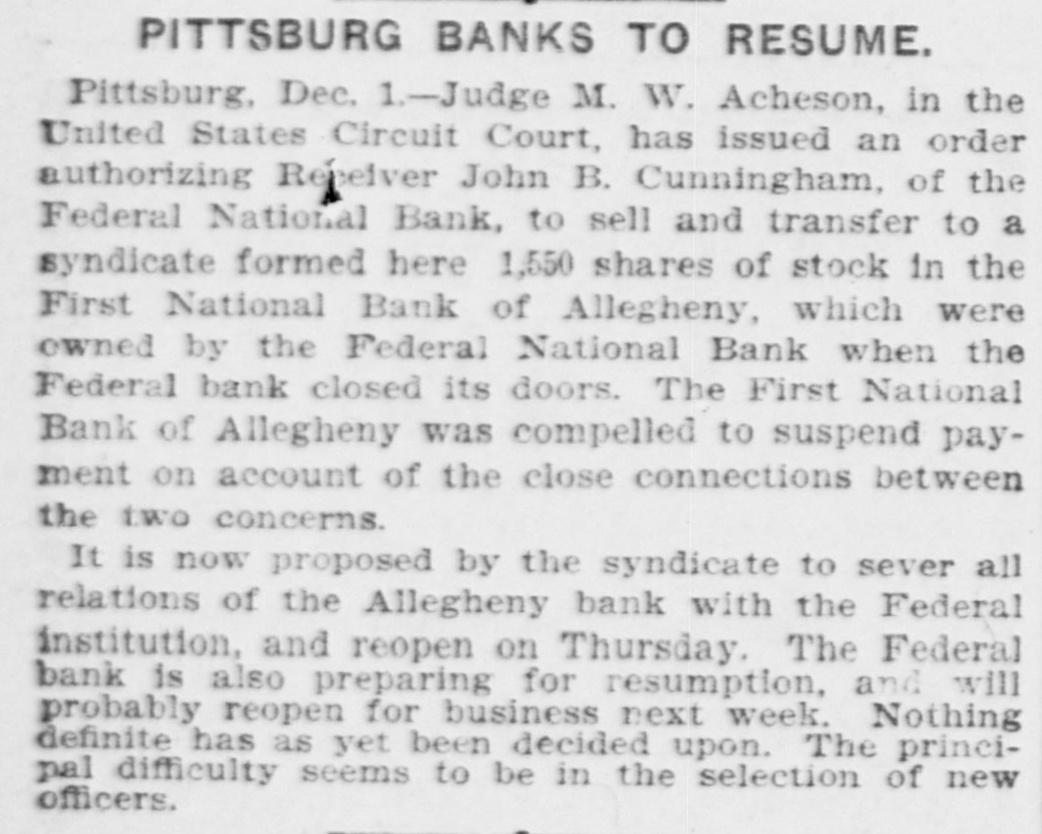
order authorizing Receiver ... to sell and transfer ... 1,550 shares of stock in the First National Bank of Allegheny ... proposed to sever all relations ... and reopen on Thursday (syndicate formed to reorganize bank).
Source
newspapers
8. December 5, 1903 Reopening
Newspaper Excerpt
The comptroller of the currency has authorized the First National Bank of Allegheny to resume business Monday, it being solvent despite the terrific run which caused the doors to close. It resumes with unimpaired capital.
Source
newspapers
9. April 19, 1913 Voluntary Liquidation
Source
historical_nic

Newspaper Articles (22)

Article from Daily New Dominion, October 21, 1903

Click image to open full size in new tab

Article Text

BANK CLOSES DOORS Big Pittsburg Concern has Asked for Receiver. Officers of the Bank say They can pay two Dollars for one-Other Banks Refuse to aid Institution When it was Subjected to a run. The directors of the Federal National bank, of Pittsburg, after being in session nearly all day on Tuesday, found that they could not withstand the demands on the bank, and decieed to ask for aid from other local banks and bankers. This, in almost every instance, it was said last night, was refused. The clearing house committee was in session several times yesterday, and it was decided that no assistance could be given the Federal National. At last midnight the Federal National directors discovered that after a thorough canvass of the local banks and bankers they would be unable to get any assistance, and upon reliable authority it was stated that a resolution was then passed to ask the comptroller of the currency to appoint a receiver for the bank. It was expected that this morning a message will be sent to the comptroller to this effect. Yesterday between $500,000 and $600,000, it was stated, was drawn from the institution by depositors, and banks in Pennsylvania, Ohio, West Virginia and elsewhere. The deposits yesterday were small. Most of the money withdrawn yesterday was by banks for which the Federal National was acting as reserve agent. An ppezl was made to the clearing house committee for assistance, and before noon the committee was in session. The decision that no help could be given the bank was not reached by the committee until late last evening. The Federal National bank is said to have secured some aid from the First National bank of Allegheny yesterday, and the latter institution took care of $70,000 worth of clearings for the Federal bank. Officers of Morgantown banks say that the failure will have no effect whatever in local circles. None of the Morgantown banks had any business with the concern except the Federal Trust empany. The Pittsburg people do not owe anything to this concern but the Federal people owe a small over draft to Pittsburg. It is also stated that information has been received from Pittsburg to the effect that the closed bank will be able to pay two dollars for one when they realize their holdings, Further news was received this afternoon from two of the most conservative banking institutions in the city say that there is no more trouble anticipated. The clearing house has agreed to protect all banks in the city. A ticker dispatch received at three o'clock this afternoon says that the First National Bank of Allegheny has failed. This is unconfirmed.

Article from The Evening Statesman, October 22, 1903

Click image to open full size in new tab

Article Text

Caused by Failure of Federal. Pittsburg, Oct. 22.-The First National bank of Allegheny, owing to connection with the Federal National bank of this city, concluded to enter into liquidation. The directors at 4 this morning after an all night conference, made an announcement in which it is stated that the bank is perfectly solvent, but its connection with the Federal had created such wide distrust and caused such a run that the bank voluntarily enters liquidation. They assert that after all obligations are paid there will be a handsome surplus and profits left for shareholders. The September statement shows a surplus and undivided profits of $150,000. The total resources are $1,750,000.


Article from Waterbury Evening Democrat, October 22, 1903

Click image to open full size in new tab

Article Text

First National of Allegheny Closed Its Doors. PITTSBURG BANK THE CAUSE. President Thompson Issued a State ment Giving Reasons for Closing--Bank Has Ample Assets-The Acting Comptroller Gives His Views on Going Into Voluntary Liquidation. Pittsburg, Oct 22.-At 3:30 o'clock morning Vice President R. J. Stoof the First of ney, this jr, National bank stateAllegheny, issued the following ment after a meeting of the officers and directors with the clearing house committee of the Pittsburg Clearing House association. which lasted from 8 o'clock last evening until 3:20 o' clock this morning: "Allegheny, Pa, Oct 21, 1903. "At a meeting of the board of directors of the First National bank of Allegheny. held this evening, it was resolved that. although the bank has ample assets to pay all of its depositors in full and leave a handsome surplus for the shareholders, yet its supposed connection with the Federal National bank of Pittsburg has created wide distrust and caused a run on this bank to such an extent that we feel It to be our duty to place the bank in voluntary liquidation. and the officers of the bank and directors have decided to make application to the comptroller of the currency to take necessary steps to accomplish this purpose. "JOHN THOMPSON. President." The First National bank of Allegheny was organized in January, 1864, and has a capital stock of $850,000. a surplus of $100.000, and undivided profits of $34,871.80. The officers are as follows: President. John Thompson; vice president. R. J. Stoney, jr: cashier, E. R. Kramer: assistant cashier, John D. Kramer. The First National is one of the oldest banking institutions in Allegheny. The directors of the bank are connected with some of the most important manufacturing interests in Allegheny. Many rumors during the past few days have connected the bank with the Federal National and for two days people have demanded their deposits after learning of the condition of the Pittsburg institution. The clearing house committee bankers have a very sanguine opinion of the general institution, but the two banks so unfortunate at this time were found to be beyond the immediate reach of aid. although both are declared to be solvent and in good condition. The correspondents of the bank are New York. National Park bank: Philadelphia. First National bank: Chicago, First National bank. According to a report of the condition of the bank at the close of business September 9 the liabilities were $1.785.476; amount due depositors. $1.052.128: cash on hand. $113.113. Other resources were given to bring the total to $1,735,476. Washington, Oct 22.--The acting controller of the currency last night received the following telegram from John Thompson, president of the First National bank of Allegheny, Pa: "At a meeting of the directors of the bank. held this evening, it was resolved on account of the adverse rumors in connection with the failure of the Federal National bank of Pittsburg and inability to realize quickly on assets to go into voluntary liquidation." The acting controller states, in this connection. that an application to go into voluntary liquidation cannot be considered until the bank has been officially examined and its condition as. certained.


Article from The Minneapolis Journal, October 22, 1903

Click image to open full size in new tab

Article Text

ALLEGHENY BANK GLOSES Alleghany First National, Affected by the Pittsburg Affair, Will Liquidate. Pittsburg, Oct. 22.-Following the suspension yesterday of the Federal National bank, Pittsburg, the First National bank of Allegheny failed to open its doors for business to-day and its directors have notified the controller of the, currency that the institution has gone into voluntary liquidation and requested him to take the necessary action in such cases. For some time the Allegheny bank has been connected by rumor with the Federal National bank, but it was believed up to late yesterday that it would weather the storm, notwithstanding the heavy run made on it. The Pittsburg stock exchange opening this morning was quiet and trading light. By a vote of the exchange it was decided that for the remainder of the week no bank nor trust stocks will be dealt in. The suspension of the Allegheny bank which has been the representative of the Federal National in the clearing house is looked upon by bankers generally as an almost necessary sequence of the failure of yesterday and it is not believed further trouble will follow.


Article from Alexandria Gazette, October 22, 1903

Click image to open full size in new tab

Article Text

TELEGRAPHIC BREVITIES. Sam Parks, the iron workers' walking delegate, indicted for perjury in connection with his trial for extortion, surrendered himself to the New York authorities today. A man found dead near Clinton, Tenn., today, with a pile of letters burned beside him, is supposed to be E. L. Wentz, the millionaire missing from Big Stone Gap, Va. The First National Bank of Allegheny, Pa., has concluded to go into liquidation. It is claimed that the bank has ample assets to pay all of its depositors in full, and leave a handsome surplus for the shareholders. Charged with forgery, Mrs. Evelyn Sherwood, a well dressed woman who claims to have wealthy relatives in eastern cities, was arrested at Racine, Wis., yesterday for the alleged forging of a check on a bank of that city, Mayor Harrison of Chicago has given notice of his intention to stop all forms of race course gambling and to proceed against handbook evils through the rev-o cation of licenses of all saloons in which that form of the betting evil is permitted. Additional information on the peculiar business methods of that followed in the formation of the United States Shipbuilding Company was given today, in New York by Lewis Nixon, President of the company Mr. Nixon said that previous to the application for a receiver, he had made repeated attempts to hold a meeting of the board of directors, but always failed to get a quorum. The Schwab members of the board failed to attend.


Article from Deseret Evening News, October 22, 1903

Click image to open full size in new tab

Article Text

First National Bank of Allegheny, Pa., Failed to Open for Business Today. CAUSED BY FEDERAL FAILURE. Pittsburg Stock Exchange Decided Not To Deal in Bank or Trust Stocks For Rest of Week. Pittsburg Pa., Oct. 22.-Following the suspension yesterday of the Federal National bank of Pittsburg. the First National bank of Allegheny failed to open for business today and its directors have notified the comptroller of the currency that the institution has gone into voluntary liquidation and requested him to take the necessary action in such cases. For some time the Allegheny has been connected by rumor with the Federal National bank, but it was believed up to late yester lay that it would weather the storm notwithstanding the neavy run made on it, brought about by these reports. The directors, however, at a meeting last night, decided that considering the best interests of all concerned. the action note above should be taken. The Pittsburg Stock exchange opening this morning was quiet and trading light. By the vote of the exchange it was decided that for the balance of the week no bank or trust stocks will be dealt in. The suspension of the Allegheny bank, which has been the representative of the Federal National in the clearing house is looked upon by bankers generally as an almost necessary sequence of the failure yesrerday and they believe that no further trouble will follow. Robert Lyons. deputy comptroller of the currency at Washington, D. C., is in charge of the Allegheny bank. J. D. Kramer, the assistant cashier, stated that as soon as the assets were realized the depositors would be paid off dollar for dollar. Early today Vice President R. J. Stoney Jr., issued the following statement "Allegheny, Pa., Oct. 21, 1903. "At a meeting of the board of directors of the First Naational bank of Allegheny held this evening, Oct. 21, 1903, it was resolved that, although the bank has ample assets to pay all of its depositors in full and leave a handsome surplus for the shareholders, yet its supposed connection with the Federal National bank of Pittsburg has creatd wide distrust and caused a run on this bank to such an extent that we feel it to be our duty to place the bank in voluntary liquidation, and the officers of the bank and directors have decided to make application to the comptroller of the currency to take the necessary steps to accomplish this purpose. (Signed.) "JOHN THOMPSON, President." The First National bank of Allegheny was organized in January, 1864, and has a capital stock of $350,000, a surplus of $100.000 and undivided profits of $34,871.80. The directors of the bank are connected with some of the most important manufacturing interests in Allegheny. The clearing house bankers have a very sanguine opinion of the affair, but the two banks so unfortunate at this time were found to be beyond the immediate reach of aid, although both are declared to be solvent and in good condition. The correspondents of the First National bank are as follows: New York, National Park bank; Philadelphia. First National bank; Chicago, First National bank. The report of the condition of the First Allegheny National bank of Allegheny at the close of business on Sept. 9, 1903, is as folows: RESOURCES. Loans and discounts $1,240,980 Overdrafts, secured and unsecured 3,012 U. S. bonds to secure circulation. 100,000 Premiums on U. S. bonds 6,000 Stocks, securities, etc 60,350 Banking house furniture and fixtures 118,625 Other real estate owned 5,729 Due from national banks (not 5,721 reserve agents) Due from state banks and bankers 4,158 Due from approved reserve 89,610 agent 834 Checks and other cash items 27,026 Exchanges for Clearing House 2,311 Notes of other national banks Fractional paper currency, 128 nickels and cents 113,113 Lawful money reserve in bank 7,850 Due from U.S. treasurer Total $1,735,476 LIABILITIES. $ 350,000 Capital stock paid in 100,000 Surplus fund Undivided profits, less expenses 53,630 and taxes paid National bank notes outstand100,000 ing Individual deposits subject to 1,052,128 check 76,456 Demand certificates of deposits 3,205 Cashier's checks outstnading $1,735,476 Total Washington, Oct 22.-The acting comptroller of the currency said today that the application of the First Na-


Article from The Sun, October 23, 1903

Click image to open full size in new tab

Article Text

FINANCIAL AND COMMERCIAL THURSDAY, Oct. 22. The dominant feature of the stock market to-day was the demand for the investment issues. Evidences of a growing interest in securities of this grade have not been wanting of late and have been duly emphasized in this column. But to-day the dealings in bonds quite overshadowed operations in the stock market proper. All the established railway bonds were dealt in in good volume and at advancing prices, and, indeed, the prices of these bonds have already risen SO that the choice of bargains among them is by no means what it was even two weeks since. There is a natural order in operations of this kind which is almost invariably followed. The demand converges, at first, on issues of the very best character, first mortgage bonds of the well known railway lines yielding only a small return, but furnishing the very highest security, whose prices under almost all conditions fluctuate but little. It is obvious that a very small advance, comparatively, in the prices of bonds of this kind brings them to a point where their interest yield becomes sensibly diminished and where the prospective investor is inclined to turn from them to consideration of bonds which, although not quite SO well secured, are still thoroughly safe and afford a greater interest return. In time the supply of good bonds at suitable prices becomes exhausted and the buying spreads to preferred stocks, and so through the entire security list. Whether the investment of capital will proceed steadily along this path in the coming months cannot, of course, be said to be a settled question. It has, however, started on the journey after its accustomed fashion, and in the past its footsteps have rarely wavered from the beaten way. The combined strength and dulness of the stock market are, too, just what would naturally be expected under these circumstances. Bearish operators have discovered that there is no further liquidation by the general public upon the receipt of unfavorable news, a fact which usually indicates that these unfavorable developments were long ago foreseen and duly prepared for. Hence, while a "bull market" is by no means in order yet, and while any attempt of speculators to inaugurate such an affair would undoubtedly meet with disaster, prices of stocks stubbornly resist artificial attempts to depress them and in their own good time may be expected to display the effects of the general market convalescence. It seems to be clear that a very sharp line is now being drawn by all careful students and dispassionate observers of financial affairs between such events as the collapse of overboomed local enterprises in various cities, dragging down with them trust companies and other money lending institutions which have advanced funds upon forms of security for which there is little market, and the general business life of the whole country, especially that in the Western and Southwestern agricultural sections. It would be very singular if we had seen the last of suspensions, temporary or otherwise, of institutions of this character because of reasons like the foregoing. The important point for investors and speculators alike to remember is that such disasters as these-many of them of only small importance at best-are not of such a character as to involve sales of securities in Wall Street. While of course, they have a perceptibly greater bearing upon the general situation than the bursting of such incorporation bubbles in the industrial world as prevailed SO notably in 1899, the two phenomena are really kith and kin, and the wealth and prosperity of the country are such that far less harm to the business life of the country. as a whole, will be done by them than many people might suppose. Prices of stocks to-day closed very irregularly, most of the active issues, however, showing small advances. Among the railroad issues the Rock Island shares were especially strong, while in the industrial list a sharp break in Republic Iron and Steel preferred followed the announcement that a-number of the employees of the Republic Iron and Steel Company in Minnesota had been laid off. The decision of a local court in Montana awarding possession of the Minnie Healy mine to the Amalgamated Copper Company's chief antagonist, and restraining the Boston and Montana company from paying any dividends to the Amalgamated Company, but refusing to put the Boston and Montana company in the hands of a receiver, was really more favorable to the Amalgamated company than had been expected. Litigation over these matters, is of course merely in its preliminary stage and must pass through the higher courts before a final adjustment is reached. As the Amaigamated company has not been in receipt of the Boston and Montana dividends for some time, the preliminary decision to-day does not change the status of affairs in the least. The decision of the First National Bank of Allegheny, Pa., to go into voluntary liquidation, as a result of the suspension of the Federal National Bank of Pittsburg. with which it was allied, was considered as of little importance in Wall Street, because the solvent condition of the bank was perfectly realized. The one other important new development of the day was the declaration of an extra dividend of


Article from The Indianapolis Journal, October 23, 1903

Click image to open full size in new tab

Article Text

Request Will Not Be Granted Until Examination of the Bank's Condition Is Completed. BIG CONCERN EMBARRASSED ACME HARVESTER COMPANY, OF PEORIA, IN FINANCIAL STRAITS. Its Affairs Placed in Control of a Committee-Failure of a Cold Storage Company. PITTSBURG, Oct. 22.-Following the suspension yesterday of the Federal National Bank, Pittsburg, the First National Bank of Allegheny failed to open its doors for business to-day. Its directors notified the controller of the currency that the institution had gone into voluntary liquidation and requested him to take the necessary action in such cases. The controller, however, replied that no voluntary liquidation could take place until the conditon of the bank had been examined. For some time the Allegheny Bank has been connected by rumor with the Federal National Bank, but it was believed up to late yesterday that it would weather the storm, notwithstanding the heavy run made on it, brought about by these reports. The directors, however, at a meeting last night, decided that, considering the best interests of all concerned, the action noted above should be taken. The following statement, prepared last night and signed by John Thompson, president, was made public today: "At a meeting of the board of directors of the First National Bank of Allegheny, held this evening, Oct. 21, 1903, it was resolved that although the bank has ample assets to pay all of its depositors in full and leave a handsome surplus for Its creditors, yet its supposed connection with the Federal National Bank of Pittsburg has caused wide distrust and caused a run on this bank to such an. extent that we feel it to be our duty to place the bank in voluntary liquidation, and the officers of the bank and the directors have decided to make application to the controller of the currency to take the necessary steps to accomplish this purpose." The First National Bank of Allegheny was organized in 1864. The officers are as follows: President, John Thompson; vice president, R. J. Stoney, jr.: cashier, E. R. Kramer; assistant cashier. John D. Cramer. The correspondents of the bank are as follows: New York, National Park Bank; Philadelphia, First National Bank; Chicago. First Natonal Bank. The report of the condition of the bank at the colse of business Sept. 9, 1903, was as follows: -Resources


Article from Bismarck Daily Tribune, October 23, 1903

Click image to open full size in new tab

Article Text

Pittsburg, Oct. 23.-Following the suspension Wednesday of the Federal National bank of Pittsburg the First National bank of Allegheny failed to open its doors for business during the day and its directors have notified the comptroller of the currency that the institution has gone into voluntary liquidation and requested him to take the necessary action in such cases. For some time the Allegheny bank has been connected by rumor with the Federal National bank, but it was believed that it would weather the storm, notwithstanding the heavy run on it brought about by these reports. The directors, however, at a meeting, decided that, considering the best interests of all concerned, the action noted in the foregoing should be taken. The Pittsburg Stock Exchange opening was quiet and trading light. By a vote of the exchange it was decided that for the remainder of the week no bank or trust stocks will be dealt in. The suspension of the Allegheny bank, which has been the representative of the Federal National bank in the clearinghouse, is looked upon by bankers generally as the almost necessary sequence of the first failure and that no further trouble will follow. All of the outside banks which have been doing their clearing through the Federal National and the First National of Allegheny have made arrangements with other banks to care for their paper in the future. Bank Examiner E. J. Vaughan has been appointed receiver for the bank by the comptroller of the currency.


Article from Americus Times-Recorder, October 23, 1903

Click image to open full size in new tab

Article Text

RUN CLOSES BANK IN ALLEGHENY, PA. First National Announces Its Voluntary Liquidation. ISSUE OFFICERS STATEMENT. Was Organized in January, 1864, and Had Capital Stock of $350,000-Connection with Federal National said To Have Created Distrust. Pittsburg, Oct. 22.-Early today Vice President R. J. Stoney, Jr., of the First National Bank of Allegheny, issued the following statement after a meeting of the officers and directors with the clearing house committee of the Pittsburg clearing house association, which lasted from 8 o'clock last evening until this morning: "Allegheny, Oct. 21.-At a meeting of the board of directors of the First National Bank of Allegheny held this evening, Oct. 21, 1903, it was resolved that although the bank has ample assets to pay all of its depositors in full and leave a handsome surplus for the shareholders, yet its supposed connection with the Federal National bank of Pittsburg has created wide distrust and caused a run on this bank to such an extent that we feel it to be our duty to place the bank in voluntary liquidation and the officers of the bank and directors have decided to make application to the comptroller of the currency to take necessary steps to accomplish this purpose. (Signed) John Thompson, president." The First National Bank of Allegheny was organized in January, 1864, and has a capital stock of $350,000, a surplus of $100,000 and undivided profits of $34,971. The officers are as follows: President, John Thompson; vice president, R. J. Stoney, Jr.; cashier, E. R. Kramer; assistant cashier, John D. Kramer. For some time the Allagheny bank has been connected by rumor with the Federal National bank, but it was believed up to a late hour yesterday that it would weather the storm notwithstanding the heavy run made on it brought about by these reports. The directors, however, at a meet ing last night, decided that consider ing the best interests of all concerned the action noted above should be taken. The Pittsburg Stock Exchange opening this morning was quite and trading light. By a vote of the exchange it was de cided that for the balance of the week no bank or trust stocks will be dealt in. The suspension of the Allegheny bank which has been the representative of the Federal National in the clearing house is looked upon by bankers generally as an almost necessary sequence of the failure yesterday and believe that no further trouble will follow. Federal National and the First National of Allegheny have made arrangement with other banks to care for their papers in the future. This morning a small crowd of depositors gathered in front of the First National Bank of Allegheny. There appeared to be lit. tle excitement among the depositors though several were restless and wish ed to gain admission to the bank The clerks of the bank were busy on their books the entire morning. Robert Lyons, deputy comptroller of the cur rency at Washington, was in charge of the bank. D. Kramer, the assistant cashier, was at the bank this morning and stated as soon as the assets were realized the depositors would be paid off dollar for dollar. He said he did not think any of the other banks of Al legheny would be affected.


Article from The Barre Daily Times, October 23, 1903

Click image to open full size in new tab

Article Text

ALLEGHENY BANK FAILS First National Goes Into Voluntary Liquidation. FEARED RESULT OF RUN. Supposed Connection With Defunct Federal National of Pittsburg Had Aroused Distrust Among Depositors. Pittsburg, Oct. 23,-Vice President R.J. Stoney, Jr., of the First National Bank of Allegheny, Issued the following statement after a meeting of the officers and directors with the clearing house committee of the Pittsburg Clearing House association, which lasted from 8 p. m. until 3:20 a. m.: "At a meeting of the board of directors of the First National Bank of Allegheny it was resolved that. although the bank has ample assets to pay all of the depositors in full and leave a handsome surplus for the shareholders. yet its supposed connection with the Federal National bank of Pittsburg has created wide distrust and caused a run on this bank to such an extent that we feel it to be our duty to place the bank in voluntary liquidation, and the officers of the bank and directors to make application to the comptroller of the currency to take necessary steps to aecomplish this purpose." Organized In 1864, "The First National Bankof Allegheny was organized in January, 1864, and has a capital stock of $350,000, a surplus of $100,000 and undivided profits of $34,871.80. The officers are as follows: President, John Thompson; vice president, R, J. Stoney, Jr.; cashier, E R. Kramer; assistant cashier, John D. Kramer. The First National is one of the oldest banking institutions of Allegheny. The directors of the bank are connected with some of the most important manufacturing interests in Allegheny. Many rumors during the past few days have connected the bank with the Federal, and for two days people have demanded their deposits after learning of the condition of the Pittsburg Institution. The clearing house committee bankers have a very sanguine opinion of the general situation, but the two banks so unfortunate at this time were found to be beyond the immediate reach of aid, although both are declared to be solvent and in good condition.


Article from The Savannah Morning News, October 24, 1903

Click image to open full size in new tab

Article Text

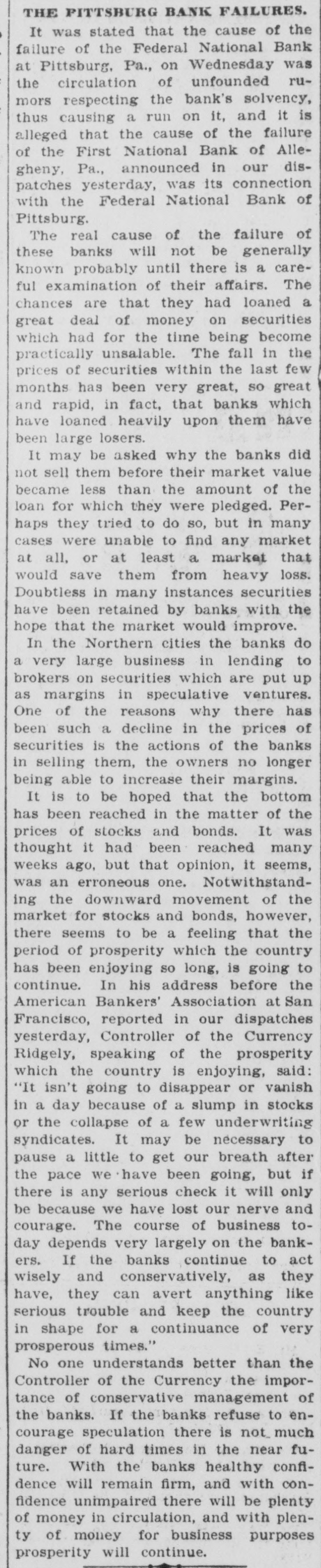
THE PITTSBURG BANK FAILURES. It was stated that the cause of the failure of the Federal National Bank at Pittsburg. Pa., on Wednesday was the circulation of unfounded rumors respecting the bank's solvency, thus causing a run on it, and it is alleged that the cause of the failure of the First National Bank of Allegheny, Pa., announced in our dispatches yesterday, was its connection with the Federal National Bank of Pittsburg. The real cause of the failure of these banks will not be generally known probably until there is a careful examination of their affairs. The chances are that they had loaned a great deal of money on securities which had for the time being become practically unsalable. The fall in the prices of securities within the last few months has been very great, so great and rapid, in fact, that banks which have loaned heavily upon them have been large losers. It may be asked why the banks did not sell them before their market value became less than the amount of the loan for which they were pledged. Perhaps they tried to do so, but in many cases were unable to find any market at all, or at least a market that would save them from heavy loss. Doubtless in many instances securities have been retained by banks with the hope that the market would improve. In the Northern cities the banks do a very large business in lending to brokers on securities which are put up as margins in speculative ventures. One of the reasons why there has been such a decline in the prices of securities is the actions of the banks in selling them, the owners no longer being able to increase their margins. It is to be hoped that the bottom has been reached in the matter of the prices of stocks and bonds. It was thought it had been reached many weeks ago, but that opinion, it seems, was an erroneous one. Notwithstanding the downward movement of the market for stocks and bonds, however, there seems to be a feeling that the period of prosperity which the country has been enjoying so long, is going to continue. In his address before the American Bankers' Association at San Francisco, reported in our dispatches yesterday, Controller of the Currency Ridgely, speaking of the prosperity which the country is enjoying, said: "It isn't going to disappear or vanish in a day because of a slump in stocks or the collapse of a few underwriting syndicates. It may be necessary to pause a little to get our breath after the pace we have been going, but if there is any serious check it will only be because we have lost our nerve and courage. The course of business today depends very largely on the bankers. If the banks continue to act wisely and conservatively, as they have, they can avert anything like serious trouble and keep the country in shape for a continuance of very prosperous times." No one understands better than the Controller of the Currency the importance of conservative management of the banks. If the banks refuse to encourage speculation there is not_ much danger of hard times in the near future. With the banks healthy confidence will remain firm, and with confidence unimpaired there will be plenty of money in circulation, and with plenty of money for business purposes prosperity will continue.


Article from The Bamberg Herald, October 29, 1903

Click image to open full size in new tab

Article Text

Cream of News. Brief Summary of Most Important Events of Each Day. -The increased rate on lumber said to be having a depressing effect on the business in Georgia. Land owners are thinking of joining the saw mill men in their fight against the railroads. -Sensational developments are ex pected at a meeting of the creditors of the Southern Car and Foundry Company at Chattanooga, when officials of the bankrupt corporation will be asked to explain certain actions al leged to be irregular. -President Roper, of the Anniston, Ala., Trades Council, is suing the editor of The Hot Blast for $10,000 libel damages for stating that he was in crap game. -Details of the cave-in of the roofs of the subway in New York Saturday night, in which ten men were killed, show that the accident was due to neg ligence on the part of the superintendent, who knew the rock above was cracked. -Jesse McClure, a farm hand, mar ders his two sons, aged 5 and 7 years near Marion, Ind., and then surrez ders. Sheriff spirited McClure away Indianapolis jail to prevent a lynching -Mrs. Iverson, of Monterey, Cai. strangled her three children to death saying that a supreme, power had commanded.her/to kill them. She has had been ill for a long time, and shown signs of mental dΓ©rangement -James L. Blair, of St. Louis, who is alleged to have misappropriated funds of the St. Louis fair, is unable to answer fully, on account of his ill ness. -Professor Thurston, of Cornell university, dies suddenly at his home on the campus. --Fire at Ashland, Wis., Sunday destroyed a fine block of buildings, doing $150,000 damage. -Dispatches from St. Petersburg say there is a growing ill-feeling in Russia against the United States and England on account of the supposed sympathy of these countries for Ja pan. -Revolutionary bands, operating in eastern Macedonia, are reported to be returning to Bulgaria and Sofia's streets are thronged with them. They beg for food and shelter. -Venezuela is said to have concen trated a large body of troops on the Colombian frontier, in order to indirectly aid the new opposition to the Colombian government. -A Japanese secretary of legation was refused permission to land at Yongampho. One report states that fight occurred. War is likely at any time between Russia and Japan. -Silas Hulin was chief witness in the habeas corpus proceedings of Clar ence Peak at Knoxville, Tenn., Peak being under eighteen years sentence for killing Hulin. Court holds that Hulin is dead to all intents and purposes. -Two survivors of the schooner J. T. Williams arrived at Newport News, Va., Thursday. Out of fourteen men on board these two were saved. The vessel was sunk during last Friday's storm. -Felix Hall, negro, was hanged at Birmingham, Ala., Thursday. On the first drop the rope slipped and the man was lowered and hanged again, -Union machinists in Lonsdale Tenn., shops of the Southern railway quit work because non-union men were allowed to dismantle engines. -The Southern Steamship Company at Mobile, Ala., has been reorganized with a capital of $150,000. -Monument to the confederate dead was unveiled at Greenwood S. Thursday. -Following the suspension of Federal National bank, Pittsburg, Pa. the First National bank of Allegheny fail ed to open its doors for business Thursday. -The confederate veterans of Macon, Ga., are preparing to extend warm welcome to all veterans who tend the state fair in that city. -Addressing the pan-American con ference of bishops, Bishop Gailor said the Episcopal church should change its name, eschew Anglicism and become an American church. -Speaking of the race problem be fore the American Missionary Society, Dr. Gladden declared that the south deserved great credit for what it had done for the negro. of -While Congressman Baker, Brooklyn, was speaking for Tom Johnson at Cincinnati, he was whipped and drenched by the driver of a sprinkling cart. -The Alaskan boundary decision has been brought up for discussion in the Canadian senate. -Brown, the New Orleans cotton king, in a statement, declares that French money was used to make his famous corner and that it will result in a permanent higher price for the fleecy staple. -There has been no change in the Far Eastern situation. War between Japan and Russia seems probable. -Charles Kratz, the alleged St. Louis boodler who jumped his bon. in for $20,000, has been captured Mexico.


Article from Reporter and Farmer, November 5, 1903

Click image to open full size in new tab

Article Text

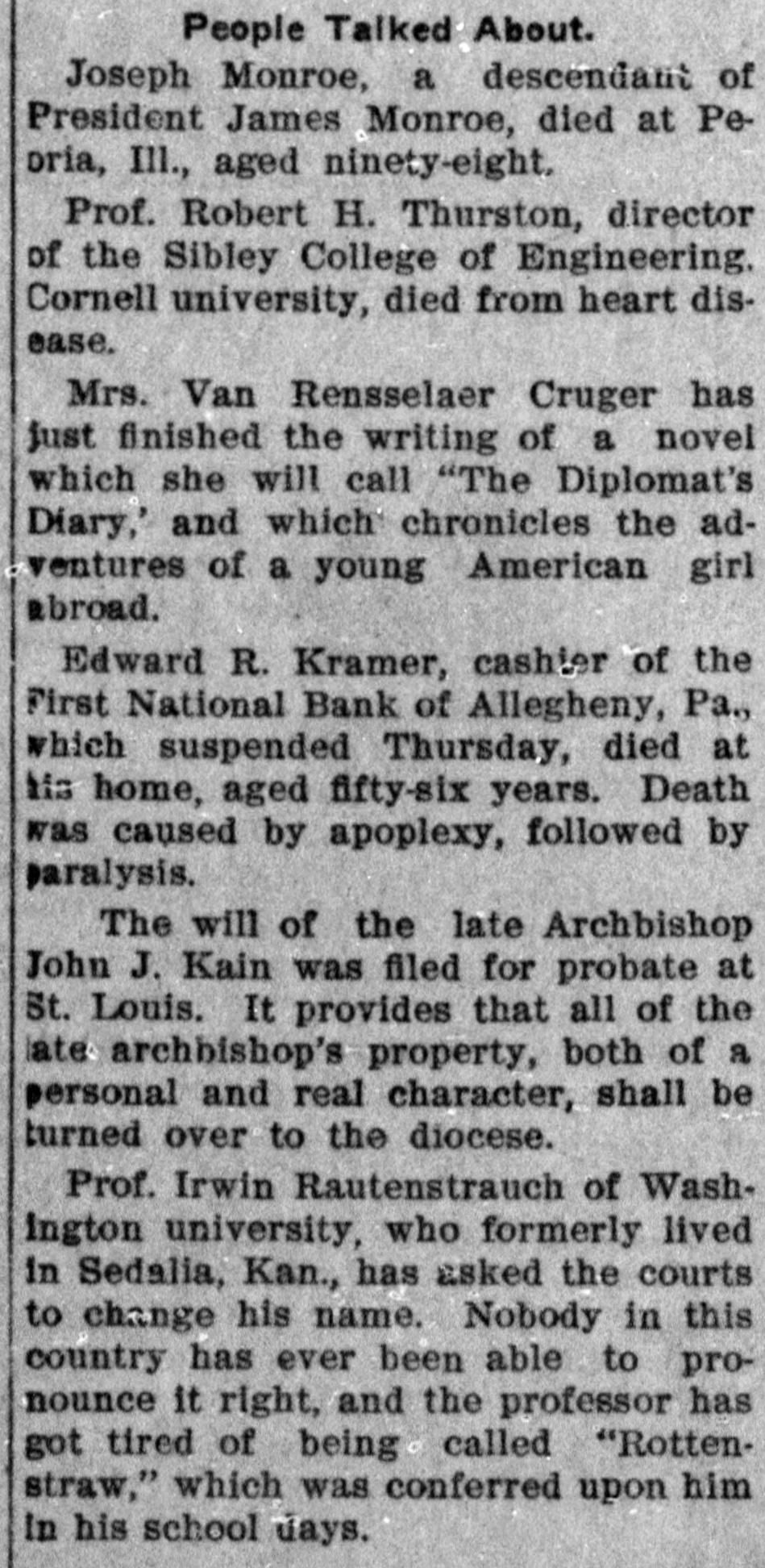
People Talked About. Joseph Monroe, a descendant of President James Monroe, died at Peoria, Ill., aged ninety-eight, Prof. Robert H. Thurston, director of the Sibley College of Engineering. Cornell university, died from heart disease. Mrs. Van Rensselaer Cruger has just finished the writing of a novel which she will call "The Diplomat's Diary,' and which chronicles the adventures of a young American girl abroad. Edward R. Kramer, cashier of the First National Bank of Allegheny, Pa., which suspended Thursday, died at tis home, aged fifty-six years. Death was caused by apoplexy, followed by paralysis. The will of the late Archbishop John J. Kain was filed for probate at St. Louis. It provides that all of the late archhishop's property, both of a personal and real character, shall be turned over to the diocese. Prof. Irwin Rautenstrauch of Washington university, who formerly lived in Sedalia, Kan., has asked the courts to change his name. Nobody in this country has ever been able to pronounce it right, and the professor has got tired of being called "Rottenstraw," which was conferred upon him In his school days.


Article from The Pioneer Press, November 5, 1903

Click image to open full size in new tab

Article Text

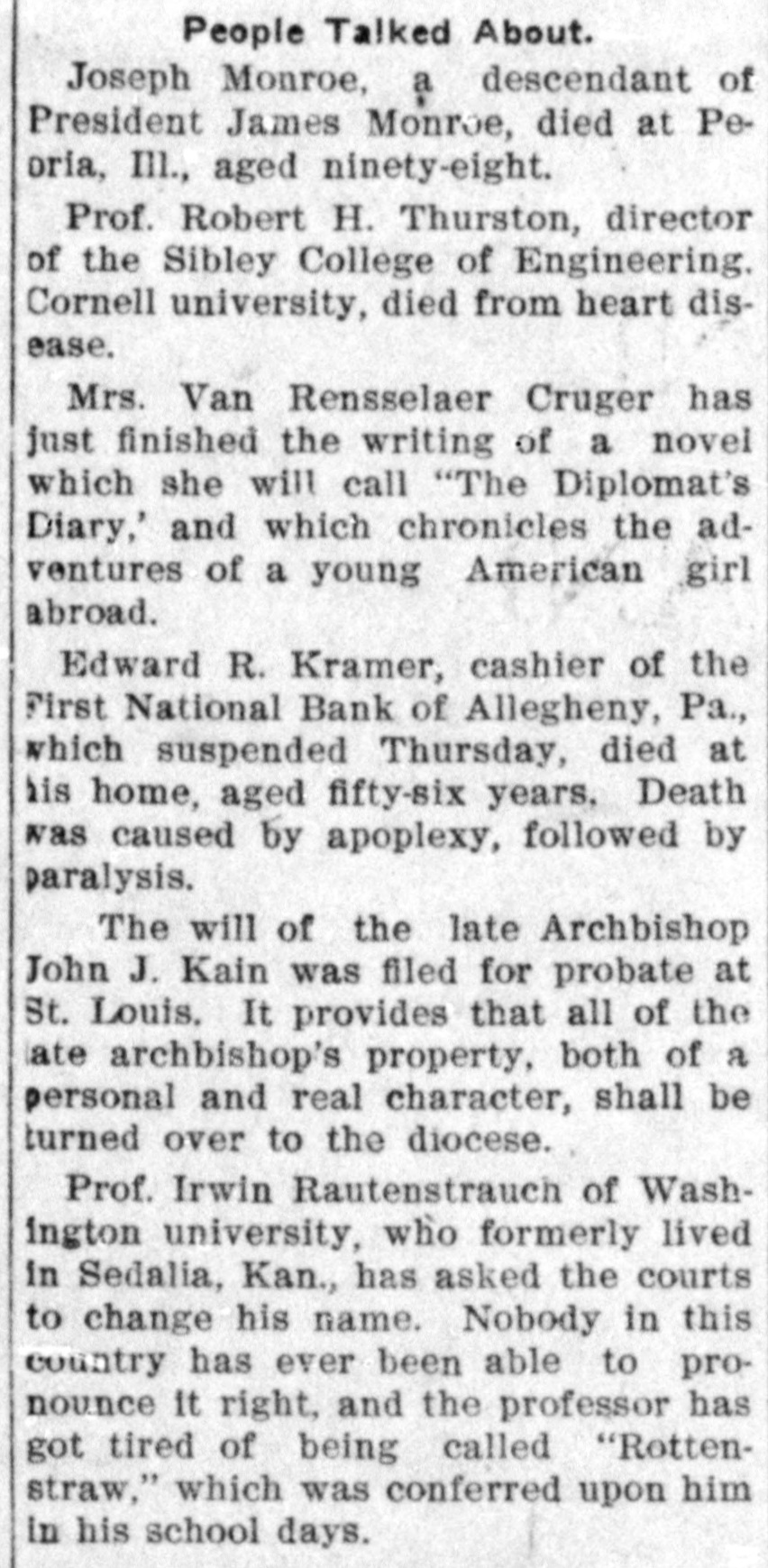
People Talked About. Joseph Monroe, a descendant of President James Monroe, died at Peoria, III., aged ninety-eight. Prof. Robert H. Thurston, director of the Sibley College of Engineering. Cornell university, died from heart disease. Mrs. Van Rensselaer Cruger has just finished the writing of a novel which she will call "The Diplomat's Diary,' and which chronicles the adventures of a young American girl abroad. Edward R. Kramer, cashier of the First National Bank of Allegheny, Pa., which suspended Thursday, died at his home, aged fifty-six years, Death was caused by apoplexy, followed by paralysis. The will of the late Archbishop John J. Kain was filed for probate at St. Louis. It provides that all of the ate archbishop's property, both of a personal and real character, shall be turned over to the diocese. Prof. Irwin Rautenstrauch of Washington university, who formerly lived in Sedalia, Kan., has asked the courts to change his name. Nobody in this country has ever been able to pronounce It right, and the professor has got tired of being called "Rottenstraw," which was conferred upon him in his school days.


Article from The Herald-Advance, November 6, 1903

Click image to open full size in new tab

Article Text

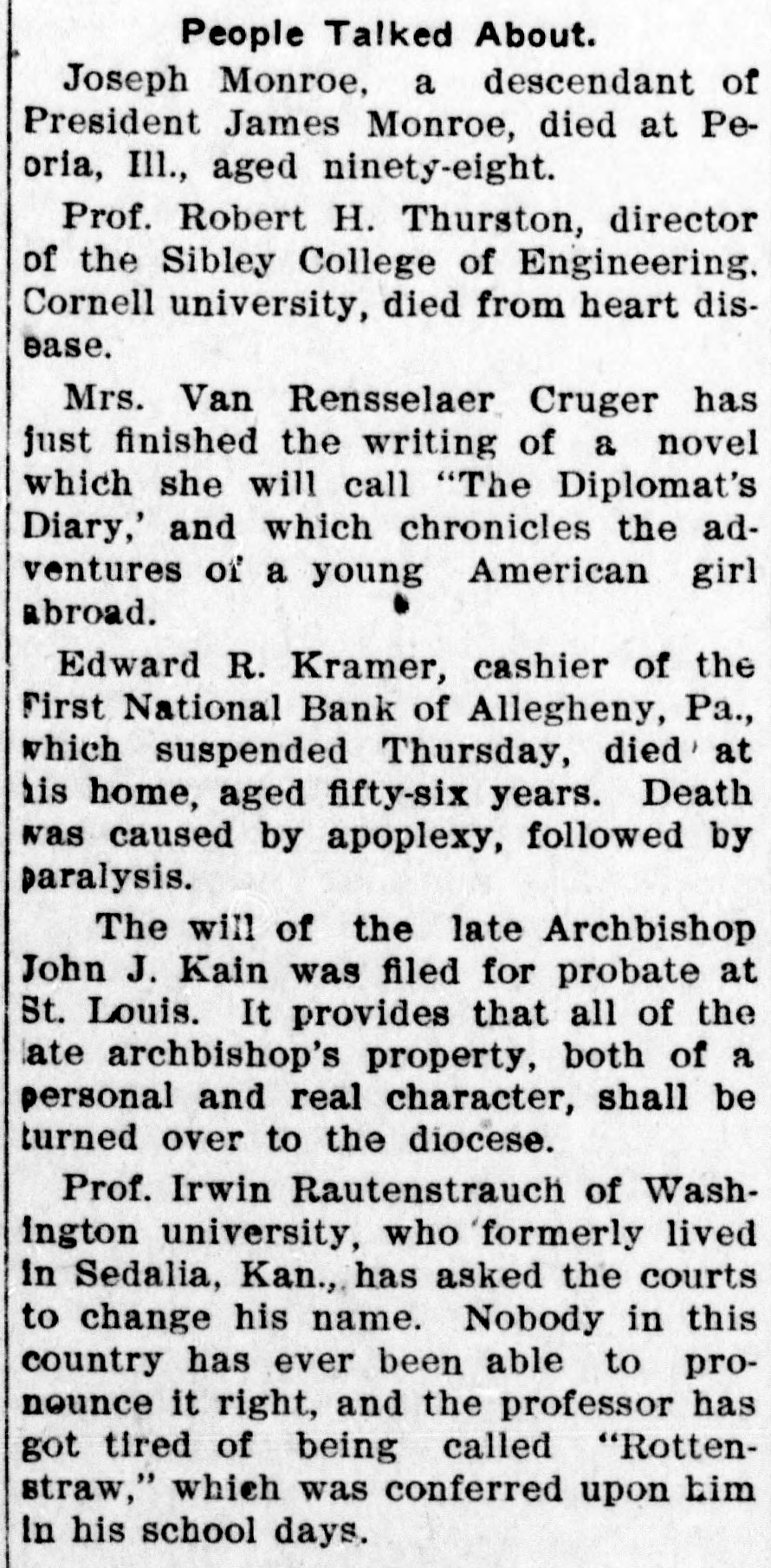
People Talked About. Joseph Monroe, a descendant of President James Monroe, died at Peoria, III., aged ninety-eight. Prof. Robert H. Thurston, director of the Sibley College of Engineering. Cornell university, died from heart disease. Mrs. Van Rensselaer Cruger has just finished the writing of a novel which she will call "The Diplomat's Diary,' and which chronicles the adventures of a young American girl abroad. Edward R. Kramer, cashier of the First National Bank of Allegheny, Pa., which suspended Thursday, died at his home, aged fifty-six years. Death was caused by apoplexy, followed by paralysis. The will of the late Archbishop John J. Kain was filed for probate at St. Louis. It provides that all of the ate archbishop's property, both of a personal and real character, shall be turned over to the diocese. Prof. Irwin Rautenstrauch of Washington university, who formerly lived in Sedalia, Kan., has asked the courts to change his name. Nobody in this country has ever been able to pronounce it right, and the professor has got tired of being called "Rottenstraw," which was conferred upon him In his school days.


Article from New-York Tribune, December 2, 1903

Click image to open full size in new tab

Article Text

PITTSBURG BANKS TO RESUME. Pittsburg, Dec. 1.-Judge M. W. Acheson, in the United States Circuit Court, has issued an order authorizing Receiver John B. Cunningham, of the Federal National Bank, to sell and transfer to a syndicate formed here 1,550 shares of stock in the First National Bank of Allegheny, which were owned by the Federal National Bank when the Federal bank closed its doors. The First National Bank of Allegheny was compelled to suspend payment on account of the close connections between the two concerns. It is now proposed by the syndicate to sever all relations of the Allegheny bank with the Federal institution, and reopen on Thursday. The Federal bank is also preparing for resumption, and will probably reopen for business next week. Nothing definite has as yet been decided upon. The principal difficulty seems to be in the selection of new officers.


Article from The Spokane Press, December 5, 1903

Click image to open full size in new tab

Article Text

Will Resume. WASHINGTON, Dec. 5. - The comptroller of the currency has authorized the First National Bank of Allegheny to resume business Monday, it being found solvent despite the terrific run which caused the doors to close. It resumes with unimpaired capital.


Article from Daily Capital Journal, December 5, 1903

Click image to open full size in new tab

Article Text

The Bank Reopened. Washington, Dec. 5.-The comptroller of the currency has authorized the First National Bank of Allegheny to resume business Monday, it being solvent, despite the terrific run which recently caused its doors to close. It resumes with unimpaired capital.


Article from The Indianapolis Journal, December 6, 1903

Click image to open full size in new tab

Article Text

TRADE, LABOR, INDUSTRY. The board of directors of the Westinghouse Airbrake Company yesterday declared the regular quarterly dividend of 2Β½ per cent. and an extra dividend of 3Β½ per cent. payable to stockholders of record Jan. 11, 1904. Acting on the orders of the United States Steel Corporation retrenchment is making in all departments of the Bessemer & Lake Erie Railroad. Operators, trainmen and employes of all classes to the number of several hundred have been discharged. Elisha W. Bucklin and Felton M. Lyttle, stock brokers of Boston, doing business as E. W. Bucklin & Co., filed a voluntary petition in bankruptcy yesterday. James D. Lowell, of Boston, was appointed receiver. Liabilities are placed at $63,870, all unsecured. It has been decided to amalgamate the Algemeine and Union Elektricitaets companies of Germany, which had already formed a working agreement. The Union Company's 24,000,000 shares will be transformed into 16,000,000 shares of the Algemeine shares, making the capital of the latter $19,000,000. Twenty-seven men who arrived at Coal Creek, Tenn., Friday from St. Louis to work in the mines were escorted out of the town during the night by a body of 500 striking miners. It is understood the St. Louis miners came from Colorado. They said they did not know the miners were on strike. The controller of the currency has authorized the First National Bank of Allegheny, Pa., to resume business Monday next. Charles E. Speer, president of the First National Bank of Pittsburg, has been elected president and a reorganization of the board of directors has been effected. The bank was found to be entirely solvent and will resume with unimpaired capital. Judge Thayer, acting as special judge of the United States Circuit Court at St. Louis, granted an injunction yesterday restraining seventy-five members of the St. Louis Typefounders' Union No. 5 and other former employes of the St. Louis branch of the American Typefounders' Company from interfering with the business or the present employes of the company. Headquarters of the Brotherhood of Railroad Freight and Baggagemen of America at Lancaster, Pa., was closed yesterday at the request of President Robert F. Neill. General Secretary John Rupeley, it is said, was directed to attend the biennial convention of the brotherhood, now in session in Baltimore. On Rupeley's failure to appear to answer charges that certain of his actions were detrimental to the brotherhood the officers decided to close the office until a thorough investigation be made. William Clarke & Sons, bankers at New York, yesterday assigned for the benefit of creditors to the Van Norden Trust Company. The firm is composed of James and Hudson Clarke and had a mercantile rating of from $75,000 to $125,000. The failure is said to be intended for a clearing-up business rather than because of any great deficiency in accounts. Attorneys for the firm announced that "it is merely a formal assignment." The firm expects to pay dollar for dollar and then have a balance to spare. Cotton manufacturers at Fall River have received circulars from manufacturers in North Carolina inviting them to attend a meeting to be held in Charlotte, N. C., on Tuesday to consider some plan for a united curtailment to meet the cotton crop conditions. Two of the Fall River mill owners have gone to North Carolina in an unofficial capacity, but it is said that if they report any strength of the movement in the South it is possible that an effort will be made to bring about favorable action on a curtailment proposition. The Austrian cotton manufacturers are seriously affected by the advance in the American cotton market. A majority of the manufacturers were entirely unprepared for the rise, carrying very small stocks, and consequently they will be obliged to restrict their output to the lowest amount. Some factories are expected to shut down temporarily. Experts say that the entire continental cotton industry must be readjusted to meet the new conditions and some profess to see consolation in the probability that the general curtailment of manufactured goods will tend to a healthier condition in the cotton industry of Europe.


Article from Ottumwa Tri-Weekly Courier, December 8, 1903

Click image to open full size in new tab

Article Text

BANK HAS REOPENED FIRST NATIONAL BANK OF ALLE. GHENY, PA., IS REORGANIZED AFTER BREAK. First Pittsburg, Pa.. Dec. 7.-The which National bank of Alleghany, closed its doors shortly after the suspension of the Federal National bank of this city several weeks ago, was reopened today., The institution has been reorganized and the men at its head are stableland experienced business men.


Article from Morgan County Democrat, December 11, 1903

Click image to open full size in new tab

Article Text

George D. Woods, owner of private banks in Iowa at Colfax, Mitchellville, Ira and Baxter, committed suicide in Colfax without any apparent cause A labor war has been started in the Fox River valley, where Chicago firms moved to escape strikers. Cold weather has stimulated trade throughout the country. Bunan-Varilla's name has been added to the diplomatic roll in Washington as minister from Panama. The supreme court has declared that the Minnesota sugar bounty is unconstitutional. Yale won the annual intercollegiate debate in New Haven with Harvard vard. An employe in Pittsburg of the United States Express company confessed that for years an organized gang had been robbing the company of packages. A tiny phial of actinium valued at $100,000,000 a pound has reached Dr. George F. Kunz, the New York mineral and diamond expert. In its official trial trip over the Cape Ann course the new cruiser Des Moines exceeded its contract requirement, making an average of 16.633 knots an hour Lewis Jackson (colored) was lynched by a mob near Tampa, Fla. for attempted assault on a white girl. Creditors holding claims for $300,000 decided to support John Alexander Dowie, and appointed a committee to assure the overseer of their confidence in him and to offer him aid in ousting the receivers. The Miami Military institute at Germantown O., was destroyed by fire. Fire destroyed the big lake steamer J. Emory Owen at Sturgeon Bay, Wis., with 80,000 busheis of grain. The Romanic sailed from Boston with 1,583 steerage passengers for Meditorransan ports. This is a record list. Secretary of War Root in his annual report gives the army's strength at 2,764 officers and 55,500 men: 39,068 of the latter are in the United States and 14,669 in the Philippines. Conductor McGrath, Brakeman W. E Crowley and Charles Kaughn were killed in a railway collision near Worcester, Mass. The last pile has been driven in the 30-mile trestle across the Great Salt lake. which is a part of the cutoff of the Southern Pacific road. John Spires. aged 30, killed Lina Perkins, aged 15. at Winslow, N. M., and then killed himself. Jealousy was the motive. Six labor union men were indicted in Chicago for conspiracy to spirit away witnesses to prevent the prosecution of one of their brethren for vandalism. Dell Thompson killed Addle Hacker, his financee, and then committed suicide at a wedding feast in Camden N.J., the couple having agreed to die together Two hundred Rhode Island clergymen have begun a crusade against divorce and will refuse to remarry divorced persons. The comptroller of the currency has authorized the First national bank of Allegbeny Pa., to resume business.