Multiple contemporary articles (Jan 31–Feb 21, 1916) report a baseless rumor-driven run on the Farmers Deposit Savings Bank in Pittsburg, Pa. Bank met withdrawals, paid depositors with extra tellers and police kept order; officials offered $5,000 reward for those who started the rumors. No suspension or receivership is mentioned, so classified as run_only.
Events (1)
1.January 29, 1916Run
Cause
Rumor Or Misinformation
Cause Details
Baseless/malicious rumors circulated that the bank was in financial difficulties; officials offered $5,000 reward for originators and threatened prosecution.
Measures
Paid depositors steadily; met all legal demands; in some cases paid $100 and required 30-day notice for remainder; deployed extra tellers and coordinated with police; refused outside banks to accept withdrawn funds.
Newspaper Excerpt
The run on the Farmers' Deposit Savings bank, started Saturday by the circulation of rumors that the bank was in financial difficulties, continued today.
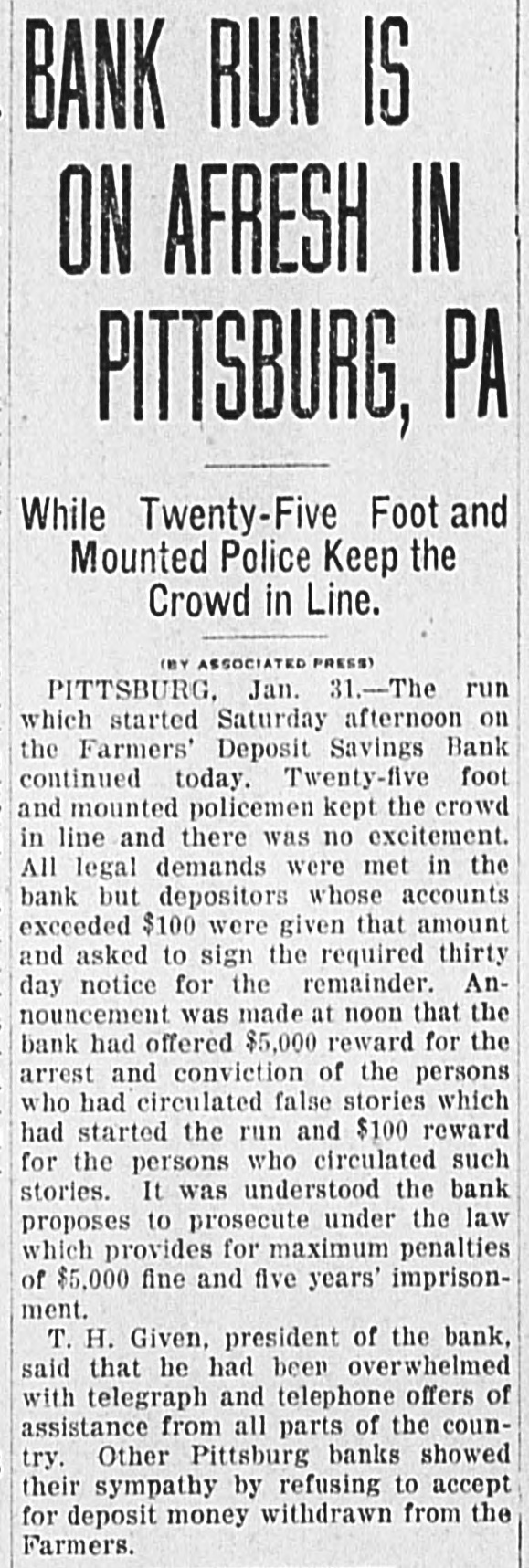
BANK RUN IS ON AFRESH IN PITTSBURG, PA While Twenty-Five Foot and Mounted Police Keep the Crowd in Line. (BY ASSOCIATED PRESS) PITTSBURG, Jan. 31.-The run which started Saturday afternoon on the Farmers' Deposit Savings Bank continued today. Twenty-five foot and mounted policemen kept the crowd in line and there was no excitement. All legal demands were met in the bank but depositors whose accounts exceeded $100 were given that amount and asked to sign the required thirty day notice for the remainder. Announcement was made at noon that the bank had offered $5,000 reward for the arrest and conviction of the persons who had circulated false stories which had started the run and $100 reward for the persons who circulated such stories. It was understood the bank proposes to prosecute under the law which provides for maximum penalties of $5,000 fine and five years' imprisonment. T. H. Given, president of the bank, said that he had been overwhelmed with telegraph and telephone offers of assistance from all parts of the country. Other Pittsburg banks showed their sympathy by refusing to accept for deposit money withdrawn from the Farmers.
2.January 31, 1916The Oklahoma City TimesOklahoma City, OK
Click image to open full size in new tab
Article Text
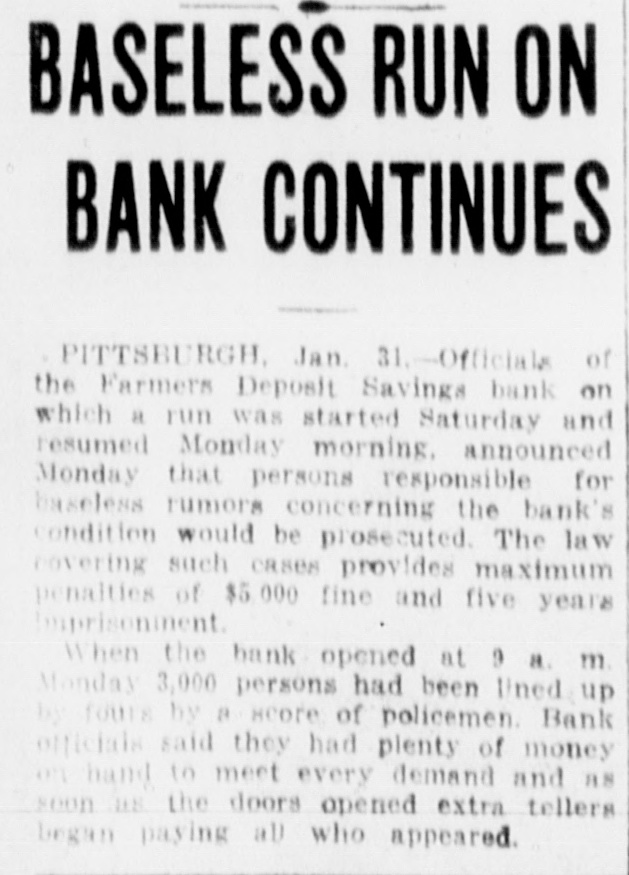
BASELESS RUN ON BANK CONTINUES PITTSBURGH, Jan. 31.-Officials of the Farmers Deposit Savings bank on which H run was started Saturday and resumed Monday morning. announced Monday that persons responsible for baseless rumors concerning the bank's condition would be prosecuted The law covering such CRSBA provides maximum penalties of $5.000 fine and five years Imprisonment When the bank opened at 9 a m Monday 3,000 persons had been Uned up by fours by a score of policemen. Bank officials said they had plenty of money on hand to meet every demand and as soon us the doors opened extra tellers began paying all who appeared
3.January 31, 1916South Bend News-TimesSouth Bend, IN
Click image to open full size in new tab
Article Text
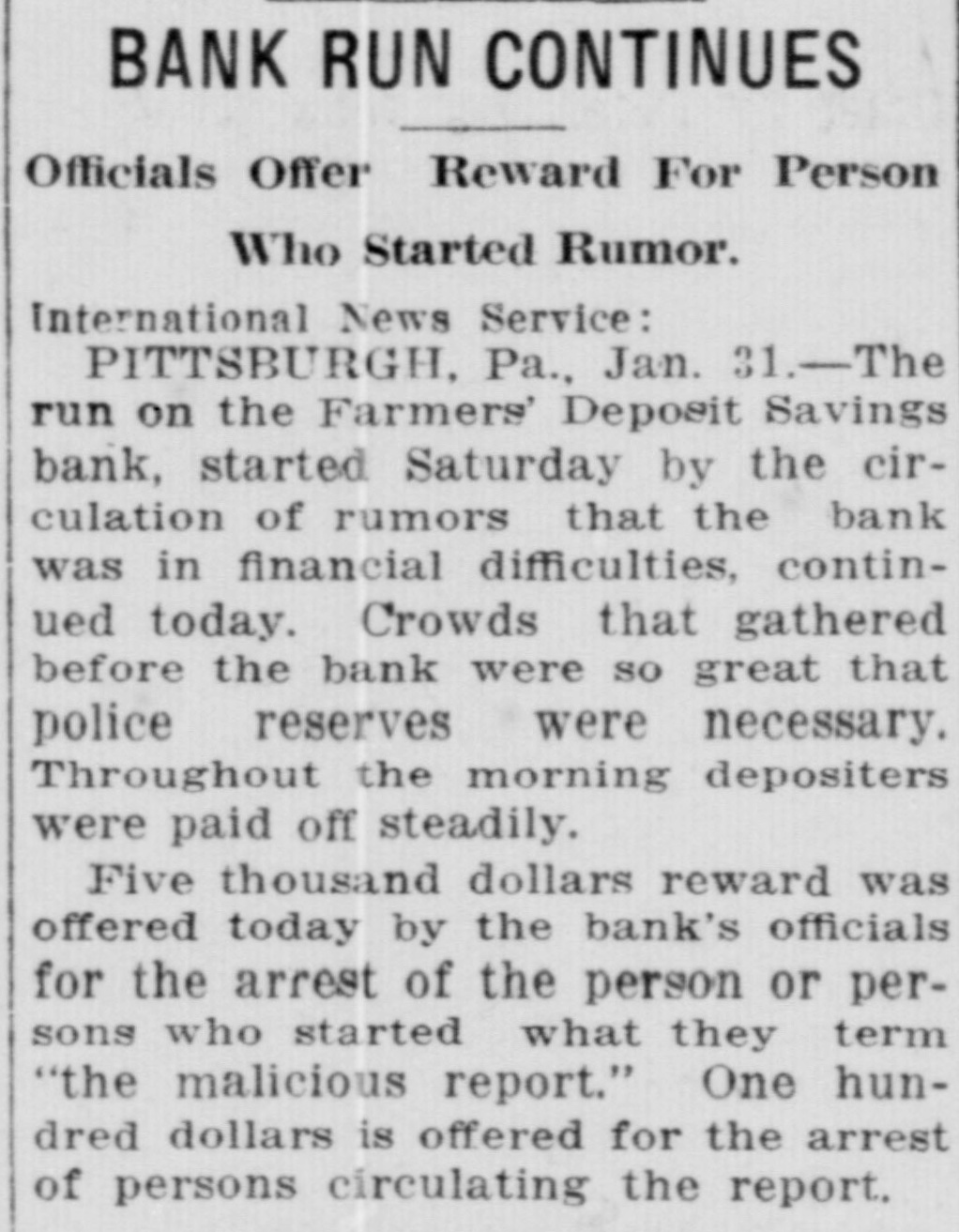
BANK RUN CONTINUES Officials Offer Reward For Person Who Started Rumor. International News Service: PITTSBURGH, Pa., Jan. 31.-The run on the Farmers' Deposit Savings bank, started Saturday by the circulation of rumors that the bank was in financial difficulties, continued today. Crowds that gathered before the bank were so great that police reserves were necessary. Throughout the morning depositers were paid off steadily. Five thousand dollars reward was offered today by the bank's officials for the arrest of the person or persons who started what they term "the malicious report." One hundred dollars is offered for the arrest of persons circulating the report.
4.February 1, 1916Norwich BulletinNorwich, CT
Click image to open full size in new tab
Article Text
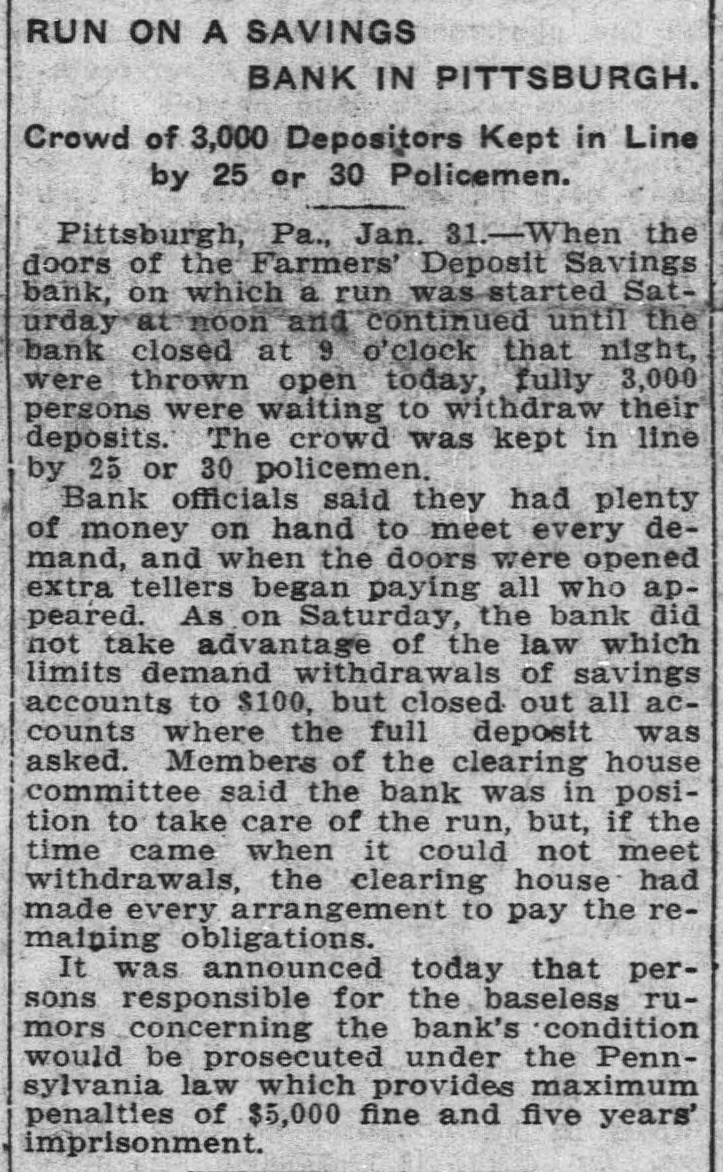
RUN ON A SAVINGS BANK IN PITTSBURGH. Crowd of 3,000 Depositors Kept in Line by 25 or 30 Policemen. Pittsburgh, Pa., Jan. 31.-When the doors of the Farmers' Deposit Savings bank, on which a run was-started Saturday at noon and continued until the bank closed at 9 o'clock that night, were thrown open today, fully 3,000 persons were waiting to withdraw their deposits. The crowd was kept in line by 25 or 30 policemen. Bank officials said they had plenty of money on hand to meet every demand, and when the doors were opened extra tellers began paying all who appeared. As on Saturday, the bank did not take advantage of the law which limits demand withdrawals of savings accounts to $100, but closed out all accounts where the full deposit was asked. Members of the clearing house committee said the bank was in position to take care of the run, but, if the time came when it could not meet withdrawals, the clearing house had made every arrangement to pay the remaining obligations. It was announced today that persons responsible for the baseless rumors concerning the bank's condition would be prosecuted under the Pennsylvania law which provides maximum penalties of $5,000 fine and five years' imprisonment.
5.February 1, 1916The Topeka State JournalTopeka, KS
Click image to open full size in new tab
Article Text
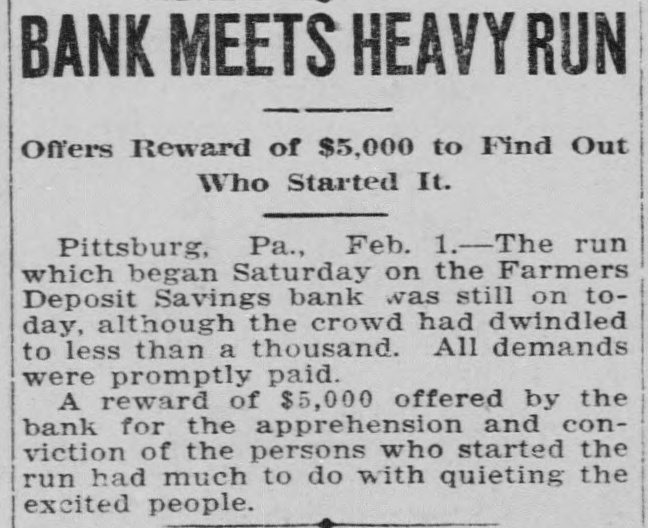
BANK MEETS HEAVY RUN Offers Reward of $5,000 to Find Out Who Started It. Pittsburg, Pa., Feb. 1.-The run which began Saturday on the Farmers Deposit Savings bank was still on today, although the crowd had dwindled to less than a thousand. All demands were promptly paid. A reward of $5,000 offered by the bank for the apprehension and conviction of the persons who started the run had much to do with quieting the excited people.
6.February 1, 1916The SunNew York, NY
Click image to open full size in new tab
Article Text
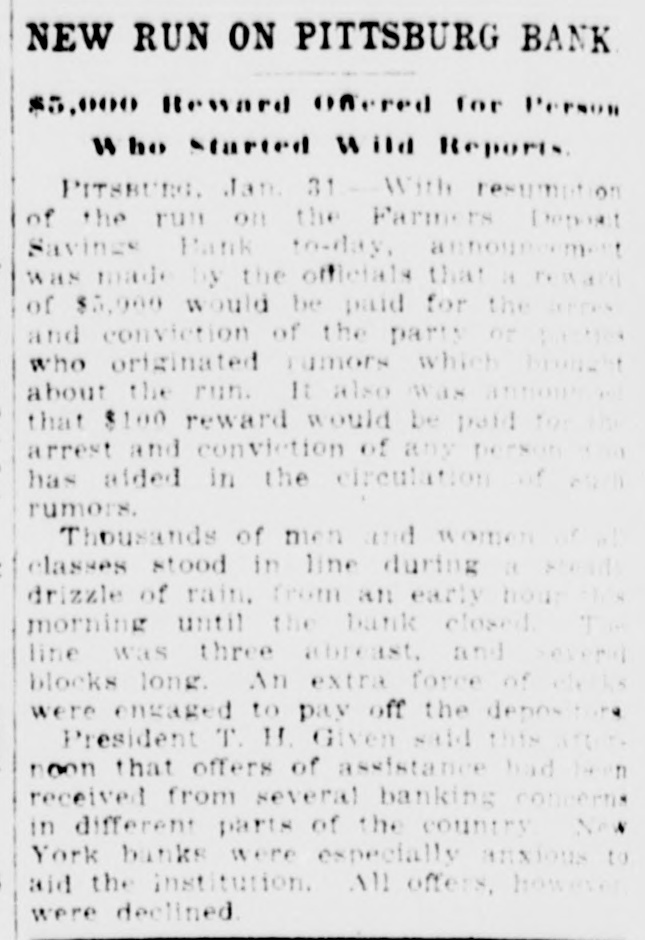
NEW RUN ON PITTSBURG BANK $5,000 Reward Offered for Person Who Started Wild Reports. PITSBURG. Jan. 31 - With resumution of the run on the Farmers Deposit Savings Bank to-day, announcement was made by the officials that it reward of $5,000 would be paid for the arres and conviction of the party or who originated rumors which bronght about the run. It also was that $100 reward would be paid arrest and conviction of any person has aided in the circulation of rumors. Thousands of men and women classes stood in line during a steads drizzle of rain. from an early hourstop morning until the bank closed To line was three abreast, and blocks long. An extra force of were engaged to pay off the deposities President T. H. Given said this noon that offers of assistance had received from several banking concerns in different parts of the country New York banks were especially anxious to aid the institution. All offers, however were declined
7.February 1, 1916Harrisburg TelegraphHarrisburg, PA
Click image to open full size in new tab
Article Text
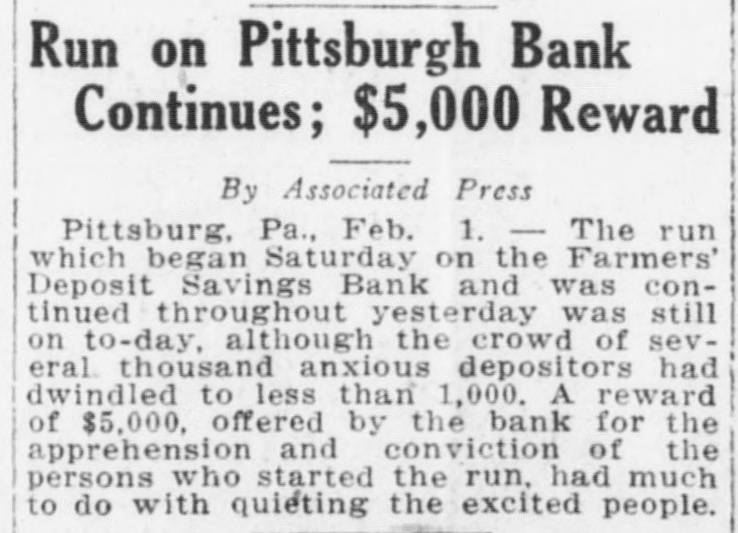
Run on Pittsburgh Bank Continues; $5,000 Reward By Associated Press Pittsburg, Pa., Feb. 1. - The run which began Saturday on the Farmers' Deposit Savings Bank and was continued throughout yesterday was still on to-day, although the crowd of several thousand anxious depositors had dwindled to less than 1,000. A reward of $5,000. offered by the bank for the apprehension and conviction of the persons who started the run, had much to do with quieting the excited people.
8.February 1, 1916The Washington HeraldWashington, DC
Click image to open full size in new tab
Article Text
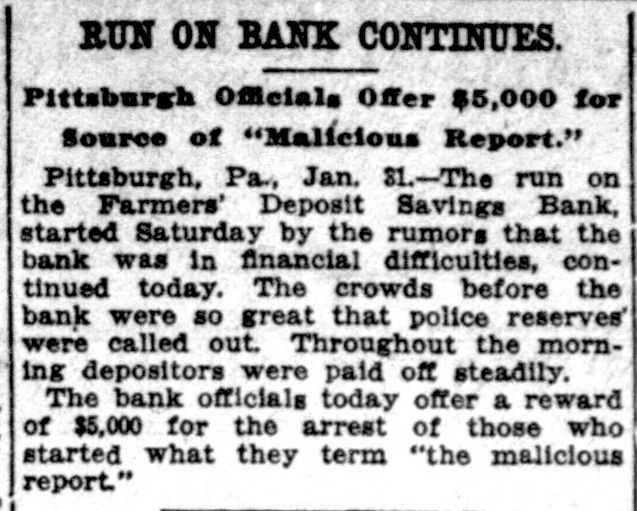
RUN ON BANK CONTINUES. Pittsburgh Officials Offer $5,000 for Source of "Malicious Report." Pittsburgh, Pa., Jan. 81.-The run on the Farmers' Deposit Savings Bank, started Saturday by the rumors that the bank was in financial difficulties, continued today. The crowds before the bank were so great that police reserves were called out. Throughout the morning depositors were paid off steadily. The bank officials today offer a reward of $5,000 for the arrest of those who started what they term "the malicious report."
Native eggs, 33c doz. Russell Bros. RUN ON BANK. Pittsburgh, Feb. 1.-The run which began Saturday on the Farmers' Deposit Savings bank was still on today. The crowd of depositors was less than a thousand. All demands were promptly paid, but persons who sought to place their money in other banks met with decisive refusal.
10.February 21, 1916The Alaska Daily EmpireJuneau, AK
Click image to open full size in new tab
Article Text
SEARCH GOES ON FOR PERSON RESPONSIBLE FOR RUN ON PITTSBURGH BANK PITTSBURGH, Pa., Feb. 21.-Off. cials of the Farmers' Deposit Savings Bank, on which a run was started on Saturday last at noon and continued until the bank closed at 9 o'clock Saturday night, announced today that persons responsible for the baseless rumors concerning the bank's condition will be prosecuted under the Pennsylvania law. The law which was passed in 1900 to cover just such cases, provides the miximum punishment penalties of $50.000 fine and five years' imprisonment. Detectives, it was announced, are working on the case, and arrests are expected soon.