16692. United States Exchange Bank (New York, NY)

Bank Information

Episode Type
Run → Suspension → Reopening
Bank Type
state
Start Date
October 25, 1907
Location
New York, New York (40.714, -74.006)

Metadata

Model
gpt-5-mini
Short Digest
6824b078

Response Measures

Full suspension, Books examined

Other: Police protection requested; state examiner took charge and examined collateral securities.

Description

Multiple contemporaneous articles (Oct 25, 1907) report crowds/withdrawal pressure and a posted notice citing closing of other banks and the unusual demand for cash, police protection requested, and the State Bank Examiner taking charge — indicating a run followed by suspension. The bank later reopened with approval of the State Banking Department on Nov 25, 1907. Cause classified as local_banks because the bank cites other banks' closings as the trigger.

Events (3)

1. October 25, 1907 Run
Cause
Local Banks
Cause Details
Depositors panic and heavy withdrawals triggered by the closing of other banks and unusual demand for cash; notice posted: 'In consequence of the closing of other banks and the unusual demand for cash...'
Measures
Police protection requested; posted notice closing for the day to protect depositors.
Newspaper Excerpt
A large crowd gathered in front of the bank, and the officers telephoned to police headquarters for protection, fearing a hostile demonstration.
Source
newspapers
2. October 25, 1907 Suspension
Cause
Local Banks
Cause Details
Bank suspended payment citing inability to open due to closing of other banks and extraordinary demand for cash; state examiner (A. P. Campbell / Clark Williamson) took charge to examine collateral securities and oversee suspension.
Newspaper Excerpt
The United States Exchange Bank ... posted a notice before banking hours began, announcing its temporary suspension; State Bank Examiner took charge.
Source
newspapers
3. November 25, 1907 Reopening
Newspaper Excerpt
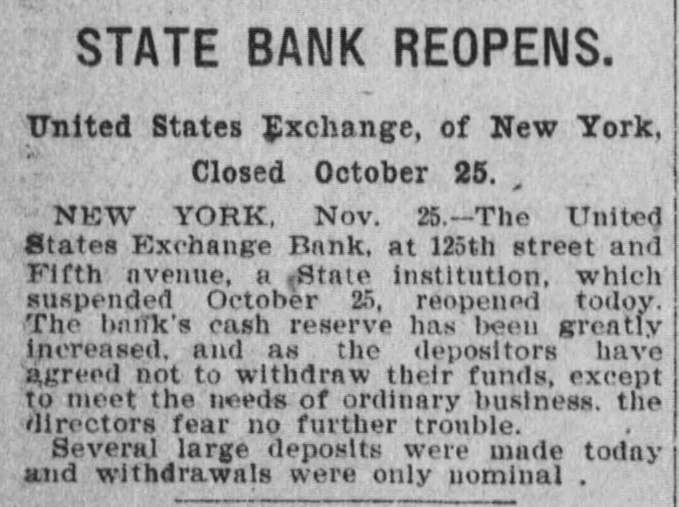
The United States Exchange Bank ... which suspended October 25, reopened today. The bank's cash reserve has been greatly increased, and as the depositors have agreed not to withdraw their funds ... the directors fear no further trouble.
Source
newspapers

Newspaper Articles (17)

Article from The Fairmont West Virginian, October 25, 1907

Click image to open full size in new tab

Article Text

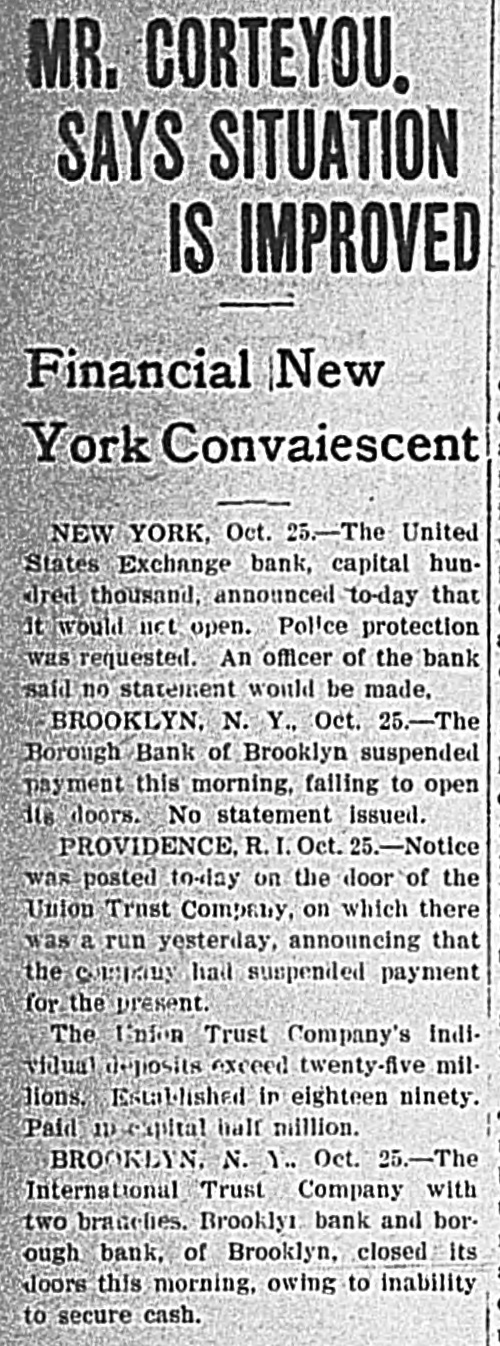
MR. CORTEYOU, SAYS SITUATION IS IMPROVED Financial New York Convaiescent NEW YORK, Oct. 25.-The United States Exchange bank, capital hundred thousand, announced to-day that dt would not open. Police protection was requested. An officer of the bank said no statement would be made, BROOKLYN, N. Y., Oct. 25.-The Borough Bank of Brooklyn suspended payment this morning, failing to open 10 doors. No statement issued. PROVIDENCE, R. I. Oct. 25.-Notice was posted to-day on the door of the Union Trust Company, on which there was a run yesterday, announcing that the cannony had suspended payment for the present. The Union Trust Company's Individual dejiosits exceed twenty-five millions. Established in eighteen ninety. Paid insecution half million. BROOKEYN. N. Y.. Oct. 25.-The International Trust Company with two branches. Brooklyn bank and borough bank, of Brooklyn, closed its doors this morning, owing to inability to secure cash.


Article from The Barre Daily Times, October 25, 1907

Click image to open full size in new tab

Article Text

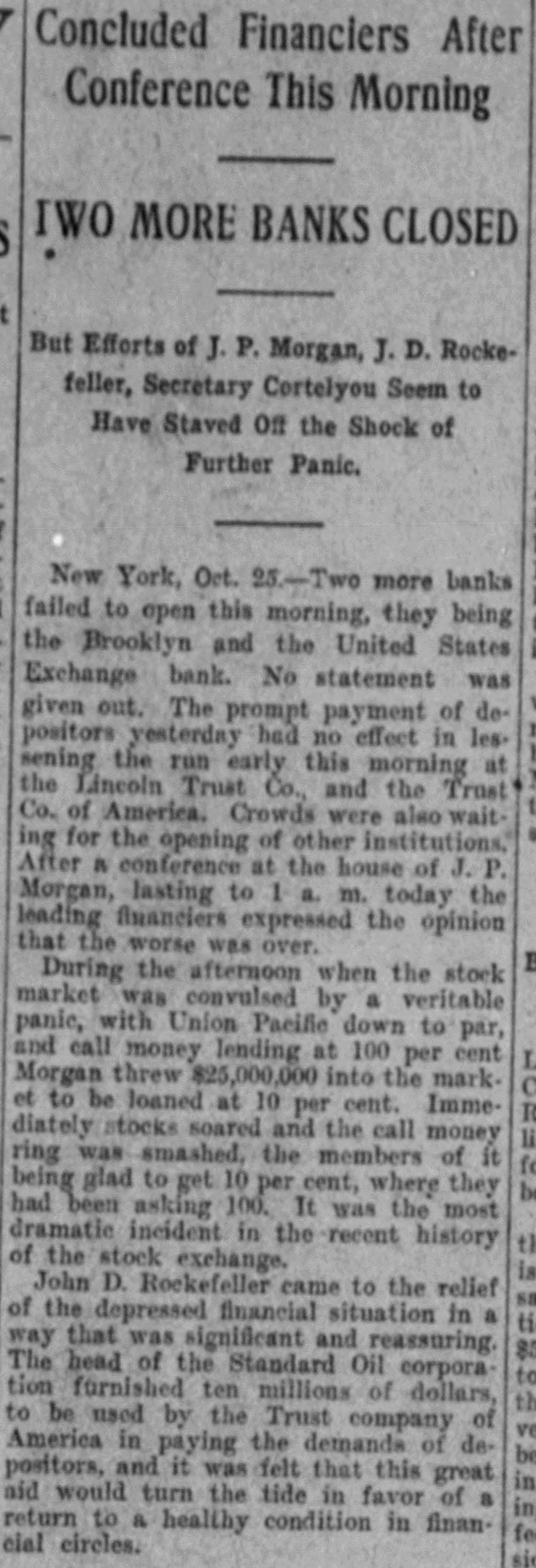
Concluded Financiers After Conference This Morning TWO MORE BANKS CLOSED But Efforts of J. P. Morgan, J. D. Rockefeller, Secretary Cortelyou Seem to Have Staved Off the Shock of Further Panic. New York, Oct. 25.-Two more banks failed to open this morning, they being the Brooklyn and the United States Exchange bank. No statement was given out. The prompt payment of depositors yesterday had no effect in les. sening the run early this morning at the Lincoln Trust Co., and the Trust Co. of America. Crowds were also waiting for the opening of other institutions, After a conference at the house of J. P. Morgan, lasting to 1 a. m. today the leading financiers expressed the opinion that the worse was over. During the afternoon when the stock market was convulsed by a veritable panic, with Union Pacific down to par, and call money lending at 100 per cent Morgan threw $25,000,000 into the mark. et to be loaned at 10 per cent. ImmeR diately stocks soared and the call money li ring was smashed, the members of it f being glad to get 10 per cent, where they b had been asking 100. It was the most dramatic incident in the recent history of the stock exchange. is John D. Rockefeller came to the relief of the depressed financial situation in a ti way that was significant and reassuring. The head of the Standard Oil corporato tion furnished ten millions of dollars, to be used by the Trust company of ve America in paying the demands of debe positors, and it was felt that this great in aid would turn the tide in favor of a in return to a healthy condition in finanfe cial circles.


Article from The Washington Times, October 25, 1907

Click image to open full size in new tab

Article Text

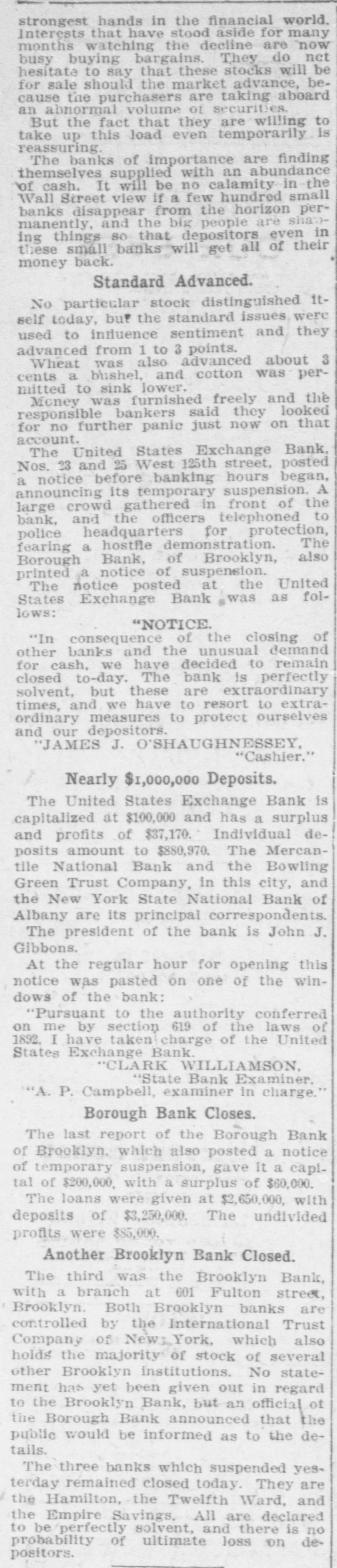
strongest hands in the financial world. Interests that have stood aside for many months watching the decline are now busy buying bargains. They do net hesitate to say that these stocks will be for sale should the market advance, because the purchasers are taking aboard an abnormal volume ot securities. But the fact that they are willing to take up this load even temporarily is reassuring. The banks of importance are finding themselves supplied with an abundance of cash. It will be no calamity in the Wall Street view if a few hundred small banks disappear from the horizon permanently, and the big people are shaning things so that depositors even in these smáll banks will get all of their money back. Standard Advanced. No particular stock distinguished itself today, but the standard issues were used to influence sentiment and they advanced from 1 to 3 points. Wheat was also advanced about 3 cents a bushel, and cotton was permitted to sink lower. Money was furnished freely and the responsible bankers said they looked for no further panic just now on that account. The United States Exchange Bank, Nos. 23 and 25 West 125th street, posted a notice before banking hours began, announcing its temporary suspension, A large crowd gathered in front of the bank, and the officers telephoned to police headquarters for protection, fearing a hostile demonstration. The Borough Bank, of Brooklyn, also printed a notice of suspension. The notice posted at the United States Exchange Bank was as follows: "NOTICE. "In consequence of the closing of other banks and the unusual demand for cash, we have decided to remain closed to-day. The bank is perfectly solvent, but these are extraordinary times, and we have to resort to extraordinary measures to protect ourselves and our depositors. "JAMES J. O'SHAUGHNESSEY, "Cashier." Nearly $1,000,000 Deposits. The United States Exchange Bank is capitalized at $100,000 and has a surplus and profits of $37,170. Individual deposits amount to $880,970. The Mercantile National Bank and the Bowling Green Trust Company, in this city, and the New York State National Bank of Albany are its principal correspondents. The president of the bank is John J. Gibbons. At the regular hour for opening this notice was pasted on one of the windows of the bank: "Pursuant to the authority conferred on me by section 619 of the laws of 1892, I have taken charge of the United States Exchange Bank. "CLARK WILLIAMSON, "State Bank Examiner. "A. P. Campbell, examiner in charge." Borough Bank Closes. The last report of the Borough Bank of Brooklyn, which also posted a notice of temporary suspension, gave It a capital of $200,000, with a surplus of $60,000. The loans were given at $2,650,000, with deposits of $3,250,000. The undivided profits were $85,000. Another Brooklyn Bank Closed. The third was the Brooklyn Bank, with a branch at 601 Fulton street, Brooklyn. Both Brooklyn banks are controlled by the International Trust Company of New York, which also holds the majority of stock of several other Brooklyn institutions. No statement has yet been given out in regard to the Brooklyn Bank, but an official of the Borough Bank announced that the public would be informed as to the details. The three banks which suspended yesterday remained closed today. They are the Hamilton, the Twelfth Ward, and the Empire Savings. All are declared to be perfectly solvent, and there is no probability of ultimate loss on depositors.
Article from Alexandria Gazette, October 25, 1907

Click image to open full size in new tab

Article Text

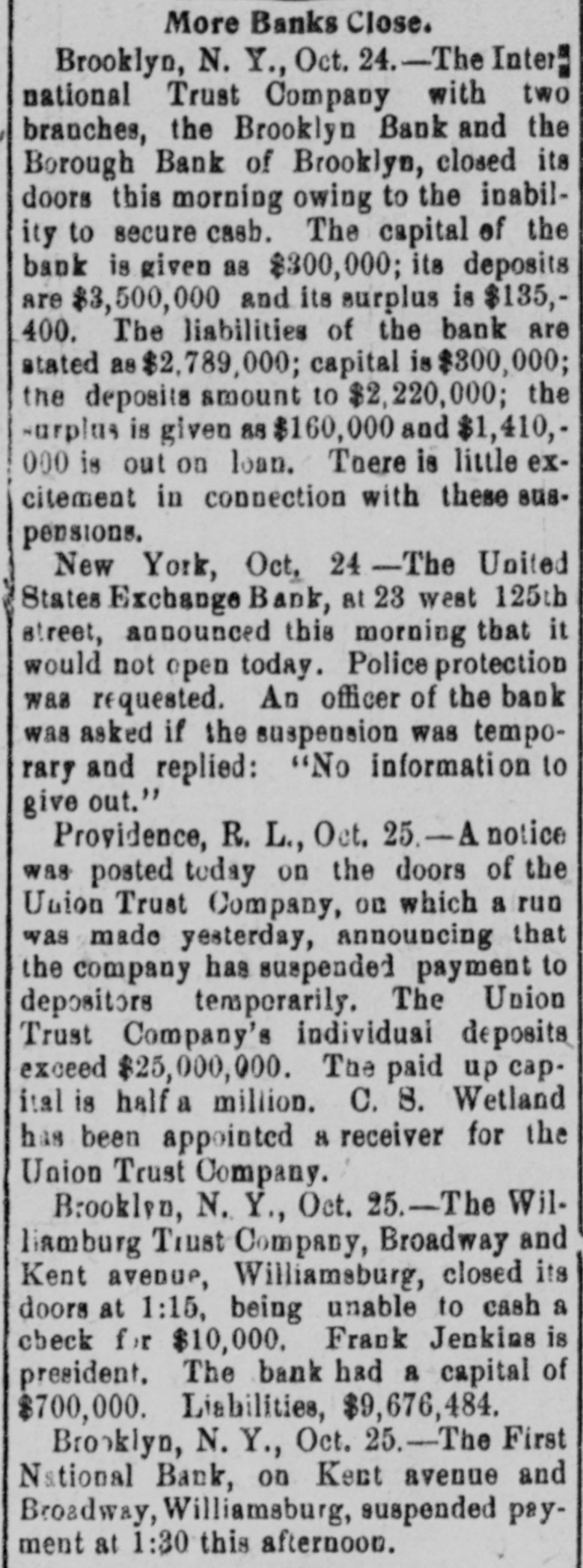
More Banks Close. Brooklyn, N. Y., Oct. 24.-The Inter: national Trust Company with two branches, the Brooklyn Bank and the Borough Bank of Brooklyn, closed its doors this morning owing to the inability to secure cash. The capital of the bank is given as $300,000; its deposits are $3,500,000 and its surplus is $135,400. The liabilities of the bank are stated as $2,789,000; capital is $300,000; the deposits smount to $2,220,000; the surplus is given as $160,000 and $1,410,000 is out on loan. There is little excitement in connection with these suspensions. New York, Oct, 24 -The United States Exchange Bank, at 23 west 125th street, announced this morning that it would not open today. Police protection was requested. An officer of the bank was asked if the suspension was temporary and replied: "No information to give out." Providence, R. L., Oct. 25.-A notice was posted today on the doors of the Union Trust Company, on which a run was made yesterday, announcing that the company has suspended payment to depositors temporarily. The Union Trust Company's individual deposits exceed $25,000,000. The paid up capital is halfa million. C. S. Wetland has been appointed a receiver for the Union Trust Company. Brooklyn, N. Y., Oct. 25.-The Williamburg Trust Company, Broadway and Kent avenue, Williamsburg, closed its doors at 1:15, being unable to cash a cbeck for $10,000. Frank Jenkins is president. The bank had a capital of $700,000. Liabilities, $9,676,484. Brooklyn, N. Y., Oct. 25.-The First National Bank, on Kent avenue and Broadway, Williamsburg, suspended payment at 1:30 this afternoon.


Article from Deseret Evening News, October 25, 1907

Click image to open full size in new tab

Article Text

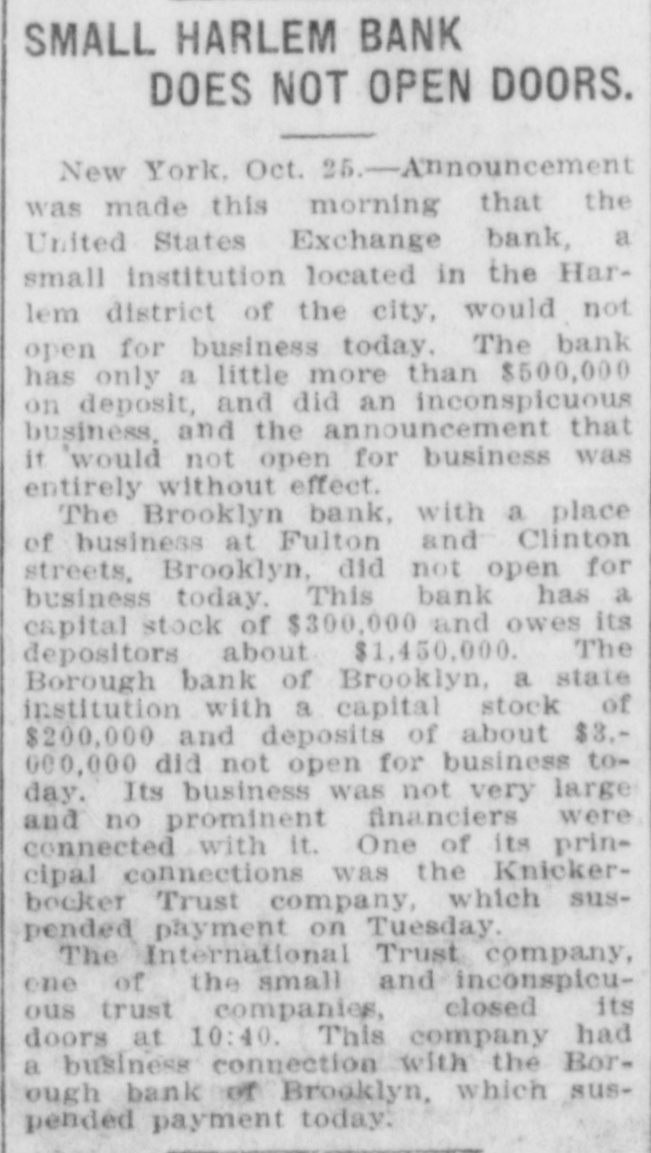
SMALL HARLEM BANK DOES NOT OPEN DOORS. New York, Oct. 25.-Announcement was made this morning that the United States Exchange bank, a small institution located in the Harlem district of the city, would not open for business today. The bank has only a little more than $500,000 on deposit, and did an inconspicuous business, and the announcement that it would not open for business was entirely without effect. The Brooklyn bank, with a place of business at Fulton and Clinton streets, Brooklyn, did not open for business today. This bank has a capital stock of $300,000 and owes its depositors about $1,450,000. The Borough bank of Brooklyn, a state institution with a capital stock of $200,000 and deposits of about $3.000,000 did not open for business today. Its business was not very large and no prominent financiers were connected with it. One of its principal connections was the Knickerbocker Trust company, which suspended payment on Tuesday. The International Trust company, one of the small and inconspicuous trust companies, closed its doors at 10:40. This company had a business connection with the Borough bank of Brooklyn, which suspended payment today:


Article from Daily Press, October 26, 1907

Click image to open full size in new tab

Article Text

# THREE SMALL BANKS # CLOSE THEIR DOORS New York Capitalists Say They Have No Bearing on Situation and Conditions Are Better. # YESTERDAY A NERVE-RACKING DAY Savings Banks Compel Depositors to Give Thirty or Sixty Days Notice of Withdrawal of Accounts-Plenty of Money on the Stock Exchange- Clearing House Certificates. (By Associated Press.) NEW YORK, Oct. 25.-Another nerve racking day has passed but the financial institutions of New York have shown extraordinary power of resistance to the pressure put upon them. While it is true that several minor institutions have been forced to close their doors, yet two things should be said about them-first, that the amount involved was not so great as to exert any marked influence on the general situation as those banks were located in residential quarters and did not come into touch with the larger financial institutions of the metropolis, and second-that there are several rea- sons to believe that these banks and trust companies are entirely solvent and their difficulties will prove to be only temporary and due entirely to in- ability to secure ready cash on gilt- edged securities in their vaults. In the light of the general excite- ment, the savings banks thought it wise to put into effect the rule re quiring thirty to sixty days notice for the withdrawal of deposits and this will prevent the withdrawal of money which would otherwise be put in safety deposit boxes. The savings banks, if they continued to make pay- ments, would be obliged to withdraw funds from the National banks, there- by causing an additional strain on the general banking situation. There was not the slightest hint that any of the savings institutions was in anything but in the soundest condition as it was pointed out that the savings banks of this state are so restricted by law in investing their money that there can be no question that all of the securities in their possession are of good value and readily salable in normal times. The institutions which closed their doors today with the sums due de- positors, were: the United States Ex- change Bank, Harlem, $6,600,000. In- ternational Trust Company, Brooklyn, $7,500,000. The First National Bank of Brooklyn, $3,500,000. The First National Bank of Brook- lyn the Williamsburg Trust Company and the International Trust Company, were allied institutions. None of these companies had important con- nections with the larger banks, which are representative of the city's finan- cial affairs. On the other hand, a number of fa- vorable features marked the day. The Trust Company of American and the Lincoln Trust Company, the two or- ganizations which have suffered most from runs, have been slowly paying out their deposits and closed today with all demands having been met. In the case of the Trust Company of America, the run has well nigh spent its force as the bulk of the depositors have been paid off. At the close of business there were a good many in line at the Lincoln Trust Company, but also there was a marked reduction in the number of anxious depositors. Plenty of Money for Stock Exchange. The most favorable incident of the day was that the Stock Exchange was provided with funds ample to meet its immediate necessities by a money pool headed by J. Pierpont Morgan, which sent about $15,000,000 to the Exchange during the afternoon. As all the loans made today hold over until Monday, the Stock Exchange situation will not be affected in the problems that bankers may be called upon to solve tomorrow. A very encouraging feature of the afternoon's developments was a sign- ed statement by Clark Williams, the newly appointed state superintendent of banking, affirming the solvency of the local institutions. A further encouraging development of the afternoon, the good effect of which can scarcely be over estimated, was the decision arrived at, unofficial- ly, to issue clearing house certificates, probably tomorrow. There will be a full meeting of the clearing houses a- ssociation tomorrow morning at 11 o'clock for the purpose of taking of- ficial action for the issuance of these certificates. The immediate effect of this will be to enable the banks to settle the bal- ances between themselves with these certificates, and thereby release large sums of currency for the regular needs of business. Clearing House Certificates. The decision to issue clearing house


Article from The Pacific Commercial Advertiser, October 26, 1907

Click image to open full size in new tab

Article Text

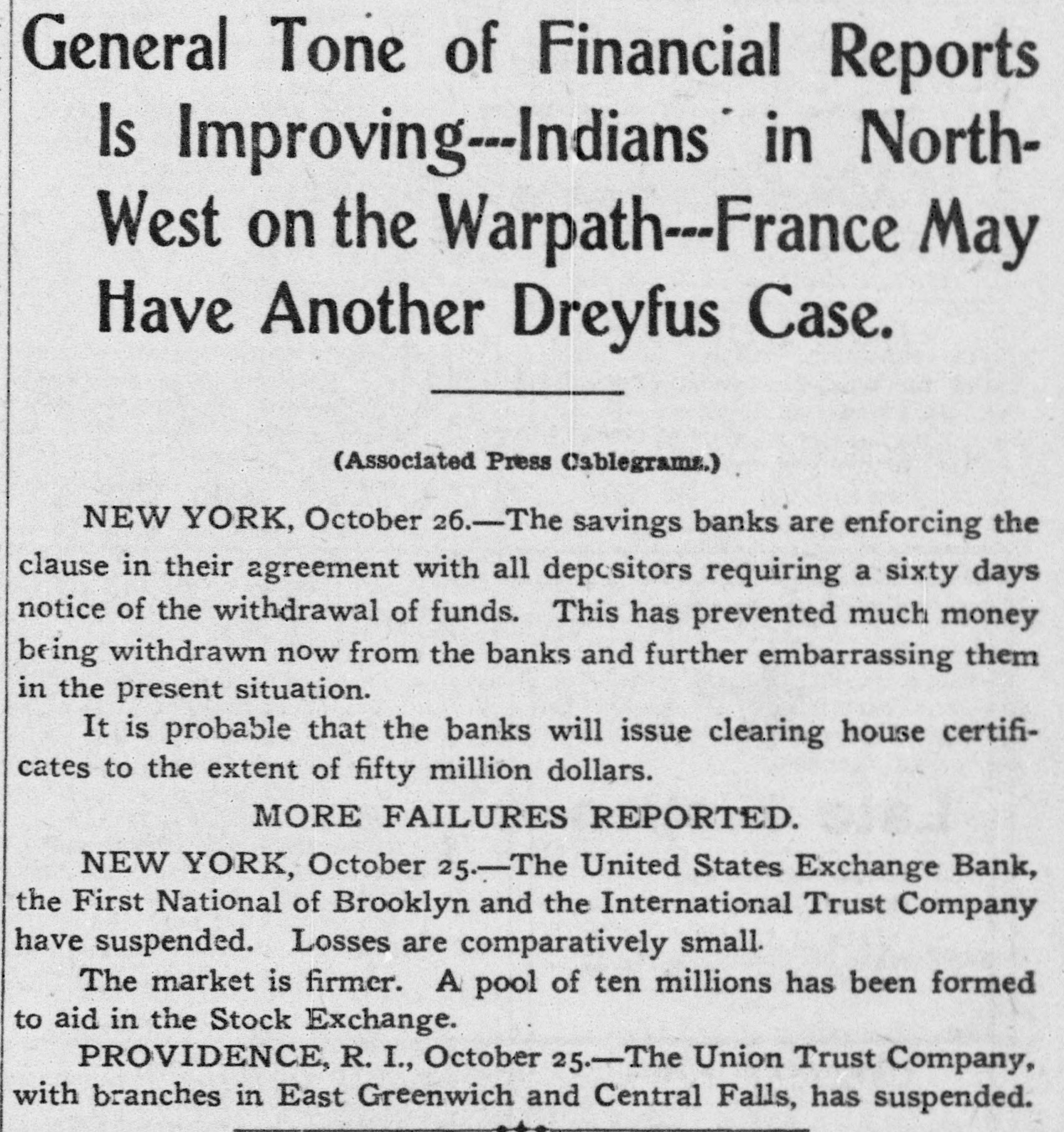
General Tone of Financial Reports Is Improving--Indians in NorthWest on the Warpath--France May Have Another Dreyfus Case. (Associated Press Cablegrams.) NEW YORK, October 26.-The savings banks are enforcing the clause in their agreement with all depositors requiring a sixty days notice of the withdrawal of funds. This has prevented much money being withdrawn now from the banks and further embarrassing them in the present situation. It is probable that the banks will issue clearing house certificates to the extent of fifty million dollars. MORE FAILURES REPORTED. NEW YORK, October 25.-The United States Exchange Bank, the First National of Brooklyn and the International Trust Company have suspended. Losses are comparatively small. The market is firmer. A pool of ten millions has been formed to aid in the Stock Exchange. PROVIDENCE, R. I., October 25.-The Union Trust Company, with branches in East Greenwich and Central Falls, has suspended.


Article from New-York Tribune, October 26, 1907

Click image to open full size in new tab

Article Text

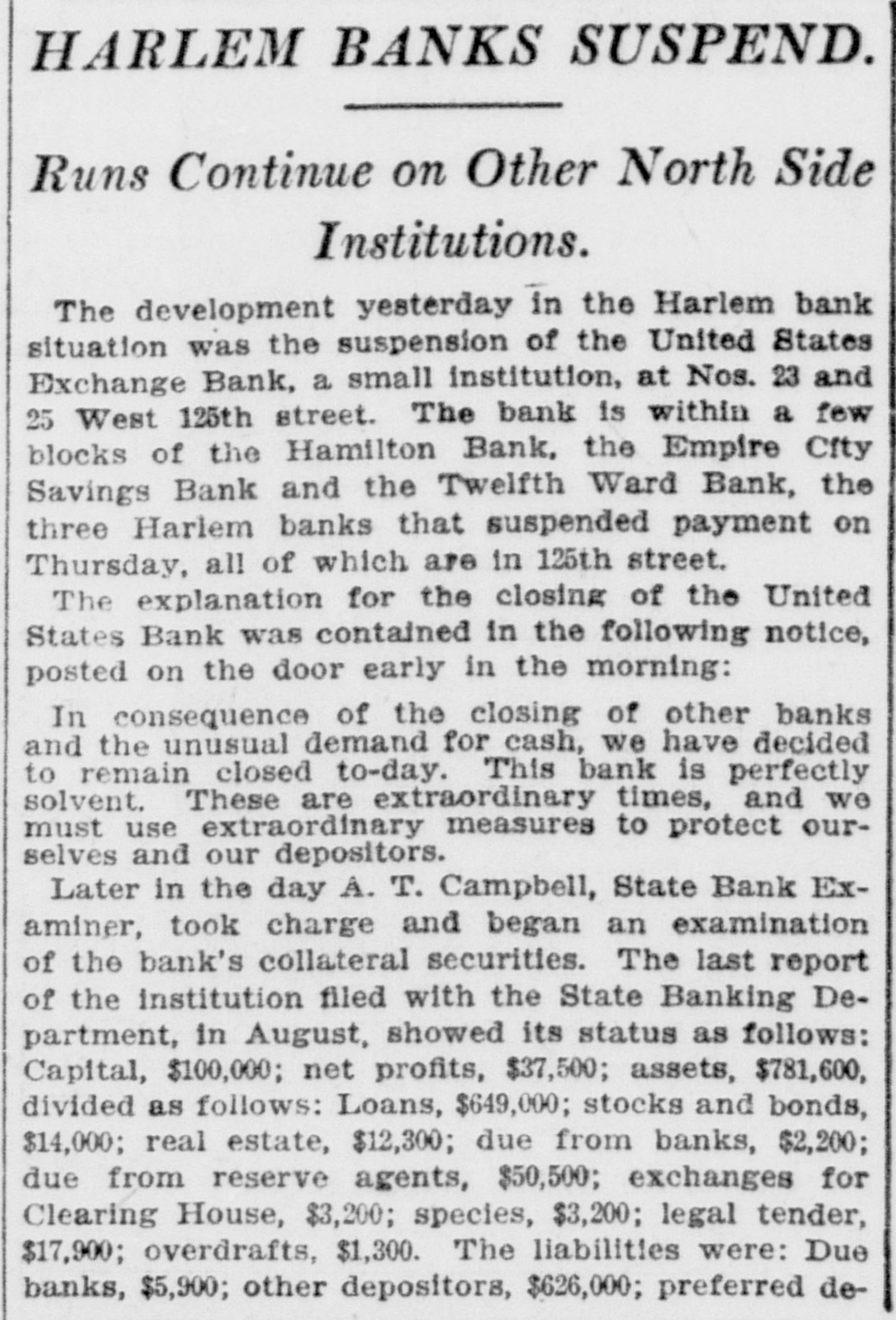
HARLEM BANKS SUSPEND. Runs Continue on Other North Side Institutions. The development yesterday in the Harlem bank situation was the suspension of the United States Exchange Bank, a small institution, at Nos. 23 and 25 West 125th street. The bank is within a few blocks of the Hamilton Bank, the Empire City Savings Bank and the Twelfth Ward Bank, the three Harlem banks that suspended payment on Thursday, all of which are in 125th street. The explanation for the closing of the United States Bank was contained in the following notice, posted on the door early in the morning: In consequence of the closing of other banks and the unusual demand for cash, we have decided to remain closed to-day. This bank is perfectly solvent. These are extraordinary times, and we must use extraordinary measures to protect ourselves and our depositors. Later in the day A. T. Campbell, State Bank Examiner, took charge and began an examination of the bank's collateral securities. The last report of the institution filed with the State Banking Department, in August, showed its status as follows: Capital, $100,000; net profits, $37,500; assets, $781,600, divided as follows: Loans, $649,000; stocks and bonds, $14,000; real estate, $12,300; due from banks, $2,200; due from reserve agents, $50,500; exchanges for Clearing House, $3,200; species, $3,200; legal tender, $17,900; overdrafts, $1,300. The liabilities were: Due banks, $5,900; other depositors, $626,000; preferred de-


Article from Waterbury Evening Democrat, October 26, 1907

Click image to open full size in new tab

Article Text

SAVES THE SITUATION Clearing House of New York Will Issue Loan Certificates. SAVINGS BANKS TAKE ACTION Will Take Advantage of Law Requiring Sixty Days' Notice From Depositors-Crisis Is Over, Cortelyou, Morgan and Leading Financiers Declare. New York, Oct. 26.-J. Pierpont Morgan, Secretary Cortelyou and leading financiers of this city were a unit in declaring that the financial crisis is practically over. Many things occurred to clear and improve the situation. The most important of these was the action of the Clearing House Association of Banks in issuing certificates redeemable in currency and the agreement made by the presidents of savings banks throughout the city to take advantage of the law requiring sixty days' notice from their depositors before withdrawing funds. Money for all legitimate purposes in the Wall street district was provided by the alliance created by Mr. Morgan and shared in by the Washington government and leading bankers. Ten millions of dollars was used to relieve the condition on the stock exchange. The probable importation of $5,000,000 in gold by the National City bank was another factor that contributed to the feeling of restored confidence and inspired Secretary Cortelyou, Mr. Morgan and other men who have been striving to relieve the strained conditions to express the opinion that the worst of the financial trouble is over and that only common sense on the part of the people will be required to prevent serious disaster. President Satisfied With Situation. So encouraging a view did President Roosevelt and his cabinet at Washington take .of the situation that a semiofficial announcement was authorized expressing satisfaction with the steps taken by the government, acting in conjunction with Mr. Morgan, to bring about a return to normal conditions. There were no failures of banking institutions, though eight of those doing business in Greater New York closed their doors to prevent runs inspired by the fear of the people. These institutions were the United States Exchange bank. the International Trust company and the Guardian Savings bank of Manhattan; the Borough bank of Brooklyn, the Brooklyn bank, Williamsburg Trust company, the First National bank of Brooklyn and the Jenkins Trust comt pany of Brooklyn, holding deposits ag gregating $22,000,000. There is little or no question of the h solvency of these institutions. Like many other banks, trust companies and savings institutions. they are merely short of ready money and hold B securities representing an actual value W of more than double their obligations. d Closed to Prevent Spread of Panic. f The action of the officers of these banks was due entirely to their desire ti to prevent a spread of the senseless ti panic which has threatened for several days. The closing of these inspired the presidents of all the savings banks in Greater New York to apply the six ty day rule, beginning this morning. This action was taken to prevent possible disaster to both the banks and pr their depositors. a State officials and officers of the savgo ce ings banks unite in the statement that 00 there is not the slightest question of th the solvency of those institutions, and 60 as soon as the frenzy of fear among the people passes away the sixty day rule will be ignored. So confident are the officers of the an savings banks of their ability to meet L every legitimate demand that they fic have decided to make exceptions to the ve operation of the rule wherever it is he found actually necessary. W The savings banks of the city hold on deposit $1,052,663,000. which is represented by actual cash or gilt edged securities that can be turned into cash under normal conditions. $4. Wall Street Regains Courage. ter A much calmer feeling prevailed in 5.2 Wall street than the day before. Values on the stock exchange were higher an than at any time during the week. In bu The loaning of $10,000,000 by Mr bu Morgan and his associates at normal cet rates of interest dispelled the alarm ( which existed for an hour or two dur bet cer Ing the morning. and exchange leaders expressed the opinion that the calampor ty which threatened Thursday had been averted. 271 The issuance of clearing house cer271 ificates which was ordered today will fai in the opinion of bankers do more to ext 21a elieve the Wall street situation than C anything else. Certificates of this charore eter were last issued fourteen years am go. 16c. The subtreasury assisted in the work Sep of helping out the banks by turning ver to them $8,000,000 in gold. taking government securities in exchange. pot a12 The Trust Company of America was 72/60 gain the storm center of the troubles E sel n Wall street, and the run inauguehr ated on it on Wednesday continued 34a. throughout the day. Every demand ext resented to the paying tellers met che ed. with prompt payment. The Lincoln T Trust company also withstood the run 6a6 rhich began on Thursday H s Officials of both institutions united position


Article from New-York Tribune, October 29, 1907

Click image to open full size in new tab

Article Text

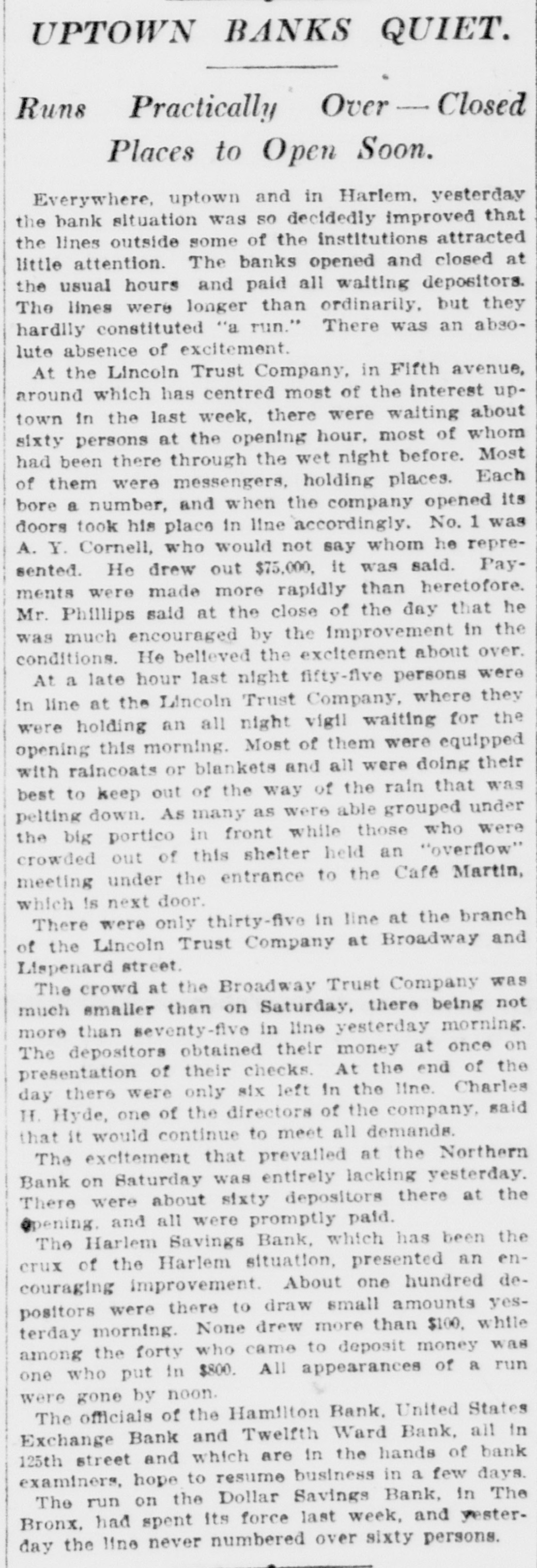
UPTOWN BANKS QUIET. Runs Practically Over - Closed Places to Open Soon. Everywhere, uptown and in Harlem. yesterday the bank situation was so decidedly improved that the lines outside some of the institutions attracted little attention. The banks opened and closed at the usual hours and paid all waiting depositors. The lines were longer than ordinarily, but they hardlly constituted "a run." There was an absolute absence of excitement. At the Lincoln Trust Company, in Fifth avenue, around which has centred most of the interest uptown in the last week, there were waiting about sixty persons at the opening hour, most of whom had been there through the wet night before. Most of them were messengers, holding places. Each bore a number, and when the company opened its doors took his place in line accordingly. No. 1 was A. Y. Cornell, who would not say whom he represented. He drew out $75,000. it was said. Payments were made more rapidly than heretofore. Mr. Phillips said at the close of the day that he was much encouraged by the improvement in the conditions. He believed the excitement about over. At a late hour last night fifty-flve persons were in line at the Lincoln Trust Company, where they were holding an all night vigil waiting for the opening this morning. Most of them were equipped with raincoats or blankets and all were doing their best to keep out of the way of the rain that was pelting down. As many as were able grouped under the big portico in front while those who were crowded out of this shelter held an "overflow" meeting under the entrance to the Cafe Martin, which is next door. There were only thirty-five in line at the branch of the Lincoln Trust Company at Broadway and Lispenard street. The crowd at the Broadway Trust Company was much emailer than on Saturday, there being not more than seventy-five in line yesterday morning. The depositors obtained their money at once on presentation of their checks. At the end of the day there were only six left In the line. Charles H. Hyde, one of the directors of the company, said that it would continue to meet all demands. The excitement that prevailed at the Northern Bank on Saturday was entirely lacking yesterday. There were about sixty depositors there at the pening. and all were promptly paid. The Harlem Savings Bank, which has been the crux of the Harlem situation, presented an encouraging improvement. About one hundred depositors were there to draw small amounts yesterday morning. None drew more than $100. while among the forty who came to deposit money was one who put in $800. All appearances of a run were gone by noon. The officials of the Hamilton Bank. United States Exchange Bank and Twelfth Ward Bank, all in 125th street and which are in the hands of bank examiners, hope to resume business in a few days. The run on the Dollar Savings Bank, in The Bronx. had spent its force last week, and yesterday the line never numbered over sixty persons.


Article from The Evening Star and Newark Advertiser, November 25, 1907

Click image to open full size in new tab

Article Text

STATE BANK REOPENS. United States Exchange, of New York, Closed October 25. NEW YORK, Nov. 25.-The United States Exchange Bank, at 125th street and Fifth avenue, a State institution, which suspended October 25, reopened todoy. The bank's cash reserve has been greatly increased. and as the depositors have agreed not to withdraw their funds, except to meet the needs of ordinary business. the directors fear no further trouble. Several large deposits were made today and withdrawals were only nominal. .


Article from Evening Times-Republican, November 25, 1907

Click image to open full size in new tab

Article Text

New York Bank Reopens. New York, Nov. 25.-The United States Exchange bank, a state institution, which suspended October 25, reopened today. A number of large deposits were made today, and withdrawals were only nominal.


Article from Evening Star, November 26, 1907

Click image to open full size in new tab

Article Text

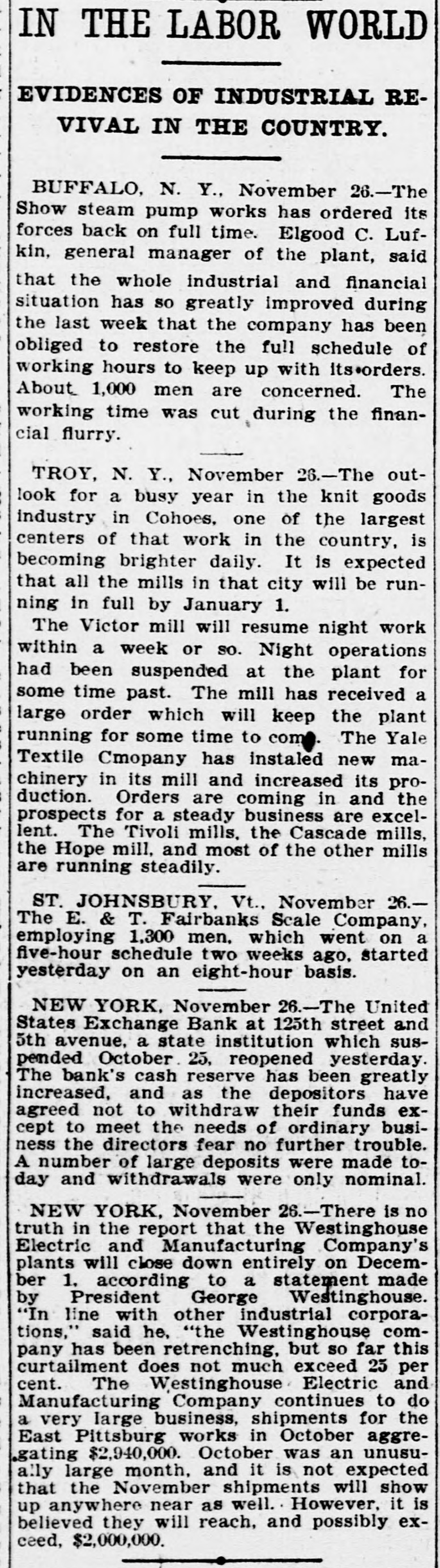
IN THE LABOR WORLD EVIDENCES OF INDUSTRIAL REVIVAL IN THE COUNTRY. BUFFALO, N. Y., November 26.-The Show steam pump works has ordered its forces back on full time. Elgood C. Lufkin, general manager of the plant, said that the whole industrial and financial situation has so greatly improved during the last week that the company has been obliged to restore the full schedule of working hours to keep up with its*orders. About 1,000 men are concerned. The working time was cut during the financial flurry. TROY, N. Y., November 26.-The outlook for a busy year in the knit goods industry in Cohoes, one of the largest centers of that work in the country, is becoming brighter daily. It is expected that all the mills in that city will be running in full by January 1. The Victor mill will resume night work within a week or so. Night operations had been suspended at the plant for some time past. The mill has received a large order which will keep the plant running for some time to com The Yale Textile Cmopany has instaled new machinery in its mill and increased its production. Orders are coming in and the prospects for a steady business are excellent. The Tivoli mills, the Cascade mills, the Hope mill, and most of the other mills are running steadily. ST. JOHNSBURY. Vt., November 26.The E. & T. Fairbanks Scale Company, employing 1,300 men, which went on a five-hour schedule two weeks ago, started yesterday on an eight-hour basis. NEW YORK, November 26.-The United States Exchange Bank at 125th street and 5th avenue, a state institution which suspended October. 25, reopened yesterday. The bank's cash reserve has been greatly increased, and as the depositors have agreed not to withdraw their funds except to meet the needs of ordinary business the directors fear no further trouble. A number of large deposits were made today and withdrawals were only nominal. NEW YORK, November 26.-There is no truth in the report that the Westinghouse Electric and Manufacturing Company's plants will close down entirely on December 1. according to a statement made by President George Westinghouse. "In line with other industrial corporations," said he, "the Westinghouse company has been retrenching, but so far this curtailment does not much exceed 25 per cent. The Westinghouse Electric and Manufacturing Company continues to do a very large business, shipments for the East Pittsburg works in October aggregating $2,940,000. October was an unusually large month, and it is not expected that the November shipments will show up anywhere near as well. However, it is believed they will reach, and possibly exceed, $2,000,000.


Article from The Marion Daily Mirror, November 26, 1907

Click image to open full size in new tab

Article Text

BITS OF NEWS. The United States exchange bank at New York City, a state institution which suspended October 25, has reopened. The E. & T. Fairbanks Scale Co., of St. Johnsbury, Vt., employing 1,300 men, which went on a five-hour schedule two weeks ago, has started on an eight-hour basis. Mount Vesuvius, after two months of inactivity, is emitting clouds of dense smoke, accompanied by considerable roaring from three fissures around the old crater. Alarm is felt by the people of surrounding towns.


Article from New-York Tribune, November 26, 1907

Click image to open full size in new tab

Article Text

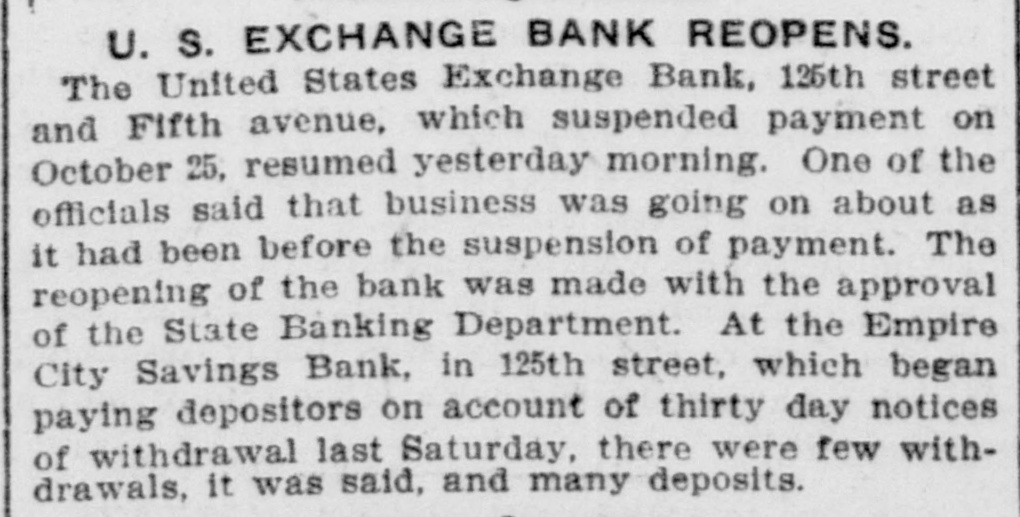
U. S. EXCHANGE BANK REOPENS. The United States Exchange Bank, 125th street and Fifth avenue, which suspended payment on October 25, resumed yesterday morning. One of the officials said that business was going on about as it had been before the suspension of payment. The reopening of the bank was made with the approval of the State Banking Department. At the Empire City Savings Bank, in 125th street, which began paying depositors on account of thirty day notices of withdrawal last Saturday, there were few withdrawals, it was said, and many deposits.


Article from Evening Journal, November 26, 1907

Click image to open full size in new tab

Article Text

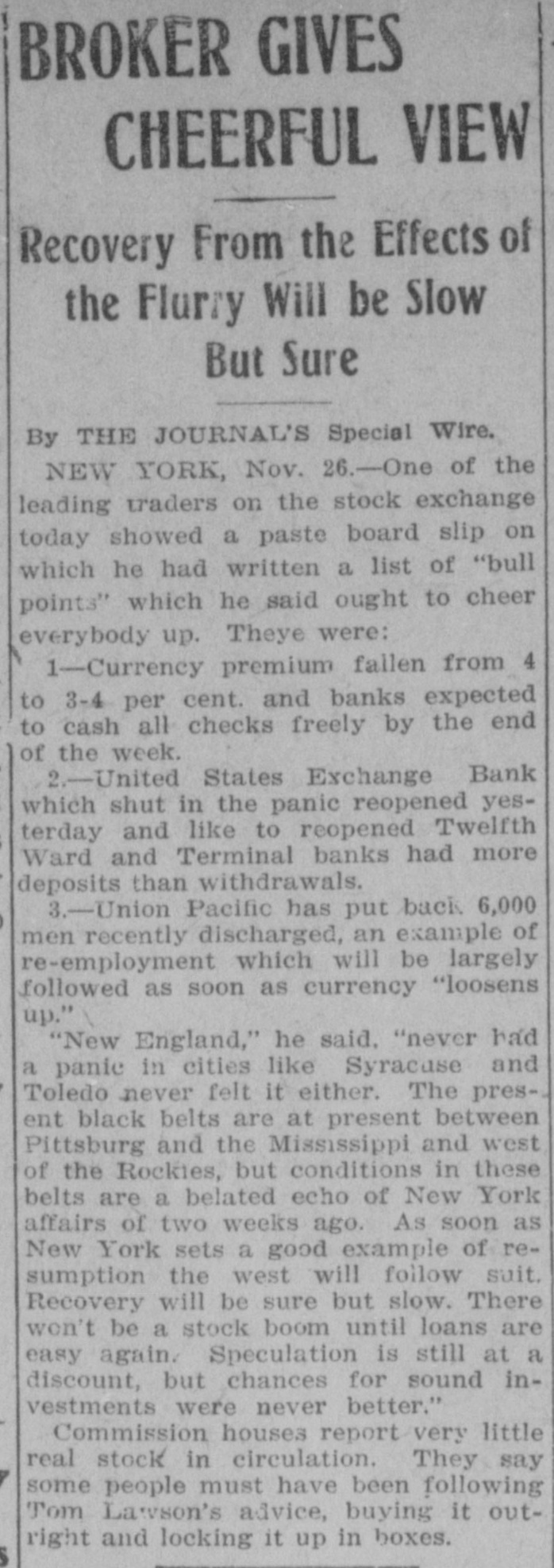
BROKER GIVES CHEERFUL VIEW Recovery From the Effects of the Flurry Will be Slow But Sure By THE JOURNAL'S Special Wire. NEW YORK, Nov. 26.-One of the leading traders on the stock exchange today showed a paste board slip on which he had written a list of "bull points" which he said ought to cheer everybody up. Theye were: 1-Currency premium fallen from 4 to 3-4 per cent. and banks expected to cash all checks freely by the end of the week. 2.-United States Exchange Bank which shut in the panic reopened yesterday and like to reopened Twelfth Ward and Terminal banks had more deposits than withdrawals. 3.-Union Pacific has put back 6,000 men recently discharged, an example of re-employment which will be largely followed as soon as currency "loosens up." "New England," he said. "never had a panic in cities like Syracuse and Toledo never felt it either. The present black belts are at present between Pittsburg and the Mississippi and west of the Rockies, but conditions in these belts are a belated echo of New York affairs of two weeks ago. As soon as New York sets a good example of resumption the west will follow suit. Recovery will be sure but slow. There won't be a stock boom until loans are easy again. Speculation is still at a discount, but chances for sound investments were never better." Commission houses report very little real stock in circulation. They say some people must have been following Tom Lawson's advice, buying it outright and locking it up in boxes.


Article from New-York Tribune, April 28, 1908

Click image to open full size in new tab

Article Text

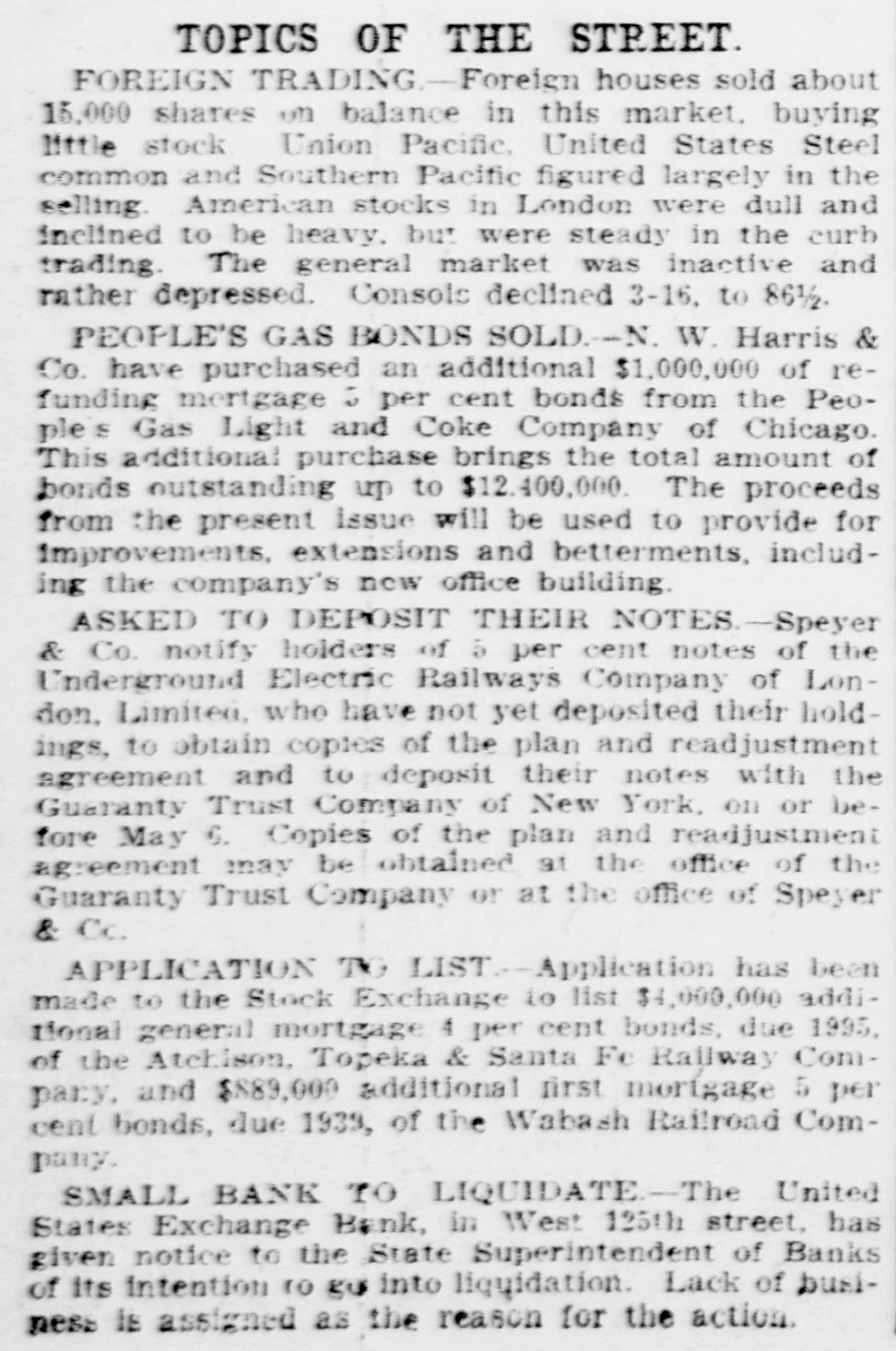
TOPICS OF THE STREET. FOREIGN TRADING.-Foreign houses sold about 15,000 shares on balance in this market. buying little stock Union Pacific, United States Steel common and Southern Pacific figured largely in the selling. American stocks in London were dull and inclined to be heavy. but were steady in the curb trading. The general market was inactive and rather depressed. Consols declined 3-16, to 86½. PEOPLE'S GAS BONDS SOLD.-N. W. Harris & Co. have purchased an additional $1,000,000 of refunding mertgage : per cent bonds from the People's Gas Light and Coke Company of Chicago. This additional purchase brings the total amount of bonds outstanding up to $12.400,000. The proceeds from the present Issue will be used to provide for improvements, extensions and betterments, including the company's new office building. ASKED TO DEPOSIT THEIR NOTES.-Speyer & Co. notify holders of 5 per cent notes of the Underground Electric Railways Company of London. Limited, who have not yet deposited their holdings, to obtain copies of the plan and readjustment agreement and to deposit their notes with the Guaranty Trust Company of New York, on or before May 6. Copies of the plan and readjustment agreement may be obtained at the office of the Guaranty Trust Company or at the office of Speyer & Cc. APPLICATION TO LIST--Application has been made to the Stock Exchange to list $4,000,000 additional general mortgage 1 per cent bonds, due 1995. of the Atchison, Topeka & Santa Fe Rallway Compary, and $89,000 additional first mortgage 5 per cent bonds, due 1939, of the Wabash Railroad Company. SMALL BANK TO LIQUIDATE.-The United States Exchange Bank, in West 125th street, has given notice to the State Superintendent of Banks of Its intention to go into liquidation. Lack of business is assigned as the reason for the action.