16620. Trades Savings Bank (New York, NY)

Bank Information

Episode Type
Suspension → Closure
Bank Type
savings bank
Start Date
August 26, 1876
Location
New York, New York (40.714, -74.006)

Metadata

Model
gpt-5-mini
Short Digest
2d02297a

Response Measures

None

Description

The Trades Savings Bank was ordered to stop doing business and closed by court injunction on Aug 26, 1876 due to insolvency and dubious/fictitious mortgage assets. A receiver (S. B. White) was appointed in mid-November 1876 and the bank remained in receivership (closure) with subsequent dividend proceedings. No run on deposits is described in the articles; closure resulted from bank-specific insolvency and regulatory action.

Events (2)

1. August 26, 1876 Suspension
Cause
Bank Specific Adverse Info
Cause Details
Court-ordered closing after bank examiner found large deficiencies, unrecorded or unprovable mortgages and doubtful assets (about $20,939 deficiency). Persistent refusal of officers to permit full examination led to injunction.
Newspaper Excerpt
The Trades' Savings Bank ... was closed yesterday on an order of Judge Landon ... The order commands the bank to show cause why a receiver should not be appointed.
Source
newspapers
2. November 15, 1876 Receivership
Newspaper Excerpt
On November 15, S. B. White ... was appointed receiver. The Trades' Savings Bank ... suspended on the 26th of August last, and the receiver was appointed the following November.
Source
newspapers

Newspaper Articles (19)

Article from The New York Herald, August 27, 1876

Click image to open full size in new tab

Article Text

ANOTHER SAVINGS BANK GONE. The Trades' Savings Bank, No. 224 West Twenty. third street, was closed yesterday on an order of Judge Landon, of the Supreme Court, on the complaint of Deputy Superintendent Henry C. Lamb, of the Banking Department. The report of the bank for July stated that it held $97,209 03 of assets, with a surplus of $2,294 97, $94,913.06 being due depositors. Its resources are reported distributed as follows:-Bonds and mortgages, $55,375; bonds of cities in this State, $7,000; amount loaned on collaterals, $11,250; cash in other banks or trust companies, $10,061 95, and cash on hand, $8,229 13. All examination made by Mr. Roid, bank examiner in January last, did not show anyhing materially different from this statement, although the excess of income was shown to be only $643 49, and he suspected that untrue statements were made regarding matters of which be could take no proof by the officers. Upon the recommendation of the Superintendent he made frequent visits to the bank in consequence of this suspicion, and on August 9 last he made an official report of its condition to the department, of which the following is an abstract:--The resources as claimed were as follows:-Three bonds and mortgages on the property of C. Baker, in Eightythird street, quoted at $9,000, at $8,000 and at $5,000, which had been assigned by Mr. Lesley, the President, to T. W. Freese; two bonds and mortgages of Michael Grace, as Greenpoint, for $6,000; a bond and mortgage of William Atwater, for $6,000, upon the property No. 237 Bedford avenue, Brooklyn, which was claimed by the bank, but to which no title could be shown. and two bonds and mortgages of A. M. Lesley, the President of the bank, to a property in Beach street for $15,000, which were not recorded, and to which no title was shown: call loans on United States bonds, $250; F. Kingman's receipt for J. R. Friese, bond and mortgage, $10,000; loan to E. B. Newburn, $5,000; an overdraft, said 10 be good. of $868 14, and other assets, which made a total of $88,439 34. The liabilities showed $88,178 67 due depositors and $200 due for interest, which would leave a surplus of $60 67. But Mr. Reid could not credit the bonds and mortgages to which no title was shown, and he deducts $21,000 from the assets on this account, leaving the bank deficient in assets to the amount of $20,939 Mr. Reid needed no further proof of the insufficiency of the bonds and mortgages claimed than these facts, but he had been in receipt of additional proof for some time in the persistent refusal of the Secretary, Mr. Freese, to give him full liberty of examination, and on one occasion so rude was Mr. Freese's opposition that a regular commission, requiring and empowering Mr. Reid to make the examination. was deemed necessary to be issued by the Banking Department Ugly st ries have been current for some time about the management of the bank, and one of the most suspicious circumstances connected with its failure is the fact that a brother of the secretary has very recently applied to be relieved as a bondsman of the officers. The number of depositors was $42. and 11 is doubtful if they will get more than day cents on the dollar. The order of the Supreme Court requires the bank to show cause before Judge Landon, at Saratoga, September 1. why there should not be a receiver appointed. It IS the opinion of Mr. Lamb that no general distrust of saving institu. tions is likely to proceed from this failure, as people generally looked upon It as "shaky."
Article from The Sun, August 27, 1876

Click image to open full size in new tab

Article Text

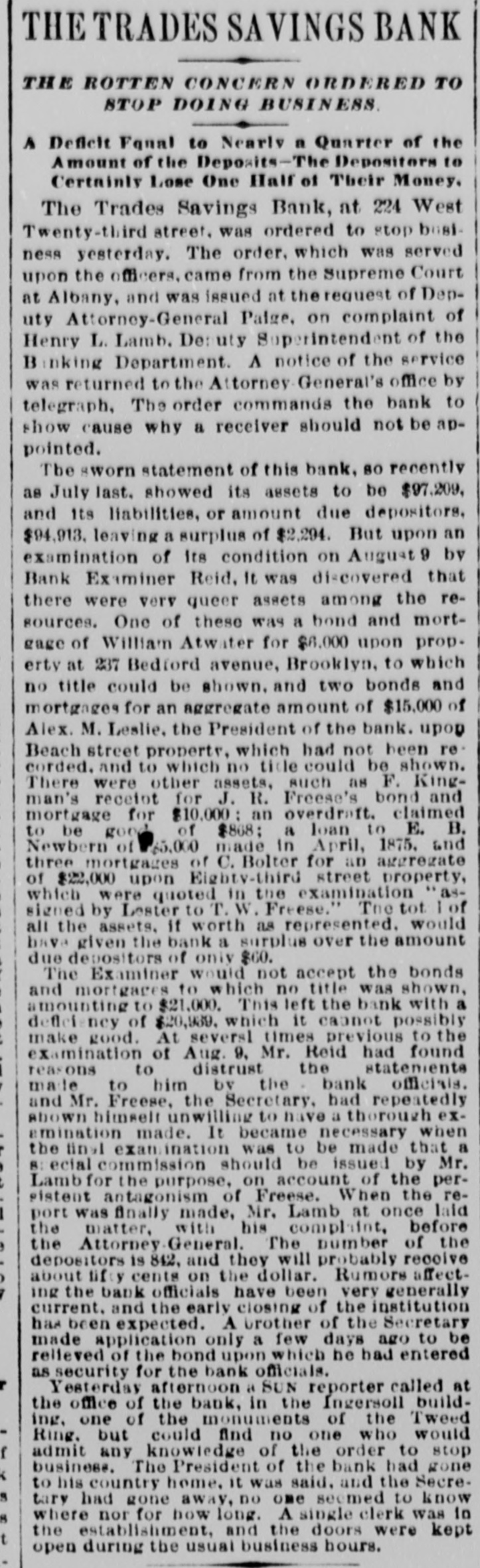
THE TRADES SAVINGS BANK THE ROTTEN CONCERN ORDERED TO STOP DOING BUSINESS A Deficit Fanal to Nearly a Quarter of the Amount of the Deposits-The Depositors to Certainly Lose One Half of Their Money. The Trades Savings Bank, at 224 West Twenty-third street, was ordered to stop best ness yesterday. The order. which was served upon the officers. came from the Supreme Court at Albany, and was issued at the request of Deputy Attorney-General Palge. on complaint of Henry L. Lamb. De: Superintendent of the B inking Department. A notice of the service was returned to the Attorney General's office by telegraph, The order commands the bank to show cause why a receiver should not be appointed. The sworn statement of this bank. 80 recently as July last. showed its assets to be $97,209, and its liabilities, or amount due depositors. $94,913. leaving a surplus of $2,294. But upon an examination of its condition on August 9 by Bank Examiner Reid, It was discovered that there were very queer assets among the resources. One of these was a bond and mortgage of William Atwater for $6,000 upon prop. erty at 237 Bedford avenue, Brooklyn, to which no title could be shown. and two bonds and mortgages for an aggregate amount of $15,000 of Alex. M. Lealie, the President of the bank. upon Beach street property, which had not been re corded. and to which no ticle could be shown. There were other assets. such as F. Kingman's recetot for J. R. Freese's bond and mortgage for $10,000 : an overdraft. claimed to be good of $868; a loan to E. B. Newbern of $5,000 made in April, 1875. and three mortgages of C. Bolter for an aggrezate of $22,000 upon Eightv-third street property, which were quoted in the examination "assigned by Lester to T. W. Freese." The tot of all the assets. if worth as represented. would have given the bank a surplus over the amount due depositors of only $60. The Examiner would not accept the bonds and mortgages to which no title was shown, amounting to $21,000. This left the bank with a deficia ney of $20,939. which it cannot possibly make good. At seversl times previous to the examination of Aug. 9. Mr. Reid had found reasons to distrust the statements made to him by the bank officials. and Mr. Freese, the Secretary. had repeatedly shown himself unwilling to have a thorough exemination made. It became necessary when the final examination was to be made that a 8: ecial commission should be issued by Mr. Lamb for the purpose, on account of the persistent antagonism of Freese. When the reI port was finally made, Mr. Lamb at once laid the matter. with his complaint, before ) the Attorney-General. The number of the depositors is 842, and they will probably receive about lifty cents on the dollar. Rumors affect7 ing the bank officials have been very generally current. and the early closing of the institution has been expected. A brother of the Secretary made application only a few days ago to be relieved of the bond upon which he had entered as security for the bank officials. Yesterday afternoon a SUN reporter called at the office of the bank, in the Ingersoll building. one of the monuments of the Tweed Ring. but could find no one who would f admit any knowledge of the order to stop business. The President of the bank had gone ' to his country home. it was said. and the Secre8 tary had gone away, no one seemed to know 8 where nor for how long. A single clerk was in the establishment, and the doors were kept t open during the usual business hours.


Article from The Sun, August 28, 1876

Click image to open full size in new tab

Article Text

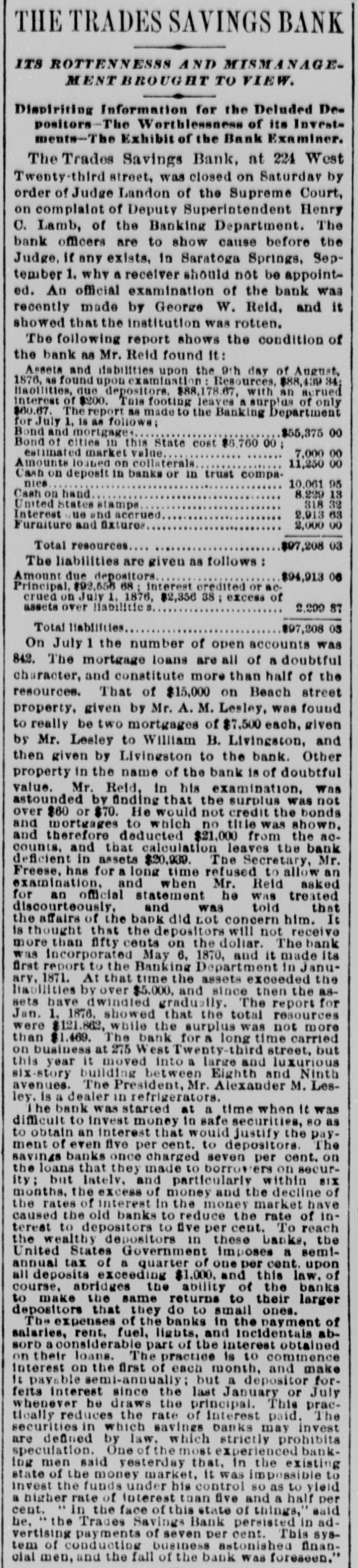
THE TRADES SAVINGS BANK ITS ROTTENNESSS AND MISMANAGEMENT BROUGHT TO VIEW. Dispiriting Information for the Deluded Invest= Depositors-The Worthleasness of Examiner. its ments-The Exhibit of the Bank Trades Savings Bank, at 224 West The street, was closed on Saturday Court, by Twenty-third of Judge Landon of the Supreme Henry order complaint of Deputy Superintendent The on Lamb, of the Banking Department. the C. officers are to show cause before Sepbank If any exists. in Saratoga Springs. Judge, 1. why a receiver should not be appoint- was tember An official examination of the bank and it ed. recently made by George W. Reld. showed that the institution was rotten. The following report shows the condition of the bank as Mr. Reid found it: Assets and liabilities examination upon the : Resources, 9th day of $88,439.34 August, 1876, as found due upon depositors. $88,178.67. with surplas an of acrued only Haollities, Tois footing leaves a Department $60.67. interest The of $200. report as made to the Banking for July 1, is as follows: mortgage $55,375 0 7,000 0 Bond Bond and of cities in this State cost $6,760 00 estimated market value. 11,250 loabed on collaterals nics 10,061 95 Amounts Cash on deposit in banks or in trust compa8.229 13 Cash on hand 818 32 United States stampe 2.913 Interest ue and accrued 2,000 00 Furniture and fixtures $97,208 Total resources The liabilities are given as follows : $94,913 06 Amount due 192,656 depositors 68 interest credited or ac- of 2,299 Principal, crued on July 1 1876, $2,356 38 excess assets over liabilities $97,208 Total liabilities July 1 the number of open accounts doubtful was On The mortgage loans are all of a of the 842. and constitute more than half street character, That of $15,000 on Beach found resources. given by Mr. A. M. Lesley. was given property, be two mortgages of $7,500 each. and to really Mr. Lealey to William B. Livingston, Other by given by Livingston to the bank. doubtful then in the name of the bank is of was property Mr. Reid, in his examination. was not value. by finding that the surplus the bonds astounded $70. He would not credit shown. over $60 or to which no title was the acand mortgages deducted $21,000 from bank and therefore that calculation leaves the Mr. counts. and in assets $20,939. The Secretary, to allow an deficient has for a long time refused Reid asked Freese. and when Mr. treated examination. for an official statement was he was told that discourteously. discourte of the bank and did Lot concern not him. receive It the affairs that the depositors will The bank more is thought than fifty cents on 6, the 1870, dollar. and it made its was Incorporated to the Banking May Department exceeded in janu- the first report that time the assets the asary. 1871. At over $5.000, and since then report for liabilities by dwindled gradually. total The resources sets have 1876. showed that the not more Jan. 1. while the surplus was time carried were $121.862, The bank for a long street, but than $1.469. at 275 West Twenty-third luxurious on business moved into a large and Ninth this year it between Eighth and M. Lessix-story building The President, Mr. Alexander avenues. ley. is a dealer in started refrigerators. at a time when It 80 was as The bank invest was money in safe securities, the paydifficult to an interest that would justify The to obtain five per cent. to depositors. cent. on savings ment of banks even once charged to borrovers seven per on securthe loans that lately. they and made particularly within decline SIX of ity; but excess of money and the market have months. the interest In the money of inthe rates of banks to reduce the rate To reach caused to the depositors old to five per cent. banks, the terest depositors in these a the wealthy Government imposes cent. States semi- upon of United of quarter of one per this law. annual tax exceeding a $1,000. and of the banks all deposits abridges the ability their larger course, the same returns to ones. depositors to make that of they the banks do to in small the incidentals payment ab- of The expenses rent. fuel, lights, and interest obtained Borb a considerable salaries, part practice of the is 10 commence their the first of each interest on semi-annually; but January a or is payable interest loans. since The the last month. depositor This and make prac- July forfeits draws the principal. paid. The tically whenever reduces be the rate of interest banks may invest securities in which law. savings which strictly prohibits bankare defined by One of the most experienced the existing speculation. 10g men said yesterday market. that, it was in impossible yieid to state of the funds money under his control and so as a half to per a higher rate of of this state of things," In Savings Bank This cent. invest the Trades the face interest toan five cent. persisted in said sys- adbe, the payments of seven per astonished finanolal men, tem vertising of conduction and the fall business of the bank was foreseen."


Article from New-York Tribune, August 30, 1876

Click image to open full size in new tab

Article Text

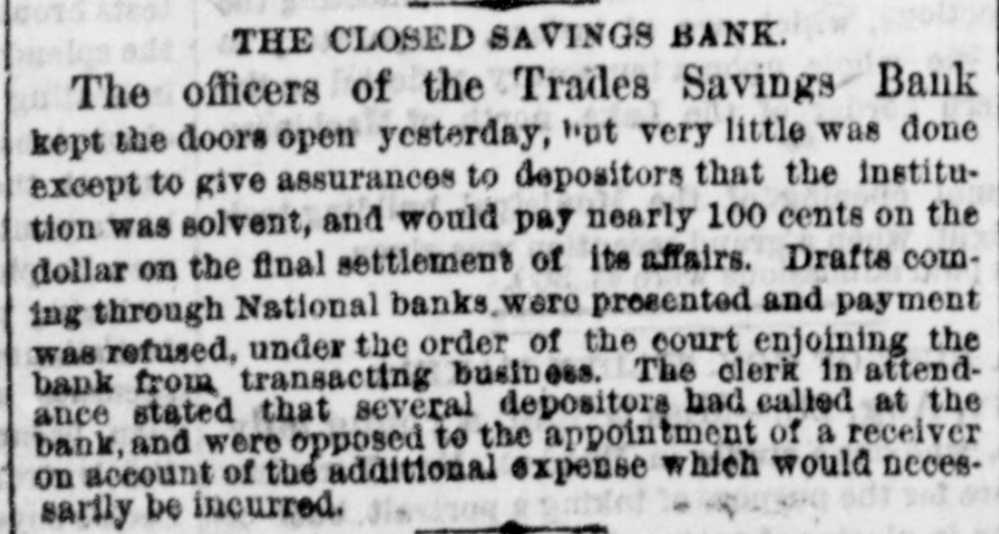
THE CLOSED SAVINGS BANK. The officers of the Trades Savings Bank kept the doors open yesterday, not very little was done except to give assurances to depositors that the institution was solvent, and would pay nearly 100 cents on the dollar on the final settlement of its affairs. Drafts coming through National banks were presented and payment was refused, under the order of the court enjoining the bank from transacting busin ess. The clerk in attendance stated that several depositors had called at the bank, and were opposed to the appointment of a receiver on account of the additional expense which would necessarily be incurred.


Article from The Sun, August 31, 1876

Click image to open full size in new tab

Article Text

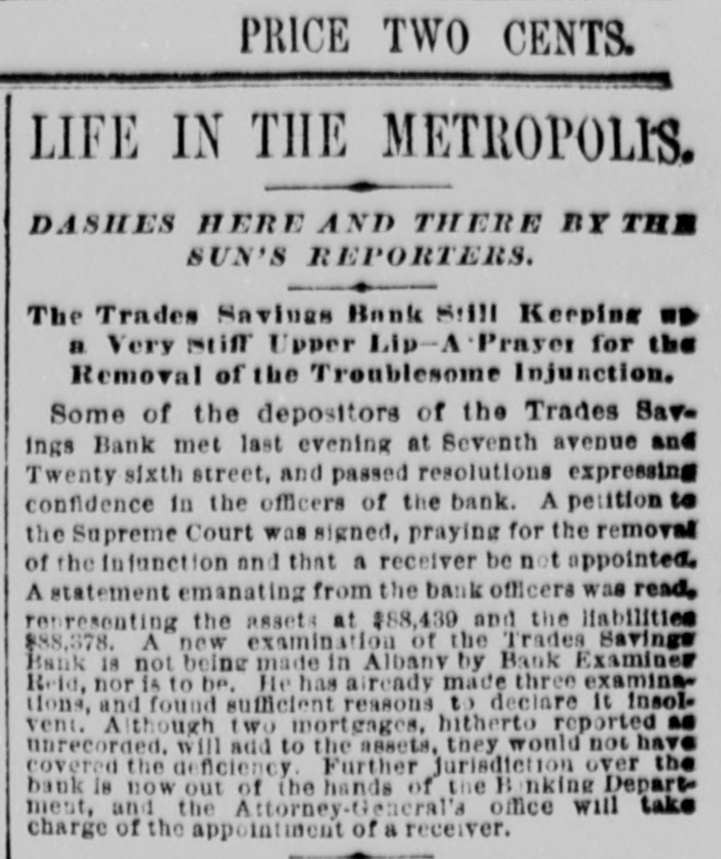
PRICE TWO CENTS. LIFE IN THE METROPOLIS. DASHES HERE AND THERE BY THE SUN'S REPORTERS. The Trades Savings Bank Still Keeping wb a Very stiff Upper Lip-A Prayer for the Removal of the Troublesome Injunction. Some of the depositors of the Trades Savings Bank met last evening at Seventh avenue and Twenty sixth street, and passed resolutions expressing confidence in the officers of the bank. A petition to the Supreme Court was signed, praying for the removal of the Infunction and that a receiver be not appointed. A statement emanating from the bank officers was read, representing the assets at $88,439 and the liabilities $88,378. A new examination of the Trades Savings Bank 18 not being made in Albany by Bank Examiner Reid, nor is to be. He has already made three examinations, and found sufficient reasons to declare It Insolvent. Although two mortgages, hitherto reported as unrecorded, will add to the assets. they would not have covered the deficiency. Further jurisdiction over the bank is now out of the hands of the B nking Depart meat, and the Attorney. General's office will take charge of the appointment of a receiver.


Article from New-York Tribune, August 31, 1876

Click image to open full size in new tab

Article Text

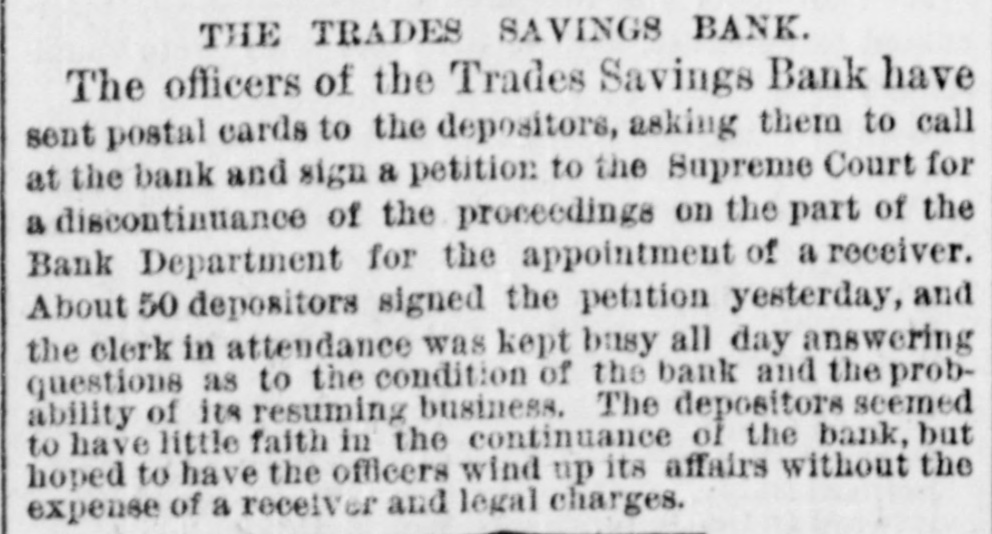
THE TRADES SAVINGS BANK. The officers of the Trades Savings Bank have sent postal cards to the depositors, asking them to call at the bank and sign a petition to the Supreme Court for a discontinuance of the proceedings on the part of the Bank Department for the appointment of a receiver. About 50 depositors signed the petition yesterday, and the clerk in attendance was kept busy all day answering questions as to the condition of the bank and the probability of its resuming business. The depositors seemed to have little faith in the continuance of the bank, but hoped to have the officers wind up its affairs without the expense of a receiver and legal charges.


Article from The New York Herald, November 21, 1876

Click image to open full size in new tab

Article Text

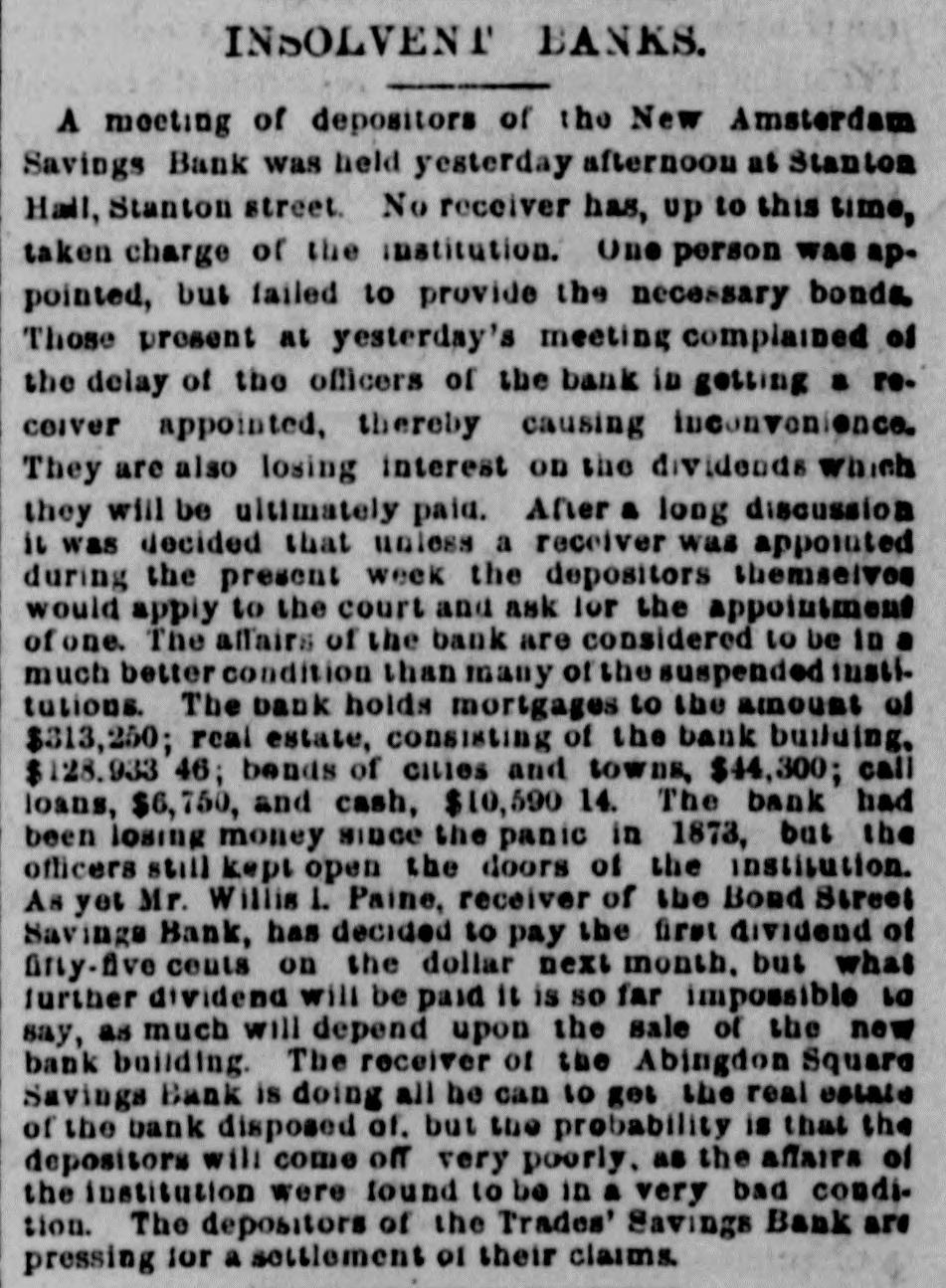
INSOLVENT BANKS. A meeting of depositors of the New Amsterdam Savings Bank was held yesterday afternoon as Stanton Hall, Stanton street. No receiver has, up to this time, taken charge of the institution. One person was appointed, but failed to provide the necessary bonds Those present at yesterday's meeting complained of the delay of the officers of the bank in getting a re. coiver appointed, thereby causing inconvenience. They are also losing interest on the dividends which they will be ultimately paid. After a long discussion it was decided that unless a receiver was appointed during the present week the depositors themselves would apply to the court and ask for the appointment of one. The affairs of the bank are considered to be in a much better condition than many of the suspended institutions. The bank holds mortgages to the amount of $313,250; real estate, consisting of the bank building. $128.933 46; bends of Cities and towns, $44,300; call loans, $6,750, and cash, $10,590 14. The bank had been losing money since the panic in 1873, but the officers still kept open the doors of the institution. As yet Mr. Willis 1. Paine, receiver of the Bond Street of Savings Bank, has decided to pay the first dividend fifty. five cents on the dollar next month. but what further dividend will be paid it is so far impossible LO say, as much will depend upon the sale of the ne bank building. The receiver of the Abingdon Square Savings Bank is doing all he can 10 get the real estaid of the bank disposed of. but the probability is that the depositors will come off very poorly. as the affairs of the institution were found to be in a very bad condition. The depositors of the Trades' Savings Bank are pressing for a settlement of their claims.


Article from The Sun, March 18, 1877

Click image to open full size in new tab

Article Text

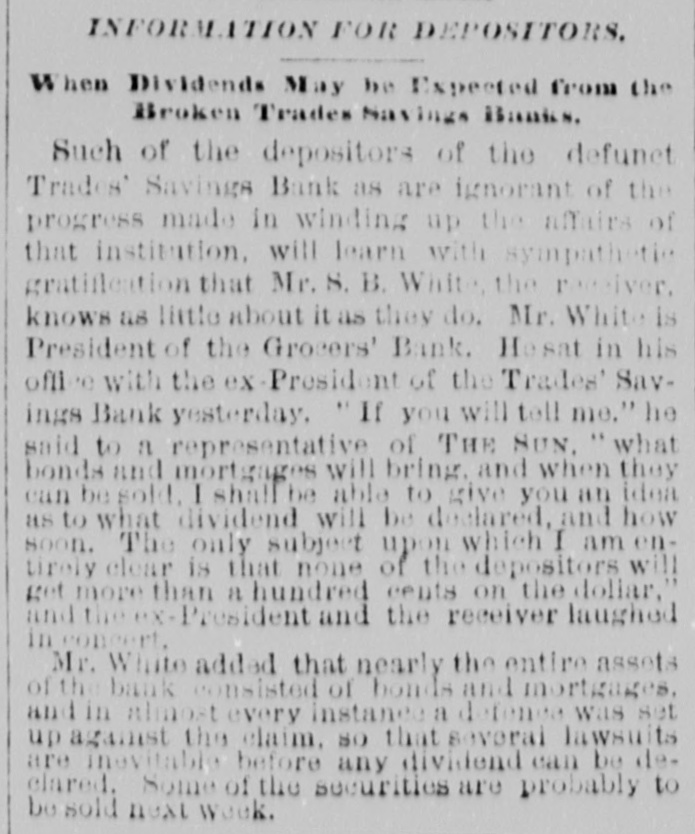
INFORMATION FOR DEPOSITORS, hen Dividends May be Expected from the Broken Trades Savings Banks. Such of the depositors of the defunet Trades' Savings Bank as are ignorant of the progress made in winding up the affairs of that institution. will learn with sympathetic gratification that Mr. S. B. White the receiver knows as little about it as they do. Mr. Whit is President of the Grocers' Bank. Hesat in his offi e with the ex President of the Trades' Savings Bank yesterday. "If you will tell me." he said to a representative of THE SUN. "what bonds and mortgages will bring. and when they can be sold. I shall be able to give you an idea as to what dividend will be declared, and how soon. The only subject upon which I am entirely clear is that none of the depositors will get more than a hundred cents on the dollar, and theex President and the receiver laughed in concert. Mr. White added that nearly the entire assets of th bank consisted of bonds and mortgages. and in almost every instance a d fenda was set up against the claim. so that several lawsuits are inevitable before any dividend can be declared. Some of the securities are probably to be sold next Week.


Article from The Sun, May 10, 1877

Click image to open full size in new tab

Article Text

on Banking this morning resumed gation of the charges preferred against Superintendent Ellis. Mr. Ellis testified that he had an examination of the department made to find all papers pertaining to the charge about the 1 rades Savings Bank, which Mr. Mack called for yesterday. The bundle of papers was produeed. and comprised letters, reports. teleand miscellaneous examination made in these grams, the memoranda; November showed among a 1875, deflof that bank. This examination ciency of $6,538.29 of assets. and of income $1,425.75. Mr. Ellis said that the real estate reported among the assets as worth $13,000 wassoid soon afterward for $28,000. He told the Secretary of the bank after receiving the report showing a deflefency, that the trustees must make the dellcleney good. and put it upon a sound basis or he would close it up. The Secretary said he would do it. A letter was then shown witness. which he said he sent to the President of the bank on Dec. 25. in which he required that the bank must be put upon a sound basis at A copy of a telegram was also shown office. from 1 Secretary of the bank. dated Dec. 3. stating that everything had been fixed upas proposed. Witness had, however, caused the examiner to make another investigation to verify these statements. and that examination showed surplus of $213.34. and an excess of income of $013. 19. After this examination another was made in August. the examiner havthe instruction to keep an eye vigilantly upon this bank. and veral others which had but litsurplus. and were consequently weak. The particular examination upon which the bank was elos up was directed by Deputy Superin- beendent Lamb during Mr. Elis's absence. cause he found the bank was advertising a good deal for dep sits, and was acting suspiciously. Wither SH belie ved that his examiner. Mr. Reid, had seasionally swornthe officers or employees of banks which he was examining. The bank law gave him dis tionary power to close up a upon H bad showing or require it to make good of such defferency and change a bad system the busin SB. The regular returns sent 111 to Inparture sworn to by the officers. The Abingdo Square Bank charge was taken and Mr. Ellis resented the examiner's reup. port of the Alingdom Square Bank. made Nov. 1. 1875. in evidence, showing the assets of that bank to be $140 and the liabilities $136.022.26. a surplus of 14,424.70, bitt it defferency of income of $664.60. long as the bank she wed a surplus. he had no power to put the bank in the hinds of a receiver. In regard to the holding of real estate in violation of their charter. which is one of the charges the report shows that they had sold their real estate at a profit. nd got in exchange purchase moneyand mortThis was done be fore date of Reid's gages. Examination. He did not believe this exchange was a violation of the spirit of the law. In February, 1876. the bank made a report for Jan. 1. showing it surplus of $7,207.58. He had consuited Attorney- General Fairchild about the law relation to the exchange of property: and while in agreeing upon the tual logality of the the exchange. that official thought. with SB. that the rule might open the way for general speculation in real estat and he expressed an opinion to against it. Upt July 26. 110 had no reason was any dellien in the bank are count. At that time he took his vacation. and Mr. Lamb had charge untilth bank was closed. 11 bank had all of its assets in Government bonds he believed it could hardly pay dollar for il a receiver was appointed. Mr. Lamb testified regarding a letter from at Hold dated July relativet showing of the and deficiency parent $7,125.39 the assets. On reported two ease to the AttorneyGeneral meldon W. Swancy chief clerk to the Atnted the record of his wing that application for an order guinst tank had been made Aug 10. 476. when adjourned until 10 A. M. to-


Article from New-York Tribune, June 8, 1877

Click image to open full size in new tab

Article Text

MEETING OF INDIGNANT DEPOSITORS, THE OFFICERS AND RECEIVER OF THE TRADES SAVINGS BANK DENOUNCED. The law offices of Henry M. Heymann, at No. 275 West Twenty-third-st., were filled last evening with an anxious throng of the depositors of the broken Trades' Savings Bank, and they were loud in their denum. clation of the trustees and officers who, they declared, had not in the least attempted to right the tangled affairs of the bank or protect the interests of the depositors. The action of the receiver who, they alleged, was appointed through the influence of Dexter A. Hawkins and I. M. Freese without consulting them in the matter, was also denounced in the most bitter terms, and such words as "fraud" and "swindler" were freely used. Alexander M. Leslie also came in for a large share of abuse. He came into the meeting last night, but was informed by the indignant depositors that be was not wanted there, and soon after withdrew. The object of the meeting last night was to hear the report of a committee which had been appointed to wait on the receiver and obtain a statement from him. The committee stated last night that Mr. White told them that there was $7,000 in bis hands, but that the only way the depositors could make him declare a dividend was to apply to the Supreme Court for a mandamus. One of the depositors said to a TRIBUNE reporter: "We have been referred to Mr. White, the receiver, time and time again, but thus far he has not given us the least satisfaction in regard to our property. To several of us he has said that he was tired at being bothered at our clamorings for our money, and hoped we would get another receiver appointed. That is just the very thing we are going to do. Why, we have thus far been victimized far worse than the depositors of the Third Avenue Bank." The depositors present last evening represented about $30,000, in sums from $50 to $5,000. Mr. Heymann, their attorney and counsel, in conversation with a TRIB UNE reporter, said that he had learned that second and third mortgages had be n made and registered at the same time, and were held by the suspended bank. "All this," he continued. "I shall lav before the AttorneyGeneral when I move for the appointment of a new TO ceiver. I have called on Mr. White. and he blankly refused to give me any information whatever." Resolutions were adopted denouncing the action of the officers and trustees in making a false statement in November last of the condition of the bank, and also to take steps to compel the receiver to render an account of the moneys in his hands. It was stated that the receiver told one of the depositors that at the time of the failure the bank had in KT088 deposits $77,000, and in nominal assets $65,000, of which $54,000 was in mortgages, including some second mortgages. The depositors lingered about the office long after the meeting adjourned. They represented méchanics, sewing girls, shop girls, and in general a class of people who can ill afford to part with their savings.


Article from The Sun, July 12, 1877

Click image to open full size in new tab

Article Text

The following IS the report of last January: RESOURCES $8.500 Bonds and mortgages 5,702.50 Long Island City bonds 2,482.92 Cash in other banks Cash on hand 2,841 24 297 50 Excess of market value of stock Interest due and accrued 563 13 Furniture and fixtures 2,500 00 $22,869 29 Total LIABILITIES $22,362.64 Due depositors 507.65 Surplus The number of depositors was 177. and the average of each deposit is $126.34. The bank was in corporated in 1869, with Harry Genet as President. IMPATIENT DEPOSITORS The Receiver of the Trades Savings Bank Called to Account-No Dividend Yet. About a hundred of the depositors of the broken Trades Savings Bank met in the Germania Assembly Rooms at Seventh avenue and Twenty-sixth street last evening. The bank closed its doors on August 26, 1876. On November 15. S. B. White, President of the Grocers' Bank. was appointed receiver. notwithstanding the alleged fact that the Grocers' Bank was a creditor of the broken bank to the amount of $1,000. At last evening's meeting. H. M. Heyman. counsel for the depositore. read a state. ment signed by the attorneys of Receiver White, setting forth that the estimated value of the assets delivered over to him was $58,500; that all the money realized from the sale of property un der foreclosure had been deposited with the Trust Company. and that the president and secretary. and not the trustees, were responsible for certain unfortunate investments. Mr. Heyman next read a letter written by him to the receiver. asking more specific information. to which no reply had been made H said that a list of the bank assets furnished to a depositor by Dexter A. Hawkins, a trustee. and now one of the counsel for the receiver footed up $64,000. while the assets when the bank first closed were estimated At $84,000, and the liabilities at $76,000. The object of the meeting Mr. Heyman wention to explain. was to force the receiver to deliver up the moneys in his possession and declare a dividend, however small. Several depositors made speeches. and a collection was taken to defray the expenses of legal proceedings. The meeting adjourned without determining on any definite plan of action.


Article from The New York Herald, July 12, 1877

Click image to open full size in new tab

Article Text

SAVINGS BANK TROUBLES. THE RECEIVER AND COUNSEL OF THE TRADES' SAVINGS BANK OVERHAULED. Some sharp words ol criticism were bestowed at the Germania Assembly Rooms last night upon S. B. White, receiver of the Trados' Savings Bank, and Dexter A. Hawkins, his attorney. The occasion was a meeting of the depositors of that defunct institution, called for the purpose of instituting legal proceedings to compel the receiver to pay adividend from the moneys DOW in his custody. Some seventy-tive depositors were present, several ladies being umong the number. All looked liko hon. est, hard working people, who could ill afford to 1080 the money intrusted by them to the broken bank. The Trades' Savings Bank, which was situated in Twenty-third street, near Eighth avenue, suspended, it will be remembered, on the 26th ot August last, and the receiver was appointed the following Noveinber. Since then the creditors have patiently waited for a dividend, but none has been made, and, according to Counsellor Henry M. Heymann, acting for the depositors, the receiver has failed to submit any report to the Court. The meeting was called to order by Mr. Jardine, who nominated for chairman Mr. Cohnfeld. The latter stated tuo object of the meeting and called upon Counsellor Heymann to speak. Mr. Heymann began by alluding to the fact that he acted in a dual capacity, as counsel to the committee of depositors and as a depositor humself, whose money had been sunk 1u the bankrupt concern. Ho then read n letter addressed by him to Receiver White, in which he demanded as counsel for the depositors a full statement of the assets and liabilities ot the late Trades' Savings Bank, the amount of cash, and the kind, value and amount of securities. PERTINENT INQUIRIES. The following passages occur in the letter:-"If any o! the mortgages are not yet paid and are not being foreclosed, will you stato the reason?" ..If you are able, will you state what the deficiency of assets, if any, is likely to amount to 9" WWILL you also state whether or not, in your opinion or as you are advised. there have been any illegal investments of the funds of the bank-if so, what amount, and whether any of the officers have made themselves liable by reason 01 such investment, and do you intend, as receiver, to press that liability home?' Mr. Heymann then road the answer coming Iroin Hawkins and Cotureu, counsel to the receiver. and severely criticised each passage. Tue answer gave a statement of the mortgages held by the receiver but did not state whether they were first, second or third mortgages. It also said:-"We have not been able to find any illegal investments, nor have we discovered any liability except $4,000 against Mr. Lesley, the President, which he denies. You have falsely stated that S. B. H. Vauce and Dexter A. Hawkins were trustees.' PLAIN TALK ABOUT THE OFFICERS. In answer 10 the last statemont Mr. Heymann exhibited bank books bearing the printed names of Vance and Hawkius as trustees. "I have found," said lic. "records in the County Clerk's office which show that Home of the mortgages taken by the bank were second and third mortgages, and I have also found that $10,000 were loaued on Jersey city property. Now the law strictly promibits bank officials from loaning depositors' money on other than first mortgages. It also stops them from loaning money on property outside of the State. The officers of the bank are, therefore, liable to indictment, and I ask why has not Receiver White taken the proper steps toward prosecution, for he well knows the lacts. "The reason IS this" continued Mr. Hey mann, warming up, "Dexter A. Hawkins, the lobbyigt, was the counsel of the defunct bank. Ho IS now the coun. sel of the receiver. The receiver also 18 u creditor of the bank, which owes the Grocers' Bank, of which be IS President, $4,000. 12 my opinion be wants to get this amount, and, between them, they want to squander the money already on hand. They have enough in the Trust Company now to pay a dividend of ten per cent. Why don't they do it? There is deception and chicanery going on but we will hound them unti. we get our money." Several other depositors followed in the same strain, denouncing the action of the receiver and his counsel 1u the severest terms and demanding their immediate prosecution. At the close of the meeting a considerable sum was subscribed to carry on the legal proceedings. Counsellor Heymann announced that he would go to Albany without delay and consuit with the Attorney General. He would also lose no time in making the proper motion in the Supreme Court toward bringing tue recoiver to a proper sense ot his duty.


Article from New-York Tribune, July 12, 1877

Click image to open full size in new tab

Article Text

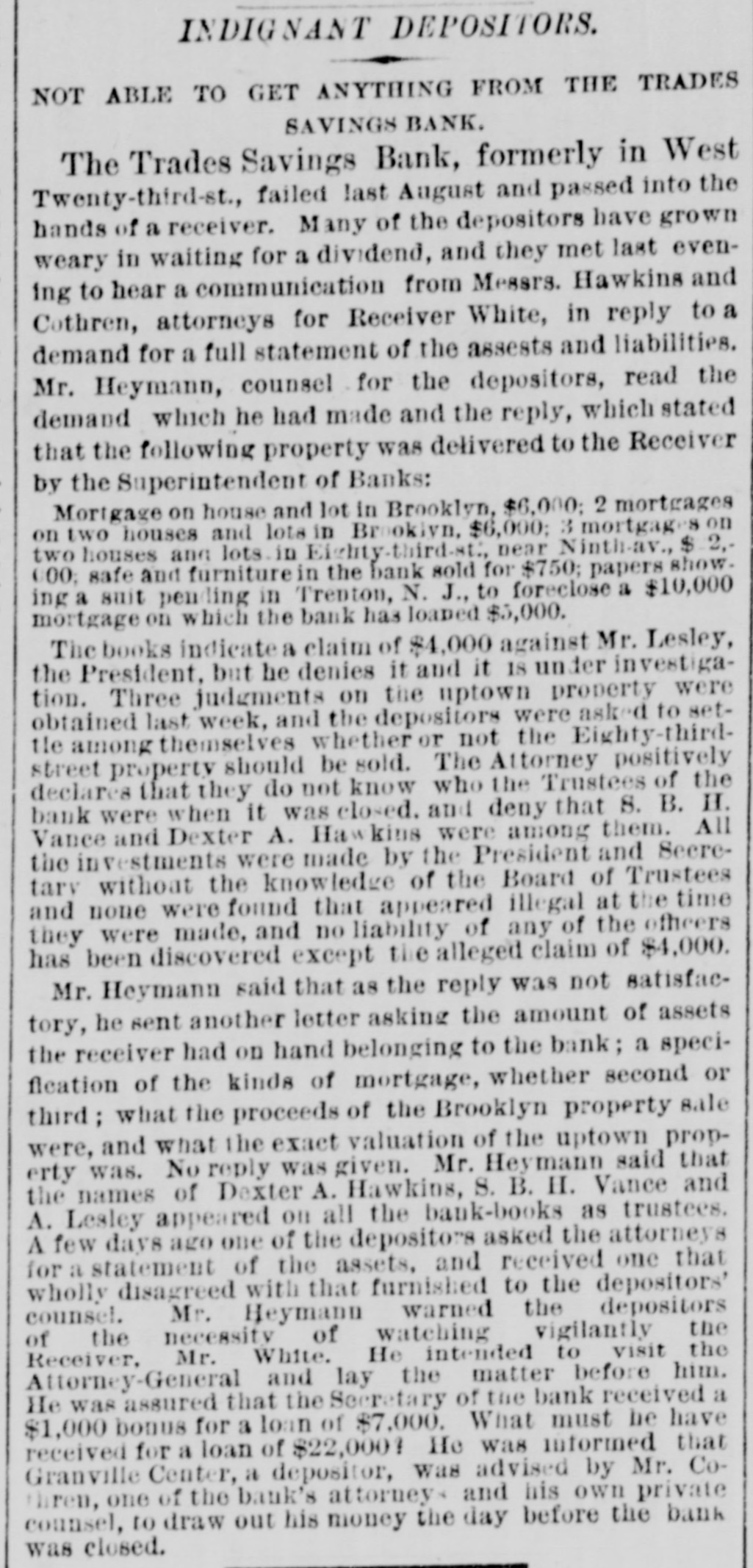
INDIGNANT DEPOSITORS. NOT ABLE TO GET ANYTHING FROM THE TRADES SAVINGS BANK. The Trades Savings Bank, formerly in West Twenty-third-st., failed last August and passed into the hands of a receiver. Many of the depositors have grown weary in waiting for a dividend, and they met last evening to hear a communication from Messrs. Hawkins and Cothren, attorneys for Receiver White, in reply to a demand for a full statement of the assests and liabilities. Mr. Heymann, counsel for the depositors, read the demand which he had made and the reply, which stated that the following property was delivered to the Receiver by the Superintendent of Banks: Mortgage on house and lot in Brooklyn, $6,000; 2 mortgages on two houses and lots in Brooklvn. $6,000; 3 mortgages on two houses and lots in Eighty.third-st. near Ninth-av., $ 2,000; safe and furniturein the bank sold for $750; papers showing a suit pending in Trenton, N. J., to foreclose a $10,000 mortgage on which the bank has loaped $5,000. The books indicate a claim of $4,000 against Mr. Lesley, the President, but he denies it and it IS under investigation. Three judgements on the uptown property were obtained last week, and the depositors were asked to setthe among themselves whether or not the Eighty-thirdstreet property should be sold. The Attorney positively declares that they do not know who the Trustees of the bank were when it was closed. and deny that S. B. H. Vance and Dexter A. Hawkins were among them. All the investments were made by the President and Secretarv withoat the knowledge of the Board of Trustees and none were found that appeared illegal at the time they were made, and no liability of any of the officers has been discovered except the alleged claim of $4,000. Mr. Heymann said that as the reply was not satisfactory, he sent another letter asking the amount of assets the receiver had on hand belonging to the bank; a specifleation of the kinds of mortgage, whether second or third; what the proceeds of the Brooklyn property sale were, and what the exact valuation of the uptown property was. No reply was given. Mr. Heymann said that the names of Dexter A. Hawkins, S. B. H. Vance and A. Lesley appeared on all the bank-books as trustees. A few days ago one of the depositors asked the attorneys for a statement of the assets, and received one that wholly disagreed with that furnished to the depositors' counsel. Mr. Heymann warned the depositors of the necessity of watching vigilantly the Receiver, Mr. White. He intended to visit the Attorney-General and lay the matter before him. He was assured that the Secretary of the bank received a $1,000 bonus for a loan of $7,000. What must be have received for a loan of $22,000? He was informed that Granville Center, a depositor, was advised by Mr. Cothren, one of the bank's attorney and his own private counsel, to draw out his money the day before the bank was closed.


Article from The Sun, August 9, 1877

Click image to open full size in new tab

Article Text

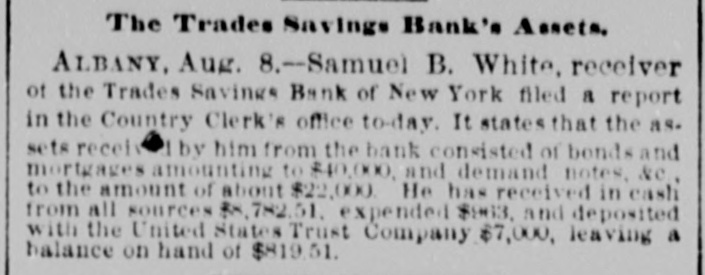
The Trades Savings Bank's Assets. ALBANY, Aug. 8.--Samuel B. White, receiver of the Trades Savings Bank of New York filed a report in the Country Clerk's office to-day. It states that the as. sets receiv el by him from the bank consisted of bonds and mortgages amounting to $40,000. and demand notes, &c. to the amount of about $22,000 He has received in cash from all sources Rx. 782.51. expended $963. and deposited with the United States Trust Company $7,000, leaving a balance on hand of $819.51.


Article from New-York Tribune, August 9, 1877

Click image to open full size in new tab

Article Text

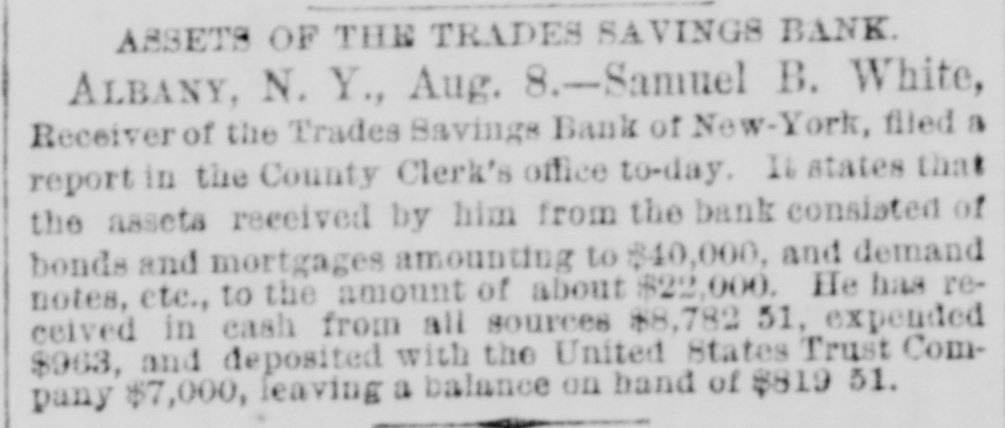
ASSETS OF THE TRADES SAVINGS BANK ALBANY, N. Y., Aug. 8.-Sanuel B. White, Receiver of the Trades Savings Bank of New-York, filed a report in the County Clerk's office to-day. It states that the asseta received by him from the bank consiated of bonds and mortgages amounting to $40,000, and demand notes, etc., to the amount of about $22,000. He has recelved in cash from all sources $8,782 51, expended $963, and deposited with the United States Trust Company $7,000, leaving a balance on hand of $819 51.


Article from The New York Herald, August 9, 1877

Click image to open full size in new tab

Article Text

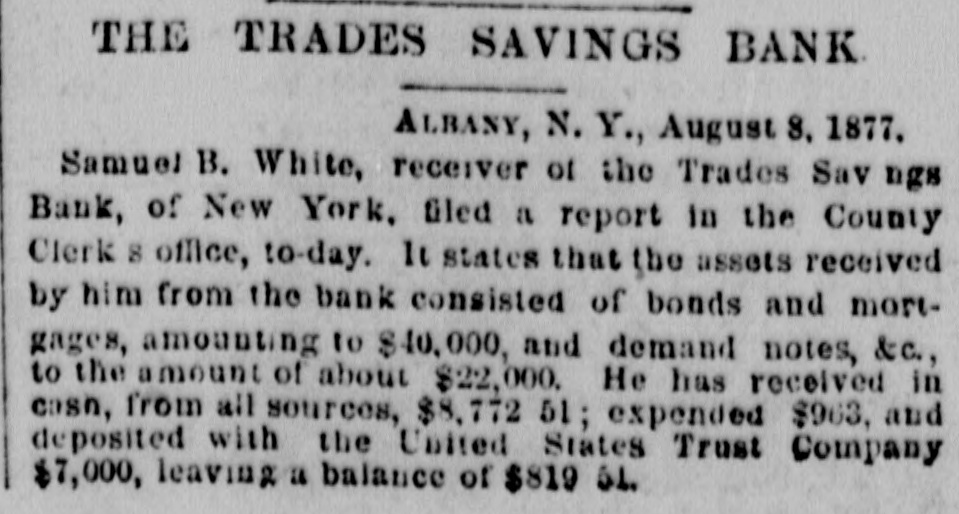
THE TRADES SAVINGS BANK ALBANY, N. Y., August 8. 1877. Samuel B. White, receiver of the Trades Sav ngs Bank, of New York, filed a report in the County Clerk 8 office, to-day. It states that the assets received by him from the bank consisted of bonds and moregages, amounting to $40,000, and demand notes, &c., to the amount of about $22,000. He has received in casn, from all sources, $8,772 51; expended $963, and deposited with the United States Trust Company $7,000, leaving is balance of $819 51.


Article from The New York Herald, September 20, 1877

Click image to open full size in new tab

Article Text

TURN ON THE LIGHTS. To THE EDITOR OF THE HERALD:The Trades Savings Bank (West Twenty-tbird street) was closed in August, 1876, and since then no depositor has received one cent of principal or interest. The press published is statement, shortly ulter the bank was closed, that $88,000 was the amount due to depositors, which was principally covered by mortgage on city property. Next January two years will have elapsed since the bauk has paid any interest. Now, 11 the interest bas been duly collected on these mortgages, the receiver should have enough on hand to pay is dividend 01 ten per coul. The "bank laves. tigation's made some disclosures about the Trades Savings Bank baving made fictitious mortgages. If such IS not the fact 18 it not quite time for the reJ. J. ceiver to let the depositors know?


Article from The New York Herald, October 30, 1877

Click image to open full size in new tab

Article Text

THE TRADES SAVINGS BANK. -The receiver of the Prades Savings Bank, Mr. Samuel S. White, began paying the first dividend of lifteen per cent yesterday morning. Only fifty depositors out of over eight hundred appeared, as the fact of the dividend was not publicly known. Mr. Henry M. Heymann. counsel for the depositors, went to Albany last night for the purpose of taking steps to have Mr. White removed iroun the receivership and the place of trial changed to New York.


Article from The New York Herald, November 4, 1877

Click image to open full size in new tab

Article Text

SUMMARY OF LAW CASES. Judge Van Vorst yesterday rendered a decision in the foreclosure case of Samuel B. White, receiver of the Trades Savings Bank, against Alexander M. Lealle and others, giving judgment of foreclosure. Langdon W. Moore, alias Charley Adams, held for the alleged larceny of $8,000 worth of securities in Boston, was yesterday before Judge Donohue on a writ of habeas corous, obtained by Mr. William F. Howe, his counsel. Mr. Howe put in a denial that the prisoner IS Charley Adams. The Clerk of the Court, Mr. William Sinclair, was directed to take testimony as to the identity, and will commence taking the evidence on Wednesday. The resistance of the receiver appointed to take charge of property belonging to Mr. O'Net!1 in Brooklyn promises to occupy the attention at the courts until a thorough examination 18 made into the case. Timothy Crogan and James Haley, who had the propcity sold out under a chattel mortgage after the receiver had taken possession; B. F. Strauss, the lawyer who counselled the sale, and B. P. Middleton, the auc. tioneer, were all brought yesterday before Judge Dono. hue. They were represented by Assistant District Attorney Moore, of Brooklyn, as counsel, while the roceiver was represented by Mr. R. L. Grant. Alter some discussion on an adjournment was granted until Wednesday, the parties bolag allowed to go on their own recognizance, inasmuch as the property had been removed. In the case of O'Netli, charged with con. tempt of Court, interrogatories were filed and answers put in.