16563. Keystone National Bank (Philadelphia, PA)

Bank Information

Episode Type
Run → Suspension → Closure
Bank Type
national
Bank ID
2291
Charter Number
2291
Start Date
December 2, 1890
Location
Philadelphia, Pennsylvania (39.952, -75.164)

Metadata

Model
gpt-5-mini
Short Digest
0371bc53f17a8bc3

Response Measures

Accommodated withdrawals, Capital injected, Full suspension, Books examined

Receivership Details

Depositor recovery rate
18.0%
Date receivership started
1891-05-09
Date receivership terminated
1902-01-31
OCC cause of failure
Fraud
Share of assets assessed as good
33.3%
Share of assets assessed as doubtful
57.7%
Share of assets assessed as worthless
8.9%

Description

A run occurred Dec 2, 1890 caused by a returned/poorly endorsed large check that spawned rumors. The run subsided, but months later (Mar 20, 1891) the Comptroller ordered the bank closed and a receiver was appointed; the institution did not successfully resume and officers were indicted/absconded. Sequence matches run → suspension → permanent closure/receivership.

Events (6)

1. July 30, 1875 Chartered
Source
historical_nic
2. December 2, 1890 Run
Cause
Rumor Or Misinformation
Cause Details
A large check recently sent to the bank was returned because it was not properly endorsed; this apparently occasioned a rumor that the check had gone to protest, triggering withdrawals.
Random Run
Yes
Random Run Snippet
Large check returned; rumor it had gone to protest; bank declared all right.
Measures
Bank officers reassured depositors; many redeposited funds after run collapsed.
Newspaper Excerpt
There was a run Mon day on the Keystone National bank.
Source
newspapers
3. March 20, 1891 Receivership
Newspaper Excerpt
The bank was placed in the hands of a receiver last week. ... the comptroller appointed a receiver of the Spring Garden National Bank. (context shows Keystone placed in receivership).
Source
newspapers
4. March 20, 1891 Suspension
Cause
Government Action
Cause Details
Comptroller of the Currency ordered the bank closed after examiners reported the reserve had fallen below legal requirements and other adverse developments.
Newspaper Excerpt
This bank is closed by the order of the comptroller of the treasury. (Signed) N. P. DREW, National Bank Examiner.
Source
newspapers
5. April 2, 1891 Other
Newspaper Excerpt
The affairs of the Keystone National bank are gradually issuing from a state of chaos, and the officers are confident that within a few days the doors of the institution will be again opened for business.
Source
newspapers
6. May 9, 1891 Receivership
Source
historical_nic

Newspaper Articles (22)

Article from Rock Island Daily Argus, December 2, 1890

Click image to open full size in new tab

Article Text

A Run on the Bank. P1 ILADELPHIA, Dec. 2.--There was a run Mon day on the Keystone National bank. The bank has a capital of $000,000 and a surp us of $100,000. A large check from Bost on recently sent to the bank, and return d because not properly indorsed, is said to have occasioned the rumor that the chec C bad gone to protest. President Mar h says the bank is all right. It has about 4400,000 of the county's money.


Article from Waterbury Evening Democrat, December 3, 1890

Click image to open full size in new tab

Article Text

Bank Officers Rejoice. PHILADELPHIA, Dec. 3.-The run on the Keystone National Bank has collapsed. and the officers of the institution, and those who have stood behind it in the hour of its peril, are rejoicing over their victory. Many depositors who drew out their funds have redeposited them.


Article from Los Angeles Herald, March 21, 1891

Click image to open full size in new tab

Article Text

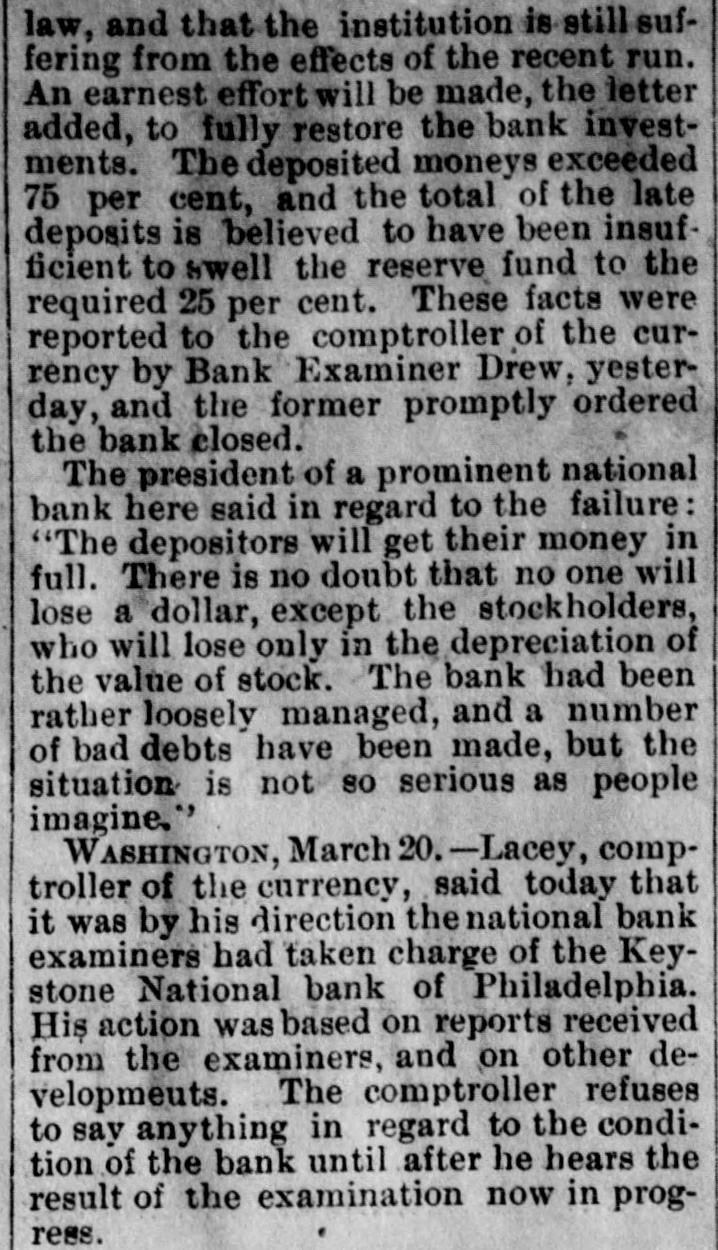
law, and that the institution is still suffering from the effects of the recent run. An earnest effort will be made, the letter added, to fully restore the bank investments. The deposited moneys exceeded 75 per cent, and the total of the late deposits is believed to have been insufficient to swell the reserve fund to the required 25 per cent. These facts were reported to the comptroller of the currency by Bank Examiner Drew, yesterday, and the former promptly ordered the bank closed. The president of a prominent national bank here said in regard to the failure: "The depositors will get their money in full. There is no doubt that no one will lose a dollar, except the stockholders, who will lose only in the depreciation of the value of stock. The bank had been rather loosely managed, and a number of bad debts have been made, but the situation is not so serious as people imagine." WASHINGTON, March 20. -Lacey, comptroller of the currency, said today that it was by his direction the national bank examiners had taken charge of the Keystone National bank of Philadelphia. His action was based on reports received from the examiners, and on other developmeuts. The comptroller refuses to say anything in regard to the condition of the bank until after he hears the result of the examination now in progress.


Article from Pittsburg Dispatch, March 22, 1891

Click image to open full size in new tab

Article Text

SEEKING A SOLUTION FOR THE WAY OUT OF THE KEYSTONE BANK DIFFICULTIES. A Consultation of Officials Held, but no Decision Arrived At-Four Heavy Stockholders Ready to Act-The Amount of Philadelphia's Deposit Not Known. EPECIAL TELEGRAM TO THE DISPATCH.: PHILADEL PHIA, March 21.-The Keystone National Bank is still closed. Bank Examiner W. P. Drew was about the first person to reach the institution this morning, and an hour later President G. W. Marsh arrived. The bookkeeper was called into the President's office, and for about 20 minutes the three persons were in consultation. When the conclave was ended Mr. Marsh was asked about the present condition of affairs. He said: "There has been no material change. We have been endeavoring to overcome the present difficulty, and think that within a few days we will have good news for all parties concerned. "There are only two ways, however, of bringing about a resumption. One way is to obtain a sufficient advancement of funds from the stockholders to warrant the Comptroller in allowing the resumption. The other way is to realize on the bank's assets in order to reach the same result. My opinion is that it is far better to obtain additional funds from the stockholders. Four heavy stockholders have come forward and said they would stand by me in any course we might conscientiously choose to adopt in trying to bridge the difficulty. "My experience as President of the bank teaches me that the head of a large financial institution should be a man of wealth. As I am not possessed of wealth I am perfectly willing to retire from the presidency when the present trouble is ended." Treasurer Bardsley was seen this afternoon with reference to the deposit of the city's money. He said it would be impossible to tell the exact amount in the bank until Monday or Tuesday next. He admitted placing an extra $50,000 in the bank on Thursday afternoon, in excess of the $400,000, but added that he had given out checks to withdraw part of the amount, and until there was some certainty as to the number cashed, he could not tell just how matters stood.


Article from Waterbury Evening Democrat, March 24, 1891

Click image to open full size in new tab

Article Text

The Keystone Bank May Resume. PHILADELPHIA, March 24-An effort is being made to establish the Keystone National Bank with new capital. The bank was placed in the hands of a receiver last week.


Article from Delaware Gazette and State Journal, March 26, 1891

Click image to open full size in new tab

Article Text

THE KEYSTONE GOES DOWN. The Philadelphia Bank Closed by Order of the Comptroller of the Treasury-Philadelphia Has a Big Deposit. Philadelphia, March 20.-Soon after the Keystone National Bank opened for business this morning the heavy iron doors were lowered and the following notice was placed upon them: PHILADELPHIA, March 20.-This bank is closed by the order of the comptroller of the treasury. (Signed) N. P. DREW, National Bank Examiner. After the closing of the bank's doors admission was denied to all persons. The closing of the bank was a surprise to most of its depositors. During the financial stringency in the latter part of last year there were rumors affecting the bank's solvency and a heavy run was made upon it, but the institution tided over the run and was thonght to be in good financial condition. The largest depositor of the bank is the city of Philadelphia which has on deposit there about $400,000. The authorized capital of the bank is $500,000 and a surplus of $100,000 was claimed. No statement of the bank's liabilities and assets is obtainable as the officials, directors and Bank Examiner Drew are at present engaged in consultation with closed doors. It is said that the bank was closed by the comptroller by reason of its reserve fund having fallen below the amount required by the national banking law. The bank has a line of deposits amounting to about $1,400,000 and it is claimed for it that it has assets sufficient to meet this amount. WHY THE COMPTROLLER ACTED. WASHINGTON, March 20.-Mr. Lacy, comptroller of the currency, said to-day that it was by his direction that the national bank examiner had taken charge of the Keystone National Bank of Philadelphia. His action was based on reports received from the examiner and on "other developments." The comptroller refuses to say anything in regard to the condition of the bank until after he hears the result of the examination now in progress. PHILADELPHIA, March 22.-It is confidently announced that the Keystone National Bank will resume in a few days. President Marsh says he is not a wealthy man and is ready to retire in favor of some one of greater means whose standing will help the bank. It is probable that the stockholders instead of paying an assessment will give over the management to capitalists, who are ready to advance money provided they are given control. City Treasurer Bardsley holds that he is not responsible for the $400,000 of city money he deposited there, because it was named as a depository of city money for that amount by city councils. Only a month ago he had over $1,000,000 on deposit in the Keystone, but only for a few days. It was soon distributed to other banks. The Keystone has always been to some extent political in its leanings, city contractors having a great deal of business with it. As


Article from The Wilmington Daily Republican, April 2, 1891

Click image to open full size in new tab

Article Text

The Keystone Bank Will Resume. PHILADELPHIA, April 2.-The affairs of the Keystone National bank are gradually issuing from a state of chaos, and the officers are confident that within a few days the doors of the institution will be again opened for business, which will be conducted on a firmer basis than has existed since the panic of last winter.


Article from New-York Tribune, May 22, 1891

Click image to open full size in new tab

Article Text

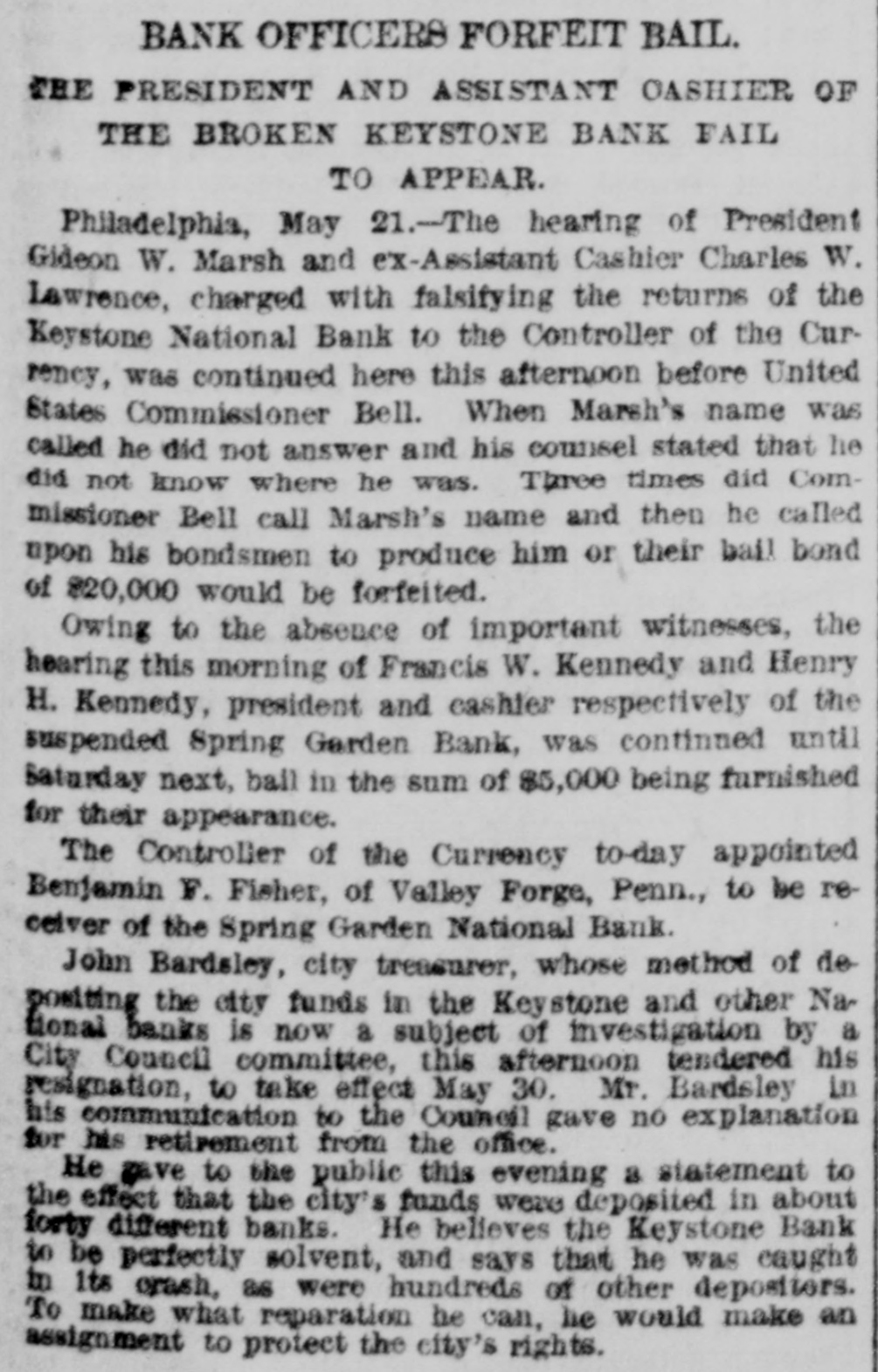
BANK OFFICERS FORFEIT BAIL. THE PRESIDENT AND ASSISTANT OASHIER OF THE BROKEN KEYSTONE BANK FAIL TO APPEAR. Philadelphia, May 21.-The hearing of President Gideon W. Marsh and ex-Assistant Cashier Charles W. Lawrence, charged with falsifying the returns of the Keystone National Bank to the Controller of the Currency, was continued here this afternoon before United States Commissioner Bell. When Marsh's name was called he did not answer and his counsel stated that he did not know where he was. Three times did Commissioner Bell call Marsh's name and then he called upon his bondsmen to produce him or their bail bond of $20,000 would be forfeited. Owing to the absence of important witnesses, the hearing this morning of Francis W. Kennedy and Henry H. Kennedy, president and cashier respectively of the suspended Spring Garden Bank, was continued until Saturday next, ball in the sum of $5,000 being furnished for their appearance. The Controller of the Currency to-day appointed Benjamin F. Fisher, of Valley Forge, Penn., to be recelver of the Spring Garden National Bank. John Bardsley, city treasurer, whose method of depositing the city funds in the Keystone and other Na tional banks is now a subject of investigation by a City Council committee, this afternoon tendered his resignation, to take effect May 30. Mr. Bardsley in his communication to the Council gave no explanation for his retirement from the office. He gave to the public this evening a statement to the effect that the city's funds were deposited in about forty different banks. He believes the Keystone Bank to be perfectly solvent, and says that he was caught in Its orash, as were hundreds of other depositors. To make what reparation be can, he would make an assignment to protect the city's rights.


Article from New-York Tribune, May 23, 1891

Click image to open full size in new tab

Article Text

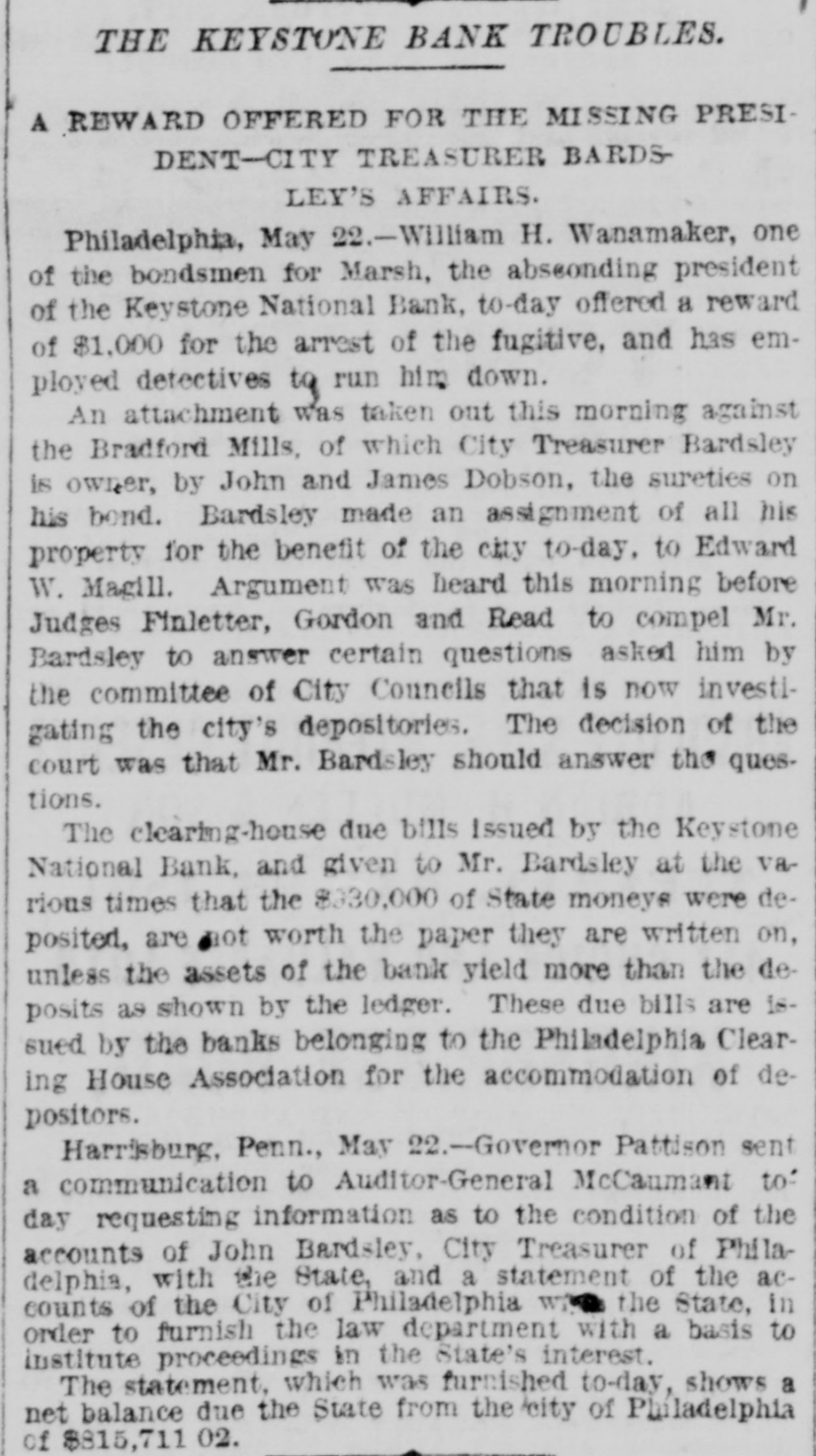
THE KEYSTONE BANK TROUBLES. A REWARD OFFERED FOR THE MISSING PRESIDENT-CITY TREASURER BARDSLEY'S AFFAIRS. Philadelphia, May 22.-William H. Wanamaker, one of the bondsmen for Marsh, the absconding president of the Keystone National Bank, to-day offered a reward of $1,000 for the arrest of the fugitive, and has employed detectives tg run him down. An attachment was taken out this morning against the Bradford Mills, of which City Treasurer Bardsley is owner, by John and James Dobson, the sureties on his bond. Bardsley made an assignment of all his property for the benefit of the city to-day. to Edward W. Magill. Argument was heard this morning before Judges Finletter, Gordon and Read to compel Mr. Bardsley to answer certain questions asked him by the committee of City Councils that is now investigating the city's depositories. The decision of the court was that Mr. Bardsley should answer the questions. The clearing-house due bills Issued by the Keystone National Bank, and given to Mr. Bardsley at the various times that the $330,000 of State moneye were deposited, are not worth the paper they are written on, unless the assets of the bank yield more than the deposits as shown by the ledger. These due bills are issued by the banks belonging to the Philadelphia Clearing House Association for the accommodation of depositors. Harrisburg, Penn., May 22.-Governor Pattison sent a communication to Auditor-General McCaumant to: day requesting information as to the condition of the accounts of John Bardsley, City Treasurer of Philadelphia, with the State, and a statement of the acin counts of the City of Philadelphia Wi the State, order to furnish the law department with a basis to institute proceedings in the State's interest. The statement, which was furnished to-day, shows a net balance due the State from the city of Philadelphia of $815,711 02.


Article from Delaware Gazette and State Journal, May 28, 1891

Click image to open full size in new tab

Article Text

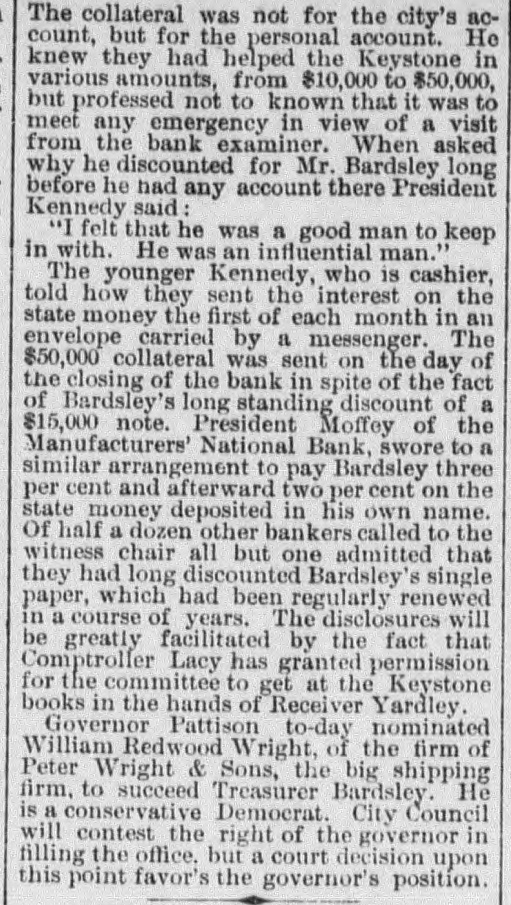
The collateral was not for the city's account, but for the personal account. He knew they had helped the Keystone in various amounts, from $10,000 to $50,000, but professed not to known that it was to meet any emergency in view of a visit from the bank examiner. When asked why he discounted for Mr. Bardsley long before he had any account there President Kennedy said: "I felt that he was a good man to keep in with. He was an influential man." The younger Kennedy, who is cashier, told how they sent the interest on the state money the first of each month in an envelope carried by a messenger. The $50,000 collateral was sent on the day of the closing of the bank in spite of the fact of Bardsley's long standing discount of a $15,000 note. President Moffey of the Manufacturers' National Bank, swore to a similar arrangement to pay Bardsley three per cent and afterward two per cent on the state money deposited in his own name. Of half a dozen other bankers called to the witness chair all but one admitted that they had long discounted Bardsley's single paper, which had been regularly renewed in a course of years. The disclosures will be greatly facilitated by the fact that Comptroller Lacy has granted permission for the committee to get at the Keystone books in the hands of Receiver Yardley. Governor Pattison to-day nominated William Redwood Wright, of the firm of Peter Wright & Sons, the big shipping firm, to succeed Treasurer Bardsley. He is a conservative Democrat. City Council will contest the right of the governor in filling the office, but a court decision upon this point favor's the governor's position.


Article from The Wichita Daily Eagle, June 4, 1891

Click image to open full size in new tab

Article Text

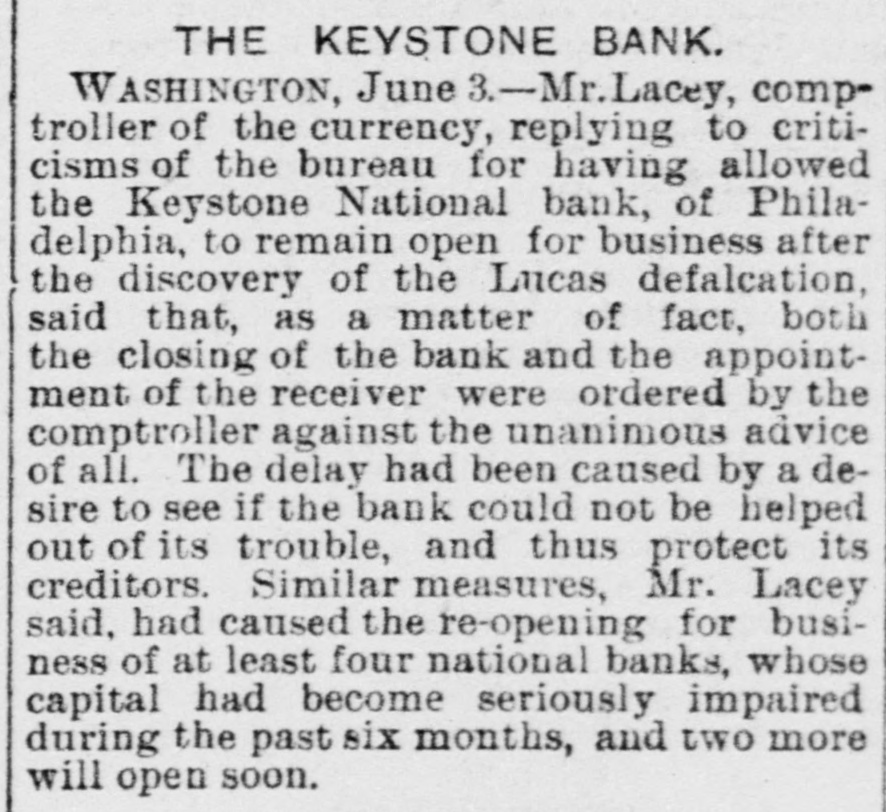
THE KEYSTONE BANK. WASHINGTON, June 3.-Mr. - Lacey, comptroller of the currency, replying to criticisms of the bureau for having allowed the Keystone National bank, of Philadelphia, to remain open for business after the discovery of the Lucas defalcation, said that, as a matter of fact, both the closing of the bank and the appointment of the receiver were ordered by the comptroller against the unanimous advice of all. The delay had been caused by a desire to see if the bank could not be helped out of its trouble, and thus protect its creditors. Similar measures, Mr. Lacey said, had caused the re-opening for business of at least four national banks, whose capital had become seriously impaired during the past six months, and two more will open soon.


Article from The Wilmington Daily Republican, June 4, 1891

Click image to open full size in new tab

Article Text

TO BENEFIT CREDITORS. Mr. Lacey Explains the Delay in Closing the Keystone Bank. W ASHINGTON, June 4.-Mr. Lacey, the comptroller of the currency, replying to criticisms of his bureau for having allowed the Keystone National bank of Philadelphia to remain open for business after the discovery of the Lucas defalcation, said: "As a matter of fact both the closing of the bank and the appointment of a receiver were ordered by the comptroller against the unanimous protest of all who had sufficient interest to express an opinion. There were many reasons why it was especially desirable to avoid a receivership, notably on account of its assets being so largely in real estate, which could only be sold by a receiver under order of the court, and hence at great disadvantage. Hence to were the yield the comptroller made to several to reopen hopeful deemed the attempts it bank his duty by which contribution of new capital under new and competent management. "A a matter of fact it was officially reported to the comptroller that $300,000 of new capital had been subscribed and that the Lucas estate was expected to make good all amounts which a complete examination should show to be due from them. Recent developments have shown that these plans could never have been carried out, but they were sufficiently promising at the time to warrant the delay asked for. In short, whatever was done was with the sole purpose of best serving the interests of creditors of the unfortunate bank."


Article from The Salt Lake Herald, June 4, 1891

Click image to open full size in new tab

Article Text

# Comptroller Lacey Defends Himself. WASHINGTON, June 3.-Referring to the criticisms of his bureau in connection with the Keystone bond failure of Philadelphia, Comptroller Lacey said, to-day, as a matter of fact, both the closing of the bond and appointment of a receiver were ordered by the comptroller against the wish of one who has sufficient interest to express his opinion; that there were many reasons why it was desirable to avoid a receivership, notably on account of its assets being so large in real estate, hence the comptroller deemed it his duty to aid in several hopeful attempts made to reopen the bank by contributions of new capital, under new management. As a matter of fact, it was officially reported to the comptroller that $300,000,000 of the new capital had been subscribed and that the Lucas estate was expected to make good all amounts due. Recent developments have shown these plans could not have been carried out, but they were sufficiently promising at the time to warrant the delay asked for. Similar measures, Lacey said, have caused the re-opening for business within the past six months of at least four national banks whose capital become impaired and two more will open soon.


Article from The National Tribune, June 11, 1891

Click image to open full size in new tab

Article Text

Asked to Investigate the Treasury Department, Postmaster-General Wanamaker has been asked to appear before the committee of Philadelphia Councilmen, at present engaged in investigating the affairs of City Treasurer Bardsley and the wrecked Keystone National Bank. The committee want Gen. Wanamaker's testimony as to his knowledge of the bank's affairs. Mayor Stuart, of Philadelphia, has written a letter to President Harrison, requesting him to have an investigation made into the action of the Treasury Department with regard to its delay in closing the Keystone Bank, and its appointment of a receiver for said bank; that the Comptroller of the Currency be instructed to appear before the committee of these Councils appointed to investigate the said bank, and that the receiver of said bank be directed to permit the said committee or its expert accountants to examine and inspect any and all the books, documents and records of the said bank. The President will take no action in the matter until he has conferred with Secretary Foster, who is not in Washington.


Article from Richmond Dispatch, June 12, 1891

Click image to open full size in new tab

Article Text

THE KEYSTONE-BANK WRECK. Comptroller Lacey's Report with Respect to It-Examiner Drew Suspended. [By telograph to the Dispatch.) WASHINGTON, June 11.-Mr. Lacey, Comptroller of the Currency, has completed the preparation of his report in regard to the Keystone National Bank of Philadelphia. It is a very long and exhaustive document and gives a detailed and circumstantial account of the Comptroller's action in the matter, together with the reports received from the examiner in charge, on which such action was mainly based. The President will transmit it to the Mayor of Philadelphia as a full and complete response to the resolutions of the Common Council. Comptroller Lacey will not appear before the local committee conducting the investigation in Philadelphia, theauthorities here having concluded that it would be establishing a bad precedent to allow anybody other than Congress to investigate Federal officials, and to have access to the official records of the Government. It is expected that the Comptroller's report will supply all the information in that officer's possession required by the committee conducting the municipal investigation. An important fact in connection with the investigation that does not appear to be generally known, is that Bank-Examiner Drew has been suspended from duty pending the result of an investigation into his administration and has been instructed to examine no more banks in his district for the present.


Article from Evening Star, June 29, 1891

Click image to open full size in new tab

Article Text

CONTROLLER LACEY said this morning that there was no special significance attaching to the visit of Mr. Yardley, receiver of the Keystone National Bank of Philadelphia, to Washington. He came simply to consult with the controller of the currency in regard to matters pertaining to the execution of his trust as receiver.


Article from Delaware Gazette and State Journal, July 9, 1891

Click image to open full size in new tab

Article Text

EXAMINER DREW MUST GO. Consuls Asked to Look for Marsh--Yard Will Appeal--Broken Banks Dropped. PHILADELPHIA, July 7.-Correspondence of the comptroller of the currency' and Bank Examiner Drew, in which the latter was taken to task for his failure, in his report of January 29th, after 15 days' investigation, to include among the liabilities of the Keystone National Bank $544,851.46, for which it was then indebted on account of clearing house certificates, is made public. Mr. Drew says the omission was clearly an accident. On July 2d, the comptroller requested the resignation of Mr. Drew as a bank examiner, but at latest accounts he had not received it. The mayor has transmitted to President Harrison the resolutions of city councils expressing the wish that the President inform the several ministers and consuls of the United States of the desire of the government to secure the arrest and extradition Bank. of President Marsh of the Keystone Counsel for H. H. Yard have decided to appeal to the supreme court from the decision of Judge Allison ordering Yard to submit himself to the sub-committee on investigation of city councils' finance committee and to be sworn and to testify. The Clearing House Association yesterday dropped the Keystone and Spring Garden National Banks from membership. The executive committee of the depositors of the Penn Trust and Safe Deposit Company, which is now in the hands of a receiver, have addressed a circular letter to depositors asking them to contribute three per cent of the amount of their deposits, to be used to complete the investigation. Ephraim Young and Frank Benton were indicted by the grand jury yesterday, on the charge of conspiracy to cheat the Millward-Cliff Cracker Company of $52,000, by the issue of certain promissory notes and other false and fraudulent means.


Article from The Wilmington Daily Republican, July 10, 1891

Click image to open full size in new tab

Article Text

At the Opera. No special attempt at decoration was made last night at Albert hall. The audience numbered about 6,000 and the artists included Albani, Nordia Belle, Edward Lloyd and the choral society. The kaiser wore the uniform of a British admiral. The kaiserin had a dress of cardinal silk with a dazzling tiara of diamonds. At the conclusion of the "Kaiser's March" the audience arose and cheered the imperial visitors and the kaiser and kaiserin bowed repeatedly. The queen's box, enlarged for the occasion, was occupied by the imperial royal personages. To Make an Exhaustive Examination WASHINGTON, July 10. - Secretary Foster has instructed Messrs. Brown and Faunce, the experts appointed to examir e the Keystone and Spring Garden banks in Philadelphia, to make a complete and exhaustive examination of those banks, exercising their own discretion as to whether they would work singly or together. They are instructed to submit partial reports every Saturday, showing the progress made and results attained, and at the conclusion of their work they are directed to make a complete report. The comptroller has directed Receivers Yardley and Fisher to furnish Messrs. Brown and Faunce all possible facilities to render their work effective.


Article from Juniata Sentinel and Republican, July 15, 1891

Click image to open full size in new tab

Article Text

minutes and 20 seconds. Miss Sudie Drier of Lewistown is the guest of her friend Miss Gertie Frank in Patterson. Miss Carrie Bouser, of Martinsburg, Blair county, is visiting her friend Miss Marion Scholl. Banker, E. S. Parker of Washington D. C., dropped in among his numerous friends here on Tuesday. Robbin's show was stranded by the sheriff of Huntingdon county, and failed to exhibit here on the 13th as advertised. The Meyers and Juniatas played a match game of ball on Monday afternoon. The score stood 7 to 5 in favor of the Juniatas. Jacob Basom, of Richfield was at the county seat on business a day or two ago. He reports the peach and wheat crop about Richfield most promising. Eli Weidman, brother of Squire A. H. Weidman died at his home near McAlisterville on the 9th inst., aged 74 years. Interment last Sat- in the McAlisterville Lutheran grave yard. During a veteran sham battle at a picnic in Perry county, "One veteran was shot in the leg with a gun wad and an other received a knock in his head from the butt of a musket during a charge." E. Dunn & Company have a saw in their mill a mile and a half from town from which they turnout first rate shingles. If you have shingle timber that is the place to have it converted into first rate shingles. Bardsley, the jailed Philadelphia City Treasurer, keeps on talking but every time his conversation reveales nothing as to the whereabouts of the million dollars except that he put it in the broken Keystone National Bank: Mrs. Benjamin Cook, and daughter of Ackron, Ohio, are visiting in Patterson. Mrs. Cook is a daughter of Jacob Frank deceased, who in his days was known as one of the first merchants in Patterson. It is reported that democratic senator Brice, of Ohio, was a citizen of New York state, when elected by the Onio Legislature to a seat in the U. S. Senate, and is therefore ineligible to the office to which he was elected. We are indebted to A. C. Pannebaker for the Pueblo Chieftain published in Pueblo, Colorado, Sunday July 4th, 1891. The paper arrived here on the 9th, four days after publication. The Chieftain is up to eastern city Sunday newspapers. Simpson Graybill, was killed at Harrisburg on the 7th inst., by being run over by the train on which he was breaking. His remains were brought to Port Royal, this county, for interment on the 10th inst. A wife and four children mourn his loss. J. L. Van Gundy, of Lewisburg, visited the family of Mr. Joseph Rothrock near town, and the family of Mr. John Kirk in town, and other families in Juniata last week. Mr. Van Gundy is professor of Latin and Natural Science in Hagerstown Seminary, Md. Have you tried South American Nervine—the gem of the century? The great cure for Indigestion, Dyspepsia and Nervousness. Warranted the most wonderful Stomach and Nerve Cure ever known, Trial bottles 15 cents. Sold by L. Banks & Co., Druggists, Mifflintown, Pa. Nov. 14, ly. List of letters uncalled for remain, ing in the Post Office at Mifflintown, Pa., for the week ending July 11th 1891. Persons calling for mail in this list will please say they are advertised. One cent will be charged for each letter advertised. Letters: Thomas Hamilton, D. A. W. Zeiders, W. J. Hains. James McCauley, P. M. Ten young men and ten young ladies from this town visited the family of Dr. Shelly in Port Royal last Thursday evening. One of the conductors on a passenger train was so suprised at the handsome delegation, that in his enthusiasm he exclaimed. Why where in the world did they all come from, and all about one age. # RHEUMATISM CURED IN A DAY. "Mystic Cure," for Rheumatism and Neuralgia, radically cures in one to three days. Its action upon the system is remarkable and mysterious. It removes at once the cause and the disease immediately disappears. The first dose greatly benefits. 75 cents. Sold by L. Banks & Co., Druguists, Mifflintown. Feb. 18, 4m. On the 8th inst., Reuben Meyers, aged about 22 years, son of Rev. Christ Meyers of Tuscarora Twp., was found dead in the passage way with a gun shot.
Article from Delaware Gazette and State Journal, July 23, 1891

Click image to open full size in new tab

Article Text

# DUE BILLS WON'T ACCOUNT FOR IT. "How many of these checks do you hold and what do they aggregate?" "I hold three checks, paid to John Bardsley between July 16th, 1890, and September 30th, 1890, amounting to $6,677.78; and 31 checks paid to him between October 10th, 1890, and May 22d, 1891, amounting to $1,264,729.79, in all $1,271,407.57. Of the whole sum $755,860.58 was recived by John Bardsley between December 11th, 1890, and May 22d, 1891, which was after the run on the Keystone Bank had ceased. The sum of $193,605.74 was received by him after the Keystone Bank had closed its doors and every bit of it, save the first mentioned sum of $6,677.78, was received after Mr. Bardsley deposited the money in the Keystone Bank which he claims to be represented by the due bills, which, it will be remembered, bear dates running from February Sth, 1890, to October 6th, 1890. What still further strengthens my view of the matter is the fact that in examining the indorsements of the checks I find that but $47,947 represented by eight checks, bear the clearing house stamp of the Keystone National Bank. One check amounting to $50,083.33, bears the written indorsement of John Bardsley and G. W. Marsh, president. So that it would appear that only $98,030.33 went in the direction of the Keystone Bank, while eighteen checks, representing $570,652.87 bear the clearing house stamp of the Third National Bank. Seven checks, representing $602,724.37 were checks drawn to 'cash' or to 'John Bardsley' or 'bearer,' and do not bear an indorsement of any kind, but appear to have been paid by the bank upon which they were drawn either in cash over the counter or by exchanging their own due bills for these checks. "While it is possible that the tracing of the checks representing the large sum of money may result in proving that Mr. Bardsley placed most of it in the depositories where he kept the funds entrusted to his care as city treasurer, nothing but a careful examination and a thorough analysis of the facts would satisfactorily prove what disposition was finally made of it. The mere fact that so large a sum as $600,000, represented by seven checks, should be drawn to 'cash' or 'bearer' would appear as something very unusual. Business men, as a rule, exercise greater care in the transmission of such large sums of money in the settlement of accounts, and this fact alone, it seems to me, would justify a careful examination of the accounts." my belief that it is possible that efforts may have been made to quietly and safely hide the funds represented by some of the other checks."


Article from The Roanoke Times, August 19, 1891

Click image to open full size in new tab

Article Text

LAWRENCE GETS SEVEN YEARS. The Sentence of the Two Kennedy's Postponed Until September. Philadelphia, Aug. 18.-[Special.]- |Charles Lawrence, ex-assistant cashier of the broken Keystone National Bank, who yesterday plead guilty in United States District court to two indictments charging him with making false entries in the bank's books and with conspiracy with Gideon E. Marsh, president of the bank, to make falso entries, was this morning sentenced by Judge Beade to seven year's imprisonment in the eas. tern penitentiary at hard labor and to pay a fine of $100 and costs. Francis W. Kennedy, president, and Henry H. Kennedy, cashier of the suspended Spring Garden National Bank, were brought before Judge Butler this morning. The two Kennedy's also plead guilty yesterday to making false entries to the comptroller of the currency, misplacing the funds of the bank and making false entries in the books. After the two men had pleaded guilty Judge Butler was petitioned by their counsel to suspend sentence to allow them to get their affairs into order. and also on the ground that they could be of great assistance to the receiver of the bank in disentangling its affairs. Judge Butler reserved his decision on this matter until to-day. This morning he decided to grant the petition and postponed sentence until September S.


Article from Abilene Weekly Reflector, January 7, 1892

Click image to open full size in new tab

Article Text

After the Keystone. PHILADELPHIA, Jan. 5.-Edward W. Magill, assignee of John Bardsley, entered suit in common pleas court against the suspended Keystone national bank to recover $100,000 Magill says that November 25, 1890, the bank received from J. Bardsley, as a loan, 100 bonds of the Baltimore Traction Co., valued at $1,000 each, the bank promising at the same time to return the bonds or give face value for them and that on November 25 President Marsh gave Bardsley a receipt for them but sold them and appropriated the proceeds to their own use.