Article Text
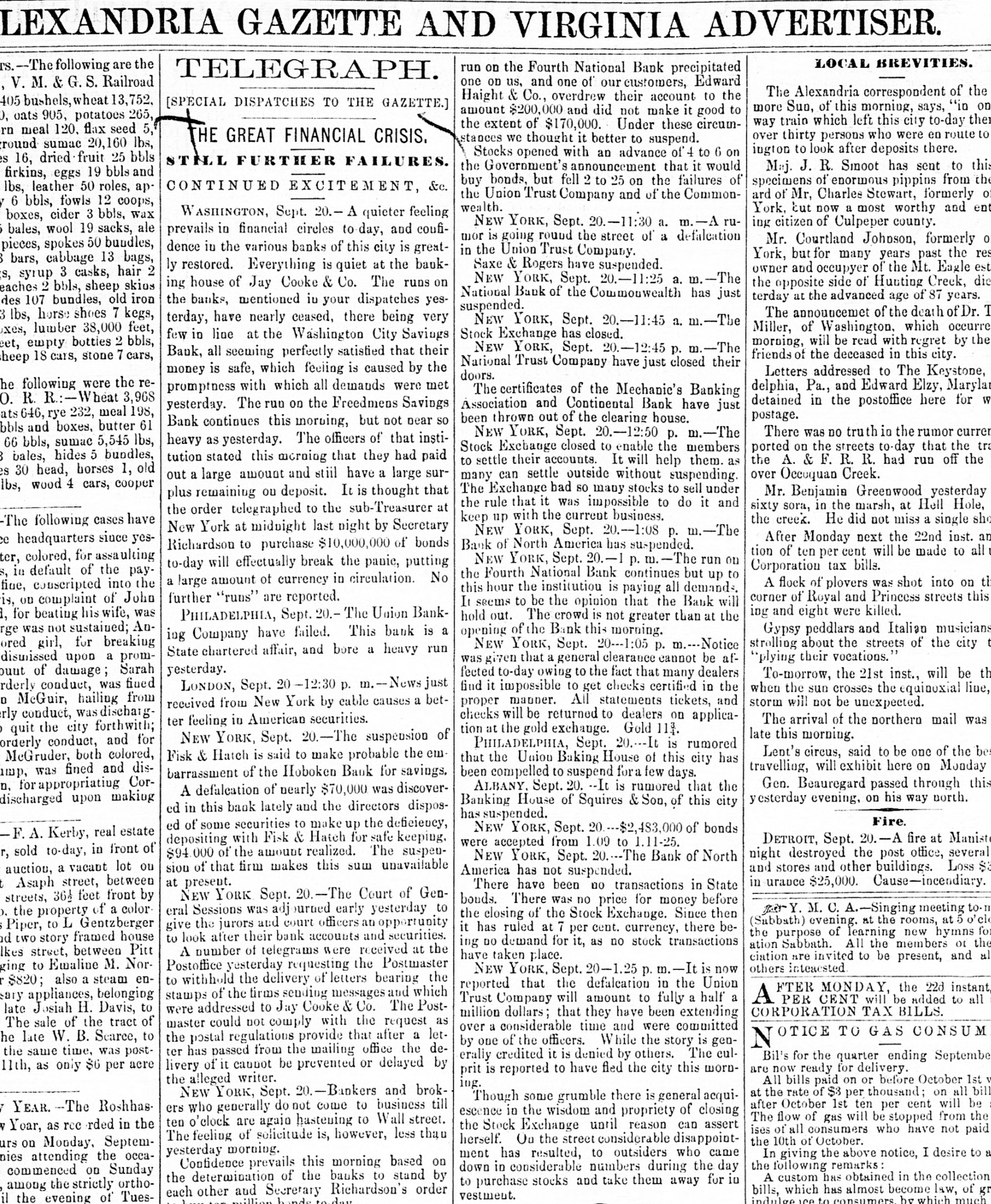
LEXANDRIA GAZETTE AND VIRGINIA ADVERTISER. LOCAL BREVITIES. TS. -The following are the run on the Fourth National Bank precipitated TELEGRAPH. one on us, and one of our customers, Edward , V. M. & G. S. Railroad The Alexandria correspondent of the Haight & Co., overdrew their account to the 405 bushels, wheat 13,752, [SPECIAL DISPATCHES TO THE GAZETTE.] more Suo, of this morning, says, "in on amount $200,000 and did not make it good to 0, oats 905, potatoes 265, way train which left this city to-day the the extent of $170,000. Under these circumrn meal 120, flax seed 5, over thirty persons who were en route to THE GREAT FINANCIAL CRISIS. stances we thought it better to suspend. round sumac 20,160 lbs, ington to look after deposits there. Stocks opened with an advance of 4 to 6 on s 16, dried fruit 25 bbls STINL FURTHER FAILURES. the Government's announcement that it would Maj. J. R. Smoot has sent to this firkins, eggs 19 bbls and buy bonds, but fell 2 to 25 on the failures of specimens of enormous pippins from the CONTINUED EXCITEMENT, &c. lbs, leather 50 roles, ap ard of Mr, Charlee Stewart, formerly of the Union Trust Company and of the Commony 6 bbls, fowls 12 coops, wealth. York, but now a most worthy and ent WASHINGTON, Sept. 20.- quieter feeling boxes, cider 3 bbls, wax NEW YORK, Sept. 20.-11:30 a. m.-A ruing citizen of Culpeper county. $ bales, wool 19 sacks, ale prevails in financial circles to day, and coufimor is going round the street of a defalcation Mr. Courtland Johnson, formerly 0 pieces, spokes 50 bundles, dence in the various banks of this city is greatin the Union Trust Company. York, but for many years past the res B bars, cabbage 13 bags, Saxe & Rogers have suspended. ly restored. Everything is quiet at the bankowner and occupyer of the Mt. Eagle est s, syrup 3 casks, hair 2 NEW YORK, Sept. 20.-11:25 a. .-The ing house of Jay Cooke & Co. The runs on the opposite side of Hunting Creek, die eaches 2 bbls, sheep skios National Bank of the Commonwealth has just terday at the advanced age of 87 years. des 107 bundles, old iron the banks, mentioned iu your dispatches yessuspended. The announcemet of the death of Dr. T 3 lbs, horse shoes 7 kegs, terday, have nearly ceased, there being very NEW YORK, Sept. 20.-11:45 a. m.-The Miller, of Washington, which occurre exes, lumber 38,000 feet, Stock Exchange has closed. few in line at the Washington City Savings morning, will be read with regret by the eet, empty botties 2 bbls, NEW YORK, Sept. 20.-12:45 p. m.-The Bauk, all seeming perfectly satisfied that their friends of the deceased in this city. sheep 18 cars, stone 7 cars, National Trust Company have just closed their money is safe, which feeling is caused by the Letters addressed to The Keystone, doors. he following were the redelphia, Pa., and Edward Elzy, Marylan promptness with which all demands were met The certificates of the Mechanic's Banking 0. R. R.:-Wheat 3,968 detained in the postoffice here for W Association and Continental Bank have just yesterday. The run on the Freedmens Savings ats 646, rye 232, meal 198, postage. been thrown out of the clearing house. Bank continues this morning, but not near so bbls and boxes, butter 61 There was no truth in the rumor currer NEW YORK, Sept. 20.-12:50 p. m.-The heavy as yesterday. The officers of that insti66 bbls, sumac 5,545 lbs, Stock Exchange closed to enable the members ported on the streets to-day that the tra 3 bales, hides 5 bundles, tution stated this morning that they had paid the A. & F. R. R. had run off the to settle their accounts. It will help them. as es 30 head, horses 1, old over Occuquan Creek. many can settle outside without suspending. out a large amount and stiil have a large surlbs, wood 4 cars, cooper The Exchange bad so many stocks to sell under Mr. Benjamin Greenwood yesterday plus remaining ou deposit. It is thought that the rule that it was impossible to do it and sixty sora, in the marsh, at Hell Hole, the order telegraphed to the sub-Treasurer at keep up with the current business. the creek. He did not miss a single she -The following cases have New York at midnight last night by Secretary NEW YORK, Sept. 20.--1:08 p. m.-The After Monday next the 22nd inst. an ce headquarters since yesRichardson to purchase $10,000,000 of bonds Bank of North America has suspended. tion of ten per cent will be made to all 1 ter, colored, for assaulting NEW YORK, Sept. 20.-1 p. run on to-day will effectually break the panic, putting Corporation tax bills. s, in default of the paythe Fourth National Bank continues but up to a large amount of currency in circulation. No A flock of plovers was shot into on th fine, conscripted into the this hour the institution is paying all demands. further "runs" are reported. corner of Royal and Princess streets this is, OD complaint of John It seems to be the opinion that the Bank will ing and eight were killed. 1, for beating his wife, was PHILADELPHIA, Sept. The Union Bankhold out. The crowd is not greater than at the rge was not sustained; AnGypsy peddlars and Italian musicians opening of the Bank this morning. ing Company have failed. This bank is a ored girl, for breaking strolling about the streets of the city t NEW YORK, Sept. 20---1:05 p. -Notice State chartered affair, and bore a heavy run dismissed upon a prom"plying their vocations." was given that a general clearance cannot be afyesterday. bunt of damage; Sarah feeted to-day owing to the fact that many dealers To-morrow, the 21st inst., will be th rderly conduct, was fined find it impossible to get checks certified in the LONDON, Sept. -12:30 p. m.--News just when the sun crosses the equinoxial line, D McGuir, hailing from proper manner. All statements tickets, and storm will not be unexpected. received from New York by cable causes a betrly conduct, was dischargchecks will be returned to dealers on applicaThe arrival of the northern mail was ter feeling in American securities. tion at the gold exchange. Gold 11 p quit the city forthwith; late this morning. NEW YORK, Sept. 20.-The suspension of orderly conduct, and for PHILADELPHIA, Sept. is rumored Lent's circus, said to be one of the bes Fisk & Hatch is said to make probable the emMcGruder, both colored, that the Union Baking House of this city has travelling, will exhibit here on Monday imp, was fined and disbarrassment of the Hoboken Bank for savings. been compelled to suspend fora few days. Gen. Beauregard passed through this n, for appropriating CorALBANY. Sept. 20. --It is rumored that the A defalcation of nearly $70,000 was discoveryesterday evening, on his way north. discharged upon making Banking House of Squires & Son, of this city ed in this bank lately and the directors disposhas suspended. Fire. ed of some securities to make up the deficiency, NEW YORK, Sept. $2,483,000 of bonds Kerby, real estate DETROIT, Sept. 20.-A fire at Manist depositing with Fisk & Hatch for safe keeping. were accepted from 1.09 to 1.11-25. r, sold to-day, in front of $94.000 of the amount realized. The suspennight destroyed the post office, several NEW YORK, Sept. The Bank of North sion of that firm makes this sum unavailable and stores and other buildings. Loss $3 auction, a vacant lot ou America has not suspended. in urance $25,000. Cause-incendiary. at present. t There have been no transactions in State Asaph street, between NEW YORK Sept. Court of Genstreets, 36 L feet front by bonds. There was no price for money before Their Y. -Singing meeting to-m eral Sessions was adj burned early yesterday to ), the property of a colorthe closing of the Stock Exchange. Since then (Subbath) evening. at the rooms, at 5 o'cle give the jurors and court officers an opportunity $ Piper, to L Gentzberger it has ruled at 7 per cent. currency, there bethe purpose of learning new hymns for to look after their bank accounts and securities. d two story framed house ing DO demand for it, as no stock transactions ation Sabbath. All the members or the Ikes street, between Pitt A number of telegrams were received at the have taken place. ciation are invited to be present, and al Postoffice yesterday requesting the Postmaster ging to Emaline M. Norothers inteacsted NEW YORK, Sept. 20-1.25 p. is now to withhold the delivery of letters bearing the r $820; also a steam enreported that the defalcation in the Union FTER MONDAY, the 22d instant, sary appliances, belonging stamps of the firms sending messages and which A Trust Company will amount to fully a half a PER CENT will be added to all late Josiah H. Davis, to were addressed to Jay Cooke & Co. The PostCORPORATION TAX BILLS. million dollars; that they have been extending The sale of the tract of master could not comply with the request as over a considerable time and were committed OTICE TO GAS CONSUM he late W. B. Searce, to the postal regulations provide that after a letby one of the officers. While the story is genthe same time, was postter has passed from the mailing office the deerally credited it is denied by others. The culBil's for the quarter ending Septembe livery of it cannot be prevented or delayed by 11th, as only $6 per acre are now ready for delivery. prit is reported to have fied the city this wornthe alleged writer. All bills paid on or before October 1st V ing. at the rate of $3 per thousand; on all bill NEW YORK, Sept. -Bankers and brokThough some grumble there is general acquiafter October 1st ten per cent will be ers who generally do not come to business till 7 YEAR. --The Roshhasescence in the wisdom and propriety of closing The flow of gas will be stopped from the ten o'clock are agaio hasteuing to Wall street. the Stock Exchange until reason can assert N Yoar, as rec rded in the ises of all consumers who have not paid The feeling of solicitude is, however, less than herself. Ou the street considerable disappointthe 10th of October urs on Monday, Septemyesterday morning. ment has resulted, to outsiders who came In giving the above notice, I desire to a nies attending the occaConfidence prevails this morning based on the following remarks: down in considerable numbers during the day commenced on Sunday A custom has obtained in the collection the determination of the bauks to stand by to purchase stocks and take them away for in among the strictly orthobills, which has almost become law, of gr each other and Secretary Richardson's order vestment. million ands to day il the evening of Tuesindulge ice to consumers by which much