16418. Northern Bank (New York, NY)

Bank Information

Episode Type
Run → Suspension → Closure
Bank Type
state
Start Date
October 26, 1907
Location
New York, New York (40.714, -74.006)

Metadata

Model
gpt-5-mini
Short Digest
30e0cd99

Response Measures

Full suspension, Books examined

Other: Receivership and liquidation followed suspension; later auctions and payout notices appear.

Description

The bank (successor to the Hamilton Bank) experienced runs during the Panic of 1907, resumed business thereafter, and was later closed/taken possession of by the New York State Superintendent of Banks (Cheney) on 1910-12-27 and placed into liquidation/receivership in early 1911. Classification: run (1907) → suspension/closing (1910) → receivership/liquidation (1911).

Events (3)

1. October 26, 1907 Run
Cause
Macro News
Cause Details
Runs occurred in the course of the nationwide Panic of 1907 and the general financial panic; frightened depositors lined up and withdrawals rose.
Measures
Bank paid depositors; officers stated firm/solvent and paid all comers; Clearing House measures and general relief aided stability.
Newspaper Excerpt
In a run on the Northern bank of New York there was so much disorder that the police had to be called.
Source
newspapers
2. December 27, 1910 Suspension
Cause
Government Action
Cause Details
Closed/taken possession by the State Superintendent of Banks (Cheney) after an examination revealed discovered conditions and certain irregular transactions; police called to keep order.
Newspaper Excerpt
The Northern Bank of New York ... was closed today by State Superintendent of Banks Cheney. A perfunctory notice was posted on the doors of the bank this morning, and soon afterward crowds began gathering in front of the place.
Source
newspapers
3. January 17, 1911 Receivership
Newspaper Excerpt
Judge Holt appointed Peter Alexander receiver ... for account of Superintendent of Banks, in charge of the Northern Bank of New York, in liquidation ... Mr. Kimbark gave the assets at approximately $900,000 ... Judge Holt appointed Peter Alexander receiver, with a bond of $10,000.
Source
newspapers

Newspaper Articles (25)

Article from The Birmingham Age-Herald, October 27, 1907

Click image to open full size in new tab

Article Text

Bankers Arrange to Issue Clearing House Certificates to All Banks ARRIVAL OF GOLD IMPORTS GIVES SUBSTANTIAL AID Banks and Trust Companies Ride the Storm of Runs Without Impairment, and the Situation Is Now Well In Hand. New York, October 26.-(Special.)-With the unanimous decision of the New York Clearing House association to issue clearing house certificates, leading financiers believe that the final steps have been taken to restore conditions in financial circles to their usual state. Of scarcely less importance as tending to restore confidence was the introduction of a resolution in the meeting of the Clearing House association applying for the readmission of trust companies to membership in the association. The announcement of the early arrival of gold imports from Europe further improved the situation today. There is a balance of $60,000,000 in our favor in the trading between Europe and the United States, and an influx of the yellow metal from Europe at this time will serve to hasten the return to normal conditions. With all these things operating to restore confidence the reaction which seu in on Friday continued unabated today. The suspension of the Terminal bank in Brooklyn, a small institution, had no effect on the situation. The Trust Company of America, the Lincoln Trust company and the other institutions which were imperiled by runs rode the storm, and their officials announced at the close of the day that tneir concerns would resume business Monday in good shape. It is understod that for the reason that Europe might get the idea that the cone ditions in New York are worse than they really are, J. P. Morgan and bankers in friendly association with them, opposed the issuance of the clearing house cer tificates, but gave way to the minority after the matter had been thoroughly threshed out Arranging Details. A committee, headed by Vice President Cannon of the Fourth National bank. was appointed to arrange the details for the issue. The final act of the meeting of the Clearing House association was the adoption of a resolution thanking Secretary Cortelyou and J. P. Morgan for their services during the time of the crisis, The regular weekly bank statement is sued today showed that the surplus which the banks had at the close of last week was entirely wiped out by the panic and that a deficit of $1,233,300 was created instead. A surprising feature of the statement was an increase of loans of $10,864,700. 11 had been expected that the enormous liquidation during the week would have resulted in a considerable decrease in this item. Frightened depositors in the Mechanics' and Traders bank. with 12 branches in Manhattan and Brooklyn, and the Broadway Trust company made a run upon these banks. All demands were met by these concerns, however. In a run on the Northern bank of New York there was so much disorder that the police had to be called. The Broadway Trust company adopted a rule that those who were withdrawing funds to pay off employes should have the first call today. General approval was given to the action of the presidents of the saving3 banks, all of which today put into effect the rule which compels the filing of 60 days notice of an intention to withdraw funds. Cortelyou's Statement. Secretary of the Treasury Cortelyou caused the following statement to be given out tonight: "On the occasion of a call on him this morning by representatives of the New York clearing house, Secretary Cortelyou asked that they convey to the clearing house his deep appreciation on behalf of the government of the courageous and high-minded manner in which they had upheld the interests, not only of the people of this city but in a sense the people of the whole country.' " Later the secretary called upon J. P. Morgan and expressed in similar terms his appreciation of the services rendered by Mr. Morgan and all who had cooperated with him in meeting the emergency. The sub-committee of the directors of the Knickerbocker Trust company, which is hoping to bring about a resumption of business of the company, met in executive session today. After the meeting Mr. Davies, the counsel for the company, said: "The committee met and after a discussion decided upon a plan of reorganization, with the end in view of resumption of business. This plan will be advertised in detail as a paid advertisement in the Monday morning newspapers. This to insure its accuracy and also its authenticity."

Article from The Washington Times, October 27, 1907

Click image to open full size in new tab

Article Text

EARING HOUSE CERTIFICATES TO STRENGTHEN BANKS Association Decides to Adopt Strong Measures and Relief Is Certain. NEW YORK, Oct. 26. With the unan imous decision of the New York Clearing House Association today to issue clearing house certificates for the settlement of debit balances by the banks, leading financiers believe that the final steps have been taken to restore conditions in financial circles to their wonted calm. The issue of these certificates will release for general circulation a large sum of currency, and the scarcity of money new the only cloud that lingers on the horizon. s Of scarcely less importance as tending to restore confidence was the introduction of a resolution in the meeting of the Clearing House Association providing for the readmission of trust companies to membership in this assoclation. This will place the trust companies under the rules of the clearing house, and tend to prevent recurrence of the situation which brought about the slump last week. News of Gold Imports Aid. Announcement of the early arrival of gold imports from Europe further improved the situation today. There is a balance of $60,000,000 in our favor in the trading between Europe and the United States, and an influx of the yellow metal from Europe at this time will serve to hasten the return to normal conditions in the financial world. Heidelbach, Ikelheimer & Co., of 37 William street, today announced that the first of the gold imports, $1,500,000 in amount, will arrive here Wednesday. With all these agencies operating to restore confidence, the reaction set in Friday continued unabated today, and the sun began to shine on Wall Street again. Except for the suspension of the Terminal Bank, in Brooklyn, a small Jenkins institution, whose closing had no effect on the situation, every report that went out over the ticker was fa. vorable. Stock Market Firm. The stock market continued firm and money was comparatively easier. The Trust Company of America, the Lincoln Trust, and the other institutions which were imperiled by runs rode the storm and their officials announced at the close of the day that their concerns would resume business Monday in capital shape to meet any demands that might be made upon them. It is understood that for the reason that Europe might get the idea that conditions are worse in New York than they reall are. J. P. Morgan and bankers in friendly association with them, opposed the issue of clearing house cer tificates, but gave way to the majority after the matter had been thoroughly threshed out. A committee headed by Vice President Cannon, of the Fourth National Bank was appointed to arrange the details for the issue. Banks will be permitted to avail themselves of the certificates to the amount of 75 per cent of their debit balances Financial men almost without exception declared after the adjournment of the meeting that this measure will undoubtedly bring to the situation the relief that is needed to restore confidence and stability to the market The final act of the meeting of the clearing house association was the adoption of a resolution thanking Secretary of the Treasury Cortelyou and J. Pierpent Morgan for their services during the time of the crisis. Surplus Was Wiped Out. The regular weekly bank statement issued today showed that the surplus which the banks had at the close of last week was entirely wiped out by the flurry, and that a deficit of $1,233,300 was created instead. A surprising feature of the statement was an increase of loans of $10,864,700. It had been expected that the enormous liquidation in the market during the week would have resulted in a considerable decrease in this item. While the skles were clearing in Wali Street, frightened depositors in- the Mechanics and Traders' Bank, 565 Broadway, with twelve branches in Manhattan and Brooklyn, and in the Broadway Trust Company, Broadway and Eighth street, made a descent upon the two institutions, and there were lively withdrawals for some time. All demands were met by the two concerns however. In a run on the Northern Bank of New York, Broadway and Fourth street, there was so much disorder that the police had to be called. The Broadway Trust Company adopted a rule that those who were withdrawing funds to pay off employes should lave the first call today. General approval was given to the action of the presidents of the savings banks, all of which today put into effect the rule which compels the filing of sixty days' notice of an intention to withdraw funds.


Article from The Washington Times, October 28, 1907

Click image to open full size in new tab

Article Text

Stock Market Strong and Advances All Along Line. Engagementof$9,000000 From London Helps Some. NEW YORK, Oct. 28.-A general restoration of confidence was indicated by the banking situation, following the improvement during the opening hours of business today. The stock market was strong under buying orders from London and advances of from one to three points were made in all active dividend-paying stocks. The engagement of $9,000,000 of gold by New York banks for immedi< ate importation from London gave much strength to the situation. The action of clearing houses in various cities in following the lead of New York in deciding to issue clearing house certificates was looked upon as a measure of safety and conservatism. The Lincoln Trust Company and the Trust Company of America paid all comers, and their lines were by far the smailest since the runs began. Minor Runs Started. Minor runs were started today on two smailer financial institutions. At the Northern Bank of New York, at Broadway and Fourth street, about seventyfive people were constantly in line. The bank officials saw to it that all the frightened depositors Were allowed in the bank out of the rain and they were paid off as rapidly as possible. Lack of sufficient small bills was given as an excuse by the officers for delay in making payments. At the Broadway Trust Company's institution about seventy-five people were also in line constantly. Paying off was conducted as rapidly as pos= sible. Officers declared the firm solvent and able to meet all demands. A report that a run nad started on the Mechanics' and Traders' Bank, which was circulated several times last week, was revived today. Investigation shewed only about thirty persons in the banks. Most of these were making deposits. At both the Broadway Trust Company and North Bank officials stated deposits were being made to almost as great an extent as withdrawals.


Article from New-York Tribune, October 29, 1907

Click image to open full size in new tab

Article Text

UPTOWN BANKS QUIET. Runs Practically Over - Closed Places to Open Soon. Everywhere, uptown and in Harlem. yesterday the bank situation was so decidedly improved that the lines outside some of the institutions attracted little attention. The banks opened and closed at the usual hours and paid all waiting depositors. The lines were longer than ordinarily, but they hardlly constituted "a run." There was an absolute absence of excitement. At the Lincoln Trust Company, in Fifth avenue, around which has centred most of the interest uptown in the last week, there were waiting about sixty persons at the opening hour, most of whom had been there through the wet night before. Most of them were messengers, holding places. Each bore a number, and when the company opened its doors took his place in line accordingly. No. 1 was A. Y. Cornell, who would not say whom he represented. He drew out $75,000. it was said. Payments were made more rapidly than heretofore. Mr. Phillips said at the close of the day that he was much encouraged by the improvement in the conditions. He believed the excitement about over. At a late hour last night fifty-flve persons were in line at the Lincoln Trust Company, where they were holding an all night vigil waiting for the opening this morning. Most of them were equipped with raincoats or blankets and all were doing their best to keep out of the way of the rain that was pelting down. As many as were able grouped under the big portico in front while those who were crowded out of this shelter held an "overflow" meeting under the entrance to the Cafe Martin, which is next door. There were only thirty-five in line at the branch of the Lincoln Trust Company at Broadway and Lispenard street. The crowd at the Broadway Trust Company was much emailer than on Saturday, there being not more than seventy-five in line yesterday morning. The depositors obtained their money at once on presentation of their checks. At the end of the day there were only six left In the line. Charles H. Hyde, one of the directors of the company, said that it would continue to meet all demands. The excitement that prevailed at the Northern Bank on Saturday was entirely lacking yesterday. There were about sixty depositors there at the pening. and all were promptly paid. The Harlem Savings Bank, which has been the crux of the Harlem situation, presented an encouraging improvement. About one hundred depositors were there to draw small amounts yesterday morning. None drew more than $100. while among the forty who came to deposit money was one who put in $800. All appearances of a run were gone by noon. The officials of the Hamilton Bank. United States Exchange Bank and Twelfth Ward Bank, all in 125th street and which are in the hands of bank examiners, hope to resume business in a few days. The run on the Dollar Savings Bank, in The Bronx. had spent its force last week, and yesterday the line never numbered over sixty persons.


Article from New-York Tribune, May 4, 1909

Click image to open full size in new tab

Article Text

MONTGOMERY IN COURT TWO MORE INDICTMENTS. Charge Former Hamilton Bank Head with Larceny of $49,400. William R. Montgomery, former president of the Hamilton Bank, which suspended in the panic of 1907, and was reorganized later as the Northern Bank, pleaded not guilty yesterday to two indictments charging grand larceny before Justice Fitzgerald, of the criminal branch of the Supreme Court. One alleged the larceny of $45,000 and the other of $4.000. He gave ball in the sum of $7,500 on the first charge and $2,500 on the second for an appearance on May 12. There are three other indictments pending against Montgomery, one for grand larceny, found about ten days ago, and two charging misdemeanors. found a year ago. The latter have not been prosecuted because the principal witnesses cannot be found. The Hamilton Bank, which had branches in The Bronx, with its main offices in West 125th street. suspended on October 23, 1907, four days after Mr. Montgomery had been elected president. It was said yesterday that the bank. through Mr. Montgomery's acts, assumed obligations amounting to more than $265,000. These were secured by property in The Bronx, which was sold two weeks ago for $245,000. E. C. Kindleberger, Assistant District Attorney, who had charge of the case upon which the indictments were found, said that Montgomery submitted a proposition to the bank's directors for a loan of $135,000 to the Bronx Mortgage Company, since failed, of which John Monoghan, a clerk in a municipal court, was president, and John M. Cantwell, a real estate dealer, at No. 22 East 177th street, was secretary and treasurer. Mr. Kindleberger said that Mr. Montgomery told the directors that the company owned property in The Bronx free and clear valued at $75,000. The $135,000 was to be used to erect thirty houses. The directors decided to lend the money on the building loan plan. $4.500 on each house. to be paid to the company as follows: $1,500 when a house was inclosed. a second payment when the brown coat was placed. the third when the standing trim was up. and the remainder when the house was completed Mr. Kindleberger said that the Bronx Mortgage Company did not own the property when the loan was applied for. having only an option. It is asserted that the full amount $135,000. was placed to the company's credit. and that on June 5. 1907. $70,000 was drawn out, and on June 11 the $65,000 remaining was taken Title to the property was not passed to the company until June 17. The option payment was $5,000. and $45,000 additional was paid to get title leaving $25,000 on mortgage. Bail was furnished yesterday for Mr. Montgomery by Clement H. Smith. of No. 460 Tremont avenue. Mr. Montgomery is under $10,000 bail on the other charges. The second indictment yesterday was in connection with a loan of $4,400 on notes given by Charles MeEwan, nominal head of the Mimford Realty Company. It was charged that Montgomery told McEwan to organize the company and said that its notes would be accepted by the bank. Mr. Montgomery is at present employed by a Wall Street house.


Article from The Washington Times, December 27, 1910

Click image to open full size in new tab

Article Text

BANK IN NEW YORK CLOSES ITS DOORS Police Called Out to Prevent Rioting by Depositors. NEW YORK, Dec. 27.-The Northern Bank of New York, at 217 West 125th street, capitalized at $700,000, and having nins branches in various parts of the city, was closed today by State Superintendent of Banks Cheney. No reason was given for the closing. A perfunctory notice was posted on the doors of the bank this morning, and soon afterward crowds began gathering in iront of the place. A- number of depositors were in the crowds, and the police were called to the scene to prevent disorder. The Northern Bank of New York sprang into existence after the failure of the Hamilton Bank, which is said to have made heavy loans to the Heinzes. The officers are: President, Frank L. Grast, formerly at the head of the Hamilton Bank; vice presidents, Henderson M. Wolf, Martin McHale, Frederick D. Ives, and H. H. Bizallion; cashier, William L. Brewer. The failure was the most sensational since the days of the 1907 panic. Rioting broke out about the Port Morris branch in 138th street this evening and the police reserves had to charge the mob of men and women who were surging about the bank clamoring for their money. But the Port Morris branch was not the only one which saw lively scenes and police action. By noon practically all the branch institutions were under police guard to hold back the excited and angry depositors. The bulk of business had been done with small traders, many of whom deposited all their Christmas receipts last week.


Article from The Bennington Evening Banner, December 28, 1910

Click image to open full size in new tab

Article Text

DEPOSITORS IN TEARS Over Closing of Northern Bank of New York New York, Dec. 28.-The Northern bank of New York at No. 215 West One Hundred and Twenty-fifth street, which has several branches in Har lem and the Bronx, was taken possession of yesterday by the Superintendent of Banks Cheney. The institution has deposits aggregating over $6,000,000. The Northern bank was formerly known as the Hamilton bank which had difficulties during the panic of 1907. A large crowd of depositors gathered around the door of the institution long before the scheduled hour of opening this morning, but could obtain no information concerning the institution. The closing of the doors of the Northern bank did not come as a surprise to those who had knowledge of the bank's condition. The suspension is regarded as unimportant in banking circles. The following statement regarding the suspension of the Northern bank was made yesterday by Superintendent of Banks Cheney: "The superintendent of banks this morning took possession of the Northern bank of New York, the main office of which is located at 215 West One Hundred and Twenty-fifth street, with nine branches situated at various points throughout the city. "The banking department has been conducting an examination of this institution for several days and because of discovered-conditions and also certain irregular jtransactions that have taken place during the time the examination has been in progress the superintendent of banks deemed it necessary to take possession for the protection of the depositors. "The superintendent has appointed Arba K. Alford, an examiner in the department, special deputy superintendent of banks, as agent to assist him in the liquidation. This institution has a capital of $700,000 and a book surplus at the time of its last published statement, November 10, 1910 of $185,965.11. Its deposits at that time were $6,912,582.62. "No further statement will be made until a complete inventory of the 18sets is obtained." Crowds of depositors gathered nt the doors of the main bank and the several branches and there tearfully bewailed their predicements. Many of the depositors were small stockholders. The police maintained order by keeping the depositors on the move.


Article from The Sun, December 28, 1910

Click image to open full size in new tab

Article Text

when they came to work Under the examiners orders the uniformed watchmen of the branches stood outside the closed doors to explain matters and no one was let in except the managers People who had safe deposit boxes in the bank and Its branches found themselves temporarily cut off from their valuables. For the most part the crowds about the doors were orderly. although occasionally an angry depositor would pound on the door and proclaim gis wrongs to any one not too busy tolisten There were many women. and some of them were rather hysterical whenthey learned that they could not get at their money At one or two of the branches it was thought necessary to call in a squad of police to handle the crowd. PLUNKITT GOT IN TO ASK ABOUT $33,000. Among the disgruntled depositors was former State Senator George W Plunkitt. who is one of the directors of the Northern. The man on guard tried to stop Mr Plunkitt at the door. but he forced his way in after relieving his mind with a few words When he camê out he said: "Things look pretty rotten to me and they tell me that it will be several days before they know how the bank stands Ihave $25,000 of my own money on deposit and $8,000 of the money of the children of the late Judge Kelly. of whom I am guardian I had no idea that there was anything wrong with the bank and I know nothing at all about this man Robin At the Port Morris branch the efforts of Joseph Wormser, a wholesale and retail meat dealer. to make a formal demand upon the manager for $1,400 which had been taken to the bank for safekeeping late Saturday night were misconstrued by a passerby and a call was sent in for extra police protection Last night Wormser said that H C Lucy. manager of the branch. had called him by telephone late on Saturday night asking him if he wasn't going to send around his money as usual to be kept in the bank's vault Wormser said at first that he wouldn't but later he acquiesced and sent around $1. 400, most of which had come in during the day. 11 was at about midnight It when the money reached the bank was not accepted as a formal deposit. Wormser said.,but was placed in a vault. he supposed A receipt was given him When he heard that the bank was in trouble he went aro and and knocked at the door Nobody came. Then he climbed on the stone coping beneath a window sill and banged on the glass. A clerk opened it a few inches and then Wormser asked for his $1,400. He said last night that he did it merely for form's sake, but Capt. Post and some men came running from a police station. hearing that there was trouble Wormser had gone away before they arrived. He said last night that six other tradesmen in that part of The Bronx had sent money around late on Saturday night too. A crowd of gypsies camped on the shores of the Bronx River hung around the Tremont branch at 505 Tremont avenue all day They were depositors in the bank. they said. and couldn't understand why they weren't allowed to get at least some of their money. At the Twenty-third street branch the crowd was large and insistent E. M O'Reilly the manager there, brought in hundreds of depositors when he took charge. Most of these were shopkeepers. whose proceeds from the holiday trade are on deposit. At all of the branches and at the main bank the examiners in charge sent back all deposits which came in the morning mail. DIRECTORS AND FINANCIAL STATEMENT The officers and directors of the Northern Bank of New York are Frank L. Grant. president: Henderson M. Wolf. Martin McHale and Frederick D. Ives. vicepresidents, and directors. William H Birkmire, George F. Brown. John J. Clancy. Frank L. Grant. Frederick E. Grant. James M. Gifford. Augustus F. Holly. Thomas Kelly. Frederick D. Kilburn. Martin McHale. Edward M. Morgan. Thomas F Murphy. Charles A. O'Donohue. Leo A Price, George W. Plunkitt. Joseph L. Heiling. Adolph Riesenberg. Joseph G Robin. Jacob C. Simon. Anthony Stumpf. James T. Wood. William P.


Article from The Evening World, December 29, 1910

Click image to open full size in new tab

Article Text

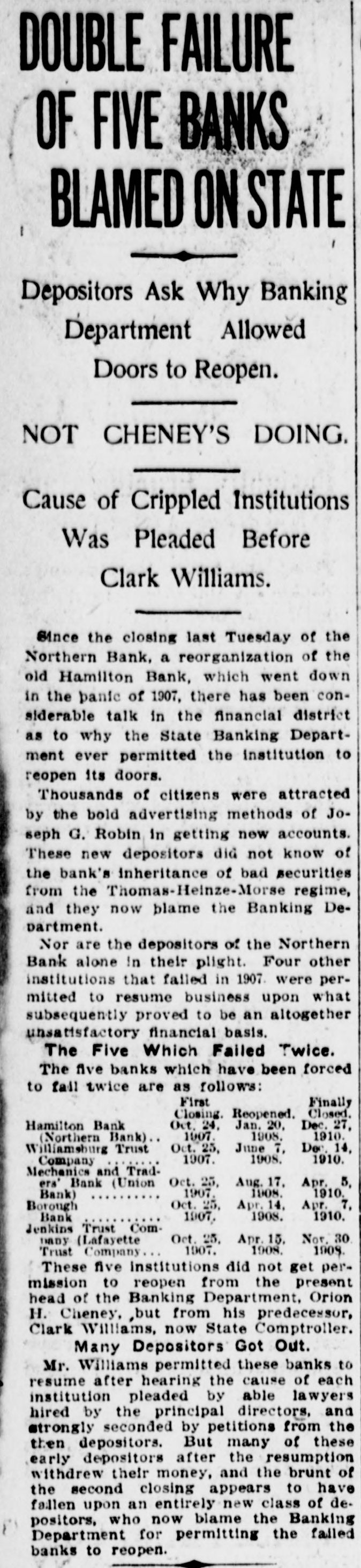
# DOUBLE FAILURE OF FIVE BANKS BLAMED ON STATE Depositors Ask Why Banking Department Allowed Doors to Reopen. NOT CHENEY'S DOING. Cause of Crippled Institutions Was Pleaded Before Clark Williams. Since the closing last Tuesday of the Northern Bank, a reorganization of the old Hamilton Bank, which went down in the panic of 1907, there has been considerable talk in the financial district as to why the State Banking Department ever permitted the institution to reopen its doors. Thousands of citizens were attracted by the bold advertising methods of Joseph G. Robin in getting new accounts. These new depositors did not know of the bank's inheritance of bad securities from the Thomas-Heinze-Morse regime, and they now blame the Banking Department. Nor are the depositors of the Northern Bank alone in their plight. Four other institutions that failed in 1907 were permitted to resume business upon what subsequently proved to be an altogether unsatisfactory financial basis. The Five Which Failed Twice. The five banks which have been forced to fall twice are as follows: | | First Closing. | Reopened. | Finally Closed. | | :---------------------------- | :------------- | :-------- | :------------- | | Hamilton Bank (Northern Bank) | Oct. 24, 1907. | Jan. 20, 1908. | Dec. 27, 1910. | | Williamsburg Trust Company | Oct. 25, 1907. | June 7, 1908. | Dec. 14, 1910. | | Mechanics and Traders' Bank (Union Bank) | Oct. 25, 1907. | Aug. 17, 1908. | Apr. 5, 1910. | | Borough Bank | Oct. 25, 1907. | Apr. 14, 1908. | Apr. 7, 1910. | | Jenkins Trust Company (Lafayette Trust Company | Oct. 25, 1907. | Apr. 15, 1908. | Nov. 30, 1909. | These five institutions did not get permission to reopen from the present head of the Banking Department, Orion H. Cheney, but from his predecessor, Clark Williams, now State Comptroller. Many Depositors Got Out. Mr. Williams permitted these banks to resume after hearing the cause of each institution pleaded by able lawyers hired by the principal directors, and strongly seconded by petitions from the then depositors. But many of these early depositors after the resumption withdrew their money, and the brunt of the second closing appears to have fallen upon an entirely new class of depositors, who now blame the Banking Department for permitting the failed banks to reopen.


Article from The Prescott Daily News, December 31, 1910

Click image to open full size in new tab

Article Text

BANKER ROBIN ATTEMPTS SUICIDE Banker Robin of the suspended Northern Bank of New York attempted suicide yesterday morning by swallowing Hyoscin, the deadly poison Dr. Crippen is supposed to have given his wife, Bell Elmore. He started to the court room to face arraignment perfectly calm although knowing he had swallowed the deadly poison. Before reaching the court room he collapsed, saying: "I'm a dead man; I've taken poison tablets." His life is in doubt. His vitality is depended upon to pull him through. The prompt work of physicians is all that has kept him alive to date.


Article from The Salt Lake Tribune, January 3, 1911

Click image to open full size in new tab

Article Text

Robin Is Better. NEW YORK, Jan. 2.-The condition of Joseph Robin. director of the suspended Northern bank who took poison in the office of the district attorney last Friday while awaiting arralgnment for grand larceny. was reported good today. He sat up and read today. Physicians report that he would be able to appear for arralgnment by Wednesday without danger to his health.


Article from The Ocala Evening Star, January 3, 1911

Click image to open full size in new tab

Article Text

ROBIN IS REVIVING New York, N. Y., Jan. 3.-The condition of Joseph G. Robin, director of the suspended Northern Bank of New York, and who took poison in the district attorney's office Monday. while waiting arraignment, is reported as being much improved. Robin is confined in the prison ward.


Article from Norwich Bulletin, January 5, 1911

Click image to open full size in new tab

Article Text

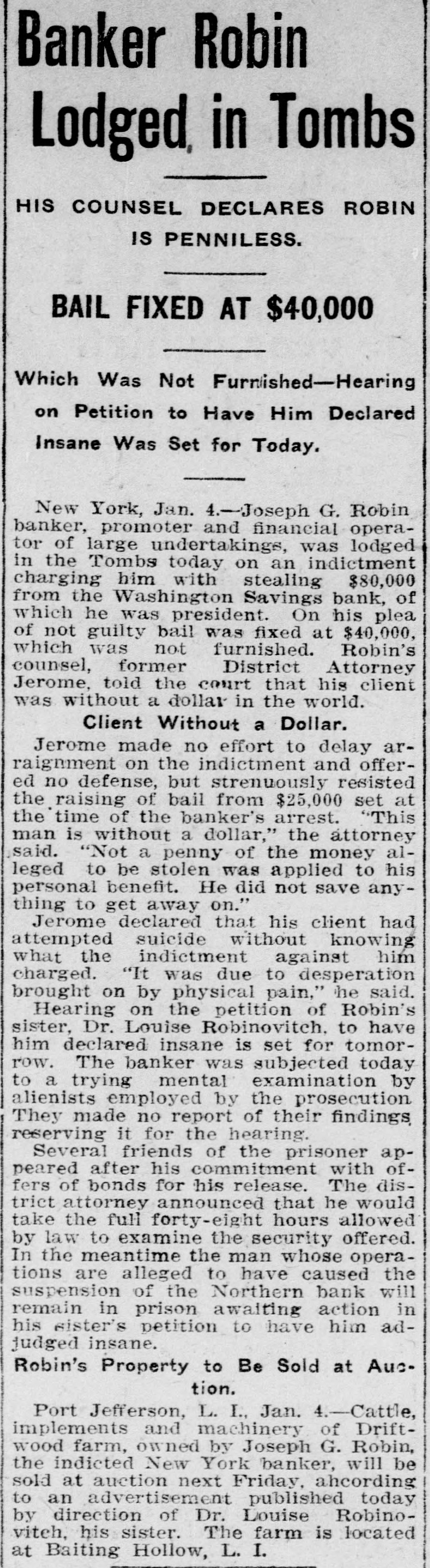
Banker Robin Lodged in Tombs HIS COUNSEL DECLARES ROBIN IS PENNILESS. BAIL FIXED AT $40,000 Which Was Not Furnished-Hearing on Petition to Have Him Declared Insane Was Set for Today. New York, Jan. 4.--Joseph G. Robin banker, promoter and financial operator of large undertakings, was lodged in the Tombs today on an indictment charging him with stealing $80,000 from the Washington Savings bank, of which he was president. On his plea of not guilty bail was fixed at $40,000, which was not furnished. Robin's counsel, former District Attorney Jerome, told the court that his client was without a dollar in the world. Client Without a Dollar. Jerome made no effort to delay arraignment on the indictment and offered no defense, but strenuously resisted the raising of bail from $25,000 set at the time of the banker's arrest. "This man is without a dollar," the attorney said. "Not a penny of the money alleged to be stolen was applied to his personal benefit. He did not save anything to get away on." Jerome declared that his client had attempted suicide without knowing what the indictment against him charged. "It was due to desperation brought on by physical pain," he said. Hearing on the petition of Robin's sister, Dr. Louise Robinovitch. to have him declared insane is set for tomorrow. The banker was subjected today to a trying mental examination by alienists employed by the prosecution They made no report of their findings reserving it for the hearing. Several friends of the prisoner appeared after his commitment with offers of bonds for his release. The district attorney announced that he would take the full forty-eight hours allowed by law to examine the security offered. In the meantime the man whose operations are alleged to have caused the suspension of the Northern bank will remain in prison awaiting action in his sister's petition to have him adjudged insane. Robin's Property to Be Sold at Auction. Port Jefferson, L. I., Jan. 4.-Cattle, implements and machinery of Driftwood farm, owned by Joseph G. Robin, the indicted New York banker, will be sold at auction next Friday, ahcording to an advertisement published today by direction of Dr. Louise Robinoviteh, his sister. The farm is located at Baiting Hollow, L. I.


Article from The Enterprise, January 5, 1911

Click image to open full size in new tab

Article Text

house of representatives as well as in the senate have surrendered to President Taft's demand for the creation of a permanent tariff commission at this session of congress. They have given a formal promise that the senate finance committee and the house committee on ways and means will report bills without delay. The revolution which began at Tabasco, Mexico, is said to be getting worse. The government has sent troops there from Vera Cruz. Gunboats are being sent from other points. This uprising is said to be directly connected with the Madero movement and is considered here to be extremely serious. The Adams county grand jury, at West Union, Ohio, reported 145 additional true bills against citizens accused of selling their votes at the November election. This makes a total of 95 indictments. The North Carolina Republican state executive committee have adopted resolutions indorsing President Taft as a "national and not a section president," and pledged support for his renomination and re-election. Earthquake shocks followed the opening of Mt. Vesuvius' crater, spread alarm among hundreds of Americans and other tourists spending the winter in southern Italy. The earthquake shocks were from east to west and are thought to be a continuation of those which rocked the southwestern part of Greece. Kansas City women must muzzle their hatpins or they will be liable to fines of $1 to $500. The upper and lower houses of the city council passed the hatpin ordinance and Mayor Brown has said he will sign it. Mrs. Julia Jameson returned to her home in Brooklyn to find that during her absence her three children had been suffocated by smoke. The Public Service corporation of New Jersey announced oid-age pension and insurance plans for employes, to go into effect January 1. The insurance plan provides for the payment of one dollar a day for 90 days to a sick or disabled employe. In case of death $300 will be paid to his widow. The unarmed cruiser Detroit has passed out of the hands of the government, having been sold to R. I. Corbin of New York, the highest bidder. The price was $20,000. Just before she was ready to go on the stage with her sketch at the Hub theater in Boston Mrs. Fred Pisano, whose stage name is Kitty Bingham, gave birth in her dressing room to a six-pound baby girl. The most damaging blow ever inflicted upon the "Black Hand" was that dealt by Judge Fawcett in Brooklyn, when he sentenced Mrs. Maria Rappa and Stanislao Pattenza, kidnapers of Michael Rizzo and Guiseppe Longo, to not less than twenty-five years nor more than forty-nine years and ten months in prison, the limit of the law. The Northern bank of New York, which has several branches in Harlem and the Bronx, was taken possession of by Bank Superintendent Cheney. The institution has deposits aggregating over $6,900,000. The Northern bank formerly was known as the Hamilton bank, which had difficulty during the panic of 1907. District Attorney Sims appeared before Judge Kohlsaat in the United States district court at Chicago and asked that the dissolution suit of the government against the National Packing company be dismissed. The order was entered by the court. The gov-


Article from The L'anse Sentinel, January 7, 1911

Click image to open full size in new tab

Article Text

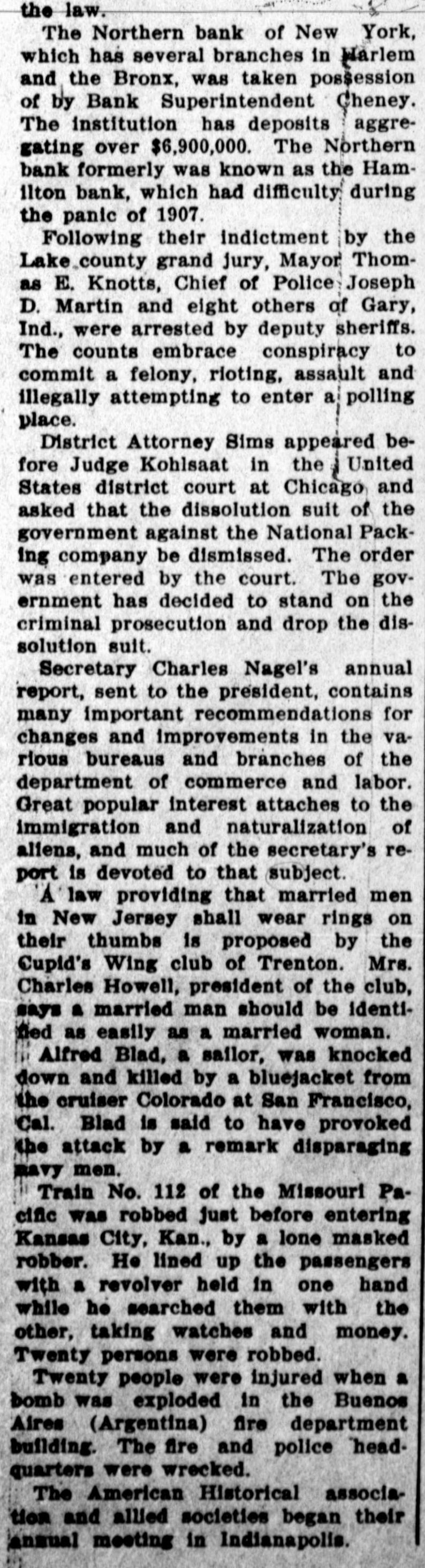
the law. The Northern bank of New York, which has several branches in Marlem and the Bronx, was taken possession of by Bank Superintendent Cheney. The institution has deposits aggregating over $6,900,000. The Northern bank formerly was known as the Hamilton bank, which had difficulty during the panic of 1907. Following their indictment by the Lake county grand jury, Mayor Thomas E. Knotts, Chief of Police Joseph D. Martin and eight others of Gary, Ind., were arrested by deputy sheriffs. The counts embrace conspiracy to commit a felony, rioting, assault and illegally attempting to enter a polling place. District Attorney Sims appeared before Judge Kohlsaat in the United States district court at Chicago and asked that the dissolution suit of the government against the National Packing company be dismissed. The order was entered by the court. The government has decided to stand on the criminal prosecution and drop the dissolution suit. Secretary Charles Nagel's annual report, sent to the president, contains many important recommendations for changes and improvements in the various bureaus and branches of the department of commerce and labor. Great popular interest attaches to the immigration and naturalization of aliens, and much of the secretary's report is devoted to that subject. A law providing that married men in New Jersey shall wear rings on their thumbs is proposed by the Cupid's Wing club of Trenton. Mrs. Charles Howell, president of the club, says a married man should be identified as easily as a married woman. Alfred Blad, a sailor, was knocked down and killed by a bluejacket from the cruiser Colorado at San Francisco, Cal. Blad is said to have provoked the attack by a remark disparaging mavy men. Train No. 112 of the Missouri Pacific was robbed just before entering Kansas City, Kan., by a lone masked robber. He lined up the passengers with a revolver held in one hand while he searched them with the other, taking watches and money. Twenty persons were robbed. Twenty people were injured when a bomb was exploded in the Buenos Aires (Argentina) fire department building. The fire and police headquarters were wrecked. The American Historical association and allied societies began their annual meeting in Indianapolis.


Article from Yorkville Enquirer, January 17, 1911

Click image to open full size in new tab

Article Text

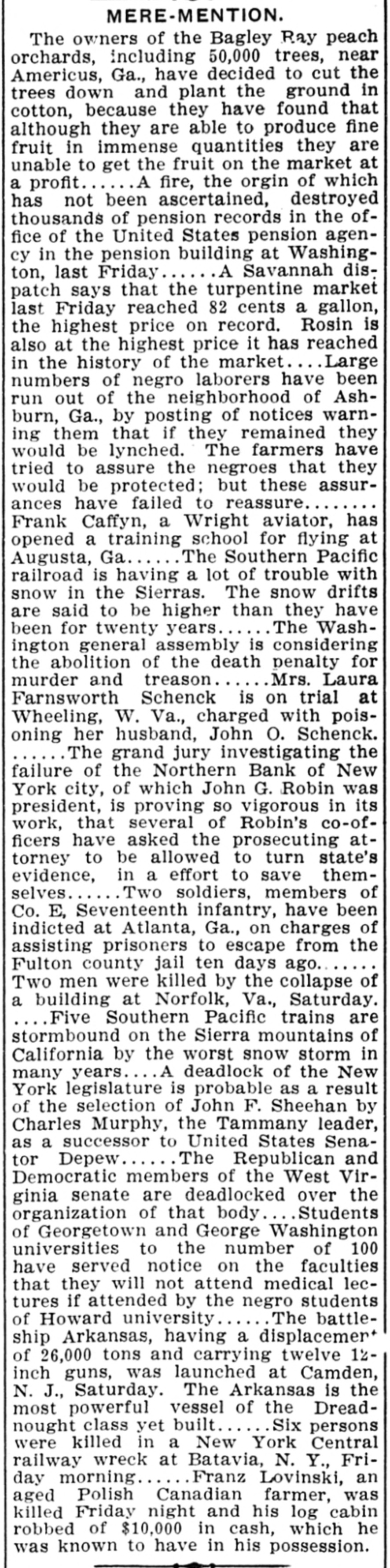
# MERE-MENTION. The owners of the Bagley Ray peach orchards, including 50,000 trees, near Americus, Ga., have decided to cut the trees down and plant the ground in cotton, because they have found that although they are able to produce fine fruit in immense quantities they are unable to get the fruit on the market at a profit...... A fire, the orgin of which has not been ascertained, destroyed thousands of pension records in the office of the United States pension agency in the pension building at Washington, last Friday...... A Savannah dispatch says that the turpentine market last Friday reached 82 cents a gallon, the highest price on record. Rosin is also at the highest price it has reached in the history of the market.... Large numbers of negro laborers have been run out of the neighborhood of Ashburn, Ga., by posting of notices warning them that if they remained they would be lynched. The farmers have tried to assure the negroes that they would be protected; but these assurances have failed to reassure... Frank Caffyn, a Wright aviator, has opened a training school for flying at Augusta, Ga...... The Southern Pacific railroad is having a lot of trouble with snow in the Sierras. The snow drifts are said to be higher than they have been for twenty years...... The Washington general assembly is considering the abolition of the death penalty for murder and treason..... Mrs. Laura Farnsworth Schenck is on trial at Wheeling, W. Va., charged with poisoning her husband, John O. Schenck. The grand jury investigating the failure of the Northern Bank of New York city, of which John G. Robin was president, is proving so vigorous in its work, that several of Robin's co-officers have asked the prosecuting attorney to be allowed to turn state's evidence, in a effort to save themselves...... Two soldiers, members of Co. E, Seventeenth infantry, have been indicted at Atlanta, Ga., on charges of assisting prisoners to escape from the Fulton county jail ten days ago... Two men were killed by the collapse of a building at Norfolk, Va., Saturday. .... Five Southern Pacific trains are stormbound on the Sierra mountains of California by the worst snow storm in many years.... A deadlock of the New York legislature is probable as a result of the selection of John F. Sheehan by Charles Murphy, the Tammany leader, as a successor to United States Senator Depew......The Republican and Democratic members of the West Virginia senate are deadlocked over the organization of that body.... Students of Georgetown and George Washington universities to the number of 100 have served notice on the faculties that they will not attend medical lectures if attended by the negro students of Howard university...... The battleship Arkansas, having a displacement of 26,000 tons and carrying twelve 12-inch guns, was launched at Camden, N. J., Saturday. The Arkansas is the most powerful vessel of the Dreadnought class yet built...... Six persons were killed in a New York Central railway wreck at Batavia, N. Y., Friday morning...... Franz Lovinski, an aged Polish Canadian farmer, was killed Friday night and his log cabin robbed of $10,000 in cash, which he was known to have in his possession.


Article from New-York Tribune, January 17, 1911

Click image to open full size in new tab

Article Text

IN AS RECEIVER FOR ROBIN Banker Figures in Involuntary Petition for Bankruptcy. WANT TRANSFERS SET ASIDE Property at Stake, Mostly Bonds and Stocks, Said to Have Value of $1,000,000. The State Banking Department joined issues yesterday with individual creditors of Joseph G. Robin and began legal proceedings to secure for the creditors of the Northern Bank and the Washington Savings property to sent gross having Bank assets of $1,000,000 believed by represet aside transfers of this property made by Robin shortly before his financial collapse. An involuntary petition in bankruptcy filed against Robin yesterday morning in the United States District Court behalf the Savings Gerald a of the Bank Northern and Bank, H. Washington Chapin, on lawyer. as petitioning creditors, was followed in the afternoon by a petition for the appointment of a receiver of Robin's property which shed some new light on the transactions of the indicted banker during the last days of his freedom. The second application was made by A. K. Alford. Deputy Superintendent of Banking. and a Elmer in M. charge Kimbark, of the Northern creditor Bank. for $1,500. This petition stated that Robin was in the Tombs and that it had become necessary to have a receiver, as he was indebted to large the petition amounts. various asserted. banking Most had institutions of these loans, in very been secured by collateral, and as many of them had been called the securities were about to be disposed of at sacrifices. Continuing the petition stated: "That on or about December 24. 1910. said alleged bankrupt delivered and transferred to one Anthony Stumpf, Frederick D. Kilburn, the Atna Indemnity Company and the Northern Bank of New York the following property: "First mortgage bonds issued by the Bankers' Realty and Security Company of the par value of $3,800 and the following stocks 180 shares of the Northern Bank of New York, 999 shares of the Babylon 86 shares AEtna Railroad Indemnity Company, Company, certificates of the trust representing 3,590 shares of stock of the F1delity Development Company. 8.760 shares of common and 14 shares of preferred stock of the Fidelity Development Company, 110 shares of the preferred and 370 shares of the common stock of the Bankers' Realty and Security Company, 317 shares of the Babylon and Oak Island Ferry Company, 25 shares of the Anthony Stumpf Publishing Company, 173 shares of the Bankers' Money Order Association 10 shares of the Hungarian-American Bank, 5 shares of the Carnegie Trust Company 4 shares of the Merchants' Exchange National Bank, 10 shares of the Alexander Hospital, 100 shares of the Cobalt Coalition Mining Company, 100 shares of the Greene Consolidated Gold Mining Company, 5 shares of the First National Bank of Amityville, 100 shares of the Reed Lumber and Timber Company and 90 shares of the Bank of Discount of the City of New York Mr. Kimbark gave the assets at approximately $900,000. consisting of stocks and bonds, all of which were held by some of the creditors as collateral for loans amounting to $880,000. Judge Holt appointed Peter Alexander receiver, with a bond of $10,000. Mr. Alexander is also receiver for the Bankers' Realty and Security Company, of which Robin is a director. The securities enumerated in the petition for the appointment of a receiver are apparently those meant in the charge made in the bankruptcy petition. in which it is alleged that Robin while insolvent transferred. on December 24. 1910. to some of his creditors various securities for the purpose of preferring those creditors over others of his creditors. The claim of the Northern Bank is based on a promissory note for $100,000. made out to the Hamilton Bank on June 24. 1907. by David A. Sullivan. former president of the Merchants and Traders' Bank and an associate of E. R. Thomas. The note was delivered to the Northern Bank on June 12 1908 The petition states that for a valuable consideration Robin, in writing. guaranteed the bank against any loss on the $75,000 then due. Payment was demanded on January 7 and was refused The Northern Bank now holds securities of a total value of $51,500 for the payment of this note. The Washington Savings Bank has a claim for $400 on Robin's note. and H. Gerald Chapin claims $300 for legal services to Robin.


Article from New-York Tribune, March 15, 1911

Click image to open full size in new tab

Article Text

MAY ESCAPE SING SING Continued from first page. upon additional enlightenment, for his of own satisfaction. on the question Robin's sanity before passing sentence upon him Mr. Jerome said that his appearance at the conference did not mean that he had renewed his connect ton with Robin's case, but that as he believed the man to be insane. he felt it was his duty to do anything he could to see that if such was the case he would be sent Mr. to the proper place. which place. Jerome thinks. is not the state prison. Tale of $100,000 Transaction The story of how one of its directors got $100,000 from the Carnegie Trust Company is concerned with a loan made to that institution by the Madison Trust Company and the Nineteenth Ward Bank The loan was made on April 10. 1910. and was for $350,000. When the check was received by the Carnegie Trust Company it was handed to one of the directors. who indorsed it on the back Deposit to my credit." and signed his name below this indorsement. The money was deposited to the di. and though the Carnegie never received any company rector's credit. benefit from afterward paid the Madiand the son the check Trust Company it Nineteenth For $100,000 on the loan District this Ward transaction Bank Attorney Whit man will ask for indictment of the director concerned for grand larceny E R. Finch and Gustave Bauman, di rectors of the Madison Trust Company were also witnesses before the grand jury yesterday William L Brower, formerly vice-president of the Northern Bank of New York. was present at the daily conference between Assistant District Attorney Clark and Robin Brower is out on $3,000 bonds on an indictment charging perjury It is understood that he Robin yesterday to extransactions plain was certain helping that preceded the closing of the Northern Bank He is one of the men exonerated by Robin in his confession to the District Attorney. Further inquiry into the transactions of the Fidelity Funding Company with the Carnegle Trust Company disclosed vesterday that in January, 1909. the late C. Dickinson then president of the trust company. made the admission that Patrick J Keiran. the promoter of the Fidelity, owed the Carnegie company about $1,200,000 This admission was not brought from president a the trust company almost without to heckling that amounted a ceiver "third degree" of the Fidelity, bv the lawyer who was for the trying that reto straighten out the tangled web Keiran wove Mr Dickinson was loath to have it known at that time that Keiran zot into the trust company to such an extent lest the publication of such knowledge might bring on a. dis astrous run. but after hours of questioning he approximated the total of the Carnegie's claim against Keiran's company at $1,200,000 Four hundred and ten thousand dollars of this $1,200,000 Mr. Dickinson listed under the heading of "bills purchased and demand loans," and though all of this paper was past due at that time. January 12. 1909. and had been since the last of the preceding No. vember. it has been carried on the Car negie's books as 100 per cent assets since that time Just when the balance of $800,000 was cleared off by Keiran or his Fidel. ity company has not been made clear examination of the books the failure from any since but Carnegie's of the which Dickinson said Keiran on January owed $1,200,000 the Carnegie in the 12. assets 1909, only $400,000 is now listed of the trust company


Article from Newark Evening Star and Newark Advertiser, April 12, 1911

Click image to open full size in new tab

Article Text

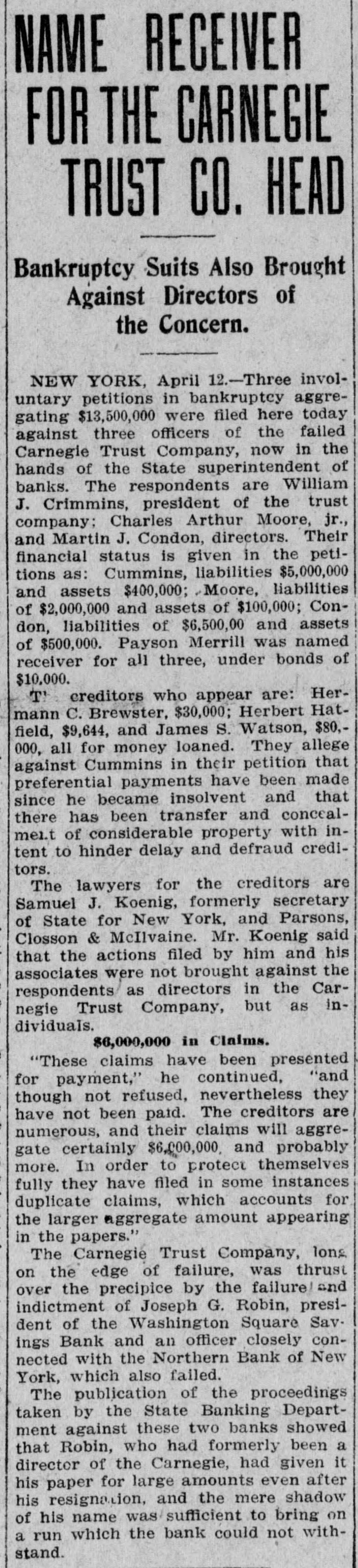
NAME RECEIVER FOR THE CARNEGIE TRUST CO. HEAD Bankruptcy Suits Also Brought Against Directors of the Concern. NEW YORK, April 12.-Three involuntary petitions in bankruptcy aggregating $13,500,000 were filed here today against three officers of the failed Carnegie Trust Company, now in the hands of the State superintendent of banks. The respondents are William J. Crimmins, president of the trust company: Charles Arthur Moore, jr., and Martin J. Condon, directors. Their financial status is given in the petitions as: Cummins, liabilities $5,000,000 and assets $400,000; Moore, liabilities of $2,000,000 and assets of $100,000; Condon, liabilities of $6,500,00 and assets of $500,000. Payson Merrill was named receiver for all three, under bonds of $10,000. T' creditors who appear are: Hermann C. Brewster, $30,000; Herbert Hatfield, $9,644, and James S. Watson, $80,000, all for money loaned. They allege against Cummins in their petition that preferential payments have been made since he became insolvent and that there has been transfer and concealmeit of considerable property with intent to hinder delay and defraud creditors. The lawyers for the creditors are Samuel J. Koenig, formerly secretary of State for New York, and Parsons, Closson & McIlvaine. Mr. Koenig said that the actions filed by him and his associates were not brought against the respondents as directors in the Carnegie Trust Company, but as individuals. $6,000,000 in Claims. "These claims have been presented for payment," he continued, "and though not refused, nevertheless they have not been paid. The creditors are numerous, and their claims will aggregate certainly $6,000,000, and probably more. In order to protect themselves fully they have filed in some instances duplicate claims, which accounts for the larger aggregate amount appearing in the papers." The Carnegie Trust Company, long on the edge of failure, was thrust over the precipice by the failure and indictment of Joseph G. Robin, president of the Washington Square Savings Bank and an officer closely connected with the Northern Bank of New York, which also failed. The publication of the proceedings taken by the State Banking Department against these two banks showed that Robin, who had formerly been a director of the Carnegie, had given it his paper for large amounts even after his resignation, and the mere shadow of his name was sufficient to bring on a run which the bank could not withstand.


Article from Pine Bluff Daily Graphic, April 13, 1911

Click image to open full size in new tab

Article Text

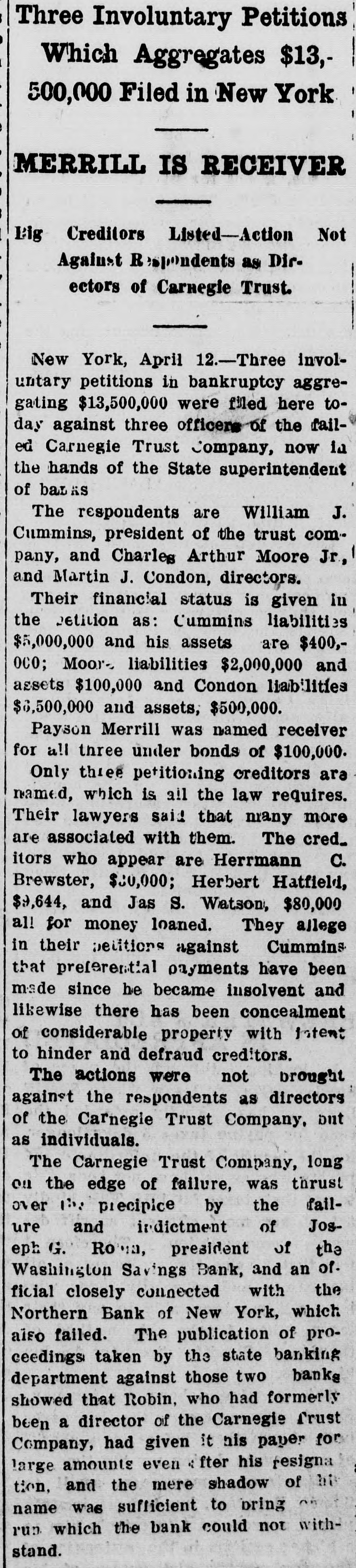
Three Involuntary Petitions Which Aggregates $13,500,000 Filed in New York MERRILL IS RECEIVER Big Creditors Listed-Action Not Against Respondents as Directors of Carnegie Trust. New York, April 12.-Three involuntary petitions in bankruptcy aggregating $13,500,000 were filed here today against three officers of the failed Carnegie Trust Company, now la the hands of the State superintendent of basks The respondents are William J. Cummins, president of the trust company, and Charles Arthur Moore Jr, and Martin J. Condon, directors. Their financial status is given in the petition as: Cummins liabilities $5,000,000 and his assets are $400,oco; Moore liabilities $2,000,000 and assets $100,000 and Condon liabilities $6,500,000 and assets, $500,000. Payson Merrill was named receiver for all three under bonds of $100,000. Only three petitioning creditors ara named, which is all the law requires. Their lawyers said that nrany more are associated with them. The cred_ itors who appear are Herrmann C. Brewster, $30,000; Herbert Hatfield, $9,644, and Jas S. Watson, $80,000 all for money loaned. They allege in their petitions against Cummins that preferential payments have been made since he became insolvent and likewise there has been concealment of considerable property with intent to hinder and defraud creditors. The actions were not brought against the respondents as directors of the Carnegie Trust Company, but as individuals. The Carnegie Trust Company, long on the edge of failure, was thrust over I've precipice by the failure and indictment of Joseph G. Ro pan, president of the Washington Savings Bank, and an of. ficial closely connected with the Northern Bank of New York, which also failed. The publication of proceedings taken by the state banking department against those two banks showed that Robin, who had formerly been a director of the Carnegie Trust Company, had given it his paper for large amounts even fter his resigna tion, and the mere shadow of at and name was sufficient to oring run which the bank could not withstand.


Article from New-York Tribune, April 14, 1911

Click image to open full size in new tab

Article Text

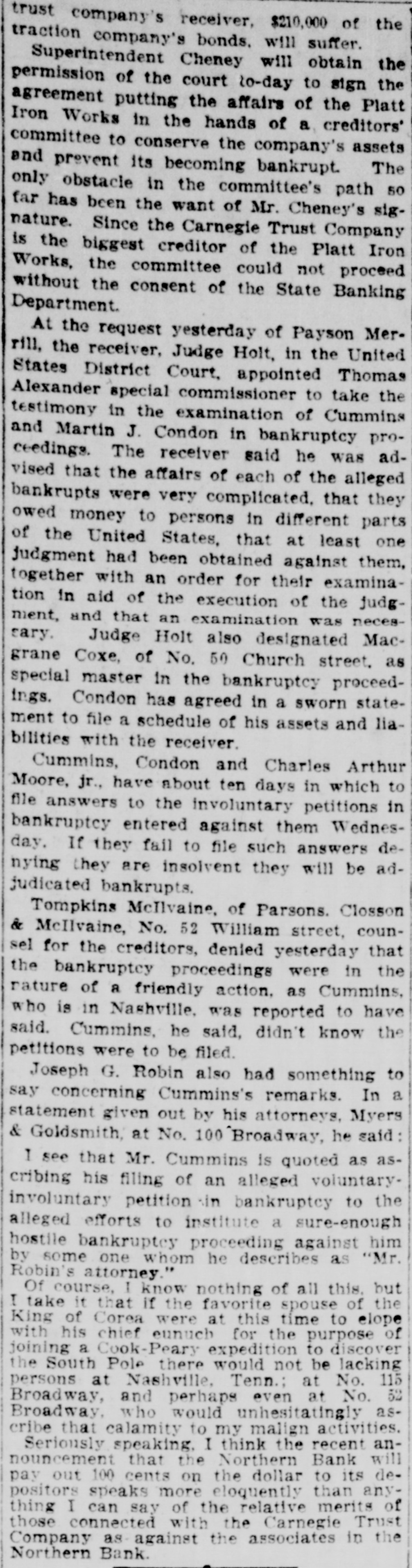
# THE PLATT IRON WORKS trust company's receiver, $210,000 of the traction company's bonds, will suffer. Superintendent Cheney will obtain the permission of the court to-day to sign the agreement putting the affairs of the Platt Iron Works in the hands of a creditors' committee to conserve the company's assets and prevent its becoming bankrupt. The only obstacle in the committee's path so far has been the want of Mr. Cheney's signature. Since the Carnegie Trust Company is the biggest creditor of the Platt Iron Works, the committee could not proceed without the consent of the State Banking Department. At the request yesterday of Payson Merrill, the receiver, Judge Holt, in the United States District Court, appointed Thomas Alexander special commissioner to take the testimony in the examination of Cummins and Martin J. Condon in bankruptcy proceedings. The receiver said he was advised that the affairs of each of the alleged bankrupts were very complicated, that they owed money to persons in different parts of the United States, that at least one Judgment had been obtained against them, together with an order for their examination in aid of the execution of the judgment, and that an examination was necessary. Judge Holt also designated Macgrane Coxe, of No. 50 Church street, as special master in the bankruptcy proceedings. Condon has agreed in a sworn statement to file a schedule of his assets and liabilities with the receiver. Cummins, Condon and Charles Arthur Moore, jr., have about ten days in which to file answers to the involuntary petitions in bankruptcy entered against them Wednesday. If they fail to file such answers denying they are insolvent they will be adjudicated bankrupts. Tompkins McIlvaine, of Parsons. Closson & McIlvaine, No. 52 William street, counsel for the creditors, denied yesterday that the bankruptcy proceedings were in the nature of a friendly action, as Cummins, who is in Nashville, was reported to have said. Cummins, he said, didn't know the petitions were to be filed. Joseph G. Robin also had something to say concerning Cummins's remarks. In a statement given out by his attorneys, Myers & Goldsmith, at No. 100 Broadway, he said: I see that Mr. Cummins is quoted as ascribing his filing of an alleged voluntary-involuntary petition in bankruptcy to the alleged efforts to institute a sure-enough hostile bankruptcy proceeding against him by some one whom he describes as "Mr. Robin's attorney." Of course, I know nothing of all this, but I take it that if the favorite spouse of the King of Corea were at this time to elope with his chief eunuch for the purpose of joining a Cook-Peary expedition to discover the South Pole there would not be lacking persons at Nashville, Tenn.; at No. 115 Broadway, and perhaps even at No. 52 Broadway, who would unhesitatingly ascribe that calamity to my malign activities. Seriously speaking, I think the recent announcement that the Northern Bank will pay out 100 cents on the dollar to its depositors speaks more eloquently than anything I can say of the relative merits of those connected with the Carnegie Trust Company as against the associates in the Northern Bank.


Article from New-York Tribune, April 18, 1911

Click image to open full size in new tab

Article Text

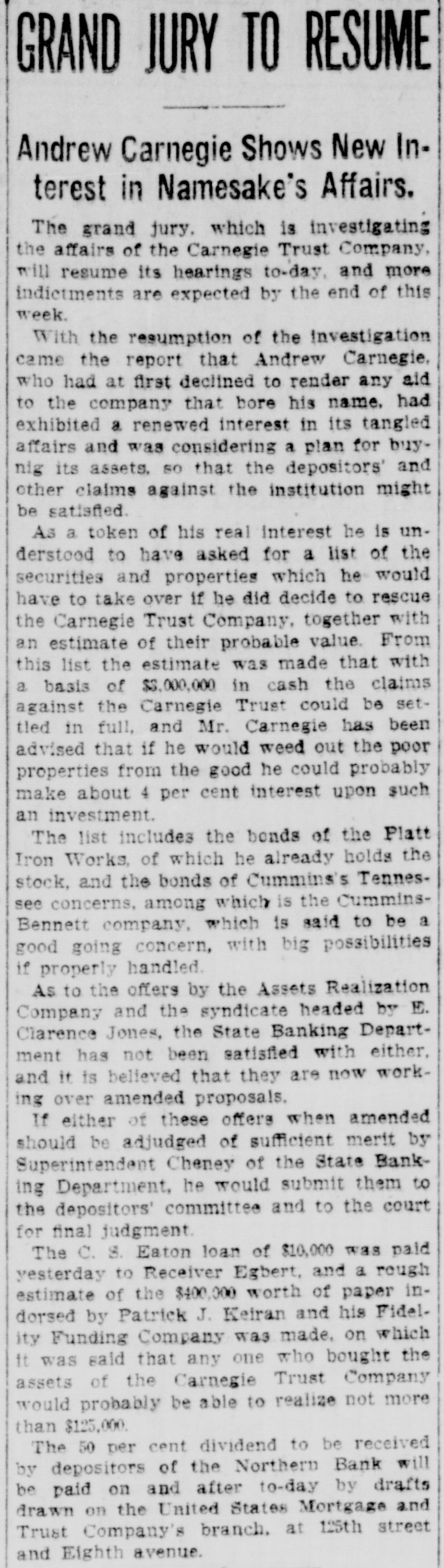
GRAND JURY TO RESUME Andrew Carnegie Shows New Interest in Namesake's Affairs. The grand jury. which is investigating the affairs of the Carnegie Trust Company, will resume its hearings to-day. and more indictments are expected by the end of this week. With the resumption of the Investigation came the report that Andrew Carnegie, who had at first declined to render any aid to the company that bore his name. had exhibited a renewed interest in its tangled affairs and was considering a plan for buynig its assets. so that the depositors' and other claims against the institution might be satisfied. As a token of his real interest he is understood to have asked for a list of the securities and properties which he would have to take over if he did decide to rescue the Carnegie Trust Company, together with an estimate of their probable value. From this list the estimate was made that with a basis of $3,000,000 in cash the claims against the Carnegie Trust could be settled in full, and Mr. Carnegie has been advised that if he would weed out the poor properties from the good he could probably make about 4 per cent interest upon such an investment. The list includes the bonds of the Platt Iron Works, of which he already holds the stock, and the bonds of Cummins's Tennessee concerns, among which is the CumminsBennett company. which is said to be a good going concern, with big possibilities if properly handled As to the offers by the Assets Realization Company and the syndicate headed by E. Clarence Jones, the State Banking Department has not been satisfied with either, and it is believed that they are now working over amended proposals. If either of these offers when amended should be adjudged of sufficient merit by Superintendent Cheney of the State Banking Department, he would submit them to the depositors' committee and to the court for final judgment. The C. S. Eaton loan of $10,000 was paid yesterday to Receiver Egbert, and a rough estimate of the $400,000 worth of paper indorsed by Patrick J. Keiran and his Fidelity Funding Company was made. on which It was said that any one who bought the assets of the Carnegie Trust Company would probably be able to realize not more than $125,000. The 50 per cent dividend to be received by depositors of the Northern Bank will be paid on and after to-day by drafts drawn on the United States Mortgage and Trust Company's branch. at 125th street and Eighth avenue.


Article from New-York Tribune, June 1, 1911

Click image to open full size in new tab

Article Text

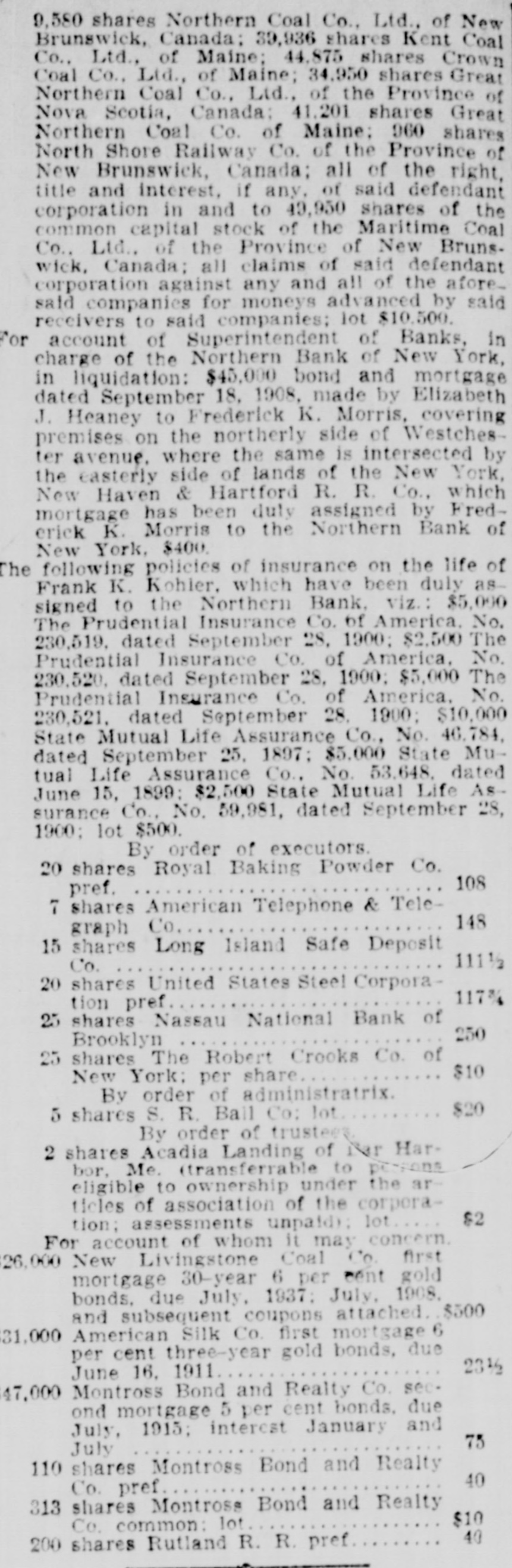
9,580 shares Northern Coal Co., Ltd., of New Brunswick, Canada; 39,936 shares Kent Coal Co., Ltd., of Maine; 44,875 shares Crown Coal Co., Ltd., of Maine; 34,950 shares Great Northern Coal Co., Ltd., of the Province of Nova Scotia, Canada; 41,201 shares Great Northern Coal Co. of Maine; 960 shares North Shore Railway Co. of the Province of New Brunswick, Canada; all of the right, title and interest, if any, of said defendant corporation in and to 49,950 shares of the common capital stock of the Maritime Coal Co., Ltd., of the Province of New Brunswick, Canada; all claims of said defendant corporation against any and all of the aforesaid companies for moneys advanced by said receivers to said companies; lot $10,500. For account of Superintendent of Banks, in charge of the Northern Bank of New York, in liquidation: $45,000 bond and mortgage dated September 18, 1908, made by Elizabeth J. Heaney to Frederick K. Morris, covering premises on the northerly side of Westchester avenue, where the same is intersected by the easterly side of lands of the New York, New Haven & Hartford R. R. Co., which mortgage has been duly assigned by Frederick K. Morris to the Northern Bank of New York, $400. The following policies of insurance on the life of Frank K. Kohler, which have been duly assigned to the Northern Bank, viz.: $5,000 The Prudential Insurance Co. of America, No. 230,519, dated September 28, 1900; $2,500 The Prudential Insurance Co. of America, No. 230,520, dated September 28, 1900, $5,000 The Prudential Insurance Co. of America, No. 230,521, dated September 28, 1900; $10,000 State Mutual Life Assurance Co., No. 46,784, dated September 25, 1897; $5,000 State Mutual Life Assurance Co., No. 53,648, dated June 15, 1899; $2,500 State Mutual Life Assurance Co., No. 59,981, dated September 28, 1900: lot $500. By order of executors. 20 shares Royal Baking Powder Co. pref. 108 7 shares American Telephone & Telegraph Co. 148 15 shares Long Island Safe Deposit Co. 111½ 20 shares United States Steel Corporation pref. 117¾ 25 shares Nassau National Bank of Brooklyn 250 25 shares The Robert Crooks Co. of New York; per share $10 By order of administratrix. 5 shares S. R. Ball Co; lot $20 By order of trustees. 2 shares Acadia Landing of Bar Harbor, Me. (transferrable to persons eligible to ownership under the articles of association of the corporation; assessments unpaid); lot $2 For account of whom it may concern. $26,000 New Livingstone Coal Co. first mortgage 30-year 6 per cent gold bonds, due July, 1937; July, 1908, and subsequent coupons attached. $500 $31,000 American Silk Co. first mortgage 6 per cent three-year gold bonds, due June 16, 1911 23½ $47,000 Montross Bond and Realty Co. second mortgage 5 per cent bonds, due July, 1915; interest January and July 75 110 shares Montross Bond and Realty Co. pref 40 313 shares Montross Bond and Realty Co. common: lot $10 200 shares Rutland R. R. pref 40


Article from New-York Tribune, June 13, 1911

Click image to open full size in new tab

Article Text

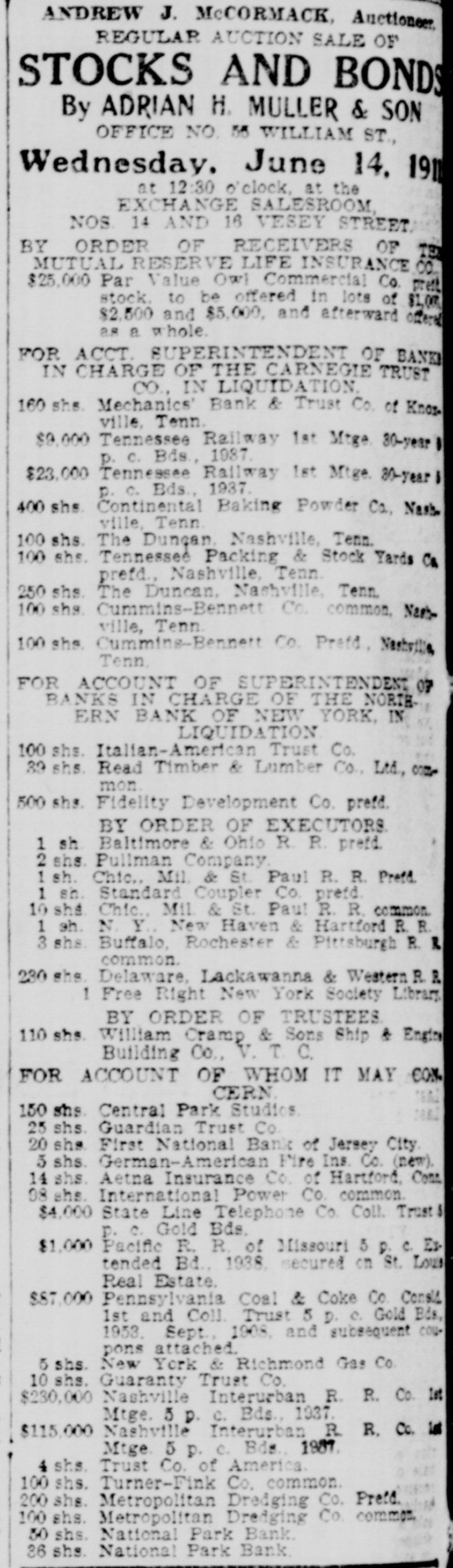
ANDREW J. McCORMACK, Auctioneer, REGULAR AUCTION SALE OF STOCKS AND BONDS By ADRIAN H. MULLER & SON OFFICE NO. 55 WILLIAM ST., Wednesday. June 14, 1911 at 12:30 o'clock, at the EXCHANGE SALESROOM, NOS 14 AND 16 VESEY STREET BY ORDER OF RECEIVERS OF THE MUTUAL RESERVE LIFE INSURANCE 00. $25,000 Par Value Owl Commercial Co. preft stock, to be offered in lots of $1,00 $2,500 and $5,000, and afterward offered as a whole. FOR ACCT. SUPERINTENDENT OF BANK IN CHARGE OF THE CARNEGIE TRUST CO., IN LIQUIDATION. 160 shs. Mechanics' Bank & Trust Co. of Knoxville, Tenn. $9,000 Tennessee Railway 1st Mtge 30-year p. C. Bds., 1987. $23,000 Tennessee Railway 1st Mtge, 30-year p. c. Bds., 1937. 400 shs. Continental Baking Powder Ca, Nash ville, Tenn. 100 shs. The Dungan, Nashville, Tenn. 100 shs. Tennessee Packing & Stock Yards Ca prefd., Nashville, Tenn. 250 shs. The Duncan, Nashville, Tenn. 100 shs. Cummins-Bennett Co. common, Nashville, Tenn. 100 shs. Cummins-Bennett Co. Prefd, Nashville, Tenn. FOR ACCOUNT OF SUPERINTENDENT OF BANKS IN CHARGE OF THE NORTH ERN BANK OF NEW YORK, IN LIQUIDATION 100 shs. Italian-American Trust Co. 39 shs. Read Timber & Lumber Co., Ltd, common. 500 shs. Fidelity Development Co. prefd. BY ORDER OF EXECUTORS. 1 sh Baltimore & Ohio R R. prefd. 2 shs. Pullman Company 1 sh. Chic., Mil. & St. Paul R. R. Prefd. 1 sh. Standard Coupler Co. prefd. 10 she Chic., Mil & St. Paul R. R. common. 1 sh. N. Y., New Haven & Hartford R. R. 3 shs. Buffalo, Rochester & Pittsburgh R. R common. 230 shs. Delaware, Lackawanna & Western R. R 1 Free Right New York Society Library BY ORDER OF TRUSTEES 110 shs. William Cramp & Sons Ship & Engine Building Co., V. T C. FOR ACCOUNT OF WHOM IT MAY COM CERN 150 shs. Central Park Studios, 25 shs. Guardian Trust Co 20 shs First National Bank of Jersey City 5 shs. German-American Fire Ins. Co. (new), 14 shs. Aetna Insurance Co. of Hartford, Cona 98 shs. International Power Co. common. $4,000 State Line Telephone Co. Coll. Trust D. c. Gold Bds. $1,000 Pacific R. R. of Missouri 5 D. c. Extended Bd., 1938, secured on St. Louis Real Estate. $87,000 Pennsylvania Coal & Coke Co. Consid 1st and Coll. Trust 5 D. e. Gold Bds, 1953. Sept., 1908, and subsequent coupons attached. 5 shs. New York & Richmond Gas Co. 10 shs. Guaranty Trust Co. $230,000 Nashville Interurban R. R. Co. 1st Mtge. 5 D. c. Bds., 1937. $115,000 Nashville Interurban R R. Co. Let Mtge. 5 p. c. Bds., 1987. 4 shs. Trust Co. of America. 100 shs. Turner-Fink Co. common. 200 shs. Metropolitan Dredging Co. Prefd. 100 shs. Metropolitan Dredging Co. common, 50 shs. National Park Bank. 36 shs. National Park Bank


Article from New-York Tribune, June 9, 1912

Click image to open full size in new tab

Article Text

to lost the Cook County Illinois tax procredure and to secure publicity of their methods The roads named paid only 90 percent of the 1911 taxes and hope to get in per cell reduction If they are success. ful the benefits will be shared by all roads in Cook County Cripple Creek Again. An echo of the Cripple Creek Mining boom days in the early nineties is coming again in the form of some press work being done by a few of the interested mine ownNE who say that as a mining camp Cripple Creek is destined to be the greatest gold producing centre in the Western Hemisphere Expect Big Increase. American Hide and Leather. according to the Boston view of expectations. will show considerable improvement In earnings for this fiscal year over 1911 The margin of increase is said to be fully in per cent In 1911 the company earned $818,934, and in 1900 only $81,501 the smallest year in the company's history May Earnings Decrease. It has been many months since the New York. New Haven & Hartford system. combining all the steamboat and trolley earnings. showed a decrease for May as compased with the same period for the previous may. but that is the report for May. 1912 There were several factors which helped to account for the loss the Inclement weather causing a falling off in trolley reints and the coal strike 5,000 cars of coal were held back as a result of the strike Great Northern Earnings Great Northern is increasing its busines at such an encouraging rate that it now seems reasonable to presume that gross earnings in the current fiscal year will ceed $66,000,000 This will be an increase approximately $4,750,000. or more than per cent over the 1911 fiscal period. Splendid earnings in April in which month the gross gained $520,000 and the net rained $352,621. it is said. will be follower by an increase of $625,000 in gross for May and an increase of a little less than $500.00 In net This is very promising May Increase Dividend. here is talk of an increase in the 48 of the St Louis Southwestern Rail the coming meeting this week. idenus on a per cent basis for d preferred were inaugurated in July 409. but were increased to per cent in the following December. In January 1911. the rate was reduced to the 1 per cent basis The earnings of the road have been good and the outlook for business is excellent. 11 would not be strange if an increase made in the preferred vidend rate. Postal Banks Popular. Dispatches from Washington say that all the 7,866 postal savings offices deposits on April so were $17,200,000. While the gove-mment pays only 2 per cent per annum. tite people as a whole seem to be taking to that style of savings bank Western Drygoods. Marshall Field & Co. in their statement of the week's trade conditions say: bright outlook was given to future business during the week by an increase in sales in many lines of merchandise for fall delivery. including dress goods, blankets, outing fannels, linings. hosiery underwear. lace curtains and other drapery, fabrics, etc Favorable weather stimulated retail selling In all seasonable lines Wholesalers were busy during the week arranging for preInventory sales for the first half of next week Heavy sales are anticipated then. as merchants bought lightly out of season and retail selling has been greatly retarded by weather conditions Values offered will Insure stocks from being well cleaned up before inventory. Increase of Gold. The gross production of the Yukon Gold Company is as follows: 603,100 cuble yards dredged. with an average recovery per yard of 81 cents. Value of bullion produced. $490.300 Comparing this with the production of May, 1911. 505,500 cuble yards were dredged average per yard, 53 cents. The value of bullion is estimated at $270,400. Condition of Steel Industry. From Chicago comes the report that the highest capacity of new steel business for the several days of this month and for May has been reached. and the result is 10 ed on as being very excellent, particula in the railroad department. Urgent inc. easing demand for track fastenings and lig rails has caused prices to advance steadily from $1 to $2 a ton during the last ten days or so--primary fact that the industry is in a very substantial condition. The volume of current business in bars, plates, structural and railroad material is far abr ve expectations, and It is said that pri OF hold firm. The new structural contra ts for the week just ended are repot d to be not so encouraging Heavy Losses Not Paying. " he Boston Post says the Boston ele. va d in the present strike will have exde ded to date over $62,000 The approximake cost a day to continue this strike will be 10,000. It is the intention of the elevat , company to spend $1,000,000. If necessary in order that the strikers may be beaten New Receiver Appointed. other change has been made in the recc. ership of the Northern Bank of New To and some new blood will be put into the attempt to wind up the affairs of this for er Robin institution by Charles A. The ne, who succeeds George B. Williams By be time the receivership costs are flgurer up there may be little left to pay stoc sholders the remainder now due. Getting Near the Time. It is about time for some bulling of Vul. can Detinning to begin, as the suit of that company against the American Can ComDan / to recover about $700,000 is expected at 10 distant period in the future. Vulcan Detinning has had several spasms of advancing prices on the prospects of this suit. and the stock has gone bounding up. and then, alas! it came rolling down so fast the bids could not be caught. The specialist in the stock was difficult to 10. cate when the booming was over. Showing Excellent Earnings. The directors of the North Butte Mining Company will meet June 19 to act