16398. North American Trust Company (New York, NY)

Bank Information

Episode Type
Suspension → Closure
Bank Type
trust company
Start Date
February 10, 1844
Location
New York, New York (40.714, -74.006)

Metadata

Model
gpt-5-mini
Short Digest
a6b7cccf

Response Measures

None

Description

Contemporary articles describe the North American Trust Company as broken, with a receiver (David Leavitt) appointed and large losses from speculative purchases and mismanagement. No article describes depositor runs; instead legal actions and receivership/special receiver appointments indicate insolvency and effective closure.

Events (2)

1. February 10, 1844 Receivership
Newspaper Excerpt
report or statement made by Mr. Leavitt, the receiver of the broken North American Trust Company, ... the statement recently issued by Mr. Talmage, the ex-President of the North American Trust Co. ... Mr. Leavitt, receiver, and others - The complainants filed a bill ... it was determined ... that Mr. John J. Palmer should be appointed special receiver ... an order was made to that effect in 1842. ... the trustees transfer and deliver over to Mr Palmer special receiver, the whole of the bonds and mortgages, and other securities in their possession, to be disposed of by him, and the proceeds retained to abide the issue. Order accordingly. (New-York Daily Tribune, 1844-10-08).
Source
newspapers
2. February 10, 1844 Suspension
Cause
Bank Specific Adverse Info
Cause Details
Company rendered insolvent by speculative purchases of state stocks and gross mismanagement; assets squandered and trusts contested in court; led to failure to continue operations.
Newspaper Excerpt
Astounding Financial Development-The North American Trust Company. ... Mr. Leavitt, the receiver of the broken North American Trust Company
Source
newspapers

Newspaper Articles (4)

Article from The New York Herald, February 10, 1844

Click image to open full size in new tab

Article Text

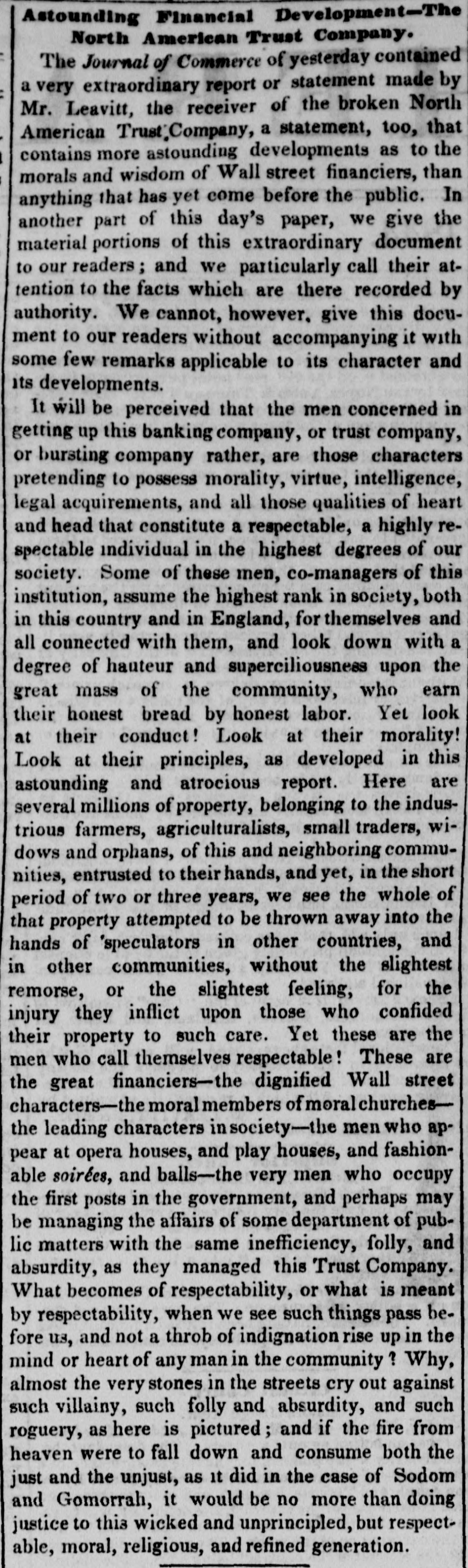
# Astounding Financial Development-The North American Trust Company. The Journal of Commerce of yesterday contained a very extraordinary report or statement made by Mr. Leavitt, the receiver of the broken North American Trust Company, a statement, too, that contains more astounding developments as to the morals and wisdom of Wall street financiers, than anything that has yet come before the public. In another part of this day's paper, we give the material portions of this extraordinary document to our readers; and we particularly call their attention to the facts which are there recorded by authority. We cannot, however, give this document to our readers without accompanying it with some few remarks applicable to its character and its developments. It will be perceived that the men concerned in getting up this banking company, or trust company, or bursting company rather, are those characters pretending to possess morality, virtue, intelligence, legal acquirements, and all those qualities of heart and head that constitute a respectable, a highly respectable individual in the highest degrees of our society. Some of these men, co-managers of this institution, assume the highest rank in society, both in this country and in England, for themselves and all connected with them, and look down with a degree of hauteur and superciliousness upon the great mass of the community, who earn their honest bread by honest labor. Yet look at their conduct! Look at their morality! Look at their principles, as developed in this astounding and atrocious report. Here are several millions of property, belonging to the industrious farmers, agriculturalists, small traders, widows and orphans, of this and neighboring communities, entrusted to their hands, and yet, in the short period of two or three years, we see the whole of that property attempted to be thrown away into the hands of 'speculators in other countries, and in other communities, without the slightest remorse, or the slightest feeling, for the injury they inflict upon those who confided their property to such care. Yet these are the men who call themselves respectable! These are the great financiers-the dignified Wall street characters-the moral members of moral churches-the leading characters in society-the men who appear at opera houses, and play houses, and fashionable soirées, and balls-the very men who occupy the first posts in the government, and perhaps may be managing the affairs of some department of public matters with the same inefficiency, folly, and absurdity, as they managed this Trust Company. What becomes of respectability, or what is meant by respectability, when we see such things pass before us, and not a throb of indignation rise up in the mind or heart of any man in the community? Why, almost the very stones in the streets cry out against such villainy, such folly and absurdity, and such roguery, as here is pictured; and if the fire from heaven were to fall down and consume both the just and the unjust, as it did in the case of Sodom and Gomorrah, it would be no more than doing justice to this wicked and unprincipled, but respectable, moral, religious, and refined generation.


Article from The New York Herald, February 12, 1844

Click image to open full size in new tab

Article Text

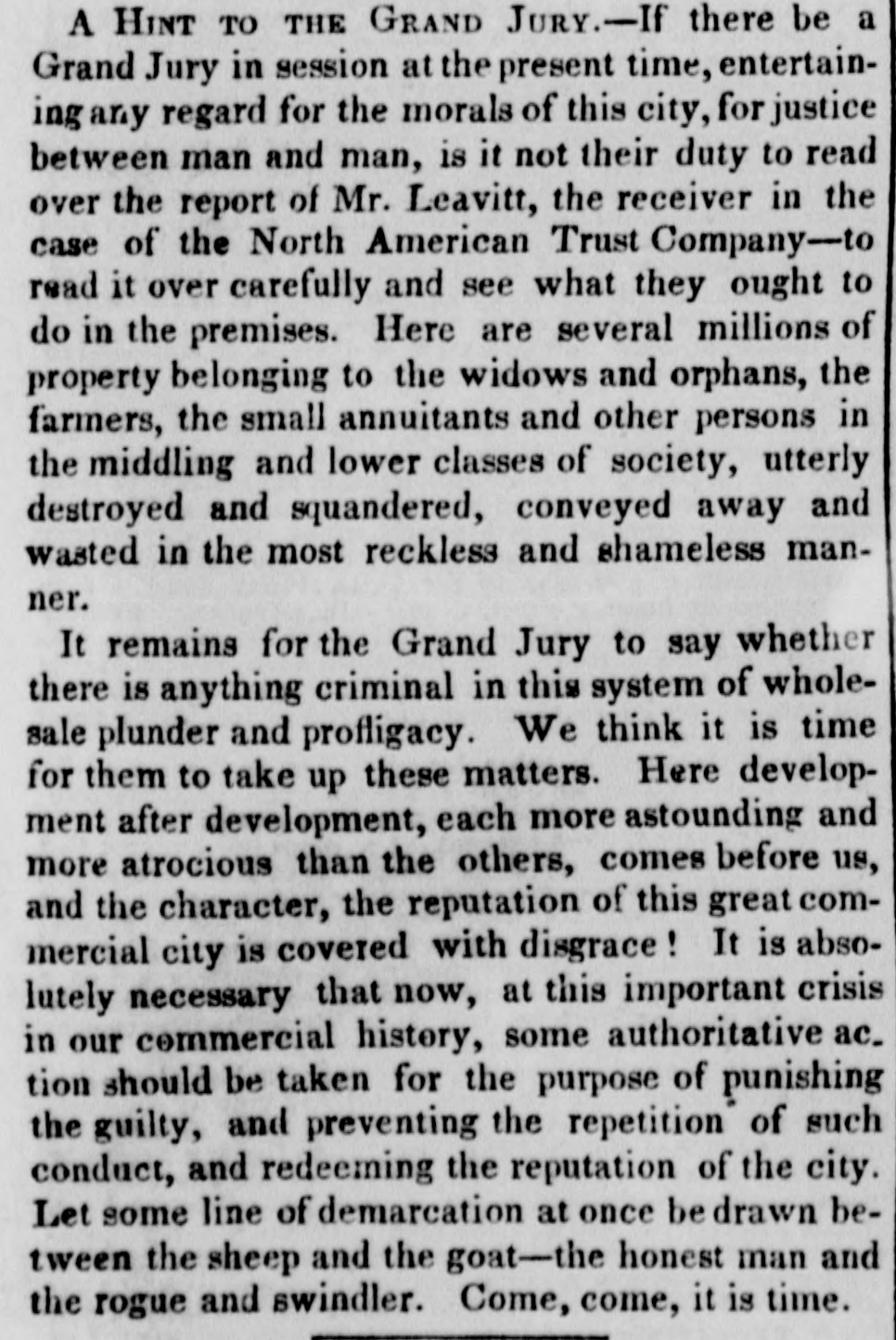
A HINT TO THE GRAND JURY.-If there be a Grand Jury in session at the present time, entertainingany regard for the morals of this city, for justice between man and man, is it not their duty to read over the report of Mr. Leavitt, the receiver in the case of the North American Trust Company-to read it over carefully and see what they ought to do in the premises. Here are several millions of property belonging to the widows and orphans, the farmers, the small annuitants and other persons in the middling and lower classes of society, utterly destroyed and squandered, conveyed away and wasted in the most reckless and shameless manner. It remains for the Grand Jury to say whether there is anything criminal in this system of wholesale plunder and profligacy. We think it is time for them to take up these matters. Here development after development, each more astounding and more atrocious than the others, comes before us, and the character, the reputation of this great commercial city is covered with disgrace It is absolutely necessary that now, at this important crisis in our commercial history, some authoritative ac. tion should be taken for the purpose of punishing the guilty, and preventing the repetition of such conduct, and redeeming the reputation of the city. Let some line of demarcation at once be drawn between the sheep and the goat-the honest man and the rogue and swindler. Come, come, it is time.


Article from The New York Herald, March 14, 1844

Click image to open full size in new tab

Article Text

OUR DOUBLE SHEET contains, among other important articles, the exposé of Mr. Talmage, Ex-President of the N. A. Trust-the famous speech of O'Connell (republished by request)-a most ori- ginal and amusing article on the Potts and Wain- wright Controversy, together with a vast assort- ment of letters, correspondence, news, incidents, reports, advertisements, &c. LATE AFFAIR OF MONOR. We have a communi- eation on this subject, from a reliable source, cor- recting some slight errors in our previous state- ment, which we shall publish to-morrow. Progress of Financial Science-North Ame- rican Trust Co. We publish in this day's paper the statement re- eently issued by Mr. Talmage, the ex-President of the North American Trust Co. This is a very clear and intelligible statement, and may be considered another step in the advancement of financial sci- ence in which so much ignorance has existed from time immemorial in Wall street. The various statements in relation to this Company, issued by the Receiver, by Mr. Graham, and now by Mr. Tal- mage, are so many little crevices, letting in light, making us acquainted with important facts, all uniting in helping us to an exhibition of the igno- rance and charlatanism which has characterised all the financiers of Wall street up to the present day. We do not mean to treat this subject as a per- sonal matter. It is more a scientific subject, and one of the most important, too, which can attract the study of the men of the present age. It is the science of common sense as applied to banking and financial affairs. Now, in this point of view, ad- mitting that all the managers of the North Ameri- can Trust Co., from the commencement, acted in good faith; yet they have given us sufficient evi- dence already by which we are justified in coming to the decided conclusion, that a set of greater finan- cial charlatans never did exist than those connect- ed with this Company in Wall street. In this cate- gory, we do not exactly mean to include Mr. Tal- mage, for he, it seems, was brought in when the Company was trembling on the verge of ruin by bad management, for the purpose of endeavoring- by his activity and business talents-to redeem it from destruction. So far as he is acquainted per- sonally with it, he gives a very clear and satisfac- tory explanation of the affa.r. And we very wil- lingly pass him before the community as entitled to all the benefit thus acquired. The whole of this business of the North Ameri- can Trust Co. and others, only affords additional illustration of the gross ignorance which prevails on all financial subjects amongst the very men in Wall street who profess to know every thing about these matters. They are so completely over- whelmed in their own little, petty, personal opera- tions, in particular stocks and narrow minded views, that it is impossible for any man in Wall street to have a comprehensive or correct view of the state 1 of the country at any particular period. Take for example the very class of men who originated this company. Who are they? What are they? What are their capacities? What evidence have they ever given of their talents? This set of men who started the North American Trust Co. and other similar concerns, were those who went to Albany, and procured the enactment of a law call- ed "the Free Banking Law," for the express pur- pose of endeavoring to preserve the bubbles of 1836 from bursting, and to continue the inflation for another period of time. They fell into the same error and exhibited the same ignorance as did the managers of the United States Bank-that was attempting to bolster up paper credits when the community had lost all confidence in them. The Southern Trust Co.-the Morris Canal and Banking Co. and a variety of other institutions in Wall street, were all organized and managed with the same degree of ignorace and want of tact, and all came to ruin from the same causes. Yet with these examples before us-with the re- mains of these institutions filling the atmosphere with pestilence and rottenness, we see the same men now in Wall street endeavoring to inflate si- milar bubbles, and go over the same road of igno- rance, folly and disaster! When will there be an end to all this? ### O'CONNELL'S FAMOUS SPEECH. We republish to- day, the famous speech made by Dan O'Connell on his trial in Dublin-and we do so in order to supply the craving appetite of his countrymen and lovers for this bonne bouche. Heretofore it has been only published in the third edition of our last Weekly and in the Sunday edition, but to reach all readers we give it again entire to-day. By the way-we perceive that some of the Philadelphia papers, like some wise acres here, consider the speech a hoax. Here is one:- A HOAX. The most stupendous hoax which has been palmed upon a gullible community, since Locke discover- ed the inhabitants in the moon, is O'Connell's speech, which was published at length in several of the papers (large and small) of this city. A penny contemporary with its usual foresight, kept all hands hard at work on Sunday night, for the purpose of issuing an extra on Mon- day morning. They did so, and have no doubt found out by this time, that they have been most egregiously hum- bugged. The speech was manufactured in New York, and although not the great Agitator's, it has created much sensation among types and steam presses-Philadelphia Chronicle. This is rich. If our acute cotemporary will take a trip to New York, and stop into our office, we will show him the copy of the Dublin Pilot, Extra, dated the afternoon of the 5th of February, from which we copied the speech. This copy ws brought by the steamer leaving Dublin that night, and reaching Liverpool next morning, in time for the afternoon papers of that city to republish a co- lumn on the 6th of February. Our agent in Liver- pool secured a copy of the "EXTRA PILOT," and sent it to us by the packet, leaving for New York that day. It was the only copy brought to this country. These are the simple facts-but if the gallant Colonel of the Chronicle believes as firmly as he does his Bible, that it was manufactured in New York," it must have been manufactured in our of- fice-it must have been spoken by ourself, and re- ported by our corps of reporters, for no other paper had the speech. If this is his solemn belief-be it so we shall take the credit, therefore, of being a greater man than even Dan O'Connell. STATE DEBTS-MARYLAND. The Legislature of Maryland has at last dissolved without making any adequate provision for the payment of the interest on the State debt, thereby leaving the honor and reputation of the State in as tarnished a condition as it has exhibited during the last few years. It is

Article from New-York Daily Tribune, October 8, 1844

Click image to open full size in new tab

Article Text

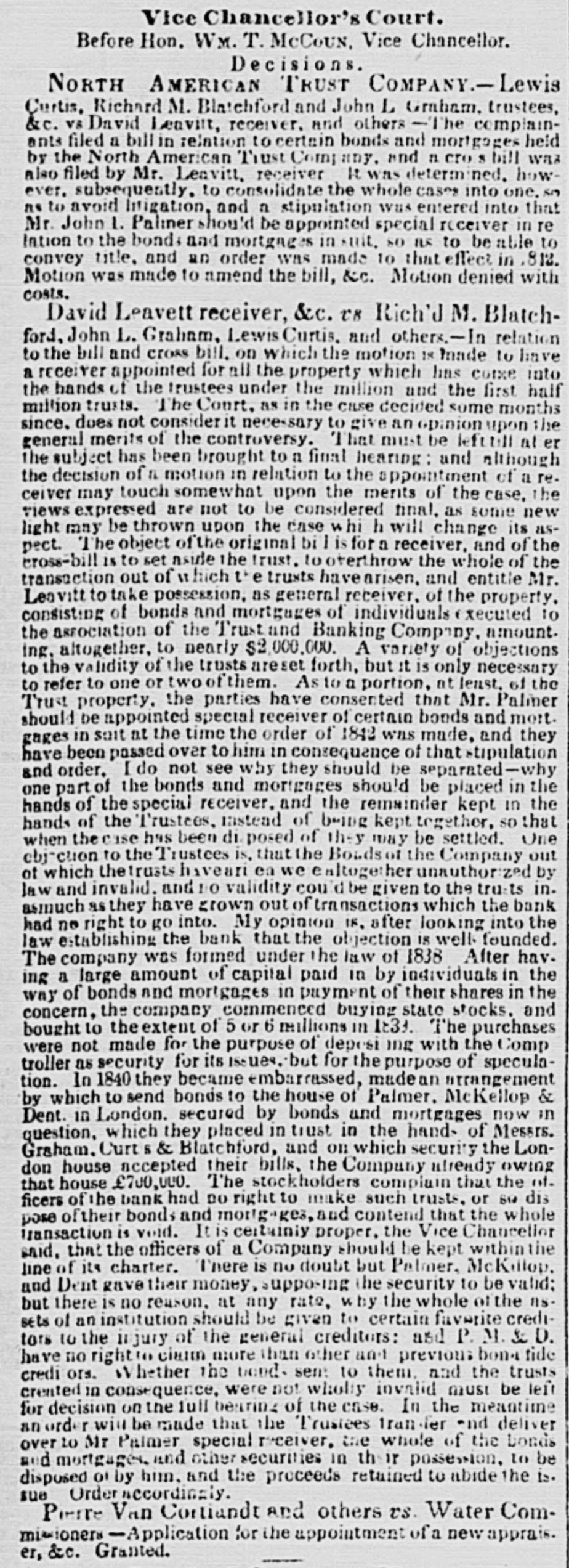
Vice Chancellor's Court. Before Hon. WM. T. McCoUN. Vice Chancellor. Decisions. NORTH AMERICAN TRUST COMPANY.-Lewis Curtis, Richard M. Blatchford and John L Graham. trustees, &c. VA David Leavilt, receiver. and others - The complainants filed a bill in relation to certain bonds and mortgages held by the North American Trust Comp any. and n cro bill was also filed by Mr. Leavitt, receiver It was determined. however. subsequently. to consolidate the whole cases into one. so as to avoid litigation, and n stipulation was entered into that Mr. John 1. Paliner should be appointed special receiver in re Intion to the bonds and mortgages in suit. so as to be able to convey title. and an order was made to that effect in 812. Motion was made to amend the bill, &c. Motion denied with costs. David Leavett receiver, &c. C8 Rich'd M. Blatchford, John L. Graham. Lewis Curtis. and others.-In relation to the bill and cross bill. on which the motion IN !nade to have a receiver appointed for all the property which has coixe into the hands of the trustees under the million and the first half million trusts. The Court. as in the case decided some months since. does not consider it necessary to give an opinion upon the general merits of the controversy. That must be lefttill at er the subject has been brought to a final hearing : and although the decision of is motion in relation to the appointment of a re. ceiver may touch somewhat upon the ments of the case, the views expressed are not to be considered final. as some new light may be thrown upon the case whi h will change its aspect. The object of the original bi I is for a receiver, and of the cross-bill is to set nside the trust. to overthrow the whole of the transaction out of which the trusts have arisen, and entitle Mr. Leavitt to take possession, as general receiver. of the property. consisting of bonds and mortgages of individuals executed to the association of the Trust and Banking Company. amount. ing. altogether. to nearly $2,000,000. A variety of objections to the validity of the trusts areset forth, but it is only necessary to refer to one or two of them. As to a portion, at least. of the Trust property. the parties have consented that Mr. Palmer should be appointed special receiver of certain bonds and mort. gages in suit at the time the order of 1842 was made, and they have been passed over to him in consequence of that stipulation and order. I do not see why they should be separated-why one part of the bonds and mortgages should be placed in the hands of the special receiver. and the remwinder kept in the hands of the Trustees, instead of being kept together, so that when the case has been di posed of they may be settled. One objection to the Trustees is, that the Boads of the Company out of which thetrusts haveari ea we Caltogether unauthor zed by law and invalid. and 10 validity could be given to the trusts in. asmuch as they have grown out of transactions which the bank had no right to go into. My opinion IS. after looking into the law establishing the bank that the objection is well- founded. The company was formed under the law of 1838 After having a large amount of capital paid in by individuals in the way of bonds and mortgages in payment of their shares in the concern, the company commenced buying state stocks. and bought to the extent of 5 or 6 millions in 1831. The purchases were not made for the purpose of deposit ing with the Comp troller as security for its issues. but for the purpose of speculation. In 1840 they became embarrassed, made an arrangement by which to send bonds to the house of Palmer. McKellop & Dent. 10 London. secured by bonds and mortgages now in question, which they placed in trust in the hand- of Mesars. Graham. Curt S & Blatchford, and on which security the London house accepted their bills, the Company already owing that house £700,000. The stockholders complain that the of ficers of the bank had DO right to make such trusts. or so dis pose of their bonds and montg ges, and contend that the whole transaction is void. It is certainly proper. the Vice Chanceller said. that the officers of a Company should be kept within the line of its charter. There is no doubt but Palmer, McKillop. and Dent gaveth money. supposing the security to be valid; but there is no reason. at any rate, why the whole of the assets of an institution should be given to certain faverite creditors to the 11 jury of the general creditors: and P. M. & D. have no right claim more than other an-1 previous bona tide credi ors. n hether the bend. sen: to them. and the trusts created in consequence, were not wholey invalid must be left for decision on the full bearing of the case. In the meantime order will be made that the Trustees transfer and deliver over to Mr Palmer special receiver, the whole of the bonds and mortgages. and other securities in th IF possession. to be disposed of by him. and the proceeds retained to abide the is. sue Order accordingly. Perre Van Cortlandt and others vs. Water Commixioners - Application for the appointment of a new apprais. er, &c. Granted.