First National Bank (Sedalia, MO)

Episode Information

Episode Type
Suspension โ†’ Closure
Start Date
May 4, 1894
Location
Sedalia, Missouri (38.704, -93.228)
Bank Type
national
Charter Number
1627

Metadata

Receivership Details

Depositor recovery rate
18.0%
Date receivership started
1894-05-10
Date receivership terminated
1909-06-30
OCC cause of failure
Fraud
Share of assets assessed as good
28.2%
Share of assets assessed as doubtful
13.9%
Share of assets assessed as worthless
57.9%

Notes

The bank failed to open on May 4, 1894, following a period of 'loss of business' triggered by a false telegram months earlier, but the immediate cause of closure was internal fraud and embezzlement by the cashier.

Events (5)

1. January 2, 1866 Chartered
Source
historical_nic
2. May 4, 1894 Suspension
Cause
Bank Specific Adverse Info
Cause Details
Embezzlement, false bookkeeping, and false reports by Cashier J. C. Thompson, who fled to Mexico.
Newspaper Excerpt
The First National bank failed to open today. The bank had a capital of $250,000 and was supposed to have a reserve of $25,000.
Source
newspapers
3. May 10, 1894 Receivership
Newspaper Excerpt
A message was received from Washington last night appointing W. A. Latimer receiver of the First National bank, which closed its doors last Friday.
Source
newspapers
4. May 10, 1894 Receivership
Source
historical_nic
5. April 15, 1895 Other
Newspaper Excerpt
James H. Eckels, comptroller of the treasury, today ordered receiver W. A. Latimer to make an assessment on the stockholders of the First National bank for $187,500
Source
newspapers

Newspaper Articles (24)

Article from Deseret Evening News, May 4, 1894

Click image to open full size in new tab

Article Text

Medalis, Mo, Bank Closed. Sedalia, Mo., May 4.-The First National bank failed to open today. The bank had a capital of $250,000 and was supposed to have a reserve of $25,000. The suspension is attributed to the 1088 of business brought about by the publication in a St. Louis paper several months ago of a telegram say. ing the bank had isiled. Other banks became suspicious. It is the general belief the depositors will be paid in full.


Article from The Helena Independent, May 5, 1894

Click image to open full size in new tab

Article Text

Missouri Bank Falls SEDALLA, Mo., May 4.-The First National bank failed to open to-day. The bank had & capital of $250,000 and was supposed to have a reserve of $25,000. The suspension is attributed to loss of business, brought about by the publication in a St. Louis paper several months ago of a telegiam saying the bank had failed, when other banks became suspicious. It is the general belief that depositors will be paid in full.


Article from Asheville Daily Citizen, May 5, 1894

Click image to open full size in new tab

Article Text

Examinailon comes Too Late. WASHINGTON, May 5.-Thecomptroller of the currency is advised that the First national bank of Sedalia, Mo., had suspended payments. Bank Examiner Latimer is ordered to make an examination.


Article from The Roanoke Times, May 5, 1894

Click image to open full size in new tab

Article Text

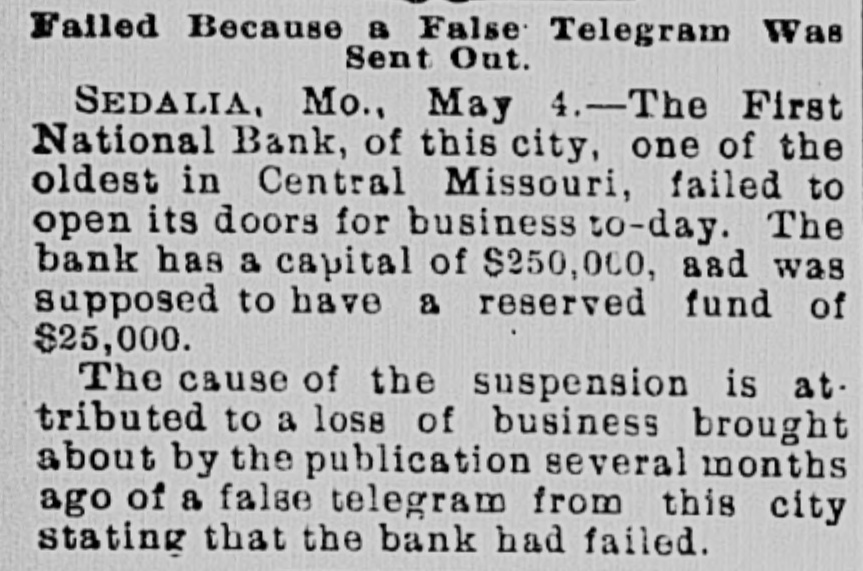
Failed Because a False Telegram Was Sent Out. SEDALIA, Mo., May 4.-The First National Bank, of this city, one of the oldest in Central Missouri, failed to open its doors for business to-day. The bank has a capital of $250,000, and was supposed to have a reserved fund of $25,000. The cause of the suspension is at. tributed to a loss of business brought about by the publication several months ago of a false telegram from this city stating that the bank had failed.


Article from The Salt Lake Herald, May 5, 1894

Click image to open full size in new tab

Article Text

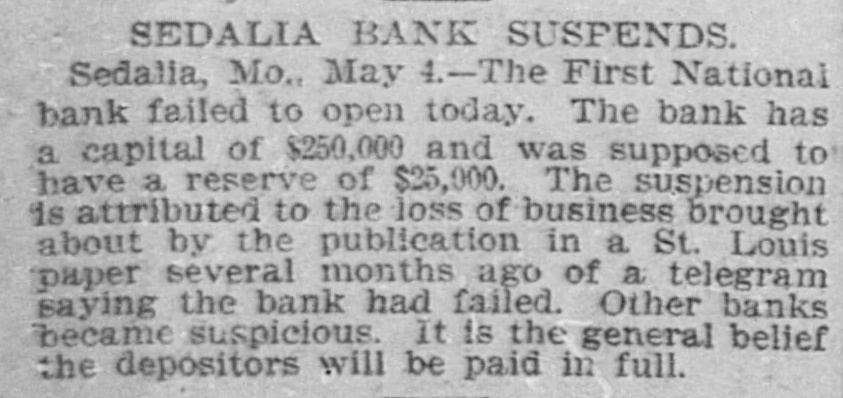
SEDALIA BANK SUSPENDS. Sedalia, Mo., May 4.-The First National bank failed to open today. The bank has a capital of $250,000 and was supposed to have a reserve of $25,000. The suspension is attributed to the loss of business brought about by the publication in a St. Louis paper several months ago of a telegram saying the bank had failed. Other banks became suspicious. It is the general belief the depositors will be paid in full.


Article from Santa Fe Daily New Mexican, May 8, 1894

Click image to open full size in new tab

Article Text

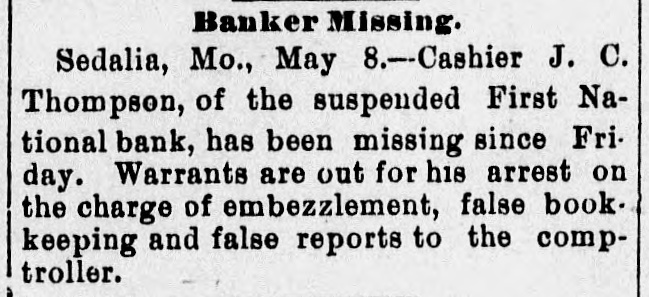
Banker Missing. Sedalia, Mo., May 8.--Cashier J. C. Thompson, of the suspended First National bank, has been missing since Friday. Warrants are out for his arrest on the charge of embezzlement, false book. keeping and false reports to the comptroller.


Article from The Topeka State Journal, May 10, 1894

Click image to open full size in new tab

Article Text

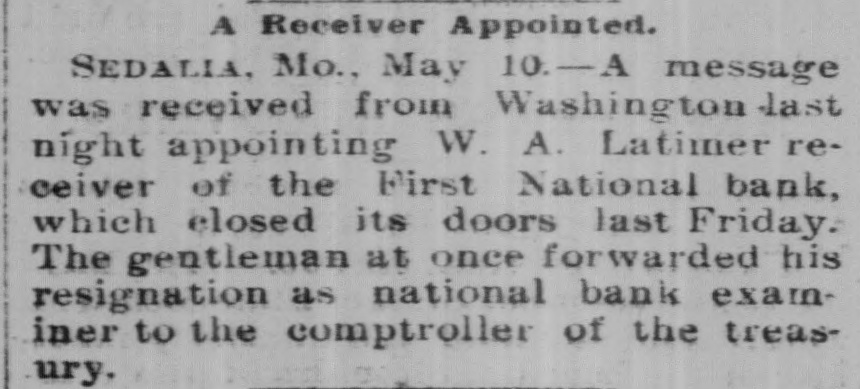
A Receiver Appointed. SEDALIA, Mo., May 10.-A message was received from Washington last night appointing W. A. Latimer receiver of the First National bank, which closed its doors last Friday. The gentleman at once forwarded his resignation as national bank examiner to the comptroller of the treasury.


Article from The True Northerner, May 11, 1894

Click image to open full size in new tab

Article Text

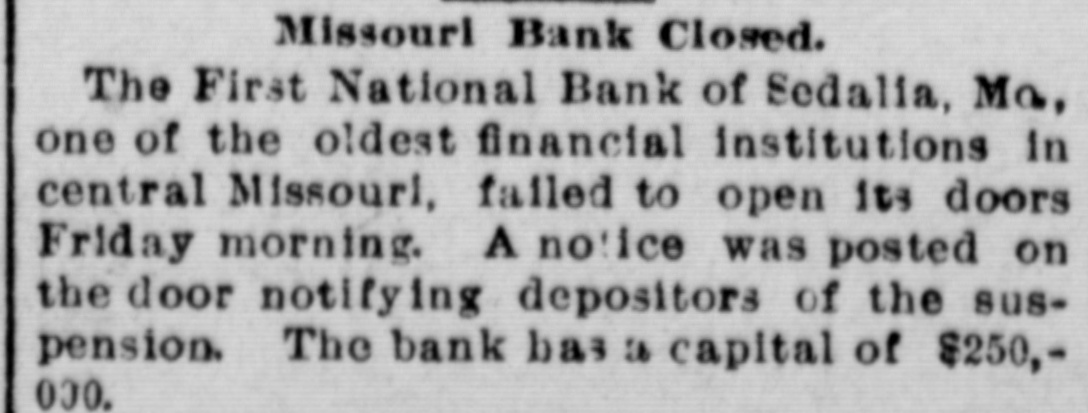
Missouri Bank Closed. The First National Bank of Sedalia, Mo., one of the oldest financial institutions in central Missouri, failed to open its doors Friday morning. A no:ice was posted on the door notifying depositors of the suspension. The bank has is capital of $250,000.


Article from The Progressive Farmer, May 15, 1894

Click image to open full size in new tab

Article Text

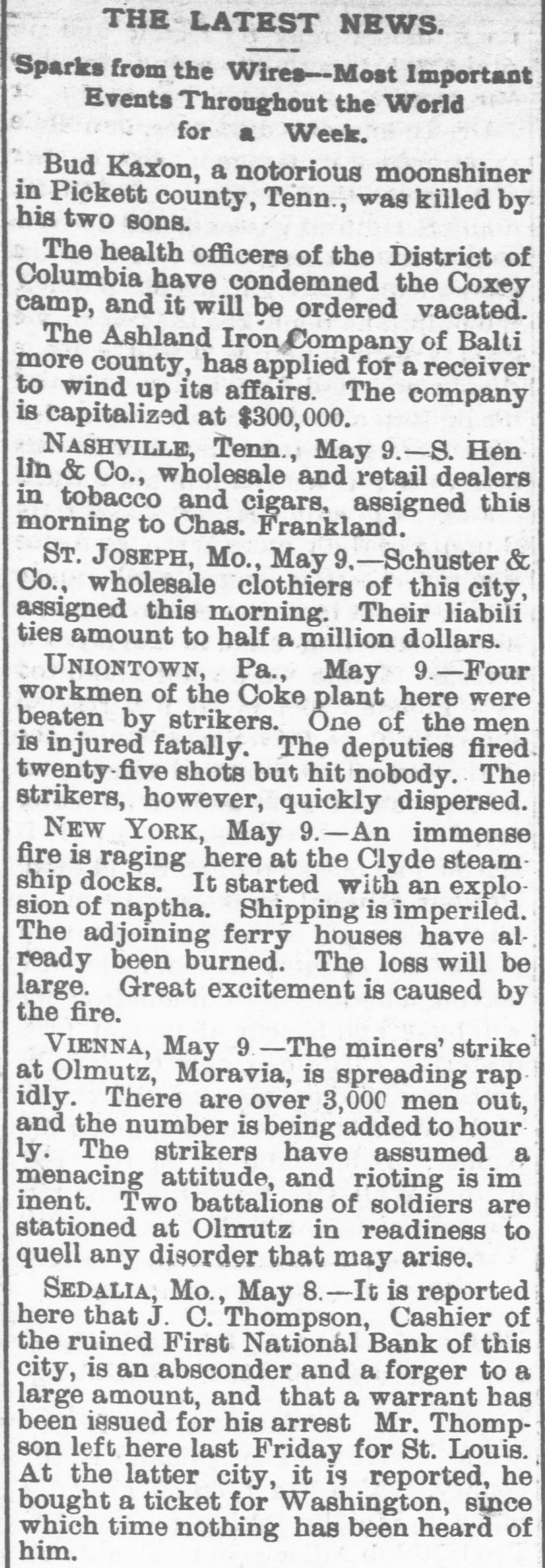
THE LATEST NEWS. Sparks from the Wires--Most Important Events Throughout the World for a Week. Bud Kaxon, a notorious moonshiner in Pickett county, Tenn., was killed by his two sons. The health officers of the District of Columbia have condemned the Coxey camp, and it will be ordered vacated. The Ashland Iron Company of Balti more county, has applied for a receiver to wind up its affairs. The company is capitalized at $300,000. NASHVILLE, Tenn., May 9.-S. Hen lin & Co., wholesale and retail dealers in tobacco and cigars, assigned this morning to Chas. Frankland. ST. JOSEPH, Mo., May 9.-Schuster & Co., wholesale clothiers of this city, assigned this morning. Their liabili ties amount to half a million dollars. UNIONTOWN, Pa., May 9.-Four workmen of the Coke plant here were beaten by strikers. One of the men is injured fatally. The deputies fired twenty-five shots but hit nobody. The strikers, however, quickly dispersed. NEW YORK, May 9.-An immense fire is raging here at the Clyde steamship docks. It started with an explosion of naptha. Shipping is imperiled. The adjoining ferry houses have already been burned. The loss will be large. Great excitement is caused by the fire. VIENNA, May 9 -The miners' strike at Olmutz, Moravia, is spreading rap idly. There are over 3,000 men out, and the number is being added to hour ly. The strikers have assumed a menacing attitude, and rioting is im inent. Two battalions of soldiers are stationed at Olmutz in readiness to quell any disorder that may arise. Sedalia, Mo., May 8.-It is reported here that J. C. Thompson, Cashier of the ruined First National Bank of this city, is an absconder and a forger to a large amount, and that a warrant has been issued for his arrest Mr. Thompson left here last Friday for St. Louis. At the latter city, it is reported, he bought a ticket for Washington, since which time nothing has been heard of him.


Article from Iron County Register, May 17, 1894

Click image to open full size in new tab

Article Text

MISSOURI STATE NEWS. The First National of Sedalla. SEDALIA. May 8.-W. A. Latimer, na tional bank examiner, has charge o: the First national bank, which sus pended May 4. It is said that he found less than $1,000 in cash Mr. Latime has been busy day and night investi gating the bank's condition, but when seen last night and interrogated about the rumor that Cashier J. C. Thomp son was a fugitive, he would neither affirm nor deny the report. He admit ted, however, that he had wired con siderable important information to Comptroller Eckles regarding the bank's condition, and also consid erable regarding Mr. Thompson personally, but beyond that he would say nothing. It is known tha Mr. Thompson has lost heavily in the past three or four years in real estate deals in Kansas City and California and the belief is fast gaining ground that depositors will realize very little out of the bank's assets. Mr. Thomp son has for years been one of the lead ing citizens of Sedalia, a pillar in the Episcopal church and there was never a public enterprise that he did not con tribute to it both his time and means His residence property has been adver tised at sheriff's sale to satisfy a judg ment in favor of the First national bank of Jefferson City; and this, it is be lieved. is but the beginning of much litigation. A few years ago the First national did the largest banking busi ness in the city, but when the rumor came a year ago that it was in a shaky condition many of its theaviest depositors changed to other banks, but up to the very last it had a goodly num ber who stood by it and were positive that the stringency of the times was the sole cause of the trouble. A RECEIVER APPOINTED. SEDALIA, May 11.-Bank Examine: Latimer has been appointed receiver the First national, having resigned temporarily as examiner. It is be lieved that Cashier Thompson has flec to Mexico. and the statement is made that he commenced crooked work in the bank two years ago. Thompsor has many friends, who express sym pathy for him, and they would have raised thousands of dollars to have prevented the crash. TURNS OVER EVERY DOLLAR. SEDALIA, May 11.-Cyrus Newkirk president of the suspended bank, has given a bill of sale on every dollar's worth of property owned by him, here and elsewhere, in behalf of the bank's depositors. HOT AFTER THOMPSON. SEDALIA, May 12.-Reliable information coming from a government official has been received from Washington to the effect that the treasury department is taking extraordinary measures to secure the arrest of Cashier Thompson. It is stated that the total of the misappropriation by Thompson can not be estimated with any accuracy; in fact a guess might easily be $100,000 away from the actual figures. LOOKS LIKE A CLEAN SWEEP. As the examination continues the condition of affairs grows worse. The investigation thus far, while far from being complete, warrants the statement that the bank examiner will be compeled at an early date to order an assessment of 100 per cent. on the cap ital stock. That means a levy of $250, 000, a sum which, as large as it is, may not be sufficient to repay depositors dollar for dollar. Republican State Convention. The Republican state central committee met at Excelsior Springs and decided to call the state convention for August 15, at Excelsior Springs. The basis of representation was one delegate for each 250 votes cast for Maj. Warner in 1892, and one for every fraction of 125. It is estimated that this ratio will give the state convention about 1,200 delegates. The date and mode of electing the delegates to the state convention was left discretionary with the county committees, provided that all delegates must be elected not later than August 11. A Coal Famine Imminent. It was stated on the 9th that the question of coal supply for St. Louis had reached a critical stage, caused by the miners' strike. There was estimated to be about a ten-days' supply on hand, and after that is exhausted, and the miners were still idle, many of the large industries would be compeled to shut down. The street railway companies had about a week's supply, the water-works about enough to run for two weeks, and the price of coal had jumped from 7 cents to 15 cents per bushel, with little to be had at those figures, Heavy Failure in St. Joseph. A. N. Schuster & Co., wholesale clothing. St. Joseph, have assigned; liabilities, estimated, $500,000. Mr. Schuster's real estate possessions in St. Joseph, aggregating $1,000,000, were placed in the hands of the assignee. The firm did a business of over $1,000,000 annually, and was until a short time ago considered one of the most substantial in the west. ST. JOSEPH, May 11.-The liabilities in the Schuster failure are placed at $500,000 and the assets at $800,000. From Washington. NEW POSTMASTERS. Edge Hill. Reynolds county. J.S. Eaton, vice David Latham. resigned. Leopolis. Livingston county, Arsenius Fable F. DeSales. vice resigned. Overton. Cooper county, W. F. Allen, vice H. H. Woolridge resigned. Valley Forge. St. Francois county, D. F. Giessing, vice Fred Giessing, resigned. W. H. Emerson. Hon. W. H. Emerson, ex-representative from Pettis county in the legislature, died at his home in Lamonte the other morning, aged over 50 years. A Great Strawberry Festival. The Daughters of the Confederacy have concluded
Article from The Pioneer Express, May 25, 1894

Click image to open full size in new tab

Article Text

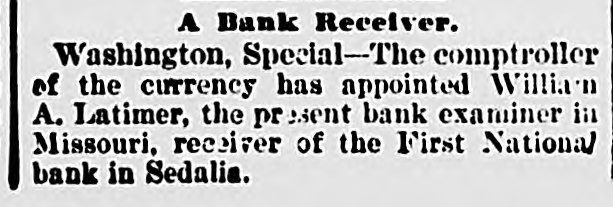
Bank Receiver. A Washington, Special-The comptroller of the currency has appointed William A. Latimer, the present bank examiner iii Missouri. receiver of the First National bank in Sedalia.


Article from The State Republican, May 31, 1894

Click image to open full size in new tab

Article Text

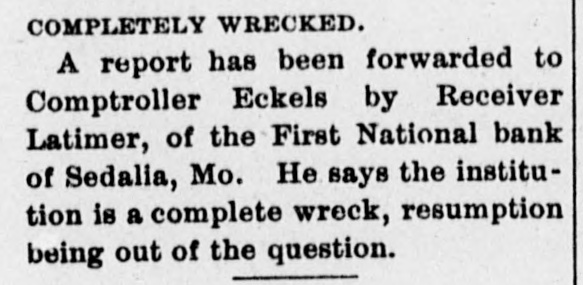
COMPLETELY WRECKED. A report has been forwarded to Comptroller Eckels by Receiver Latimer, of the First National bank of Sedalia, Mo. He says the institution is a complete wreck, resumption being out of the question. -


Article from Iron County Register, May 31, 1894

Click image to open full size in new tab

Article Text

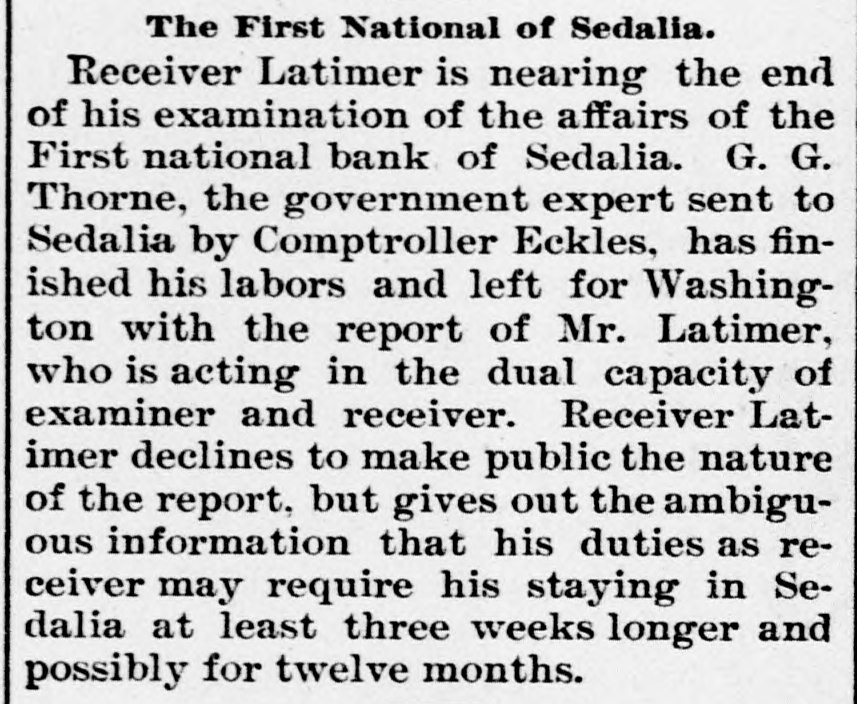
# THE FIRST NATIONAL OF SEDALIA. Receiver Latimer is nearing the end of his examination of the affairs of the First national bank of Sedalia. G. G. Thorne, the government expert sent to Sedalia by Comptroller Eckles, has finished his labors and left for Washington with the report of Mr. Latimer, who is acting in the dual capacity of examiner and receiver. Receiver Latimer declines to make public the nature of the report, but gives out the ambiguous information that his duties as receiver may require his staying in Sedalia at least three weeks longer and possibly for twelve months.


Article from Mexico Weekly Ledger, May 31, 1894

Click image to open full size in new tab

Article Text

Children Cry for Pitcher's Castoria. A report has been forwarded to Comptroller Eckels by Receiver Latimer of the First National Bank of Sedalia, Mo. He says the institution is a complete wreck, resumption being out of the question.


Article from Birmingham Age-Herald, April 16, 1895

Click image to open full size in new tab

Article Text

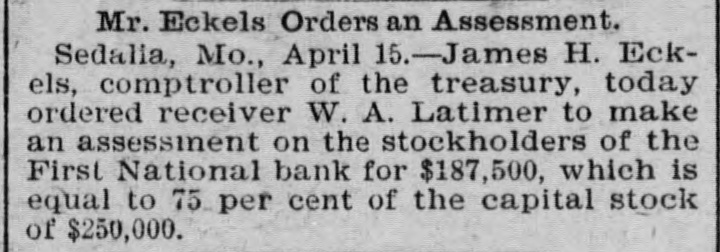
Mr. Eckels Orders an Assessment. Sedalla, Mo., April 15.-James H. Eckels, comptroller of the treasury, today ordered receiver W. A. Latimer to make an assessment on the stockholders of the First National bank for $187,500, which is equal to 75 per cent of the capital stock of $250,000.


Article from Richmond Dispatch, April 16, 1895

Click image to open full size in new tab

Article Text

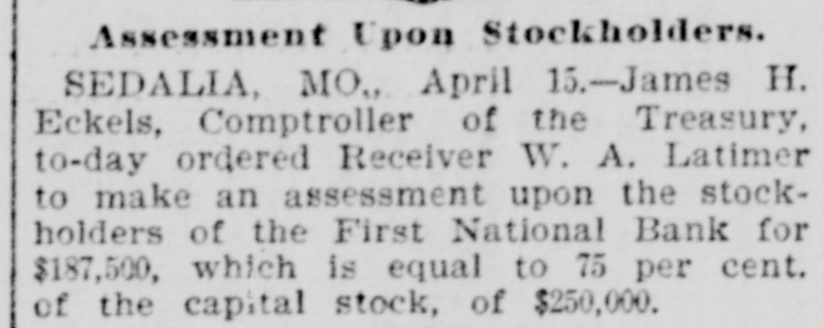
Assessment Upon Stockholders. SEDALIA, MO,, April 15.-James H. Eckels, Comptroller of the Treasury, to-day ordered Receiver W. A. Latimer to make an assessment upon the stockholders of the First National Bank for $187,500, which is equal to 75 per cent. of the capital stock, of $250,000.


Article from River Falls Journal, April 18, 1895

Click image to open full size in new tab

Article Text

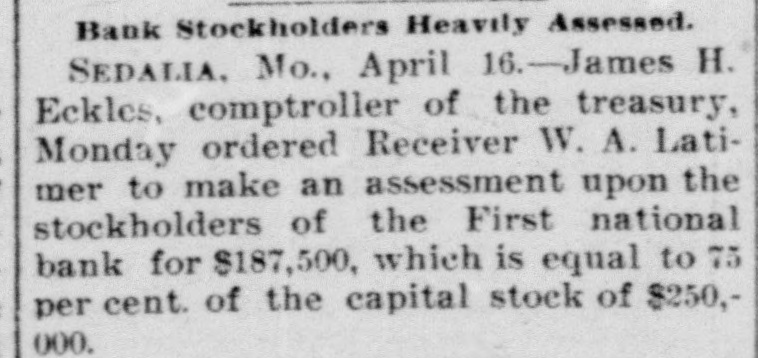
Bank Stockholders Heavily Assessed. SEDALIA. Mo., April 16.-James H. Eckles, comptroller of the treasury, Monday ordered Receiver W. A. Latimer to make an assessment upon the stockholders of the First national bank for $187,500, which is equal to 75 per cent. of the capital stock of $250,000.


Article from The Dalles Daily Chronicle, April 19, 1895

Click image to open full size in new tab

Article Text

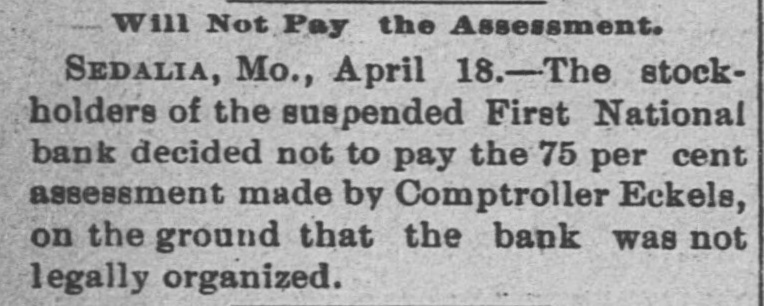
Will Not Pay the Assessment. SEDALIA, Mo., April 18.-The stockholders of the suspended First National bank decided not to pay the 75 per cent assessment made by Comptroller Eckels, on the ground that the bank was not legally organized.


Article from St. Paul Daily Globe, April 19, 1895

Click image to open full size in new tab

Article Text

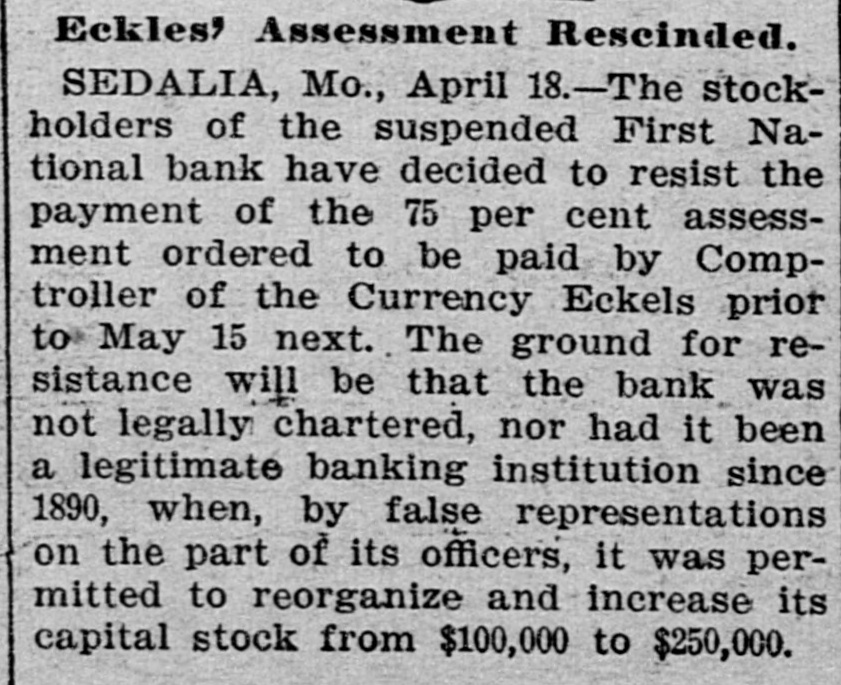
Eckles' Assessment Rescinded. SEDALIA, Mo., April 18.-The stockholders of the suspended First National bank have decided to resist the payment of the 75 per cent assessment ordered to be paid by Comptroller of the Currency Eckels prior to May 15 next. The ground for resistance will be that the bank was not legally chartered, nor had it been a legitimate banking institution since 1890, when, by false representations on the part of its officers, it was permitted to reorganize and increase its capital stock from $100,000 to $250,000.


Article from The Pioneer Press, April 25, 1895

Click image to open full size in new tab

Article Text

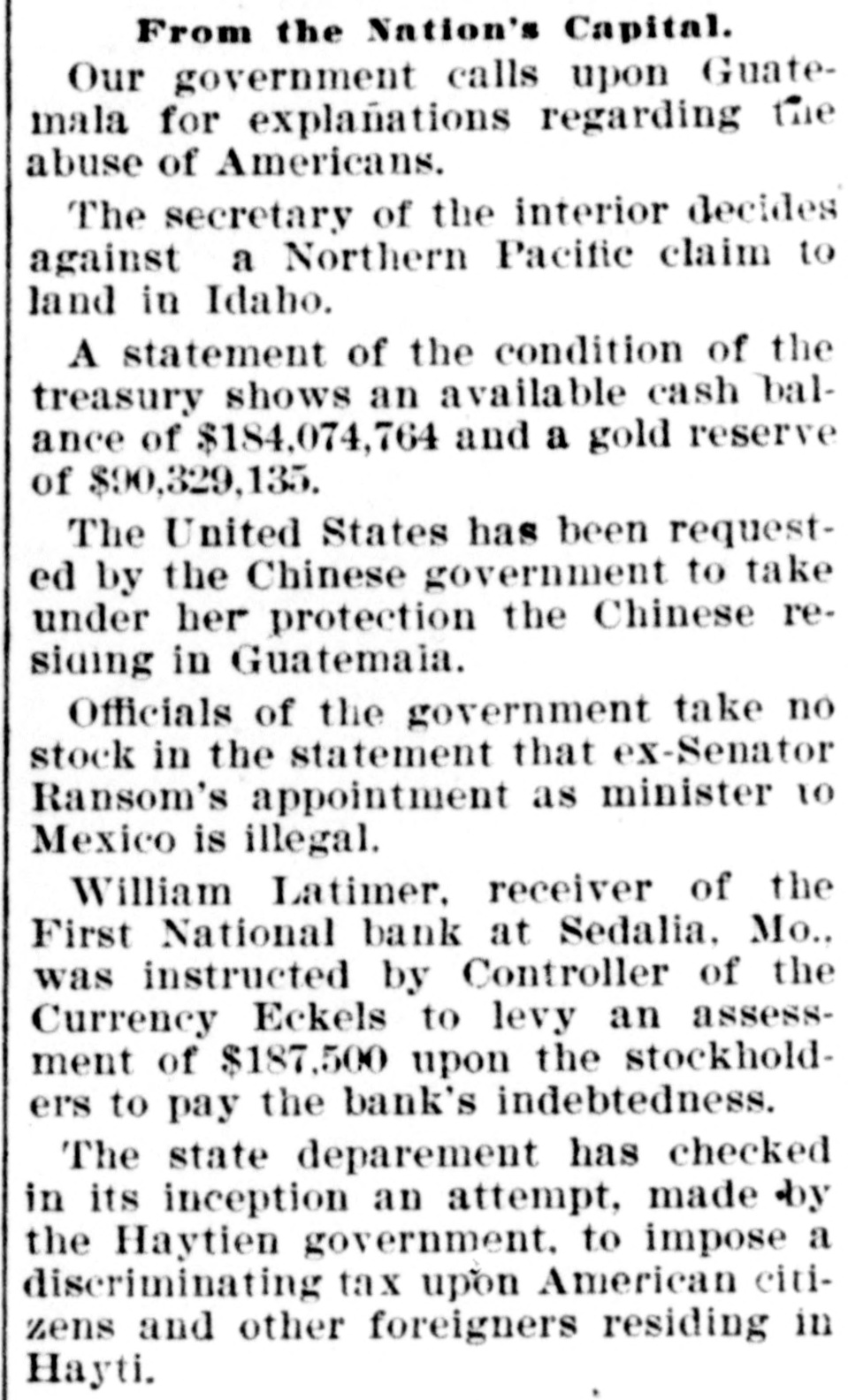
From the Nation's Capital. Our government calls upon Guatemala for explanations regarding the abuse of Americans. The secretary of the interior decides against a Northern Pacific claim to land in Idaho. A statement of the condition of the treasury shows an available cash balance of $184,074,764 and a gold reserve of $90,329,135. The United States has been requested by the Chinese government to take under her protection the Chinese residing in Guatemala. Officials of the government take no stock in the statement that ex-Senator Ransom's appointment as minister to Mexico is illegal. William Latimer, receiver of the First National bank at Sedalia, Mo., was instructed by Controller of the Currency Eckels to levy an assessment of $187,500 upon the stockholders to pay the bank's indebtedness. The state deparement has checked in its inception an attempt, made by the Haytien government, to impose a discriminating tax upon American citizens and other foreigners residing in Hayti.


Article from Iron County Register, October 22, 1896

Click image to open full size in new tab

Article Text

MISSOURI STATE NEWS, An Inoperative Law. The Pettis county grand jury has made a recommendation which may lead to the repeal of an inoperative law. The report says: We recommend the repeal of the law requiring grand jurors to examine the books of the county officials. The improbability of the possibility of drawing 12 men at any one time that would have the ability to recognize an error in bookkeeping, even if such error should be bold on its face, conneoted with the limited time in which juries would be compelled to audit the books of every department to honestly find an error, makes it apparent to us that the law is very absurd and unreasonable. Therefore, we ask for its repeal, and would recommend in its place that the county court be empowered to employ experts to examine the books, when in their judgment the court thought it necessary, or a commission be appointed by the state, as in the case of banks. The Case of Ex-Banker Newkirk. At Sedalia Judge W. W. Wood overruled the motion to quash the four indictments found against Cyrus Newkirk, president of the suspended First national bank, charged with having received deposits when he knew the bank to be in a failing condition. The defendant, whois 76 years old, is quite ill in California, and his physicians say that to compel him to return to Sedalia in December, the time set for the trial of the cases, will result fatally. The bank failed May 4, 1894, with a shortage of $254,000, and the depositors have not yet received a dividend.


Article from The Wichita Daily Eagle, March 25, 1897

Click image to open full size in new tab

Article Text

other occupants of the schoolhouse to find his home in flames. It was impossible to enter the house, as it was crumbling when Penrod reached It. The children's beds were by the window, however, and Penrod burst the window open and succeeded in pulling the 8-year-old and 4year-old boys out, horribly burning himself in the act. They never regained consciousness and died in a short time. The others were burned (until only a few bones were found in the debris of the house. The coroner's inquest threw no light on the origin of the fire. A WHOLESALE FIREBUG. Detroit, Mich., March 24.-A special to the News from Cleveland, Ohio, says: William Ingless, under arrest here for incendiarism. confessed today to having set fire to forty buildings in Detroit. BICYCLE WORKS BURNED. Reading, Pa., March 24.-The large plant of the Acme bicycle works was destroyed by fire early this morning. All the valuable machinery was destroyed, making the total loss about $75,000, covered by insurance. The building contained material for fully 5,000 bicycles. BANKERS INVESTIGATED. St. Paul, Minn., March 24.-A Bismarck, N. D., special to the Pioneer Press says: The banking methods of some of the suspended national banks of the state are being investigated by the United States grand jury now in session. Two indictments have already been found, one against Lee Booker, extreasurer and president of Grand Forks National bank, and the other against H. F. Salayards, president of the First National bank of Minot. Booker is charged with making false returns to the comptroller of the currency. He was arraigned today, plead not guilty, and was held for trial in $5,000 bonds. Salayards is charged with aiding and abetting in making false entries in the bank's books. He pleaded not guilty and was held in $6,000 bonds for trial. The indictment of Booker came as a great surprise to his friends throughout the state. He was state treasurer for three years, entering the office in 1893, and has always taken an active part in state politics. BOGUS BONDS MUST BE PAID. Kansas Cty, March 24.-A special to the Star from Sedalia, Mo., says: Judge W. W. Wood, of the Johnson county circuit court, has decided that the Sedalia school district must pay $23,000 to the holders of school bonds issued in 1883 and fraudulently sold to eastern people. The bonds were paid ten years later and left in the custody of J. C. Thompson, cashier of the First National bank and financial agent for the school bonds. Instead of turning them over to the treasurer to destroy, Thompson resold them to eastern people and by paying the interest on the coupons the swindle was not detected until the bank failed and Thompson had fled to Mexico. SHOT HER PARAMOUR. Middlesboro, Ky., March 24.-A special from Hancock county, Tenn., states that Martha Bull shot and killed her paramour, Thomas McRae, and then shot herself. The Bull woman thirty years ago was a leader of society in Camden, Va. She claimed to be collaterally related to Washington. DURRANTS APPEAL San Francisco, March 24.-The attorneys for Theodore Durrant have filed a petition in the supreme court for rehearing of the application, previously dei nied, for a new trial. No new points are cited and it will be decided without argument. The prosecution believes the I petition will be denied.


Article from Kansas City Journal, May 3, 1897

Click image to open full size in new tab

Article Text

INVESTIGATION ASKED FOR. Depositors of a Defunct Sedalia Bank Make Grave Charges Against Comptroller Eekels. Sedalia, Mo., May 2.-(Special.) A letter containing grave charges reflecting upon the official conduct of the comptroller of the currency, prior to, and subsequent to. the wrecking of the Sedalia First National bank, has been prepared and signed by the majority of the depositors of the bank and will be forwarded to-morrow to Judge James Cooney, of Washington, demanding that he press the request of the depositors for a congressional investigation. The letter recalls the circumstances connected with the failure of the bank, its robbery, the flight of the cashier to Mexico and the farcical attempt to extradite him, and the indictments against President Cyrus Newkirk, now living in plenty in California, which were never tried. The summarized charges are: "First-In July, 1893. the bank was publicly and widely reported as in a failing condition, and such facts were known to the comptroller of the currency. "Second-That, by the neglect or care. lessness of the United States officials, the bank was permitted to run until its prestdent. cashier (J. C. Thompson) and other officers had robbed it of all they could place their hands upon, and closed it themselves when there was nothing more left for them to plunder. "Third-That, shortly prior to the abandonment of the bank, W. A. Latimer, now receiver, was sent to Sedalia to examine the bank, but, as he was about to enter upon his examination, the comptroller of the currency sent Latimer a telegram to defer the examination, said intervention having been procured by the officers of the bank through influential persons, and the officers took advantage of the respite to spread the report that the condition of the bank was SO good that the examiner would not waste his time to examine the books, and they proceeded without delay to secure deposits. and to rob. wreck and transfer for their own use and benefit the assets and appropriate the property of the bank to their own use, close its doors and flee from the country. "Fourth-That Receiver Latimer's administration has been of unreasonable length of time; that he has made no effort to recover property that was transferred by fraud and stealth by the officers of the bank just prior to its abandonment: that he has, by mismanagement, greatly reduced the assets and the funds available for liquidation: that he has paid numerous large and unnecessary lawyers' fees, and that property of the bank has been left in charge and control of relations and kinsmen of the former officers of the bank, and he keeps on his force of clerks and employes the relations and clerks of the former officers of the bank."


Article from The Sun, September 1, 1897

Click image to open full size in new tab

Article Text

LETTER FROM SENATOR VEST. He Explains His Request Relating to the Sedalia National Bank. SEDALIA, Mo., Aug. 31.-United States Senator George G. Vest has addressed a letter to Congressman James Cooney of the Seventh Missouri district in reply to a recent communication from James H. Eckles, Comptroller of the Currency, in which the reader was led to infer that Senator Vest had requested in 1894 that the proposed examination of the Sedalia First National Bank, in April of that year, be deferred until certain that the bank's assets could be realized upon. The letter is as follows: "My attention has been called to a letter of the 22d inst. from the Hon. J. H. Eckels, Comptroller of the Currency, to the Hon. James Cooney, in which the statement is made that in April, 1894, I requested the postponement of an examination by the National Bank Examiner of the First National Bank of Sedalia. The facts are simply these: "In March, or April, 1894, Mr. Cyrus Newkirk, President of the bank, and Mr. J. C. Thompson, the cashier, wrote me that an examination of the bank was about to be made before the time fixed by the established rule of the Comptroller, and that, on account of a false report put in circulation by some one that the institution had failed, and the additional fact that on account of the stringency prevailing they were unable to collect, there was danger of a run on the bank if an examination was made before the regular time. They requested me to lay these facts before the Comptroller of the Currency. Believing them to be honest men, and that their statements were true, I did so. I have no apology to make, and hope there will G. G. VEST." be the fullest investigation.