Click image to open full size in new tab
Article Text
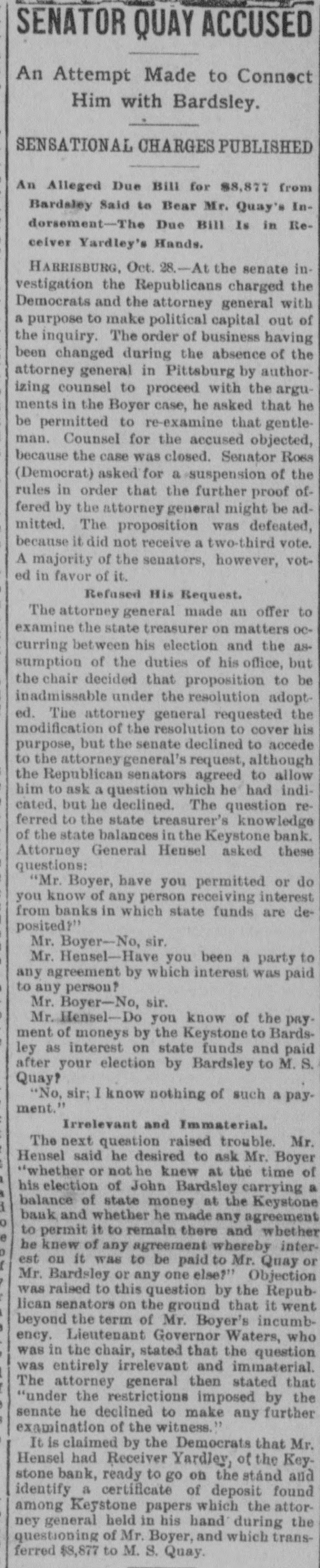
SENATOR QUAY ACCUSED An Attempt Made to Connect Him with Bardsley. SENSATIONAL CHARGES PUBLISHED An Alleged Due Bill for $8,877 from Bardsley Said to Bear Mr. Quay's Indorsement-The Due Bill Is in Receiver Yardley's Hands. HARRISBURG, Oct. 28.-At the senate investigation the Republicans charged the Democrats and the attorney general with a purpose to make political capital out of the inquiry. The order of business having been changed during the absence of the attorney general in Pittsburg by authorizing counsel to proceed with the arguments in the Boyer case, he asked that he be permitted to re-examine that gentleman. Counsel for the accused objected, because the case was closed. Senator Ross (Democrat) asked for a suspension of the rules in order that the further proof offered by the attorney general might be admitted. The proposition was defeated, because it did not receive a two-third vote. A majority of the senators, however, voted in favor of it. Refused His Request. The attorney general made an offer to examine the state treasurer on matters occurring between his election and the assumption of the duties of his office, but the chair decided that proposition to be inadmissable under the resolution adopted. The attorney general requested the modification of the resolution to cover his purpose, but the senate declined to accede to the attorney general's request, although the Republican senators agreed to allow him to ask a question which he had indicated, but he declined. The question referred to the state treasurer's knowledge of the state balances in the Keystone bank. Attorney General Hensel asked these questions: "Mr. Boyer, have you permitted or do you know of any person receiving interest from banks in which state funds are deposited?" Mr. Boyer-No, sir. Mr. Hensel-Have you been a party to any agreement by which interest was paid to any person? Mr. Boyer-No, sir. Mr. Hensel-Do you know of the payment of moneys by the Keystone to Bardsley as interest on state funds and paid after your election by Bardsley to M. S. Quay? "No, sir; I know nothing of such a payment." Irrelevant and Immaterial. The next question raised trouble. Mr. Hensel said he desired to ask Mr. Boyer "whether or not he knew at the time of his election of John Bardsley carrying a balance of state money at the Keystone bank and whether he made any agreement to permit it to remain there and whether he knew of any agreement whereby interest on it was to be paid to Mr. Quay or Mr. Bardsley or any one else?" Objection was raised to this question by the Republican senators on the ground that it went beyond the term of Mr. Boyer's incumbency. Lieutenant Governor Waters, who was in the chair, stated that the question was entirely irrelevant and immaterial. The attorney general then stated that "under the restrictions imposed by the senate he declined to make any further examination of the witness." It is claimed by the Democrats that Mr. Hensel had Receiver Yardley, of the Keystone bank, ready to go on the stand and identify a certificate of deposit found among Keystone papers which the attor-