Click image to open full size in new tab
Article Text
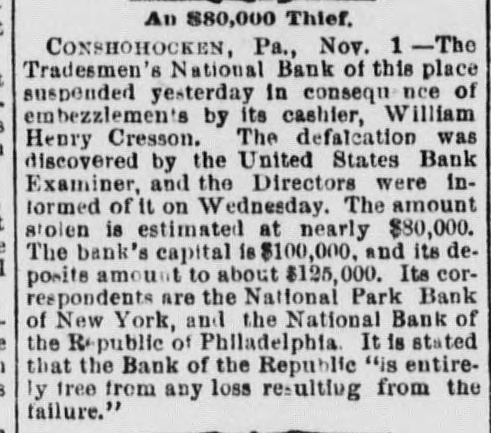
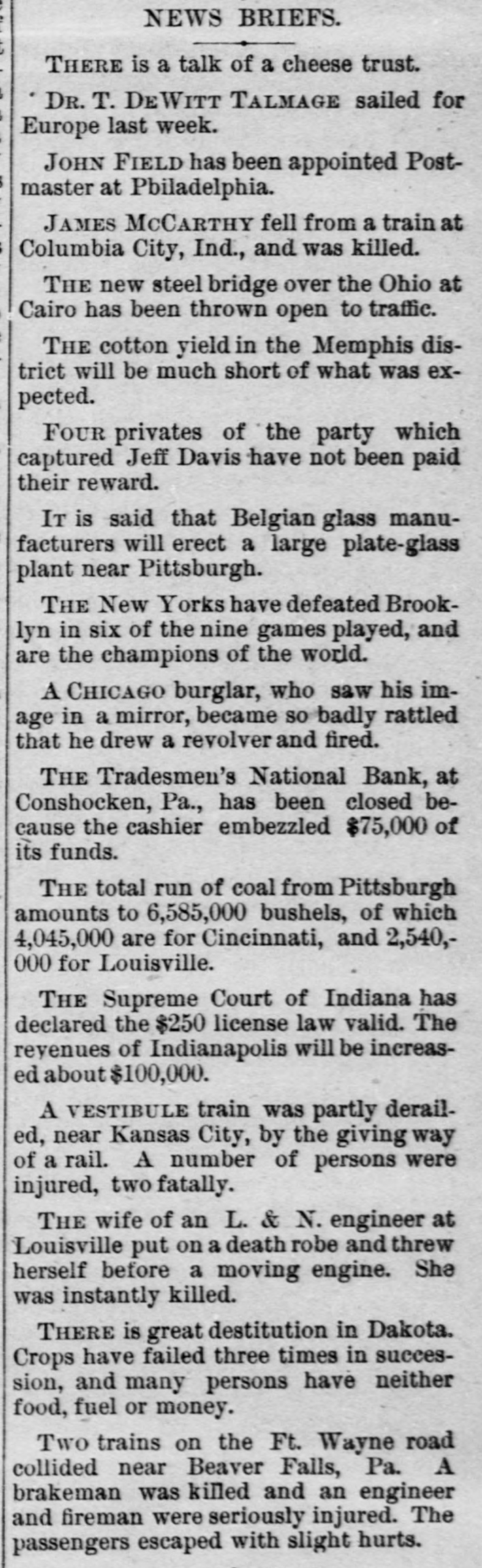
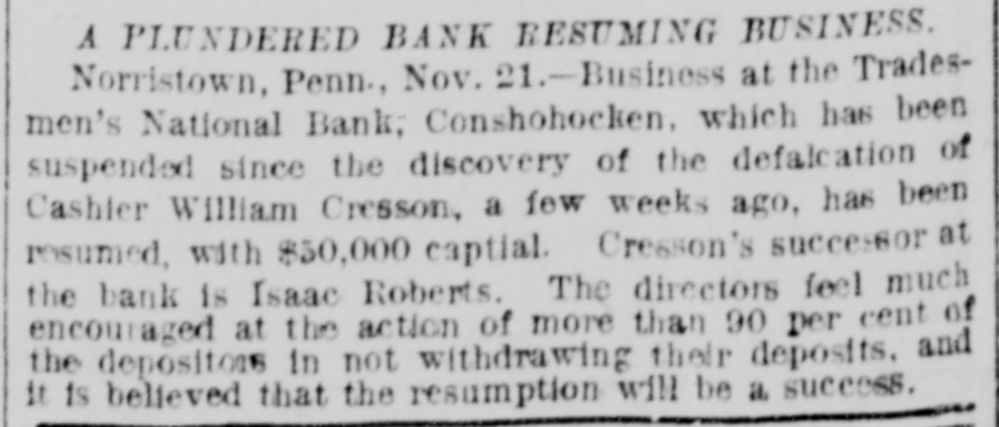
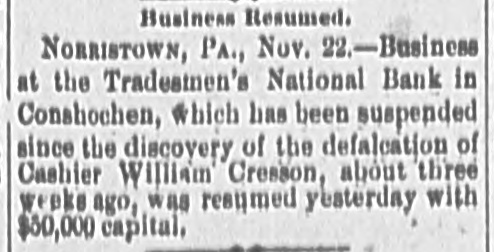
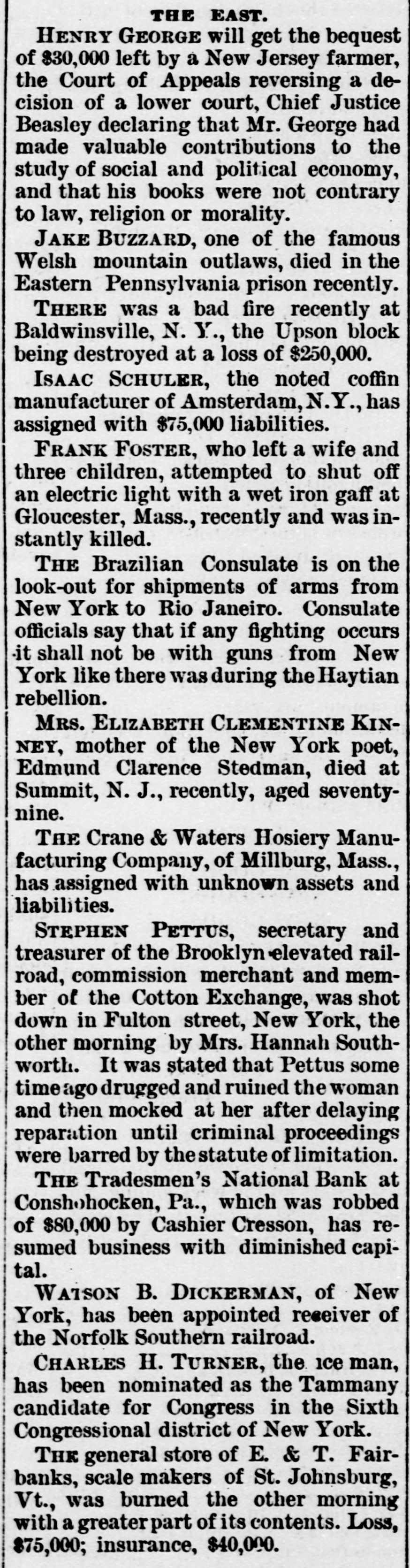
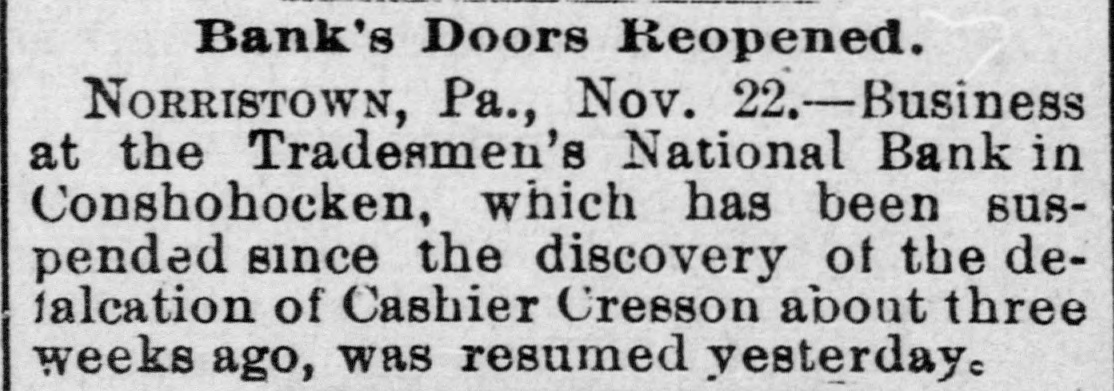
rates Chicago to the Baltimore centennial $17.50. The Denmark government proposes to abolish a large part of its tariff and reduce the balance. Belgium will propose a 5 per cent. duty on Congo state imports, for use in suppressing slavery. The visit of the prince of Wales to Egypt is regarded as clinching English supremacy on the Nile. Fifty-five French priests have been deprived of their stipends because of sermons on the elections. Judgment for nearly $30,000 has been entered against the Chicago consolidated bottling company. Fire did $30,000 damage to the Chicago coal yards of W. E. Johnson and the Lehigh Valley company. W. A. Robinson & Co., oil manufacturers of New Bedford, Mass., settle for 27½ cents on the dollar. W. H. Harvey will hang at Guelph, Ont., Nov. 29 for the murder of his wife and two daughters. The Oshkosh (Wis.) Mutual insurance company will go out of business because of adverse local laws. C. W. Hatch, the Bostonian arrested for his uncle's murder in Colorado, was released on $2,500 bail. The papers for the sale of the Washburn and Pillsbury mills to an English syndicate have been signed. New York now has an ordinance prohibiting the playing of street-bands, hand-organs, etc., on the street. The story that a battle occurred between the Hatfields and McCoys at Milton, W. Va., is absolutely false. The American missionary association at Chicago chose the Rev. William Taylor of New York, president. The alleged Bender women will reach Parsons, Kas., this morning. They refuse to talk about their case. A 5-per cent. advance in tank furnace window-glass is made by Jeannette, Pa.; 15 per cent. since Oct. 10. The Grand Island branch of the Union Pacific voluntarily advanced engineers' wages from $3.25 to $3.85. Senator Moody and Representative Gifford conferred with the president concerning South Dakota's admission. Cornelius Oberwalter and Bertha Weber, who escaped from the Netherlands, were arrested at Cincinnati. Thomas McCausland. a wealthy merchant of McCausland, la., was probably fatally shot by Burglar John Webb. At Baltimore the Navassa rioters, 124 in number, were lodged in jail, thirty-one being charged with murder. Lewis Martin, a Chicago lumber dealer and politician, shot himself because of domestic and financial troubles. Investigation by the Minneapolis board of trade shows that reports of Dakota destitution are vastly exaggerated. A further over-issue of Louisiana state bonds, amounting to $400,000 has been discovered in Treasurer Burke's books. Odin (III.) miners to the number of 250 struck against the pluck-me-stores and overcharges for powder and supplies. Israel Sheppard was killed and Engineer Crittenden badly wounded by a thrasher explosion at Grafton, N. D. In the last six months the San Francisco custom-house has been beaten out of $400,000 by Chinese opium smugglers. The Tradesmen's bank at Conshohocken, Pa., will be forced to wind up its affairs, as Cashier Cresson's shortage is $100,000. The Chicago Times company sued ex-Editor West for $100,000 on confession of judgment and $90,000 overdrawn account. All St. Louis breweries but the AnheuserBusch, Lemp and Albert have been sold to the English syndicate for $5,250,000. The Rock Island has made a combination with the D. & R. G., by which it will run through trains from Chicago to Salt Lake. Minneapolis mills made one of their heaviest runs last week- -174,310 barrels. Mills run by water power are putting in steam. Rival highbinders in San Francisco had a pitched battle, in which many shots were exchanged, but no one seriously hurt. Gen. Howard thinks the Atlantic coast can be defended with guns using the new "Americanite" explosive at small expense. General Supt. Carr, Division Supts. Booth and Seymour and several minor officials of the Hocking Valley road have resigned. The C., M. & St. P. will extend from Juneau, Wis., to Lake Superior, under the name of the New Lisbon, Necedah & Lake Superior. French artisans in Belgian towns threaten to create serious disturbances because of the in troduction of German rifles into the army. Quebec hay dealers, with claims of $800,000 against the United States for illegal duties paid, will meet at St. Johns and organize. At Paola, Kas., three skeletons of men who had evidently been murdered by having their skulls crushed were found under an old building. Bonds purchased: Registered 4s, $115,000 and $107,000 at 127; coupon 4s, $1,000 at 127; registered 41/28, $16,000 and $52,500 at 1053/4. The Norfolk & Western has issued forty-fivemillion-dollar bonds for double track and extensions to Ironton, 0., and North Carolina. Chicago's grand jury found two new indictments against ex-Editor West and one against ex-Secy. Graham for overissuing Times stock. Edmund Green got judgment for $150,000 against William Henry at New York, for sharp practices in a Mexican railroad deal. Frank Nourse and Ben Strawler, youths of sixteen, engaged in a drunken quarrel at Lima, O., and Nourse brained Strawler with an ax. Alexander Harris, the absconding Milford (Del.) merchant, was captured with his paramour, Miss Ellis, at Chicago, but released on bail. Lawrence Perry Dawson, son of the ex-commissioner of the bureau of education, was arrested for stealing postage stamps from the bureau. Asst. Atty-Gen. Shields holds that the Cherokees can legally sell the outlet to the United States by consent of the Cherokee council. It is now said the Alton-Union Pacific deal is merely a traffic arrangement for ten years, by which the former will run through trains to Salt Lake. Pottawatomie Indians are suing to recover a large part of their Kansas reservation, hich they sold through false representations by the purchasers. The ezar is said to be again completely under the influence of the pan-slavists, and isn't half as peaceably inclined as when Bismarek was talking to him. Charles Francis Adams denies that the Alton-Union Pacific deal has been or will be made, and C., B. & Q. officials deny the "Q"Pennsy deal. Bond purchases-Registered 4s, $82,300 and $75,000 at 127; coupon 4s, $1,000 at $1.27: registered 41/28. $252,500 and $50,000 at 1053/4; coupon 4½, $2,000 at 105%. Indian Commissioner Morgan wants schools on the public school plan for all Indian children, mixing students of all tribes to destroy tribal antagonism. ride tracire