Article Text
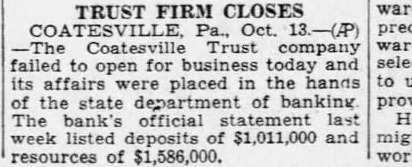
TRUST FIRM CLOSES Oct. Coatesville Trust company failed to open for business today and its affairs placed the hands the state department of banking The bank's official statement He $1,011,000 might resources of $1,586,000. work
fc96167cba72e22eNone
Click image to open full size in new tab
TRUST FIRM CLOSES Oct. Coatesville Trust company failed to open for business today and its affairs placed the hands the state department of banking The bank's official statement He $1,011,000 might resources of $1,586,000. work
Click image to open full size in new tab
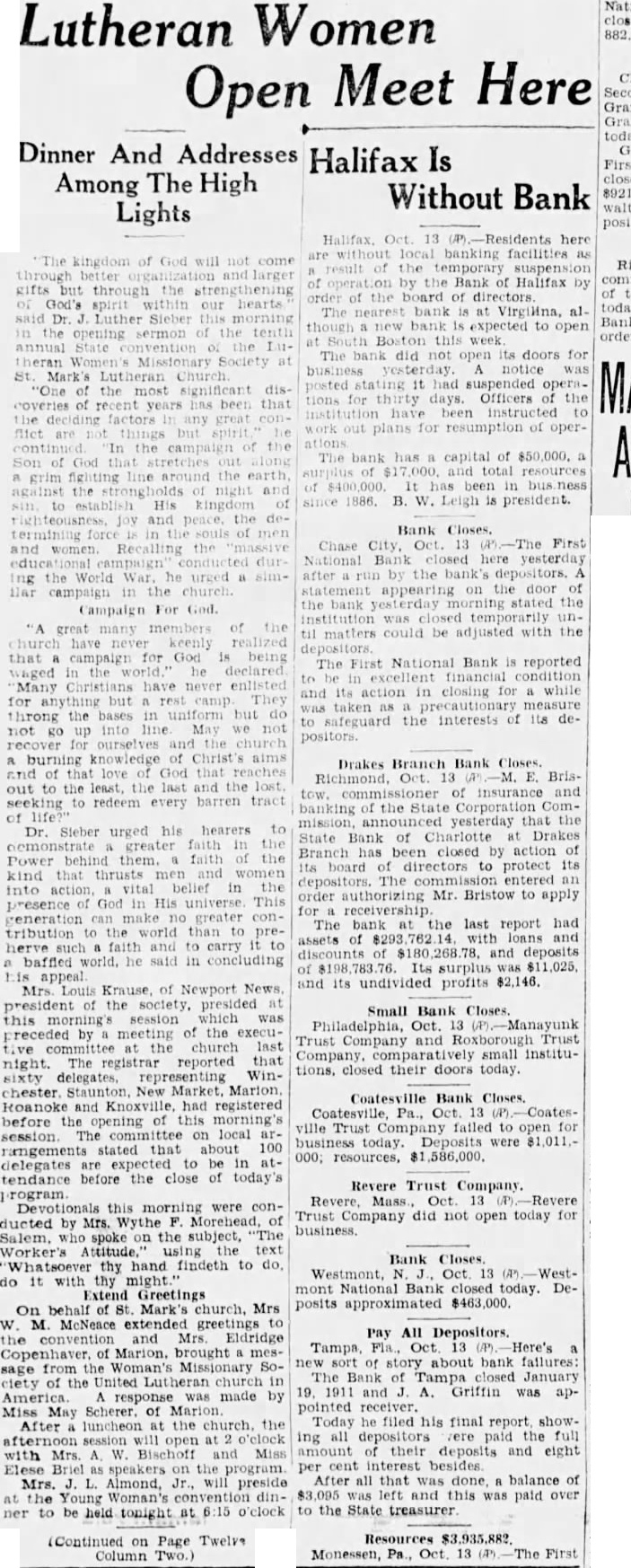
Lutheran Women Open Meet Here Dinner And Addresses Among The High Lights through through Luther Sieber opening sermon significant that factors His Recalling campaign Campaign God. great members keenly campaign God waged Many enlisted throng the but ourselves and the burning Christ's out and the redeem every barren tract urged his hearers greater behind them. the Power thrusts women vital belief God His This tribution and to carry world. said in concluding appeal Mrs Louis Krause, of Newport News. president the society. presided morning's session meeting of the the church reported that night. sixty representing WinRoanoke Knoxville, registered before the opening this session committee local 100 rangements delegates tendance before the close today's Devotionals were conducted by Mrs. Wythe Morehead, spoke the subject, Worker's using text thy hand findeth to do, do it with thy might.' Greetings On behalf Mark's Mrs McNeace extended greetings and Eldridge Copenhaver of Marion. brought sage the Woman's Missionary ciety of the United Lutheran church response made by of After the church. the Mrs. Miss Elese Briel speakers on the Mrs. Almond, preside Young Woman's to be tonight o'clock (Continued on Page Twelve Column Two.) Halifax Is First Without Bank here suspension Halifax Bank to order The doors notice suspended days. Officers operpresident. Bank Chase First City, yesterday the the stated temporarily could be adjusted with National Bank reported financial condition action closing taken the interests of its positors. Drakes Branch Bank Closes. Brisof insurance and banking yesterday State of Drakes Branch closed action its board protect its Mr. Bristow to apply The bank the last report had assets of and and deposits and its undivided profits $2,146. Bank Closes. Philadelphia, Oct. Trust Company Roxborough Trust small institutions, closed their doors today. Coatesville Bank Closes. Pa., CoatesTrust failed to for 000; Revere Trust Company. Revere. Oct Trust Company did not open today for Westmont, mont closed today. Deposits approximated $463,000. Pay All Depositors. Here's about bank failures: The Bank January 19. Griffin appointed Today filed his final showing all depositors the full their deposits eight per besides that balance of and this was paid to the State treasurer Monessen, First
Click image to open full size in new tab
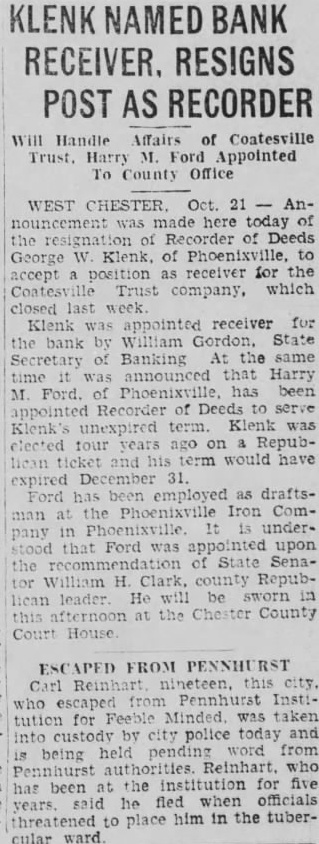
KLENK NAMED BANK RECEIVER. RESIGNS POST AS RECORDER Will Handle Affairs of Coatesville Trust. Harry Ford Appointed To County Office WEST CHESTER Oct. 21 Anhere today of Recorder of Deeds George W. Klenk. of Phoenixville, to accept position as receiver for the Coatesville Trust company, which closed last Klenk appointed receiver for William State Secretary of Banking the same time announced that Harry Ford. has been appointed Deeds unexpired term. Klenk was Klenk's elected years ago on Republican ticket and his term would have expired December 31. Ford has as draftsthe Phoenixville Iron Company underthat Ford was upon the of State SenaWilliam H. Clark, county Republeader He will be sworn lican at the Chester County Court House ESC FROM PENNHURST Pennhurst Instiwho for Feeble Minded. was taken into custody by city police today and held pending word from being Pennhurst authorities. Reinhart. who has been the institution for five said he fled officials years. threatened to place him in the tubercular ward.

Click image to open full size in new tab
25 FIRE POLICE ALSO SWORN IN AS EXTRA COPS Coatesville Mayor Augments Police Force; Will Patrol Fairs, Carnivals Coatesville Mayor William Gordon Monday night swore in fire police, giving the oath special Besides taking their duties at fires, these will act also with the local force in civic especially at dances, fairs, carnivals and other public events. Coatesville potential police force of 35 including the regular and the new special acted only at fires. Run on Bank There depositors the Coatesville company Monday opened doors pay on all deposits for period of days The bank, which was last expected pay in at Held for William Lipka, West was charged Monday for the larceny an belonging Mrs. Theodore Sazitch, this by Constable John Steen Chief McNeil Bergstrom found machine at Cat Swamp, in Valley township. Lipka was given hearing before Alderman night, and to jail default of $1,000 bail, to action. Finds Death Ford Monday evening that Howard Johnson, forty, who was found dead in his cabin near Buck six miles of natural Monday not seen to investigate. Thieves Go Pen Four chicken were administered Chester county justice by Judge Frank Hause when they pleaded guilty in Court Monday All were terms. to from four and to nine one drawing term of one and onehalf to three The three upon which the heavy sentence was the arrested in the joint authorities and State police and the Inter-State sociation officials, put stop chicken stealing in southern Chester county. They are, Arley Luff, 38, Ponelli, 30, New GarPaul 31, of London. Luff Messinger were charged with eight robberies, while Ponelli was charged with thirteen. Each sentenced to three bills of the sentence on bill one and to each being three the penitentiary, the to run The sentenced to one and man three years term William colored. near Honey Brook. He was arrested ago by Deputy Sheriff Charles the course vestigation the theft 30 chickens from Mrs. Annie Conway Birdell. Officer Cook arrested the finding in his home the mate shoe Mrs house. Collins then admitted his guilt.
Click image to open full size in new tab
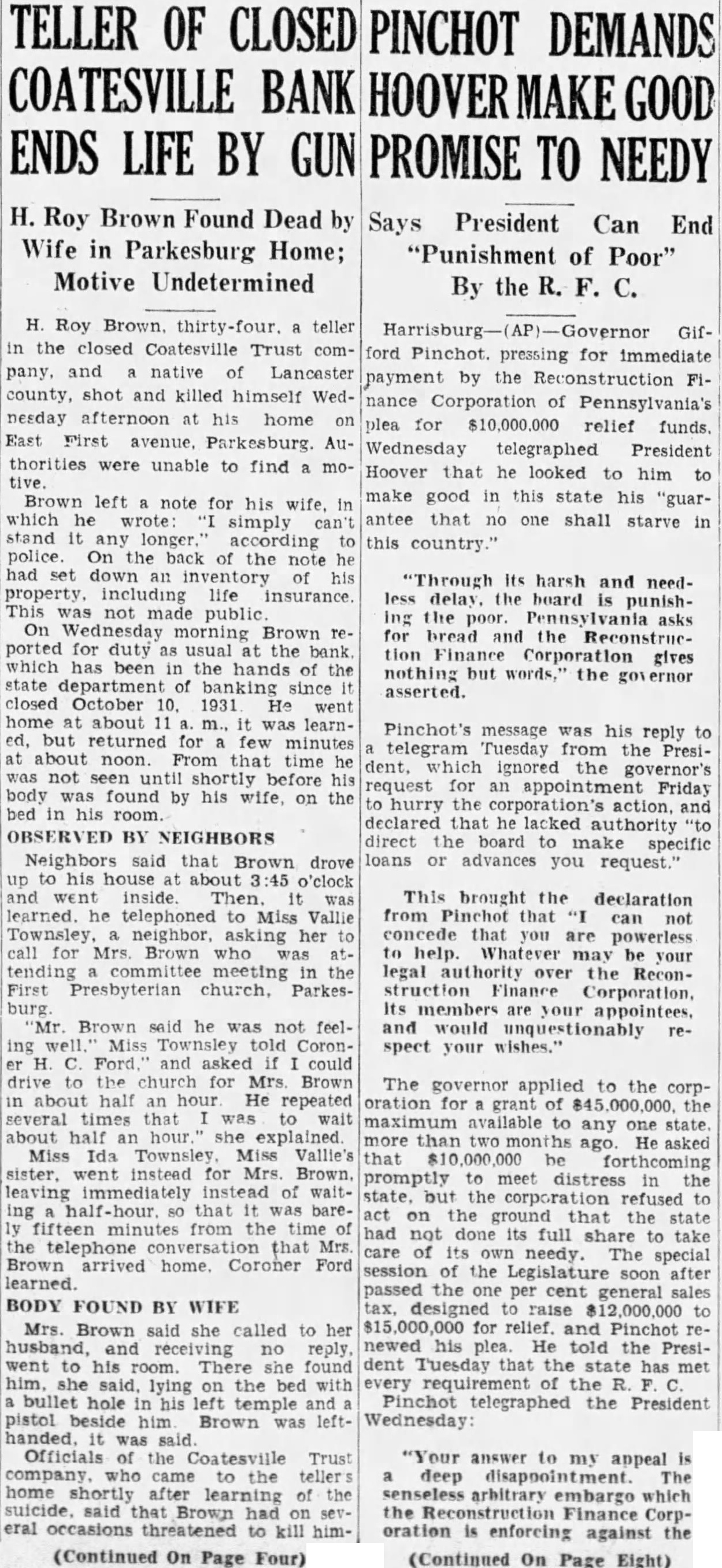
TELLER OF CLOSED PINCHOT DEMANDS COATESVILLE BANK GOOD ENDS LIFE BY GUN PROMISE TO NEEDY H. Roy Brown Found Dead by Wife in Parkesburg Home; Motive Undetermined H. Roy Brown. thirty-four. in the closed Coatesville Trust pany, and native of Lancester county, shot and killed himself Wednesday his home East First avenue. Authorities unable to find moBrown left note for his wife, which he simply stand it any according police. On the back of the note had set down an inventory including insurance This On Brown ported for duty usual the bank which been the hands of the department of banking since closed October 10. 1931 home about learnbut returned minutes noon. From that body was found by his wife, on the in his room. BY NEIGHBORS Neighbors that Brown drove to his house about o'clock went inside. learned. he telephoned to Miss Vallie Townsley, neighbor, asking her call for Brown First Presbyterian church, ParkesBrown said he not feeling Townsley told Coronand Brown about He repeated several that about she Ida Miss Vallie's instead for Mrs. leaving immediately instead of that fifteen from telephone that Mrs Brown arrived home. Ford BODY FOUND BY WIFE Mrs. Brown said she called to her to his There found she on the bed with hole temple beside Brown lefthanded, Officials the Coatesville Trust home shortly after learning of said Brown eral threatened to kill (Continued On Page Four) Says President Can End "Punishment of Poor" By the C. GifPinchot. for immediate payment by the Finance of Pennsylvania's plea for relief Wednesday telegraphed President Hoover that he looked to him to make good in this state his "guarantee that no one shall starve in country. "Through Its harsh and needdelay. the board is punishIng the asks for bread and the Reconstruction gives nothing but words," the governor asserted. Pinchot's message was his reply to telegram Tuesday from the President, ignored the governor's request for appointment Friday hurry the and declared authority direct the board specific loans or advances you request.' This brought the declaration from Pinchot that you are powerless help. be legal the Reconstruction Corporation. Its members and would spect your wishes." The governor applied to the corporation grant the maximum available state any more He asked $10,000,000 promptly meet distress the the corporation refused act on the ground the had not its full share to take its special session the Legislature after passed the one per designed for relief. and Pinchot newed his He told the President Tuesday that met requirement Pinchot telegraphed the President answer to my appeal deep senseless arbitrary embargo which the Finance Corporation is enforcing against the (Continued On Page Eight)