Article Text
PANICS AND DEPRESSIONS
A Brief Outline of These Recurring dear reader, that millions were milked from the various public treasEconomic Disasters, showing the Need of Drastic Changes in the uries, federal, state and municipal on American System of Finance, to the plea that the people might have Make Them Impossible. efficient public service. to say noth-
ARTICLE VI
During the last quarter of the Nineteenth Century there had grown up in the country a powerful financial oligarchy. This oligarchy had attained its financial eminence by the exploitation of the nation's vast natural resources, and its operations were carried on through gigantic corporations. Long before the advent of the Twentieth Century, the rights of the individual had been insidiously subordinated to those of the corporation; particularly was this true in the legislatures and courts. The powerful few who constituted the oligarchy, dealt with the masses of their fellow men through these corporations. Thus were they able to escape every moral and many legal responsibilities. The phrase "the soulless corporations" is a frightful truth, and has much to do with the social, financial and economic ills of the present day. Consider for a moment the corporation in its relation to the individual: in the business world a corporation to all general purposes is a person; it possesses all the legal rights of the individual and enjoys many privileges he does not have. The corporation is not a human being, it has no human characteristics in or out of the business world. But its relations are very much with human individuals. It trades with them, competes with them, and I dare say participates in their government. Yet the corporation has no religious, moral or patriotic nature which, more or less, restrains the individual from many reprehensible actions. The individual is, therefore, always at a disadvantage in his dealings with corporate interests, or perhaps I should say, these interests have the individual at a disadvantage because of his human nature. The corporation is not subject to the decrepitude of age, it does not grow senile with time. It has indeed. a sort of immortality; it escapes inheritance taxes, and it has no heirs to dissipate its substance. It seizes and devours the keenest commercial brains of every generation, and it drives its minions of slaves with thongs that bite deeper into human flesh than ever did the lash of the Pharaohs at the building of the pyramids. The corporation's sole purpose of existence is to garner profits, and if the entire wealth of the world were dumped at its feet, it would be as greedily hungry as in the moment of its creation. It is a Frankinstein monster, it has corrupted the government, devastated American agriculture, bankrupted and impoverished independent business, abolished opportunity, and finally destroyed the initiative of the individual. A few great corporations, dominated by the financial oligarchy above referred to. had reached a high state of perfection in the year 1900, but not until thirty years later did the system crash and the people realize the extent of ruin to which they had been brought. In 1901 there were five men who stood out conspicuously as leaders of this oligarchy. They were J. Pierpont Morgan, James J. Hill, Jacob Schiff, John W Gates and Edward H. Harriman. That the reader may fully understand the smooth-running financial machine as piloted by the gentlemen aforesaid for the profit of the few at the expense of the masses of American citizens, I quote in detail from a compilation of facts and figures concerning the panics of 1901 and 1907. neither of which was accompanied by any depression, a slight recession in business being the only effect felt by the country. It should be noted, however, that in 1907 the stage was set as surely as it was in '93. 73 or '37. for a major depression Fortunately there were conditions present which mitigated against the depression and which by the farthest stretch of the imagina tion could not be attributed to the farsightedness of the financial powers in Wall Street. Principal among these conditions were the bumper farm crops of 1908, the largest or record at that time, and considering the panic in Wall Street, prices of these crops as well as those of commodities in general were maintained at profitable levels. Thus the nation's farmers saved the country ference to the rank and file of American citizens, and its disregard for the public service-but recollect, ing of the valuable franchises granted, all over the country, to these powerful corporations. I quote from a commentor on the panic of 1901: "Great combinations of capital followed the panic of 1893. J. P. Morgan formed the Steel Trust, financed international merchant marine and the Harvester Trust. Gates was conspicuous in heading a group of financiers who undertook gigantic promotions. James J. Hill, another of the group, bought the St. Paul & Pacific and built it up to the Great Northern system. Morgan was banker for Hill and they began the reorganization of the Union Pacific as the Northern Pacific fell into bankrupcy. They bought heavily in Northern Pacific Co. Edward H Harriman was trying to get control of the Northern Pacific and the Burlington Railways. Harriman had linked the Union Pacific to the Southern Pacific. With the Morgan line of steamers he had made a continuous transportation system from New York to San Francisco, but the railroad monopoly of the Southwest was not all that he desired. Hill stood in his way. Hill commanded the Northwest with his Great Northern and his control of the Northern Pacific. Neither Hill nor Harriman had an outlet to Chicago. The Burlington provided this. Jacob H. Schiff, of Kunn Loeb & Co. was Harriman's banker. They decided to get control of the Burlington, also they discovered that Hill was trying to buy up the stock. Hill and Morgan finally bought the Burlington for $200,000,000 and split up the control of the Burlington between Great Northern and Northern Pacific. They then controlled the route to Chicago. Morgan and Hill's control of the Northern Pacific was nominal, they had only a minority interest. The real control was in outstanding stock.
Schiff and Harriman decided they could get control of the Great Northern, Northern Pacific, Burlington situation by accumulating Northern stock and started to acquire $60,000.000 in Northern Pacific By doing so they would control Northern Pacific and thus command one-half interest in Burlington and would be masters of the entire West from the Mexican border.
Morgan wired from Europe to buy 150.000 shares of Northern Pacific This meant an expenditure of eighteen to twenty million dollars. Even Europe was scoured for the stock This brought on a terrific battle between Hill and Harriman for control of the Northern Pacific. Each side bought and brokers began making short sales. Finally each side of the contest had a majority of the stock under contract but where was the stock to be bought? The market was swept clean on short selling. The brokers began to offer premiums in order to fill these short sales when they were demanded. As high as 10 per cent was offered for the loan of shares for a few days This meant brokers would pay $1,000 for the privilege of borrowing 100 shares for 24 hours.
Millions in profits were made by those who loaned their stock. The stock finally advanced to $180 a share. Those who had loaned the shares then called them in and as high as 85 per cent was offered for 500 shares which meant they offered to pay $8,500 to borrow for a few hours stock of par value of $10,000 The stock leaped to $1,000 per share. There was then great trade in Northern Pacific and in order for the brokers to get this they threw other stocks suddenly on the market. The situation got SO bad that finally, in order to stop an entire break down of the financial centers of the United States, the short sellers were permitted to compromise by paying $150 share for the stock they could not deliver.
Hill and Morgan finally won out. and the Northern Securities Co. was formed to control the Northern Pacific and Burlington railroads. But the Supreme Court annulled the Northern Securities Co. as being a violation of the "Anti-trust Laws.' This was altogether a Wall Street panic which bankrupted a great many of the small-fry gamblers of he "Street," but nevertheless. many millions of dollars were lost to the investing public. Another item of interest is that brokers who had sold the stock of Northern Pacific short were permitted to cover at $150 per share. Doubtless many of their customers were sold out without any such benevolent consideration.
1907
The panic of 1907 was the greatest panic the United States had experienced to this date. I am going to quote somewhat at length from the same commentator because of the effect this new "note in panics" has on the small investor, who is not a gambler but wishes to participate in his country's natural development. The reader should also note the individuals and corporations who were the prime movers in this panic. The quotation follows:
Henry H. Rogers was president of the Standard Oil. Millions had been made by his company. These millions sought investments. He invested them in copper mines in Montana, organized the Amalgamated. The National City Bank of New York (This is the same of Mitchell fame of recent date) advanced $150,000,000. J. P. Morgan was behind the issue of stock. The world went copper mad. Finally the price decreased to $70 a share and the copper pool was crashed F. Augustus Heinze of Montana, was also interested in copper. He was crushed by Wall Street in the copper pool. H dcidd to fight on; got control of various properties and Rogers finally bought him out for $15,000,000 Heinze went to New York, fell in with Charles W. Morse, who owned the Hudson Navigation Co., the Metropolitan Life, the Eastern Steam. ship Co., the Ward & Clyde Lines, a fleet of 74 ships. In order to carry on his financial transactions, Morse bought a string of banks. Then followed mergers of steamship companies. Systems of branch and chain banks were established Morse used the stock and surplus of one bank in order to buy the next. He hypothecated and rehypothecated his securities in depositories in New England. Heinze and Morse were joined by Russell Thomas, a young sportsman with a large income. He had manipulated a $2,000,000 corner in cotton. He became a power in certain banks. Charles T. Barney, another wealthy young man. joined the group. He was president of the Knickerbocker Trust Co. Other financial interests in Wall Street, such as the National City Bank, the National Bank of Commerce, the First National, Hanover National, Farmers Loan & Trust. The United States Trust, the New York Trust & Guarantee Trust, an institution of the Standard Oil. These were dominated by J. P. Morgan and his partner, Robert Bacon, William Rockefeller and Rogers of the Standard Oil. These were prosperous years Western railroads sold big issues of their shares. The paper securities of the Great Northern Pacific, St. Paul, swept up to high levels. Heinze exploited his new corporation, United Copper, with $50,000,000 capital. It shot up to a higher price than Amalgamated. owned by his rivals. He then tried to corner United and asked for deliveries; but much to his surprise, offerings were made immediately. and he was unable to raise the cash to pay for them. Secret instructions went out to call loans on all securities of all companies with which Heinze, Morse and Thomas were associated The three were ruined by this move of Morgan, Standard Oil, National City Bank group demanding payment of large amounts. The banks which Heinze, Thomas, and Morse closed included the Knickerbocker Trust Co. and American stocks dropped even in Europe. Then a rumor was whispered apparently compromising the Trust Co. of America This caused a run on the bank and it was closed. The Hamilton and twelfth ward banks suspended, and sixteen savings banks in Manhattan demanded 60 days notice before withdrawals of money. The Union Trust of Providence suspended. Distress was everywhere and call money was not to be had At meeting of some of the financiers, $25,000,000 was pledged to stop the runs, but the runs continued just the same. The Trust Company of America had paid out $34,000,000 in a few days, and the Lincoln Trust $12,000,000: then ultimatums were delivered to both that they must surrender their unpledged assets to the ruling bankers and then they would provide funds for the remaining depositors. They were forced to accept. This was done so the Morgan group could get control of the Tennessee Coal and Iron Co. which securities were held by the Trust Co. of America. Morgan thereby vanquished John W. Gates, the steel king, from the Street. Gates had been the promoter of the Tennessee Iron & Coal Co. When Gates came to New York he had not been accepted by the Morgan group. In retaliation he had put Morgan's southern railroad in peril. He had bought control of the Louisville & Nashville. Morgan had been forced to buy him out at a profit of $10,000,000 to Gates.
Gates controlled the Tennessee Iron & Coal Co. Morgan wanted this and financial writers made the bold assertion that the run on the Knickerbocker was engineered for this purpose. Morgan got control of the Tennessee Company and turned it over to the Steel Trust
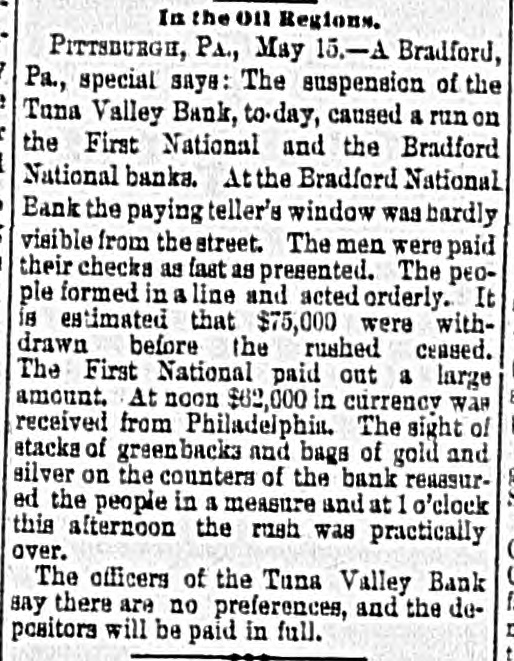
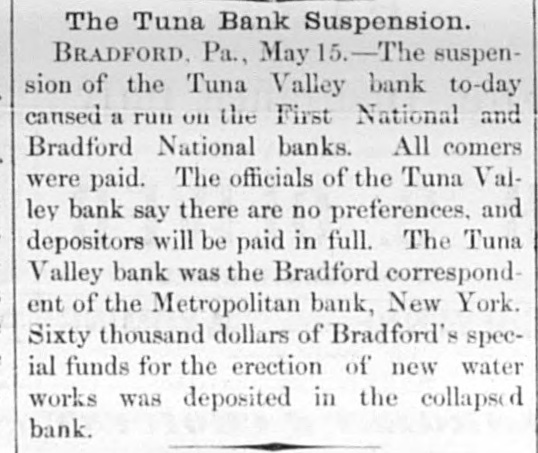
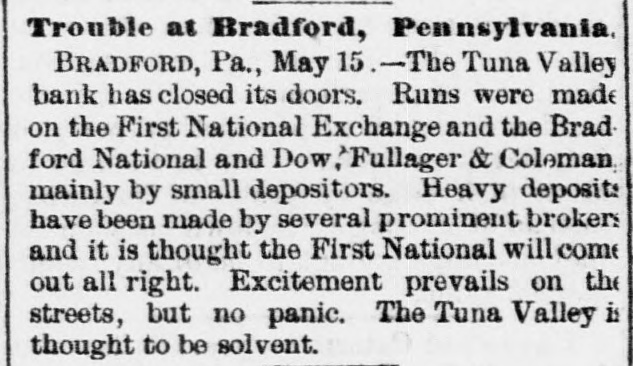
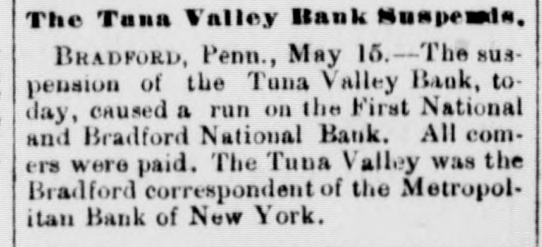
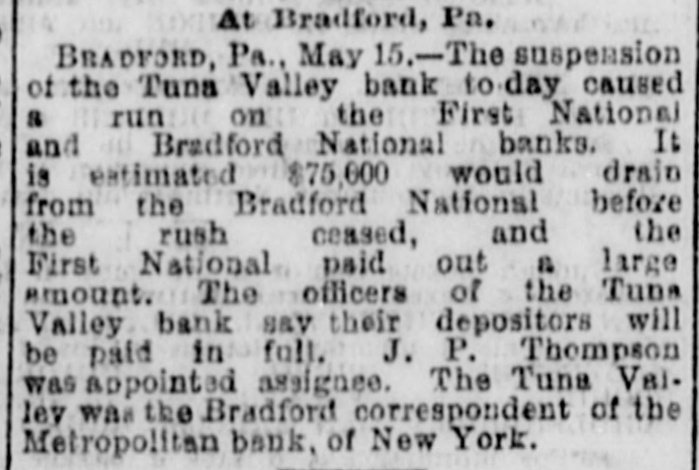
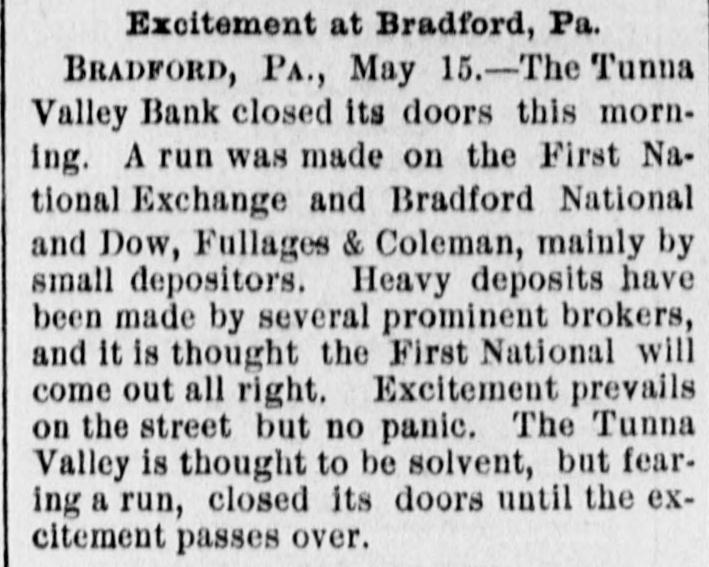
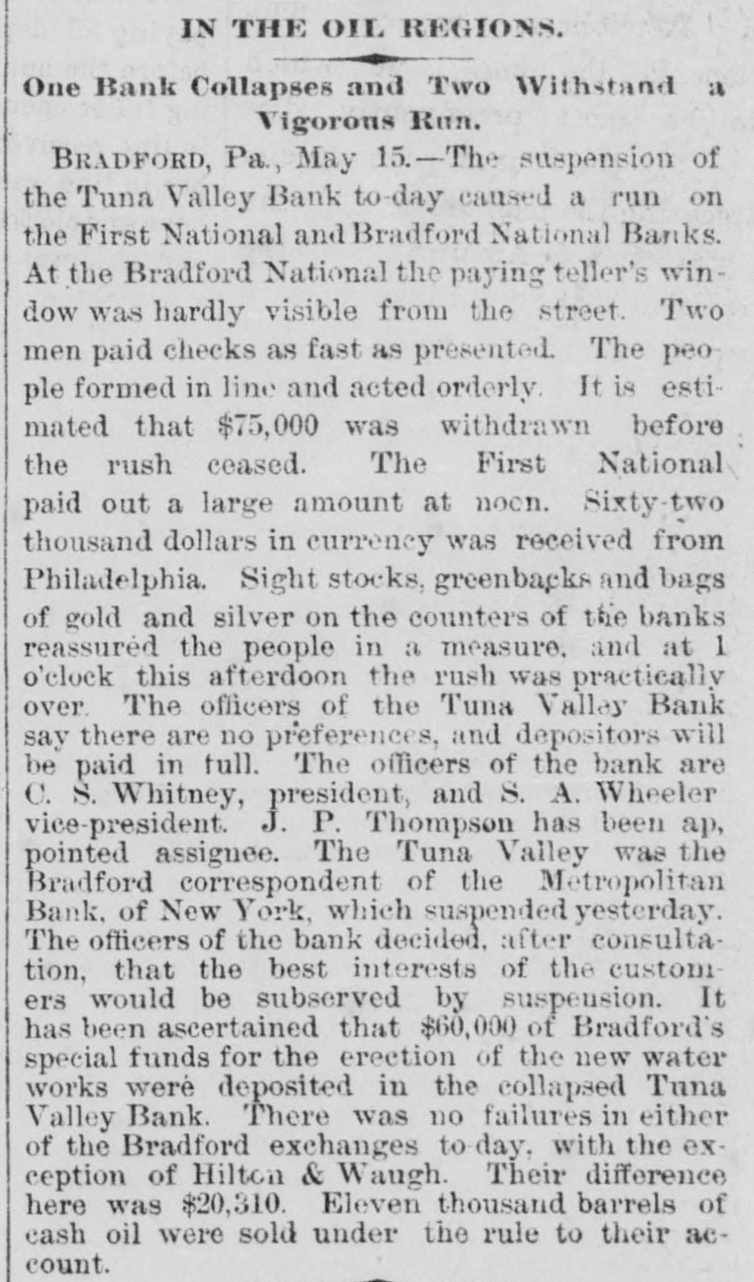
Bank failures continued and the Southern Steel Co. became bankrupt. The Westinghouse Electric went under in Pittsburgh Western governors appointed holidays to protect State banks which could not meet their drafts. Out-of-town banks tried to recall the $800,000,000 on deposit in New York. Clearing house certificates were issued to stop outgo of specie. Philadelphia and Pittsburgh locked the doors of their own vaults. Chicago exchange on New York was almost unobtainable. and Boston credits in New York were exhausted. The business centers of the country were frozen solid. People hawked cash in Wall Street.
Barney, in reality an innocent party in this jobbery of the Morgans and Rockefellers, killed himself when his bank went under.
It developed that the Knickerbocker Trust was absolutely solvent and had been deliberately ruined by the aforementioned group. After all obligations were met the bank had a balance on hand of $15,000,000.
The banks of Heinze, Morse, and Thomas were permitted to fall into bankruptcy and were finally absorbed by the Morgan group."
Thus ended the panic of 1907. It caused grave money troubles for a year. Many industrial concerns were compelled to resort to scrip to meet their pay-rolls, but there was no depression. (Next week 1914, the beginning of the Great War and the Great Depression.-Ed.)