15987. Henry Allen & Co. (New York, NY)

Bank Information

Episode Type
Suspension → Closure
Bank Type
private
Start Date
December 18, 1899
Location
New York, New York (40.714, -74.006)

Metadata

Model
gpt-5-mini
Short Digest
222e61fb

Response Measures

None

Description

Contemporary press reports (Dec 18–19, 1899) announce Henry Allen & Co. suspended on the Stock Exchange, blaming customers' failure to meet margin calls amid a Wall Street panic. No articles describe a depositor run or later reopening; papers treat the firm as a failure/suspension (some call it a 'failure' or 'go to the wall'). Classified as suspension_closure because suspension appears permanent in these reports.

Events (1)

1. December 18, 1899 Suspension
Cause
Bank Specific Adverse Info
Cause Details
Suspension attributed to failure of customers to respond to margin calls after sharp market declines; firm's trading/margin exposure rendered it unable to meet obligations.
Newspaper Excerpt
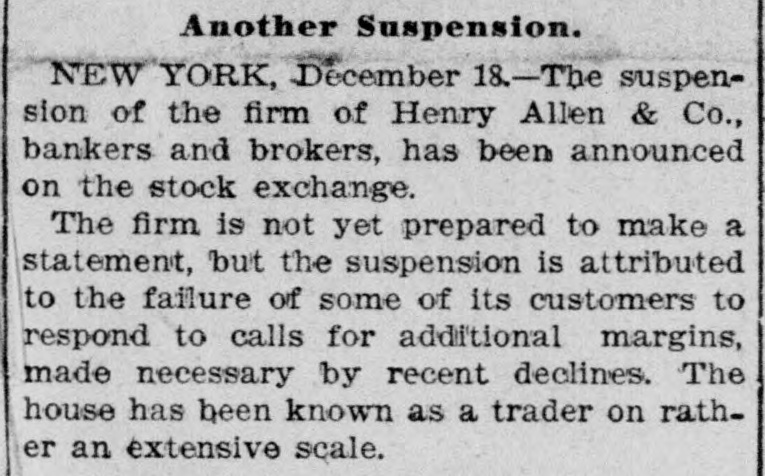
The suspension of the firm of Henry Allen & Co., bankers and brokers, has been announced on the stock exchange. The suspension is attributed to the failure of some of its customers to respond to calls for additional margins, made necessary by recent declines.
Source
newspapers

Newspaper Articles (10)

Article from Daily Kennebec Journal, December 19, 1899

Click image to open full size in new tab

Article Text

THE MONEY PANIC. Slaughter of Values on New York Stock Exchange. Clearing House Banks Afford Relief and Market Slightly Recovers. Failures-Treasury to Increase Bank Deposits-Situation at Boston. New York, Dec. 18.-Panic conditions developed on the Stock Exchange, this afternoon, with the imperative need of money developed by the violent conraction in values. Stocks were thrown over without the slightest regard to the price they would bring, and at distressing sacrifice of values. No end to the helplessness of the situation seemed sight when, in the last half hour of the market, some $10,000,000,000 was offered on the Stock Exchange by the concerted action of the Clearing House banks to force the rate down to 6 per cent., without regard to the distracted bidding at higher rates, which was being done by brokers for distressed operators. The collapse in the money rate checked the decline and drove the bears to cover. The recoveries profueed by their urgent bidding were almost as violent as the declines had been, but the losses were by no means entirely retrieved. Large offerings of stocks continued at the rally and at some points of the list prices broke before the close, making the closing exceedingly irregular and unsettled. The excitement continued to the end, with sentiment looking forward anxiously for the developments if another day. The seriousness of the risis has called north the best efforts if powerful and conservative financial interests, who are busy concerting neasures to tide over the mony difficulies, which beset the stock market, and which, by reason of their extent and the choice of the interests involved. threaten to affect the country's business interests unless obstacles are opposed. It is considered a point gained have effected a cessation of the uthless sacrifice of values long enough for a period of consideration over night. So far as actual news was concerned. oday. there was a suspension by a newly organized trust company. the Produce Exchange Trust Co., and by firm of bankers and brokers, Henry Allen & Co., who have figured as tradin stock to an extent of some imortance. Neither event in itself would have been sufficient to precipitate a risis. But they were supplemented with a whole crop of wild rumors which pared no interest. however powerful. established and hitherto free from uspicion it may have been. In spite the exaggerated reports. the day losed with two failures above menioned as the sum total of disaster, SO as admitted insolvency was conerned. The reason for the widespread ffect upon sentiment of the Trust Co's. suspension was that it was one of a arge number of institutions recently ormed on similar lines and which I ave thrived upon the multiplying of ocurities incident to the vast indus-
Article from Akron Daily Democrat, December 19, 1899

Click image to open full size in new tab

Article Text

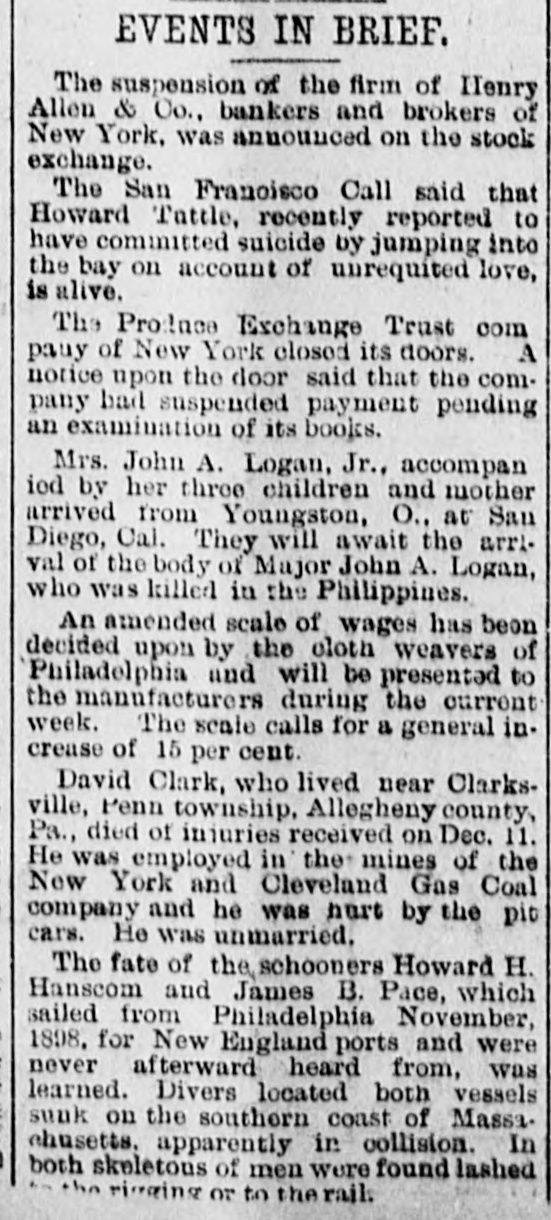
EVENTS IN BRIEF. The suspension of the firm of Henry Allen & Co., bankers and brokers of New York, was announced on the stock exchange. The San Franoisco Call said that Howard Tattle, recently reported to have committed suicide by jumping into the bay on account of unrequited love, is alive. The Produce Exchange Trust com A pauy of New York closed its doors. notice upon the door said that the company bad suspended payment pending an examination of its books. Mrs. John A. Logan, Jr., accompan iod by her three children and mother arrived from Youngston, O., at San Diego, Cal. They will await the arrival of the body of Major John A. Logan, who was killed in the Philippines. An amended scale of wages has beon decided upon by the cloth weavers of Philadelphia and will be presented to the manufacturers during the current week. The scale calls for a general increase of 15 per cent. David Clark, who lived near Clarksville, Penn township, Allegheny county, Pa., died of injuries received on Dec. 11. He was employed in the mines of the New York and Cleveland Gas Coal company and he was hurt by the pit cars. He was unmarried, The fate of the, schooners Howard H. Hanscom and James B. Pace, which sailed from Philadelphia November, 1898. for New England ports and were never afterward heard from, was learned. Divers located both vessels sunk on the southorn coast of Massa. chusetts. apparently in collision. In both skeletous of men were found lashed the or to the rail.


Article from Ottumwa Semi-Weekly Courier, December 19, 1899

Click image to open full size in new tab

Article Text

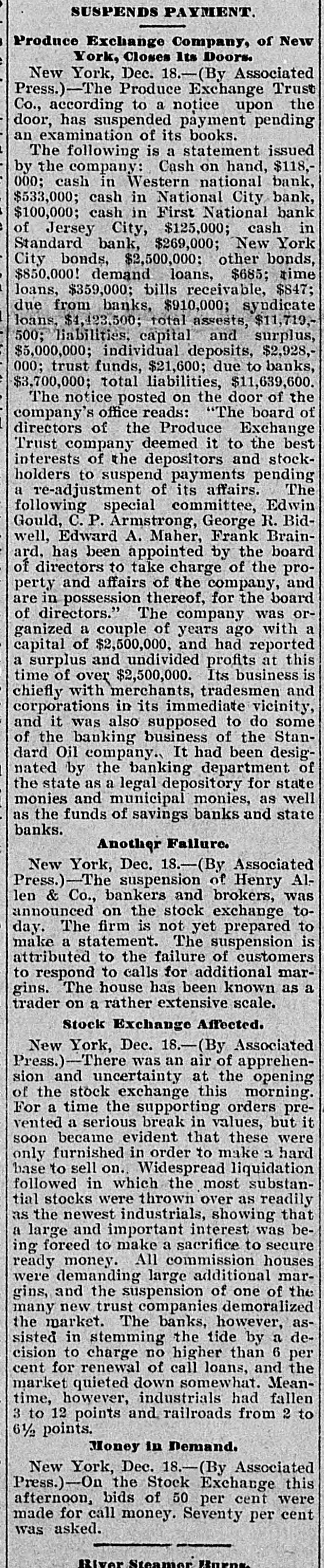
SUSPENDS PAYMENT. Produce Exchange Company, of New York, Closes Its Doors. New York, Dec. 18.-(By Associated Press.)-The Produce Exchange Trust Co., according to a notice upon the door, has suspended payment pending an examination of its books. The following is a statement issued by the company: Cash on hand, $118,000; cash in Western national bank, $533,000; cash in National City bank, $100,000; cash in First National bank of Jersey City, $125,000; cash in Standard bank, $269,000; New York City bonds, $2,500,000: other bonds, $850,000! demand loans. $685; time loans, $359,000; bills receivable, $847; due from banks, $910,000; syndicate loans, $4,423,500; total assests, $11,719,500; liabilities. capital and surplus, $5,000,000; individual deposits, $2,928,000; trust funds, $21,600; due to banks, $3,700,000; total liabilities, $11,639,600. The notice posted on the door of the company's office reads: 'The board of directors of the Produce Exchange Trust company deemed it to the best interests of the depositors and stockholders to suspend payments pending a re-adjustment of its affairs. The following special committee, Edwin Gould, C.P. Armstrong, George R. Bidwell, Edward A. Maher, Frank Brainard. has been appointed by the board of directors to take charge of the property and affairs of the company, and are in possession thereof, for the board of directors." The company was organized a couple of years ago with a capital of $2,500,000. and had reported a surplus and undivided profits at this time of over $2,500,000. Its business is chiefly with merchants, tradesmen and corporations in its immediate vicinity, and it was also supposed to do some of the banking business of the Standard Oil company. It had been designated by the banking department of the state as a legal depository for state monies and municipal monies, as well as the funds of savings banks and state banks. Another Failure. New York, Dec. 18.-(By Associated Press.)-The suspension of Henry Allen & Co., bankers and brokers, was announced on the stock exchange today. The firm is not yet prepared to make a statement. The suspension is attributed to the failure of customers to respond to calls for additional margins. The house has been known as a trader on a rather extensive scale. Stock Exchange Affected. New York, Dec. 18.-(By Associated Press.)-There was an air of apprehension and uncertainty at the opening of the stock exchange this morning. For a time the supporting orders prevented a serious break in values, but it soon became evident that these were only furnished in order to make a hard base to sell on. Widespread liquidation followed in which the most substantial stocks were thrown over as readily as the newest industrials, showing that a large and important interest was being forced to make a sacrifice to secure ready money. All commission houses were demanding large additional margins, and the suspension of one of the many new trust companies demoralized the market. The banks, however, assisted in stemming the tide by a decision to charge no higher than 6 per cent for renewal of call loans, and the market quieted down somewhat. Meantime, however, industrials had fallen 3 to 12 points and railroads from 2 to 61/2 points. Money in Demand. New York, Dec. 18.-(By Associated Press.)-On the Stock Exchange this afternoon, bids of 50 per cent were made for call money. Seventy per cent was asked. River Steamer Burns


Article from Wheeling Register, December 19, 1899

Click image to open full size in new tab

Article Text

Another Suspension. NEW YORK, December 18.-The suspension of the firm of Henry Allen & Co., bankers and brokers, has been announced on the stock exchange. The firm is not yet prepared to make a statement, but the suspension is attributed to the failure of some of its customers to respond to calls for additional margins, made necessary by recent declines. The house has been known as a trader on rather an extensive scale.


Article from The Portland Daily Press, December 19, 1899

Click image to open full size in new tab

Article Text

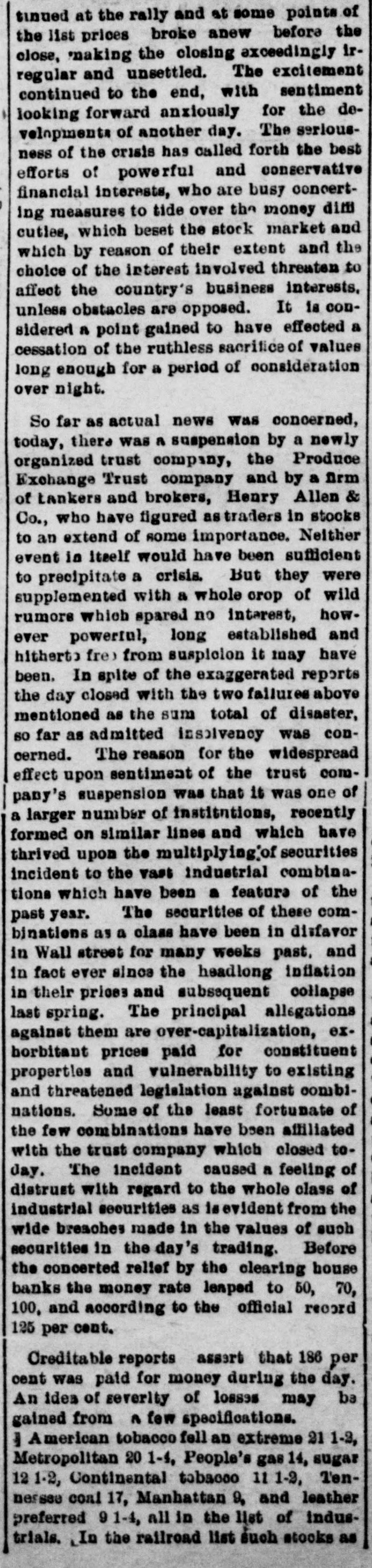
tinued at the rally and at some points of the list prices broke anew before the close, making the closing exceedingly irregular and unsettled. The excitement continued to the end, with sentiment looking forward anxiously for the developments of another day. The seriousness of the crisis has called forth the best efforts of powerful and conservative financial interests, who are busy concerting measures to tide over the money dim cutles, which beset the stock market and which by reason of their extent and the choice of the interest involved threaten to affect the country's business interests. unless obstacles are opposed. It is considered a point gained to have effected a cessation of the ruthless sacrifice of values long enough for a period of consideration over night. So far as actual news was concerned, today, there was A suspension by a newly organized trust company, the Produce Exchange Trust company and by a firm of tankers and brokers, Henry Allen & Co., who have figured as traders in stocks to an extend of some importance. Neither event in itself would have been sufficient to precipitate a crisis. But they were supplemented with a whole crop of wild rumors which spared no interest, however powerful, long established and hitherto fre) from suspicion it may have been. In spite of the exaggerated reports the day closed with the two failures above mentioned as the sum total of disaster, so far as admitted insolvency was concerned. The reason for the widespread effect upon sentiment of the trust company's suspension was that it was one of a larger number of institutions, recently formed on similar lines and which have thrived upon the multiplying'of securities incident to the vast industrial combinations which have been a feature of the past year. The securities of these combinations as a class have been in disfavor in Wall street for many weeks past, and in fact ever since the headlong inflation in their prices and subsequent collapse last spring. The principal allegations against them are over-capitalization, exhorbitant prices paid for constituent propertles and vulnerability to existing and threatened legislation against combinations. Some of the least fortunate of the few combinations have been affiliated with the trust company which closed today. The incident caused a feeling of distrust with regard to the whole class of industrial securities as is evident from the wide breaches made in the values of such securities in the day's trading. Before the concerted relief by the clearing house banks the money rate leaped to 50, 70, 100, and according to the official record 125 per cent. Creditable reports assert that 186 per cent was paid for money during the day. An idea of severity of losses may be gained from A few specifications. I American tobacco fell an extreme 21 1-3, Metropolitan 20 1-4, People's gas 14, sugar 12 1.2, Continental tobacco 11 1-2, Tennessee coal 17, Manhattan 9, and leather preferred 9 1-4, all in the list of industrials. In the railroad list such stocks as


Article from The Wilmington Daily Republican, December 19, 1899

Click image to open full size in new tab

Article Text

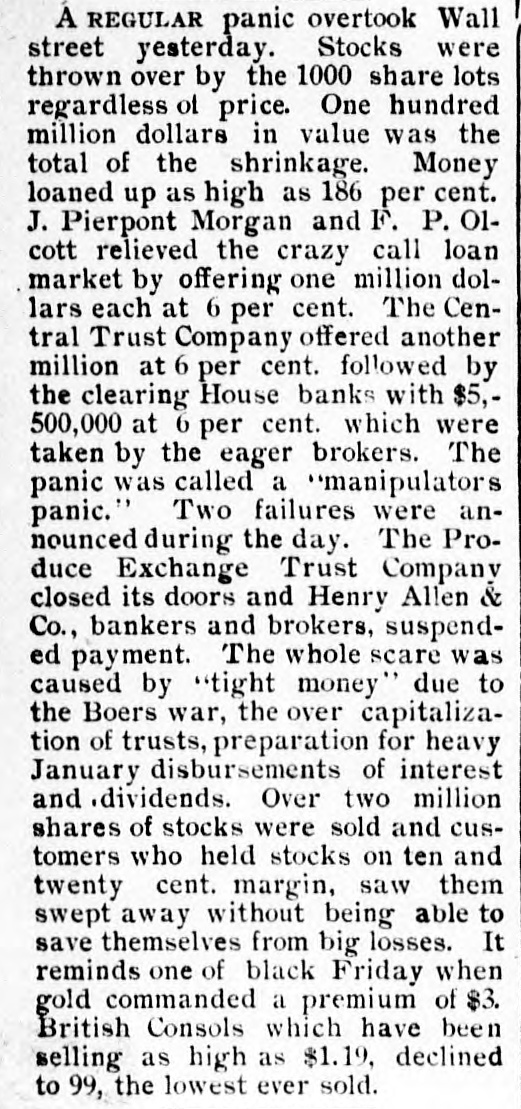
A REGULAR panic overtook Wall street yesterday. Stocks were thrown over by the 1000 share lots regardless of price. One hundred million dollars in value was the total of the shrinkage. Money loaned up as high as 186 per cent. J. Pierpont Morgan and F. P. O1cott relieved the crazy call loan market by offering one million dollars each at 6 per cent. The Central Trust Company offered another million at 6 per cent. followed by the clearing House banks with $5,500,000 at 6 per cent. which were taken by the eager brokers. The panic was called a "manipulators panic." Two failures were announced during the day. The Produce Exchange Trust Company closed its doors and Henry Allen & Co., bankers and brokers, suspended payment. The whole scare was caused by "tight money" due to the Boers war, the over capitalization of trusts, preparation for heavy January disbursements of interest and dividends. Over two million shares of stocks were sold and customers who held stocks on ten and twenty cent. margin, saw them swept away without being able to save themselves from big losses. It reminds one of black Friday when gold commanded a premium of $3. British Consols which have been selling as high as $1.19, declined to 99, the lowest ever sold.


Article from The Wellington Enterprise, December 20, 1899

Click image to open full size in new tab

Article Text

PANIC IN WALL STREET. Prices of Stocks Tumble and a Trust Company and a Firm of Brokers Fail. New York, Dec. 19.-Panic conditions developed on the stock exchange Monday afternoon with the imperative need of money developed by the violent contraction in values. Stocks were being thrown over without the slightest regard to the price they would bring and at distressing sacrifice of values. No end to the helplessness of the situation seemed in sight when in the last half hour of the market some $10,000,000 was offered on the stock exchange by the concerted action of the clearing house banks to force the rate down to 6 per cent. without regard to the distracted bidding at higher rates which was being done by brokers for distressed operators. The collapse in the money rate checked the decline and drove the bears to cover. The recoveries produced by their urgent bidding were almost as violent as the declines had been, but the losses were by no means entirely retrieved. The excitement continued to the end, with sentiment looking forward anxiously for the developments of another day. The seriousness of the crisis has called forth the best efforts of powerful financial interests, which are busy concerting measures to tide over the money didiculties which beset the stock market, and which by reason of their extent and the importance of the interests involved, threaten to affect the country's business interests unless obstacles are opposed. So far as actual news was concerned there was a suspension by a newly organized trust company and by a firm of bankers and brokers which has figured as traders in stocks to an extent of some importance. Neither event in itself would have been sufficient to precipitate a crisis. But they were supplemented with a whole crop of wild rumors which spared no interest. The reason for the widespread effect upon sentiment of the trust company's suspension was that it was one of a large number of institutions recently formed on similar lines and which have thrived upon the multiplying of securities incident to the industrial combinations which have been a feature of the past year. The securities of these combinations as a class have been in disfavor in Wall street for many weeks past. Before the concerted relief by the clearing house banks the money rate leaped to 50, 100 and 125 per cent. Credible reports assert that 186 per cent was paid for money during the day. The official record of such a transaction was lost in the excitement. An idea of the severity of losses may be gained from a few specifications. Thus American Tobacco fell 21½ points, Metropolitan 201/4, Peoples' Gas 14, Sugar 12½/2. The most prominent and active railroad stocks in the whole list showed losses all the way from 4 to 9 points. The suspension of the firm of Henry Allen & Co., bankers and brokers, was announced on the stock exchange at an early hour and soon afterward the Produce Exchange Trust Co. closed its doors. The Produce Exchange Trust Co. was organized a couple of years ago with a capital of $2,500,000. Its business was chiefly with merchants, tradesmen and côrporations and it was also supposed to do some of the banking business of the Standard Oil Co. It had been designated by the banking department of the state as a legal depository for state moneys and municipal moneys, as well as for the funds of savings banks and state banks. Its assets are given as $11,719,600, with liabilities of $11,649,600. It is claimed that the bank will pay creditors dollar for dollar.


Article from St. Johnsbury Caledonian, December 20, 1899

Click image to open full size in new tab

Article Text

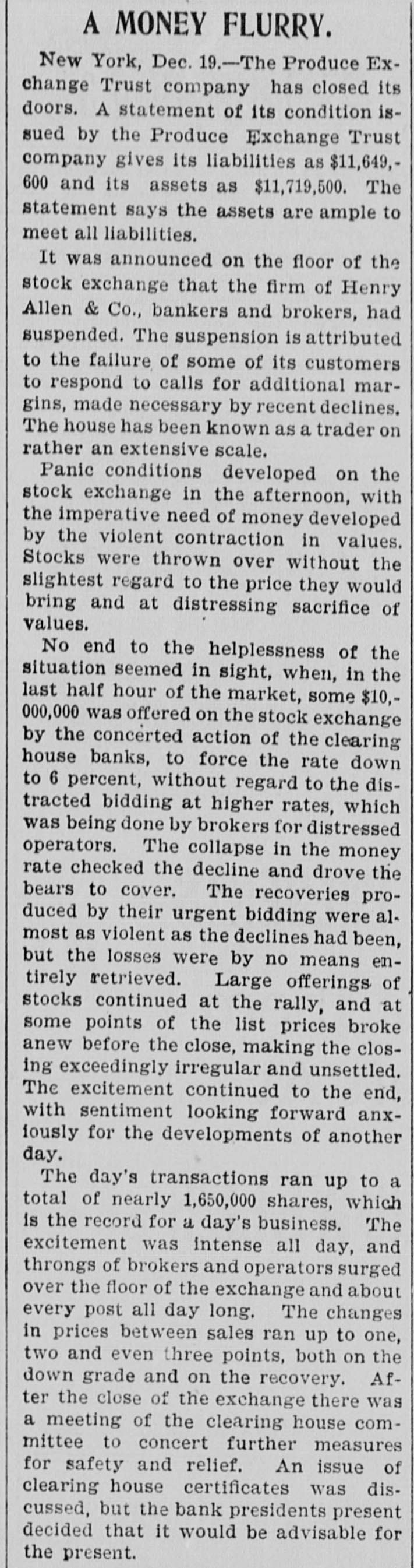
A MONEY FLURRY. New York, Dec. 19.-The Produce Exchange Trust company has closed its doors. A statement of its condition issued by the Produce Exchange Trust company gives its liabilities as $11,649,600 and its assets as $11,719,500. The statement says the assets are ample to meet all liabilities. It was announced on the floor of the stock exchange that the firm of Henry Allen & Co., bankers and brokers, had suspended. The suspension is attributed to the failure of some of its customers to respond to calls for additional margins, made necessary by recent declines. The house has been known as a trader on rather an extensive scale. Panic conditions developed on the stock exchange in the afternoon, with the imperative need of money developed by the violent contraction in values. Stocks were thrown over without the slightest regard to the price they would bring and at distressing sacrifice of values. No end to the helplessness of the situation seemed in sight, when, in the last half hour of the market, some $10,000,000 was offered on the stock exchange by the concerted action of the clearing house banks, to force the rate down to 6 percent, without regard to the distracted bidding at higher rates, which was being done by brokers for distressed operators. The collapse in the money rate checked the decline and drove the bears to cover. The recoveries produced by their urgent bidding were almost as violent as the declines had been, but the losses were by no means entirely retrieved. Large offerings of stocks continued at the rally, and at some points of the list prices broke anew before the close, making the closing exceedingly irregular and unsettled. The excitement continued to the end, with sentiment looking forward anxiously for the developments of another day. The day's transactions ran up to a total of nearly 1,650,000 shares, which is the record for a day's business. The excitement was intense all day, and throngs of brokers and operators surged over the floor of the exchange and about every post all day long. The changes in prices between sales ran up to one, two and even three points, both on the down grade and on the recovery. After the close of the exchange there was a meeting of the clearing house committee to concert further measures for safety and relief. An issue of clearing house certificates was discussed, but the bank presidents present decided that it would be advisable for the present.


Article from The Sauk Centre Herald, December 21, 1899

Click image to open full size in new tab

Article Text

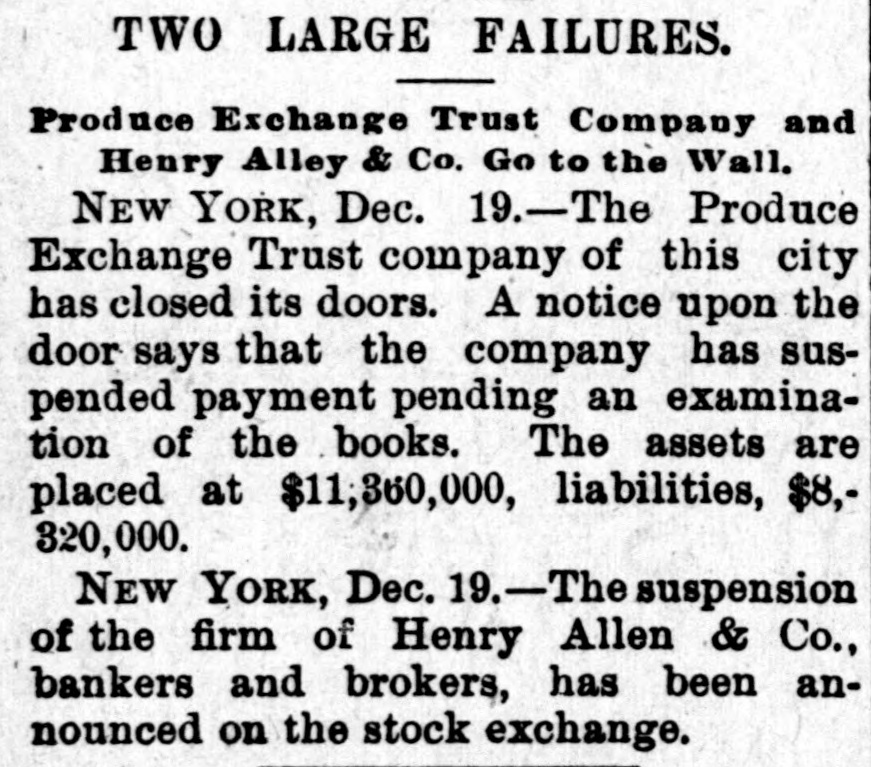
TWO LARGE FAILURES. Produce Exchange Trust Company and Henry Alley & Co. Go to the Wall. NEW YORK, Dec. 19.-The Produce Exchange Trust company of this city has closed its doors. A notice upon the door says that the company has suspended payment pending an examination of the books. The assets are placed at $11,360,000, liabilities, $8,320,000. NEW YORK, Dec. 19.-The suspension of the firm of Henry Allen & Co., bankers and brokers, has been announced on the stock exchange.


Article from Vernon County Censor, December 27, 1899

Click image to open full size in new tab

Article Text

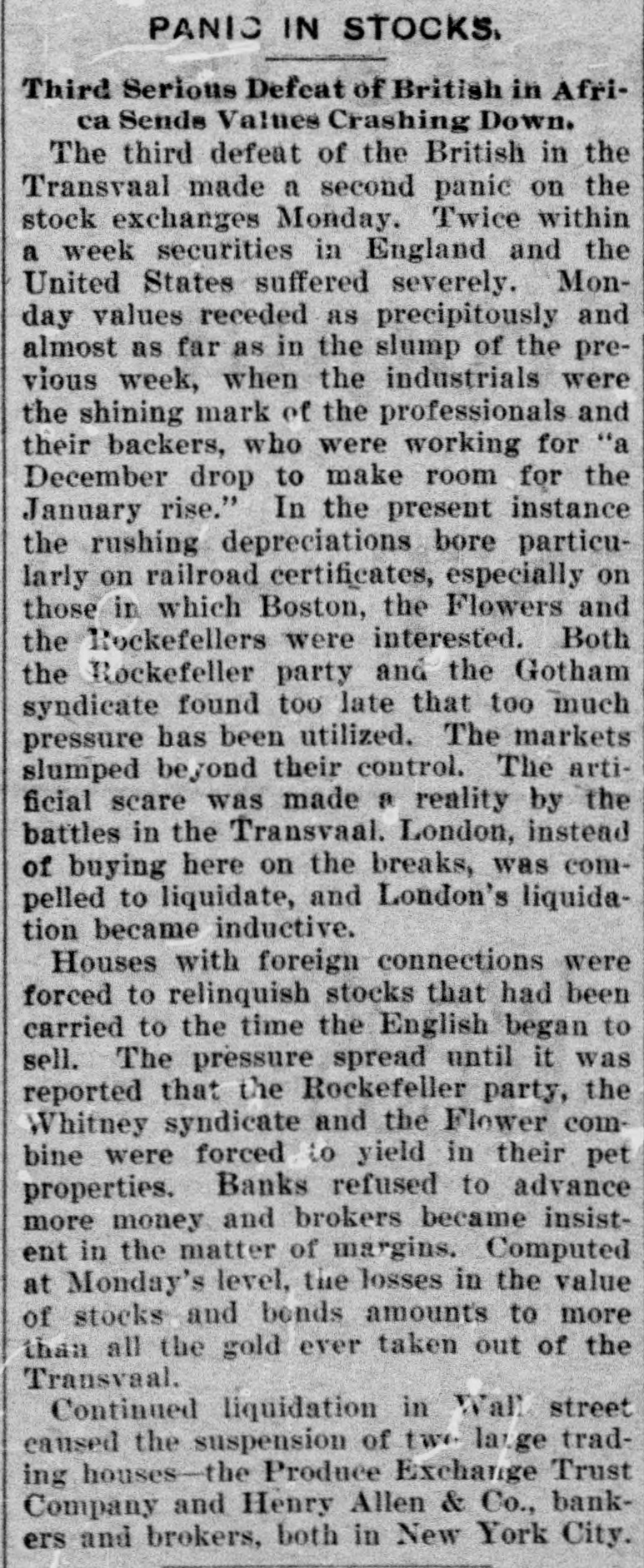
PANIC IN STOCKS. Third Serious Defeat of British in Africa Sends Values Crashing Down. The third defeat of the British in the Transvaal made a second panic on the stock exchanges Monday. Twice within a week securities in England and the United States suffered severely. Monday values receded as precipitously and almost as far as in the slump of the previous week, when the industrials were the shining mark of the professionals and their backers, who were working for "a December drop to make room for the January rise." In the present instance the rushing depreciations bore particularly on railroad certificates, especially on those in which Boston, the Flowers and the Rockefellers were interested. Both the Rockefeller party and the Gotham syndicate found too late that too much pressure has been utilized. The markets slumped be yond their control. The artificial scare was made a reality by the battles in the Transvaal. London, instead of buying here on the breaks, was compelled to liquidate, and London's liquidation became inductive. Houses with foreign connections were forced to relinquish stocks that had been carried to the time the English began to sell. The pressure spread until it was reported that the Rockefeller party, the Whitney syndicate and the Flower combine were forced to yield in their pet properties. Banks refused to advance more money and brokers became insistent in the matter of margins. Computed at Monday's level, the losses in the value of stocks and bonds amounts to more than all the gold ever taken out of the Transvaal. Continued liquidation in Wall street caused the suspension of two. lauge trading houses-the Produce Exchange Trust Company and Henry Allen & Co., bankers and brokers, both in New York City.