15972. Harlem River Bank (New York, NY)

Bank Information

Episode Type
Suspension → Closure
Bank Type
state
Start Date
April 27, 1894
Location
New York, New York (40.714, -74.006)

Metadata

Model
gpt-5-mini
Short Digest
5a855a33

Response Measures

None

Description

The Banking Department/examiner took possession and closed the Harlem River Bank in late April 1894 after the Garfield National Bank ceased to act as its clearing-house agent. Depositors gathered and sought funds after the closure, and a temporary receiver was appointed May 2, 1894. The bank did not resume business; receivership followed, so classify as suspension leading to closure. Bank appears state-chartered (State Banking Department involved).

Events (3)

1. April 27, 1894 Suspension
Cause
Government Action
Cause Details
State Banking Department/Examiner Judson walked into the bank, ordered it closed and took possession after Garfield National refused to continue as its clearing-house agent.
Newspaper Excerpt
I have received information that the Banking Department has taken possession of the Harlem River Bank, and we have accordingly sent out notices that we will cease to clear for that bank.
Source
newspapers
2. April 28, 1894 Run
Cause
Correspondent
Cause Details
Depositor agitation and attempted withdrawals followed publicity that the Garfield National Bank had refused to act as the Harlem River Bank's clearing-house agent and the Banking Department's intervention.
Measures
Cash (about $8,000, principally specie) was carted away and deposited in a downtown bank to the credit of the superintendent; examiner took control and closed the bank.
Newspaper Excerpt
A number of depositors gathered in front of the closed Harlem River Bank ... and made anxious inquiries as to the time when they could withdraw their money from the bank.
Source
newspapers
3. May 2, 1894 Receivership
Newspaper Excerpt
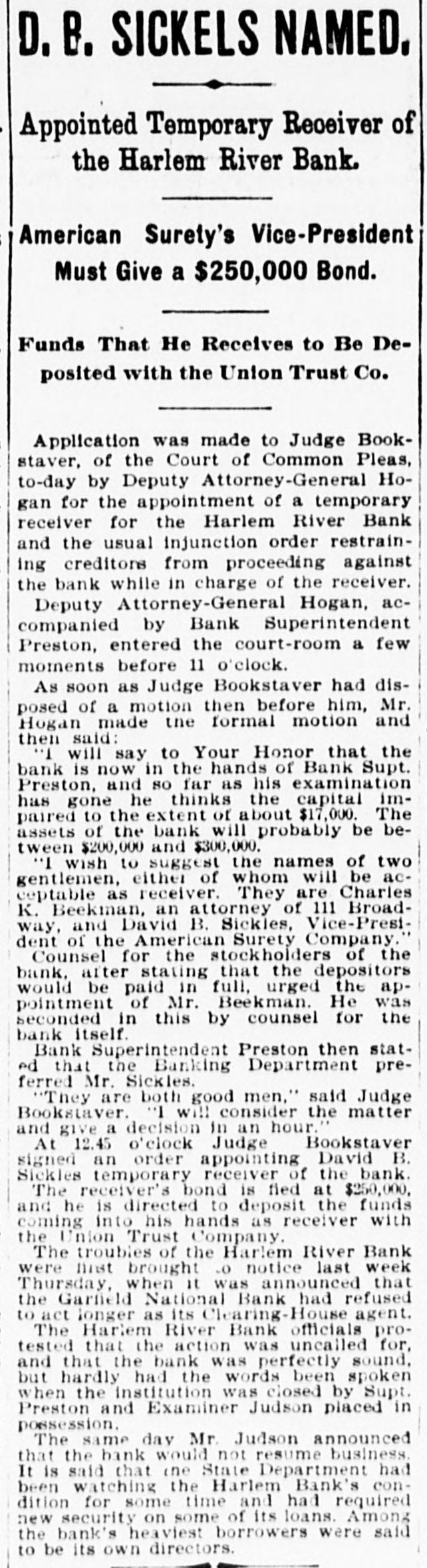
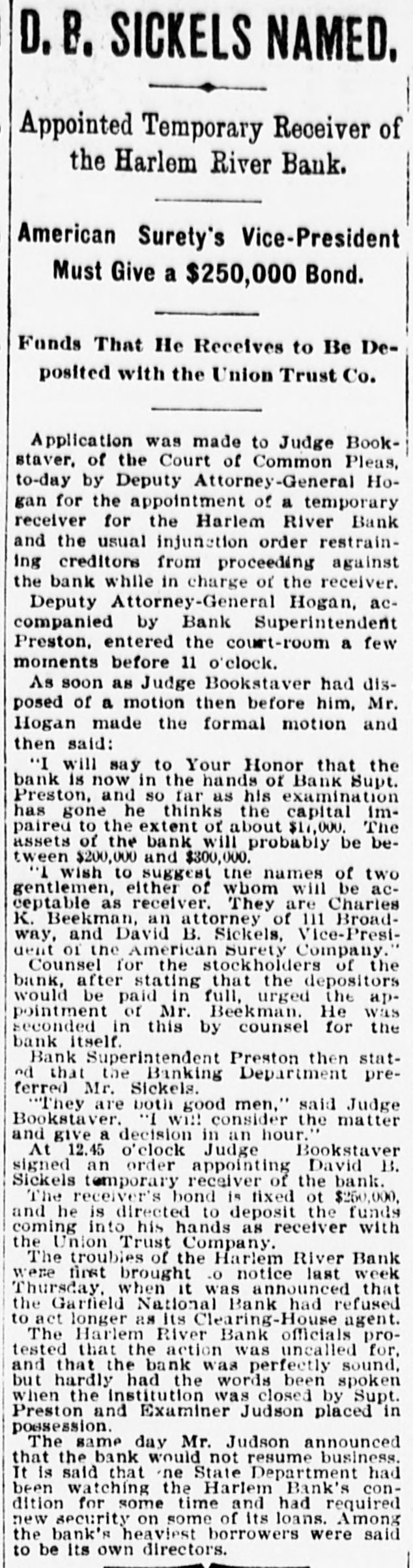
At 12.45 o'clock Judge Bookstaver signed an order appointing David B. Sickles temporary receiver of the bank. The receiver's bond is fixed at $250,000, and he is directed to deposit the funds coming into his hands as receiver with the Union Trust Company.
Source
newspapers

Newspaper Articles (19)

Article from New-York Tribune, April 27, 1894

Click image to open full size in new tab

Article Text

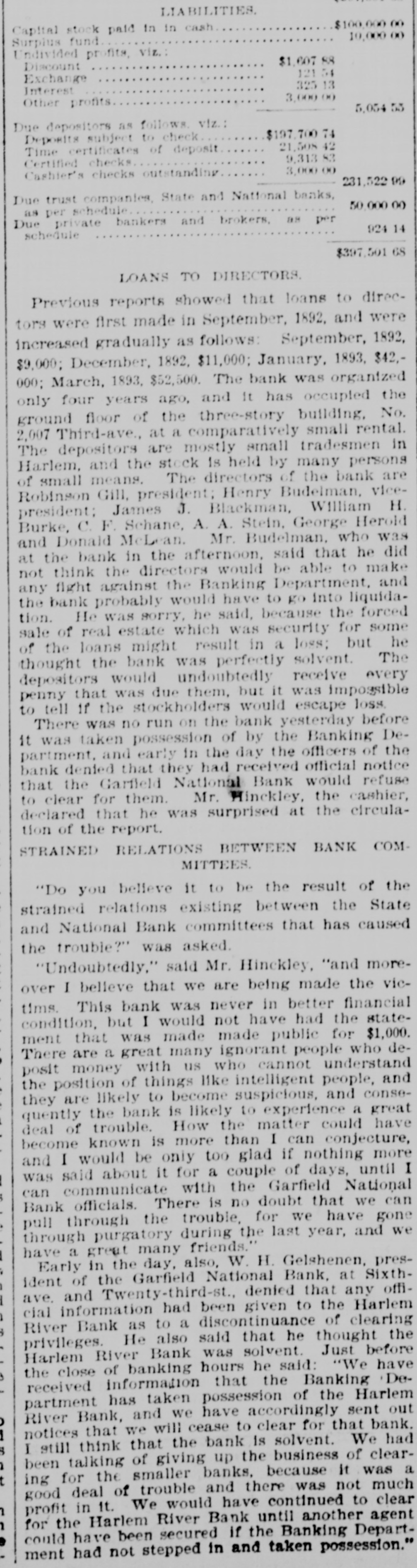
Exchange 325.13 Interest 3,000 0 Other profits 5,054.53 Due depositors as follows. viz.: $197,700.74 Deposits subject to check 21,508 42 Time certificates of deposit 9,313 83 Certified checks 3,000.00 Cashier's checks outstanding 231,522.99 Due trust companies State and National banks, 50,000.00 as per schedule Due private bankers and brokers, as per 924 14 schedule $397,501.68 LOANS TO DIRECTORS Previous reports showed that loans to directors were first made in September, 1892, and were increased gradually as follows: September, 1892, $9,000; December, 1892, $11,000; January, 1893, $42,000: March, 1893, $52,500. The bank was organized ago, and it has occupied the floor of the three-story at a comparatively are mostly small 2,007 only ground The Third-ave. depositors four years building, tradesmen small rental. No. in Harlem, and the stock is held by many persons The directors of the bank are Gill, president; Henry of Robinson small means. Budelman, William vice- H. president; James J. Blackman, Burke, C. F. Schane, A. A. Stein, George Heroid and Donald McLean. Mr. Budelman, who was at the bank in the afternoon, said that he did not think the directors would be able to make any fight against the Banking Department, and the bank probably would have to go into liquidation. He was sorry, he said, because the forced sale of real estate which was security for some of the loans might result in a loss: but he bank was perfectly would thought depositors the undoubtedly receive solvent. every The penny that was due them, but it was impossible to tell If the stockholders would escape loss no run on the bank it taken possession of by There was was the yesterday Banking before De- the partment, and early in the day the officers of bank denied that they had received official notice that the Garfield National Bank would refuse to clear for them. Mr. Hinckley, the cashier, declared that he was surprised at the circulation of the report. STRAINED RELATIONS BETWEEN BANK COMMITTEES. "Do you believe it to be the result of the strained relations existing between the State and National Bank committees that has caused the trouble?" was asked. "Undoubtedly," said Mr. Hinckley, "and moreover I believe that we are being made the victims. This bank was never in better financial condition, but I would not have had the statement that was made made public for $1,000. There are a great many ignorant people who deposit money with us who cannot understand of things like are likely to become the they position suspicious, intelligent people, and conse- and quently the bank is likely to experience a great deal of trouble. How the matter could have become known is more than I can conjecture, and I would be only too glad if nothing more I was said about it for a couple of days, until can communicate with the Garfield National Bank officials. There is no doubt that we can pull through the trouble, for we have gone through purgatory during the last year, and we have a great many friends." I : Early in the day, also, W. H. Gelshenen, presh ident of the Garfield National Bank, at Sixthand Twenty-third-st., denied that any offiI ave. had been given to the Harlem ) as to a discontinuance 4 He also said that cial River privileges. information Bank he thought Just of clearing before the Harlem River Bank was solvent. , the close of banking hours he said: "We have received information that the Banking Department has taken possession of the Harlem 5 River Bank, and we have accordingly sent out 1 notices that we will cease to clear for that bank. 8 I still think that the bank is solvent. We had 1 been talking of giving up the business of cleart ing for the smaller banks, because It was a good deal of trouble and there was not much n profit in it. We would have continued to clear 1 for the Harlem River Bank until another agent e could have been secured if the Banking Department had not stepped in and taken possession."
Article from The Evening World, April 28, 1894

Click image to open full size in new tab

Article Text

EXAMINERS STILL AT WORK. No Statement of the Harlem Bank's Condition Yet Ready. A Receiver May Be Applied for After the Investigation. Everything is quiet at the Harlem River Bank this morning. Examiner Barker is busy going over the bank's books, and stated that he would not finish his examination before noon. All the bank's cash, amounting to about $8,000, principally in specie, was carted away in a grocer's wagon and deposited in % downtown bank to the credit of Supt. Preston. Cashier Hinckley denied emphatically this morning the intimation that there was any scandal connected with the bank's difficulties. Bank Examiner Judson will not say yet whether application will be made for a receiver. The wife of a wealthy Harlem business man went into the bank this morning to get some money to pay her butcher's bill. Her husband, who has a large balance at the bank, is out of town, and she was without any money at all. She was greatly disappointed when she found that the bank could give her no assistance.


Article from The Evening World, April 28, 1894

Click image to open full size in new tab

Article Text

EXAMINERS STILL AT WORK. No Statement of the Harlem Bank's Condition Yet Ready. A Receiver May Be Applied for After the Investigation. Everything is quiet at the Harlem River Bank this morning. Examiner Barber is busy going over the bank's books, and stated that he would not finish his examination before noon. All the bank's cash, amounting to about $8,000, principally in specie, was carted away in a grocer's wagon and deposited in a downtown bank to the credit of Supt. Preston. Cashier Hinkley denied emphatically this morning the intimation that there was any scandal connected with the bank's difficulties. Bank Examiner Judson will not say yet whether application will be made for a receiver. The wife of a wealthy Harlem business man came into the bank this morning to get some money to pay her butcher's bill. Her husband, who has a large balance at the bank, is out of town, and she was without any money at all. She was greatly disappointed when she found that the bank could give her no assistance.


Article from New-York Tribune, April 28, 1894

Click image to open full size in new tab

Article Text

DEPOSITORS ARE ANXIOUS. INQUIRIES AT THE HARLEM RIVER BANK THE CASHIER DECLARES THEY WILL BE PAID IN FULL - -LIQUIDATION PROBABLE, SAYS BANK EXAMINER JUDSON A number of depositors gathered in front of the closed Harlem River Bank, at No. 2,007 Third-ave., yesterday morning, and made anxious Inquiries as to the time when they could withdraw their money from the bank. Some of them said that they could 111 afford to do without their money while the examination of the bank's affairs were being made, although they thought they would lose nothing in the end. Some of the tradesmen in the neighborhood. who were depositors, and had drawn checks against their accounts in the bank on Thursday, posted notices on the front of the bank saying that they would personally cash the checks at their places of business. Mr. Hinckley, the cashier of the bank, was at his post early and answered many questions. He said there was not the slightest doubt that the depositors would be paid in full some time, but he thought it would be a week, and perhaps longer, before any money could be drawn by the depositors. "We will have to wait until the examination is completed before we can do anything," he said, "and the action of the directors will depend on the result of the examination. Possibly an application may be made to the courts for a receiver to wind up the affairs of the bank. That will be the only course if the capital of the bank is found to be impaired. There was no reason for placing the bank in this unfortunate position, however. Had it not been for the published statement that we had been informally notified by the Garfield National Bank people that they desired us to secure another Clearing House agent, things would have gone just as smoothly as ever. There is not the slightest doubt that the Garfield Bank would have continued to act as our agent. When Mr. Judson walked into the bank yesterday afternoon, he told us to close our doors, and then announced that he was in charge. I never was more shocked and surprised in my life." There was no meeting of the directors of the bank yesterday, and it was said that no meeting probably would be held until the examination of the bank's affairs was completed. Mr. Judson, the examiner, was at the bank nearly all day. He expressed the belief that the bank would be compelled to go into liquidation, because it would be impossible for it to get a Clearing House agent. The bank had not been in good standing, he said although its capital might be found not to be impaired. Regarding the increase in the loans to directors recently, Mr. Judson said that the directors had not been borrowers to a great extent, but they had been made to appear as borrowers by their action in securing loans to other persons. A. H. Leszynsky, the former president of the bank. yesterday contradicted a report that he owed $10,000 to the bank. Robinson Gill, the present president of the bank. was a director of the Commercial Bank, of Brooklyn, which failed some time ago, and was one of the directors who gave their notes for $10,000 each to make good an impairment of the capital of the Commercial Bank


Article from New-York Tribune, May 1, 1894

Click image to open full size in new tab

Article Text

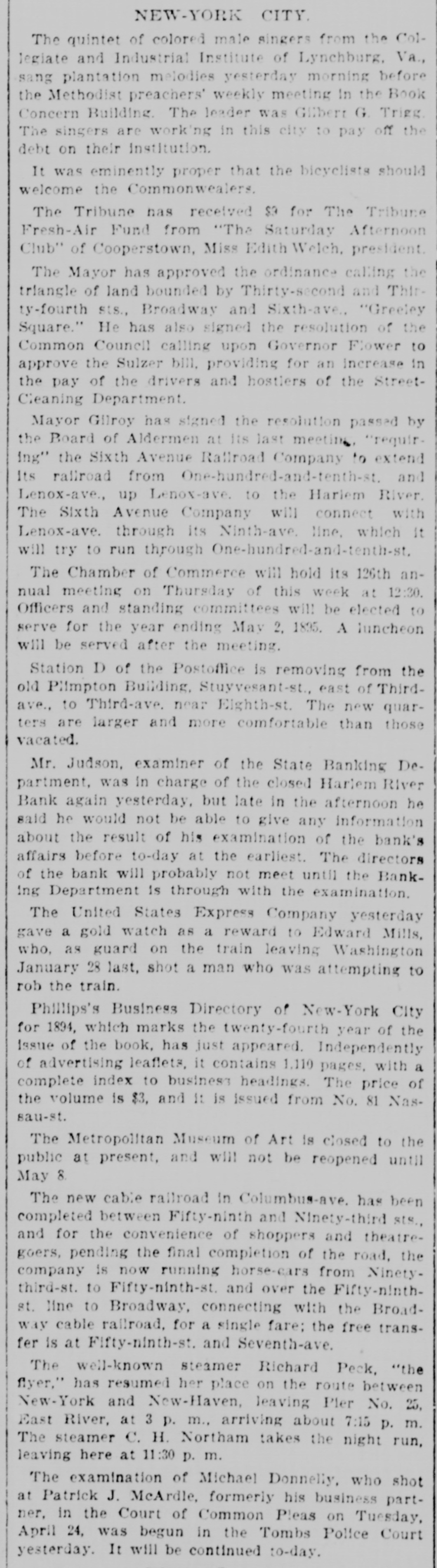
NEW-YORK CITY. The quintet of colored male singers from the Collegiate and Industrial Institute of Lynchburg, Va., sang plantation melodies yesterday morning before the Methodist preachers' weekly meeting In the Book Concern Building. The leader was Glibert G. Trigg. The singers are working in this city to pay on the debt on their institution. It was eminently proper that the bicyclists should welcome the Commonwealers. The Tribune has received $9 for The Tribune Fresh-Air Fund from "The Saturday Afternoon Club" of Cooperstown, Miss Edith Welch, president. The Mayor has approved the ordinance calling the triangle of land bounded by Thirty-second and Thirty-fourth sts., Broadway and Sixth-ave., "Greeley Square." He has also signed the resolution of the Common Council calling upon Governor Flower to approve the Sulzer bill, providing for an increase in the pay of the drivers and hostlers of the StreetCleaning Department. Mayor Gilroy has signed the resolution passed by the Board of Aldermen at its last meeting, "requiring" the Sixth Avenue Railroad Company to extend Its railroad from One-hundred-and-tenth-st, and Lenox-ave., up Lenox-ave. to the Harlem River. The Sixth Avenue Company will connect with Lenox-ave. through its Ninth-ave. line, which It will try to run through One-hundred-and-tenth-st. The Chamber of Commerce will hold its 126th annual meeting on Thursday of this week at 12:30. Officers and standing committees will be elected to serve for the year ending May 2, 1895. A luncheon will be served after the meeting. Station D of the Postoffice is removing from the old Plimpton Building, Stuyvesant-st., east of Thirdave., to Third-ave. near Eighth-st. The new quarters are larger and more comfortable than those vacated. Mr. Judson, examiner of the State Banking Department, was in charge of the closed Harlem River Bank again yesterday, but late in the afternoon he said he would not be able to give any information about the result of his examination of the bank's affairs before to-day at the earliest. The directors of the bank will probably not meet until the Banking Department is through with the examination. The United States Express Company yesterday gave a gold watch as a reward to Edward Mills, who, as guard on the train leaving Washington January 28 last, shot a man who was attempting to rob the train. Phillips's Business Directory of New-York City for 1894, which marks the twenty-fourth year of the Issue of the book, has just appeared. Independently of advertising leaflets, it contains 1,110 pages, with a complete index to business headings. The price of the volume is $3, and it is issued from No. 81 Nassau-st. The Metropolitan Museum of Art is closed to the public at present, and will not be reopened until May 8. The new cable railroad in Columbus-ave. has been completed between Fifty-ninth and Ninety-third sts., and for the convenience of shoppers and theatregoers, pending the final completion of the road, the company is now running horse-cars from Ninetythird-st. to Fifty-ninth-st. and over the Fifty-ninthst. line to Broadway, connecting with the Broadway cable railroad, for a single fare; the free transfer is at Fifty-ninth-st. and Seventh-ave. The well-known steamer Richard Peck, "the flyer," has resumed her place on the route between New-York and New-Haven, leaving Pler No. 25, East River, at 3 p. m., arriving about 7:15 p. m. The steamer C. H. Northam takes the night run, leaving here at 11:30 D. m. The examination of Michael Donnelly, who shot at Patrick J. McArdle, formerly his business partner, in the Court of Common Pleas on Tuesday, April 24, was begun in the Tombs Police Court yesterday. It will be continued to-day.


Article from The Evening World, May 1, 1894

Click image to open full size in new tab

Article Text

PRESTON TO VISIT THE BANK. Decision May Be Reached and Made Known This Evening. Bank Examiner Judson, who is in charge of the suspended Harlem River Bank, said this morning that Bank Superintendent Preston is in town, and will visit the bank this evening. when a decision will probably be reached and promulgated. Many depositors and stockholders were at the bank this morning. but there was no excitement, all seeming to be destrous for a favorable decision and an early resumption of business by the bank.


Article from The Evening World, May 1, 1894

Click image to open full size in new tab

Article Text

PRESTON TO VISIT THE BANK. Decision May Be Reached and Made Known This Evening. Bank Examiner Judson, who is in charge of the suspended Harlem River Bank, said this morning that Bank Superintendent Preston is in town, and will visit the bank this evening. when a decision will probably be reached and promulgated. Many depositors and stockholders were at the bank this morning. but there was no excitement. all seeming to be desirous for a favorable decision and an early resumption of business by the bank.


Article from The Evening World, May 2, 1894

Click image to open full size in new tab

Article Text

RECEIVER ASKED FOR. Harlem River Bank and Depositors Prefer Chas. K. Beekman. Bank Superintendent Preston Favors David B. Sickles. Judge Bookstaver Likes Both, but Promises to Consider. Application was made to Judge Bookstaver, of the Court of Common Pleas, to-day by Deputy Attorney-General Hogan for the appointment of a temporary receiver for the Harlem River Bank and the usual injunction order restraining creditors from proceeding against the bank while in charge of the receiver. Deputy Attorney-General Hogan, accompanied by Bank Superintendent Preston, entered the court-room a few moments before 11 o'clock. As soon as Judge Bookstaver had disposed of the motion then before Mr. Hogan made the formal motion and then said: "I will say to Your Honor that the bank is now in the hands of Bank Supt. Preston, and so far as his examination has gone he thinks the capital impaired to the extent of about $17,000. The assets of the bank will probably be between $200,000 and $300,000. "I wish to suggest the names of two gentlemen, either of whom will be acon They ero


Article from The Evening World, May 2, 1894

Click image to open full size in new tab

Article Text

D.B. SICKELS NAMED. Appointed Temporary Receiver of the Harlem River Bank. American Surety's Vice-President Must Give a $250,000 Bond. Funds That He Receives to Be Deposited with the Union Trust Co. Application was made to Judge Bookstaver, of the Court of Common Pleas, to-day by Deputy Attorney-General Hogan for the appointment of a temporary receiver for the Harlem River Bank and the usual injunction order restraining creditors from proceeding against the bank while in charge of the receiver. Deputy Attorney-General Hogan, accompanied by Bank Superintendent Preston, entered the court-room a few moments before 11 o'clock. As soon as Judge Bookstaver had disposed of a motion then before him, Mr. Hogan made the formal motion and then said: "1 will say to Your Honor that the bank is now in the hands of Bank Supt. Preston, and so far as his examination has gone he thinks the capital impaired to the extent of about $17,000. The assets of the bank will probably be between $200,000 and $300,000. "I wish to suggest the names of two gentlemen, either of whom will be acceptable as receiver. They are Charles K. Beekman, an attorney of 111 Broadway, and David B. Sickles, Vice-President of the American Surety Company.' Counsel for the stockholders of the bank, after stating that the depositors would be paid in full, urged the appointment of Mr. Beekman. He was seconded in this by counsel for the bank itself. Bank Superintendent Preston then stated that the Banking Department preferred Mr. Sickles. "They are both good men," said Judge Bookstaver. "I will consider the matter and give a decision in an hour. At 12.45 o'clock Judge Bookstaver signed an order appointing David B. Sickles temporary receiver of the bank. The receiver's bond is fied at $250,000, and he is directed to deposit the funds coming into his hands as receiver with the Union Trust Company. The troubles of the Harlem River Bank were first brought -0 notice last week Thursday, when it was announced that the Garfield National Bank had refused to act longer as its Clearing-House agent. The Harlem River Bank officials protested that the action was uncalled for, and that the bank was perfectly sound, but hardly had the words been spoken when the institution was closed by Supt. Preston and Examiner Judson placed in possession. The same day Mr. Judson announced that the bank would not resume business. It is said that the State Department had been watching the Harlem Bank's condition for some time and had required new security on some of its loans. Among the bank's heaviest borrowers were said to be its own directors.


Article from The Evening World, May 2, 1894

Click image to open full size in new tab

Article Text

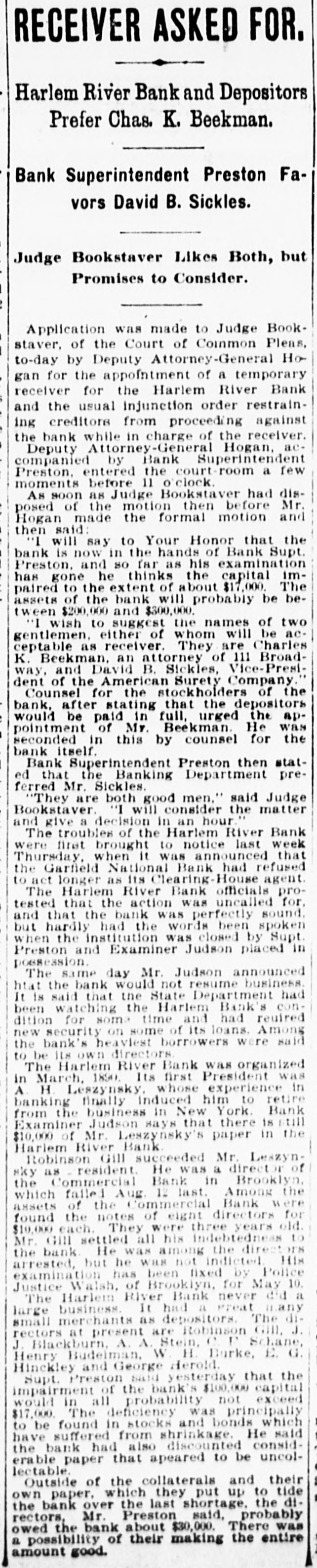
D.B. SICKELS NAMED. Appointed Temporary Receiver of the Harlem River Bank. American Surety's Vice-President Must Give a $250,000 Bond. Funds That He Receives to Be Deposited with the Union Trust Co. Application was made to Judge Bookstaver, of the Court of Common Pleas, to-day by Deputy Attorney-General Hogan for the appointment of a temporary receiver for the Harlem River Bank and the usual injunction order restraining creditors from proceeding against the bank while in charge of the receiver. Deputy Attorney-General Hogan, accompanied by Bank Superintendent Preston, entered the court-room a few moments before 11 o'clock. As soon as Judge Bookstaver had disposed of a motion then before him, Mr. Hogan made the formal motion and then said: "I will say to Your Honor that the bank is now in the hands of Bank Supt. Preston, and so far as his examination has gone he thinks the capital impaired to the extent of about $17,000. The assets of the bank will probably be between $200,000 and $300,000. "1 wish to suggest the names of two gentlemen, either of whom will be acceptable as receiver. They are Charles K. Beekman, an attorney of 111 Broadway, and David B. Sickels, Vice-President 01 the American Surety Company." Counsel for the stockholders of the bank, after stating that the depositors would be paid in full, urged the appointment of Mr. Beekman. He was seconded in this by counsel for the bank itself. Bank Superintendent Preston then stated that the Banking Department preferred Mr. Sickels. "They are both good men," said Judge Bookstaver. "I will consider the matter and give a decision in an hour." At 12.45 o'clock Judge Bookstaver signed an order appointing David B. Sickels temporary receiver of the bank. The receiver's bond is fixed ot $250,000. and he is directed to deposit the funds coming into his hands as receiver with the Union Trust Company. The troubles of the Harlem River Bank were first brought .0 notice last week Thursday, when it was announced that the Garfield National Bank had refused to act longer as its Clearing-House agent. The Harlem River Bank officials protested that the action was uncalled for, and that the bank was perfectly sound, but hardly had the words been spoken when the institution was closed by Supt. Preston and Examiner Judson placed in possession. The same day Mr. Judson announced that the bank would not resume business. It is said that ne State Department had been watching the Harlem Bank's condition for some time and had required new security on some of its loans. Among the bank's heaviest borrowers were said to be its own directors.


Article from The Sun, May 2, 1894

Click image to open full size in new tab

Article Text

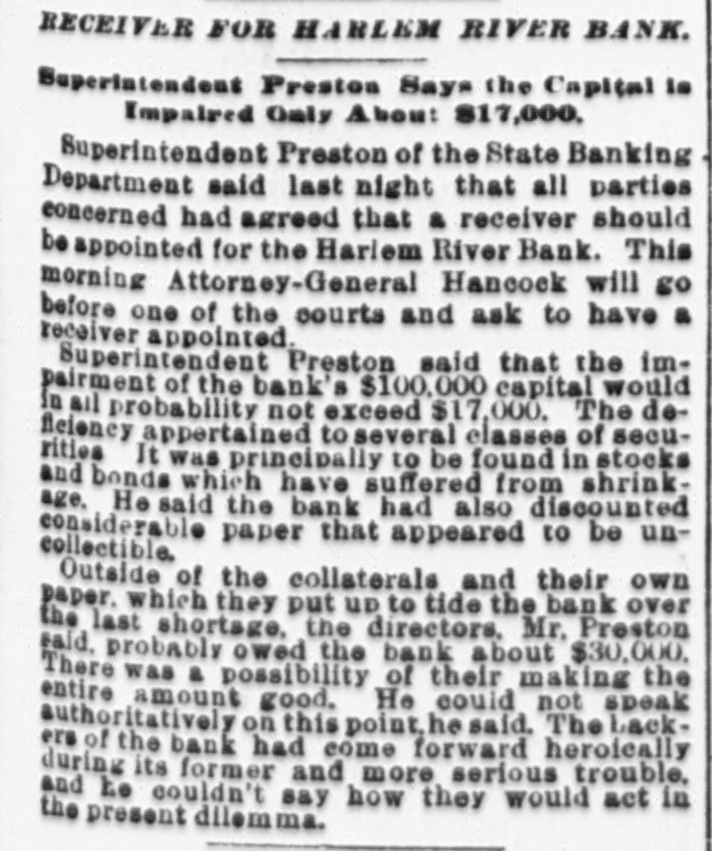
RECEIVER FOR HARLEM RIVER BANK. Superintendent Preston Says the Capital is Impaired Only About $17,000. Superintendent Preston of the State Banking Department said last night that all parties concerned had agreed that & receiver should be appointed for the Harlem River Bank. This morning Attorney-General Hancock will go before one of the courts and ask to have a receiver appointed. Superintendent Preston said that the impairment of the bank's $100,000 capital would in ail probability not exceed $17,000. The deficioncy apportained to several classes of securities It was principally to be found in stocks and bonds which have suffered from shrinkage. He said the bank had also discounted considerable collectible. paper that appeared to be unOutside of the collaterals and their own paper. which they put UD to tide the bank over the last shortage, the directors. Mr. Preston said. probably owed the bank about $30,000. There was a possibility of their making the entire amount good. He could not speak authoritatively on this point, he said. The Lackers of the bank had come forward heroically during its former and more serious trouble, and he couldn't say how they would act in the present dilemma.


Article from The Evening World, May 7, 1894

Click image to open full size in new tab

Article Text

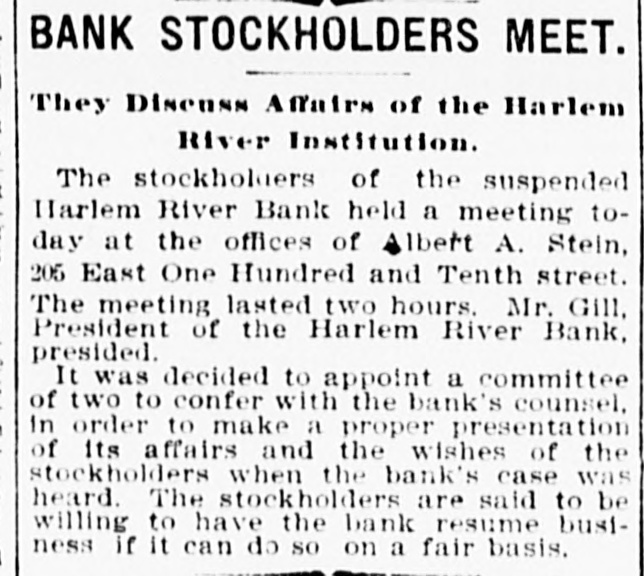
BANK STOCKHOLDERS MEET. They Discuss Affairs of the Harlem River Institution. The stockholuers of the suspended Harlem River Bank held a meeting today at the offices of Albert A. Stein, 205 East One Hundred and Tenth street. The meeting lasted two hours. Mr. Gill, President of the Harlem River Bank, presided. It was decided to appoint a committee of two to confer with the bank's counsel, In order to make a proper presentation of its affairs and the wishes of the stockholders when the bank's case was heard. The stockholders are said to be willing to have the bank resume business if it can do so on a fair basis.


Article from New-York Tribune, May 8, 1894

Click image to open full size in new tab

Article Text

HARLEM RIVER BANK AFFAIRS. The stockholders of the Harlem River Bank, which was recently placed in the hands of a receiver, met yesterday morning at the office of A. A. Stein, No. 205 East One-hundred-and-tenth-st. The conference lasted two hours. It was decided to appoint a come mittee of two to confer with the counsel of the bank, and to arrange for the proper presentation of the affairs of the bank when the case is heard in court. It is not known what the proposition is, and the stockholders refused to say. It is understood, now- to ever, that It will be proposed to allow the bank continue business on the old basis.


Article from New-York Tribune, May 9, 1894

Click image to open full size in new tab

Article Text

HARLEM RIVER BANK AFFAIRS. Immediately after David B. Sickels was appointed temporary receiver of the Harlem River Bank, at No. 2,007 Third-ave., he made a call for loans, amounting to $39,800, which had been made to directors of the bank. An unofficial statement of the loans gave the amounts due from each director as follows: Robinson Gill, president, $15,000; James J. Blackman, $2,500; W. H. Burke, $1,000; Henry Budelman. $5,000; George Herold, $5,000; A. A. Stein, $6,300. and C. F. Schane, $5,000. In explanation of the loans it was said that the directors had taken up other loans on real estate to which objection had been made by Mr. Judson, the examiner, in February, The real estate, It was sald, could be placed at the disposal of the receiver if the directors were unable to respond to the call. Objection may be made to some of the paper held by the bank as security for other loans. A claim for damages against the Third Avenue Railroad Company was given as security for a loan of $1,400, and a loan for a larger sum WAS given on two checks upon which payment had been stopped. Those loans were considered. and the alleged collateral was thrown out In the recent examination which resulted in the statement of Bank Superintendent Preston that the capital of the bank had been impaired to the extent of $17,000.


Article from Mineral Point Tribune, May 31, 1894

Click image to open full size in new tab

Article Text

where he is serving a sentence for bigamy. Two previous ceremonies had been performed. Business men of the northwest met at Minneapolis and formed an association whose object is to built up a home market for home-manufactured goods. The No. 6 Wamsutta mill at New Bedford, where the weavers have been on strike 14 weeks, has shut down indefinitely. Attempts have been made to keep the mill running with "knobsticks" without success, as the "knobsticks" were induced to leave soon after they began work. David B. Sickles, receiver of the Harlem River bank at New York, says that as soon as the experts now examining the bank's books get further along in their work it will develop that Kean, the defaulting book-keeper, had accomplices. The total defalcation, will foot up fully $30,000. Armsted Rice was hanged at Eutaw, Ala., for the murder of Burrell Kimbro last December. On the scaffold Rice confessed the crime also to having murdered a man in Mississippi years ago, and afterward another in Birmingnam, and to shooting a woman in Greene county last fall.


Article from The Evening World, July 19, 1894

Click image to open full size in new tab

Article Text

SICKELS DEFENDS HIMSELF. Harlem River Bank's Receiver Replies to Depositors' Charges. Denies that He Is Slow or Protecting Bank Officials. Col. David B. Sickels, receiver for the defunct Harlem River Bank, was somewhat indignant this morning at the action of the depositors and shareholders of the broken bank at a meeting held last night. at which it was openly charged that the receiver was endeavoring to protect the officers of the bank and that outsiders had obtained access to the books, while they were refused even a list of the depositors. They also attacked Col. Sicke's for not endeavoring to bring Bookkeeper Kean back from Canada, and hold that he is unnecessarily slow in winding up the affairs of the Institution. "I do not want to protect any one," Col. Sickels said to an "Evening World" reporter to-day. "If any of these depositors will show me evidence incriminating the officers of the bank I will help them to secure a conviction. "I am perfectly willing to assist them in any way that is possible, but I cannot spend the money of the bank without an order from the Court. They complain that nothing has been done about Kean. I cannot personally bring him back. His case is in the hands of the District-Attorney, and I understand an indictment has been found against him. .. As to winding up the affairs of the bank I am doing it as rapidly as is possible. When I took the receivership I receipted for $348,425.58 available assets. A great deal of this was in outstanding paper. In sixty days I have collected $65,000, and have declared a dividend of 20 per cent. payable July 23. Some notes fall due the latter part of August. I cannot collect them before they are due. As business men they should know that. "It is not true that I refused them a list of depositors. Three gentlemen called on me just as I was leaving town. and I requested them to call again. One did so and said they were going to form an association and wanted a list of depositors. I replied that I wished to consult my counsel before furnishing the list." M. W. Libas, of 140 Nassau street, a member of the Committee appointed to engage counsel and bring the matter before the Grand Jury. said the Committee would meet to-morrow. He said that they had evidence that President Robert Gill had advanced money on a third mortgage, and had also received a deposit of $4.500 after Supt. Preston was in charge of the bank. They would recommen at the meeting of the depositors to be held next Wednesday. that these facts be laid before the Grand Jury. Mr. Libas said that it was apparent that the officers did not want Kean brought back for fear he would make a statement the tendency of which would be to implicate them.


Article from New-York Tribune, July 26, 1894

Click image to open full size in new tab

Article Text

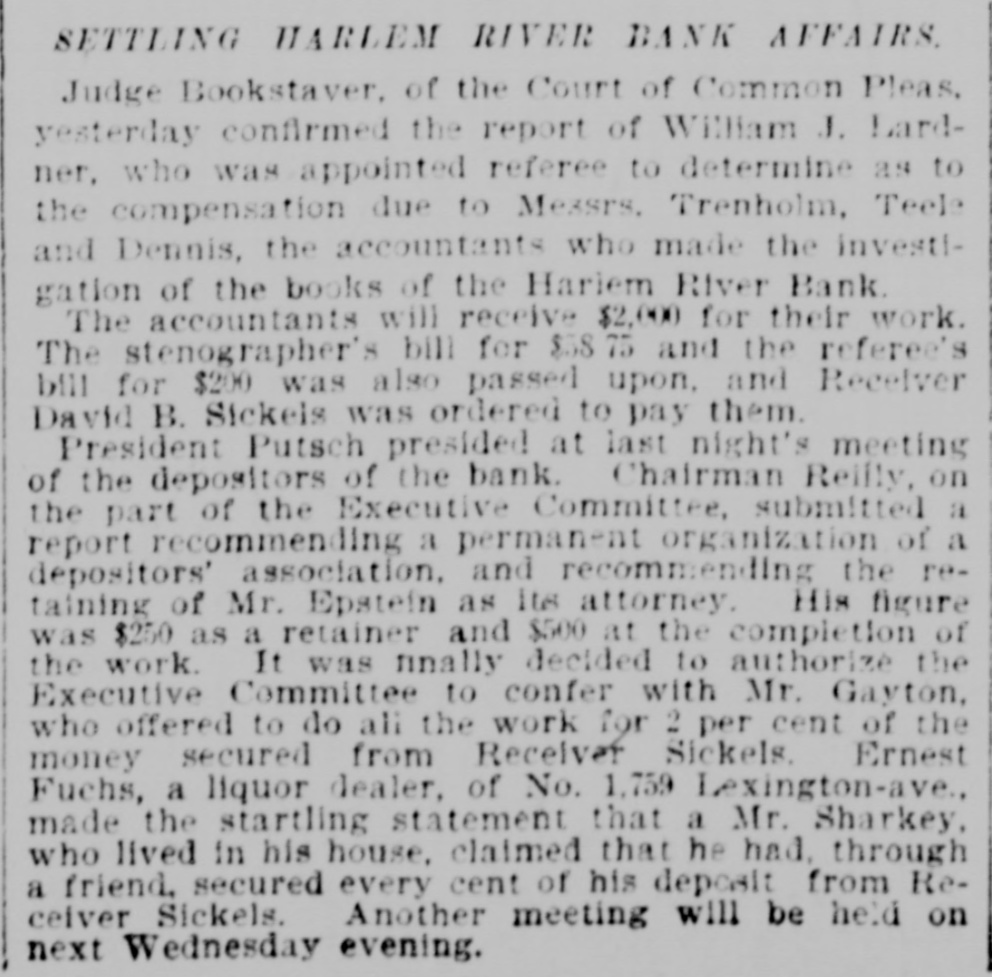
# SETTLING HARLEM RIVER BANK AFFAIRS. Judge Bookstaver, of the Court of Common Pleas, yesterday confirmed the report of William J. Lardner, who was appointed referee to determine as to the compensation due to Messrs. Trenholm, Teele and Dennis, the accountants who made the investigation of the books of the Hariem River Bank. The accountants will receive $2,000 for their work. The stenographer's bill for $58.75 and the referee's bill for $200 was also passed upon, and Receiver David B. Sickels was ordered to pay them. President Putsch presided at last night's meeting of the depositors of the bank. Chairman Reilly, on the part of the Executive Committee, submitted a report recommending a permanent organization of a depositors' association, and recommending the retaining of Mr. Epstein as its attorney. His figure was $250 as a retainer and $500 at the completion of the work. It was finally decided to authorize the Executive Committee to confer with Mr. Gayton, who offered to do all the work for 2 per cent of the money secured from Receiver Sickels. Ernest Fuchs, a liquor dealer, of No. 1,759 Lexington-ave., made the startling statement that a Mr. Sharkey, who lived in his house, claimed that he had, through a friend, secured every cent of his deposit from Receiver Sickels. Another meeting will be held on next Wednesday evening.


Article from New-York Tribune, February 3, 1895

Click image to open full size in new tab

Article Text

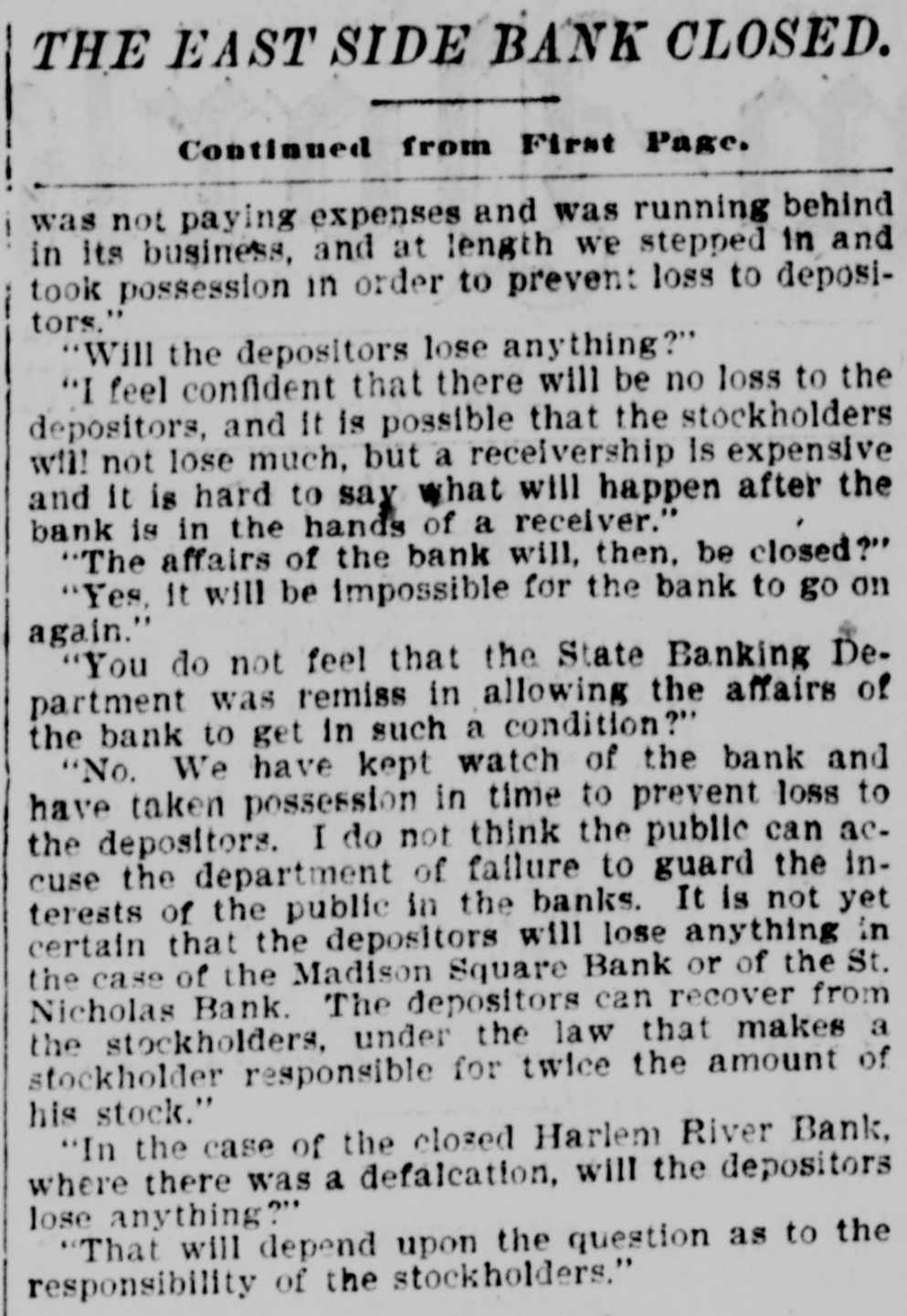
THE EAST SIDE BANK CLOSED. Continued from First Page. was not paying expenses and was running behind in its business, and at length we stepped in and took possession in order to prevent loss to depositors." "Will the depositors lose anything?" "I feel confident that there will be no loss to the depositors, and it is possible that the stockholders will not lose much, but a receivership is expensive and it is hard to say what will happen after the bank is in the hands of a receiver." "The affairs of the bank will, then, be closed?" "Yes, It will be impossible for the bank to go on again." "You do not feel that the State Banking Department was remiss in allowing the affairs of the bank to get in such a condition?" "No. We have kept watch of the bank and have taken possession in time to prevent loss to the depositors. I do not think the public can accuse the department of failure to guard the interests of the public in the banks. It is not yet certain that the depositors will lose anything in the case of the Madison Square Bank or of the St. Nicholas Bank. The depositors can recover from the stockholders, under the law that makes a stockholder responsible for twice the amount of his stock." "In the case of the closed Harlem River Bank, where there was a defalcation, will the depositors lose anything?" "That will depend upon the question as to the responsibility of the stockholders."


Article from New-York Tribune, July 10, 1896

Click image to open full size in new tab

Article Text

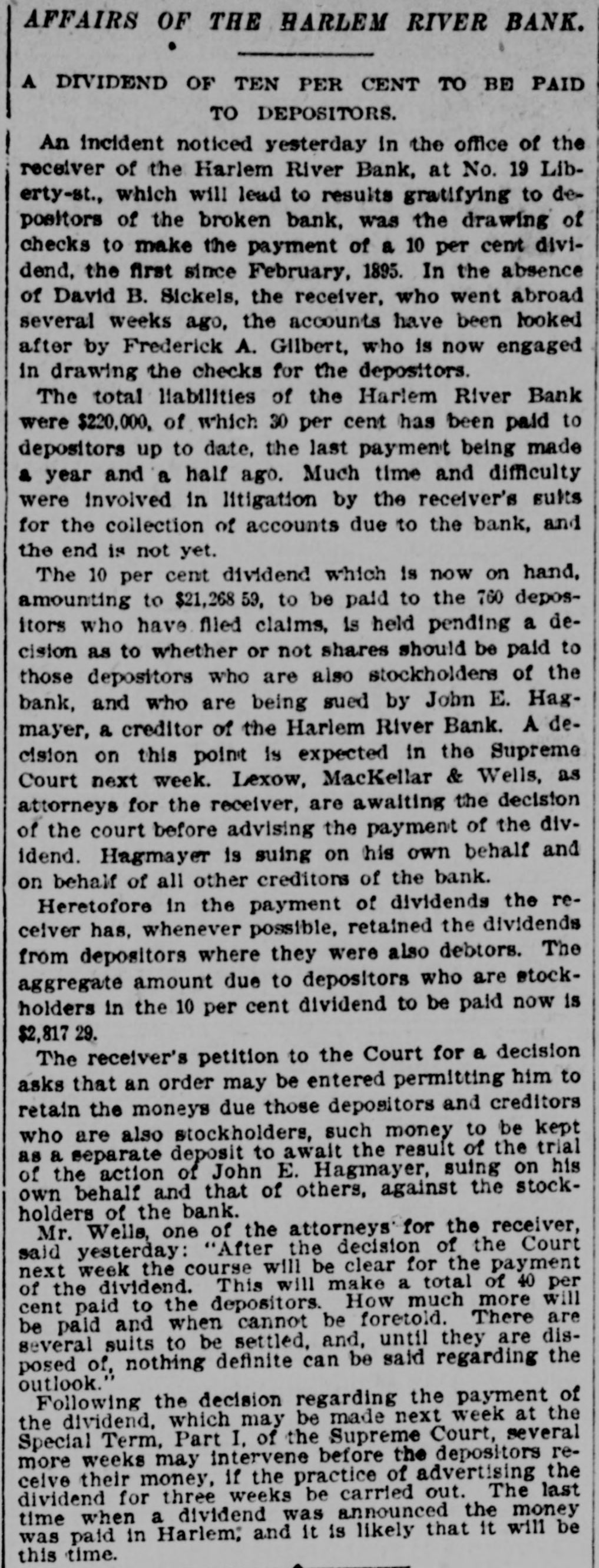
AFFAIRS OF THE HARLEM RIVER BANK. A DIVIDEND OF TEN PER CENT TO BE PAID TO DEPOSITORS. An incident noticed yesterday in the office of the receiver of the Harlem River Bank, at No. 19 Liberty-st., which will lead to results gratifying to depositors of the broken bank, was the drawing of checks to make the payment of a 10 per cent dividend, the first since February, 1895. In the absence of David B. Sickels, the receiver, who went abroad several weeks ago, the accounts have been looked after by Frederick A. Gilbert, who is now engaged in drawing the checks for the depositors. The total liabilities of the Harlem River Bank were $220,000, of which 30 per cent has been paid to depositors up to date, the last payment being made a year and a half ago. Much time and difficulty were involved in litigation by the receiver's sults for the collection of accounts due to the bank, and the end is not yet. The 10 per cent dividend which is now on hand, amounting to $21,268 59, to be paid to the 760 depositors who have filed claims, is held pending a decision as to whether or not shares should be paid to those depositors who are also stockholders of the bank, and who are being sued by John E. Hagmayer, a creditor of the Harlem River Bank. A decision on this point is expected in the Supreme Court next week. Lexow, MacKellar & Wells, as attorneys for the receiver, are awaiting the decision of the court before advising the payment of the dividend. Hagmayer is suing on this own behalf and on behalf of all other creditors of the bank. Heretofore in the payment of dividends the receiver has, whenever possible, retained the dividends from depositors where they were also debtors. The aggregate amount due to depositors who are stockholders in the 10 per cent dividend to be paid now is $2,817 29. The receiver's petition to the Court for a decision asks that an order may be entered permitting him to retain the moneys due those depositors and creditors who are also stockholders, such money to be kept as a separate deposit to await the result of the trial of the action of John E. Hagmayer, suing on his own behalf and that of others, against the stockholders of the bank. Mr. Wells, one of the attorneys for the receiver, said yesterday: "After the decision of the Court next week the course will be clear for the payment of the dividend. This will make a total of 40 per cent paid to the depositors. How much more will be paid and when cannot be foretold. There are several suits to be settled, and, until they are disposed of, nothing definite can be said regarding the outlook." Following the decision regarding the payment of the dividend, which may be made next week at the Special Term, Part I, of the Supreme Court, several more weeks may intervene before the depositors receive their money, if the practice of advertising the dividend for three weeks be carried out. The last time when a dividend was announced the money was paid in Harlem, and it is likely that it will be this time.