15917. Globe Security Company (New York, NY)

Bank Information

Episode Type
Suspension → Closure
Bank Type
state
Start Date
April 18, 1904
Location
New York, New York (40.714, -74.006)

Metadata

Model
gpt-5-mini
Short Digest
f530fc24

Response Measures

None

Description

Multiple articles from April–May 1904 report an involuntary bankruptcy petition, appointment of receivers (James McKeen and Charles C. Black), safes found empty, and allegations of fraud/misappropriation by David Rothschild. No article describes a depositor run; the company was forced into bankruptcy/receivership and remains under receiver control (closure). Corrected OCR typos (e.g., Rethschild/Rothschild, Muirhead/Mulrhead) noted in source texts.

Events (4)

1. April 18, 1904 Receivership
Newspaper Excerpt
A receiver was appointed today for the Globe Security Company. ... James McKeen was appointed receiver. Charles C. Black later qualified as receiver under New Jersey chancery proceedings as well (competing appointments). Mr. McKeen said the company has now no money in the bank, having withdrawn it a few days ago; 'There is little doubt that the company cannot meet its liabilities. It is bankrupt right enough.' (New-York Tribune and other reports).
Source
newspapers
2. April 18, 1904 Suspension
Cause
Bank Specific Adverse Info
Cause Details
Involuntary petition in bankruptcy following allegations of paying preferred creditors, concealing or removing property, and charges that David Rothschild misappropriated funds (allegedly $200,000).
Newspaper Excerpt
An involuntary petition in bankruptcy was filed in the United States District Court to-day against the Globe Security Company ... Judge Holt appointed James McKeen as temporary receiver.
Source
newspapers
3. April 25, 1904 Other
Newspaper Excerpt
The most interesting developments ... that Rothschild's massive and imposing safety vault in the Globe company offices was made of painted tin. ... The front of the vault ... was merely built by Rothschild to fool the people doing business with the concern (reports of empty/phony vault).
Source
newspapers
4. April 29, 1904 Other
Newspaper Excerpt
GLOBE SAFES EMPTY. Books of the Security Company Are Missing Now. ... It is believed that the company's books were removed on April 15.
Source
newspapers

Newspaper Articles (12)

Article from Evening Times-Republican, April 18, 1904

Click image to open full size in new tab

Article Text

RECEIVER IS APPOINTED. Globe Security Company's Affairs Aired in New York Court. New York, April 18.-A receiver was appointed today for the Globe Security Company. Last week when the Federal Bank closed it was said that David Rothschild, former president of the bank. was also interested in the Globe Security Company. Rothchild is charged with misappropriating $200,000 of the funds of the Federal Bank and was today held in $25,000 bail for examination.


Article from The St. Louis Republic, April 19, 1904

Click image to open full size in new tab

Article Text

RECEIVER IS APPOINTED FOR GLOBE SECURITY CO. David Rethschild, President of Defunct Bank, Which Dealt With Concern, Held in $25,000 Bail. I New York, April 18.-An involuntary petition in bankruptcy was filed in the United States District Court to-day against the Globe Security Company by James S. O'Neale, Asher Osterman and Samuel J. Sewell. The total amount of their claims is $7,500, with interest. James McKeen was appointed receiver. Last week, when the Federal Bank was closed by officials of the State Banking Department. it was said that David Rothschild. former president of the bank, was also interested in the Globe Security Company. The papers which were filed by the petitioners alleged that the Globe Security, contrary to the provisions of the bankruptcy law. paid alleged recent indebtedness amounting to $25,000. thus making certain persons preferred creditors. and also the allegation is made that the alleged bankrupts, within the last four months, conveyed, transferred, concealed or removed some of their property. Charged with misappropriating $200,000 of the funds of the suspended Federal Bank. David Rothschild, former president of the institution, to-day was held in $25.000 bail for examination April 20.


Article from The Salt Lake Herald, April 19, 1904

Click image to open full size in new tab

Article Text

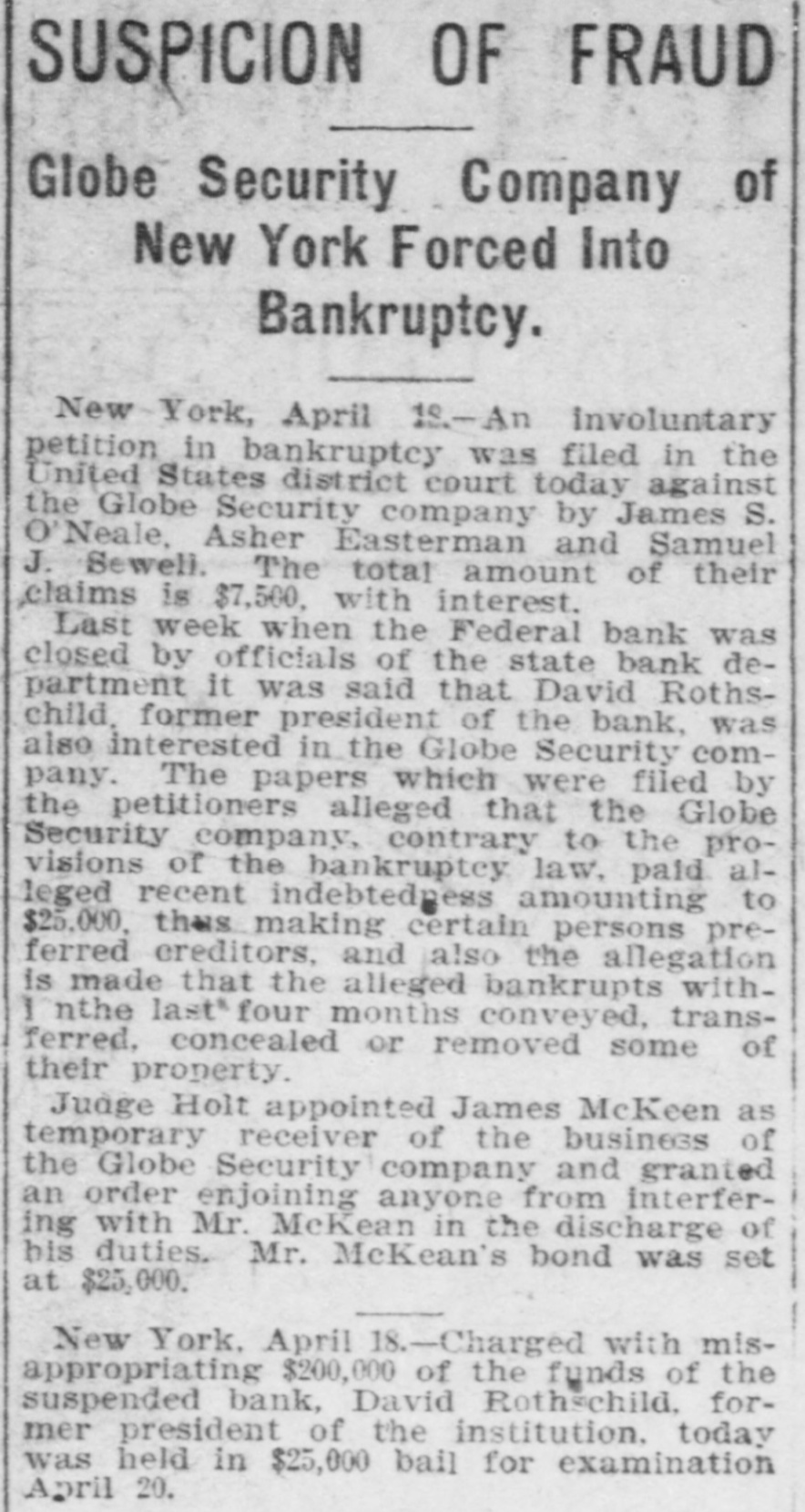
SUSPICION OF FRAUD Globe Security Company of New York Forced Into Bankruptcy. New York, April 18-An involuntary petition in bankruptcy was filed in the United States district court today against the Globe Security company by James S. Neale, Asher Easterman and Samuel J. Sewell. The total amount of their claims is $7,500. with interest. Last week when the Federal bank was closed by officials of the state bank department it was said that David Rothschild. former president of the bank, was also interested in the Globe Security company. The papers which were filed by the petitioners alleged that the Globe Security company, contrary to the provisions of the bankruptcy law, paid alleged recent indebtedness amounting to $25,000, thus making certain persons preferred creditors, and also the allegation is made that the alleged bankrupts withI nthe last four months conveyed, transferred, concealed or removed some of their property. Judge Holt appointed James McKeen as temporary receiver of the business of the Globe Security company and granted an order enjoining anyone from interfering with Mr. McKean in the discharge of his duties. Mr. McKean's bond was set at $25,000. New York, April 18.-Charged with misappropriating $200,000 of the funds of the suspended bank, David Rothschild, former president of the institution. today was held in $25,000 bail for examination April 20.


Article from New-York Tribune, April 20, 1904

Click image to open full size in new tab

Article Text

MUIRHEAD NOT FOUND. TWO GLOBE RECEIVERS. Rothschild, in the Tombs, Moans Over His Disgrace. United States Marshal Henkel, the postoffice inspectors, the temporary receiver for the Globe Security Company and other officials yesterday were all seeking William Muirhead, treasurer of the company. Muirhead has not been at his office since 10:30 a. m. on Monday. and his counsel decline to say where he is. He is under $1.000 bail in an alleged usury case to be heard on Friday. Postoffice Inspector Ashe says he would like to see him in reference to the company's use of the mails; Receiver McKeen needs the keys and ombinations of the office safes. which are without exception locked. and two process servers are out with subpoenas in connection with testimony to be taken at a hearing to be fixed at the discretion of United States Commissioner Alexander. "I have only been in charge an hour," Mr. McKeen told a Tribune reporter late yesterday afternoon, "as I waited, before taking charge. to have the petitioners' counsel file a bond. As you see, the drawers and safes are locked and closed, and I can do nothing by way of an investigation until Muirhead shows up or until I get an order from the court to have them opened. I have been told that the company has now no money in the bank, having withdrawn It a few days ago. There is little doubt that the company cannot meet Its liabilities. It is bankrupt right enough." Marshal Henkel yesterday served a subpoena in the civil action against Henry L. Swords as one of the company's directors. The marshal was unable to find Muirhead or John H. Russell. Messrs. Swords and Russell are the trustees. While Mr. McKeen was absent from the office yesterday, Charles C. Black, of Jersey City, who was appointed receiver for the company under the laws of New-Jersey, appeared and demanded possession. His appointment may not hold, as Mr. McKeen's appointment was by the federal court under the bankruptcy laws. Mr. McKeen was deluged yesterday with letters from all sections of the United States, challenging the stability of the bonds issued by the company. More than $500.000 of these bonds had been issued, and they were said to be secured by collateral to the amount of 105 per cent. Mr. Russell said yesterday that he had removed securities of the face value of more than $400,000 some weeks ago, and that they were now in the hands of a Broadway security company. PROMINENT MEN AS WRECKERS. It was said in the Criminal Courts Building yesterday that the names of men of high standing, whose reputations have been hitherto untarnished, will be connected with the wrecking of the Federal Bank and the Globe Security Company. Assistant District Attorney Kresel, in charge of the investigation of the bank's affairs, talked with more than fifteen depositors in the bank during the day. State Bank Examiner George S. Leonard. of Syracuse, assumed charge of the Federal Bank yesterday, relieving Mr. Judson. Mr. Leonard said he was engaged in listing the bank's loans. He declined to make any statement concerning the condition of the bank's affairs. David Rothschild is still in the Tombs, no $25,000 bail having been forthcoming. He will be arraigned for a hearing before Justice Wyatt, of the Court of Special Sessions, this afternoon. Mr. Kresel said yesterday that two complaints that will be prepared against Rothschild have already been drawn. One of these complaints, he said, would embody the larceny of the $10,000 check made by I. Frank the ticket scalper. How Rothschild feels the disgrace of his position was described yesterday by James J. Bryson. of Newark. N. J., one of his fellow prisoners. Bryson was discharged from the Tombs, and later he said that as he was taking his morning exercise be happened to run across Rothschild, who was walking around the prison court. "Oh, to think that I should have to be here!" Rothschild sald. When he passed Bresci, the man who is charged with the murder of Enright, the policeman, Rothschild got as far from the man as he could. "Oh, to think." he moaned, "that I should have to be here with all these thugs and thleves!" Trenton, N. J., April 19.-Charles C. Black, of Jersey City, qualified as receiver of the Globe Security Company to-day by filing a bond of $20,000 in the Court of Ghancery. The order appointing him was signed at Jersey City yesterday by ViceChancellor Pitney, the application being made by Henry L. Swords, of New-York a director and trustee of the company, in accordance with a resolution adopted at a special meeting of directors last Friday. Annexed to the bill is a statement of the affairs of the company, sworn to by Nathaniel C. Kelly, the secretary which places the assets at $512,440 and the liabilities including outstanding bonds, at $968,804 In addition to the assets mentioned, the company is supposed to have a deposit of about $5,000 in the Federal Bank. The schedule of assets prepared by Kelly, follows: Cash, $1,440; outstanding accounts, not hypothecated, $12,000; office furniture. $5,000; collateral securities deposited with trustees to protect bond issue. $479,000 claims in suits in attorneys' hands, about $15,000: total. $512,440 Among the liabilities given in the schedule are the following: Bonds outstanding, $392,000; Borough Bank of Brooklyn, $16,500; Federal Bank of New-York. $125,000 guarantee to Federal Bank, for D. L. Rethschild, $370,000; Equitable National Bank, $2,700 J. S. O'Neal $5,000; Carrie Adams, $21,000: Ike Frank. $18,000: Michael Printing Com-
Article from New-York Tribune, April 21, 1904

Click image to open full size in new tab

Article Text

HELD FOR GRAND JURY. ROTHSCHILD'S METHODS. Muirhead Found-Clash Between Globe Receivers Over Papers. Strong intimations that more prominent men and women, including a well known bank president and a Standard Off man, as well as other banking institutions heretofore reputable. were involved in the dual collapse of the Federal Bank and Globe Security Company. were made yesterday. There was a persistent report that David Rothschild speculated and lost heavily in stocks. Rothschild was again arraigned and held for the grand jury at bail aggregating $25,000. A member of the firm of Meyer & Goldsmith, attorneys for the creditors in the bankruptcy proceedings, said last night that a writ of habeas corpus for Rothschild would he asked for this morning, that he might give evidence in the hearing before Commissioner Alexander. Detectives last night had found William Muirhead, the treasurer of the company, who is under $1,000 ball in the Globe usury case, and is also wanted as a witness in the bankruptcy hearing on Saturday. Miss Carrie Adams, of No. 206 West Seventieth-st., who has been seen frequently in the company of Louis Rothschild. a brother of the ex-president, was served with a subpeens ordering her to appear before United States Commissioner Alexander A subpoena has also been issued for Mrs. David Rothschild Receiver McKeen of the Globe Security Company, who was appointed by the Federal Court. learned that Charles C. Black, who had been appointed receiver for the company by the NewJersey Chancery Court. had further qualified as receiver under a New-Jersey federal court commission. the office of neither receiver taking precedence and both applications having been made simultaneously. To confound the confusion Deputy Sheriff John J. Plunkett. who was nominally in charge, refused to leave the office, declaring that he must first have his "poundage" and that there was sufficient money in the office to pay his fee a few hundred dollars. This Receiver McKeen declined to pay. "I find that the trustees." Mr. McKeen told a Tribune reporter. "have transferred the securities to New-Jersey. and I am told on good authority that papers belonging to this office have been taken to that State I have opened several of the safes and found them-empty." Mr. Meyer. of the creditors' counsel. declared that an order had been signed by Justice Holt compelling the trustees to return the papers to the Nassau-st. office. Henry L. Lowds, one of the trustees, has already been subprened by the marshal, and John H. Russell, another trustee, is being sought. Mr. McKeen said that at Saturday's hearing he hoped by the evidence of employees to obtain the keys and combinations of safes he was unable to open. An order is also being sought authorizing Mr. McKeen to continue the business of the company in the Interests of the creditors and sue for loans due, etc. In his application Mr. McKeen states that notes are daily becoming due and must go to protest failing authorization to continue business The fact that Cuthbert the expert accountant who went over the books of Sully & Co., has charge of the accountants who are going over the Globe Security books, was considered part confirmation of the report that Rothschild had lost most of the money in cotton speculation. The only cash asset of the company that was known to exist was $2,840 in the Guardian Trust Company. Just before or immediately after the deputy sheriff took possession of the offices on Saturday, Mr. Muirhead, it is said. went to the trust company and drew out the entire deposit. United States Marshal Henkel has sought for Muirhead in vain. "Compared with the Globe Security Company." said Samuel J. Goldsmith, "the Miller syndicate pales into insignificance." Richard W. Jones, Jr., president of the Oriental Bank, at Broadway and John-st., and expresident of the defunct Seventh National Bank, declared that his institution had asked the Federal to withdraw its accounts because of the many out of town checks that it had deposited and against which it drew immediately after depositing. "Our only dealing with the Federal," said Mr. Jones, "was the carrying of its account. The Federal never owed the Oriental a dollar," Mr. Jones admitted that he had had personal dealings with David Rothschild "Did you ever recommend or indorse Mr. Rothschild?" he was asked. "I don't remember that I ever did," said Mr. Jones. Assistant District Attorney Kresel declared positively that others besides Rothschild had benefited through the Federal Bank's operations. He declined to mention any names He said he had learned that when the bank was being organized it employed ex-Alderman Louis Minski to solicit business and sell stock. According to the agreement he was to get one-half of 1 per cent on the deposits, which netted him about $3,000 a year, and a large percentage on the sale of stock. He had good reason to think it was 25 per cent. The grand jury would be asked to indict Rothschild on several counts of grand larceny. Every time Rothschild discounted an accommodation note he was guilty of grand larceny. On March a statement was issued which represented that the bank was in good condition. If it is learned that this statement was not in accordance with the facts some action would probably be taken against Rothschild on that account, probably in the form of an indictment alleging perjury. Mr. Kresel aserted that he had been informed that Rothschild would plead guilty. Several persons who had borrowed money from the company and do not read the newson fourth page


Article from New-York Tribune, April 23, 1904

Click image to open full size in new tab

Article Text

SECOND ARREST LIKELY. DEPOSITS ON LAST DAY. Mr. Kresel Involves Rothschild Relatives in His Operations. Another arrest is expected in the Federal Bank case the District the Rothpositions Attorney's held to-day. by Louis office Evidence Rothschild, yesterday disclosed Julius showed by schild and Mrs Amanda Cahn, Louis's sister-inlaw, in various companies that have figured prominently in the dual Federal Bank and Globe Security Company's collapse, and their relations to Mr. Rothschild. According to Alexander Karst, who says he represents the Federal Bank depositors, of two hundred who have called on him, not ten appear to have paid voluntary deposits. Mr. Karst said that not only had these depositora been solicited by politicians and big insurance men, but also by cantors in two of the leading Jewish synagogues. The cantors, said he, induced many to deposit, telling the depositors to conceal the solicitors' part, as it might affect the standing of the synagogues. Mr. Karst declared that a manager for a Western bank had yesterday told him that only on the Tuesday before the Federal's doors were closed he was induced by a friend of himself and of President Woods and Cashier Doolittle to deposit $6,000 of the Western bank's money in the Federal Bank. He had never recovered it. Yesterday, however, he received a telegram from the Western bank, telling him unlimited funds were at his disposalto bring those responsible to justice. Mr. Karst announced that a mass meeting of depositors was being arranged for early next week. He said that at least four persons had already come to him, telling of having made deposits on the day the bank failed. Mr. Karst is said to have been at one time connected with Leventritt & Brennan, Mr. Rothschild's present counsel Mr. Kresel announeed that Mrs. Amanda Cahn, manager of the Atna Security Company, which has figured in the twin collapse. is a sister-in-law of Julius Rothschild, and that Julius Rothschild, with whom, Mr. Kresel said. Mrs. Cahn lived, was head of the Manhattan Finance Company. which also figured in the collapse. Mr. Kresel declared that Mrs. Kahn was under arrest, charged with usury in exacting $36 for a loan of $25 for four months, the complaint coming up for examination before Justice Wyatt, in the Court of Special Sessions, yesterday, but being adjourned until next week. He said the business of the AEtna company was transacted through the National Broadway Bank. Many of the checks of William Mulrhead, treasurer of the Globe Security Company, who is under $1,000 bail in the Carpenter usury case, went through Julius Rothschild & Co., and in the Carpenter case showed the Julius Rothschild indorsement, Mr. Kresel asserted. He added that one of the Julius Rothschild & Co.'s notes--for how much he could not sayhad been discovered among the papers in the defunct Federal Bank. The Carpenter usury case, that was to have been heard yesterday and in which Mr. Muirhead was to be examined was adjourned until next week, and Mulrhead has apparently evaded the subpoena for the bankruptcy proceeding hearing. Sensational disclosures are promised at this hearing to-day. Among those who have been subponaed are David Rothschild, for whom a write of habeas testificandum was granted yesterday: Martha Lemont, ex-cashier of the Globe Security Company, who was also served yesterday: Louis Hasse, the ex-president of the company: Miss Carrie Adams, in whose company, it is said, Louis Rothschild has been seen frequently of late; pany; Catherine George C. Hene, Perkins, a bookkeeper receiver for of the the Union comSecurity and Guarantee "Company, and Henry L. Swords, one of the two trustees. An interesting exhibit at the hearing will be a stack of $1,000 Globe Security Company's bonds, three feet high. signed. but blank. which are now at the office of Meyer & Goldsmith, counsel for the creditors. said Mr. Samuel had J. Goldsmith yesterday that Kresel promised him as evidence at the proceedings all the papers taken from David Rothschild's apartments at the Ansonia Hotel. Rothschild, who is occupying cell 105 appeared to first tier of the Tombs, be furious in the when told yesterday of Mr. Kresel's seizure without a warrant. "The District Attorney's office." he snapped, "will have to take the responsibility. shall see my lawyer, Mr. Leventritt. and this afternoon he will no doubt have something to say.' "I am convinced that Mr. Kresel's action was unwarranted," Mr. Leventritt said "and matter. I I decided am considering the have later, not yet on any action, but you may rest assured that am not ignoring it.' Asked as to the truth of the reports that Mr. Rothschild was becoming insane, Mr. returned said where he Mr. had just from the Leventritt Tombs, Rothschild seemed to be sound as bell. as health to Mr. Kresel's and mentally a Asked in good statement that Rothschild would enter a plea of guilty. Mr. Leventritt said: as "It has absolutely no foundation. So long I am his lawyer he will certainly not plead gulity. and I am confident that the present charges against him cannot be proved. Mr. Leventritt said he had been "officially informed" that the two charges under which Rothschild is being held for the grand jury constituted the only evidence the District Attorney could adduce against him. When told of this official information. Mr. Kresel appeared to be much amused. "No search warrant is required in such a case," speaking of the seizure at the said Ansonia. Mr. Kresel, "The police often do that." that if it question Mr. Leventritt of criminal admitted prosecution, another became a represent his client. It is of the lawyer would will be ex-Governor Black, said that lawyer the & Bonynge, which of resents Olcott. Muirhead Black, Gruber rep- firm in the Carpenter was the Globe and etal retained by company usury as spe- case counsel in particular cases of this description.


Article from The Bennington Evening Banner, April 25, 1904

Click image to open full size in new tab

Article Text

HIS VAULT OF TIN Rothschild's Federal Bank Safe a Hollow Mockery. FRONTED BY MASSIVE STEEL BARS Receiver Strove For a Week to Obtain Entrance and Finally Went to the Rear and Shoved It In With His Shoulder. NEW YORK April -The most interesting developments in the investigation of the affairs of David Rothschild and of the wrecked Federal Bank and Globe Security company have been that Rothschild's massive and imposing safety vault in the Globe company offices was made of painted tin. The tin vault discovery was a great surprise. For nearly a week Receiver McKeen and his counsel, J. H. Brewster, strove to get into the safety vault of the company, whose offices are on the seventh floor of the Tract Society building." The vault is in the cashier's department and is most impressive looking from the front. When William Muirhead and other officers of the Globe failed to appear and reveal the combination Mr. McKeen and Mr. Brewster did not know what to do. They didn't want to use force to get into the vault, as they thought dynamite would have to be employed. The front of the vault is of heavy glazed brick, with great stone pillars on each side and an immense steel door in the middle, and it looked as solid as a rock. This steel door is fitted with scores of bolts all brightly polished. In frout of the door is a great steel barred gate. Viewed over the marble counters of the cashier's department, the vault looks strong enough to withstand projectiles from a twelve inch gun. Since Mr. Brewster has been in charge of the Globe offices he has found SO many curious things connected with the concern that he decided to attack the redoubtable vault from the rear. To get at the rear wall, supposedly of stone and steel, it was necessary to pass through a labyrinth of passages. partitions and doors. Mr. Brewster threaded this maze and then came up against a massive looking wall apparently of steel and brick forming the rear inclosure of the vault. Wearied. he leaned against it, when to his astonishment it yielded. He rapped on It with his knuckles. It was tin. The appearance of steel and brick was paint. Mr. Brewster put his shoulder against the wall, and a big section of it caved in, throwing him into the vault. Then he found that the strong box, except the front, was really built of the thinnest kind of corrugated iron. Its power of resistance is about equal to cardboard. The front of the vault, with its magnificent appearance of impressive solidIty, was merely built by Rothschild to fool the people doing business with the concern and make them think the company's affairs were of an important financial character which required great safes to hold millions in securities and cash.


Article from Waterbury Evening Democrat, April 25, 1904

Click image to open full size in new tab

Article Text

HIS VAULT OF TIN Rothschild's Federal Bank Safe a Hollow Mockery. FRONTED BY MASSIVE STEEL BARS Receiver Strove For a Week to Obtain Entrance and Finally Went to the Rear and Shoved It In With His Shoulder. NEW YORK, April 25.-The most interesting developments in the investigation of the affairs of David Rothschild and of the wrecked Federal Bank and Globe Security company have been that Rothschild's massive and imposing safety vault in the Globe company offices was made of painted tin. The tin vault discovery was a great surprise. For nearly a week Receiver McKeen and his counsel, J. H. Brewster, strove to get into the safety vault of the company, whose offices are on the seventh floor of the Tract Society building. The vault is in the cashier's department and is most impressive looking from the front. When William Muirhead and other officers of the Globe failed to appear and reveal the combination Mr. McKeen and Mr. Brewster did not know what to do. They didn't want to use force to get into the vault, as they thought dynamite would have to be employed. The front of the vault is of heavy glazed brick. with great stone pillars on each side and an immense steel door in the middle, and it looked as solid as a rock. This steel door is fitted with scores of bolts all brightly polished. In front of the door is a great steel barred gate. Viewed over the marble counters of the cashier's department, the vault looks strong enough to withstand projectiles from a twelve inch gun. Since Mr. Brewster has been in charge of the Globe offices he has found so many curious things connected with the concern that he decided to attack the redoubtable vault from the rear. To get at the rear wall, supposedly of stone and steel, it was necessary to pass through a labyrinth of passages, partitions and doors. Mr. Brewster threaded this maze and then came up against a massive looking wall apparently of steel and brick forming the rear inclosure of the vault. Wearied, he leaned against it. when to his astonishment it yielded. He rapped on it with his knuckles. It was tin. The appearance of steel and brick was paint. Mr. Brewster put his shoulder against the wall, and a big section of it caved in, throwing him into the vault. Then he found that the strong box, except the front, was really built of the thinnest kind of corrugated iron. Its power of resistance is about equal to cardboard. The front of the vault, with its magnificent appearance of impressive solidity, was merely built by Rothschild to fool the people doing business with the concern and make them think the company's affairs were of an important financial character which required great safes to hold millions in securities and cash.


Article from New-York Tribune, April 27, 1904

Click image to open full size in new tab

Article Text

ON TRACK OF $250,000 GLOBE SECURITY FUNDS. Woman in Rothschild's Confidence Said to Know Where It Is. Information brought to Mr. Kresel's notice yesterday, and further verified in reports received by Myers & Goldsmith, counsel for creditors of the Globe Security Company, indicates that a woman in the Rothschilds confidence knows the whereabouts of at least $250,000. The money is said to be on deposit in a bank beyond the jurisdiction of the local courts. The woman is now thought to be beyond the reach of the District Attorney, but within the jurisdiction of the United States District Court, and arrangements have been made to place her under arrest in default of any response to a subpoena issued for her, "I am confident that a certain young woman can tell us the whereabouts of considerable money which passed through Louis Rothschild's hands," Samuel J. Goldsmith said last night. Louis Rothschild and Miss Carrie Adams, in whose company he had frequently been seen of late. have so far successfully evaded or defled deputy marshals and others who have sought to compel their appearance in court. Although a process server is confident that he served Miss Carrie Adams last week, she did not respond to the summons. Louis Rothschild Is not in Atlantic City or Philadelphia, where he was last heard of Evidence adduced in the examination of Miss Catherine Heaney, the cashier of the company, disclosed the fact that the firms of "J. Gould & Co.," "Clark & Barrett," as well as "The NewYork Real Estate Company.' all occupied the same suite of offices on the seventh floor of the American Tract Society Building as the Globe Security Company. H. C. Brewster, counsel for Receiver McKeen, is inclined to believe that one officer frequently represented all these companies and the Globe Security Company. "J. Gould." of "J. Gould & Co.," which figures in the directory as "brokers, No. 150 Nassau-st.,' is said to have been one of Treasurer William Muirhead's clerks. The grand jury considered the two charges on which David Rothschild is held, several witnesses being examined. If indictments are found in these cases, and Rothschild fights, other indictments may be found. On the petition of Samuel C. Kelly, secretary of the Globe Security Company, through Black, O1cott, Gruber & Bonynge, Judge Holt yesterday granted an order to show cause why the hearing on the involuntary petition before United States Commissioner Alexander should not be set aside for lack of jurisdiction. The order, which acts as a stay, is returnable on Monday. In Kelly's position It is urged that the court has no jurisdiction over the company's affairs because It has been engaged in banking business. It is stated that the court cannot adjudicate the company a bankrupt for any cause whatsoever, It not being engaged in any of the businesses or pursuits mentioned in Section 4 of the Bankruptcy act. Miss Heaney, who has been threatened with contempt proceedings because of her unwillingness to disclose the combinations of the Globe company's safes, and who was too in to appear at Monday's hearing, was placed on the stand at yesterday's hearing, a physician appointed by Judge Holt reporting her physically able to testify A woman served the subpena on her. Judge Holt said It seemed to him that by the destruction of the memorandum after the service of a subpena Miss Heaney showed that she did not intend to tell the combinations of the safes. His suspicion was that she was directed to destroy the paper by some offlcer of the Globe Security Company SO as to conceal the contents of the safes. Mr. Walte, counsel for Miss Heaney, asserted that his client had innocently destroyed the paper. Judge Holt turned the contention of counsel that the subpœna had been improperly served on Miss Heaney over to Examiner Alexander, who will adjudicate on the service of the subpena and the question of Miss Heaney's intent in the destruction of the memorandum. On the witness stand Miss Heaney said she last opened the safes on Friday, April 15. They were not opened on April 16. the day the Sheriff took charge of the offices. She thought the safes were locked on Friday evening. Although she had been cashier for three years, she did not discover that the safety vault was made of tin until it became known after the collapse. There was no reason for her going to the vault. she said. Miss Heaney declared she did not know about money being paid for the changing of the combinations of the safes. She did not give the keys to Mr. Muirhead at the time of her discharge. She did not know that the books of the company were put in the safe on April 15. She did not remember whether she had paid money or countersigned checks payable to Joseph Martin. as counsel of the company She did no business with the Federal Bank or the Equitable Bank She had heard of Martin through the Globe Security Company, and had seen him in the president's office After saying she didn't know whether the company did business with any trust company she admitted that It did business with the Guardian Trust Cimpany She membered talk about the drawing of check on the Guardian Trust Company She was directed to appear on Thursday morning when Miss Lamont another employe, will be asked about the combinations of the safe In the mean time the stenographic notes of Miss Heaney's testimony will have been transcribed and presented to Judge Holt for action on the motion to punish the woman for contempt of court Mr Bonynge informed Examiner Alexander that it was understood that Assistant District Attorney Kresel knew the combinations of the safes, and if such was the case the information sought from the girls could be otherwise obtained M: Meyers replied that be did not think that the District At torney could be compe to disclose the combinations of the safes, and that the proper way was to the from them employes. get Assistant District Attorney Kresel said he had received a telephone message from the receiver of the Globe Security Company asking him to give him the combinations of the safes which were found in Rothschfld tin box when his apartments were sear M: Kresel told the receiver to call, but he did not When David Rothschild, on May 20. 1903. applied to Superintendent Kilburn for permission to open a branch of the Federal Bank in Grand-st it was refused. Superintendent Kilburn in person conducted a rigid examination of the main bank at No 590 Broadway He made it clear that he did not like the backers of the bank and that he would permit no privileges save under the most rigid conditions that the law would permit him to enforce Should the bank comply with two conditions laid down. however he would have no discretion but to grant the application The condi tions were that a surplus of $50.000 should be created. and that another examination of the bank should show it to be on a paying basis The ex amination was held, the bank shown to be making money, $50,000 was paid in in cash and the branch authorized At this time it is reported, Frank H. for Rothschild Platt was


Article from New-York Tribune, April 29, 1904

Click image to open full size in new tab

Article Text

L. MINSKY ARRESTED. Two Indictments Found Against Rothschild in Bank Case. The arrest of ex-Alderman Louis Minsky on a charge of grand larceny and the return of two indictments against David Rothschild were among the developments in the Federal Bank case yesterday. Minsky, whose name was connected with the bank's Grand-st. branch, was arrested at his drygoods store, No. 48 Walker-st., late in the afternoon on B. warrant issued by Justice Wyatt, in the Court of Special Sessions. Meyer Weiss, & tailor, of No. 215 Henry-st., says that Minsky. on March 19, represented himself to be the "boss" and owner of the Grand-st. branch. This induced Weiss to draw $300 from the State Bank by check, and deposit it, together with $170 in cash, at the Grand-st. branch. Subsequently he deposited $85, making a total of $550. Minsky is charged with the larceny of that sum. On his arrest Minsky was taken direct to Police Headquarters, where he was released on $5,000 ball later. His case will come up before Justice Wyatt today. On the two indictments found yesterday, David Rothschild was arraigned. and held in $25,000 ball. Pleadings will be heard to-day. Rothschild has been in the Tombs since his recent arrest, and he did not try to get ball yesterday. One indictment is based on the alleged discounting by Rothschild of a note for $10,000 given to the bank as security by Isaac Frank and Thomas C. Asplund, who were engaged in a business transaction in September, 1903. It is charged that Rothschild converted to his own use money 80 obtained. The basis for the other indictment is the alleged discounting of a note for $5,350 signed by Benjamin S. Wise on January 19. The District Attorney declares that every note discounted by Rothschild constitutes a separate crime. It was learned yesterday that an examination of the securities of the Weissel estate, of which Rothschild is administrator, will probably not be made unless and until Rothschild is convicted of the charges pending against him, when an application for a new administrator will be filed and the securities thoroughly overhauled. Counsel for the contesting heirs value the securities at $165,000, while the security company places their value at many thousands less. Joseph Martin appeared at the Globe Security Company's offices yesterday. displaying a power of attorney signed by William Muirhead, the ex-treasurer of the company, who is under $1,000 bail in the Carpenter usury case. Martin made a request to W. L. Brewster, representing Receiver McKeen, for Mr. Muirhead's personal mail. The request was granted. Mr. Brewster is confident that the compans, through officers or agents, has been transacting business and receiving money instalments on loans made since the temporary receiver took charge. Up to the day of the receiver's installation letters containing money had been pouring in, but during the last few days scarcely a letter of this description has arrived. Although Mr. McKeen has been in charge of the offices for more than a week he has thus far been unable to open several safes believed to contain important papers. and repeated gruelling cross-examinations of Miss Katherine Heaney, the cashier, have failed to disclose the combinations. The receiver is now seriously considering an application to Judge Holt, who appointed him, for an order to break open the safes.


Article from New-York Tribune, May 1, 1904

Click image to open full size in new tab

Article Text

GLOBE SAFES EMPTY. Books of the Security Company Are Missing Now. As was intimated in The Tribune, the safes of the Globe Security Company were found to be empty when they were opened yesterday by Mr. McKeen, the receiver. The books of the company, which Mr. McKeen thought would throw considerable light on the company's connection with the Federal Bank and David Rothschild, are accordingly missing. Mr. McKeen said yesterday that he opened the safes without the use of dynamite, and that they were practically uninjured. It is believed that the company's books were removed on April 15. The adjournment of the Federal Bank and Globe Security cases in the courts, pending decision as to whether A. C. Black, in New-Jersey, or Mr. McKeen, in New-York, is the rightful receiver of the company. and as to whether the United States District Court has jurisdiction over the company, left the investigation almost at a standstill yesterday.


Article from Daily Kennebec Journal, May 2, 1904

Click image to open full size in new tab

Article Text

BONDING COMPANY HELD. For Losses to Estate Administered by Banker Rothschild. New York, May 1.-The loss that may fall on an estate of which David Rothschild is administrator, if there was juggling of securities, may have to be borne by the Bankers' Surety Company, of Cleveland. This company bonded Rothschild for $400,000. Since the dual collapse of the Federal Bank and the Globe Security Company, with their attendant disclosures, the heirs of the $165,000 Waissel estate have been making inquiries as to their securities. David Rothschild, the exbank president now in the Tombs, is administrator of this estate, having been recommended for that office by Richard W. Jones, Jr., president of the Oriental Bank. It was reported that other securities on which much less than $165,000 could be realized had been substituted for the originals. When this rumor came to the ears of one of the lawyers after Rothschild's arrest, it is said that the lawyer visited Rothschild in the Tombs and challenged him to deny it, Rothschild giving an evasive answer. Rothschild received a note telling him of the reports and asking him if the substitution theory had any foundation in fact. He sent out word that he had no answer to make. James McKeen, temporary receiver of the Globe Security Company, had word from the District Attorney's office, it is said, that the office declined to furnish the combinations of the company's still unopened safes, pending the decision as to whether the bankruptey hearing before United States Commissioner Alexander should be discontinued for lack of jurisdiction. The safes are believed to contain papers of considerable value to the receiver in his investigation. The State Banking Department finished its examination of the Federal Bank. It has made a report to the Attorney General, who will probably apply to the Supreme Court for a permanent receiver. It is said that the bank is in a better condition than at first supposed, and that there is a possibility of a payment of 75 per cent to depositors.