
15787. Empire Savings Bank (New York, NY)

Bank Information

Episode Type
Run → Suspension → Reopening
Bank Type
savings bank
Start Date
October 25, 1907
Location
New York, New York (40.714, -74.006)

Metadata

Model
gpt-5-mini
Short Digest
388f2e1e

Response Measures

Partial suspension, Books examined

Other: Invoked 30-day notice rule and temporarily refused to pay out; state examiner involved.

Description

Newspaper accounts from Oct 25–26, 1907 describe withdrawals/withdrawal notices and the bank refusing immediate payments by invoking the thirty-day rule. This is a run that led the savings bank to suspend immediate payments but remain open (i.e., partial suspension and continued operations). Cause attributed to general nervousness and rumors after the Knickerbocker failure.

Events (3)

1. October 25, 1907 Run
Cause
Rumor Or Misinformation
Cause Details
Runs inspired by senseless fear and rumors after the Knickerbocker Trust collapse and general 1907 crisis; many depositors filed withdrawal notices totaling several hundred thousand dollars.
Measures
Accepted withdrawal notices but did not pay out large accounts immediately; invoked thirty days' notice rule for withdrawals.
Newspaper Excerpt
The day was marked by three notable episodes... the Empire Savings Bank. These banks transacted only a neighborhood business and their suspension of payment ...
Source
newspapers
2. October 26, 1907 Other
Newspaper Excerpt
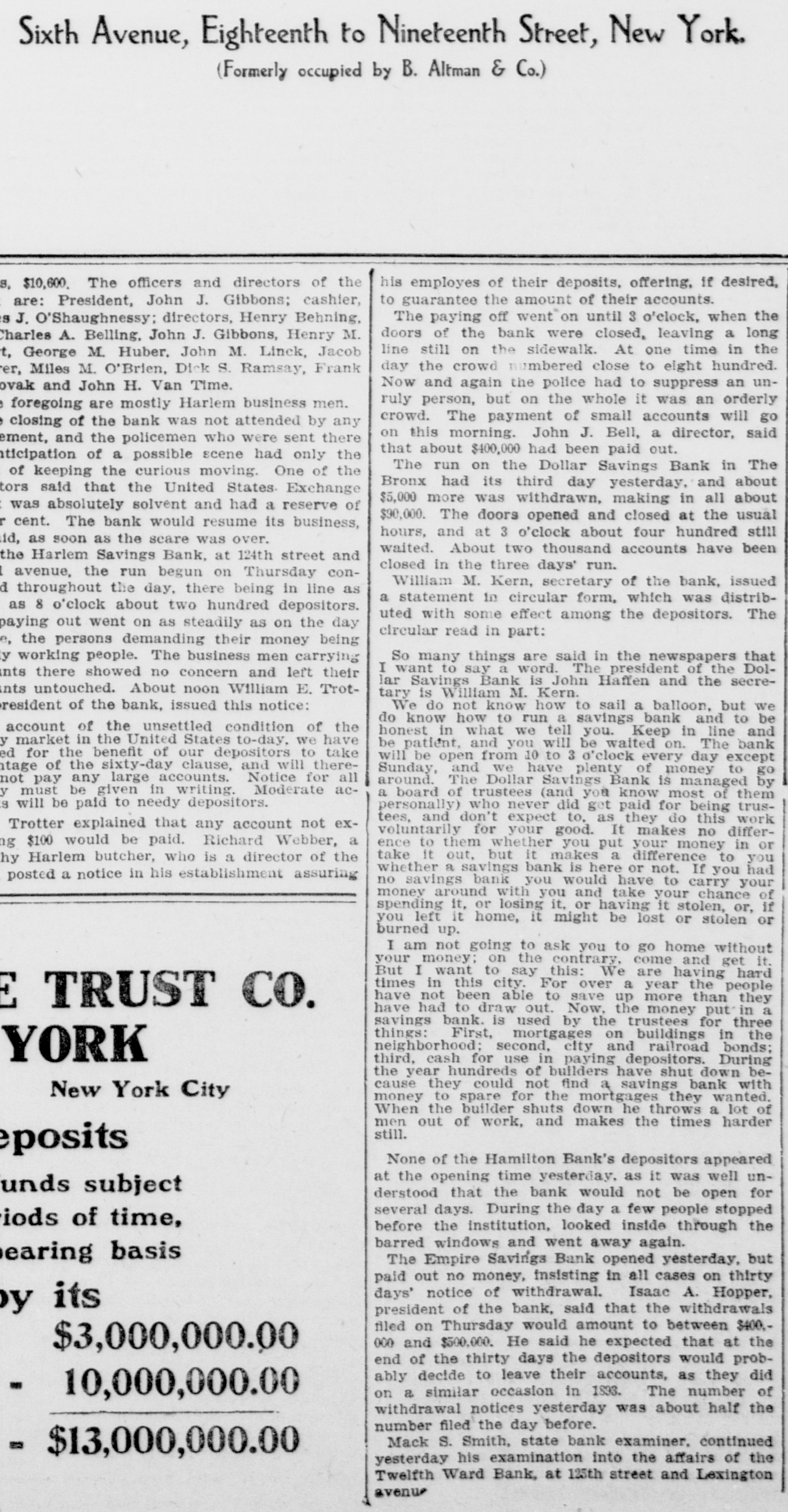
Isaac A. Hopper, president of the bank, said that the withdrawals filed on Thursday would amount to between $400,000 and $500,000. He said he expected that at the end of the thirty days the depositors would probably decide to leave their accounts, as they did on a similar occasion in 1893.
Source
newspapers
3. October 26, 1907 Suspension
Cause
Rumor Or Misinformation
Cause Details
Bank refused immediate payments and insisted on thirty days' notice to stem heavy withdrawals caused by public panic and rumors during the 1907 crisis.
Newspaper Excerpt
The Empire Savings Bank opened yesterday, but paid out no money, insisting in all cases on thirty days' notice of withdrawal.
Source
newspapers

Newspaper Articles (3)

Article from Yorkville Enquirer, October 25, 1907

Click image to open full size in new tab

Article Text

CYCLONE IN FINANCE. remendous Crisis In New Yo Quickly Averted. The financial uncertainties which been disturbing Wall Street f months past, came to a tempo crisis on Tuesday, that came nea recedented mashing rust company, things. run on the There the second Knickerbock was an large un company of New York. The rt arted without much warning an up until the company was force closed its doors at 12.30 for lack arther funds. During the day near TI 8,000,000 was paid to depositors. company had been promise 15,000,000 from other banks; but b of disclosures in connection with Morse-Heinze affair of a few da: /hen the the money that bank it was closed, had not plenty it forthcomin assured of mean I istomers which to pay all of its deposito could easily do SO within the ne: days. The depositors of tl nickerbocker Trust company include large proportion of wealthier Ne orkers, and after the run starte oney came out in great chunk /hen the suspension of payment wa nally announced the sidewalks of the main bank as well as two branch banks in other par the city were still crowded. Ne the run was resumed, and wa ontinued until the company had ispend again. A run was started o Trust Company of America ear /ednesday morning; but that concer to have plenty of money as the close of the day confidence in a large measure restored. stated that Secretary Cortelyou can the relief of the situation by de ositing about $25,000,000 of govern funds in various of the New Yo anks. A dispatch of yesterday tel story of the crisis as follows: As a result of today's developmen the financial world there is ever dication that the crisis in the banl and trust company situation ha safely passed. The Trust con any of America all through the day anking hours paid out money to de ositors as rapidly as possible an osed the day with all demands hay been met. A very favorable fea of the situation respecting th ompany was that it was able to mal payments with very little assis and another was that the con received over its counter in tl orning hours in ordinary deposi than $1,000,000. The general in ression in financial circles that th ompany having withstood a two day with so little trouble was undoub in good condition to continue i usiness and in fact that company an affairs were not considered as any longer in the general situa As the Trust Company of Ame had been the centre of the rece nancial storm it was accepted th ability it had thus shown to weat the storm was a clear indication th financial sky had cleared and th period of fair weather was now we sight. Three Notable Episodes. The day was marked by three not orthy episodes. First and earlie the day came the announcement ouble in three minor state banks tl arlem, the Hamilton Bank, welfth Ward Bank, and the Empi Savings Bank. These banl ansacted only a neighborhood bus and their suspension of payment absolutely without significan earing on the general situatio Bank Examiner Judson, hov declared this afternoon that a were solvent and that their de ositors would lose nothing. The second episode was a run in ugurated against the Lincoln Tru The against this con ompany. the was sums steady run withdrawn throughout were the da n At the close of the day tl ompany's official announced that the fully able to meet all obligation Morgan's Helping Hand. By far the most notable, even dra episode of the day was the em) of millions of money into tl tock exchange through a pool head J. P. Morgan and other financie order to avert a ruthless selling o stocks held by brokers which w: reatened because of their inability btain renewals of loans on which stocks had been carried. A r arkable condition brought about th treme stringency in money which gradually forced the interest ra ertain to resources an large almost interests had unprecedented been of charging great figur finar r ently what was in effect, if not lega usurious rates of interest on ca One institution that had be agaged in this practice was itself

Article from Waterbury Evening Democrat, October 25, 1907

Click image to open full size in new tab

Article Text

CRISIS IS AVERTED. Morgan, John D. and Uncle Sam Raise $110,000,000 Relief. HARLEM BANKS CLOSE DOORS $27,000,000 Sent Into New York Stock Exchange and Other Great Sums Distributed Clear Financial Air-Outlook Is Satisfactory, Says Cortelyou. New York. Oct. 25.-Equipped with a relief fund amounting to $60,000,000 in actual cash and with an additional $50,000,000 available J. Pierpont Morgan, co-operating with the Washington administration and John D. Rockefeller, succeeded 'in preventing the collapse of any financial institutions in this city. Had it not been for his appreciation of the situation and his promptness there would undoubtedly have resulted a most serious panic on the stock exchange. For a few tense moments the indications strongly pointed to the of on complete collapse values the exchange. That such a calamity was averted was solely due to the decisive action of Mr. Morgan and his associates who were in command of the financial situation. Three Banks Suspend Payment. Yet there was not a single failure of any financial or business institution. Runs inspired by senseless fear and rumors were on irresponsible started the Lincoln Trust company, the Harlem bank, the Savings Empire Savings bank, the Dollar bank and the Fifth Avenue Trust company. The Empire Savings bank, the Twelfth Ward bank and the Hamilton bank suspended payment for the time being and are in charge of the state department of banks. The Lincoln Trust company and the Harlem bank weathered the storm successfully, and the indications are that they will continue to meet every demand made upon their resources. No better illustration of the feeling of nervous apprehension among depositors in financial institutions could be afforded than the run on the Harlem Savings bank, one of the strongest institutions in the city. There was absolutely no justification for suspicion as the bank's to solvency beyond the anxiety existing among persons having bank accounts as a result of the suspension of the Knickerbocker Trust company and other recent financial scandals. Mr. Morgan and his associates had carefully planned to protect the banks as was and trust companies, shown by the success of the Trust Company of America in withstanding the second day's attack made on its resources by its That was depositors. institution the storm center of the financial disturbance outside of the stock exchange. It met every demand with at prompt payment. and the close the of business President Thorne and other officers of the company were confident that they would get through all right. Trust Company Took In a Million. The run on the trust company continued all day, but toward the close of it the number of persons who demanded their money were not as many as had been expected. The most hopeful feature of the run was that while only $4,000,000 was paid out as against $9,000,000 on the previous day deposits aggregating nearly $1,000,000 were taken in by the receiving tellers.


Article from New-York Tribune, October 26, 1907

Click image to open full size in new tab

Article Text

Sixth Avenue, Eighteenth to Nineteenth Street, New York. (Formerly occupied by B. Altman & Co.) his employes of their deposits, offering, if desired, S. $10,600. The officers and directors of the to guarantee the amount of their accounts. are: President, John J. Gibbons; cashier, The paying off went on until 3 o'clock, when the s J. O'Shaughnessy; directors, Henry Behning, doors of the bank were closed, leaving a long Charles A. Belling. John J. Gibbons, Henry M. line still on the sidewalk. At one time in the t, George M. Huber, John M. Linck, Jacob day the crowd numbered close to eight hundred. er, Miles M. O'Brien, Dick S. Ramsay, Frank Now and again the police had to suppress an unovak and John H. Van Time. ruly person, but on the whole it was an orderly , foregoing are mostly Harlem business men. crowd. The payment of small accounts will go $ closing of the bank was not attended by any on this morning. John J. Bell, a director, said ement, and the policemen who were sent there that about $400,000 had been paid out. nticipation of a possible scene had only the The run on the Dollar Savings Bank in The of keeping the curious moving. One of the Bronx had its third day yesterday, and about tors said that the United States. Exchange $5,000 more was withdrawn, making in all about : was absolutely solvent and had a reserve of $90,000. The doors opened and closed at the usual r cent. The bank would resume its business, hours, and at 3 o'clock about four hundred still id, as soon as the scare was over. waited. About two thousand accounts have been the Harlem Savings Bank, at 124th street and closed in the three days' run. 1 avenue, the run begun on Thursday conWilliam M. Kern, secretary of the bank, issued d throughout the day, there being in line as a statement in circular form, which was distribas 8 o'clock about two hundred depositors. uted with some effect among the depositors. The paying out went on as steadily as on the day circular read in part: e, the persons demanding their money being y working people. The business men carrying So many things are said in the newspapers that I want to say a word. The president of the Dolnts there showed no concern and left their lar Savings Bank is John Haffen and the secrents untouched. About noon William E. Trottary is William M. Kern. We do not know how to sail a balloon. but we president of the bank, issued this notice: do know how to run a savings bank and to be account of the unsettled condition of the honest in what we tell you. Keep in line and y market in the United States to-day, we have be patient, and you will be waited on. The bank ed for the benefit of our depositors to take will be open from 10 to 3 o'clock every day except tage of the sixty-day clause, and will thereSunday, and we have plenty of money to go not pay any large accounts. Notice for all around. The Dollar Savings Bank is managed by a board of trustees (and you know most of them y must be given in writing. Moderate acs will be paid to needy depositors. personally) who never did get paid for being trustees, and don't expect to, as they do this work Trotter explained that any account not exvoluntarily for your good. It makes no differng $100 would be paid. Richard Webber, a ence to them whether you put your money in or take it out, but it makes a difference to you hy Harlem butcher, who is a director of the whether a savings bank is here or not. If you had posted a notice in his establishment assuring no savings bank you would have to carry your money around with you and take your chance of spending it, or losing it. or having it stolen, or, if you left it home, it might be lost or stolen or burned up. I am not going to ask you to go home without your money; on the contrary, come and get it. But I want to say this: We are having hard times in this city. For over a year the people have not been able to save up more than they E TRUST CO. have had to draw out. Now. the money put in a savings bank. is used by the trustees for three things: First, mortgages on buildings in the neighborhood; second, city and railroad bonds: YORK third, cash for use in paying depositors. During the year hundreds of builders have shut down because they could not find a savings bank with New York City money to spare for the mortgages they wanted. When the builder shuts down he throws a lot of men out of work, and makes the times harder still. eposits None of the Hamilton Bank's depositors appeared at the opening time yesterday, as it was well ununds subject derstood that the bank would not be open for several days. During the day a few people stopped iods of time, before the institution, looked inside through the barred windows and went away again. earing basis The Empire Savings Bank opened yesterday, but paid out no money, insisting in all cases on thirty days' notice of withdrawal. Isaac A. Hopper, by its president of the bank, said that the withdrawals filed on Thursday would amount to between $400,000 and $500,000. He said he expected that at the $3,000,000.00 end of the thirty days the depositors would probably decide to leave their accounts, as they did on a similar occasion in 1893. The number of 10,000,000.00 withdrawal notices yesterday was about half the number filed the day before. = Mack S. Smith, state bank examiner. continued $13,000,000.00 yesterday his examination into the affairs of the Twelfth Ward Bank, at 125th street and Lexington avenue