15747. Wilkin Hale State Bank (Oklahoma City, OK)

Bank Information

Episode Type
Run โ†’ Suspension โ†’ Closure
Bank Type
state
Start Date
March 8, 1922
Location
Oklahoma City, Oklahoma (35.468, -97.516)

Metadata

Model
gpt-5-mini
Short Digest
5bef11e1aef8ead0

Response Measures

None

Description

Contemporary accounts (March 8, 1922) report a quiet or slow but decided run of about three weeks driven by persistent rumors/gossip that forced the Wilkin-Hale State Bank to close and be placed in the hands of the State Banking Department for reorganization. Subsequent reporting (1925) refers to a liquidator and worthless notes, indicating the bank did not resume normal independent operations and entered liquidation/receivership.

Events (3)

1. March 8, 1922 Run
Cause
Rumor Or Misinformation
Cause Details
Persistent street rumors and gossip about the bank's solvency produced a quiet/steady run lasting roughly three weeks prior to March 8, 1922.
Measures
Attempted to obtain a national charter (nationalize); clearing house association offered help which was declined.
Newspaper Excerpt
Rumors concerning the bank's condition started a slow but decided run on the bank which has extended over the last three weeks resulting in the necessity of closing the doors.
Source
newspapers
2. March 8, 1922 Suspension
Cause
Rumor Or Misinformation
Cause Details
Suspension/closure ordered after the sustained withdrawals driven by rumors; placed in hands of State Banking Department for reorganization.
Newspaper Excerpt
The Wilkin Hale State bank ... closed its doors today with an announcement that its affairs had been placed in the hands of the state banking department for reorganization.
Source
newspapers
3. * Receivership
Newspaper Excerpt
Prentice Price, liquidator for the Wilkin-Hale Bank, Oklahoma City, says another small dividend will be paid in connection with the failure of that institution ... more than $600,000 in worthless notes is on hand, with no hope of collection.
Source
newspapers

Newspaper Articles (7)

Article from The Rock Island Argus and Daily Union, March 8, 1922

Click image to open full size in new tab

Article Text

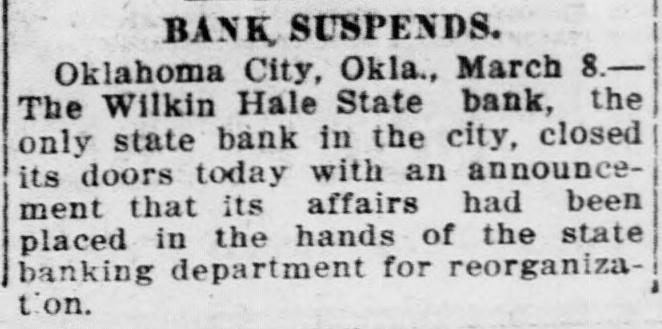
BANK SUSPENDS. Oklahoma City, Okla., March 8.The Wilkin Hale State bank, the only state bank in the city, closed its doors today with an announcement that its affairs had been placed in the hands of the state banking department for reorganizaton.


Article from The Guthrie Daily Leader, March 8, 1922

Click image to open full size in new tab

Article Text

WilkinHaleBank Fails Oklahoma City, March 8-The Wilkin-Hale bank of this city was closed to business today. The bank is in the hands of Bank Commissioner Waleott. Attempt at reorganization has been begun. Officers of the closed bank are J.L. Wilkin, president : John M. Hale and W. C. Ernest, vicepresidents : R 11. Wilkin, cashier, and Luther Jones and Patrick Roben, assistant cashiers. No other city banks are affected, it is declared. Treasurer Leocraft said $200,000 in state funds were deposited in the bank. Rumors St. rted Run The following statement was given out: Rumors concerning the bank's condition started a slow hnt decided run on the bank which has extended over the last three weeks resulting in the necessity of closing the doors. The bank had thought to nationalize but failing in this was 1111able to withstand the strain. First application for a national charter was made last November "All state, city and county funds, aggregating $245,000. are secured by Liberty bonds. We hope to be able to reorganize the bank but should we fail we are confident that the depositors will get their money as a result of limidation procedure. Clearing House Offered Help That help had been tendered the bank last Saturday by the Oklahoma City Clearing House association, but declined, was the announcement made by Dan W. Hogan. president of the association The statement, passed upon by the association. declared that closing of the Wilkin-Hale bank "does not in any way involve any other institution in this city, and it is paradoxical that it should occur at a time when the combined statements of all the other clearing house banks show the strongest reserve in the history of the institution." The statement added that the embarrassment of the Wilkin-Hale bank is an "isolated case not related to present conditions." The last state bank statement showed deposits of $2,204,627.70 in the Wilkin-Hale bank and loans and discounts of $1.570,073.69. Resources and liabilities were each given as $2,728,759.09


Article from The New York Herald, March 9, 1922

Click image to open full size in new tab

Article Text

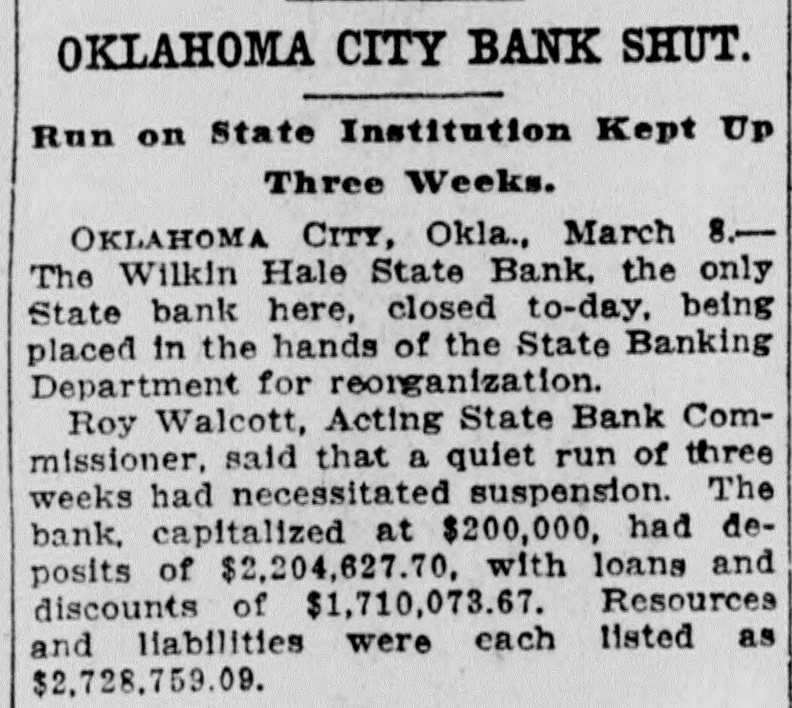
OKLAHOMA CITY BANK SHUT. Run on State Institution Kept Up Three Weeks. OKLAHOMA CITY, Okla., March 8.The Wilkin Hale State Bank, the only State bank here, closed to-day. being placed in the hands of the State Banking Department for reorganization. Roy Walcott, Acting State Bank Commissioner, said that a quiet run of three weeks had necessitated suspension. The bank, capitalized at $200,000, had deposits of $2,204,627.70, with loans and discounts of $1,710,073.67. Resources and liabilities were each listed as $2,728,759.09.


Article from The Butler Weekly Times and the Bates County Record, March 16, 1922

Click image to open full size in new tab

Article Text

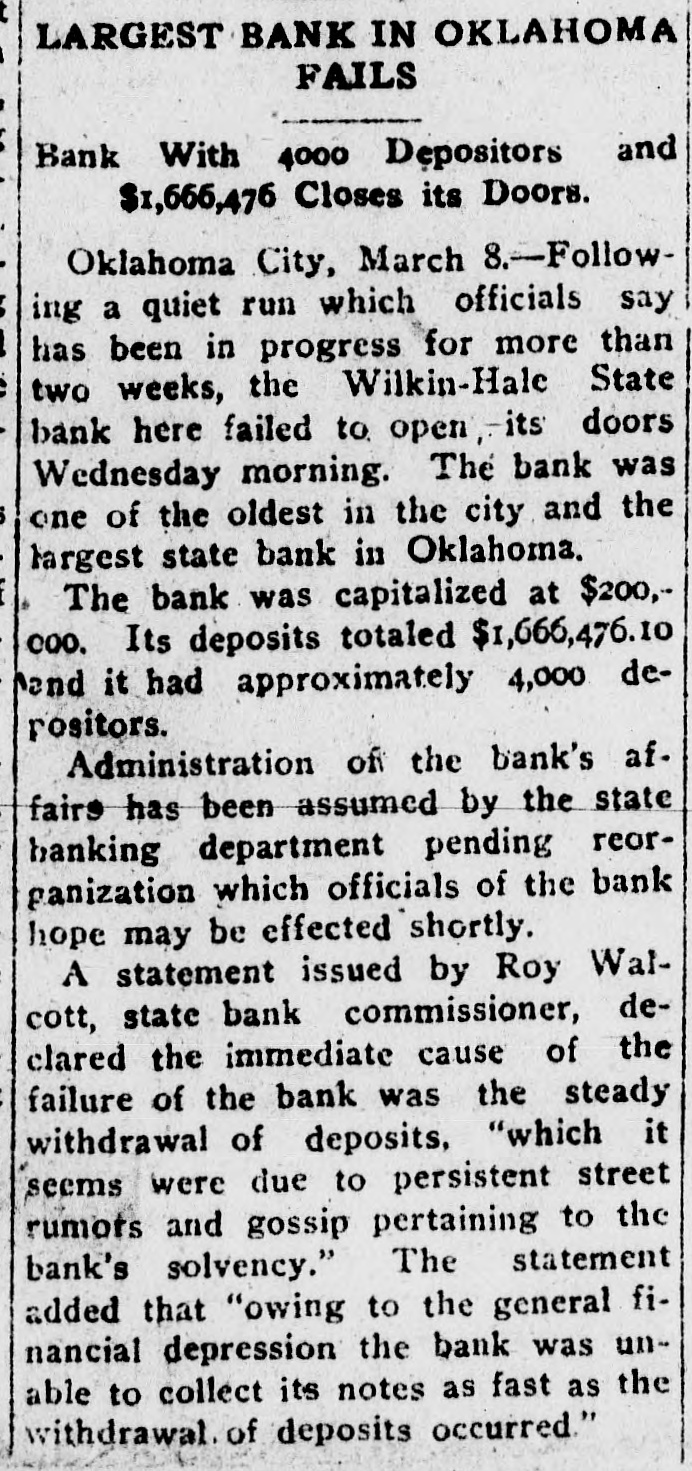
LARGEST BANK IN OKLAHOMA FAILS Bank With 4000 Depositors and $1,666,476 Closes its Doors. Oklahoma City, March 8.-Following a quiet run which officials say has been in progress for more than two weeks, the Wilkin-Hale State bank here failed to open its doors Wednesday morning. The bank was one of the oldest in the city and the largest state bank in Oklahoma. The bank was capitalized at $200,000. Its deposits totaled $1,666,476.10 and it had approximately 4,000 depositors. Administration of the bank's affairs has been assumed by the state banking department pending reorpanization which officials of the bank hope may be effected shortly. A statement issued by Roy Walcott, state bank commissioner, declared the immediate cause of the failure of the bank was the steady withdrawal of deposits, "which it seems were due to persistent street rumots and gossip pertaining to the bank's solvency." The statement added that "owing to the general financial depression the bank was unable to collect its notes as fast as the withdrawal. of deposits occurred."


Article from The Chickasha Daily Express, March 24, 1922

Click image to open full size in new tab

Article Text

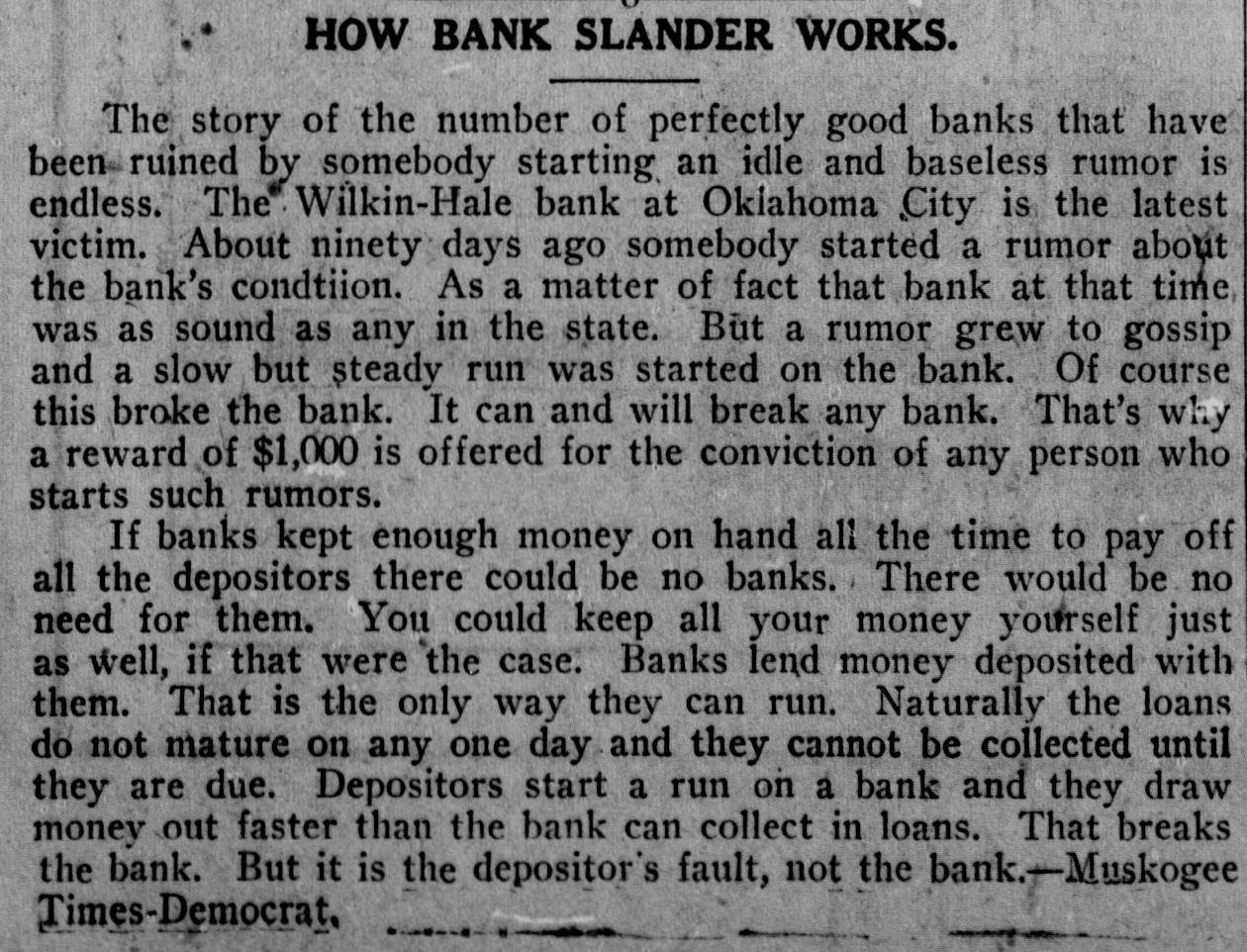
# HOW BANK SLANDER WORKS. The story of the number of perfectly good banks that have been ruined by somebody starting an idle and baseless rumor is endless. The Wilkin-Hale bank at Oklahoma City is the latest victim. About ninety days ago somebody started a rumor about the bank's condtiion. As a matter of fact that bank at that time was as sound as any in the state. But a rumor grew to gossip and a slow but steady run was started on the bank. Of course this broke the bank. It can and will break any bank. That's why a reward of $1,000 is offered for the conviction of any person who starts such rumors. If banks kept enough money on hand all the time to pay off all the depositors there could be no banks. There would be no need for them. You could keep all your money yourself just as well, if that were the case. Banks lend money deposited with them. That is the only way they can run. Naturally the loans do not mature on any one day and they cannot be collected until they are due. Depositors start a run on a bank and they draw money out faster than the bank can collect in loans. That breaks the bank. But it is the depositor's fault, not the bank. - Muskogee Times-Democrat,


Article from The Chickasha Daily Express, June 9, 1922

Click image to open full size in new tab

Article Text

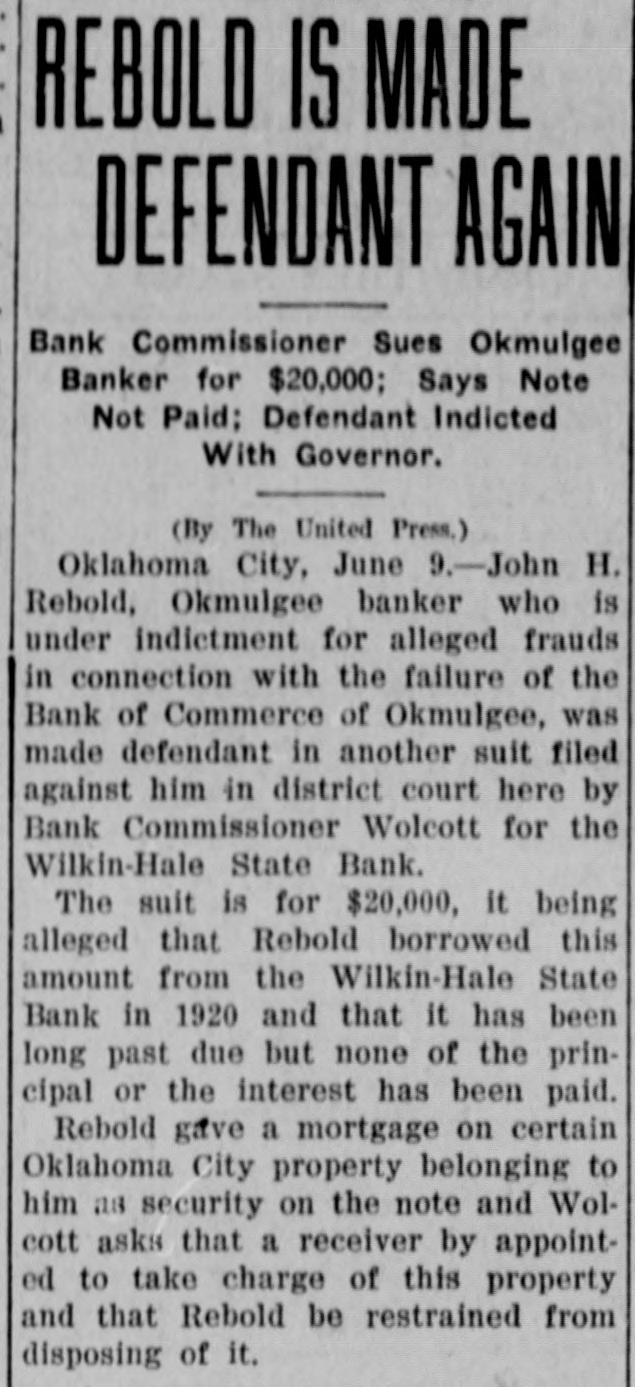
REBOLD IS MADE DEFENDANT AGAIN Bank Commissioner Sues Okmulgee Banker for $20,000; Says Note Not Paid: Defendant Indicted With Governor. (By The United Press.) Oklahoma City, June 9.-John H. Rebold, Okmulgee banker who is under indictment for alleged frauds in connection with the failure of the Bank of Commerce of Okmulgee, was made defendant in another suit filed against him in district court here by Bank Commissioner Wolcott for the Wilkin-Hale State Bank. The suit is for $20,000, it being alleged that Rebold borrowed this amount from the Wilkin-Hale State Bank in 1920 and that it has been long past due but none of the principal or the interest has been paid. Rebold gave a mortgage on certain Oklahoma City property belonging to him as security on the note and Wolcott asks that a receiver by appointed to take charge of this property and that Rebold be restrained from disposing of it.


Article from The Oklahoma Banker, November 1, 1925

Click image to open full size in new tab

Article Text

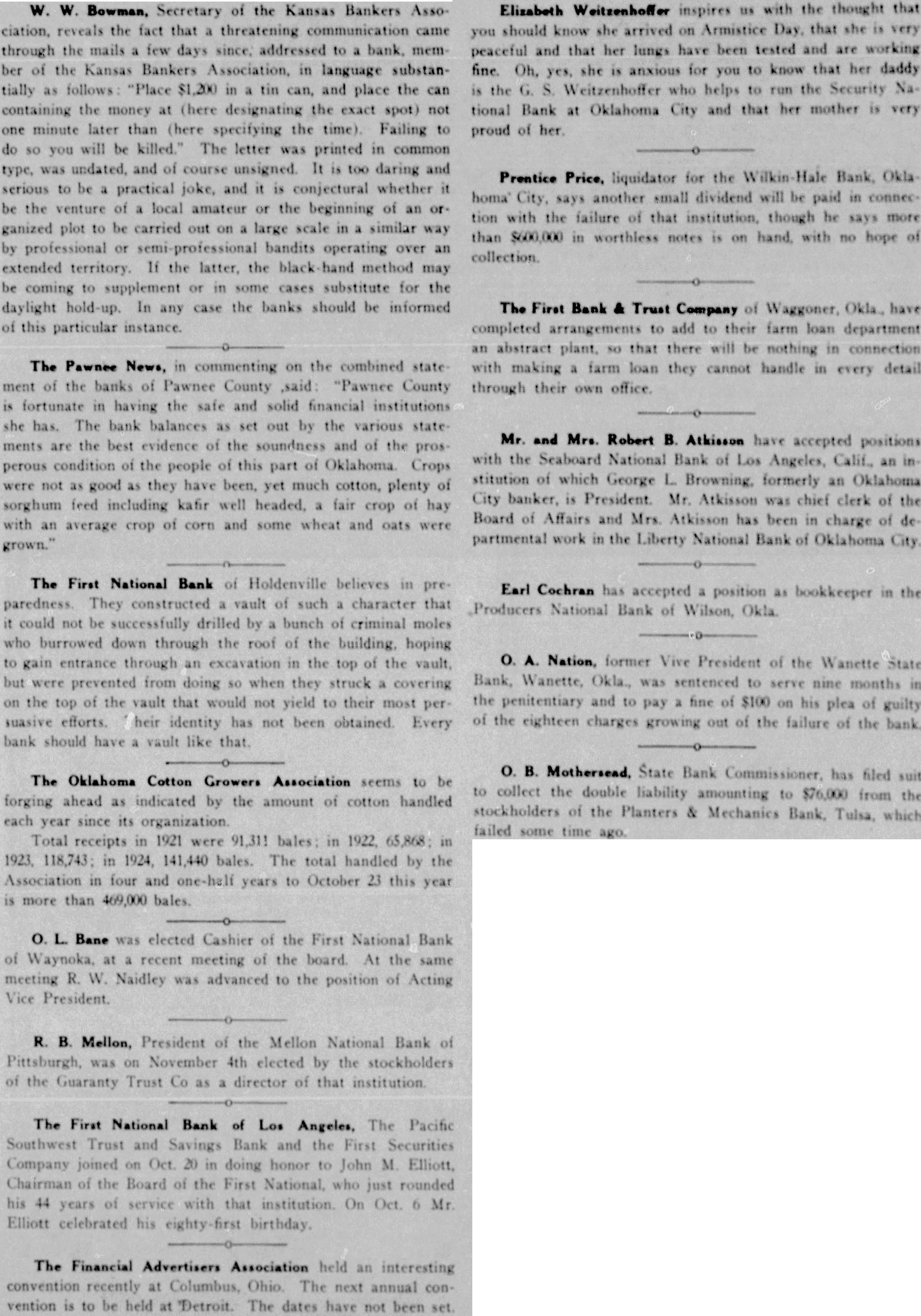
W. W. Bowman, Secretary of the Kansas Bankers Association, reveals the fact that a threatening communication came through the mails a few days since, addressed to a bank, member of the Kansas Bankers Association, in language substantially as follows: "Place $1,200 in a tin can, and place the can containing the money at (here designating the exact spot) not one minute later than (here specifying the time). Failing to do so you will be killed." The letter was printed in common type, was undated, and of course unsigned. It is too daring and serious to be a practical joke, and it is conjectural whether it be the venture of a local amateur or the beginning of an organized plot to be carried out on a large scale in a similar way by professional or semi-professional bandits operating over an extended territory. If the latter, the black-hand method may be coming to supplement or in some cases substitute for the daylight hold-up. In any case the banks should be informed of this particular instance. The Pawnee News, in commenting on the combined statement of the banks of Pawnee County ,said: "Pawnee County is fortunate in having the safe and solid financial institutions she has. The bank balances as set out by the various statements are the best evidence of the soundness and of the prosperous condition of the people of this part of Oklahoma. Crops were not as good as they have been, yet much cotton, plenty of sorghum feed including kafir well headed, a fair crop of hay with an average crop of corn and some wheat and oats were grown." The First National Bank of Holdenville believes in preparedness. They constructed a vault of such a character that it could not be successfully drilled by a bunch of criminal moles who burrowed down through the roof of the building. hoping to gain entrance through an excavation in the top of the vault, but were prevented from doing so when they struck a covering on the top of the vault that would not yield to their most persuasive efforts. heir identity has not been obtained. Every bank should have a vault like that. The Oklahoma Cotton Growers Association seems to be forging ahead as indicated by the amount of cotton handled each year since its organization. Total receipts in 1921 were 91,311 bales: in 1922, 65,868; in 1923, 118,743; in 1924, 141,440 bales. The total handled by the Association in four and one-half years to October 23 this year is more than 469,000 bales. O. L. Bane was elected Cashier of the First National Bank of Waynoka, at a recent meeting of the board. At the same meeting R. W. Naidley was advanced to the position of Acting Vice President. R. B. Mellon, President of the Mellon National Bank of Pittsburgh, was on November 4th elected by the stockholders of the Guaranty Trust Co as a director of that institution. The First National Bank of Los Angeles, The Pacific Southwest Trust and Savings Bank and the First Securities Company joined on Oct. 20 in doing honor to John M. Elliott, Chairman of the Board of the First National, who just rounded his 44 years of service with that institution. On Oct. 6 Mr. Elliott celebrated his eighty-first birthday. The Financial Advertisers Association held an interesting convention recently at Columbus, Ohio. The next annual convention is to be held at Detroit. The dates have not been set. Elizabeth Weitzenhoffer inspires us with the thought that you should know she arrived on Armistice Day. that she is very peaceful and that her lungs have been tested and are working fine. Oh, yes, she is anxious for you to know that her daddy is the G. S. Weitzenhoffer who helps to run the Security National Bank at Oklahoma City and that her mother is very proud of her. Prentice Price, liquidator for the Wilkin-Hale Bank, Oklahoma" City, says another small dividend will be paid in connection with the failure of that institution, though he says more than $600,000 in worthless notes is on hand, with no hope of collection. The First Bank & Trust Company of Waggoner, Okla., have completed arrangements to add to their farm loan department an abstract plant, so that there will be nothing in connection with making a farm loan they cannot handle in every detail through their own office. Mr. and Mrs. Robert B. Atkisson have accepted positions with the Seaboard National Bank of Los Angeles, Calif., an institution of which George L. Browning, formerly an Oklahoma City banker, is President. Mr. Atkisson was chief clerk of the Board of Affairs and Mrs. Atkisson has been in charge of departmental work in the Liberty National Bank of Oklahoma City. Earl Cochran has accepted a position as bookkeeper in the Producers National Bank of Wilson, Okla. O. A. Nation, former Vive President of the Wanette State Bank, Wanette, Okla., was sentenced to serve nine months in the penitentiary and to pay a fine of $100 on his plea of guilty of the eighteen charges growing out of the failure of the bank. O. B. Mothersead, State Bank Commissioner, has filed suit to collect the double liability amounting to $76,000 from the stockholders of the Planters & Mechanics Bank, Tulsa, which failed some time ago,