Accommodated withdrawals, Capital injected, Full suspension, Books examined
Receivership Details
Depositor recovery rate
91.3%
Date receivership started
1925-11-07
Date receivership terminated
1934-07-03
OCC cause of failure
Economic conditions
Share of assets assessed as good
62.1%
Share of assets assessed as doubtful
16.1%
Share of assets assessed as worthless
21.8%
Description
Newspapers report a run beginning mid-October 1925 that forced directors to close the bank (Oct 20–21, 1925). Examiner involvement and later appointment of L. R. Kershaw as receiver (early November 1925) indicate the bank did not resume normal operations under its charter and entered receivership; subsequent articles describe liquidation and formation of a new, separate bank in 1926. OCR errors in some articles corrected (e.g., dates and minor name spacing).
Events (5)
1.November 23, 1922Chartered
Source
historical_nic
2.October 16, 1925Run
Cause
Rumor Or Misinformation
Cause Details
Rumors and irresponsible gossip circulating for about a month provoked withdrawals and a run beginning the Friday before Oct 20–21, 1925.
Measures
Directors accepted deposits up to the last minute; called bank examiners; then closed doors to prevent preferred depositors and protect smaller depositors.
Newspaper Excerpt
Run on the bank, begun last Friday and growing to serious proportions
Source
newspapers
3.October 20, 1925Suspension
Cause
Rumor Or Misinformation
Cause Details
Directors closed the bank to halt a rapidly growing run attributed to circulating rumors and gossip; closure intended to prevent preferential withdrawals and protect depositors.
Newspaper Excerpt
Muskogee Security National bank closed its doors here at noon today. ... The doors were closed at the request of the bank's board of directors, not because of an order from the bank examiner.
Source
newspapers
4.November 7, 1925Receivership
Source
historical_nic
5.November 7, 1925Receivership
Newspaper Excerpt
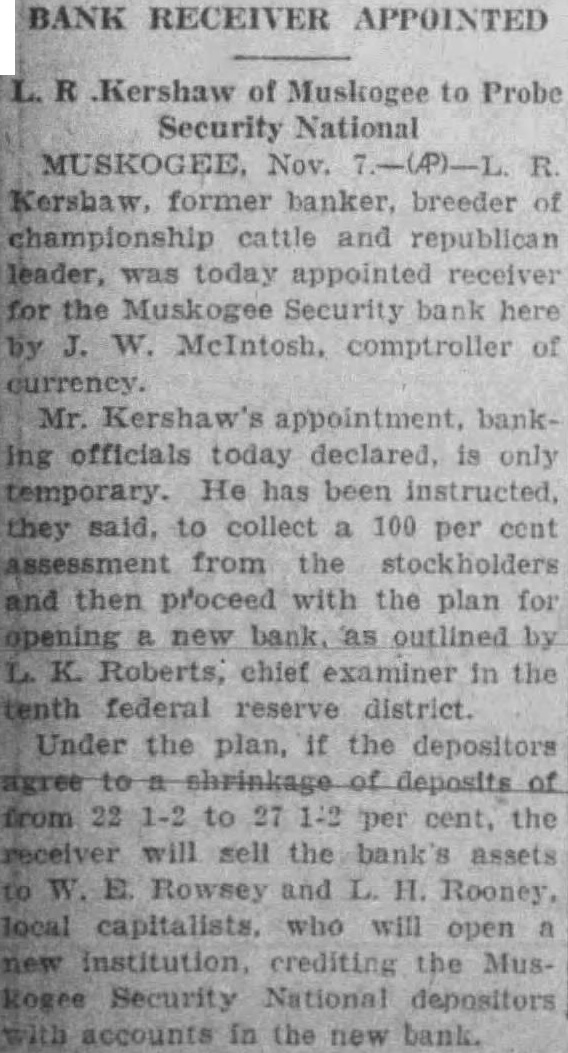
L. R. Kershaw has been appointed receiver for the Muskogee-Security National bank, and is now in charge of that institution.
Source
newspapers
Newspaper Articles (15)
1.October 21, 1925Drumright Weekly DerrickDrumright, OK
Click image to open full size in new tab
Article Text
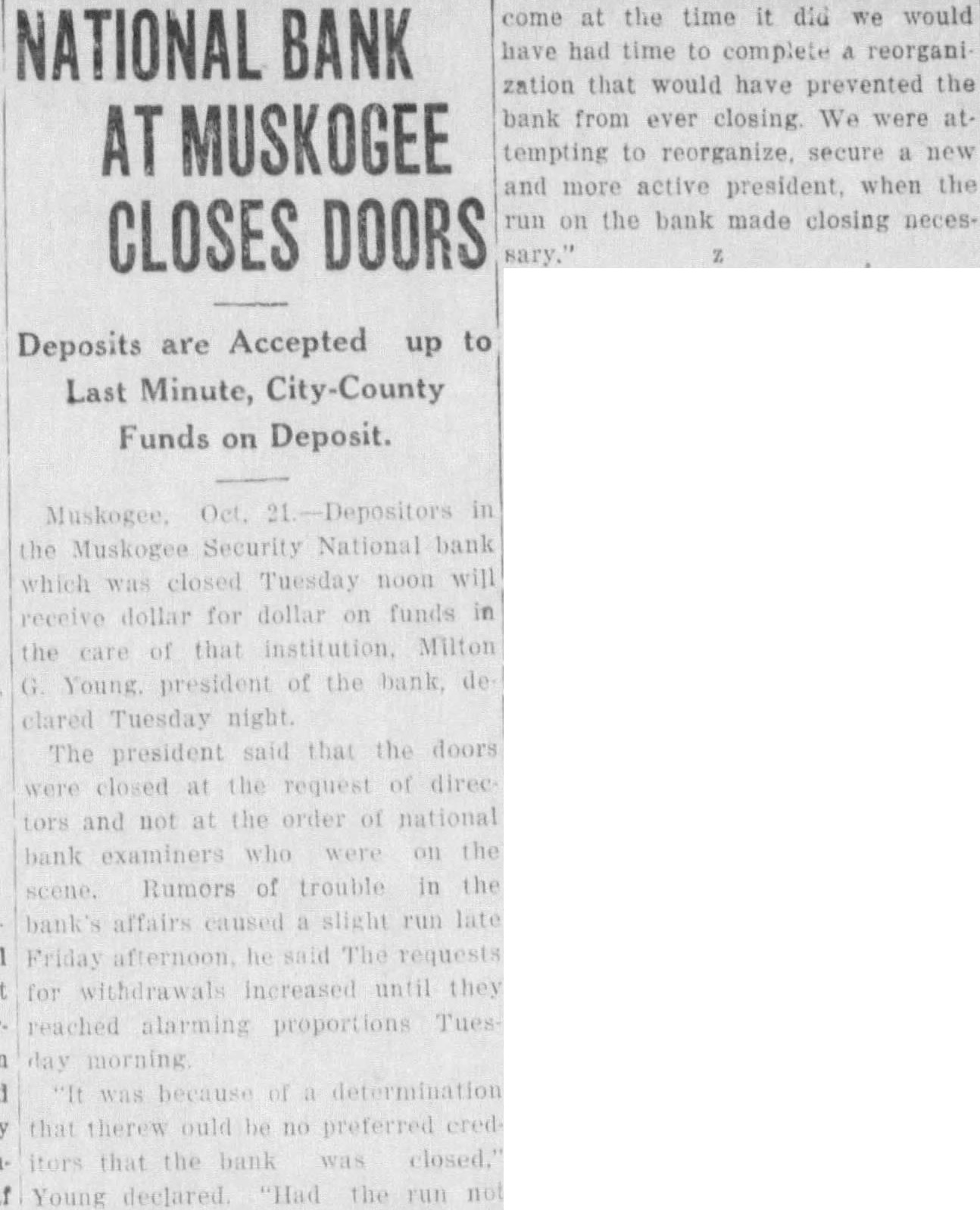
NATIONAL BANK AT MUSKOGEE CLOSES DOORS
Deposits are Accepted up to Last Minute, City-County Funds on Deposit. the Muskogee Security National bank was closed Tuesday noon will receive dollar for dollar on funds in the care of that institution. Milton G. Young. president of the bank, de clared Tuesday night. The president said that the doors were closed at the request of direc and not at the order of national tors bank examiners who were on the Rumors of trouble in the affairs caused a slight run late Friday he said The requests withdrawals until they for reached alarming proportions Tues day morning because determination that therew be no preferred that the bank was Young "Had come at the time it did would have had time to complete a reorgani zation that would have prevented the bank from ever closing We were attempting to reorganize. secure a new and more active president, when the run on the bank made closing necessary."
2.October 21, 1925Okmulgee Daily TimesOkmulgee, OK
Click image to open full size in new tab
Article Text
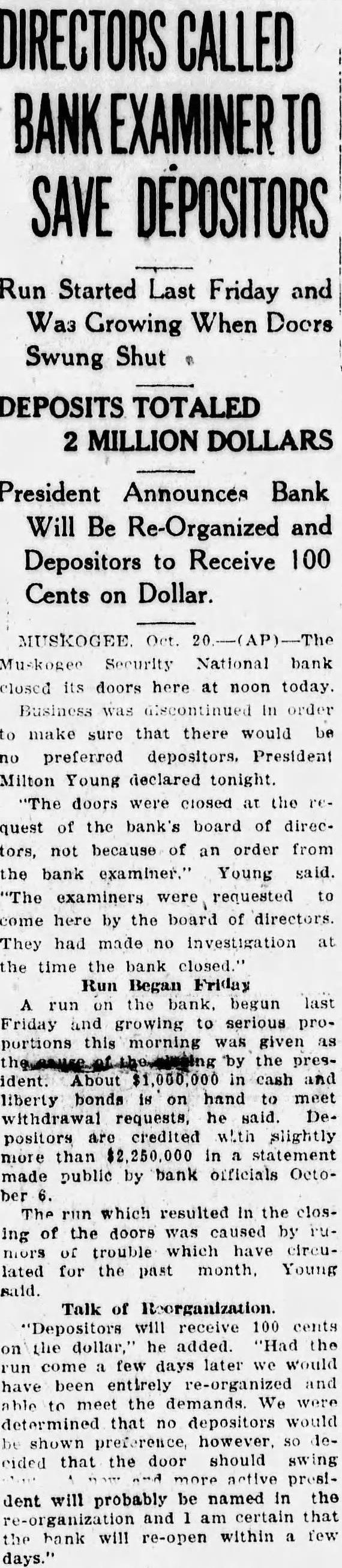
DIRECTORS CALLED BANK EXAMINER TO SAVE DÉPOSITORS
Run Started Last Friday and Was Growing When Doors Swung Shut
DEPOSITS TOTALED 2 MILLION DOLLARS
President Announces Bank Will Be Re-Organized and Depositors to Receive 100 Cents on Dollar.
MUSKOGEE Oct. 20 Muskogee Security National bank closed its doors here at noon today. Business was discontinued In order to make sure that there would be no preferred depositors. President Milton Young declared tonight. "The doors were closed at the request of the bank's board of directors, not because of an order from the bank examiner." Young said. "The examiners were requested to come here by the board of directors. They had made no investigation at the time the bank closed." Run Began Friday A run on the bank. begun last Friday and growing to serious proportions this morning was given as by the president. About $1,000,000 in cash and liberty bonds 18 on hand to meet withdrawal requests, he said. Depositors are credited with slightly more than $2,250,000 in statement made public by bank officials October 6. The run which resulted In the closing of the doors was caused by rumors of trouble which have circulated for the past month. Young said.
Talk of Reorganization. "Depositors will receive 100 cents on the dollar," he added. "Had the run come a few days later we would have been entirely re-organized and able to meet the demands. We were determined that no depositors would be shown preference, however, so lecided that the door should swing --- more active president will probably be named in the re-organization and am certain that the bank will re-open within a few days."
3.October 21, 1925Muskogee Daily Phoenix and Times-DemocratMuskogee, OK
Click image to open full size in new tab
Article Text
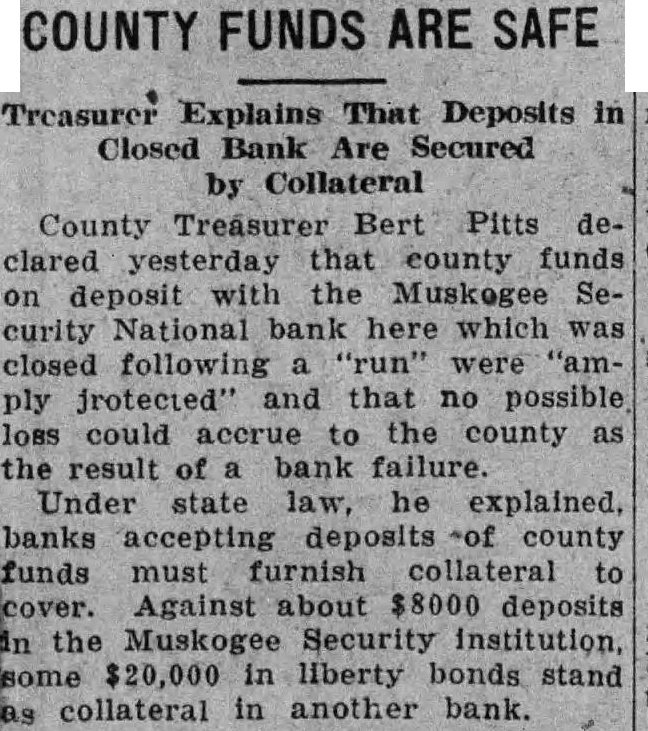
COUNTY FUNDS ARE SAFE
Treasurer Explains That Deposits in Closed Bank Are Secured by Collateral
County Treasurer Bert Pitts declared yesterday that county funds on deposit with the Muskogee Security National bank here which was closed following were "amply frotected' and that no possible loss could to the county as the result of bank failure. Under state law, he explained, banks accepting deposits of county funds must furnish collateral to Against about $8000 deposits the Muskogee Security institution, some $20,000 liberty bonds stand collateral in another bank.
4.October 21, 1925Muskogee Daily Phoenix and Times-DemocratMuskogee, OK
Click image to open full size in new tab
Article Text
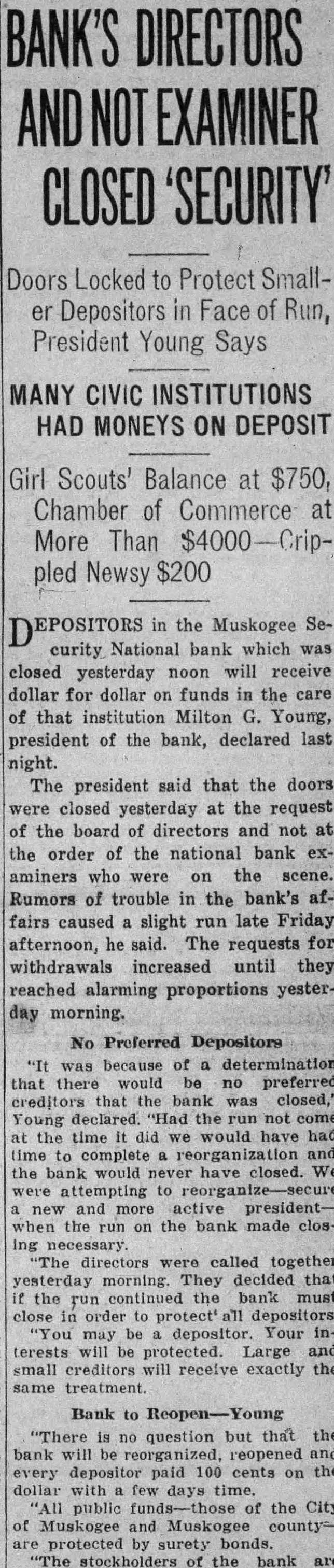
BANK'S DIRECTORS AND EXAMINER CLOSED 'SECURITY'
Doors Locked to Protect Smaller Depositors in Face of Run, President Young Says
MANY CIVIC INSTITUTIONS HAD MONEYS ON DEPOSIT
Girl Scouts' Balance at $750, Chamber of Commerce at More Than pled Newsy $200 in the Muskogee Security National bank which was closed yesterday noon will receive dollar for dollar on funds in the care of that institution Milton G. Young, president of the bank, declared last night. The president said that the doors were closed yesterday at the request of the board of directors and not at the order of the national bank examiners who were on the scene. Rumors of trouble in the bank's affairs caused slight run late Friday afternoon, he said. The requests for withdrawals increased until they reached alarming proportions yesterday morning.
No Preferred Depositors
"It was because of determination that there would be no preferred creditors that the bank was closed,' Young declared. "Had the run not come at the time did we would have had time to complete and the bank would never have closed. We were attempting to new and more active presidentwhen the run on the bank made closIng "The directors were called together yesterday morning. They decided that the run continued the bank must close in order to protect all depositors. "You may be depositor. Your interests will be protected. Large and small creditors will receive exactly the same treatment.
Bank to Reopen-Young
"There is no question but that the bank will be reorganized, reopened and every depositor paid 100 cents on the dollar with days time. public of the City of Muskogee and Muskogee countyare protected by surety bonds. "The stockholders of the bank are
5.October 21, 1925Muskogee Daily Phoenix and Times-DemocratMuskogee, OK
Click image to open full size in new tab
Article Text
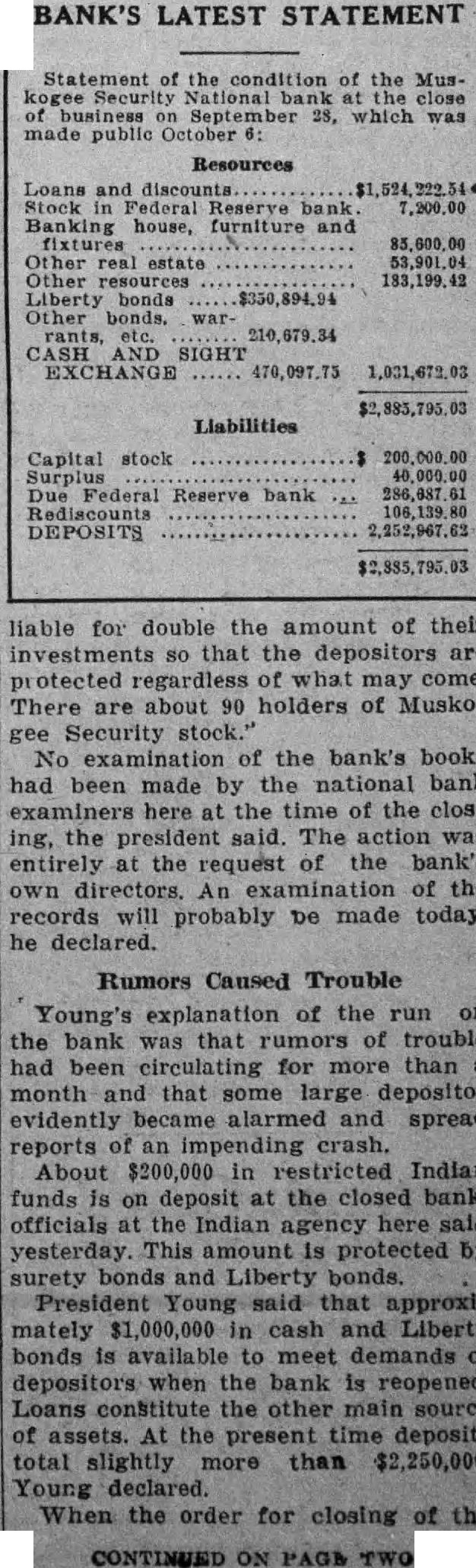
BANK'S LATEST STATEMENT
Statement condition the Muswhich was public October
Resources
Loans Reserve bank Banking house, furniture estate resources Liberty bonds AND SIGHT EXCHANGE
$2,885,795.03
Liabilities Capital stock Reserve DEPOSITS liable for double the amount of their investments SO that the depositors are protected regardless of what may come. There are about 90 holders of Muskogee Security stock." No examination of the bank's books had been made by the national bank examiners here at the time of the closing, the president said The action entirely at the request of the bank's own An of the records will probably be made today, he declared.
Rumors Caused Trouble
Young's explanation of the run on the bank was that of trouble had been circulating for more than month and that some large depositor evidently alarmed and spread reports of an crash. About $200,000 in restricted Indian funds is on deposit at the closed bank, officials at the Indian here said yesterday. This amount protected by surety bonds and Liberty bonds. that approximately $1,000,000 in cash and Liberty bonds is available to meet demands of depositors when the bank is reopened. Loans constitute the other main source of assets. At the present time deposits total slightly more than $2,250,000, Young declared. When the order for closing of the
CONTINUED ON PAGE TWO
6.October 21, 1925Tulsa WorldTulsa, OK
Click image to open full size in new tab
Article Text
MUSKOGEE CLOSES DOORS
Official Denies Action Is Ordered by Federal Examiners
PAY
Deposits Accepted Up to Last Minute; City and County Funds on Deposit the Muskogee Security National bank which Tuesday will receive dollar dollar funds in the that institution, Milton Young of the bank, declared night. The president said that the doors closed the request direcand not the order of national bank examiners who were the Rumors trouble the bank's affairs caused run Friday afternoon, he The requests until they reached alarming proportions Tuesday morning was because of determination that there would be ferred that the bank was closed,' Young declared. "Had the not come the time did would have had time to complete would have prevented the bank from ever closing. were attempting to reorganize, secure new and more active presiwhen the run the bank made closing necessary.' The directors were called together Tuesday morning. They decided that the the bank must close order to protect all question but that the bank will be reopened and every paid 100 the dollar within few days' time. public funds, those of the city of Muskogee Muskoges are protected by surely bonds." No examination of bank books been made by the national bank aminers here the time of closing. president The tion entirely the request bank's examination records will probably be made Wednesday he declared. Young's of run bank that trouble been for more than month and some large depositor evidently alarmed and spread reports of an impending crash About in dian funds deposit closed bank, officials the Indian agency here said. This amount protected surety bonds and liberty President Young said that proximately liberty bonds available meet demands of depositors when the bank reopened Loans constitute other main source of the present time deposits total more than Young When the order came for closing the the rapidly and small people milled fore the doors afternoon. and placed their savings in the bank refused home, hoping vainly that the bank doors would open during the afternoon. conference of bank officials could be plainly seen from the Deposits were accepted during the few minutes before the closed clerk employed the dian agency here entered through the front door, cashier's check and was shown the entrance the main doors banged shut employe the traffic here deposited large of money his account five the doors closed. The funds the of little more than deposit with the Muskogee Becurity Milton Michaels, partially paralized worked on the streets Muskogee for purchase his his "only automobile, has
7.October 21, 1925Nowata Daily StarNowata, OK
Click image to open full size in new tab
Article Text
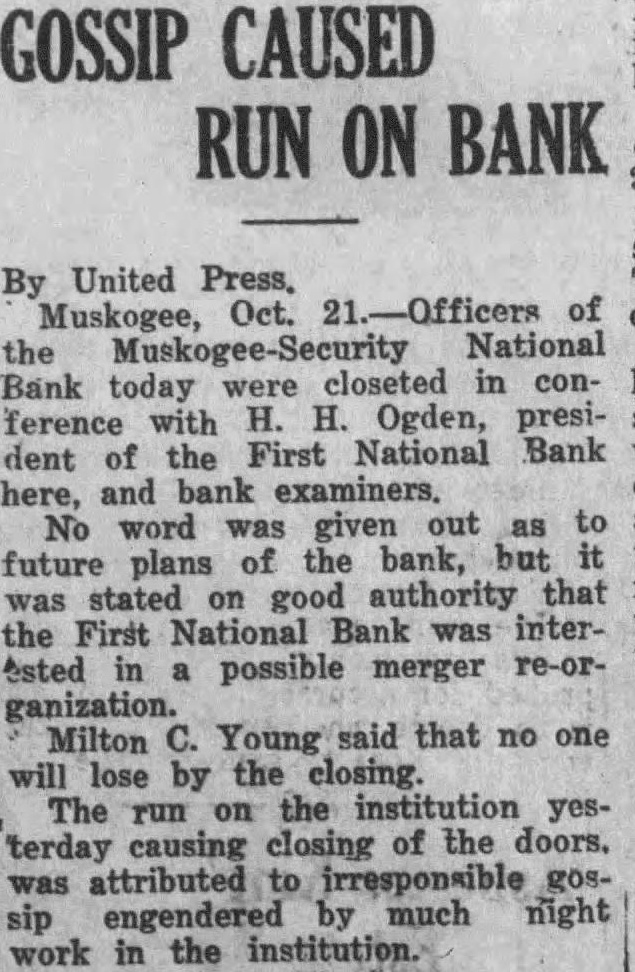
GOSSIP CAUSED RUN ON BANK
By United Press. Muskogee, Oct. -Officers of the Muskogee-Security National Bank today were closeted in conference with H. H. Ogden, president of the First National Bank here, and bank examiners. No word was given out as to future plans of the bank, but it was stated on good authority that the First National Bank was interested in a possible merger re-organization. Milton C. Young said that no one will lose by the closing. The run on the institution yesterday causing closing of the doors. was attributed to irresponsible gossip engendered by much night work in the institution.
8.November 4, 1925Muskogee Daily Phoenix and Times-DemocratMuskogee, OK
Click image to open full size in new tab
Article Text
Cash Collections Now Sufficient to Warrant Mailing Proposal to Security Patrons
RECEIVER ALTERNATIVE ISN'T YET SIDETRACKED
At Least $25,000 of Stockholders, Which Would Cut Depositors' Shrinkage Below 25 Percent hundred dollars in cash, money paid in upon assessment by stockholders of the Muskogee Security National bank, lay in the bank's vault last night. Letters carrying the proposal which L. K. Roberts, chief examiner, will make to the depositors, will therefore be mailed Thursday night, E. Allen, examiner in charge, declared. The proposition that the depositors accept loss of from 22 1-2 to 27 1-2 percent was contigent upon the shareholders putting up $100,000. Mr. Roberts will leave Kansas City Thursday morning, he said over the long distance telephone last night.
Will Press Collection
Mailing of the preposals to the depositors, however, will/not mean that no further effort will be made to collect from the stockholders, Mr. Allen said. Instead stronger representations than ever will be made them and unless every shareholder all financially able meet his pays, Mr. Roberts will stick to his plan receiver temporarily of the bank. The for day" would gally levy the 100 and would be taken against those who had not paid. Judgments also will taken against officers the bank whether they are able to pay or not.
$25,000 More in Sight
It was check from Congressman W. Hastings, out the city, which the total over the $100,000 mark, put yesterday. Milton large stockholder. also made substantial payment upon his assessment yesterThere least $25,000 more that can be readily collected from stockholders, Mr. Allen said. This will go to the depositors will probably reduce the shrinkage they will be asked to accept to 22 per7
Continue Scrutiny of Books
Should "temporary' receiver be appointed will not materially delay the opening of the agree to Mr. Roberts' proposal. The receiver would first levy 100 percent against all stockholders. He might his duty would to best serve the interests of the depositors speedily with Rowsey and H. Rooney for establishment of bank to take over the Security National's assets and deposits Examination of the books the bank's officers has not been completed, Mr. Allen said last night.
9.November 7, 1925Muskogee Times-DemocratMuskogee, OK
Click image to open full size in new tab
Article Text
PUT SQUEEZE ON MEN WHO FAIL TO PAY
Suit Will Be Filed Monday Against Sixty-Six Shareholders Who Have Failed To Pay Double Liability
L. R. Kershaw has been appointed receiver for the Muskogee-Security National bank, and is now in charge of that institution. The plan for organization of a new bank will proceed just as has been outlined except that it will be under judicial order and the matter will be handled by the receiver instead of by the examiner in charge. As before, the success or failure of this plan will depend on the depositors. They will be asked to agree to accept. reduction in their deposits of from 22 to 27 per cent, depending upon how much is realized from the assessment upon share holders and from about $400,000 worth of supposedly bad paper in the bank's assets. If they accept this proposal which will be mailed out to them Monday morning a new bank will be organized to take over the old one on this basis. Otherwise the bank will be liquidated by the receiver.
File Suits Monday
Monday morning suit will be filed against the 66 in the bank who have not voluntarily paid their 100 percent assessment. Judgment will be taken against those who do not or cannot pay up and these judgments will of course become assets of the bank.
This action was agreed upon by the comptroller of the currency upon K. Roberts, chief bank examiner for this federal district. is also understood that the plan has the sanction of the but will now have the further sanction of the federal There are approximately depositors in closed bank. They will determine for themselves within few days whether the reorganization shal proceed whether the ceiver shall liquidate the bank. Any delay their part will mean course. less sufficient number sign up the plan
Can Apply Pressure
The only difference between the now and as planned fore the was appointed is the federal authorities that squeeze on the shareholders who not voluntarily paid willing The receiver were to permit depositors chance losing the additional $100.- take 000. part that should come the funds by reason this assessment. It is believed may be this manner that and that judgments for like amount may and some of these will eventually be paid The time to consumed under this process probably be not more than the had public ceeded upon the original plan. But pro- the by those in of the bank that charge now depends the entirely upon whether not promptly sign the agreement for settlement which be mailed them. Receiver Well Known Kershaw new is well known. He pioneer breeder cattle this produced In county and gus line. He still has large farm holdings 350 head estate and He also the real investment business chairman of the county republican He tral and member of the and committees. His had the endorsement of Senators Harreld and Pine.
10.November 8, 1925Okmulgee Daily TimesOkmulgee, OK
Click image to open full size in new tab
Article Text
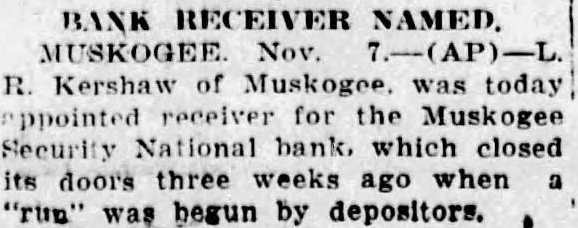
BANK RECEIVER NAMED. MUSKOGEE Nov. R. Kershaw of Muskogee. was today appointed receiver for the Muskogee Security National bank. which closed its doors three weeks ago when "run" was begun by depositors.
11.November 8, 1925Shawnee News-StarShawnee, OK
Click image to open full size in new tab
Article Text
Bank Receiver is Named
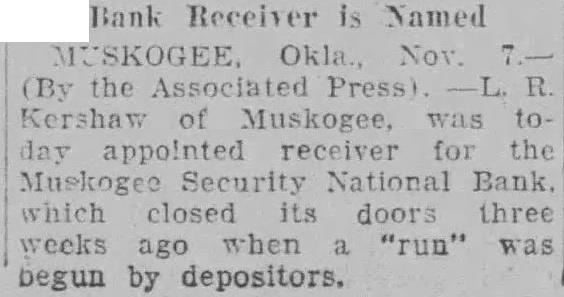
(By the Associated Press) L. R. Kershaw of Muskogee, was tolav appointed receiver for the Muskogee Security National Bank. which closed its doors three weeks ago when a "run" was begun by depositors.
12.November 8, 1925The Enid Morning NewsEnid, OK
Click image to open full size in new tab
Article Text
BANK RECEIVER APPOINTED
L. R Kershaw of Muskogee to Probe Security National Kershaw, former banker. breeder of championship cattle and republican leader, was today appointed receiver for the Muskogee Security bank here by J. W. McIntosh. comptroller of currency. Mr. Kershaw's appointment, bank. ing officials today declared. is only temporary. He has been instructed, they said, to collect a 100 per cent assessment from the stockholders and then proceed with the plan for opening a new bank. as outlined by L. K. Roberts, chief examiner in the tenth federal reserve district Under the plan, if the depositors agree to of deposits of from 22 to 1-2 per cent, the receiver will sell the bank' assets to W. E. Rowsey and L. H. Rooney, local capitalists. who will open new institution, crediting the MusRogee Security National depositors with accounts in the new bank.
13.January 19, 1926Muskogee Daily Phoenix and Times-DemocratMuskogee, OK
Click image to open full size in new tab
Article Text
NEW BANK WILL OCCUPY 'SECURITY'S' QUARTERS
Darby Expected to Apply for Charter at Once; Abandons All Plans to Liquidate Failure
CHEAPENS RECEIVERSHIP
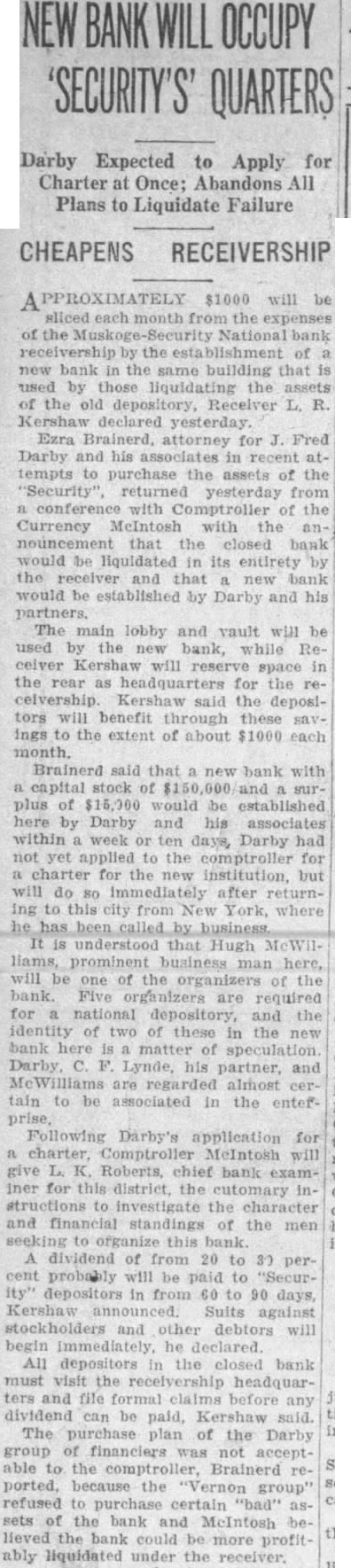
A PPROXIMATELY $1000 will be sliced each month from the expenses of the Muskoge-Security National bank receivership by the establishment of new bank in the same building that is used by those liquidating the assets of the old depository, Receiver L. R. Kershaw declared yesterday. Ezra Brainerd, attorney for J. Fred Darby and his associates in recent attempts to purchase the assets of the "Security" returned yesterday from a conference with Comptroller of the Currency MeIntosh with the announcement that the closed bank would be liquidated in its entirety by the and that new bank would be established by Darby and his partners. The main lobby and vault will be used by the new bank, while Receiver Kershaw will reserve space in the rear as headquarters for the receivership. Kershaw said the depositors will benefit through these savings to the extent of about $1000 each month. Brainerd said that a new bank with a capital stock of $150,000 and surplus of $15,000 would be established here by Darby and his associates within a week or ten days, Darby had not yet applied to the comptroller for a charter for the new institution, but will do so immediately after returning to this city from New York, where he has business. It is understood that Hugh MeWilHams, prominent business man here, will be one of the organizers of the bank. Five organizers are required for a national depository, and the identity of two of these in the new bank here is a matter of speculation Darby C. F. Lynde, his partner, and McWilliams are regarded almost certain to be associated in the enterFollowing Darby's application for a charter, Comptroller MeIntosh will give L. K. Roberts, chief bank examiner for this district, the cutomary instructions to investigate the character and financial standings of the men seeking to organize this bank A dividend of from 20 to 30 percent probably will be paid to "Security" depositors in from 60 to 90 days, Kershaw announced. Suits against stockholders and other debtors will begin immediately, he declared. All depositors in the closed bank must visit the receivership headquarters and file formal claims before any dividend can be paid, Kershaw said. The purchase plan of the Darby group of financiers was not acceptable to the comptroller, Brainerd reported, because the "Vernon group" refused to purchase certain "bad" assets of the bank and McIntosh believed the bank could be more profit ably liquidated under the receiver.
14.February 6, 1926The Chickasha Daily ExpressChickasha, OK
Click image to open full size in new tab
Article Text
LOCKED
Doors Closed Following Run on stitution Yesterday; Former President in Capital: Bank to Be Reopened.
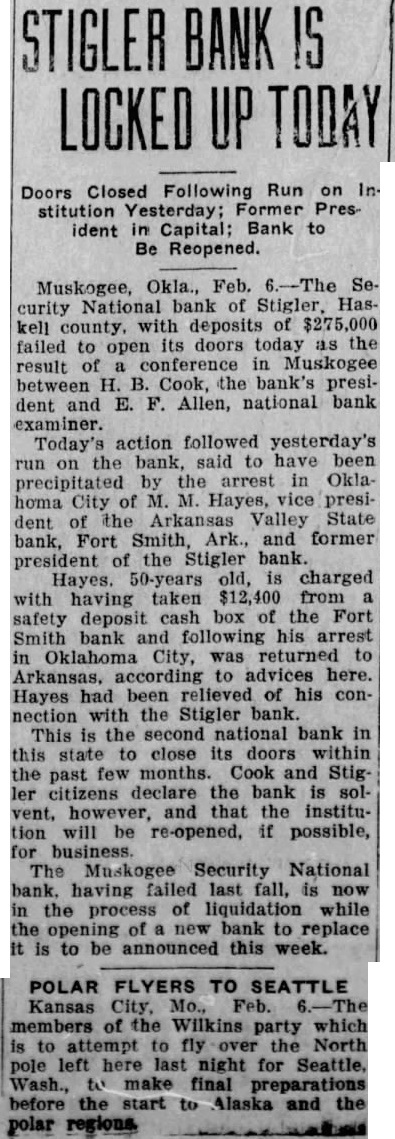
Muskogee, Okla., Feb. National bank of Hascurity kell deposits of $275,000 failed its doors today as the to open result of in Muskogee between Cook, the bank's president E. Allen, national bank examiner. Today's action followed yesterday's the bank, said to have been run by the arrest in Oklaprecipitated homa City of Hayes, vice president the Arkansas Valley State Fort Smith, Ark., and former bank, president of the Stigler bank. Hayes. 50-years charged with having taken from safety deposit box of the Fort Smith bank and following his arrest Oklahoma City, was returned to according to advices here. Hayes had been relieved of his connection with the Stigler bank. This the national bank in state to close its doors within the past few months. Cook and Stigler citizens declare the bank vent, and the institution will be re-opened, if possible, business. The Muskogee Security National bank. having failed last fall, now the process of liquidation while the opening bank to replace to be announced this week.
POLAR FLYERS TO SEATTLE Kansas City, Feb. members of the Wilkins party which to attempt to fly the North pole left here last night for Seattle, Wash., make final before the start Alaska and the
15.October 9, 1926Muskogee Times-DemocratMuskogee, OK
Click image to open full size in new tab
Article Text
BANK RECEIVER FILES 6 SUITS
Largest Amounts Sought for Defunct Oktaha Bank
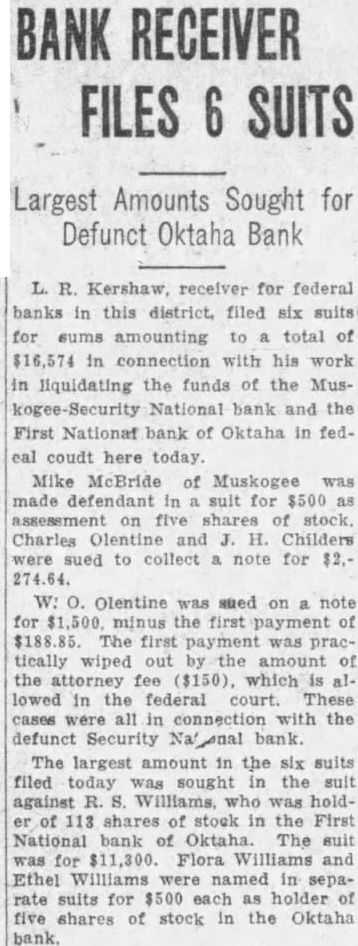
L. R. Kershaw, receiver for federal banks in this district, filed six suits for sums amounting to a total of $16,574 in connection with his work in liquidating the funds of the Muskogee-Security National bank and the First National bank of Oktaha in fedcal coudt here today. Mike McBride of Muskogee was made defendant in sult for $500 as assessment on five shares of stock. Charles Olentine and J. H. Childers were sued to collect a note for $2.W: O. Olentine was sued on a note for $1,500 minus the first payment of $188.85. The first payment was practically wiped out by the amount of the attorney fee ($150), which is allowed in the federal court. These cases were all in connection with the defunct Security Na/sonal bank The largest amount in the six suits filed today was sought in the suit against R. S. Williams, who was holder of 113 shares of stock in the First National bank of Oktaha. The suit was for $11,300. Flora Williams and Ethel Williams were named in separate suits for $500 each as holder of five shares of stock in the Oktaha bank.