Article Text
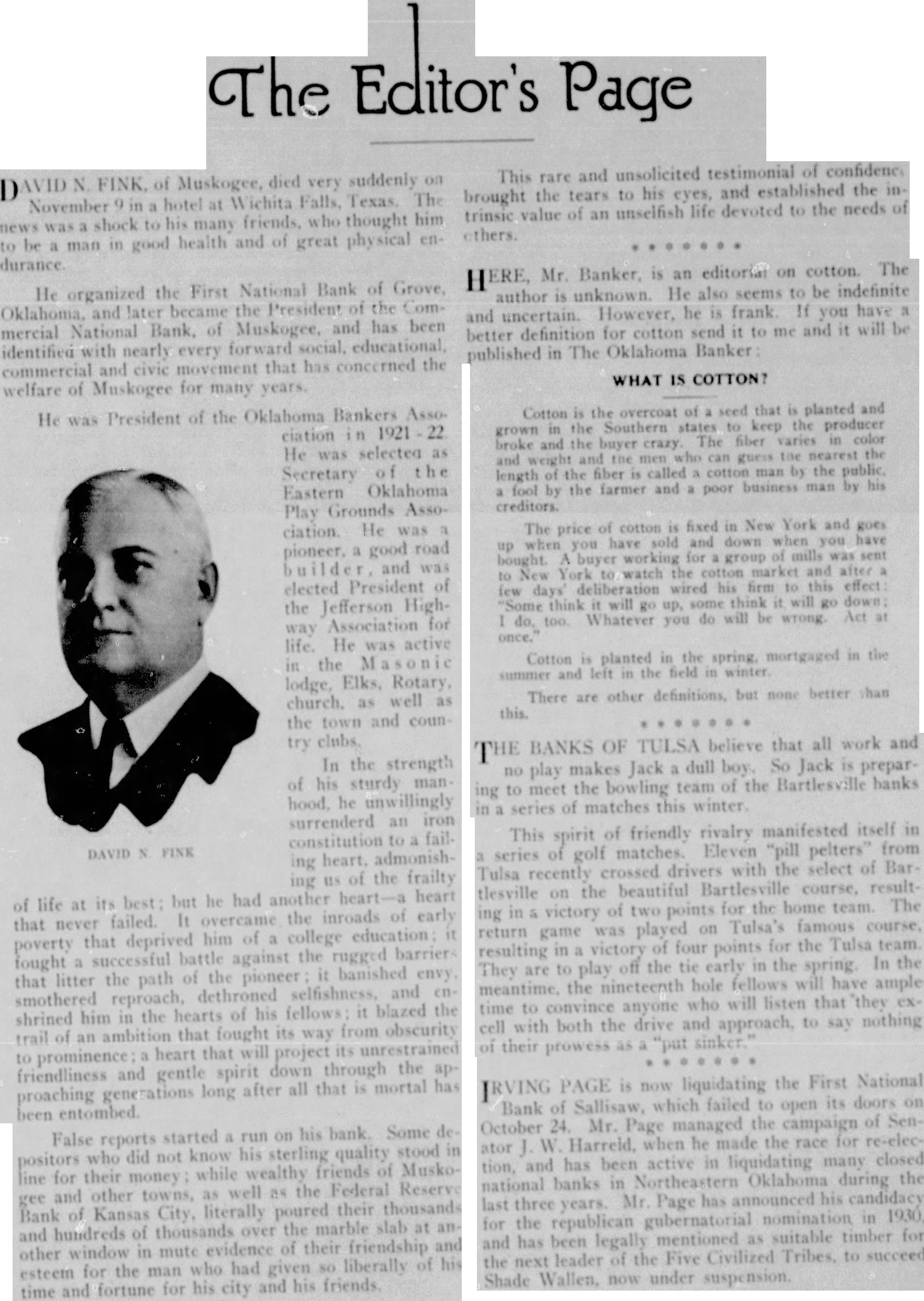
The Editor's Editor's Page AVID N. FINK, of Muskogee, died very suddenly on November 9 in a hotel at Wichita Falls, Texas. The news was a shock to his many friends, who thought him to be a man in good health and of great physical endurance. He organized the First National Bank of Grove, Oklahoma, and later became the President of the Commercial National Bank, of Muskogee, and has been identified with nearly every forward social, educational, commercial and civic movement that has concerned the welfare of Muskogee for many years. He was President of the Oklahoma Bankers Association in 1921 22. He was selected as Secretary of the Eastern Oklahoma Play Grounds Association. He was a pioneer, a good road builder, and was elected President of the Jefferson Highway Association for life. He was active in the Masonic lodge, Elks, Rotary, church, as well as the town and country clubs, In the strength of his sturdy manhood, he unwillingly surrenderd an iron constitution to a failDAVID N. FINK ing heart. admonishing us of the frailty of life at its best: but he had another heart-a heart that never failed. It overcame the inroads of early poverty that deprived him of a college education: it fought a successful battle against the rugged barriers that litter the path of the pioneer : it banished envy. smothered reproach, dethroned selfishness, and cnshrined him in the hearts of his fellows: it blazed the trail of an ambition that fought its way from obscurity to prominence; a heart that will project its unrestrained friendliness and gentle spirit down through the approaching generations long after all that is mortal has been entombed. False reports started a run on his bank. Some depositors who did not know his sterling quality stood in line for their money; while wealthy friends of Muskogee and other towns, as well as the Federal Reserve Bank of Kansas City, literally poured their thousands and hundreds of thousands over the marble slab at another window in mute evidence of their friendship and esteem for the man who had given so liberally of his time and fortune for his city and his friends. This rare and unsolicited testimonial of confidence brought the tears to his eyes, and established the intrinsic value of an unselfish life devoted to the needs of others. HERE, Mr. Banker, is an editorial on cotton. The author is unknown. He also seems to be indefinite and uncertain. However, he is frank. If you have a better definition for cotton send it to me and it will be published in The Oklahoma Banker: WHAT IS COTTON? Cotton is the overcoat of a seed that is planted and grown in the Southern states to keep the producer broke and the buyer crazy. The fiber varies in color and weight and the men who can guess the nearest the length of the fiber is called A cotton man by the public, a fool by the farmer and a poor business man by his creditors. The price of cotton is fixed in New York and goes up when you have sold and down when you have bought. A buyer working for a group of mills was sent to New York to watch the cotton market and after a few days' deliberation wired his firm to this effect: "Some think it will go up, some think it will go down: I do, too. Whatever you do will be wrong. Act at once." Cotton is planted in the spring, mortgaged in the summer and left in the field in winter. There are other definitions, but none better than this. THE BANKS OF TULSA believe that all work and no play makes Jack a dull boy. So Jack is preparing to meet the bowling team of the Bartlesville banks in a series of matches this winter. This spirit of friendly rivalry manifested itself in a series of golf matches. Eleven "pill pelters" from Tulsa recently crossed drivers with the select of Bartlesville on the beautiful Bartlesville course, resulting in a victory of two points for the home team. The return game was played on Tulsa's famous course, resulting in a victory of four points for the Tulsa team. They are to play off the tie early in the spring. In the meantime, the nineteenth hole fellows will have ample time to convince anyone who will listen that 'they excell with both the drive and approach, to say nothing of their prowess as a "put sinker." IRVING PAGE is now liquidating the First National Bank of Sallisaw, which failed to open its doors on October 24. Mr. Page managed the campaign of Senator J. W. Harreld, when he made the race for re-election, and has been active in liquidating many closed national banks in Northeastern Oklahoma during the last three years. Mr. Page has announced his candidacy for the republican gubernatorial nomination in 1930, and has been legally mentioned as suitable timber for the next leader of the Five Civilized Tribes, to succeed Shade Wallen, now under suspension.