15693. Corbin Banking company (New York, NY)

Bank Information

Episode Type
Suspension → Closure
Bank Type
state
Start Date
March 28, 1907
Location
New York, New York (40.714, -74.006)

Metadata

Model
gpt-5-mini
Short Digest
2c49fb64

Response Measures

None

Description

Multiple contemporaneous news reports (Mar 28–29, 1907) state the Corbin Banking Company 'assigned for the benefit of creditors' due to inability to meet maturing obligations despite assets exceeding liabilities. This is an assignment/closure by the private banking firm (not a depositor run). A bankruptcy petition was filed after the assignment. No articles describe a depositor run or subsequent reopening.

Events (1)

1. March 28, 1907 Suspension
Cause
Voluntary Liquidation
Cause Details
Firm of private bankers made an assignment for benefit of creditors because valuable real estate assets could not be sold quickly to meet maturing obligations; assignment driven by illiquidity rather than depositor panic or government action.
Newspaper Excerpt
The Corbin Banking company today assigned for the benefit of creditors...The assets exceed the liabilities by over $1,000,000...The members of the firm deemed it best for the creditors, therefore, that they should make an assignment.
Source
newspapers

Newspaper Articles (10)

Article from East Oregonian : E.O, March 28, 1907

Click image to open full size in new tab

Article Text

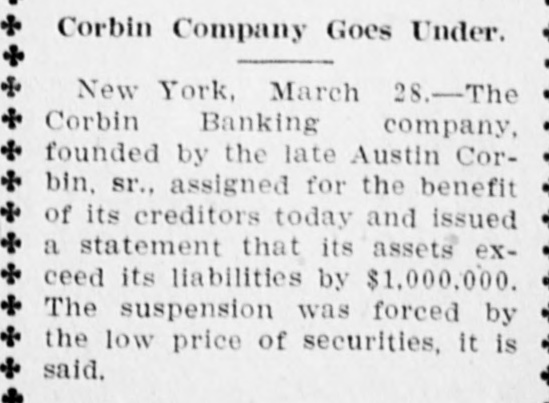
Corbin Company Goes Under. New York, March 28.-The Corbin Banking company, founded by the late Austin Corbin, sr., assigned for the benefit of its creditors today and issued a statement that its assets exceed its liabilities by $1,000,000. The suspension was forced by the low price of securities, it is said.


Article from The Topeka State Journal, March 28, 1907

Click image to open full size in new tab

Article Text

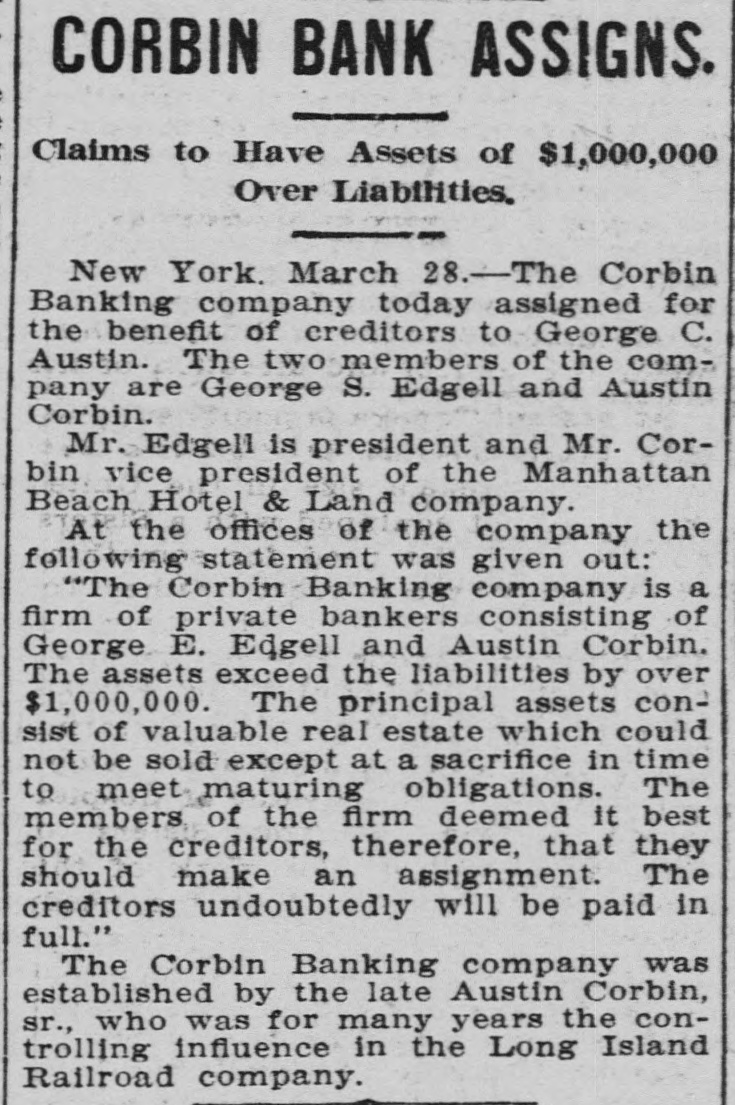
CORBIN BANK ASSIGNS. Claims to Have Assets of $1,000,000 Over Liabilities. New York. March 28.-The Corbin Banking company today assigned for the benefit of creditors to George C. Austin. The two members of the company are George S. Edgell and Austin Corbin. Mr. Edgell is president and Mr. Corbin vice president of the Manhattan Beach Hotel & Land company. At the offices of the company the following statement was given out: "The Corbin Banking company is a firm of private bankers consisting of George E. Edgell and Austin Corbin. The assets exceed the liabilities by over $1,000,000. The principal assets consist of valuable real estate which could not be sold except at a sacrifice in time to meet maturing obligations. The members of the firm deemed it best for the creditors, therefore, that they should make an assignment. The creditors undoubtedly will be paid in full." The Corbin Banking company was established by the late Austin Corbin, sr., who was for many years the controlling influence in the Long Island Railroad company.


Article from Bryan Morning Eagle, March 29, 1907

Click image to open full size in new tab

Article Text

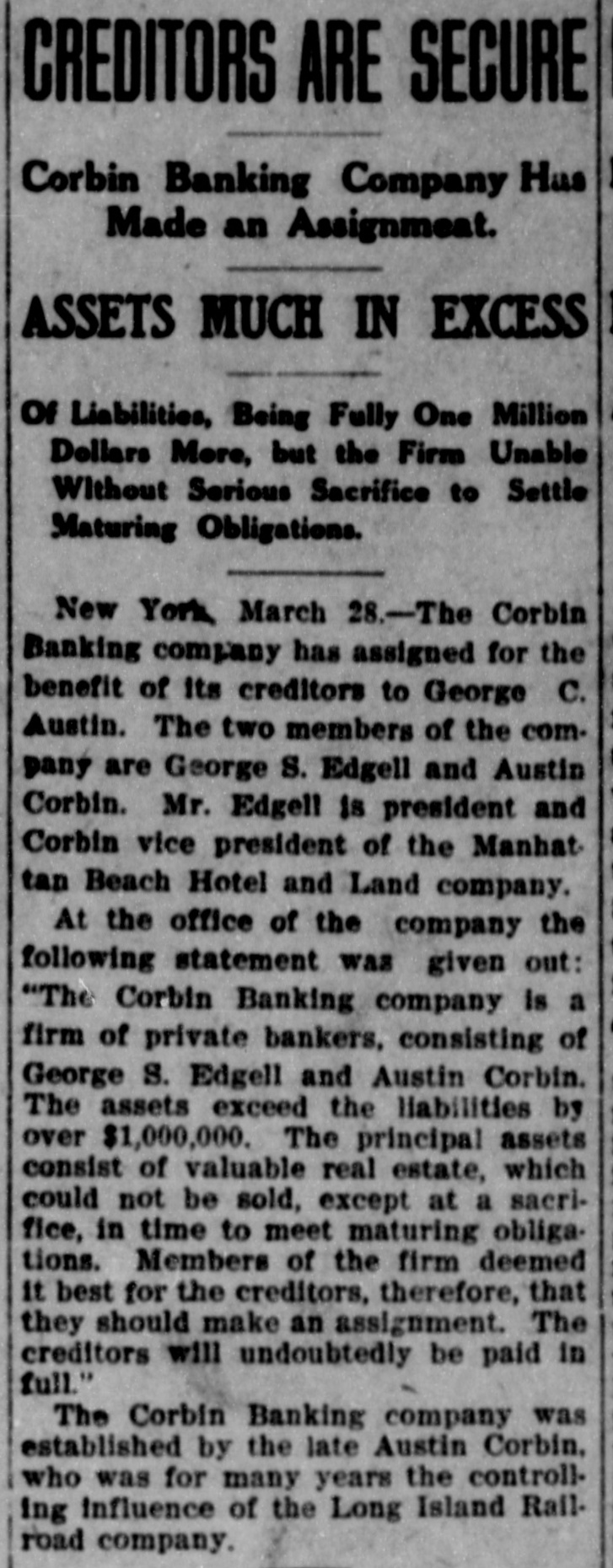
CREDITORS ARE SECURE Corbin Banking Company Has Made an Assignment. ASSETS MUCH IN EXCESS Of Liabilities, Being Fully One Million Dollars More, but the Firm Unable Without Serious Sacrifice to Settle Maturing Obligations. New York March 28.-The Corbin Banking company has assigned for the benefit of Its creditors to George C. Austin. The two members of the company are George S. Edgell and Austin Corbin. Mr. Edgell is president and Corbin vice president of the Manhat tan Beach Hotel and Land company. At the office of the company the following statement was given out: "The Corbin Banking company is a firm of private bankers, consisting of George S. Edgell and Austin Corbin. The assets exceed the liabilities by over $1,000,000. The principal assets consist of valuable real estate, which could not be sold, except at a sacrifice, in time to meet maturing obligations. Members of the firm deemed It best for the creditors, therefore, that they should make an assignment. The creditors will undoubtedly be paid in full." The Corbin Banking company was established by the late Austin Corbin. who was for many years the controlling influence of the Long Island Rallroad company.


Article from Los Angeles Herald, March 29, 1907

Click image to open full size in new tab

Article Text

CORBIN BANKING COMPANY ASSIGNS NEW YORK FIRM, HOWEVER, WILL PAY IN FULL Assets Said to Exceed Liabilities by at Least $1,000,000-Valuable Real Estate Holdings Included in Former By Associated Press. NEW YORK, March 28.-The Corbin Banking company today assigned for the benefit of creditors to George C. Austin. The two members of the company are George S. Edgell and Austin Corbin. Mr. Edgell is president and Mr. Corbin vice president of the Manhattan Beach and Land company. At the office of the company the following statement was given out: "The Corbin Banking company is a firm of private bankers consisting of George E. Edgell and Austin Corbin. The assets exceed the liabilities by over $1,000,000. The principal assets consist of valuable real estate which could not be sold except at a sacrifice in time to meet maturing obligations. The members of the firm deemed it best for the creditors, therefore, that they should make an assignment. The creditors undoubtedly will be paid in full." The Corbin Banking company was established by the late Austin Corbin was for years Sr., who many the Island controlling influence in the Long Railroad company. A petition praying that Austin Corbin and George S. Edgell be declared bankrupt was filed in the United States court today. The petitioners are Isabelle H. Knott of Denver, Alice C. Hill of Los Angeles, and Alexander J. Shamburg of New York, depositors in the bank. Their petition is based on the ground that the making of an assignment was in violation of the bankruptcy act.


Article from Omaha Daily Bee, March 29, 1907

Click image to open full size in new tab

Article Text

BANKING COMPANY ASSIGNS House Founded by Austin Corbin, Unable to Meet Demands, Closes Doors. NEW YORK, March 28.-The Corbin Banking company today assigned for the benefit of creditors to George C. Austin. The two members of the company are George S. Edgell and Austin Corbin. Mr. Edgell is president and Mr. Corbin vice president of the Manhattan Beach hotel and Land company. At the office of the company this statement was given out: The Corbin Banking company is a firm of private bankers consisting of George S. Edgell and Austin Corbin. The assets exceed the liabilities by over $1,000,000. The principal assets consist of valuable real estate, which could not be sold, except at a sacrifice. in time to meet maturing obligations. The members of the firm deemed it best for the creditors, therefore, that they should make an assignment. The creditors will undoubtedly be paid in full. The .Corbin Banking company was established by the late Austin Corbin, sr., who was for many years the controlling influence in the Long Island Railroad company. A petition praying that Austin Corbin and George S. Edgell be declared bankrupts was filed in the United States court today. The petitioners are Isabelle H, Knott of Denver, Alice Hill of Los Angeles and Alexander J. Shamburg of New York, depositors in the bank. Their petition is based on the ground that the making of an assignment was in violation of the bankruptey act.


Article from The Madison Daily Leader, March 29, 1907

Click image to open full size in new tab

Article Text

LIABILITIES OF $1,700,000 CORBIN BANKING COMPANY OF NEW YORK CITY MAKES AN ASSIGNMENT. New York, March 29.-The Corbin Banking company has assigned for the benefit of its creditors to George C. Austin. The two members of the company are George S. Edgell and Austin Corbin. Mr. Edgell is president and Mr. Corbin vice president of the Manhattan Beach Hotel and Land company. Mr. Austin said a rough estimate placed the liabilities at $1,700,000 and the assets at $3,000,000. "The assignment was due to the maturing of obligations," said Mr. Austin. "Times are hard and money is high. The company owns 400 acres of land at Manhattan Beach and Far Rockaway, which is worth $3,000,000, but it could not be sold today under existing conditions for $1,500,000. You cannot get any one to buy real estate at present. There is other valuable real estate in the South and West, but loans and contracts prevented It from being disposed of." The Corbin Banking company was established by the late Austin Corbin, Sr., who was for many years the controlling influence in the Long Island Railroad company.


Article from The Birmingham Age-Herald, March 29, 1907

Click image to open full size in new tab

Article Text

CORBIN BANKING HOUSE ASSIGNS ASSETS EXCEED LIABILITIES BY $1,000,000, SAYS THE STATEMENT GIVEN OUT AT THE OFFICE IN NEW YORK. New York, March 28.--The Corbin Banking company today assigned for the benefit of creditors to George R. Austin. The two members of the company are George S. Edgell and Austin Corbin. Mr. Edgell is president and Mr. Corbin vice president of the Manhattan Beach Hotel and Land company. At the office of the company the following statement was given out: "The Corbin Banking company is a firm of private bankers consisting of George S. Edgell and Austin Corbin. The assets exceed the liabilities by over $1,000,000. The principal assets consist of valuable real estate, which could not be sold except at a sacrifice in time to meet maturing obligations. The members of the firm deemed it best for the creditors, therefore, that they should make an assignment. The creditors will undoubtedly be paid in full." The Corbin Banking company was established by the late Austin Corbin, Sr., who was for many years the controlling influence in the Long Island Railroad company. Mr. Corbin said a rough estimate placed the liabilities at $1,700,000 and the assets t-$3,000,000. "The assignment was due to the maturing obligations," said he. "Times are hard and money is high. The company owns 400 acres of land at Manhattan Beach and Far Rockaway, which is worth $5,000,000, but it could not be sold today under existing conditions for $1,500,000. You cannot get anyone to buy real estate at 6 per cent. There is other valuable real estate in the south and west, but loans and contracts prevented it from being disposed of. A petition praying that Austin Corbin and George S. Edgell individually and as co-partners in the Corbin Banking company be declared bankrupts was filed in the United States court today. The petitioners are Isabelle H. Knott of Denver, Colo.; Alice H. Hill of Los Angeles, and Alexander J. Shamburg of New York. The petition alleges that the Corbin banking firm owes more than half a million dollars, and mentions various sums deposited by the three petitioners. The plea for the declaration of the bankruptcy of Edgell and Corbin is made on the ground that the filing of an assignment was in violation of the bankruptcy act.


Article from River Falls Journal, January 2, 1908

Click image to open full size in new tab

Article Text

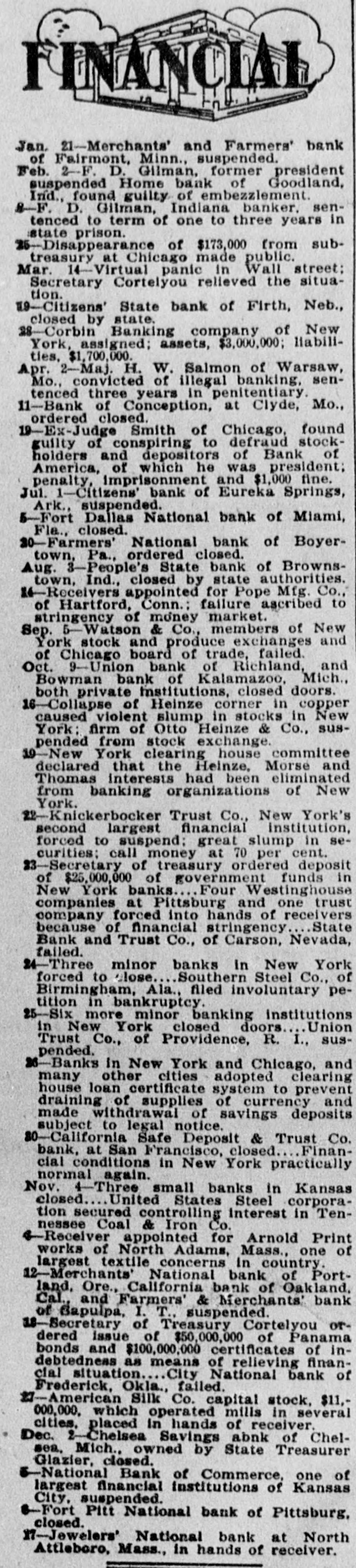
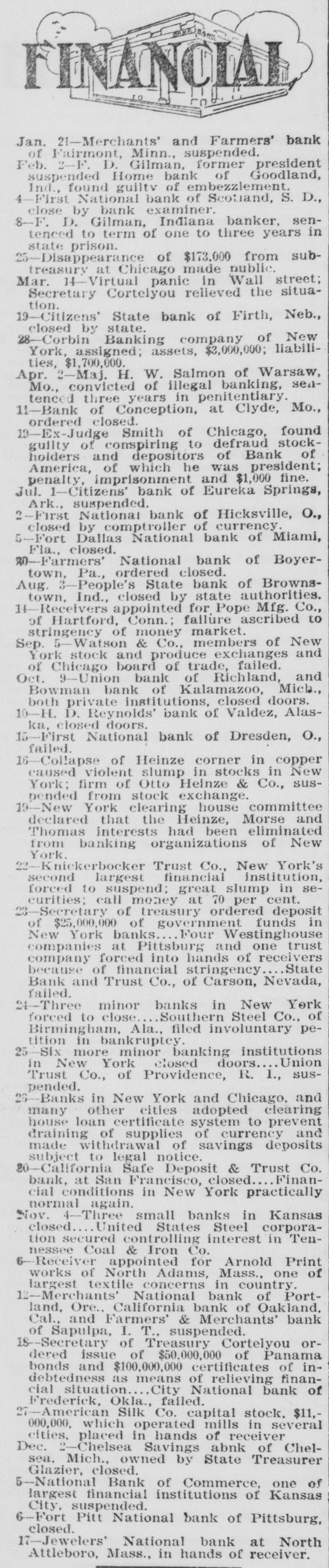
FINANCIAL Jan. 21-Merchants' and Farmers' bank of Fairmont, Minn., suspended. Feb. 2-F. D. Gilman, former president suspended Home bank of Goodland, Ind., found guiltv of embezzlement. 4-First National bank of Scotland, S. D., close by bank examiner. 8-F. D. Gilman, Indiana banker, sentenced to term of one to three years in state prison. 25-Disappearance of $173,000 from subtreasury at Chicago made public. Mar. 14-Virtual panic in Wall street; Secretary Cortelyou relieved the situation. 19-Citizens' State bank of Firth, Neb., closed by state. 28-Corbin Banking company of New York, assigned; assets, $3,000,000; liabilities, $1,700,000. Apr. 2-Maj. H. W. Salmon of Warsaw, Mo., convicted of illegal banking, sentenced three years in penitentiary. 11-Bank of Conception, at Clyde, Mo., ordered closed. 19-Ex-Judge Smith of Chicago, found guilty of conspiring to defraud stockholders and depositors of Bank of America, of which he was president; penalty, imprisonment and $1,000 fine. Jul. 1-Citizens' bank of Eureka Springs, Ark., suspended. 2-First National bank of Hicksville, O., closed by comptroller of currency 5-Fort Dallas National bank of Miami, Fla., closed. 20-Farmers' National bank of Boyertown, Pa., ordered closed. Aug. 3-People's State bank of Brownstown, Ind., closed by state authorities. 14-Receivers appointed for Pope Mfg. Co., of Hartford, Conn.; failure ascribed to stringency of money market. Sep. 5-Watson & Co., members of New York stock and produce exchanges and of Chicago board of trade, failed. Oct. 9-Union bank of Richland, and Bowman bank of Kalamazoo, Mich., both private institutions, closed doors. 10-H. D. Reynolds' bank of Valdez, Alaska, closed doors. 15-First National bank of Dresden, O., failed. 16-Collapse of Heinze corner in copper caused violent slump in stocks in New York; firm of Otto Heinze & Co., suspended from stock exchange. 19-New York clearing house committee declared that the Heinze, Morse and Thomas interests had been eliminated from banking organizations of New York. 22-Knickerbocker Trust Co., New York's second largest financial institution, forced to suspend; great slump in securities; call money at 70 per cent. 23-Secretary of treasury ordered deposit of $25,000,000 of government funds in New York banks Four Westinghouse companies at Pittsburg and one trust company forced into hands of receivers because of financial stringency State Bank and Trust Co., of Carson, Nevada, failed. 24-Three minor banks in New York forced to close Southern Steel Co., of Birmingham, Ala., filed involuntary petition in bankruptcy. 25-Six more minor banking institutions in New York closed doors Union Trust Co., of Providence, R. 1., suspended. 26-Banks in New York and Chicago, and many other cities adopted clearing house loan certificate system to prevent draining of supplies of currency and made withdrawal of savings deposits subject to legal notice. 20-California Safe Deposit & Trust Co. bank, at San Francisco, closed. Financial conditions in New York practically normal again. Nov. 4-Three small banks in Kansas closed. United States Steel corporation secured controlling interest in Tennessee Coal & Iron Co. 6-Receiver appointed for Arnold Print works of North Adams, Mass., one of largest textile concerns in country. 12-Merchants' National bank of Portland, Ore., California bank of Oakland, Cal., and Farmers' & Merchants' bank of Sapulpa, I. T., suspended. 18--Secretary of Treasury Cortelyou ordered issue of $50,000,000 of Panama bonds and $100,000,000 certificates of indebtedness as means of relieving financial situation City National bank of Frederick, Okla., failed. 27-American Silk Co. capital stock, $11,000,000, which operated mills in several cities, placed in hands of receiver Dec. 2-Chelsea Savings abnk of Chelsea. Mich., owned by State Treasurer Glazier, closed. 5-National Bank of Commerce, one of largest financial institutions of Kansas City, suspended. 6-Fort Pitt National bank of Pittsburg, closed. 17-Jewelers' National bank at North Attleboro. Mass. in hands of receiver
Article from The Ely Miner, January 3, 1908

Click image to open full size in new tab

Article Text

Jan. 21-Merchants' and Farmers' bank of Fairmont, Minn., suspended. Feb. 2-F. D. Gilman, former president suspended Home bank of Goodland, Ind., found guilty of embezzlement. 8-F. D. Gilman, Indiana banker, sentenced to term of one to three years in state prison. -Disappearance of $173,000 from subtreasury at Chicago made public. Mar. 14-Virtual panic in Wall street; Secretary Cortelyou relieved the situation. 19-Citizens' State bank of Firth, Neb., closed by state. 28-Corbin Banking company of New York, assigned; assets, $3,000,000; liabilities, $1,700,000. Apr. 2-Maj. H. W. Salmon of Warsaw, Mo., convicted of illegal banking, sentenced three years in penitentiary. 11-Bank of Conception, at Clyde, Mo., ordered closed. 19-Ex-Judge Smith of Chicago, found guilty of conspiring to defraud stockholders and depositors of Bank of America, of which he was president; penalty, imprisonment and $1,000 fine. Jul. 1-Citizens' bank of Eureka Springs, Ark., suspended. 5-Fort Dallas National bank of Miami, Fla., closed. 20-Farmers' National bank of Boyertown, Pa., ordered closed. Aug. 3-People's State bank of Brownstown, Ind., closed by state authorities. It-Receivers appointed for Pope Mfg. Co., of Hartford, Conn.; failure ascribed to stringency of money market. Sep. 5-Watson & Co., members of New York stock and produce exchanges and of Chicago board of trade, failed. Oct. 9-Union bank of Richland, and Bowman bank of Kalamazoo, Mich., both private institutions, closed doors. 16-Collapse of Heinze corner in copper caused violent slump- in stocks in New York: firm of Otto Heinze & Co., suspended from stock exchange. 19-New York clearing house committee declared that the Heinze, Morse and Thomas interests had been eliminated from banking organizations of New York. 22-Knickerbocker Trust Co., New York's second largest financial institution, forced to suspend; great slump in securities; call money at 70 per cent. -Secretary of treasury ordered deposit of $25,000,000 of government funds in New York banks Four Westinghouse companies at Pittsburg and one trust company forced into hands of receivers because of financial stringency State Bank and Trust Co., of Carson, Nevada, failed. 24-Three minor banks in New York forced to close Southern Steel Co., of Birmingham, Ala., filed involuntary petition in bankruptcy. 25-Six more minor banking institutions in New York closed doors Union Trust Co. of Providence, R. I., suspended. 26-Banks in New York and Chicago, and many other cities adopted clearing house loan certificate system to prevent draining of supplies of currency and made withdrawal of savings deposits subject to legal notice. 30-California Safe Deposit & Trust Co. Finanbank, at San Francisco, closed cial corditions in New York practically normal again. Nov. 4- Three small banks in Kansas closed United States Steel corporation secured controlling interest in Tennessee Coal & Iron Co. 6-Receiver appointed for Arnold Print works of North Adams, Mass., one of largest textile concerns in country. 12-Merchants' National bank of Portland, Ore., California bank of Oakland, Cal., and Farmers' & Merchants' bank of Sapulpa, I. T., suspended. 18-Secretary of Treasury Cortelyou ordered issue of $50,000,000 of Panama bonds and $100,000,000 certificates of indebtedness as means of relieving financlal situation City National bank of Frederick, Okla., failed. 27-American Silk Co. capital stock, $11,000,000, which operated mills in several cities, placed in hands of receiver. Dec. 2-Chelsea Savings abnk of Chelsea, Mich., owned by State Treasurer Glazier, closed. 5-National Bank of Commerce, one of largest financial institutions of Kansas City. suspended. 6-Fort Pitt National bank of Pittsburg, closed. 17-Jewelers' National bank at North Attleboro, Mass., in hands of receiver.


Article from The Spanish Fork Press, January 9, 1908

Click image to open full size in new tab

Article Text

FINANCIAL Jan. 21-Merchants' and Farmers' bank of Fairmont, Minn., suspended. Feb. 2-F. D. Gilman, former president suspended Home bank of Goodland, Ind., found guilty of embezzlement. 8-F. D. Gilman, Indiana banker. sentenced to term of one to three years in state prison. -Disappearance of $173,000 from subtreasury at Chicago made public. Mar. 14-Virtual panic in Wall street: Secretary Cortelyou relieved the situation. 19-Citizens' State bank of Firth, Neb., closed by state. 28-Corbin Banking company of New York, assigned; assets, $3,000,000; liabilities, $1,700,000. Apr. 2-Maj. H. W. Salmon of Warsaw, Mo., convicted of illegal banking, sentenced three years in penitentiary. 11-Bank of Conception, at Clyde, Mo., ordered closed. 19-Ex-Judge Smith of Chicago, found guilty of conspiring to defraud stockholders and depositors of Bank of America, of which he was president; penalty, imprisonment and $1,000 fine. Jul. 1-Citizens' bank of Eureka Springs, Ark., suspended. 5-Fort Dallas National bank of Miami, Fla., closed. 20-Farmers' National bank of Boyertown, Pa., ordered closed. Aug. 3-People's State bank of Brownstown, Ind., closed by state authorities. M-Receivers appointed for Pope Mfg. Co., of Hartford, Conn.: failure ascribed to stringency of money market. Sep. 5-Watson & Co., members of New York stock and produce exchanges and of Chicago board of trade, failed. Oct. 9-Union bank of Richland, and Bowman bank of Kalamazoo, Mich., both private Institutions, closed doors. 16-Collapse of Heinze corner in copper caused violent slump in stocks in New York: firm of Otto Heinze & Co., suspended from stock exchange. 19-New York clearing house committee declared that the Heinze, Morse and Thomas interests had been eliminated from banking organizations of New York. 22-Knickerbocker Trust Co., New York's second largest financial institution, forced to suspend; great slump in securities: call money at 70 per cent. 23-Secretary of treasury ordered deposit of $25,000,000 of government funds in New York banks. Four Westinghouse companies at Pittsburg and one trust company forced into hands of receivers because of financial stringency State Bank and Trust Co., of Carson, Nevada, failed. M-Three minor banks in New York forced to close Southern Steel Co., of Birmingham, Ala., filed involuntary petition in bankruptcy. 25-Six more minor banking institutions in New York closed doors. Union Trust Co., of Providence, R. I., suspended. Banks in New York and Chicago, and many other cities adopted clearing house loan certificate system to prevent draining of supplies of currency and made withdrawal of savings deposits subject to legal notice. $0-California Safe Deposit & Trust Co. bank, at San Francisco, closed Financial conditions in New York practically normal again. Nov. 4-Three small banks in Kansas closed United States Steel corporation secured controlling Interest in Tennessee Coal & Iron Co. -Receiver appointed for Arnold Print works of North Adams, Mass., one of largest textile concerns in country. 12-Merchants' National bank of Portland, Ore., California bank of Oakland, Cal. and Farmers' & Merchants' bank of Bapulpa, I.T., suspended. as Secretary of Treasury Cortelyou ordered issue of $50,000,000 of Panama bonds and $100,000,000 certificates of indebtedness as means of relieving financial situation City National bank of Frederick, Okla., failed. 17-American Silk Co. capital stock, $11,000,000, which operated mills in several cities, placed in hands of receiver. Dec. Chelsea Savings abnk of Chelsea, Mich., owned by State Treasurer Glazier, closed. -National Bank of Commerce, one of largest financial institutions of Kansas City, suspended. Fort Pitt National bank of Pittsburg, closed. l7-Jewelers' National bank at North Attleboro, Mass., in hands of receiver.