1565. Stonington Savings Bank (Stonington, CT)

Bank Information

Episode Type
Suspension โ†’ Closure
Bank Type
savings bank
Start Date
March 29, 1904
Location
Stonington, Connecticut (41.336, -71.906)

Metadata

Model
gpt-5-mini
Short Digest
06ab825371b4c642

Response Measures

None

Description

Articles (Mar 29 and Apr 1, 1904) describe the Stonington Savings Bank being ordered to enforce 60 days' notice (suspension of immediate payments) by the Connecticut bank commissioners because of depreciated securities and a deficit, and a court directing officials to liquidate. No bank run is mentioned; a receiver was considered but not appointed. I infer state-chartered savings bank from the name and context.

Events (2)

1. March 29, 1904 Suspension
Cause
Bank Specific Adverse Info
Cause Details
Depreciation in securities and insufficient realizable assets led commissioners to require 60 days' notice prior to withdrawals; deposits and assets inadequate to meet demands.
Newspaper Excerpt
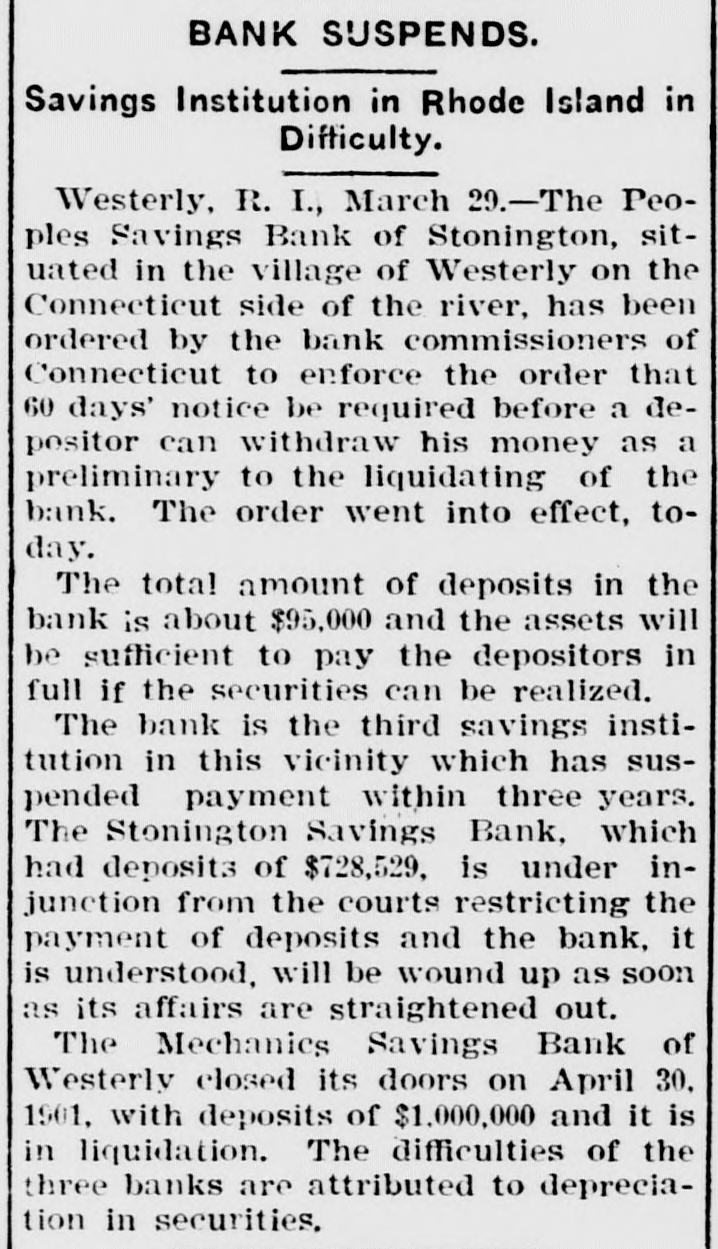
The Peoples Savings Bank of Stonington ... has been ordered by the bank commissioners of Connecticut to enforce the order that 60 days' notice be required before a depositor can withdraw his money as a preliminary to the liquidating of the bank. The order went into effect, today.
Source
newspapers
2. April 1, 1904 Other
Newspaper Excerpt
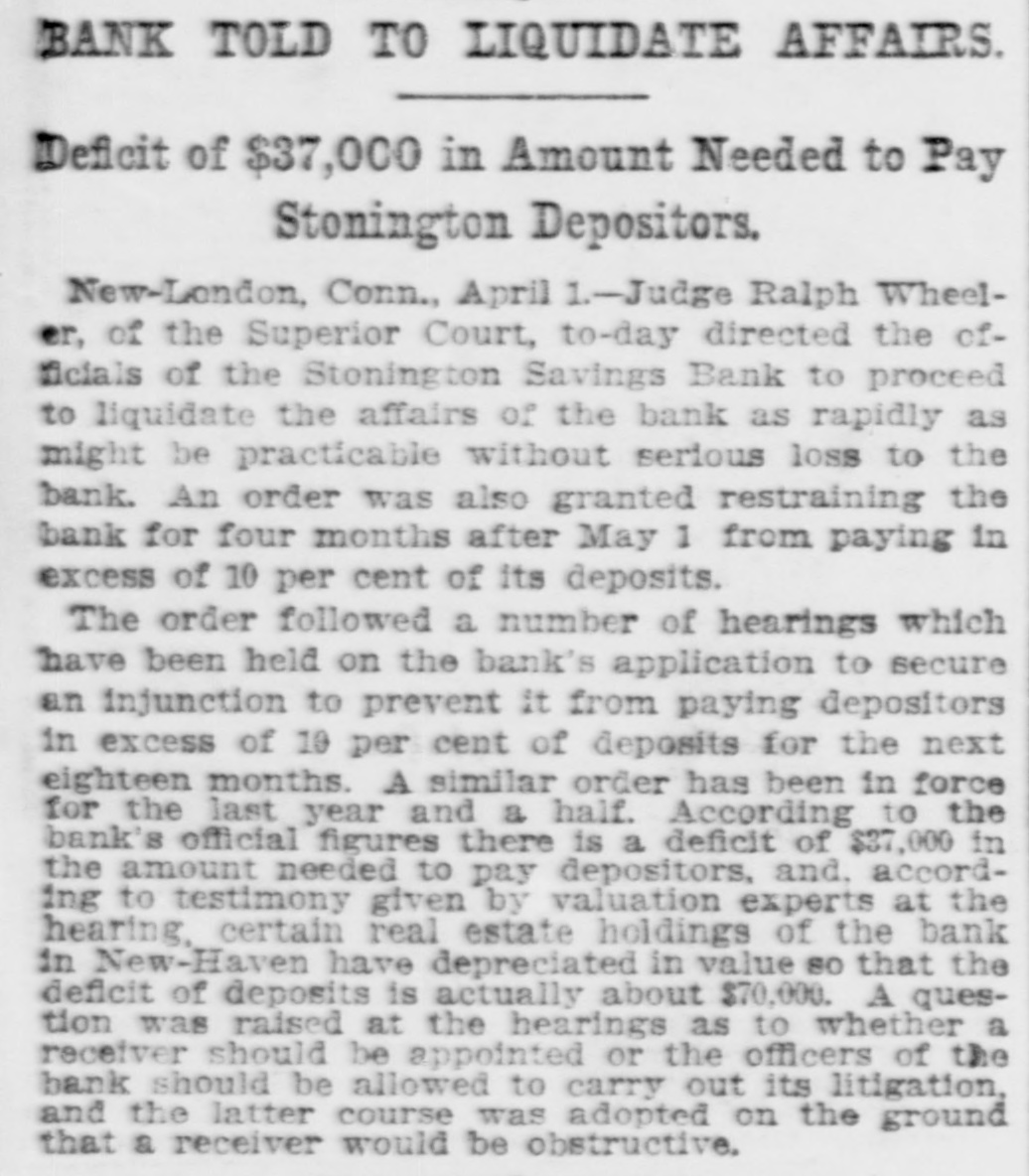
Judge Ralph Wheeler ... directed the officials of the Stonington Savings Bank to proceed to liquidate the affairs of the bank ... An order was also granted restraining the bank for four months after May 1 from paying in excess of 10 per cent of its deposits. According to the bank's official figures there is a deficit of $37,000 ... valuation experts ... deficit ... about $70,000.
Source
newspapers

Newspaper Articles (2)

Article from Daily Kennebec Journal, March 30, 1904

Click image to open full size in new tab

Article Text

BANK SUSPENDS. Savings Institution in Rhode Island in Difficulty. Westerly, R. I., March 29. - -The Peoples Savings Bank of Stonington, situated in the village of Westerly on the Connecticut side of the river, has been ordered by the bank commissioners of Connecticut to enforce the order that 60 days' notice be required before a depositor can withdraw his money as a preliminary to the liquidating of the bank. The order went into effect, today. The total amount of deposits in the bank is about $95,000 and the assets will be sufficient to pay the depositors in full if the securities can be realized. The bank is the third savings institution in this vicinity which has suspended payment within three years. The Stonington Savings Bank, which had deposits of $728,529, is under injunction from the courts restricting the payment of deposits and the bank, it is understood, will be wound up as soon as its affairs are straightened out. The Mechanics Savings Bank of Westerly closed its doors on April 30. 1901, with deposits of $1.000,000 and it is in liquidation. The difficulties of the three banks are attributed to depreciation in securities.

Article from New-York Tribune, April 2, 1904

Click image to open full size in new tab

Article Text

BANK TOLD TO LIQUIDATE AFFAIRS. Deficit of $37,000 in Amount Needed to Pay Stonington Depositors. New-London, Conn., April 1.-Judge Ralph Wheeler, of the Superior Court, to-day directed the officials of the Stonington Savings Bank to proceed to liquidate the affairs of the bank as rapidly as might be practicable without serious loss to the bank. An order was also granted restraining the bank for four months after May 1 from paying in excess of 10 per cent of its deposits. The order followed a number of hearings which have been held on the bank's application to secure an injunction to prevent it from paying depositors in excess of 10 per cent of deposits for the next eighteen months. A similar order has been in force for the last year and a half. According to the bank's official figures there is a deficit of $37,000 in the amount needed to pay depositors, and. according to testimony given by valuation experts at the hearing, certain real estate holdings of the bank in New-Haven have depreciated in value so that the deficit of deposits is actually about $70,000. A question was raised at the hearings as to whether a receiver should be appointed or the officers of the bank should be allowed to carry out its litigation, and the latter course was adopted on the ground that a receiver would be obstructive.