Article Text
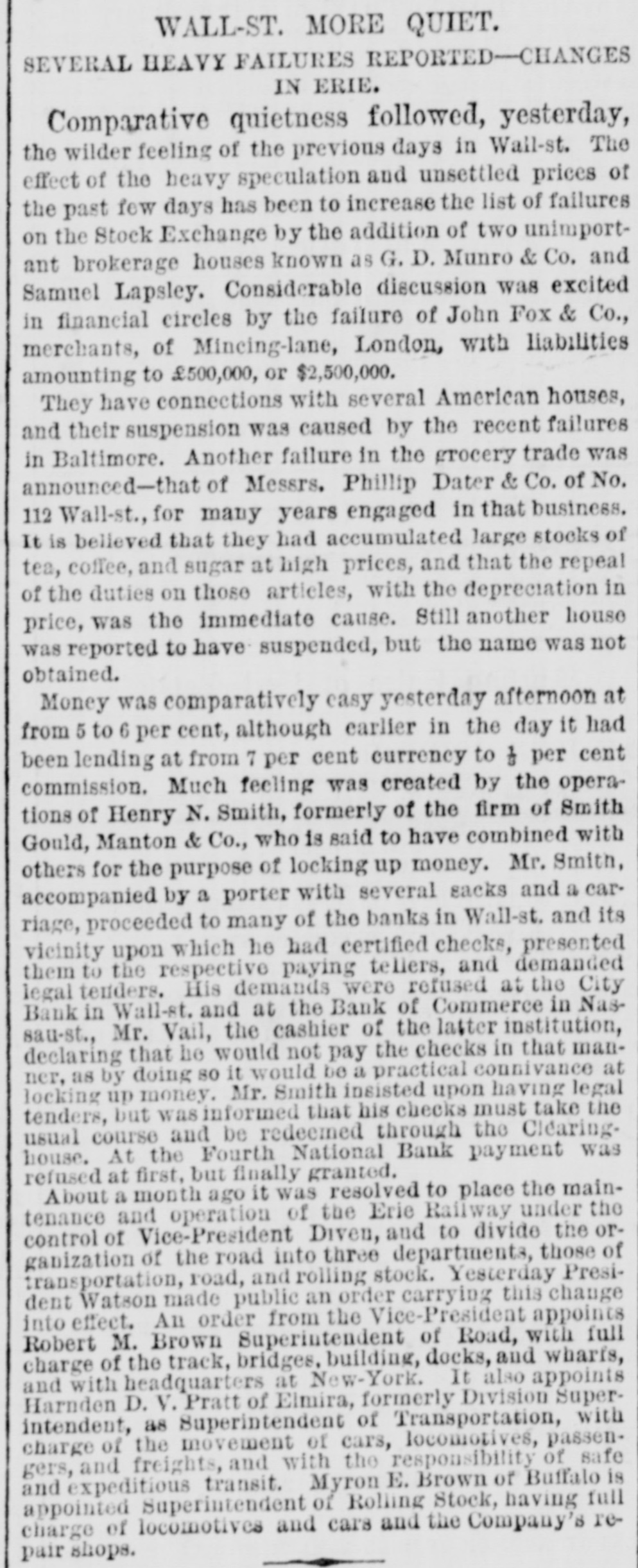
WALL-ST. MORE QUIET. SEVERAL HEAVY FAILURES REPORTED-CHANGES IN ERIE. Comparative quietness followed, yesterday, the wilder feeling of the previous days in Wall-st. The effect of the heavy speculation and unsettled prices of the past few days has been to increase the list of failures on the Stock Exchange by the addition of two unimportant brokerage houses known as G. D. Munro & Co. and Samuel Lapsley. Considerable discussion was excited in financial circles by the failure of John Fox & Co., merchants, of Mincing-lane, London, with liabilities amounting to £500,000, or $2,500,000. They have connections with several American houses, and their suspension was caused by the recent failures in Baltimore. Another failure in the grocery trade was announced-that of Messrs. Phillip Dater & Co. of No. 112 Wall-st., for many years engaged in that business. It is believed that they had accumulated large stocks of tea, coffee, and sugar at high prices, and that the repeal of the duties on those articles, with the depreciation in price, was the immediate cause. Still another house was reported to have suspended, but the name was not obtained. Money was comparatively easy yesterday afternoon at from 5 to 6 per cent, although earlier in the day it had been lending at from 7 per cent currency to 1 per cent commission. Much feeling was created by the operations of Henry N. Smith, formerly of the firm of Smith Gould, Manton & Co., who is said to have combined with others for the purpose of locking up money. Mr. Smith, accompanied by a porter with several sacks and a carriage, proceeded to many of the banks in Wall-st. and its vicinity upon which he had certified checks, presented them to the respective paying tellers, and demanded legal tenders. His demands were refused at the City Bank in Wall-st. and at the Bank of Commerce in Nassau-st., Mr. Vail, the cashier of the latter institution, declaring that he would not pay the checks in that manner, as by doing so it would be a practical connivance at locking up money. Mr. Smith insisted upon having legal tenders, but was informed that his checks must take the usual course and be redeemed through the Clearinghouse. At the Fourth National Bank payment was refused at first, but finally granted. About a month ago it was resolved to place the maintenance and operation of the Erie Railway under the control of Vice-President Diven, and to divide the organization of the road into three departments, those of transportation, road, and rolling stock. Yesterday President Watson made public an order carrying this change into effect. An order from the Vice-President appoints Robert M. Brown Superintendent of Road, with full charge of the track, bridges. building, docks, and wharfs, and with headquarters at New-York. It also appoints Harnden D. V. Pratt of Elmira, formerly Division Superintendent, as Superintendent of Transportation, with charge of the movement of cars, loconotives, passengers, and freights, and with the responsibility of safe and expeditious transit. Myron E. Brown of Buffalo is appointed Superintendent of Rolling Stock, having full charge of locomotives and cars and the Company's repair shops.