Article Text
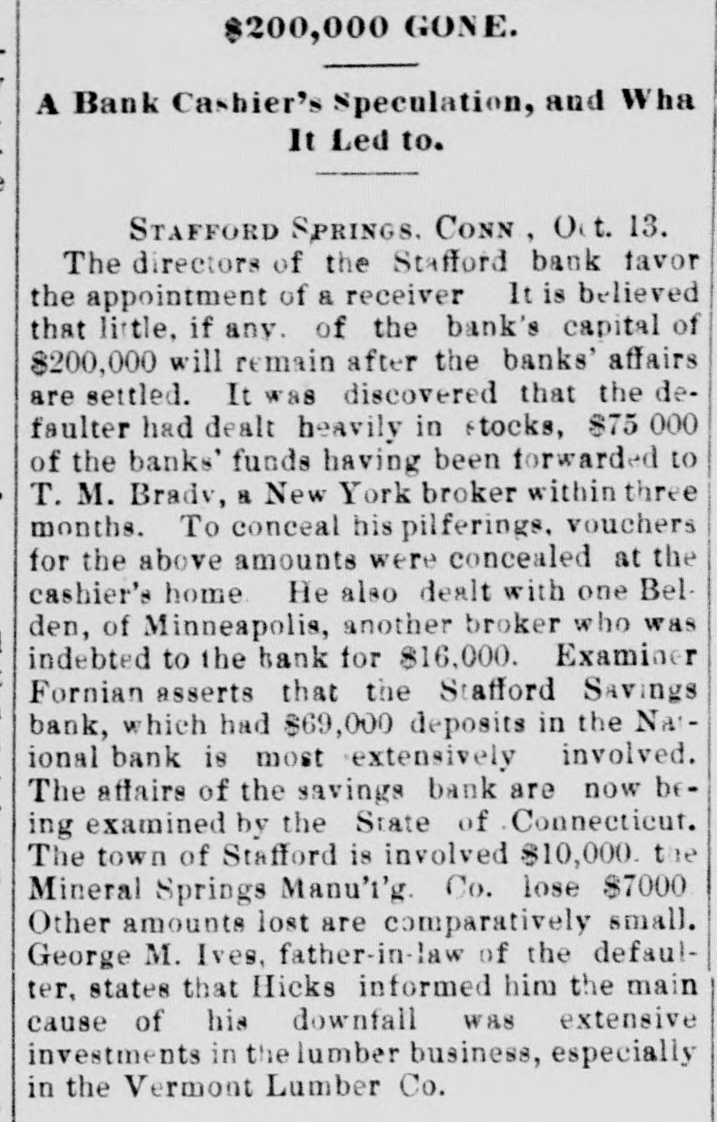
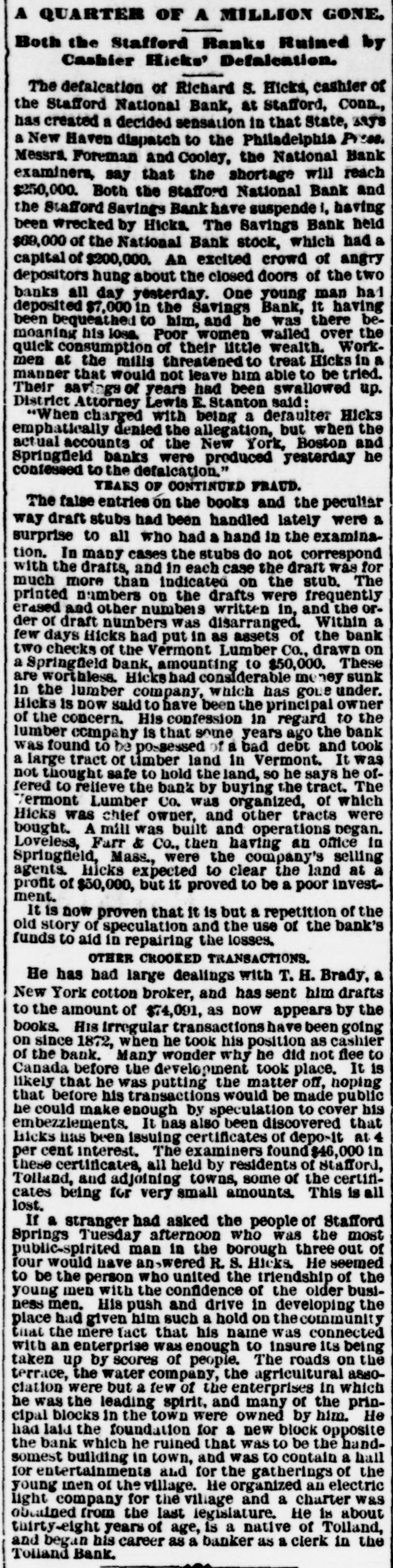
A QUARTER OF A MILLION GONE. Both the Stafford Banks Ruined by Cashier Hicks' Defalcation. The defalcation of Richard S. Hicks, cashier of the Stafford National Bank, at Stafford, Conn., has created a decided sensation in that State, says a New Haven dispatch to the Philadelphia Press. Messrs. Foreman and Cooley, the National Bank examiners, say that the shortage will reach $250,000. Both the Stafford National Bank and the Stafford Savings Bank have suspende i, having been wrecked by Hicks. The Savings Bank held $69,000 of the National Bank stock, which had a capital of $200,000. An excited crowd of angry depositors hung about the closed doors of the two banks all day yesterday. One young man had deposited $7,000 in the Savings Bank, It having been bequeathed to him, and he was there bemoaning his loss. Poor women walled over the quick consumption of their little wealth. Workmen at the mills threatened to treat Hicks in a manner that would not leave him able to be tried. Their savings of years had been swallowed up. District Attorney Lewis E. Stanton said: "When charged with being a defaulter Hicks emphatically denied the allegation, but when the actual accounts of the New York, Boston and Springfield banks were produced yesterday he confessed to the defalcation." YEARS OF CONTINUED FRAUD. The false entries on the books and the pecultar way draft stubs had been handled lately were a surprise to all who had a hand in the examination. In many cases the stubs do not correspond with the drafts, and in each case the draft was for much more than indicated on the stub. The printed numbers on the drafts were frequently erased and other numbers written in, and the order or draft numbers was disarranged. Within a few days Hicks had put in as assets of the bank two checks of the Vermont Lumber Co., drawn on a Springfield bank, amounting to $50,000. These are worthless. Hicks had considerable me ney sunk in the lumber company, which has gone under. Hicks is now said to have been the principal owner of the concern. His confession in regard to the lumber company is that some years ago the bank was found to be possessed of a bad debt and took a large tract or timber land in Vermont. It was not thought safe to hold the land, so he says he offered to relieve the bank by buying the tract. The Vermont Lumber Co. was organized, or which Hicks was chief owner, and other tracts were bought. A mill was built and operations began. Loveless, Farr & Co., then having an office to Springfield, Mass., were the company's selling agents. Hicks expected to clear the land at a profit of $50,000, but it proved to be a poor investment. It is now proven that it is but a repetition of the old story of speculation and the use of the bank's funds to aid in repairing the losses. OTHER CROOKED TRANSACTIONS. He has had large dealings with T. H. Brady, a New York cotton broker, and has sent him drafts to the amount of $74,091, as now appears by the books. His Irregular transactions have been going on since 1872, when he took his position as cashier of the bank. Many wonder why he did not flee to Canada before the development took place. It is likely that he was putting the matter off, hoping that before his transactions would be made public he could make enough by speculation to cover his embezziements. It has also been discovered that Hicks has been issuing certificates of depo-it at 4 per cent interest. The examiners found $46,000 in these certificates, all held by residents of Stafford, Tolland, and adjoining towns, some of the certificates being for very small amounts. This is all lost. If a stranger had asked the people of Stafford Springs Tuesday afternoon who was the most public-spirited man in the borough three out of four would have an-wered R. S. Hicks. He seemed to be the person who united the triendship of the young men with the confidence of the older business men. His push and drive in developing the place had given him such a hold on the community that the mere fact that his name was connected with an enterprise was enough to insure its being taken up by scores of people. The roads on the terrace, the water company, the agricultural assoclation were but a few of the enterprises in which he was the leading spirit, and many of the principal blocks in the town were owned by him. He had laid the foundation for a new block opposite the bank which he ruined that was to be the handsomest building in town, and was to contain a hall for entertainments and for the gatherings of the young men of the village. He organized an electric light company for the village and a charter was obtained from the last legislature. He is about thirty-eight years of age, is a native of Tolland, and began his career as a banker as a clerk in the Tolland Bank.