Click image to open full size in new tab
Article Text
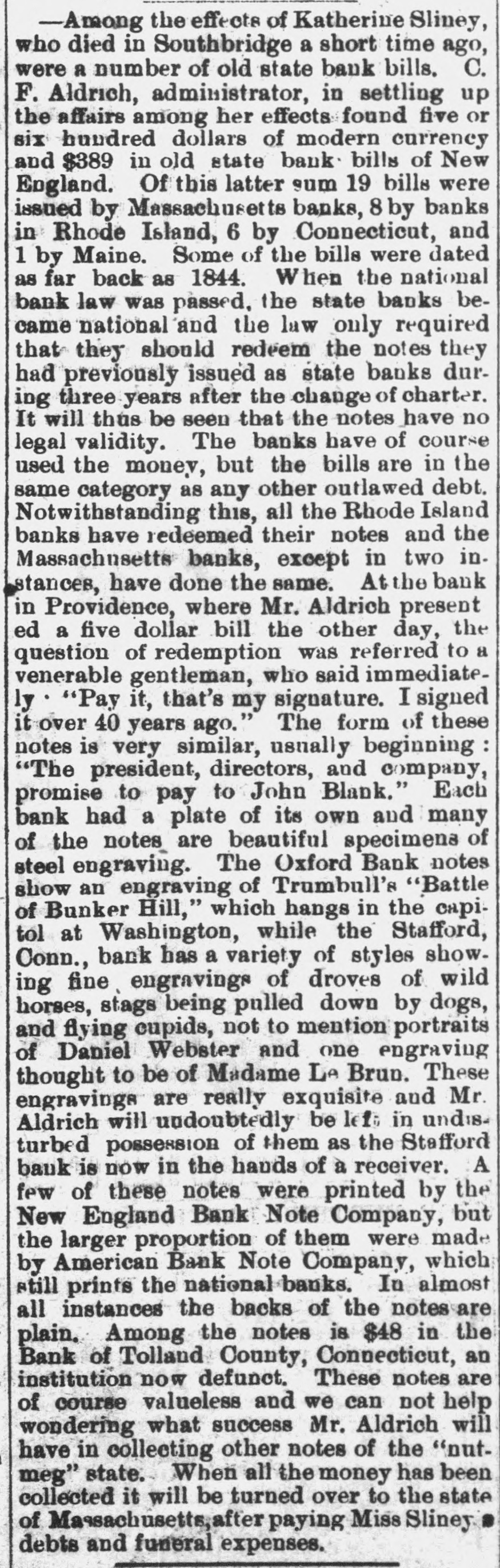
-Among the effects of Katherine Sliney, who died in Southbridge a short time ago, were a number of old state bank bills. C. F. Aldrich, administrator, in settling up the affairs among her effects found five or six hundred dollars of modern currency and $389 in old state bank bills of New England. Of this latter sum 19 bills were issued by Massachusetts banks, 8 by banks in Rhode Island, 6 by Connecticut, and 1 by Maine. Some of the bills were dated as far back as 1844. When the national bank law was passed. the state banks became national and the law only required that they should redeem the notes they had previously issued as state banks during three years after the change of charter. It will thus be seen that the notes have no legal validity. The banks have of course used the money, but the bills are in the same category as any other outlawed debt. Notwithstanding this, all the Rhode Island banks have redeemed their notes and the Massachnsetts banks, except in two in. stances, have done the same. At the bank in Providence, where Mr. Aldrich present ed a five dollar bill the other day, the question of redemption was referred to a venerable gentleman, who said immediate. ly "Pay it, that's my signature. I signed it over 40 years ago.' The form of these notes is very similar, usually beginning "The president, directors, and company, promise to pay to John Blank." Each bank had a plate of its own and many of the notes are beautiful specimens of steel engraving. The Oxford Bank notes show an engraving of Trumbull's "Battle of Bunker Hill," which hangs in the capitol at Washington, while the Stafford, Conn., bank has a variety of styles showing fine engravings of droves of wild horses, stags being pulled down by dogs, and flying cupids, not to mention portraits of Daniel Webster and one engraving thought to be of Madame Le Brun. These engravings are really exquisite and Mr. Aldrich will undoubtedly be left in undis. turbed possession of them as the Stafford bauk is now in the hands of a receiver. A few of these notes were printed by the New England Bank Note Company, but the larger proportion of them were made by American Bank Note Company, which still prints the national banks. In almost all instances the backs of the notes are plain. Among the notes is $48 in the Bank of Tolland County, Connecticut, an institution now defunct. These notes are of course valueless and we can not help wondering what success Mr. Aldrich will have in collecting other notes of the "nutmeg" state. When all the money has been collected it will be turned over to the state of Massachusetts,after paying Miss Sliney debts and funeral expenses.