Article Text
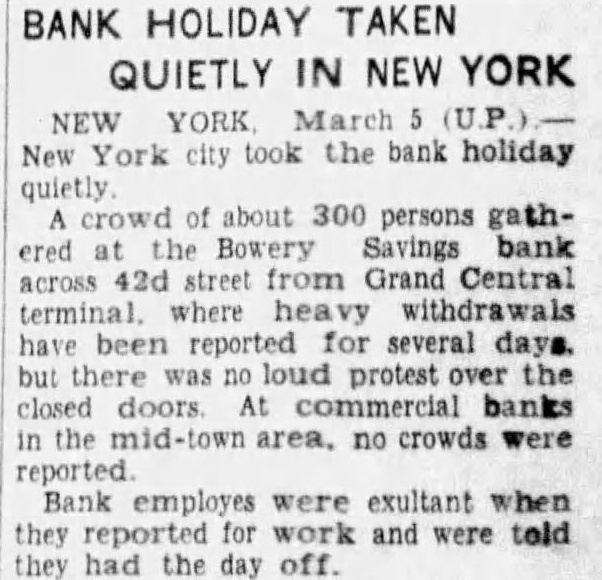
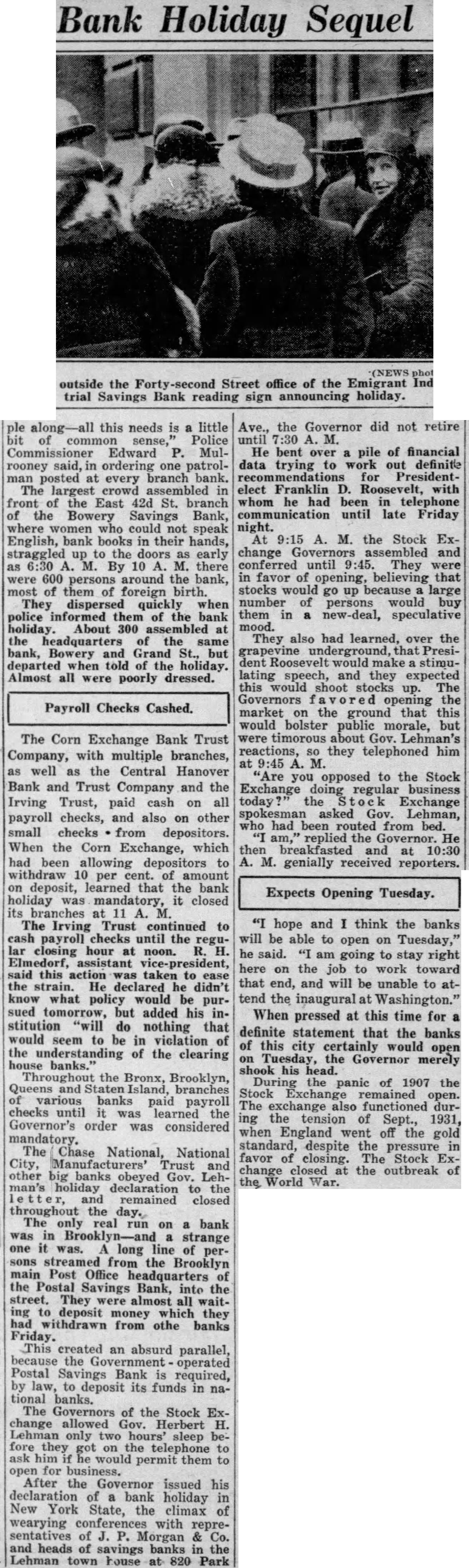
Bank Holiday Sequel ple along-all this needs is a little bit of common sense," Police Commissioner Edward P. Mulrooney said, in ordering one patrolman posted at every branch bank. The largest crowd assembled in front of the East 42d St. branch of the Bowery Savings Bank, where women who could not speak English, bank books in their hands, straggled up to the doors as early as 6:30 A. M. By 10 A. M. there were 600 persons around the bank, most of them of foreign birth. They dispersed quickly when police informed them of the bank holiday. About 300 assembled at the headquarters of the same bank, Bowery and Grand St., but departed when told of the holiday. Almost all were poorly dressed. Payroll Checks Cashed. The Corn Exchange Bank Trust Company, with multiple branches, as well as the Central Hanover Bank and Trust Company and the Irving Trust, paid cash on all payroll checks, and also on other small checks from depositors. When the Corn Exchange, which had been allowing depositors to withdraw 10 per cent. of amount on deposit, learned that the bank holiday was mandatory, it closed its branches at 11 A. M. The Irving Trust continued to cash payroll checks until the regular closing hour at noon. R. H. Elmedorf, assistant vice-president, said this action was taken to ease the strain. He declared he didn't know what policy would be pursued tomorrow, but added his institution "will do nothing that would seem to be in viclation of the understanding of the clearing house banks." Throughout the Bronx, Brooklyn, Queens and Staten Island, branches of various banks paid payroll checks until it was learned the Governor's order was considered mandatory. The Chase National, National City, Manufacturers' Trust and other big banks obeyed Gov. Lehman's holiday declaration to the letter, and remained closed throughout the day. The only real run on a bank was in Brooklyn-and a strange one it was. A long line of persons streamed from the Brooklyn main Post Office headquarters of the Postal Savings Bank, into the street. They were almost all waiting to deposit money which they had withdrawn from othe banks Friday. This created an absurd parallel, because the Government operated Postal Savings Bank is required, by law, to deposit its funds in national banks. The Governors of the Stock Exchange allowed Gov. Herbert H. Lehman only two hours' sleep before they got on the telephone to ask him if he would permit them to open for business. After the Governor issued his declaration of a bank holiday in New York State, the climax of wearying conferences with representatives of J. P. Morgan & Co. and heads of savings banks in the Lehman town house at 820 Park Ave., the Governor did not retire until 7:30 A. M. He bent over a pile of financial data trying to work out definite recommendations for Presidentelect Franklin D. Roosevelt, with whom he had been in telephone communication until late Friday night. At 9:15 A. M. the Stock Exchange Governors assembled and conferred until 9:45. They were in favor of opening, believing that stocks would go up because a large number of persons would buy them in a new-deal, speculative mood. They also had learned, over the grapevine underground, that President Roosevelt would make a stimulating speech, and they expected this would shoot stocks up. The Governors favored opening the market on the ground that this would bolster public morale, but were timorous about Gov. Lehman's reactions, SO they telephoned him at 9:45 A. M. "Are you opposed to the Stock Exchange doing regular business today the Stock Exchange spokesman asked Gov. Lehman, who had been routed from bed. "I am," replied the Governor. He then breakfasted and at 10:30 A. M. genially received reporters. Expects Opening Tuesday. "I hope and I think the banks will be able to open on Tuesday," he said. "I am going to stay right here on the job to work toward that end, and will be unable to attend the inaugural at Washington." When pressed at this time for a definite statement that the banks of this city certainly would open on Tuesday, the Governor merely shook his head. During the panic of 1907 the Stock Exchange remained open. The exchange also functioned during the tension of Sept., 1931, when England went off the gold standard, despite the pressure in favor of closing. The Stock Exchange closed at the outbreak of the World War.