Article Text
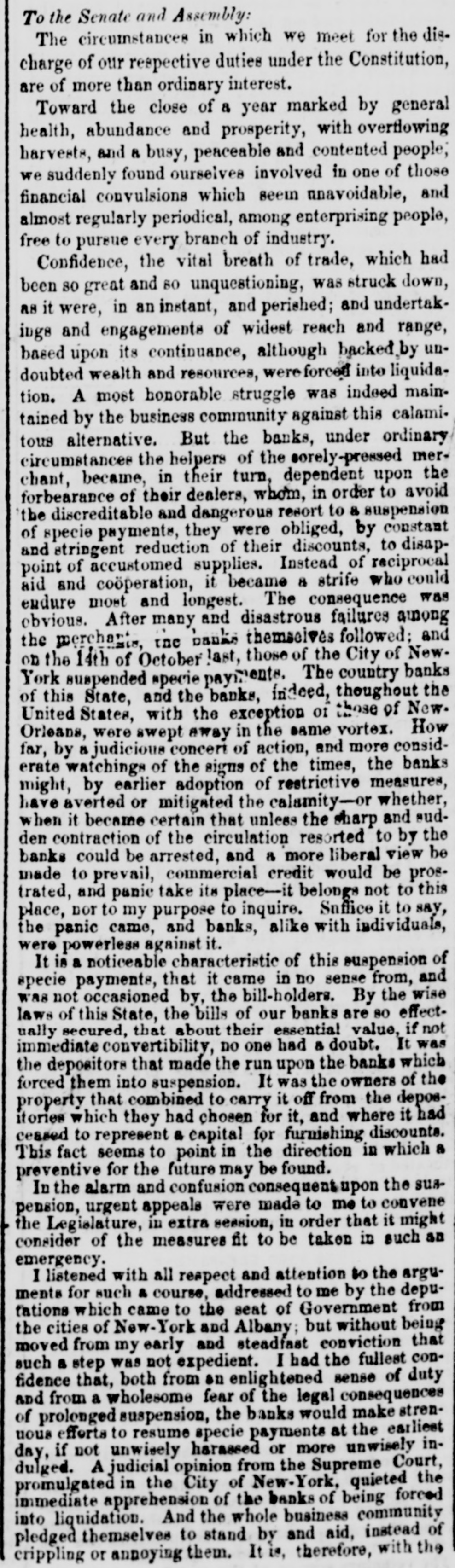
resumption, amply vindicated by the spontameous return to their regular course of business of all the banks of the City of New-York, on the 16th of December, within to months of the period of their auspension. The banks of the whole State followed the lead immediately, and those of other cities and States, with a few exceptions, did likewise, and now the liabilities of the banks are redeemed on demand in coin, as quietly and surely as though no interruption had oc. curred. I confess to some pride, as a citizen of the State of New-York, in such an exhibition, alike of the high sense of duty, of the integrity and of the solvency of the banks, ascontrasted, moreover, with the necessity which recently forced the Bank of England to ask and to avail itself of the intervention of the Government, for its relief, although armed with a defensive power, which our banks have not, of raising the rate of discount to 8 percentage that may become prohibitory. It is a just cause of satisfaction that our banks, partaking of all the freedom of our political institutions, after yielding for a brief space, yet, of their own motion, vigor and sense of duty, triumphed over like difficulties without aid from the Government. It would be unwise, however, to let the present opportunity pass without seeking some preventive of these periodical conv ulsions, so fraught with disaster, both to individuals and the public. The effect of the recent derangement in business has been to bring about a general settling up of accounts, and no period could, therefore, well be more propitious for the inauguration of any new provisions having for their object the greater security and steadiness of the business of banks, which combine, as ours do, the character both of banks of issue and banks of discount and deposit. With regard to the issues of the banks, I propose no change, for I perceive no necessity for any. The bank notes circulating as money are now so well secured, and 80 firmly established in public confidence, that oven the suspension of specie payments did not, as we have seen, sensibly affect their value, and though not at the moment redeemable in coin, they continued to pass current as before. These derangements in the money market have their source, not in the issues, but in the deposits of banks. Great competition exists among these institutions to secure large deposits at a low rate of interest. These deposits become the basis of extended and profitable discounts, thereby unduly expanding the circulation. Various expedients, more or less complieated, have been suggested to guard against this danger. But a simple and effectual course would seem to be, to require each bank to keep on hand a fixed relative proportion of coin to the total amount of its cash liabilities, exclusive of its notes, and to impose adequate penalties for the violation of this law. This would go to the root of the evil, for the cost of keeping in the vaults 80 much unproductive coin would be certain. There would be less desire, therefore, for large deposits; and these would be more equally ditfused among many banks-of itself an advantage instead of being, as now, monopolized by a few. Entertaining these views, Isubmit, for the consideration of the Legislature, the expediency of requiring, by law, under adequate penalties, that every bank shall keep on hand twenty-five per cent, in coin, of the amount of all its cash liabilities, exclusive of its notes. In order to avoid unnecessary inconveniences in carrying such a provision into effect, it might be 80 graduated, as to time, as to reach the minimum by a progressive a monthly percentage; but whenever reached, at day to be fixed, not to be departed from. Under a law similar to this, the chief banks of New-Orleans, alone of all the banks of the country, were enabled to resist the pressure of universal suspension elsewhere, and maintain their integrity. Such a law in this State, together with the weekly statements, under oath, of the City banks-now 80 judiciously required to be published-and the operation of the daily settlements at the Clearing-House, would, it is believed, go very far to prevent catastrophes such 88 that from which we are just emerging. I can perceive no objection, in expediency or equity, to such a restriction upon the banks, which, as creatures of the State, may and should be required so to conduct their operations as that the public safety shall not be postponed to the desire of adding to the profits of their private stockholders. The condition of the banks, in all their details, will be communicated to you at an early day by the Suporintendent of the Banking Department to which & would beg leave to refer you for such further information as you may desire upon these subjects. The condition of the finances of the State is such as to require, I amconstrained to say, continued taxation, in order to the maintenance of the public credit, and the due provision for the ordinary expenses. The Canal revenues are again deficient, and it becomes 8 duty to express the opinion that under existing circumstances, the Legislature may, with equal fitness and justice, repeal the law of 10th of July, 1851, entitled An Act to abolish tolls on Railroads, and then, by further act, re-establish the tolls on competing rail. roads, which had been pledged, by the Constitution, as part of the Canal revenues, for the security and ultimate redemption of the public debt. Railroads are great public benefits, and there should be no desire to deal in an illiberal spirit with their owners and managers. It is for the general safety and convenience that those who invest their money in such enterprises should be permitted to derive therefrom a just return of profits, but always in subordina. tion to the public good and the rights of others. It is in this view I recommend, as an equivalent for restablishipg the tolls on freight, that railroed companies, paying such tolls, be permitted to make such equitable increase in their present charges for the transportation of passengers as the Legislature may authorise. There will doubtless be addressed to you-applications for grants of money to various deserving enterprises and institutions: but it is my duty to say that, in the present condition of the Treasury, 8 deaf ear should be turned to all such applications; for it can only be through the exercise of the strictest economy, and of retreno hment wherever retrenchment can properly be made, that we shall be able to meet our ordinary ex. penditure, and to fulfill our obligations to those State institutions which habitually rely upon our annual appropriations. The reports annually presented to the Legislature will make known to you the general condition of the State, of its eleemosynary institutions, of its Housesof Refuge, its Prisons and Penitentiaries, and to these I refer, without reproducing their statements here. The Superintendent of the Onondaga Salt Springs reports to me that the inspection of salt manufactured on the Onondaga Salt Springs Reservation, during the past year, is 4,312,000 bushels. This is a falling off of the production of the preceding year of about 700,000 bushels. The Superintendent ascribes this falling off to the recent general derangement of business in the country, but expresses the confident belief that this important staple will speedily recover from its depression, and go on, as heretofore, with steady increase. Of the Canals, however, I must speak at some length and with entire frankness, not concealing whatever there may be of disappointment and discouragement in the statement to be made, but as certainly not doubting nor desponding, either as to ability, the obligation, or the expediency of persistent efforts and sacrifices, if need be, speedily to complete the enlargement; and therein and thereby put the State in possession of a system of internal navigation, unsurpassed in its extent and completeness, and unequaled in its productiveness. The net tolls of the past year, extending from Oct. 1, 1856, to Oct. 1, 1857, fall short, As appears by the annexed abstract from the report to me of the Auditoi of the Canal Department by $110,984 40 of the sum of $1,700,000 required by the Con-