National City Bank (New York, NY)

Episode Information

Episode UID
154301294
Episode Type
Run Only
Bank Type
national
Bank ID
15430 national
Charter Number
1543
Start Date
October 23, 1907
Location
New York, New York (40.714, -74.006)

Metadata

Model
gpt-5-mini (chosen from majority vote of a three-model LLM ensemble)
Short Digest
ad6acc90ac7c8a65

Response Measures

Accommodated withdrawals, Borrowed from banks or large institutions, Clearinghouse loan, Fed/other loan, Public signal of financial health

Clearinghouse involved: Yes (loan, examination, or other measures)

Events (4)

1. August 29, 1865 Chartered
Source
historical_nic
2. October 23, 1907 Run
Cause
Macro News
Cause Details
Part of the nationwide 1907 financial panic and loss of confidence leading to heavy withdrawals across New York banks
Measures
Paid large depositors in checks, offered/withdrew vault cash to meet demands; later engaged/imported gold and announced large gold purchases to bolster reserves
Newspaper Excerpt
Hundreds of depositors were gathered at the vaults ... hours before the usual time of opening
Source
newspapers
3. October 28, 1907 Other
Newspaper Excerpt
Late this afternoon the National City bank announced that it had engaged $1,250,000 in gold ... making a total of $7,250,000 for that institution ... business resumed its normal routine.
Source
newspapers
4. August 26, 1919 Voluntary Liquidation
Source
historical_nic

Newspaper Articles (24)

Article from The Spokane Press, October 23, 1907

Click image to open full size in new tab

Article Text

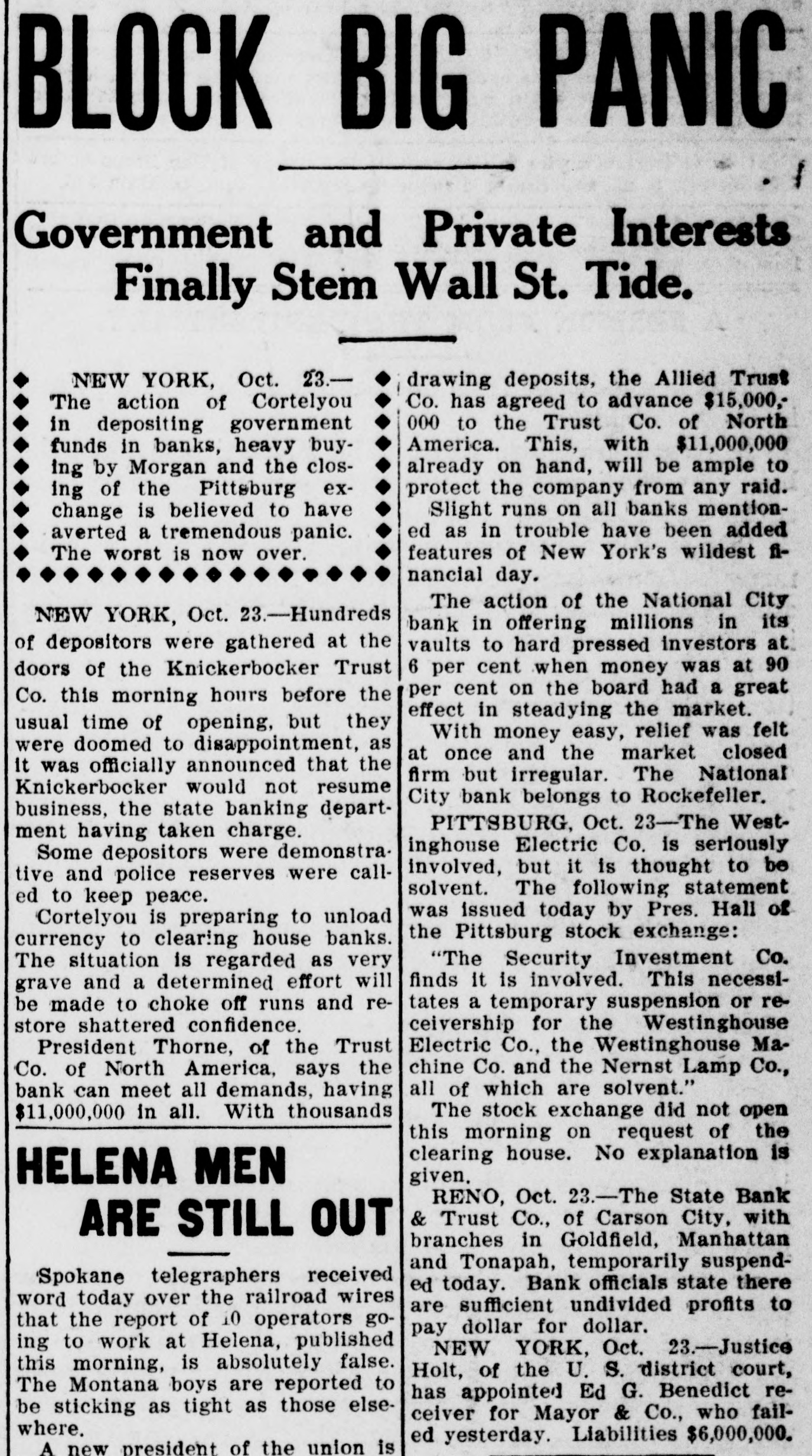
BLOCK BIG PANIC Government and Private Interests Finally Stem Wall St. Tide. NEW YORK, Oct. 23.drawing deposits, the Allied Trust The action of Cortelyou Co. has agreed to advance $15,000,000 to the Trust Co. of North in depositing government America. This, with $11,000,000 funds in banks, heavy buyalready on hand, will be ample to ing by Morgan and the closprotect the company from any raid. ing of the Pittsburg exSlight runs on all banks mentionchange is believed to have ed as in trouble have been added averted a tremendous panic. features of New York's wildest fiThe worst is now over. nancial day. The action of the National City NEW YORK, Oct. 23.-Hundreds bank in offering millions in its of depositors were gathered at the vaults to hard pressed investors at 6 per cent when money was at 90 doors of the Knickerbocker Trust per cent on the board had a great Co. this morning hours before the effect in steadying the market. usual time of opening, but they With money easy, relief was felt were doomed to disappointment, as at once and the market closed It was officially announced that the firm but irregular. The National Knickerbocker would not resume City bank belongs to Rockefeller. business, the state banking departPITTSBURG, Oct. 23-The Westment having taken charge. inghouse Electric Co. is seriously Some depositors were demonstra. involved, but it is thought to be tive and police reserves were callsolvent. The following statement ed to keep peace. was issued today by Pres. Hall of Cortelyou is preparing to unload the Pittsburg stock exchange: currency to clearing house banks. "The Security Investment Co. The situation is regarded as very finds it is involved. This necessigrave and a determined effort will tates a temporary suspension or rebe made to choke off runs and restore shattered confidence. ceivership for the Westinghouse Electric Co., the Westinghouse MaPresident Thorne, of the Trust chine Co. and the Nernst Lamp Co., Co. of North America, says the all of which are solvent." bank can meet all demands, having The stock exchange did not open $11,000,000 in all. With thousands this morning on request of the clearing house. No explanation is HELENA MEN given. RENO, Oct. 23.-The State Bank & Trust Co., of Carson City, with ARE STILL OUT branches in Goldfield, Manhattan and Tonapah, temporarily suspendSpokane telegraphers received ed today. Bank officials state there word today over the railroad wires are sufficient undivided profits to that the report of 10 operators gopay dollar for dollar. ing to work at Helena, published NEW YORK, Oct. 23.-Justice this morning, is absolutely false. Holt, of the U. S. district court, The Montana boys are reported to has appointed Ed G. Benedict rebe sticking as tight as those elseceiver for Mayor & Co., who failwhere. ed yesterday. Liabilities $6,000,000. A new president of the union is
Article from The Seattle Star, October 23, 1907

Click image to open full size in new tab

Article Text

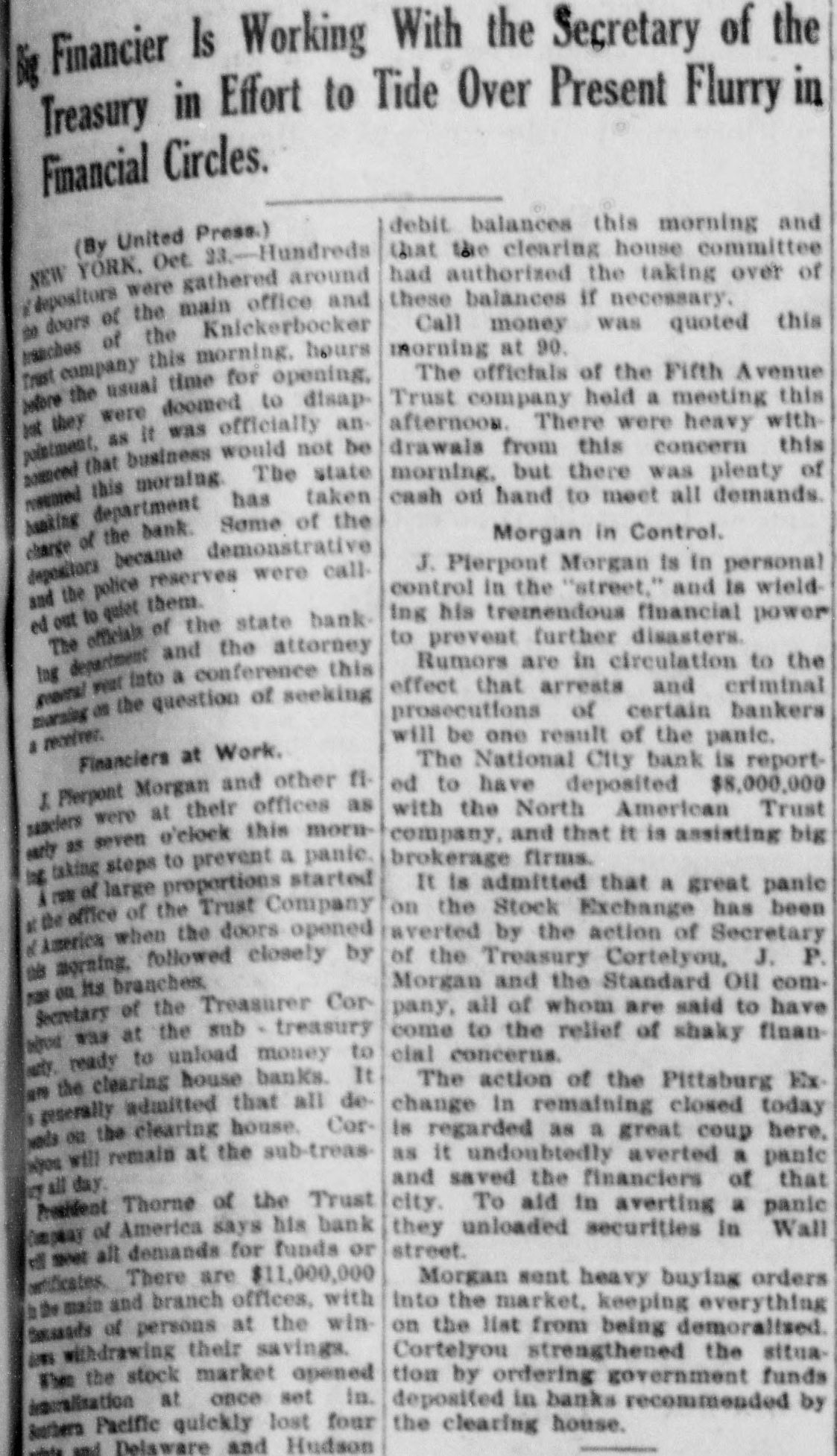
Financier Is Working With the Secretary of the Treasury in Effort to Tide Over Present Flurry in Financial Circles. debit balances this morning and (By United Press.) that the clearing house committee had authorized the taking over of NEW YORK. Oct. gathered 23.-Hundreds around these balances if necessary. Call money was quoted this morning at 90. tranches $ depositors of were the the main Knickerbocker office hours and The officials of the Fifth Avenue company this morning. for opening, Trust company held a meeting this afternoon. There were heavy withdrawals from this concern this before Trust just they the were usual it doomed time was officially would to not disap- an- be morning, but there was plenty of nomeed business The state cash on hand to meet all demands. resumed this morning. taken department has Morgan in Control. banking of the bank. Some of the J. Pierpont Morgan is in personal control in the "street," and is wielding his tremendous financial power 1 ed out to state bankto prevent further disasters. The officials of the Rumors are in circulation to the department and conference the attorney this effect that arrests and criminal general Ing wear into a of seeking prosecutions of certain bankers morning on the question will be one result of the panic. a receiver. The National City bank is reportFinanciers at Work. ed to have deposited $8,000,000 I. Pierpont Morgan and other fl. with the North American Trust sanciers were at their offices as company, and that It is assisting big early as seven o'clock this mornbrokerage firms. If taking steps to prevent a panie. It is admitted that a great panic À - of large proportions started on the Stock Exchange has been the office of the Trust Company averted by the action of Secretary # of America when the doors opened of the Treasury Cortelyou, J. P. - morning, followed closely by Morgan and the Standard Oil com- on its branches. pany, all of whom are said to have Secretary of the Treasurer Corcome to the relief of shaky finanblood was at the sub treasury cial concerns. early. ready to unload money to The action of the Pittsburg Exare the clearing house banks. It change In remaining closed today generally admitted that all deis regarded as a great coup here, waits on the clearing house. Coras it undoubtedly averted a panic wyou will remain at the sub-treasand saved the financiers of that n all day. city. To aid in averting a panic President Thorne of the Trust they unloaded securities in Wall (mplay of America says his bank street. di givet all demands for funds or Morgan sent heavy buying orders certificates. There are $11,000,000 into the market, keeping everything the main and branch offices, with on the list from being demoralized. texasits of persons at the winCortelyou strengthened the situain withdrawing their savings. tion by ordering government funds The the stock market opened deposited in banks recommended by immilization at once set In. the clearing house. Burbers Pacific quickly lost four wints and Delaware and Hudson


Article from The Salt Lake Herald, October 29, 1907

Click image to open full size in new tab

Article Text

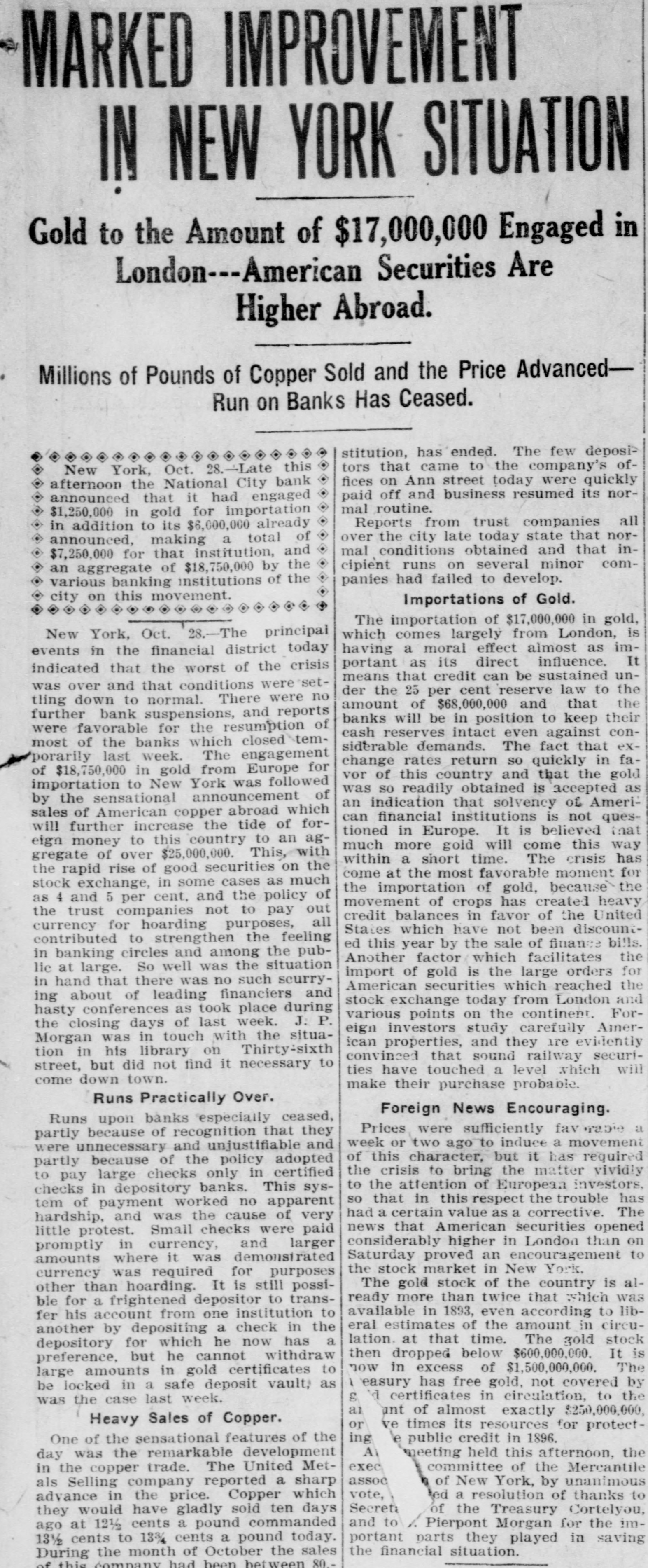
MARKED IMPROVEMENT IN NEW YORK SITUATION Gold to the Amount of $17,000,000 Engaged in London---American Securities Are Higher Abroad. Millions of Pounds of Copper Sold and the Price AdvancedRun on Banks Has Ceased. stitution, has ended. The few depositors that came to the company's ofNew York, Oct. 28.-Late this fices on Ann street today were quickly afternoon the National City bank paid off and business resumed its norannounced that it had engaged mal routine. $1,250,000 in gold for importation Reports from trust companies all in addition to its $6,000,000 already over the city late today state that norannounced, making a total of mal conditions obtained and that in$7,250,000 for that institution, and cipient runs on several minor coman aggregate of $18,750,000 by the panies had failed to develop. various banking institutions of the city on this movement. Importations of Gold. The importation of $17,000,000 in gold, New York, Oct. 28.-The principal which comes largely from London, is having a moral effect almost as imevents in the financial district today portant as its direct influence. It indicated that the worst of the crisis means that credit can be sustained unwas over and that conditions were setder the 25 per cent reserve law to the tling down to normal. There were no amount of $68,000,000 and that the further bank suspensions, and reports banks will be in position to keep their were favorable for the resumption of cash reserves intact even against conmost of the banks which closed temsiderable demands. The fact that exporarily last week. The engagement change rates return SO quickly in faof $18,750,000 in gold from Europe for vor of this country and that the gold importation to New York was followed was SO readily obtained is accepted as by the sensational announcement of an indication that solvency of Amerisales of American copper abroad which can financial institutions is not queswill further increase the tide of fortioned in Europe. It is believed that eign money to this country to an agmuch more gold will come this way gregate of over $25,000,000. This, with within a short time. The crisis has the rapid rise of good securities on the come at the most favorable moment for stock exchange, in some cases as much the importation of gold, because the as 4 and 5 per cent, and the policy of movement of crops has created heavy the trust companies not to pay out credit balances in favor of the United currency for hoarding purposes, all States which have not been discountcontributed to strengthen the feeling ed this year by the sale of finance bills. in banking circles and among the pubAnother factor which facilitates the lic at large. So well was the situation import of gold is the large orders for in hand that there was no such scurryAmerican securities which reached the ing about of leading financiers and stock exchange today from London and hasty conferences as took place during various points on the continent. Forthe closing days of last week. J. P. eign investors study carefully AmerMorgan was in touch with the situaican properties, and they are evidently tion in his library on Thirty-sixth convinced that sound railway securistreet, but did not find it necessary to ties have touched a level which will come down town. make their purchase probable. Runs Practically Over. Foreign News Encouraging. Runs upon banks especially ceased, Prices were sufficiently fav Table a partly because of recognition that they week or two ago to induce a movement were unnecessary and unjustifiable and of this character, but it has required partly because of the policy adopted the crisis to bring the matter vividly to pay large checks only in certified to the attention of European investors, checks in depository banks. This sysSO that in this respect the trouble has tem of payment worked no apparent had a certain value as a corrective. The hardship, and was the cause of very news that American securities opened little protest. Small checks were paid considerably higher in London than on promptly in currency, and larger Saturday proved an encouragement to amounts where it was demonstrated the stock market in New York, currency was required for purposes The gold stock of the country is alother than hoarding. It is still possiready more than twice that which was ble for a frightened depositor to transavailable in 1893, even according to libfer his account from one institution to eral estimates of the amount in circuanother by depositing a check in the lation. at that time. The gold stock depository for which he now has a then dropped below $600,000,000. It is preference, but he cannot withdraw now in excess of $1,500,000,000. The large amounts in gold certificates to \ easury has free gold, not covered by be locked in a safe deposit vault, as g XI certificates in circulation, to the was the case last week. ai ant of almost exactly $250,000,000, Heavy Sales of Copper. or ve times its resources for protectOne of the sensational features of the ing public credit in 1896. A\ meeting held this afternoon, the day was the remarkable development exec committee of the Mercantile in the copper trade. The United Metassoc of New York, by unanimous als Selling company reported a sharp ted a resolution of thanks to vote, advance in the price. Copper which Secreta of the Treasury Cortelyou, they would have gladly sold ten days to and Pierpont Morgan for the imago at 12½ cents a pound commanded portant parts they played in saving 13½ cents to 13% cents a pound today. the financial situation. During the month of October the sales of this company had been between 80.-


Article from The Salt Lake Herald, October 29, 1907

Click image to open full size in new tab

Article Text

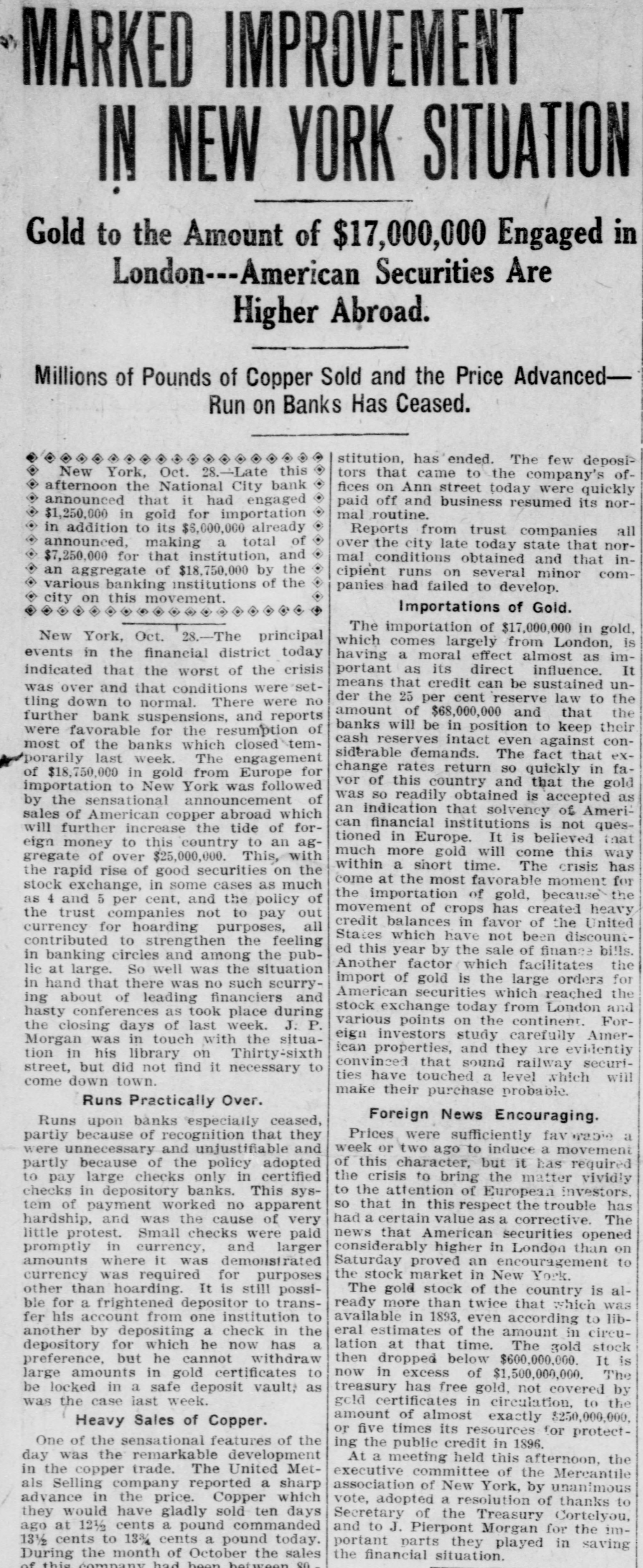
MARKED IMPROVEMENT IN NEW YORK SITUATION Gold to the Amount of $17,000,000 Engaged in London---American Securities Are Higher Abroad. Millions of Pounds of Copper Sold and the Price Advanced— Run on Banks Has Ceased. stitution, has ended. The few deposiNew York, Oct. 28.-Late this tors that came to the company's ofafternoon the National City bank fices on Ann street today were quickly announced that it had engaged paid off and business resumed its normal routine. $1,250,000 in gold for importation in addition to its $6,000,000 already Reports from trust companies all announced, making a total of over the city late today state that nor$7,250,000 for that institution, and mal conditions obtained and that inan aggregate of $18,750,000 by the cipient runs on several minor comvarious banking institutions of the panies had failed to develop. city on this movement. Importations of Gold. The importation of $17,000,000 in gold, New York, Oct. 28.-The principal which comes largely from London, is events in the financial district today having a moral effect almost as imindicated that the worst of the crisis portant as its direct influence. It means that credit can be sustained unwas over and that conditions were setder the 25 per cent reserve law to the tling down to normal. There were no amount of $68,000,000 and that the further bank suspensions, and reports banks will be in position to keep their were favorable for the resumption of cash reserves intact even against conmost of the banks which closed temsiderable demands. The fact that exporarily last week. The engagement change rates return SO quickly in faof $18,750,000 in gold from Europe for vor of this country and that the gold importation to New York was followed was SO readily obtained is accepted as by the sensational announcement of an indication that solvency of Amerisales of American copper abroad which can financial institutions is not queswill further increase the tide of fortioned in Europe. It is believed that eign money to this country to an agmuch more gold will come this way gregate of over $25,000,000. This, with within a short time. The crisis has the rapid rise of good securities on the come at the most favorable moment for stock exchange, in some cases as much the importation of gold, because the as 4 and 5 per cent, and the policy of movement of crops has created heavy the trust companies not to pay out credit balances in favor of the United currency for hoarding purposes, all States which have not been discountcontributed to strengthen the feeling ed this year by the sale of finance bills. in banking circles and among the pubAnother factor which facilitates the lic at large. So well was the situation import of gold is the large orders for in hand that there was no such scurryAmerican securities which reached the ing about of leading financiers and stock exchange today from London and hasty conferences as took place during various points on the continent. Forthe closing days of last week. J. P. eign investors study carefully AmerMorgan was in touch with the situaican properties, and they are evidently tion in his library on Thirty-sixth convinced that sound railway securistreet, but did not find it necessary to ties have touched a level which will come down town. make their purchase probable. Runs Practically Over. Foreign News Encouraging. Runs upon banks especially ceased, Prices were sufficiently fav Trable a partly because of recognition that they week or two ago to induce a movement were unnecessary and unjustifiable and partly because of the policy adopted of this character, but it has required to pay large checks only in certified the crisis to bring the matter vividly to the attention of European investors, checks in depository banks. This system of payment worked no apparent SO that in this respect the trouble has had a certain value as a corrective. The hardship, and was the cause of very little protest. Small checks were paid news that American securities opened considerably higher in London than on promptly in currency, and larger amounts where it was demonstrated Saturday proved an encouragement to the stock market in New York. currency was required for purposes other than hoarding. It is still possiThe gold stock of the country is alble for a frightened depositor to transready more than twice that which was fer his account from one institution to available in 1893, even according to liberal estimates of the amount in circuanother by depositing a check in the depository for which he now has a lation at that time. The gold stock preference, but he cannot withdraw then dropped below $600,000,000. It is large amounts in gold certificates to now in excess of $1,500,000,000. The be locked in a safe deposit vault, as treasury has free gold, not covered by was the case last week. gold certificates in circulation, to the amount of almost exactly $250,000,000, Heavy Sales of Copper. or five times its resources for protectOne of the sensational features of the ing the public credit in 1896. day was the remarkable development At a meeting held this afternoon, the in the copper trade. The United Metexecutive committee of the Mercantile als Selling company reported a sharp association of New York, by unanimous advance in the price. Copper which vote, adopted a resolution of thanks to they would have gladly sold ten days Secretary of the Treasury Cortelyou, ago at 12½ cents a pound commanded and to J. Pierpont Morgan for the im13½ cents to 13% cents a pound today. portant parts they played in saving During the month of October the sales the financial situation. of this company had been between 80


Article from The Madison Daily Leader, October 30, 1907

Click image to open full size in new tab

Article Text

SCARE IS SUBSIDING Runs Upon New York Banks Practically Cease. STOCK MARKET UNSTEADY Calling in of Loans Causes a Decline in Prices, Canadian Pacific Leading in the Slump-Worldwide Scramble for Gold. New York, Oct. 30.-The financial situation is without notable developments. and the abating interest indicates that the public has pretty well gotten over its scare. The stock markets is a little unsteady, but without extreme agitation. The announcement at the ImpeS rial bank of Germany a raised its discount rate from 5 1/2 to 6 1/2 per cent in order to protect its gold holdings was not unexpected by bankers here. It is thought quite likely that the Bank of England will follow suit by raising its rate at the regular meeting on Thursday. The scramble for gold is such at all the financial centersLondon, Paris, Berlin and New York -that the metel will go to the highest bidder and under present conditions New York is likely to appear for a time in this role. Her ability to get gold is due not only to the need for it, but to the large credits which are being established by the movement of the crops and other products-notably wheat, cotton, copper, tobacco and meats-and by the sale of American securities. These influences are usually more potent than artificial measures to obtain the yellow metal. It is believed this will be effective to place sufficient gold at the command of the New York market and to maintain credit and cause the resumption of banking operations in the usual manner within a few days. Runs upon the banks here have practically ceased since the banks adopted the policy of paying large depositors in checks. Some transfers of accounts are being made from the smaller to the larger banks, which resulted in adverse balances against the former, but strengthening the ability of the larger institutions to meet pressure and to support the market.


Article from The Roswell Daily Record, December 3, 1907

Click image to open full size in new tab

Article Text

"The current number of Harper's Weekly contains an editorial 'roast' of the clearing house certificates issued in Las Vegas, New Mexico. In view of the fact that the financial difficulties of the West were wholly due to the suspension of payment by the New York banks, and the issue by these banks of clearing house certificates and other forms of 'Johnsmith' currency—as it is now called—it would seem that the Weekly might have found a target for its ammunition nearer home.—Socorro Chieftain.


Article from Deseret Evening News, December 3, 1907

Click image to open full size in new tab

Article Text

# RESUMPTION. Horace Greely was wont to say that "the way to resume is to resume." The New York banks have been announcing for some time that specie payments are about to be resumed. It appears that the bankers elsewhere are ready to pay cash as soon as New York decides to keep its promises. It is noted as one peculiar feature of the present panic that some of the New York bankers will become rich because of it. And we doubt not that the most immediate cause of the suspension of cash payment by the banks all over the country was the stoppage of such payments by the banks in New York. As long as the banks of that city continue to withhold payment of their obligations, there seems to be no reason why they might not be purchasing the government bonds and so making a profit out of withholding cash payments to the rest of the country. Such a suggestion is made in many quarters, and the way to negative any such suspicion is for the New York banks to pay their obligations inland in the current money of the realm.


Article from Albuquerque Morning Journal, December 27, 1907

Click image to open full size in new tab

Article Text

BANK DEPOSITORS RECOVER FROM PANIC (New York. Dec. 26.-Today was the date of the expiration of most of the sixty-day withdrawal notices re. quired by the savings banks at the height of the paniè in October, but searcely a depositor called for his money


Article from The Times Dispatch, February 7, 1908

Click image to open full size in new tab

Article Text

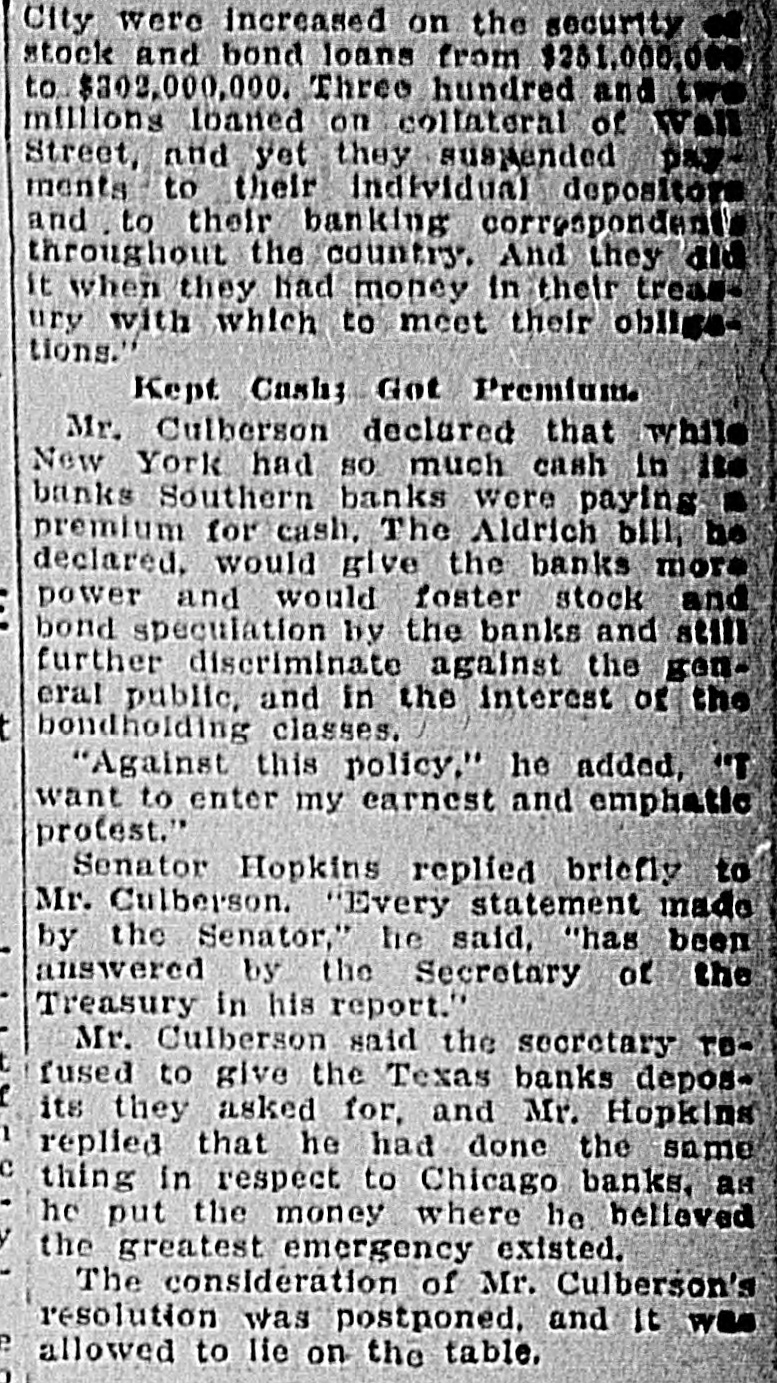
City were increased on the security of stock and bond loans from $281,000,000 to $302,000,000. Three hundred and twelve millions loaned on collateral of Wall Street, and yet they suspended payments to their individual depositors and to their banking correspondents throughout the country. And they did it when they had money in their treasury with which to meet their obliga-tions." ### Kept Cash; Got Premium. Mr. Culberson declared that while New York had so much cash in its banks Southern banks were paying a premium for cash. The Aldrich bill, he declared, would give the banks more power and would foster stock and bond speculation by the banks and still further discriminate against the general public, and in the interest of the bondholding classes. "Against this policy," he added, "I want to enter my earnest and emphatic protest." Senator Hopkins replied briefly to Mr. Culberson. "Every statement made by the Senator," he said, "has been answered by the Secretary of the Treasury in his report." Mr. Culberson said the secretary refused to give the Texas banks deposits they asked for, and Mr. Hopkins replied that he had done the same thing in respect to Chicago banks, as he put the money where he believed the greatest emergency existed. The consideration of Mr. Culberson's resolution was postponed, and it was allowed to lie on the table.


Article from The Birmingham Age-Herald, March 12, 1908

Click image to open full size in new tab

Article Text

FINANCIAL BILL HOTLY DENOUNCED Senator Clarke of Arkansas Hits Several Fierce Blows ALDRICH ATTEMPTS REPLY Investigation of Causes of the Panic Is Demanded by Senator Clarke, Who Also Denounces New York Stock Exchange. Washington, March 11.-Senator Clarke of Arkansas denounced the pending currency bill in a speech in the Senate today, declaring that no currency legislation should be enacted until an investigation is held as to the causes of the panic. "No such legislation is necessary now, said Mr. Clarke. "It is not only not necesI sary, but it may become dangerous. am not disposed to tolerate the idea of giving any support to the committee bill, nor the substitute proposed by the minority members of the Senate." If emergency currency is to be provided, Mr. Clarke said, the benefits should be extended all persons whose legitimate business demands cause them to need it. Mr. Clarke denounced the operations of stock exchanges and said the American people would not be satisfied with the proposed currency legislation without a complete knowledge of causes of the panic. "The time has arrived," he said, "when the affairs of the New .York stock exchange and other stock exchanges must be looked into." Mr. Clarke's reference to the stoppage of the payments by the New York banks called Mr. Aldrich to his feet with the remark that he did not believe the people would permit that course again to be pursued. "I trust the senator from Rhode Island as a historian," retorted Mr. Clarke, "but I do not trust him as a prophet." Mr. Clarke expressed the opinion that the majority would not pass the bill allowing the emergency circulation to be retired without limitation. Mr. Clarke said he would not only require a restriction of reserves, but he would deny to a national bank the right to pay interest on checking accounts. Senator Nelson suggested that the national banks should pay interest on the $250,000,000 of government deposits. Mr. Aldrich said that five years ago he had introduced a bill providing for the payment of interest on such deposits at the rate of 1 1/2 per cent, but, he added, senators had opposed that bill on the ground that it changed the nature of the loan. Former Senator Spooner and the late Senator Morgan, he said, opposed the bill. If that objection could be overcome he declared his willingness to again bring in such a measure. He did not know any reason unless it should be a legal one, of the kind suggested, why interest should not be charged on these deposits. Mr. Culberson, he said, had introduced a bill to require payment of interest on government deposits and it was now before the committee on finance. Mr. Bailey spoke at some length suggesting that the main purpose of his substitute was to favor the principle of government money instead of bank money He explained that he had provided for a distribution of the emergency currency in accordance with population, although he realized that business necessity was a greater measure of the amount they should have. But it was not possible to make sure of the business needs of the several sections and it was a simple matter to ascertain the population. An extended argument was made by Mr. Newlands of Nevada in favor of his view that the sending of a check from one state to another makes the business of banking interstate commerce.


Article from Rock Island Argus, October 19, 1909

Click image to open full size in new tab

Article Text

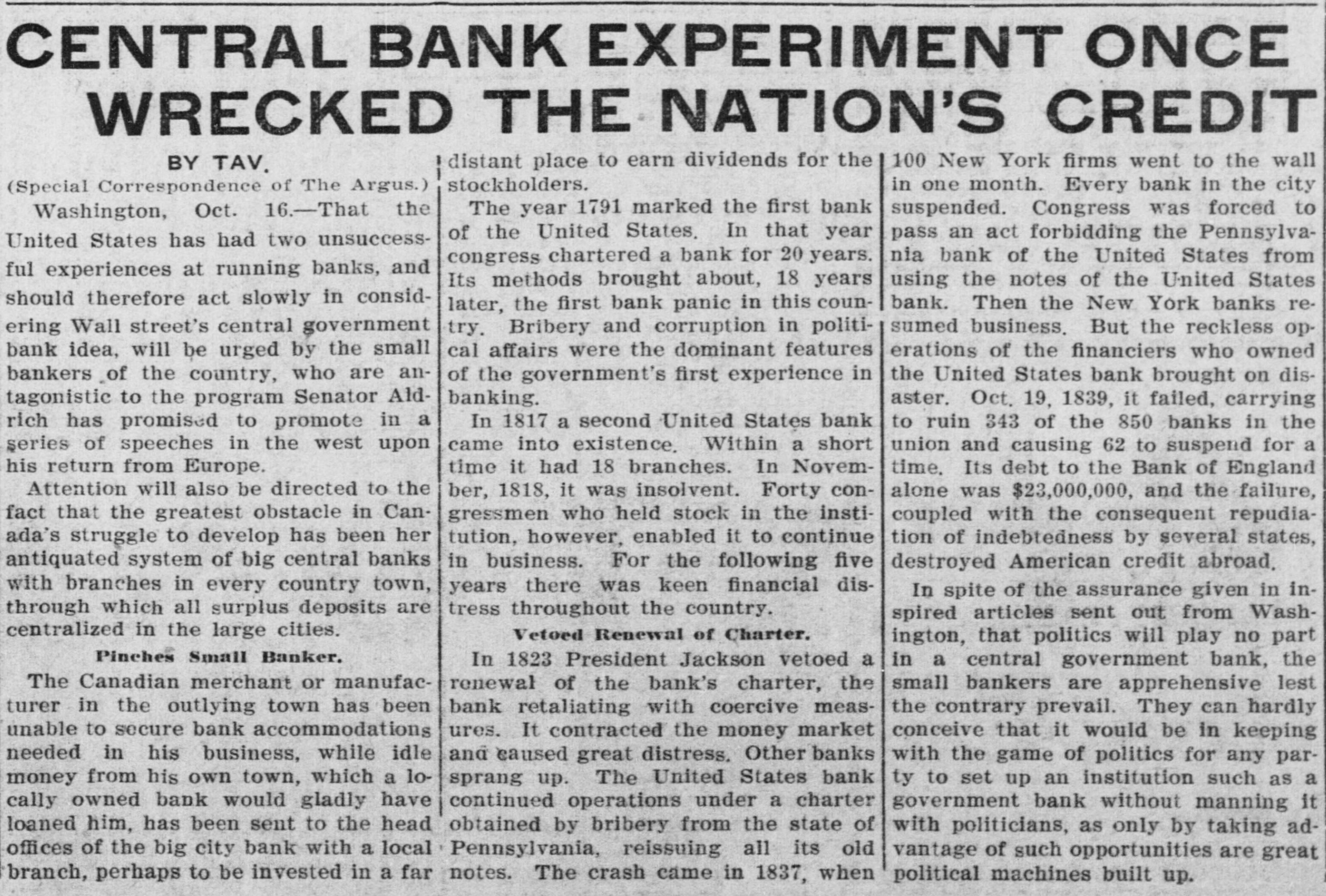
CENTRAL BANK EXPERIMENT ONCE WRECKED THE NATION'S CREDIT 100 New York firms went to the wall distant place to earn dividends for the BY TAV. stockholders. in one month. Every bank in the city (Special Correspondence of The Argus.) suspended. Congress was forced to The year 1791 marked the first bank Washington, Oct. 16.-That the of the United States. In that year pass an act forbidding the PennsylvaUnited States has had two unsuccessnia bank of the United States from congress chartered a bank for 20 years. ful experiences at running banks, and Its methods brought about, 18 years using the notes of the United States should therefore act slowly in considbank. Then the New York banks relater, the first bank panic in this counering Wall street's central government try. Bribery and corruption in politisumed business. But the reckless opcal affairs were the dominant features erations of the financiers who owned bank idea, will be urged by the small bankers of the country, who are anof the government's first experience in the United States bank brought on distagonistic to the program Senator Aldbanking. aster. Oct. 19, 1839, it failed, carrying In 1817 a second United States bank to ruin 343 of the 850 banks in the rich has promised to promote in a came into existence. Within a short series of speeches in the west upon union and causing 62 to suspend for a time it had 18 branches. In Novemhis return from Europe. time. Its debt to the Bank of England Attention will also be directed to the ber, 1818, it was insolvent. Forty conalone was $23,000,000, and the failure, fact that the greatest obstacle in Cangressmen who held stock in the insticoupled with the consequent repudiaada's struggle to develop has been her tion of indebtedness by several states, tution, however, enabled it to continue antiquated system of big central banks in business. For the following five destroyed American credit abroad. with branches in every country town, years there was keen financial disIn spite of the assurance given in inthrough which all surplus deposits are tress throughout the country. spired articles sent out from Washcentralized in the large cities. Vetoed Renewal of Charter. ington, that politics will play no part Pinches Small Banker. In 1823 President Jackson vetoed a in a central government bank, the The Canadian merchant or manufacrenewal of the bank's charter, the small bankers are apprehensive lest turer in the outlying town has been the contrary prevail. They can hardly bank retaliating with coercive measunable to secure bank accommodations ures. It contracted the money market conceive that it would be in keeping needed in his business, while idle and caused great distress. Other banks with the game of politics for any parmoney from his own town, which a losprang up. The United States bank ty to set up an institution such as a cally owned bank would gladly have continued operations under a charter government bank without manning it loaned him, has been sent to the head obtained by bribery from the state of with politicians, as only by taking adoffices of the big city bank with a local Pennsylvania, reissuing all its old vantage of such opportunities are great branch, perhaps to be invested in a far notes. The crash came in 1837, when political machines built up.


Article from The Roswell Daily Record, November 29, 1909

Click image to open full size in new tab

Article Text

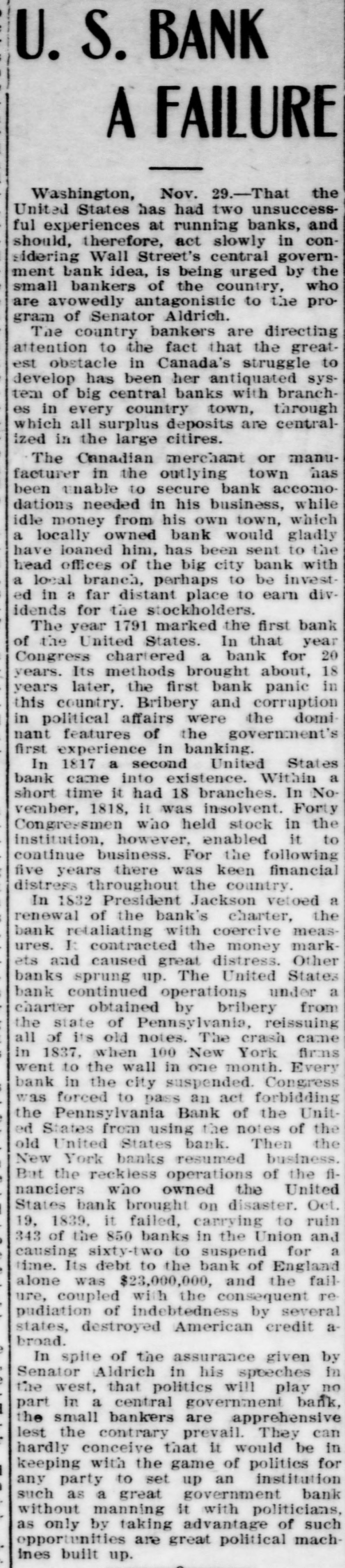
U. S. BANK A FAILURE Washington, Nov. 29.-That the United States has had two unsuccessful experiences at running banks, and should, therefore, act slowly in considering Wall Street's central government bank idea, is being urged by the small bankers of the country, who are avowedly antagonistic to the program of Senator Aldrich. The country bankers are directing attention to the fact that the greatest obstacle in Canada's struggle to develop has been her antiquated systerm of big central banks with branches in every country town, through which all surplus deposits are centralized in the large citires. The Canadian merchant or manufacturer in the outlying town has been unable to secure bank accomodations needed in his business, while idle money from his own town, which a locally owned bank would gladly have loaned him, has been sent to the head offices of the big city bank with a local branch, perhaps to be invested in a far distant place to earn dividends for the stockholders. The year 1791 marked the first bank of the United States. In that year Congress chartered a bank for 20 years. Its methods brought about, 18 years later, the first bank panic in this country. Bribery and corruption in political affairs were the domi nant features of the government's first experience in banking. In 1817 a second United States bank came into existence. Within a short time it had 18 branches. In No. vember, 1818, it was insolvent. Forty Congressmen who held stock in the institution, however, enabled it to continue business. For the following five years there was keen financial distress throughout the country. In 1832 President Jackson vetoed a renewal of the bank's charter, the bank retaliating with coercive measures. I: contracted the money markets and caused great distress. Other banks sprung up. The United States bank continued operations under a charter obtained by bribery from the state of Pennsylvania, reissuing all of its old notes. The crash came in 1837, when 100 New York firms went to the wall in one month. Every bank in the city suspended. Congress was forced to pass an act forbidding the Pennsylvania Bank of the United States from using the notes of the old United States bank. Then the New York banks resumed business. But the reckless operations of the financiers who owned the United States bank brought on disaster. Oct. 19, 1839. it failed, carrying to ruin 343 of the 850 banks in the Union and causing sixty-two to suspend for a time. Its debt to the bank of England alone was $23,000,000, and the failure, coupled with the consequent ren pudiation of indebtedness by several states, destroyed American credit abroad. In spite of the assurance given by Senator Aldrich in his speeches in the west, that politics will play no 1 part in a central government bank, the small bankers are apprehensive [ lest the contrary prevail. They can hardly conceive that it would be in I keeping with the game of politics for any party to set up an institution such as a great government bank without manning it with politicians, as only by taking advantage of such opportunities are great political machines built up. :


Article from The Daily Gate City, December 16, 1909

Click image to open full size in new tab

Article Text

CENTRAL THE NO SHAM Leading business men ail country are discussing an address livered at Indianapolis the by former Secretary of the Leslie M. Shaw in opposition establishment of a central Mr. Shaw objected to such an tution on the ground that it necessari'y be privately owned, such event it would clothe the ard Oil Trust or the Steel both with the power to expand to tract the currency, thus enabling make or break railroads, companies and other corporatic will. He said that only two money interests of the countr capable of financing such a he declared he believed the bank is a scheme to centraliz financial interests of the countr place them in control of Rockefeller and the rest of said: money group. In this connecti "There are two diseases in this country, either of liable to prove fatal. One is street-mania, and the other street-phobia. I do not think have been sadly inoculated with er, but I am frank to say seems to me quite unameric place with any group of power to contract or expand rency at will and to grant or credit to any bank, to any me and to any corporation at It was charged, and as vigorous nied, that the affiliated banks York during the panic of 1907 withdrew credit from Tennesse and Iron, called their loans, au ally adjusted the matter by over the property at a fraction admitted value, upwards of 000, and paid for it in United no Steel securities, without the of a dollar in money. Assumi I charge to be libelous, it still 2 trates what could be done D group of men possessing quisite disposition to be in the central bank. Of a set Year resolutions given out a ago by Josh Billings, I rememb one: 'Resolved, That if a me a mule won't kick, I'll believ a but I won't go near the mule.' p "But, lest it be charged that a appealing to popular prejudice willing to go on record that if to have a Central bank I A e come control by the Standar company or by the United State I corporation, though preferab -9 both combined. This is not personal friendship, though measure of personal friend : hope, exists, but it is based "1 on task. the question of fitness U "At the risk of being criticise o going to inject a few statemer e commendation of the Standa E people. They rendered, by u the greatest service of any S tion or any group of people panic of 1907. From October S year until Jan. 15 following, tional City bank of New anced exports of cotton, in als, and other commodities to tent of $250,000,000. If any B stitution in the United States B a million in exports during tha e I shall be glad to know its 1 Mr Shaw declared that it u ficult to over-estimate the P this service. These exports P ed our foreign bills and paid p the gold we imported. In all this without calling a 1 same bank granted assistance " dividuals, firms and corporatio the extent of $40,000,000. said, is a wonderful record, I must be taken into the account 7 sidering this great subject. p to do these gigantic things render these herculean service -( ment essential consideration in el


Article from Devils Lake Inter-Ocean, August 4, 1911

Click image to open full size in new tab

Article Text

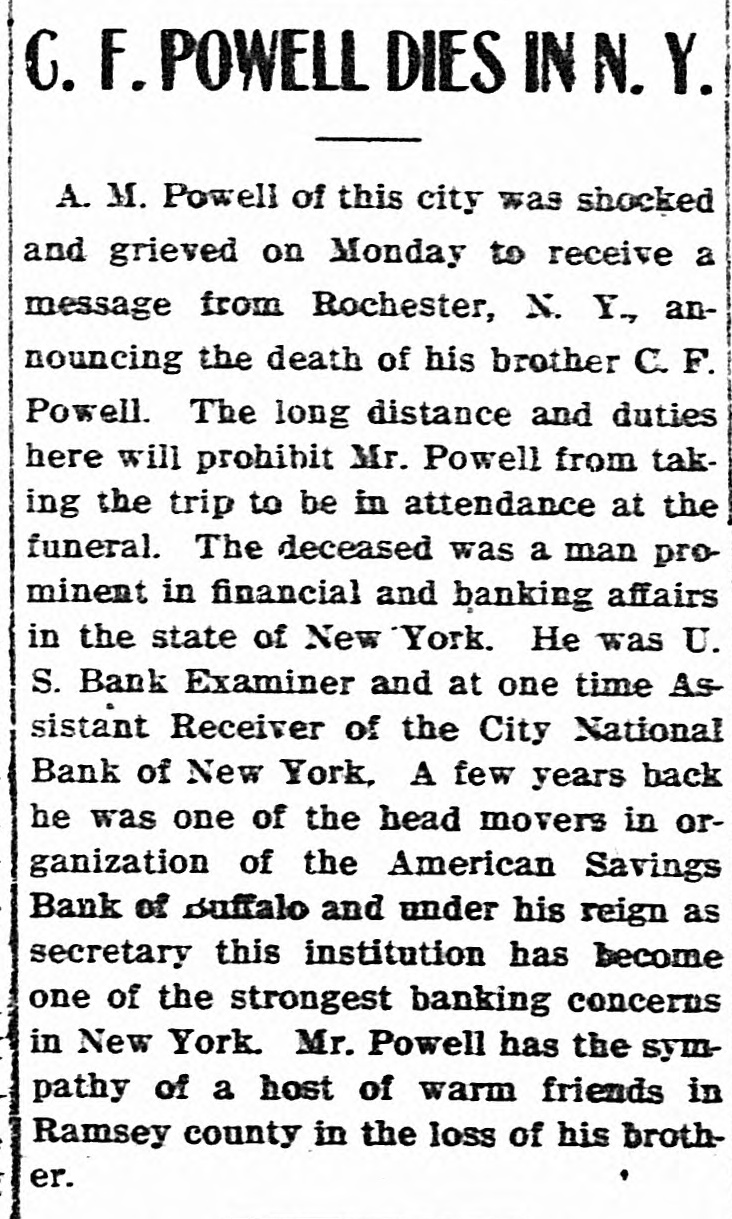
# C. F. POWELL DIES IN N. Y. A. M. Powell of this city was shocked and grieved on Monday to receive a message from Rochester, N. Y., announcing the death of his brother C. F. Powell. The long distance and duties here will prohibit Mr. Powell from taking the trip to be in attendance at the funeral. The deceased was a man prominent in financial and banking affairs in the state of New York. He was U. S. Bank Examiner and at one time Assistant Receiver of the City National Bank of New York. A few years back he was one of the head movers in organization of the American Savings Bank of Buffalo and under his reign as secretary this institution has become one of the strongest banking concerns in New York. Mr. Powell has the sympathy of a host of warm friends in Ramsey county in the loss of his brother.


Article from Albuquerque Evening Herald, June 12, 1912

Click image to open full size in new tab

Article Text

Witness in Money Trust In. vestigation Tells How King of Bankers Turned Loose Twenty-Five Millions. HERETOFORE UNWRITTEN HISTORY OF 1907 CRASH Testimony Reveals All Powerful Sway of Single Man Over Financial Destinies of American Continent. (By Evening Herald A. P. Leased Wire) New York, June 12.-Some heretofore unwritten history of how J. P. Morgan helped stem the panic of 1907, by supplying $25,000,000 at is crucial time, was dramatically told on the witness stand today by H. R. Thomas, president of the stock exchange at that time, testifying before the Pujo committee investigation the so-called money trust. Mr. Thomas said that on October 24, 1907, 60 per cent was being offered for call money and none was available. He went to James Stillman, then president of the National City bank, and asked him for relief, if possible. He told the banker that $26,000,000 was needed, he said. Stillman sent him to Morgan, saying that he would tell Morgan he was coming. When I got to Mr. Morgan's office there was great excitement," said the witness, speaking in dramatic tones and with many gestures. Mr. Morgan was in a conference and people were going in and out. The excitement was intense. I waited for some twenty minutes. He came out of his private office and said to me: "We are going to lend you. $25.000,000. Go over to the stock exchange and announce it.' 'Allow me to make a suggestion, Mr. Morgan, he sald yes, yes: what is It? "I think, I said, 'that this money should be divided up into lots and distributed among the banks. It will have a better effect. " 'Very good suggestion," said Mr. Morgan. "Perkins," he said, and snapping his fingers, Perkins divide that $25,000,000 up into small lots.' George W. Perkins, former partner of J. P. Morgan, was the "Perkins" referred to. Mr. Thomas testified that the loan had a very decided effect in relleving panie conditions. "Then it rested with one man to say whether the panic would go on? Don't you think that is a dangerous condition?" pointedly asked Samuel Untermyer, counsel for the coinmittee. "I couldn't answer that," replied the witness.


Article from The Topeka State Journal, June 12, 1912

Click image to open full size in new tab

Article Text

STOPPED A PANIC Witness in the Investigation of the Money Trust Tells How J. Pierpont Morgan Saved the Country. New York, June 12.-Some heretofore unwritten history of how J. P. Morgan helped stem the panic of 1907 by supplying $25,000,000 at a crucial time, was dramatically told on the witness stand today by R. H. Thomas, president of the stock exchange at that time, testifying before the Pujo committee investigating the socalled money trust Mr. Thomas said that Oct. 24, 1907, sixty per cent was being offered for call money and none was available. He went to James Stillman then president of the National City and asked him for relief if possible. He told the banker that $25,000,000 was needed he said. Stillman sent him to Morgan, saying that he would tell Morgan he was coming. "When I got to Mr. Morgan's office there was great excitement," said the witness speaking in dramatic tones and with many gestures. "Mr. Morgan was in a conference and people were going in and out. The excitement was intense. I waited for him 20 minutes. He came out of his private office and said to me: " 'We are going to lend you $25,000.000. Go over to the stock exchange and announce it.' "Allow me to make a suggestion, Mr. Morgan. He said, 'Yes, what is it?' I think, I said, that this money should be divided up into lots and distributed among banks. It will have a better effect. 'Very good suggestion, said Morgan. 'Perkins,' he said, and snapped his fingers; 'Perkins, divide that $25,000,000 up into small lots.' George W. Perkins, former partner of J. P. Morgan was the "Perkins" referred to. Mr. Thomas testified that the loan had a very decided effect in relieving the panic. "Then it rested with one man to say whether the panic would go on. Don't you think that a dangerous condition?" pointedly asked Samuel Untermyer. "Couldn't answer that," replied the witness.


Article from The Birmingham Age-Herald, June 13, 1912

Click image to open full size in new tab

Article Text

Wall Street Unearthed by Committee LOANED TWENTY-FIVE MILLIONS AT CRISIS Adequate Punishment Not Meted Out to Men Who Manipulate Stocks Falsely-Mabon Testifies New York, June -Some heretofore unwritten history of how J. P. Morgan helped stem the panic of 1907 by supplying $25,000,000 at a crucial time was dramatically told on the witness stand today by R. H. Thomas, president of the stock exchange at that time, testlfying before the Pujo committee investigating the so-called money trust. Mr. Thomas said on October 24, 1907, 60 per cent was being offered for money on call and none was available. He went to James Stillman, then president of the Nationaly City bank, and told him $25.000,000 was needed. Stillman sent him to Morgan saying he would tell Morgan he was coming. "When I got to Mr. Morgan's office there was great excitement," said the witness. "Mr. Morgan was in a conference and people were going in and out I steadily. The excitement was intense. waited for him 20 minutes. He came out of his office and said to me: 'We are going to lend you $25,000,000 and, 'Go over to the exchange and announce it. I said: 'Allow me to make a suggestion. Mr. Morgan. He said: 'Yes, yes, what is it?' 'I think, I said, 'that this money should be divided up into lots and distributed among the banks. It would have better effect.' 'Very good suggestion, said he. 'Perkins,' he said, 'divide that $25,000,000 into small parcele.' He snapped his fingers. Perkins was the Perkins referred to in other transactions." Relieved Panic Mr. Thomas said the loan had a decided effect in relieving the panic. 'Then It rested with one man to say whether the panic would noton and do you think that a dangerous condition ?" Samuel Untermeyer asked as counsel for the committee. "I could not answer that," replied the witness sotto voce. Mr. Thomas says that when he went back to the exchange and announced the Morgan loan the effect was almost instantaneous. "It popped up in a number of places instantly. The banks began to loan money and the rate on call money s dropped back to 6 per cent and then to per cent." James B. Mabon, president of the stock exchange, was questioned at length by Mr. Untermeyer in an effort to get him to admit that the New York exchange was used as an instrument to concentrate the control of securities of corporations in New York city for the benefit of the great banks. The witness conceded that the majority of the collateral ac. cepted by the banks on call loans was composed of securities listed only on the stock exchange and said, in turn, it was of great advantage to a corporation to have its stock listed there. Reason for Exchange He was reluctant to admit, however, that the chief reason why corporations listed their securities on the exchange was to give them a loanable value. Mabon mentioned Standard Oil stock as one example of an unlisted security available for bank loans and said he was sure there were others. The attorney then raised the question with the witness as to whether "manipulation on the stock exchange was not going on now as wild as ever?' "Oh, I don't think so,' Mabon replied. The stock exchange is trying to get the public's confidence. We have fined and punished members for manipulation Cne of them is S. B. Chapin, I don't remember the others. "Mr. Chapin is the man that created a fictitious market value for Rock Island?" "Yes." "You punished him terribly. I suppose." "Yes, he was punished. "By 30 days suspension?" said Mr. Untermeyer. "You call that a punishment for such a glaring piece of work as that Rock Island deal?' The witness was silent. Have Autocratic Powers In an effort to show that the various committees of the stock exchange were endowed with autocratic power in the operation of the Institution, Mr. Untermeyer read into the record a number of rules and regulations, emphasizing particularly one fixing commissions and forbidding members to split commissions with outside brokers, or with customers. Mabon was asked if he did not think the latter rule was an agreement in restraint of trade. 'Why, any group of men can get together and start another stock exchange, Mabon said. "Why make such a statement?'' snapped the lawyer. "You know that you would kill it off like you have choked the consolidated stock exchange for 20 years. "I don't think we are trying to kill off the consolidated or anything else," replied the witness with some heat. 'What do you call it then? Don't you know that it is absolutely impossible for another exchange to start under the present rules?' commented Mr. Untermeyer The hearing will be continued tomorrow


Article from The Richmond Virginian, June 13, 1912

Click image to open full size in new tab

Article Text

Former Wall Street Head Describes Flooding of $25,000,600 on Floor MONEY TRUST HAD CURRENCY CORNERED Dramatic Story Is Related of Scenes Just Preceding Great Panic of Five Years Ago NEW YORK, June 12-In two minutes, J. Pierpont Morgan shoveled out twenty five million dollars, to still one the most violent storms that ever shook the New York Exchange building from turret to foundation. This was at the beginning of the panic of 1907. Until the king of millions lifted his mighty finger, the stock exchange was growing more frenzied every second. Sharp twiste had been given to the screws of contraction. and the money -the actual coin of the realm-had been drawn into the vaults of the money trust Nearly every financial institution in New York was feeling the squeeze. Brokers by the hundred, were hysterically plealing for loans to save themselves, and thousands of customers from ruin. The rate on call money had jumped to 100 per cent: but even at that offer no money was fortheoming. The best securities in America were being offered for loans. These did not tempt a frightened, timid, dollar from its safe retreat in the vaults of the money trust. But the money gushed out when Morgan waved his wand. A dramatic story of this remarkable incident was told to the Pujo committee today, by R. H. Thomas, who was president of the Stock Exchange at the time Morgan alone saved the day, by ordering George W Perkins, then one of his partners, to release $25,000,000 to the hysterical brokers. Mr. Thomas in appearance and manner, is the incarnation of the *spirit of the stock exchange. High strung. nervous. jerky in speech, and movement, he related his narrative under the examination of Samuel Untermyer, counsel to the congressional committee, investigating the money trust, almost in monosyllables and between breaths. Mr. Thomas was called to the witness stand today in place of George W. Ely. secretary of the Stock Exchange, who had proved such an obstrepous witness the day before. The committe will probably tackle the recalcitrant secretary again tomorrow Recalls It All Right. "You recall very distinctly. 1 suppose," began Mr. Untermyer. when Mr. Thomas had taken the witness chair facing him. "the stirring days of the panic of 1907. don't you?" "Yes, I do." snapped the eager Mr. Thomas "Do you remember the days that call money was exceptionally high ?" "Yes, I remember It was high. I don't know for R fact. for 1 was not on the floor, but I was told it was 100 per cent Otcober 24. 1907." Then, under only slight prompting. by Mr. Untermyer, the former president of the Stock Exchange, told excitedly of the strenuous, nerve-racking events upon the floor of the exchange and in the offices of the National City bank, and those of J. Pierpont Morgan. a half hour before the terrific strain was relieved. Call money. he sald, was posted at 6 per cent. but there was no money. In the consternation that had appalled every unit of the scrambilng. screeching mass of brokers that swirled and eddied around to Joan post, he dashed up to the City National bank in a desperate effort to get some money released from the vaults "There I saw James Stillman," Mr. Thomas said. "When 1 told him that we had to have at least twenty-five million dollars at the stock exchange immediately. or everything would go to smash. he told me to go see Mr. Morgan at once. Mr. Stillman added that before I could arrive at Mr. Morgan's office he would communicate with Mr. Morgan by telephone, and let him knew our desperate situation. When I got to the Morgan banking house, the outer room and passageways were filled with men of millions, all as badly frightened as the crowd on the floor of the exchange I had just left. Mr. Morgan was holding a conference in his private office with several financiers. Their names 1 did not get. I saw them when they emerged twenty minutes later with him, but I was too Intent on my mission to make mental note of their names,and so I cannot now recall a single one of them except Mr. Morgan. Him I was looking for, and him alone. I stepped up to him immediately. and told him that we must five million dollars at


Article from Omaha Daily Bee, June 13, 1912

Click image to open full size in new tab

Article Text

CALL MONEY AT 60 PER CENT Appeal Made by Banks to James Stillman for Aid. REFERRED TO J. P. MORGAN Conference Held in Private Office of Financier. MONEY DIVIDED UPON WORD Magnate Gives Order to G. W. Perkins to Have Cash Given to Various Banks October 24, 1907. NEW YORK, June 12.-Some heretofore unwritten history of how J. P. Morgan helped stem the panic of 1907 by supplying $25,000,000 at a crucial time was dramatically told on the witness stand today by R. H. Thomas, presidént of the Stock exchange at that time, testifying before the Pujo committee investigating the so-called money trust. Mr. Thomas said that on the morning of October 24, 1907, 60 per cent was being offered for call money and was not available. He went to James Stillman, president of the National City bank and asked him for relief, if possible. He told the banker that $25,000,000 was needed. Stillman sent him to Morgan, saying that he would tell Morgan he was coming. "When I got to Mr. Morgan's office there was great excitement," said the witness, speaking in dramatic tones and with many gestures. "Mr. Morgan was in a conference and people were going in and out. The excitement was intense. I waited for him twenty minutes. He came out of his private office and said to me: "We are going to lend you $25,000,000. Go over to the Stock exchange and announce it.' 'Allow me to make a suggestion, Mr. Morgan.' "He said, 'Yes, yes, what is it?' " I think,' I said, 'that this money should be divided up into lots and distributed among the banks. It will have a better effect.' ''Very good suggestion," said Mr. Morgan. "Perkins," he said, and snapped his fingers, 'Perkins, divide that $25,000,000 up into small lots.' George W. Perkins, former partner of J. P. Morgan, was the "Perkins" referred to. Mr. Thomas testified that the loan had a very decided effect in relieving panic conditions. "Then it rested with one man to say whether the panic would go on? Don't you think that's a dangerous condition?" pointedly asked Samuel Untermeyer, counsel for the committee. "I couldn't answer that," replied the witness.


Article from The Wheeling Intelligencer, June 13, 1912

Click image to open full size in new tab

Article Text

UNWRITTEN HISTORY GIVEN TO MONEY TRUST PROBERS. Loan of Twenty-Five Million Dollars Dumped Into Banks, Turned the Tide. NEW YORK, June 12.Some heretofore unwritten history on how J. P. Morgan helped stem the panie of 1907 by supplying $25,000,000 at a crucial time was dramatically told on the witness stand today by R. H. Thomas, president of the Stock Exchange at that time, estifying before the Panjo committee investigating the so-called money trust. Mr. Thomas said that on the morning of October 24, 1907, 60 per cent was being offered for small money and none was available. He went to James Stillman, then president of the City National bank, and asked him for relief if possible. He told the banker that $25,000,000 was needed, he said. Stillman sent him to J. P. Morgan, saying that he would tell Morgan that he was coming. "When I got to Mr. Morgan's office there was great excitement," said the witness, speaking in dramatic tones and with many gestures. Morgan to the Rescue. "Mr. Morgan was in a conference, and people were going in and out. The excitement was intense. I waited for him for twenty minutes. He came out of his private office and said to me: "We are going to lend you $25,000,000. Go over to the stock exchange and announce it! I said 'allow me to make a suggestion Mr. Morgan.' "He said, 'yes, yes, what is it?' "I think' I said, 'that this money should be divided up into lots and distributed among the banks. It would have a better effect.' 'Very good suggestion' said Mr. Morgan, 'Perkins' he said and snapped his fingers, 'Perkins, divide that $25,000,000 up into small lots.' George W. Perkins former partner of J. P. Morgan was the Perkins referred today. Mr. Thomas said that when he went back to the exchange and announced the loan the effect was almost instaneous. "How soon did relief come " asked Mr. Untermeyer. "In a couple of minutes," replied the witness. "There did it come from?" Relief Was Instant. "I don't know where it came from, but it popped up in a number of places instantly. The banks began to loan money, and the rate on call dropped back to 6 per cent. and then to 3 per cent." James B. Mabon, president of the Stock Exchange, was questioned at length by Mr. Untermeyer in an effort to get him to admit that the New York Stock Exchanged was used as instrument to concentrate the control of the securities of corporations in New York City for the benefit of the


Article from The Detroit Times, June 14, 1912

Click image to open full size in new tab

Article Text

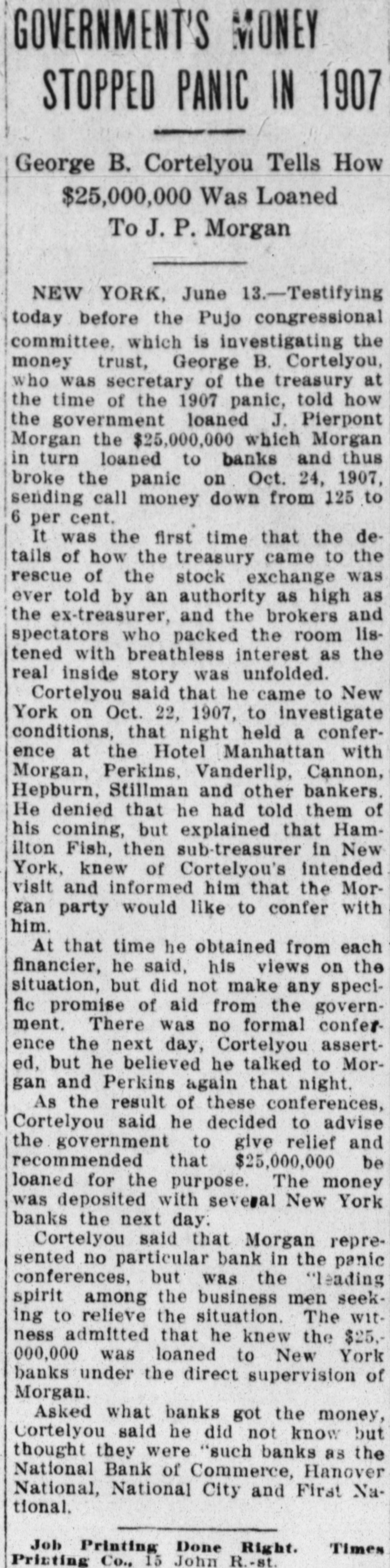
GOVERNMENT'S MONEY STOPPED PANIC IN 1907 George B. Cortelyou Tells How $25,000,000 Was Loaned To J. P. Morgan NEW YORK, June 13.-Testifying today before the Pujo congressional committee. which is investigating the money trust, George B. Cortelyou, who was secretary of the treasury at the time of the 1907 panic, told how the government loaned J. Pierpont Morgan the $25,000,000 which Morgan in turn loaned to banks and thus broke the panic on Oct. 24, 1907, sending call money down from 125 to 6 per cent. It was the first time that the details of how the treasury came to the rescue of the stock exchange was ever told by an authority as high as the ex-treasurer, and the brokers and spectators who packed the room listened with breathless interest as the real inside story was unfolded. Cortelyou said that he came to New York on Oct. 22, 1907, to investigate conditions, that night held a conference at the Hotel Manhattan with Morgan, Perkins, Vanderlip, Cannon, Hepburn, Stillman and other bankers. He denied that he had told them of his coming, but explained that Hamilton Fish, then sub-treasurer in New York, knew of Cortelyou's intended visit and informed him that the Morgan party would like to confer with him. At that time he obtained from each financier, he said, his views on the situation, but did not make any specific promise of aid from the government. There was no formal conference the next day, Cortelyou asserted, but he believed he talked to Morgan and Perkins again that night. As the result of these conferences, Cortelyou said he decided to advise the government to give relief and recommended that $25,000,000 be loaned for the purpose. The money was deposited with several New York banks the next day: Cortelyou said that Morgan represented no particular bank in the panic conferences, but was the "leading spirit among the business men seeking to relieve the situation. The witness admitted that he knew the $25,000,000 was loaned to New York banks under the direct supervision of Morgan. Asked what banks got the money, Cortelyou said he did not know but thought they were "such banks as the National Bank of Commerce, Hanover National, National City and First National. Job Printing Done Right. Times Printing Co., 15 John R.-st.


Article from Atlanta Semi-Weekly Journal, June 14, 1912

Click image to open full size in new tab

Article Text

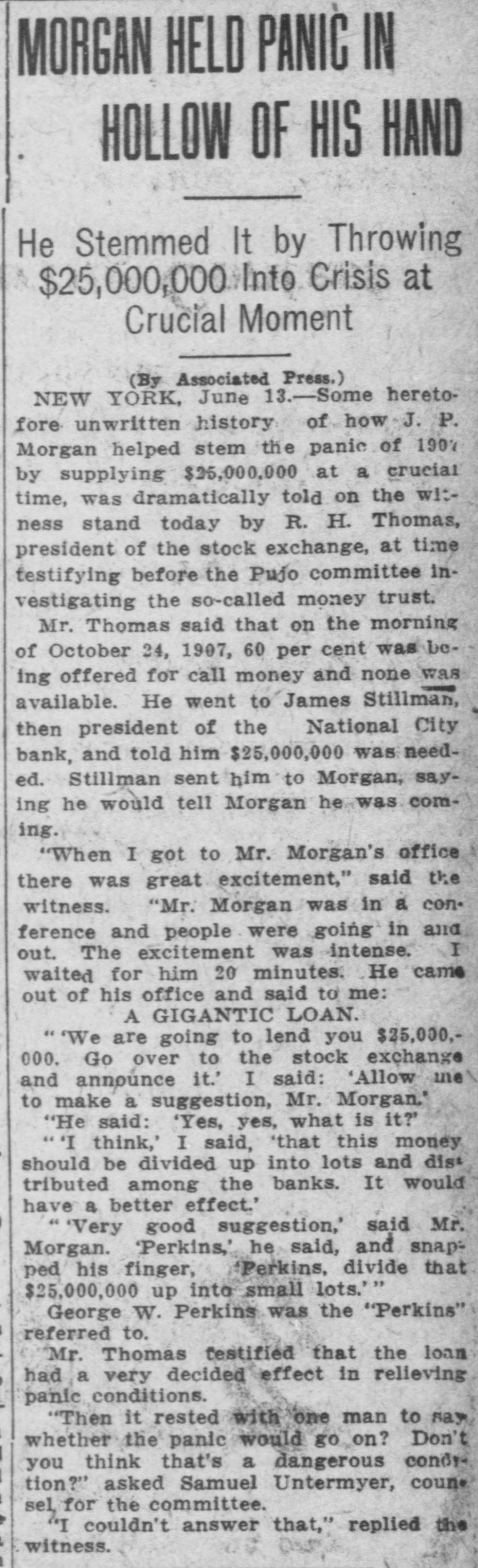
MORGAN HELD PANIC IN HOLLOW OF HIS HAND He Stemmed It by Throwing $25,000,000 Into Crisis at Crucial Moment (By Associated Press.) NEW YORK, June 13.-Some heretofore unwritten history of how J. P. Morgan helped stem the panic of 1907 by supplying $25,000,000 at a crucial time, was dramatically told on the witness stand today by R. H. Thomas, president of the stock exchange, at time testifying before the Pujo committee investigating the so-called money trust. Mr. Thomas said that on the morning of October 24, 1907, 60 per cent was being offered for call money and none was available. He went to James Stillman, then president of the National City bank, and told him $25,000,000 was needed. Stillman sent him to Morgan, saying he would tell Morgan he was coming. "When I got to Mr. Morgan's office there was great excitement," said the witness. "Mr. Morgan was in a conference and people were going in and out. The excitement was intense. I waited for him 20 minutes. He came out of his office and said to me: A GIGANTIC LOAN. "We are going to lend you $25,000,000. Go over to the stock exchange and announce it.' I said: 'Allow me to make a suggestion, Mr. Morgan." "He said: 'Yes, yes, what is it?' "I think,' I said, 'that this money should be divided up into lots and dist tributed among the banks. It would have a better effect.' "Very good suggestion,' said Mr. Morgan. 'Perkins,' he said, and snapped his finger, Perkins, divide that $25,000,000 up into small lots." George W. Perkins was the "Perkins" referred to. Mr. Thomas testified that the loan had a very decided effect in relieving panic conditions. "Then it rested with one man to say whether the panic would go on? Don't you think that's a dangerous condrtion?" asked Samuel Untermyer, coun. sel for the committee. "I couldn't answer that," replied the witness.


Article from New-York Tribune, December 9, 1913

Click image to open full size in new tab

Article Text

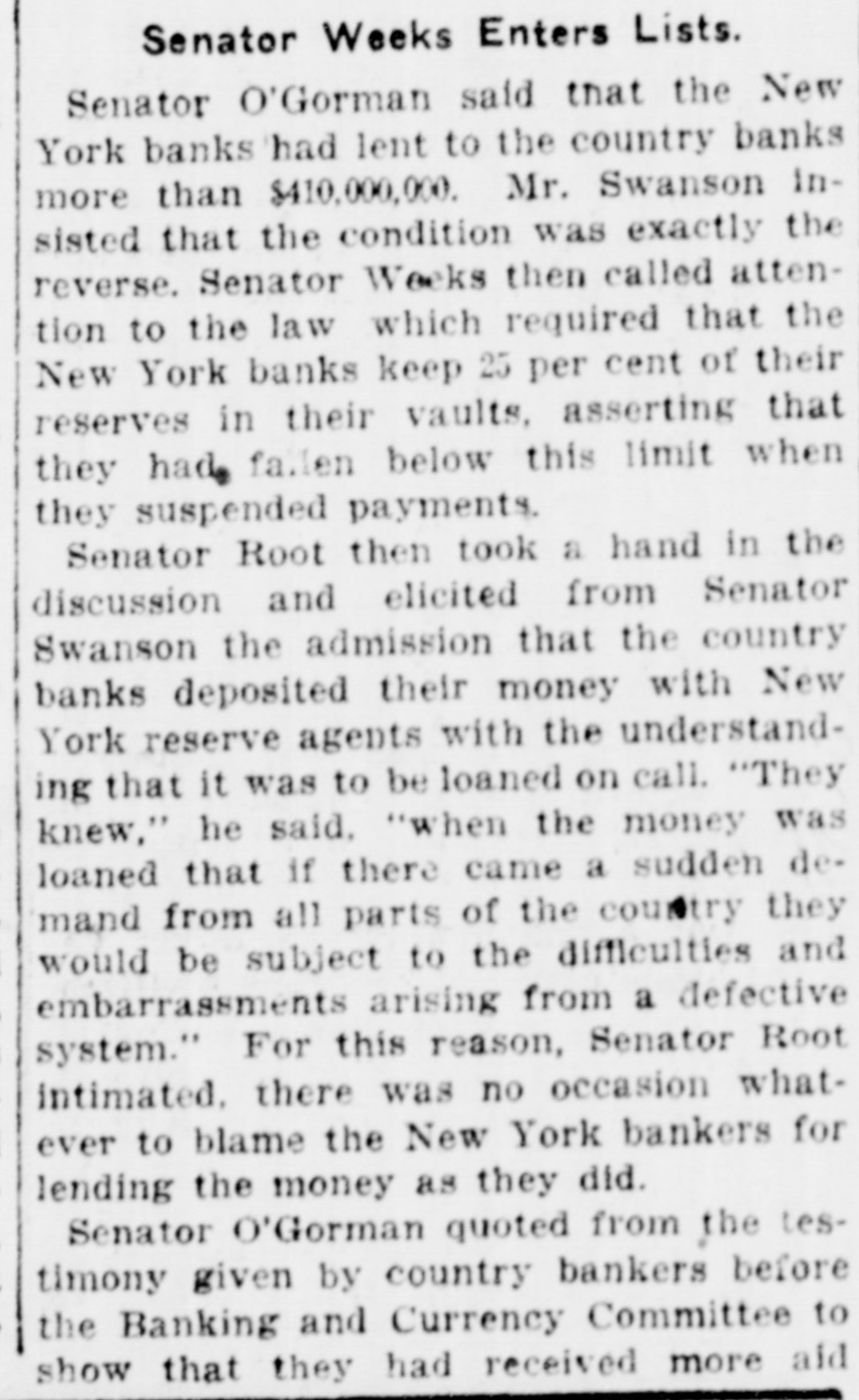
# Senator Weeks Enters Lists. Senator O'Gorman said that the New York banks had lent to the country banks more than $410,000,000. Mr. Swanson insisted that the condition was exactly the reverse. Senator Weeks then called attention to the law which required that the New York banks keep 25 per cent of their reserves in their vaults, asserting that they had fallen below this limit when they suspended payments. Senator Root then took a hand in the discussion and elicited from Senator Swanson the admission that the country banks deposited their money with New York reserve agents with the understanding that it was to be loaned on call. "They knew," he said, "when the money was loaned that if there came a sudden demand from all parts of the country they would be subject to the difficulties and embarrassments arising from a defective system." For this reason, Senator Root intimated, there was no occasion whatever to blame the New York bankers for lending the money as they did. Senator O'Gorman quoted from the testimony given by country bankers before the Banking and Currency Committee to show that they had received more aid


Article from Evening Star, August 7, 1914

Click image to open full size in new tab

Article Text

be prevented, or, at least, its effects minimized can by the proper organization sysand control of a country's banking tem. No such premium upon money or taken such collapse of credit has of in of the leading that the last 100 years as Noplace general Europe during any States countries in in the United in December of 1907, war and social witnessed vember periods and of condition revolution. except of similar disastrous for a and credits in England one must Namoney back to the time of the wars of go while in Germany no such foun- ocpoleon, has taken place since the shown currence of the empire. France has the dation such a banking condition but once that in was several generations, and last defeat at the hands of Prussia, war after her payment of her billion-dollar troubles. indemity the and bitter internal There have been suspensions of banks and great failures of business and banking houses in Failures Abroad Not these countries just the same as as Heavy as Here. in the United States, yet these disasters have not (as so offen has been the case here) been alIowed to paralyze the credit of the country. In Great Britain, the powerful firm of Overend Gurney failed in 1866, the Bank of Glasgow in 1878 and the house of Baring Bros. in 1890. Yet, on each occasion, the trouble was confined and no national financial convulsion followed. In France the same ability to avert financial panic was shown upon the failof such great banking institutions as ure the Union Generale in 1882 and the Comptoir d' Escompte in 1899; while in Germany the failure of the famous Leipziger Bank in 1901 is another example. in the United States, the suspension of Yet, payments by the New York banks has been followed by distress from Maine to California. Although banking reform had been demanded for a number of years, it took the panic of 1907 to insure a thorough prosecution of the task. Minor changes in our banking laws had been made from time to time, but the great prosperity of the country caused Congress to shrink from the responsibility of undertaking extensive reconstruction of the laws to under any which business had attained such mighty proportions. * * In 1000 Congress pased a currency act for the better support of the greenbacks, the Treasury notes of 1890 Better Support of and the silver Greenbacks by Law. dollars. After the panic of 1007 the Aldrich-Vreeland act was promulgated, which provided that the national banks might organize themselves into national currency assoclations, and that a member bank, with outstanding note circulation secured by States bonds equal to 40 per cent of might extend its United its capital, note issues upon other classes of securities until the total was equal to the sum of its capital and surplus. This act was intended only to be an emergency measure, and was enacted to expire by limitation June 30, 1914. The provision for increasing their note issue up to the present has not been taken advantage of by the banks The act has been extended to June 30. 1915. Further, following the panic, the national monetary commission was established, for the purpose of investigating means for improving credit arrangements in this country. Members of this commission visited England, France and Germany, and made thorough studies of the banking systems in vogue in these coun- of tries. The banking arrangements Canada, Scotland, Belgium, Sweden. Switzerland, Italy, Russia, Mexico and Japan were also investigated. The findings of the commission were published in reforty volumes, which form a good view of the world's banking business. Out of these studies grew proposals for the establishment of a National Reserve Association, a representative association the banks, the units of which were of to all be the clearing house associations which the banks of each city now mainThe democratic Congress rejected this tain. plan in favor of the federal reserve whose provisions, wisely enforced. act, will probably be found better suited to needs of the country than would have been the any one among the numberless plans which have been proposed.