Click image to open full size in new tab
Article Text
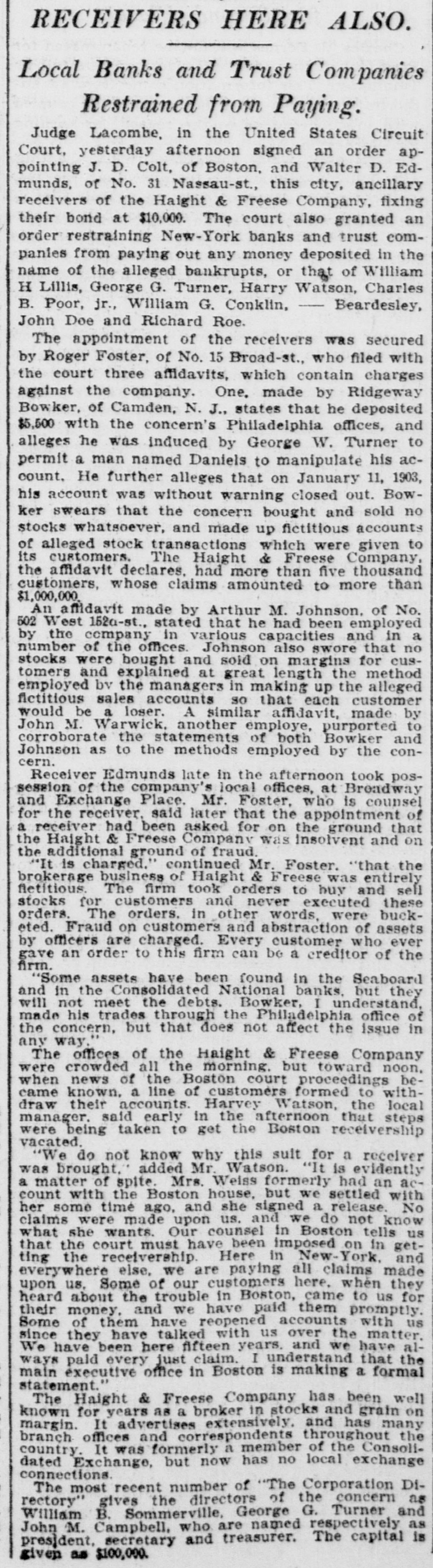
RECEIVERS HERE ALSO. Local Banks and Trust Companies Restrained from Paying. Judge Lacombe, in the United States Circuit Court, yesterday afternoon signed an order appointing J. D. Colt, of Boston, and Walter D. Edmunds, of No. 31 Nassau-st., this city, ancillary receivers of the Haight & Freese Company, fixing their bond at $10,000. The court also granted an order restraining New-York banks and trust companies from paying out any money deposited in the name of the alleged bankrupts, or that of William H Lillis, George G. Turner, Harry Watson, Charles B. Poor, jr., William G. Conklin, - Beardesley, John Doe and Richard Roe. The appointment of the receivers was secured by Roger Foster, of No. 15 Broad-st., who filed with the court three affidavits, which contain charges against the company. One. made by Ridgeway Bowker, of Camden, N. J., states that he deposited $5,500 with the concern's Philadelphia offices, and alleges he was induced by George W. Turner to permit a man named Daniels to manipulate his account. He further alleges that on January 11, 1903, his account was without warning closed out. Bowker swears that the concern bought and sold no stocks whatsoever, and made up fictitious accounts of alleged stock transactions which were given to its customers. The Haight & Freese Company, the affidavit declares. had more than five thousand customers, whose claims amounted to more than $1,000,000. An affidavit made by Arthur M. Johnson, of No. 502 West 152a-st., stated that he had been employed by the company in various capacities and in a number of the offices. Johnson also swore that no stocks were bought and sold on margins for customers and explained at great length the method employed by the managers in making up the alleged fictitious sales accounts so that each customer would be a loser. A similar affidavit, made by John M. Warwick, another employe, purported to corroborate the statements of both Bowker and Johnson as to the methods employed by the concern. Receiver Edmunds late in the afternoon took possession of the company's local offices, at Broadway and Exchange Place. Mr. Foster, who is counsel for the receiver. said later that the appointment of a receiver had been asked for on the ground that the Haight & Freese Company was insolvent and on the additional ground of fraud. "It is charged." continued Mr. Foster. "that the brokerage business of Haight & Freese was entirely fletitious. The firm took orders to buy and sell stocks for customers and never executed these orders. The orders. in other words. were bucketed. Fraud on customers and abstraction of assets by officers are charged. Every customer who ever gave an order to this firm can be a creditor of the firm. "Some assets have been found in the Seaboard and in the Consolidated National banks. but they will not meet the debts. Bowker, I understand, made his trades through the Philadelphia office of the concern, but that does not affect the issue in any way." The offices of the Haight & Freese Company were crowded all the morning. but toward noon, when news of the Boston court proceedings became known, a line of customers formed to withdraw their accounts. Harvey Watson, the local manager. said early in the afternoon that steps were being taken to get the Boston receivership vacated. "We do not know why this suit for a receiver was brought, added Mr. Watson. "It is evidently a matter of spite. Mrs. Welss formerly had an account with the Boston house, but we settled with her some time ago, and she signed a release. No claims were made upon us. and we do not know what she wants. Our counsel in Boston tells us that the court must have been imposed on in getting the receivership. Here in New-York, and everywhere else, we are paying all claims made upon us. Some of our customers here. when they heard about the trouble in Boston, came to us for their money. and we have paid them promptly. Some of them have reopened accounts with us since they have talked with us over the matter. We have been here fifteen years. and we have always paid every just claim. I understand that the main executive office in Boston is making a formal statement." The Haight & Freese Company has been well known for years as a broker in stocks and grain on margin. It advertises extensively. and has many branch offices and correspondents throughout the country. It was formerly a member of the Consolidated Exchange, but now has no local exchange connections. The most recent number of "The Corporation Directory" gives the directors of the concern as William B. Sommerville, George G. Turner and John M. Campbell, who are named respectively as president, secretary and treasurer. The capital is given as $100,000.