Article Text
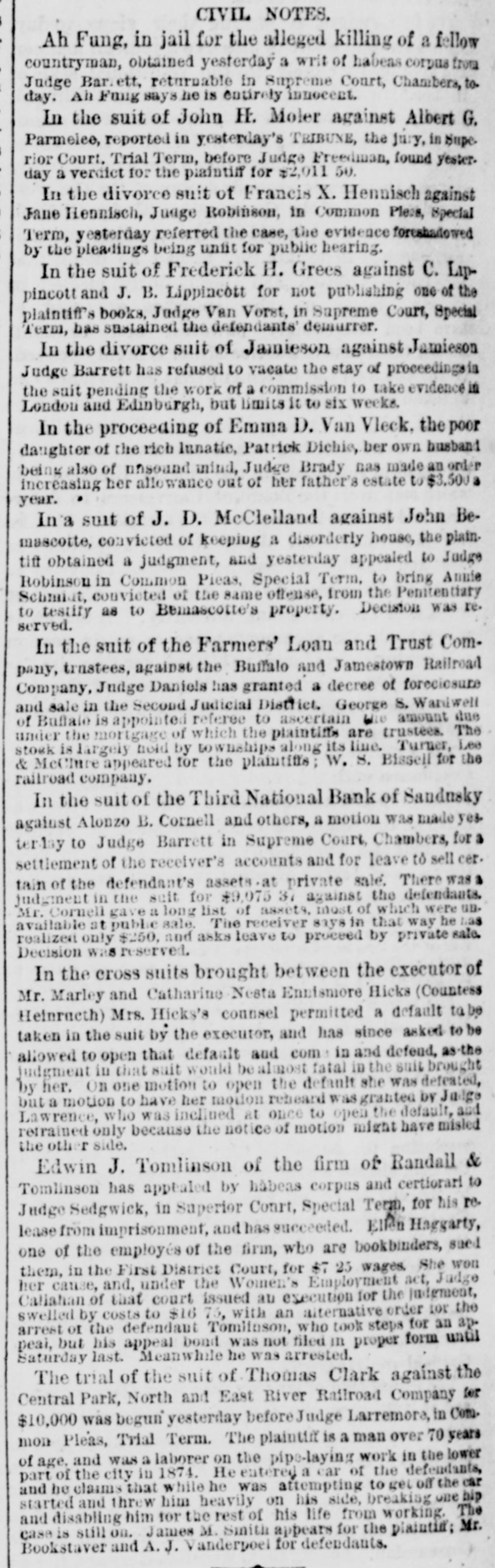
CIVIL NOTES. Ah Fung, in jail for the alleged killing of a fellow countryman, obtained yesterday a writ of habeas corpus from Judge Bar.ett, returnable in Supreme Court, Chambers, day. Ah Fung says he is entirely innocent. In the suit of John H. Moler against Albert G. Parmelee, reported in yesterday's TRIBUNE, the jury, in Supe. rior Court. Trial Term, before Judge Freedman, found yester. day a verdict for the piaintiff for $2,011 50. In the divorce suit of Francis X. Hennisch against Jane Hennisch, Judge Robinson, in Common Pleas, Special Term, yesterday referred the case, the evidence foreshadowed by the pleadings being untit for public hearing. In the suit of Frederick H. Grees against C. Lip= pincott and J. B. Lippincott for not publishing one of the plaintiff's books, Judge Van Vorst, in Sapreme Court, Special Term, has sustained the defendants' demarrer. In the divorce suit of Jamieson against Jamieson Judge Barrett has refused to vacate the stay of proceedingsia the suit pending the work of a commission to take evidence in London and Edinburgh, but limits it to six weeks. In the proceeding of Emma D. Van Vleck. the poor daughter of the rich lunatic, Patrick Dichie, ber own husband being also of unsound mind, Judge Brady nas made an order increasing her allowance out of her father's estate $3.500 year. In'a suit of J. D. McClelland against John Bemascotte, convicted of keeping a disorderly house, the plaintiff obtained a judgment, and yesterday appealed to Judge Robinson in Common Pieas, Special Term, to bring Annie Schmiut, convicted of the same offense, from the Penitentiary to testify as to Bemascotte's property. Decision was re. served. In the suit of the Farmers' Loan and Trust Company, trustees, against the Buffalo and Jamestown Railroad Company, Judge Daniels has granted a decree of foreciosure and sale in the Second Judicial District. George S. Wardwell of Buffale is appointed referee to ascertain Wite amount due under the mortgage of which the plaintiffs are trustees. The stock is largely hold by townships along its line. Turner, Lee & McClure appeared for the plantiffs: W. 8. Bissell for the raitroad company. In the suit of the Third National Bank of Sandusky against Alonzo B. Cornell and others, a motion was made yes terlay to Judge Barrett in Supreme Court, Chambers, for settlement of the receiver's accounts and for leave to sell cer. tain of the defendant's assets at private sale. There was judgement in the suit for $9,075 37 against the defendants. Mr. Cornell gave a long list of assets, most of which were un. available at public sale. The receiver says in that way he has realized only $250, and asks leave to proceed by private sale. Decision was reserved. In the cross suits brought between the executor of Mr. Marley and Catharine Nesta Ennismore Hicks (Countess Heinrneth) Mrs. Hicks's counsel permitted a default tabe taken in the suit by the executor, and has since asked to be allowed to open that default and come in and defend, as the judgment in that suit would bealmost fatal in the suit brought by her. on one motion to open the default she was defeated, but a motion to have her motion reheard was granted by Judge Lawrence, who was inclued at once to open the default, and retrained only because the notice of motion might have misled the other side. Edwin J. Tomlinson of the firm of Randall & Tomlinson has appealed by hábeas corpus and certiorari to Judge Sedgwick, in Superior Court, Special Term, for his re. lease from imprisonment, and has succeeded. Ellen Haggarty, one of the employés of the firm, who are bookbinders, sued them, in the First District Court, for $7 25 wages. She won her cause, and, under the Women's Employment act, Judge Caliahan of that court issued au execution for the judgement, swelled by costs to $16 75, with an alternative order for the arrest of the defendant Tominoson, who took steps for an appeai, but his appeal bond was not filed in proper form until Saturday last. Meanwhile he was arrested. The trial of the suit of Thomas Clark against the Central Park, North and East River Railroad Company for $10,000 was begun yesterday before Judge Larremora, in Com. mon Pleas, Trial Term. The plaintiff is a man over 70 years of age, and was a laborer on the pipe-laying work in the lower part of the city in 1874. He eatered a car of the defendants, and he claims that while he was attempting to get off the car started and threw him heavily on his side, breaking one hip and disabling him for the rest of his life from working. The case is still on. James M. Smith appears for the plaintiff; Mr. Bookstaver and A.J. Vanderpoel for defendants.