15290. American Loan & Trust Company (New York, NY)

Bank Information

Episode Type
Run → Suspension → Closure
Bank Type
trust company
Start Date
February 17, 1891
Location
New York, New York (40.714, -74.006)

Metadata

Model
gpt-5-mini
Short Digest
3ee5f584

Response Measures

Accommodated withdrawals, Full suspension, Books examined

Other: Receiver appointed; later dividends paid to preferred creditors (35%).

Description

New York trust experienced a run by small depositors beginning Feb 17, 1891; closed/suspended Feb 18, 1891 after large demands by savings banks/correspondents it could not meet. A receiver was subsequently appointed (March 1891) and the institution did not resume normal operations as an independent bank; receiver later paid dividends to preferred creditors.

Events (3)

1. February 17, 1891 Run
Cause
Correspondent
Cause Details
Run driven by heavy withdrawals, largely small depositors; later large demands from savings banks/correspondents precipitated liquidity stress.
Measures
Met small demands; requested holders of large checks to wait a few hours; invoked contractual right to require notice (five days) though not exercised initially.
Newspaper Excerpt
The run on the American Loan and Trust Company continues this morning... The run was mostly by small depositors, and the bank met all their demands.
Source
newspapers
2. February 18, 1891 Suspension
Cause
Correspondent
Cause Details
Closure/suspension resulted from unexpected large payment demands (reported $200,000–$360,000) by several savings banks/correspondent institutions that the company could not honor in cash, producing a suspension and examiner taking possession.
Newspaper Excerpt
The American Loan and Trust Company has just closed its doors. The immediate cause of the failure was the demand for a large amount of money, made by a savings bank of this city which the Trust Company could not meet.
Source
newspapers
3. March 6, 1891 Receivership
Newspaper Excerpt
The committee has failed and a receiver has been asked for and will probably be appointed to-morrow... a receiver would have to be appointed.
Source
newspapers

Newspaper Articles (25)

Article from The Record-Union, February 18, 1891

Click image to open full size in new tab

Article Text

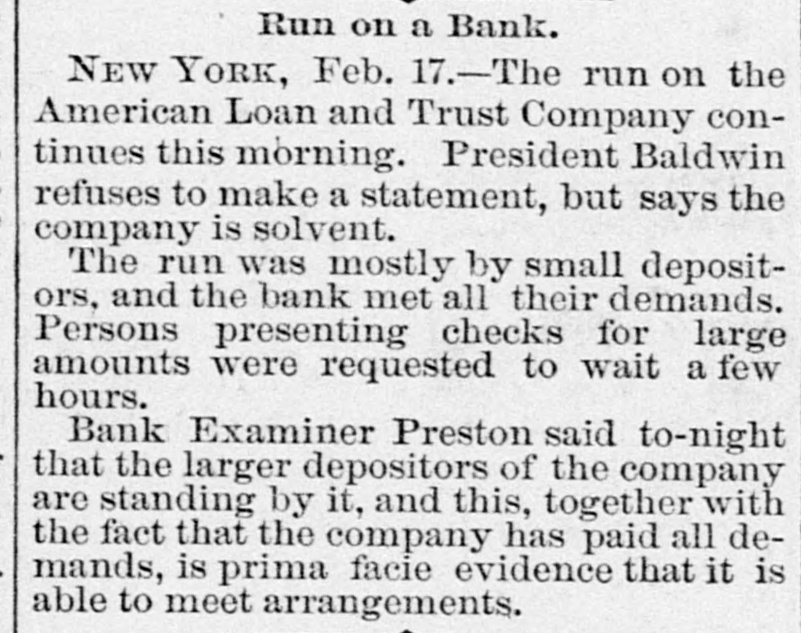
Run on a Bank. NEW YORK, Feb. 17.-The run on the American Loan and Trust Company continues this morning. President Baldwin refuses to make a statement, but says the company is solvent. The run was mostly by small depositors, and the bank met all their demands. Persons presenting checks for large amounts were requested to wait a few hours. Bank Examiner Preston said to-night that the larger depositors of the company are standing by it, and this, together with the fact that the company has paid all demands, is prima facie evidence that it is able to meet arrangements.


Article from The Seattle Post-Intelligencer, February 18, 1891

Click image to open full size in new tab

Article Text

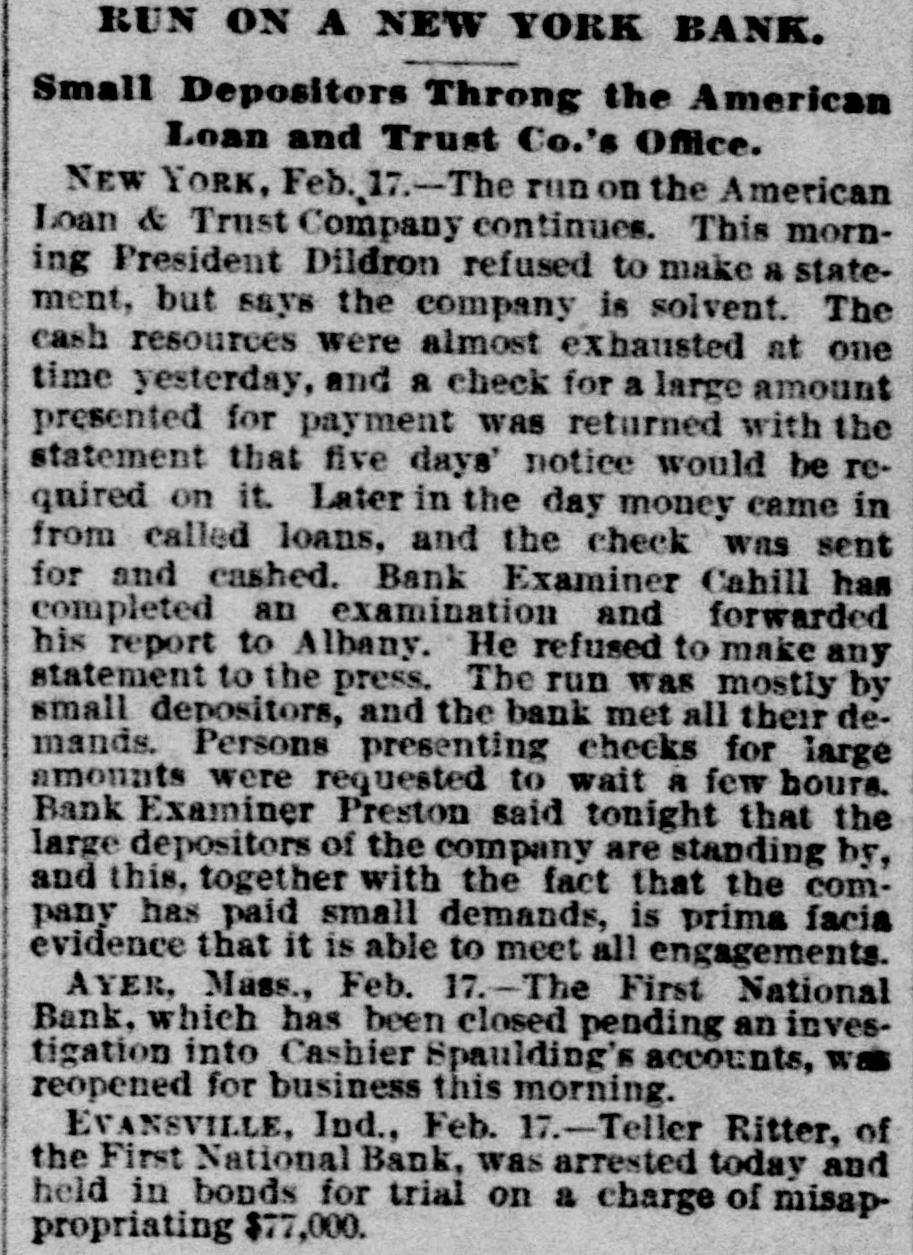
RUN ON A NEW YORK BANK. Small Depositors Throng the American Loan and Trust Co.'s Office. NEW YORK, Feb. 17.-The run on the American Loan & Trust Company continues. This morning President Dildron refused to make 8 statement, but says the company is solvent. The cash resources were almost exhausted at one time yesterday, and a check for a large amount presented for payment was returned with the statement that five days' notice would be required on it. Later in the day money came in from called loans, and the check was sent for and cashed. Bank Examiner Cahill has completed an examination and forwarded his report to Albany. He refused to make any statement to the press. The run was mostly by small depositors, and the bank met all their demands. Persons presenting checks for large amounts were requested to wait a few hours. Bank Examiner Preston said tonight that the large depositors of the company are standing by, and this, together with the fact that the company has paid small demands, is prima facia evidence that it is able to meet all engagements. AYER, Mass., Feb. 17. The First National Bank. which has been closed pending an investigation into Cashier Spaulding's accounts, was reopened for business this morning. EVANSVILLE, Ind., Feb. 17.-Teller Ritter, of the First National Bank, was arrested today and held in bonds for trial on a charge of misappropriating $77,000.


Article from Los Angeles Herald, February 18, 1891

Click image to open full size in new tab

Article Text

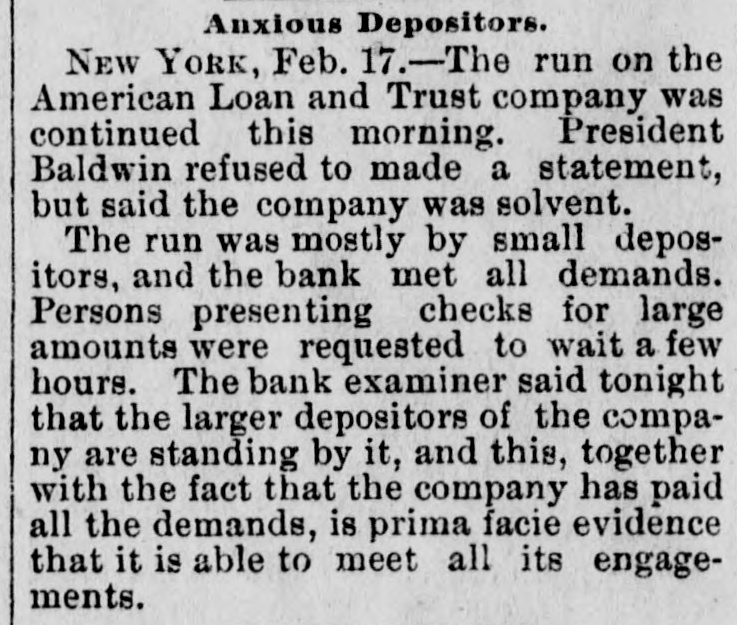
Anxious Depositors. NEW YORK, Feb. 17.-The run on the American Loan and Trust company was continued this morning. President Baldwin refused to made a statement, but said the company was solvent. The run was mostly by small depositors, and the bank met all demands. Persons presenting checks for large amounts were requested to wait a few hours. The bank examiner said tonight that the larger depositors of the company are standing by it, and this, together with the fact that the company has paid all the demands, is prima facie evidence that it is able to meet all its engagements.


Article from St. Paul Daily Globe, February 18, 1891

Click image to open full size in new tab

Article Text

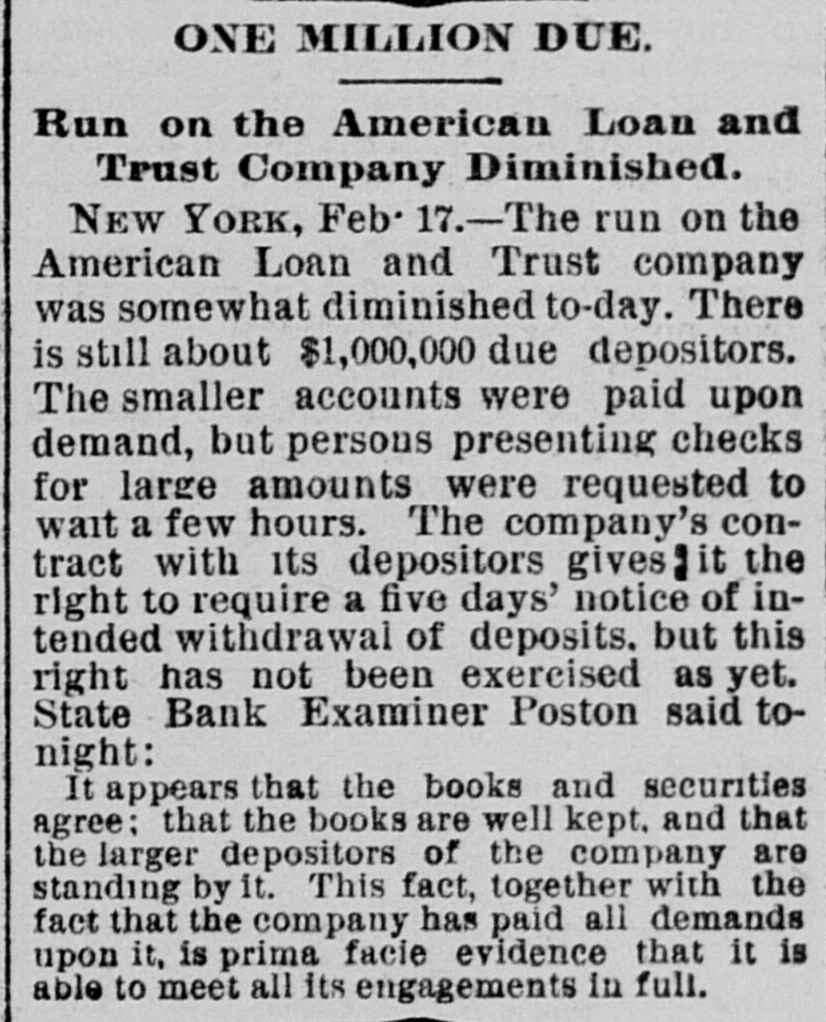
ONE MILLION DUE. Run on the American Loan and Trust Company Diminished. NEW YORK, Feb: 17.-The run on the American Loan and Trust company was somewhat diminished to-day. There is still about $1,000,000 due depositors. The smaller accounts were paid upon demand, but persons presenting checks for large amounts were requested to wait a few hours. The company's contract with its depositors gives it the right to require a five days' notice of intended withdrawal of deposits. but this right has not been exercised as yet. State Bank Examiner Poston said tonight: It appears that the books and securities agree; that the books are well kept. and that the larger depositors of the company are standing by it. This fact, together with the fact that the company has paid all demands upon it, is prima facie evidence that it is able to meet all its engagements in full.


Article from The Record-Union, February 19, 1891

Click image to open full size in new tab

Article Text

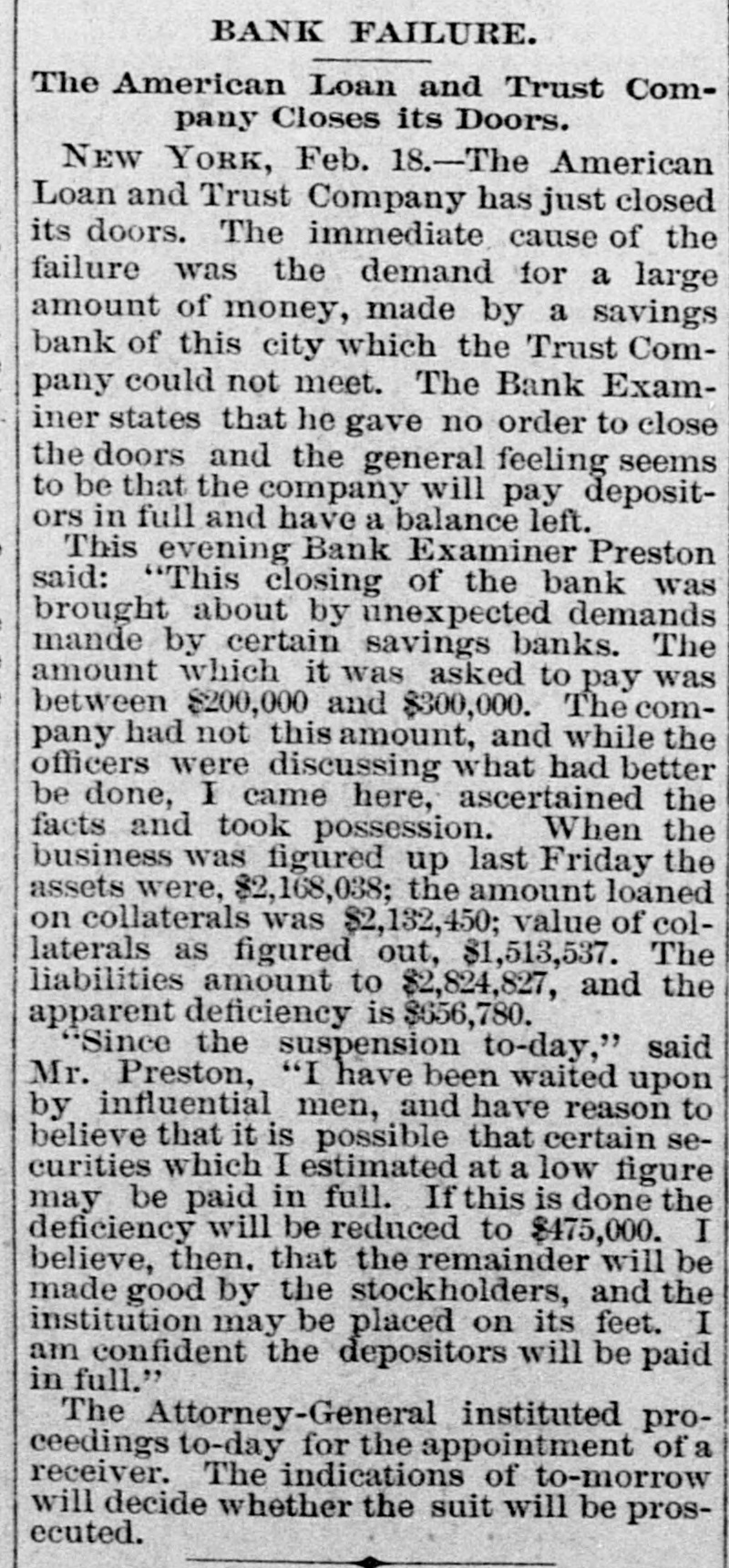
BANK FAILURE. The American Loan and Trust Company Closes its Doors. NEW YORK, Feb. 18.-The American Loan and Trust Company has just closed its doors. The immediate cause of the failure was the demand for a large amount of money, made by a savings bank of this city which the Trust Company could not meet. The Bank Examiner states that he gave no order to close the doors and the general feeling seems to be that the company will pay depositors in full and have a balance left. This evening Bank Examiner Preston said: "This closing of the bank was brought about by unexpected demands mande by certain savings banks. The amount which it was asked to pay was between $200,000 and $300,000. The company had not this amount, and while the officers were discussing what had better be done, I came here, ascertained the facts and took possession. When the business was figured up last Friday the assets were, $2,168,038; the amount loaned on collaterals was $2,132,450; value of collaterals as figured out, $1,513,537. The liabilities amount to $2,824,827, and the apparent deficiency is $656,780. "Since the suspension to-day," said Mr. Preston, "I have been waited upon by influential men, and have reason to believe that it is possible that certain securities which I estimated at a low figure may be paid in full. If this is done the deficiency will be reduced to $475,000. I believe, then. that the remainder will be made good by the stockholders, and the institution may be placed on its feet. I am confident the depositors will be paid in full." The Attorney-General instituted proceedings to-day for the appointment of a receiver. The indications of to-morrow will decide whether the suit will be prosecuted.


Article from The Helena Independent, February 19, 1891

Click image to open full size in new tab

Article Text

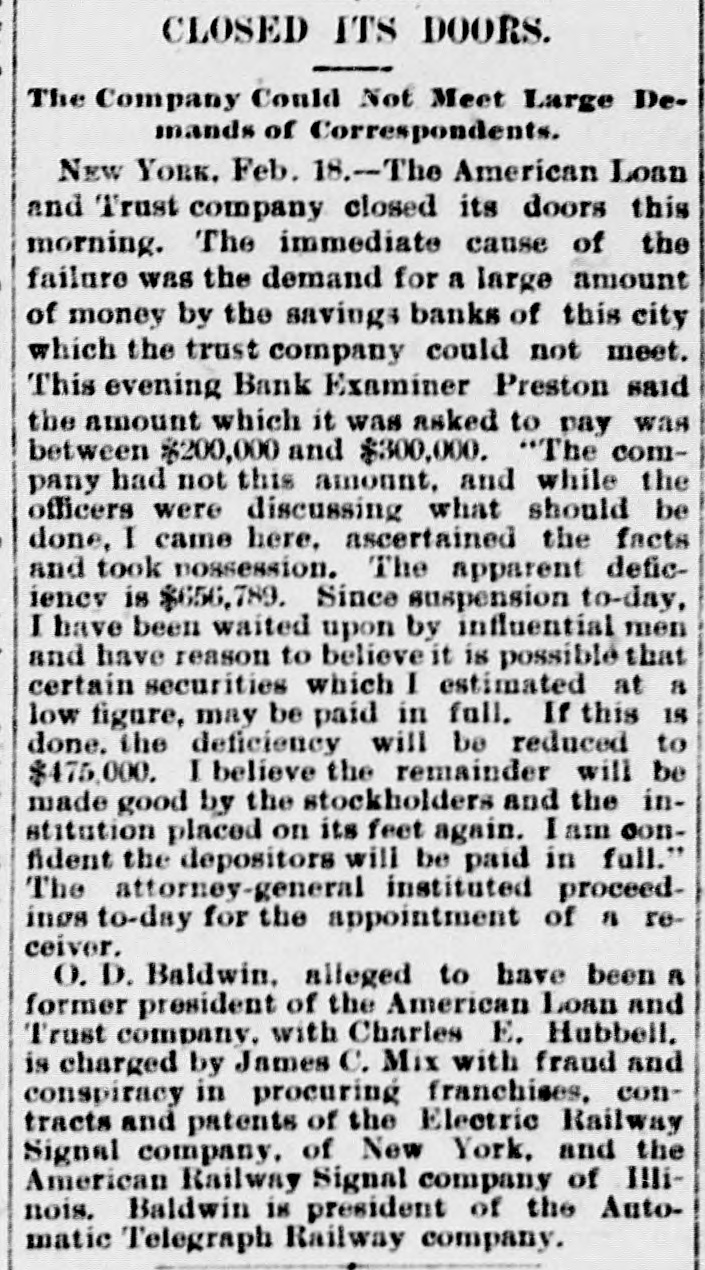
CLOSED ITS DOORS. The Company Could Not Meet Large Demands of Correspondents. NEW YORK. Feb. 18.-The American Loan and Trust company closed its doors this morning. The immediate cause of the failure was the demand for a large amount of money by the savings banks of this city which the trust company could not meet. This evening Bank Examiner Preston said the amount which it was asked to pay was between $200,000 and $300,000. "The company had not this amount. and while the officers were discussing what should be done, I came here. ascertained the facts and took possession. The apparent deficienev is $656,789. Since suspension to-day, I have been waited upon by influential men and have reason to believe it is possiblé that certain securities which I estimated at a low figure, may be paid in full. If this 18 done. the deficiency will be reduced to $475,000. I believe the remainder will be made good by the stockholders and the institution placed on its feet again. I am confident the depositors will be paid in full." The attorney-general instituted proceedings to-day for the appointment of n receiver. O. D. Baldwin, alleged to have been A former president of the American Loan and Trust company. with Charles E. Hubbell. is charged by James C. Mix with fraud and conspiracy in procuring franchises. contracts and patents of the Electric Railway Signal company. of New York, and the American Railway Signal company of Illinois. Baldwin is president of the Automatic Telegraph Railway company.


Article from Waterbury Evening Democrat, February 19, 1891

Click image to open full size in new tab

Article Text

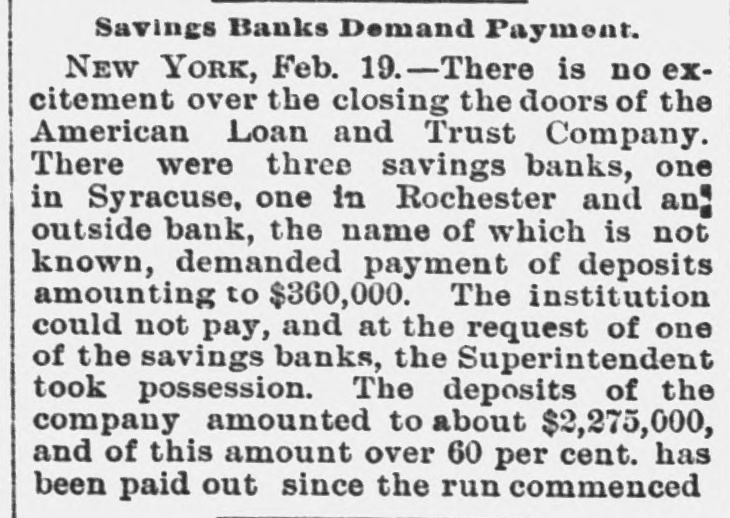
Savings Banks Demand Payment. NEW YORK, Feb. 19.-There is no excitement over the closing the doors of the American Loan and Trust Company. There were three savings banks, one in Syracuse, one in Rochester and an: outside bank, the name of which is not known, demanded payment of deposits amounting to $360,000. The institution could not pay, and at the request of one of the savings banks, the Superintendent took possession. The deposits of the company amounted to about $2,275,000, and of this amount over 60 per cent. has been paid out since the run commenced


Article from Deseret Evening News, February 19, 1891

Click image to open full size in new tab

Article Text

CAUSE OF THE FAILURE. Demand for Large Sums of Money by is New York Bank. NEW YORK, Feb. 18.-The immediate cause of the failure of the American Loan and Trust Company was a demand for " large amount of money made by a savings bank of this city which the company could not meet. The bank examiner states that he gave no order to close doors, and the general feeling seems to be that the company will pay the depositors in full, and have a balance left. Three savings banks, one In Syracuse, one in Rochester and another outside bank demanded payment of deposits amounting to $300,000. The Institution could not pay and, at the request of one of the savings banks, the superintendent took possession. Later he sent for Bank Examiner Cahill, who is now in charge. No statement can be had yet. This evening Bank Examiner Pres. ton said the closing of the bank was brought about by UNEXPECTED DEMANDS by certain savings banks. "The amount which it was asked to pay was between $200,000 and $300,000. The company had not this amount, and while the officers werediscussing what had better be done, I came here, ascertained the facts and took possession. When the business was figured up last Friday the assets were $2,168,036. The amount loaned on collaterals was $1,513,637. The liabilities amount to $2.824,826 and the apparent deficiency is $656,789." "Since the suspension today," said Mr. Preston, "I have been waited upon by influential men and have reason to believe it is possible that certain securities which I estimated at a low figure may be PAID IN FULL. If this is done the deficiency will be reduced to $475,000. I believe then the remainder will be made good by the stockholders, and the institution be placed on Its feet. I am confident the depositors will be paid in full." The Attorney-General instituted proceedings today for the appointment of a receiver. The indications tomorrow will decide whether the suit will be pressed. O. D. Baldwin, alleged to be the


Article from Richmond Dispatch, February 19, 1891

Click image to open full size in new tab

Article Text

A New York Trust Company Suspends. [By telegraph to the Dispatch.] NEW YORK, February 18.-The American Loan and Trust Company closed its doors at half-past 12 to-day, the immediate cause being a demand for a large amount of money which the Trust Company could not meet. Three savings banks, a bank in Syracuse, one in Rochester, and other outside banks, the names of which are not known, demanded payment of deposits amounting to $360,000. The institution could not pay, and at the request of one of the savings banks the Superintendent took possession. Later he sent for Bank-Examiner Cahill, who is now in charge. Bank-Examiner Preston says the apparent deficiency in the assets of the Ainerican Loan and Trust Company is $656,789. He has reason to believe that to-morrow this will be reduced to $475,000. This amount, some interested people expect, will be made good by the stockholders and the institution be placed on its feet again.


Article from The Morning News, February 19, 1891

Click image to open full size in new tab

Article Text

$-: May delivery $6 04 bid; July delivery $6 28; refined steady; continent $6 00@6 25; South America $6 75. Butter quiet at 18@ 25c. Cheese active; light skims 5.816c. Freights to Liverpool weak and dull: cotton 1/8d; grain 24d. CHICAGO, Feb. 18.-The grain markets started with the mild form of a panic among the shorts. Wheat started with a jump of %c over the closing prices of the previous afternoon. Aa easier feeling succeeded and a decline to 98c had been brought about by 11 o'clock, then it broke toward noon to 979ge. St. Louis speculators reported it snowing there, and the suspension of the American Loan and Trust Company of New York assisted the dewnward movement, and 80 did the fact that the bulls had, on the morning bulge, unloaded their wheat on shorts. It only needed a little courage on the part of the bears to cause a further decline, and they gathered enough of it together in the last fifteen minutes to cause a drop to 9736c. The corn market was just a trifle excited at the opening. and the price for May was advanced 1/2/14c. First trades in May were made at 52% and not until considerable business had been done at 3/4c over the highest of those quotations did the market show any signs of having satisfied the shorts; 54130 was substantially the highest point of the general trading. There was a good buying in oats early. May advanced from 401/4c at the opening to 465gc. A weaker feeling then manifested and the price declined until the close. The opening of the provision market was quiet but firm in sympathy with grain and there was no pressure of offerings. The demand for lard at the concession of 23/6c from yesterday's closing price was the feature on call. The closing price of May lard was 2½c lower than on Tuesday. Pork and ribs declined a fraction less than lard. CHICAGO, Feb. 18.-Cash quotations were as follows: Flour firm; spring patents $4.40@ 480; winter patents $450@480; bakers' $375@ 4 75. Wheat No. 2, spring 94c; No. 2, red, Corn-No. 2, 511/2. OatsNo. 2, 45c. Mess pork, per barrel, $9 25 @9 87½. Lard at 35 55. Short rib sides, loose, $4 45@150. Dry salted shoulders, boxed, 3390@4.00. Short clear sides, boxed, $4800 485. Whisky at $1 14. Leading futures ranged as follows: Opening. Highest. Closing.


Article from The Madison Daily Leader, February 20, 1891

Click image to open full size in new tab

Article Text

BUSINESS REVERSES. A Large New York Concern Closen Its Doors. NEW YORK, Feb. 19.-The American Loan and Trust company has closed its doors. The immediate cause of the fallure was a demand for a large amount of money made by the Savings bank, of this city, which the trust company could not meet. Bank Examiner Preston said: The closing of the bank was brought about by unexpected demands by certain savings banks. The amount which It was asked to pay was beetween $200,000 and $300,000. The company had not this amount, and while the officers were discussing what had better be done, I came here. ascertained the facts, and took possession. When the business was figured up last Friday the assets were $2,168,038; the amount loaned on collaterals was $2,132,450. and the value of collaterals, as figured out, was $1,513,637. The liabilities amount to $2,824,897 and the apparent deficiency is $656,789. Since the suspension, I have been waited upon by influential men and have reason to believe It is possible that certain securities which I estimated at a low figure may be paid in full If this is done. the defielency will be" reduced to $475,000. I believe then the remainder will be made good by the stockholders and the institution may be placed on Its feet. I am confident the depositors will be paid in full. This is One at Kansas City. KANSAS CITY, Feb. 19.-The Union Invest. ment company assigned to-day for the beneft of creditors. The liabilities are about $1,000,000. and the assets. according to the officials of the company, about the same. It is Impossible, they say, to give an exact statement at present. The cause of the failure is given as a difficulty in calling western loans and negotiating paper in the east.


Article from Iowa County Democrat, February 27, 1891

Click image to open full size in new tab

Article Text

THE LATEST TELEGRAMS. NEWS IN BRIEF WORK on the world's fair site in Jack son Park was resumed Thursday. GENERAL HENRY H SIBLEY, Minnesota's first governor, is dying at St. Paul. ADOLPH HOFFMAN and Alfred E. Frommett, silk manufacturers, of Paterson, N.. J. have assigned. THE finest alabaster quarry in the world has been discovered near Canyon City, Col. THE only child of Rider Haggard is reported to have died at the city of Mexico. THE Ohio river is still rising at Cincinnati, and a disastrous flood at that point is feared. "DIAMOND Joe Reynolds, the wellknown capitalist and steamboat-owner of Iowa, died Saturday at Prescott. Iowa. THIRTY inches of snow has fallen in Bozeman, Mont. within the last two days, and it is still snowing. THE crippled American loan and trust company of New York will be reorganized and financially strengthened. THE John D. Knox & Co., banking house at Topeka. Kas., has failed. Estimated liabilities, $250,000. THE bill conferring the elective franchise on women passed Thursday by the Kensas house of representatives. THE body of Professor Bancroft, of Brown's University, Providence, R. I., was found in Dyer's Pond Monday. He disappeared on December 8. PROFESSOR ALEXANDER WINCHELL of the Michigan University, a geologist of world-wide reputation, died at Ann Arbor Thursday morning. A PECULIAR feature of a recent storm at Salt Lake was a large quantity of salt which fell with the snow, all mixed ready to place in the freezer. MASTER WORKMAN T. V. POWDERLY of the Knights of Labor was stricken with heart disease at Toveka, Kan., but his condition is not dangerous. GIBSON, ot the whisky trust, gave bail in the sum of $25,000 Wednesday for his appearance when the indictment found against him by the state grand jury shall come to trial. OVER $2,000,000 was divided among the four children of Chauncy B. Blair, by the will of the late banker which was filed for probate Tuesday. THE will of the late J. N. McCullough, Vice President of the Pennsylvania Company, has been filed for probrate. His estate is valued at from $7,000,000 to $10,000.


Article from The Iola Register, February 27, 1891

Click image to open full size in new tab

Article Text

General. Feb. 17.-A Columbus, Hocking Valley & Toledo passenger train crashed into a Scioto Valley freight train at a crossing near Columbus, O., by a dense fog obscuring the target lights, and Engineer Charles Botwell of Portsmouth and two brothers named Johnson of Columbus were probably fatally injured, and Mr. Robert McClure of Reynoldsville, O., was less seriously hurt. Near Pittsburg, Pa., Monday morning a bowlder rolled from Du Quesne Heights and crashed into a Panhandle express train, breaking one car any killing Miss Clara Fleming aged 19 years, and seriously injuring several others. The drought in central and southern California has been broken by a heavy rainfall. S. W. Cowles, a banker of Clarks, Neb., was arrested Monday for the murder of his wife a short time ago. The visible supply Saturday as compiled by the New York Produce Exchange was of wheat, 23, 167,953 bushsls, a decrease of 190,873 bushels and of corn, 2,400,807 bushels, a decrease of 191,144 bushels. Butter was in brisk demand on the Elgin board of trade Monday, and 21,420 pounds sold at prices ranging from 29 to 291 cents against 261 and 271 cents one year ago. Women in Ohio have begun a crusade against obscene theatrical posters. In Springfield O., Monday. white paper was pasted over pictures of burlesquers. Charges of bribery when in office have been made against Ignatius Donnelly of cryptogram fame, a suit of damages resulting. The world's fair directors have asked Mayor Cregier of Chicago, for police protection for the Italian laborers at work at Jackson Park. Secretary Gibson of the whiskv trust has been indicted by the state of Illinois for his connection with the alleged dynamite conspiracy. The trust has issued a statement disclaiming all knowledge of the plot. Feb. 18.-Floods have done great damage in Pennsylvania towns, residents in many places being compelled to abandon their homes. Wrecked bridges and washouts have entirely stopped or retarded railway travel, and in West Virginia and parts of Ohio losses by the deluge will be heavy. The will of the late J. N. McCullough, vice president of the Pennsylvania Railway company. was filed for probate at Pittsburg Monday. His estate is valued at from $3,000,000 to $10,000,000. Tuesday at Philadelphia Miss Ava Lawle Willing was married to John Jacob Astor, of New York, and the jewels worn by the bride, many of which were gifts from the Astor family, are said to be almost priceless. The remains of admiral Porter, who died last Friday, were interred at Arlington Tuesday with imposing ceremonies. Judge Berkshire, of the Indiana supreme court was reported to be dying Tuesday. The St. Joseph Ballot has suspended publication. At Springfield. III., the republicans have split badly on the senatorial question. Maj. Anderson of New York has submitted a scheme for an elaborate naval display to the World's Fair directors. J. W. Saeter, a passenger on an Iron Mountain train, became suddenly insane at Bald Knob, Ark., and shot and killed Pullman Conductor Leech and Isadore Meyers, a drummer. The steamboat Thomas Sherlock struck the pier of a railroad bridge just after leaving Cincinnatti for New Orleans and sank. Three lives were lost. The Union Investment Company, of Kansas City, filed an assignment on Wednesday at Boston. Gen. H. H. Sibley, the first Governor af Minnesota, died Wednesday morning in his home at St. Paul. The Illinois senate, on Wednesday passed the bill making the contract rate of interest 7 per cent, and the legal rate 5 per cent. John D. Knox & Co., bankers of Topeke, Kas., have assigned. Liabilities, $250,000; assets, $400,000. The American Loan and Trust Company closed its doors in New York with liabilities of $2,234,874The apparent deficit is $656,789. The
Article from The Sun, March 5, 1891

Click image to open full size in new tab

Article Text

# Maybe a Receivership After All, Two long and agitated meetings of directors and stockholders of the American Loan and Trust Company were held yesterday, and the final meeting will be held to-day. If at this meeting a plan of reorganization cannot be agreed upon, Judge Ingraham will be asked to appoint a receiver to-morrow. Certain interests refuse to subscribe to the plan submitted.


Article from Idaho County Free Press, March 6, 1891

Click image to open full size in new tab

Article Text

at Cleveland can. Resolutions impeaching U. S. Judge oarman of Louisiana have been inoduced in the house. The long drought in southern Illiis has been broken by one of the eaviest rains in years. The California senate has passed the buse bill appropriating $300, for e world's fair exhibit. The Kansas house, by a vote of 69 34, reconsidered and passed the bill anting female suffrage. John D. Knox & Co., bankers of Toka, Kas., have assigned. Liabilities 50, 000: assets, $400,000. Senator Quay, it is said, will proed civilly and criminally against the e w York World for libel. There is talk of possible indictments St. Louis officials for violations of e interstate commerce law. An assassin shot at Dr. Wm. Lamb Shiloh, Miss., but the contents of el shotgun killed his nephew. The lower house of the Montanalegature defeated the bill fixing eight urs for a day's work in the mines. -0.1 the JO греш s! dening especial "V eq 01 st B 1641 1.1 - the Ohio and Mississippi Railroad. Maj. Anderson of New York has subtted a scheme for an elaborate naval play to the World's fair directors. It is believed if the 2-cent rate is forced in Kansas and Illinois, as ems likely, the cut will extend to the cific. General Sibley, the first governor of nnesota, died at his home in Minnea, died at his home in St. Paul on 14161 € Sheriff Timberlake, who hunted wn the James gang and employed b Ford in the matter, died at Liby, Mo. Nelson Pyle of New Albany. Ind., d of hydrophobia from a dog bite licted December 9. His sufferings re frightful. The world's fair contractors will ploy only American citizens, by ich action they expect to avert any ther trouble. The investigation committee found t at the end of the first term of easurer Woodruff of Arkansas the 61% mil pomo on It is stated that the senate will ree to confirm James H. Beatty, nomted some days since for United tes judge in Idaho. United States revenue officials made eneral raid on Chicago cigar dealers o were counterfeiting the governnt import stamps. The American Loan and Trust comny closed its doors in New York th liabilities of $2, 234. 847. The aprent deficit is $656, 789. A supreme court decision makes a Joseph woman a bigamist. She 1 married after her husband had JO conviction ue Secretary Noble, in an opinion susns a contention that a Chickasaw o takes out naturalization papers 11 holds his nation rights. Mr. Kelley of Kansas introduced in , house a bill to repeal that portion the bank act that compels national nks to purchase United States bonds. The bill making prize fighting in xas a penitentiary offense was passed the house. The term of imprisonnt provided for ranges from two to fears. e -IV Rasus on pooM 'N 'S JO [1110] V nce men, marked "private and conential, has brought suspicion upon Insure. 11 The AEtna coal company at Chattaoga has assigned with liabilities of ), 000, and assets in lands and mines $300,000. Inability to secure an ension of paper was the cause. The election for congressman in the cond district of Rhode Island was y tame. Arnold refused to run and republicans generally refrained m voting. Page(dem.) was elected. Senator Manderson will report favory to the senate the bill which was e reported from committeeadverseallowing artificial limbs for the vetns every three instead of five years. five of the largest brewerics in Chio have joined with the Val Blatz


Article from Richmond Dispatch, March 7, 1891

Click image to open full size in new tab

Article Text

THE AMERICAN LOAN & TRUST CO. Abandonment of the Long Struggle to Revivify the Concern, (By telegraph to the Dispatch.] New YORK. March 6.-The long struggle made by the Reorganization Committee of the American Loan and Trust Company to infuse new life into the concern is over. The committee has failed and a receiver has been asked for and will probably be appointed to-morrow. Ex-Judge Hawes, the counsel for the company, said this afternoon that it had been found impossible to get a two thirds majority of the stockholders to consent to Mr. Sage's plan of reorganization, and 80 a receiver would have to be appointed. He said that efforts would be continued, though, to put the concern on its feet again. The stock of the company was offered on the street to-day at 20. It sold at auction on Tuesday at 34. This looks as if some persons had known of the failure of the plan of reorganization, though the committee has asserted all along that everything was going on nicely. It was learned late this afternoon that the failure of the Sage plan of reorganization was due to the withdrawal of the Brooklyn stockholders from the committee.


Article from Evening Star, July 21, 1891

Click image to open full size in new tab

Article Text

Leave to Pay a Dividend Granted. NEW YORK, July 21.-Judge Barrett of the supreme court today granted the application of T. Edward Simmons, receiver of the American Loan and Trust Company. for leave to pay a dividend of 35 per cent to twenty-seven savings $577,184.99. banks, which hold claims aggregating


Article from The Madison Daily Leader, July 22, 1891

Click image to open full size in new tab

Article Text

Receiver Files His Report. NEW YORK, July 22.-The receiver of the American Loan and Trust company has filed his report in the supreme court. The report sets forth that the receiver has collected in cash the sum of $390,205.20 and disbursed $110,666.61. The cash balance at the date of the report is $279,538.39. A statement of the names of savings banks and others for whom the company acted as trustee or guardian of funds aggregating nearly $705,000 is given and the receiver adds that he is advised that these creditors should be treated as preferred claim. ants. He asks the authority of the court to pay these creditors a dividend of 35 per cent.


Article from New-York Tribune, August 4, 1891

Click image to open full size in new tab

Article Text

AN AMERICAN LOAN AND TRUST DIVIDEND. J. Edward Simmons, the receiver for the American Loan and Trust Company, announced yesterday that he was prepared to pay a dividend of 35 per cent to the preferred creditors of the concern.


Article from The Sun, November 8, 1891

Click image to open full size in new tab

Article Text

Criminal Proceedings May Follow. Receiver Simmons of the American Loan and Trust Company said yesterday that he was investigating with the intention of proceeding criminally against those who wrecked the company as soon as he could obtain sufficient evidence. He has brought suit against ex-President Hazard on his notes which amounted to about $225,000. The Trust Company had $100,000 capital. $225,000. surplus, and $400, 000 common deposits. Allthe receiver has been able to find is some worthless collatoral that may not repay the trouble and expense of the suits brought to recover the amounts lonned on it.


Article from The Sun, April 27, 1892

Click image to open full size in new tab

Article Text

# BALDWIN'S CATS AND DOGS. A Million, Par Value, of Them Actually Brings $45,000 at Auction. Men with great faith in human nature and with surplus cash assisted Mr. J. Edward Simmons, receiver of the American Loan and Trust Company, to get rid of some of the old securities which the officers of that company had foisted upon it. An idea of the manner in which President O. D. Baldwin managed the company's affairs may be gathered from the fact that fifty blocks of securities, whose face value was $1,035,560, were sold yesterday for $46,491, and yet it was generally admitted that the auctioneer had obtained very good prices. The only security in the entire lot that was sure of repaying the investor was the $1,000 Union Pacific bond, which brought the market price, $1,055. Some of the prices were amusing because, although small, they were far in excess of the actual value of the securities, which should have gone to the waste paper man. Such, for instance, were the three $1,000 bonds of the City Water Company of Belleville, Ill., due in 1906, which brought $2.50; seven of the same, due in 1888, which brought $1 apiece; 600 shares of the Old Dominion Mining and Railroad Company, par value $60,000, price $6; 1,328 shares of the American Graphic Company, defunct, which went for $2, and 250 shares of the City Water Works Company of Lawrence, Kan., par value $25,000, price $36. Some of the stocks brought reasonable prices, but shrewd persons said the buyers were taking big chances. Mr. Simmons said that the securities sold were the collateral deposited by persons who had received loans from the obliging President, and who have since failed to repay these loans. He still has some securities obtained in this way, but the owners have promised to redeem them.


Article from The Sun, July 13, 1893

Click image to open full size in new tab

Article Text

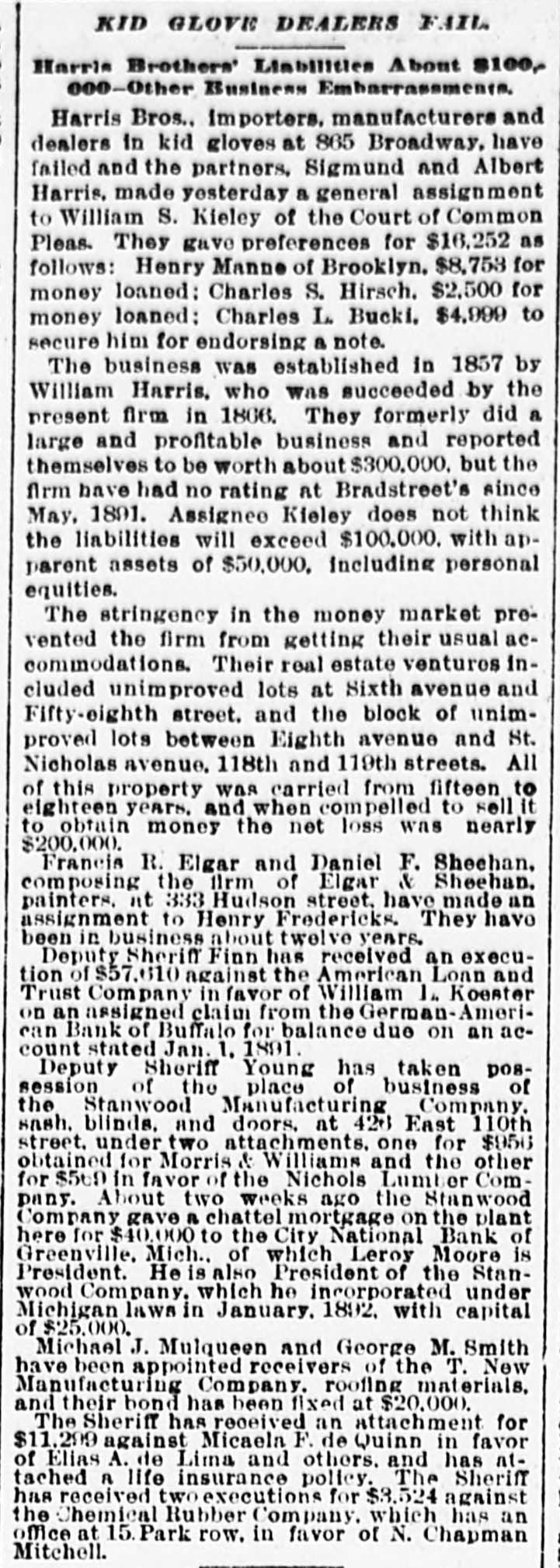
# KID GLOVE DEALERS FAIL Harris Brothers' Liabilities About $100, 000-Other Business Embarrassments. Harris Bros., importers, manufacturers and dealers in kid gloves at 865 Broadway, have failed and the partners, Sigmund and Albert Harris, made yesterday a general assignment to William S. Kieley of the Court of Common Pleas. They gave preferences for $16,252 as follows: Henry Manne of Brooklyn, $8,753 for money loaned; Charles S. Hirsch, $2,500 for money loaned; Charles L. Bucki, $4,999 to secure him for endorsing a note. The business was established in 1857 by William Harris, who was succeeded by the present firm in 1866. They formerly did a large and profitable business and reported themselves to be worth about $300,000, but the firm have had no rating at Bradstreet's since May, 1891. Assignee Kieley does not think the liabilities will exceed $100.000, with ap- parent assets of $50,000, including personal equities. The stringency in the money market pre- vented the firm from getting their usual ac- commodations. Their real estate venturos in- cluded unimproved lots at Sixth avenue and Fifty-eighth street, and the block of unim- proved lots between Eighth avenue and St. Nicholas avenue, 118th and 119th streets. All of this property was carried from fifteen to eighteen years, and when compelled to sell it to obtain money the net loss was nearly $200,000. Francis R. Elgar and Daniel F. Sheehan, composing the firm of Elgar & Sheehan, painters, at 333 Hudson street, have made an assignment to Henry Fredericks. They have been in business about twelve years. Deputy Sheriff Finn has received an execu- tion of $57,010 against the American Loan and Trust Company in favor of William 1. Koester on an assigned claim from the German-Ameri- can Bank of Buffalo for balance due on an ac- count stated Jan. 1, 1891. Deputy Sheriff Young has taken pos- session of the place of business of the Stanwood Manufacturing Company, sash, blinds, and doors, at 420 East 110th street, under two attachments, one for $956 obtained for Morris & Williams and the other for $509 in favor of the Nichols Lumber Com- pany. About two weeks ago the Stanwood Company gave a chattel mortgage on the plant here for $40.000 to the City National Bank of Greenville, Mich., of which Leroy Moore is President. He is also President of the Stan- wood Company, which he incorporated under Michigan laws in January, 1892, with capital of $25,000. Michael J. Mulqueen and George M. Smith have been appointed receivers of the T. New Manufacturing Company, roofing materials, and their bond has been fixed at $20,000. The Sheriff has received an attachment for $11,209 against Micaela F. de Quinn in favor of Elias A. de Lima and others, and has at- tached a life insurance policy. The Sheriff has received two executions for $3.524 against the Chemical Rubber Company, which has an office at 15. Park row, in favor of N. Chapman Mitchell.


Article from The Progressive Farmer, July 18, 1893

Click image to open full size in new tab

Article Text

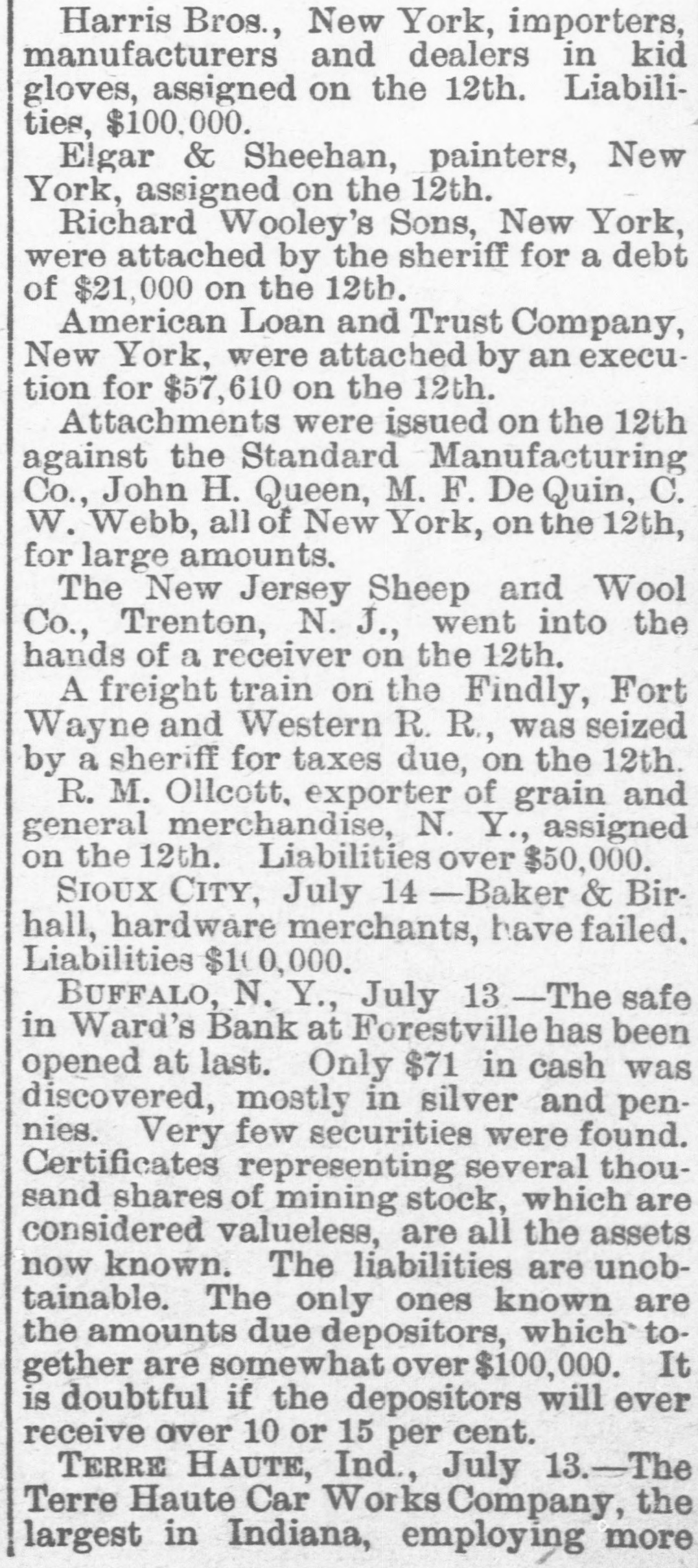
Harris Bros., New York, importers, manufacturers and dealers in kid gloves, assigned on the 12th. Liabilities, $100,000. Elgar & Sheehan, painters, New York, assigned on the 12th. Richard Wooley's Sons, New York, were attached by the sheriff for a debt of $21,000 on the 12th. American Loan and Trust Company, New York, were attached by an execution for $57,610 on the 12th. Attachments were issued on the 12th against the Standard Manufacturing Co., John H. Queen, M. F. De Quin, C. W. Webb, all of New York, on the 12th, for large amounts. The New Jersey Sheep and Wool Co., Trenton, N. J., went into the hands of a receiver on the 12th. A freight train on the Findly, Fort Wayne and Western R. R., was seized by a sheriff for taxes due, on the 12th. R. M. Ollcott, exporter of grain and general merchandise, N. Y., assigned on the 12th. Liabilities over $50,000. SIOUX CITY, July 14 - -Baker & Birhall, hardware merchants, have failed. Liabilities $10.000. BUFFALO, N. Y., July 13 The safe in Ward's Bank at Forestville has been opened at last. Only $71 in cash was discovered, mostly in silver and pennies. Very few securities were found. Certificates representing several thousand shares of mining stock, which are considered valueless, are all the assets now known. The liabilities are unobtainable. The only ones known are the amounts due depositors, which together are somewhat over $100,000. It is doubtful if the depositors will ever receive over 10 or 15 per cent. TERRE HAUTE, Ind., July 13.-The Terre Haute Car Works Company, the largest in Indiana, employing more


Article from New-York Tribune, November 16, 1894

Click image to open full size in new tab

Article Text

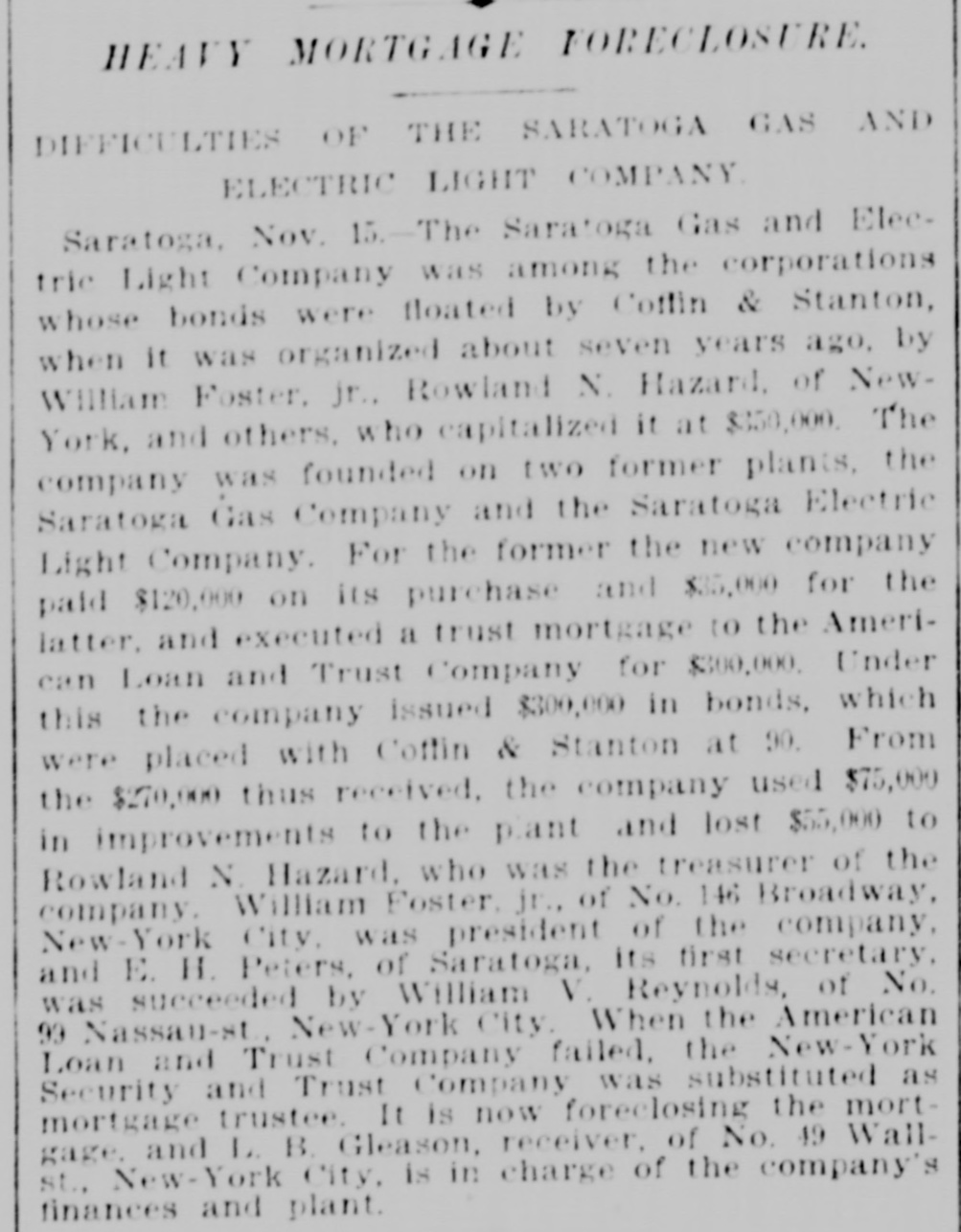
HEAVY MORTGAGE FORECLOSURE DIFFICULTIES OF THE SARATOGA GAS AND ELECTRIC LIGHT COMPANY Saratoga, Nov. 15.-The Saratoga Gas and Electrie Light Company was among the corporations whose bonds were floated by Coffin & Stanton, when it was organized about seven years ago, by William Foster, jr., Rowland N. Hazard of NewYork, and others, who capitalized it at $350,000. The company was founded on two former plants, the Saratoga Gas Company and the Saratoga Electric Light Company For the former the new company paid $120,000 on its purchase and $35,000 for the latter. and executed a trust mortgage to the American Loan and Trust Company for $300,000. Under this the company issued $300,000 in bonds, which were placed with Coffin & Stanton at 90. From the $270,000 thus received, the company used $75,000 in improvements to the plant and lost $55,000 to Rowland N Hazard, who was the treasurer of the company. William Foster jr., of No. 146 Broadway, New-York City, was president of the company, and E. H. Peters, of Saratoga, its first secretary, was succeeded by William V. Reynolds, of No. 93 Nassau-st. New-York City, When the American Loan and Trust Company failed. the New-York Security and Trust Company was substituted as mortgage trustee. It is now foreclosing the mortgage. and 1. B. Gleason, receiver, of No. 49 Wallst., New- York City, is in charge of the company's finances and plant.


Article from The Daily Morning Journal and Courier, November 30, 1894

Click image to open full size in new tab

Article Text

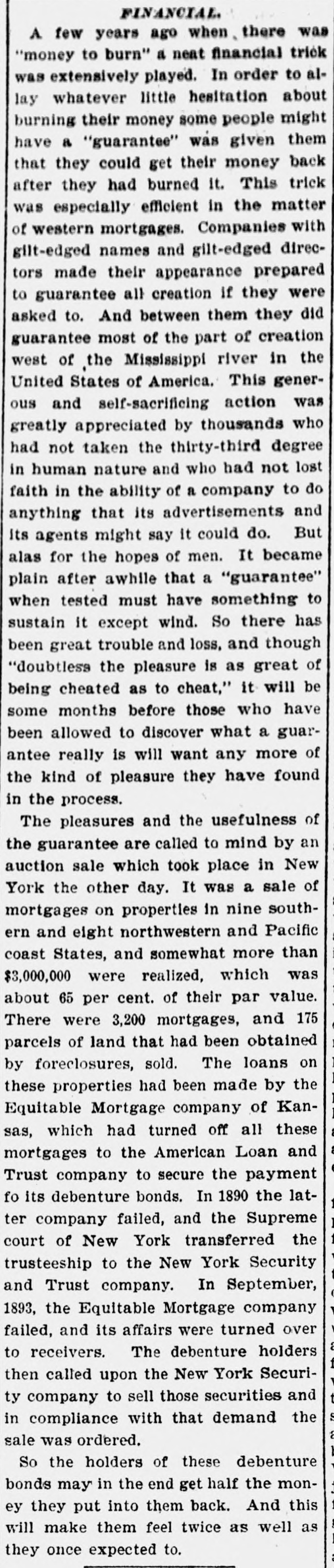
FINANCIAL A few years ago when, there was "money to burn" a neat financial trick was extensively played. In order to allay whatever little hesitation about burning their money some people might have a "guarantee" was given them that they could get their money back after they had burned it. This trick was especially efficient in the matter of western mortgages. Companies with gilt-edged names and gilt-edged directors made their appearance prepared to guarantee all creation If they were asked to. And between them they did guarantee most of the part of creation west of the Mississippi river in the United States of America. This generous and self-sacrificing action was greatly appreciated by thousands who had not taken the thirty-third degree in human nature and who had not lost faith in the ability of a company to do anything that its advertisements and its agents might say it could do. But alas for the hopes of men. It became plain after awhile that a "guarantee" when tested must have something to sustain it except wind. So there has been great trouble and loss. and though "doubtless the pleasure is as great of being cheated as to cheat," it will be some months before those who have been allowed to discover what a guarantee really is will want any more of the kind of pleasure they have found in the process. The pleasures and the usefulness of the guarantee are called to mind by an auction sale which took place in New York the other day. It was a sale of mortgages on properties in nine southern and eight northwestern and Pacific coast States, and somewhat more than $3,000,000 were realized, which was about 65 per cent. of their par value. There were 3,200 mortgages, and 175 parcels of land that had been obtained by foreclosures, sold. The loans on these properties had been made by the Equitable Mortgage company of Kansas, which had turned off all these mortgages to the American Loan and Trust company to secure the payment fo its debenture bonds. In 1890 the latter company failed, and the Supreme court of New York transferred the trusteeship to the New York Security and Trust company. In September, 1893, the Equitable Mortgage company failed, and its affairs were turned over to receivers. The debenture holders then called upon the New York Security company to sell those securities and in compliance with that demand the sale was ordered. So the holders of these debenture bonds may in the end get half the money they put into them back. And this will make them feel twice as well as they once expected to.