Article Text
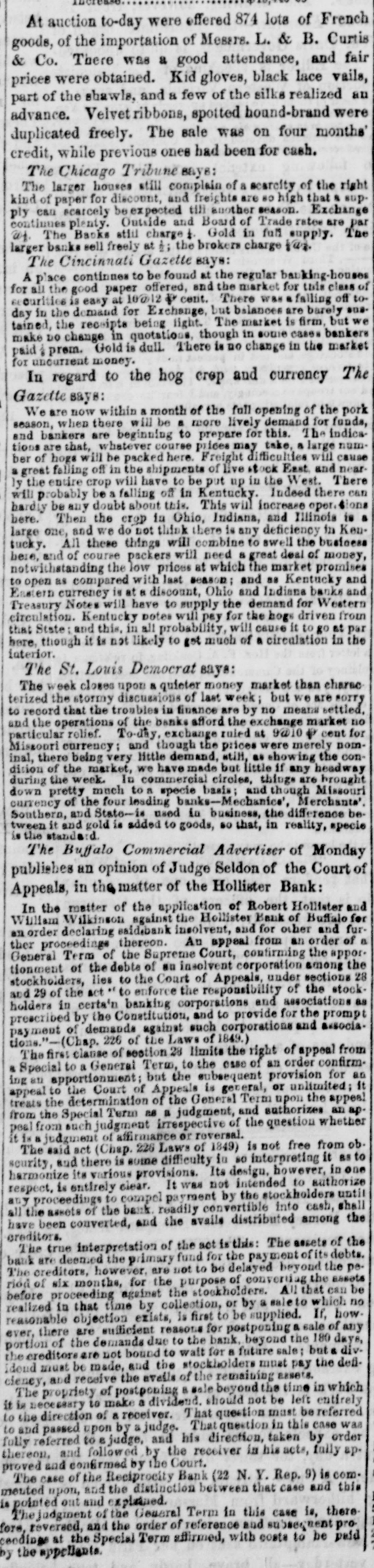
At auction to-day were offered 874 lota of French goods, of the importation of Messre. L. & B. Curtis & Co. There was a good attendance, and fair prices were obtained. Kid gloves, black lace vails, part of the shawle, and a few of the silks realized an advance. Velvet ribbons, spotted bound-brand were duplicated freely. The sale was on four months credit, while previous ones had been for cash. The Chicago Tribune says: The larger houses still complain of a scarcity of the right kind of paper for discount, and freights are 80 high that & sup. ply can scarcely be expected till another season. Exchange continues plenty. Outside and Board of Trade rates are par wt. The Banks still charge 1. Gold in full supply. The larger banks sell freely at #: the brokers charge Var. The Cincinnati Gazette says: A place continues to be found at the regular bar king-houses for all the good paper offered, and the market for this class of securities is easy at 10012 & cent. There was a failing off today in the demand for Exchange, but balances are barely and tained, the receipts being light. The market is firm, but we make DO change in quotations, though in some cases bankers paid prem. Gold is dull. There is no change in the market for uncurrent money. In regard to the hog crop and currency The Gazette says: We are now within a month of the full opening of the pork season, when there will be a more lively demand for funds, and bankers are beginning to prepare for this. The indications are that, whatever course prices may take, a large number of hogs will be packed here. Freight difficulties will cause great falling off in the shipments of live st lock East and nearly the entire crop will have to be put up in the West. There will probably be a falling off in Kentucky. Indeed there can hardly be any doubt about this. This will increase open. ions a here. Then the crop in Ohio, Indiana, and Illinois is large one, and we do not think there is any deficiency in Kentucky. All these things will combine to swell the business here, and of course packers will need a great deal of money, notwithstanding the low prices at which the market promises open as compared with last season and as Kentucky and Eastern currency is at a discount, Ohio and Indiana banks and Treasury Notes will have to supply the demand for Western circulation. Kentucky notes will pay for the hogs driven from that State and this, in all probability, will cause it to go at par here, though it is not likely to gst much of a circulation in the interior. The St. Louis Democrat says: The week closes upon a quieter money market than charge terized the stormy discussions of last week; but we are sorry to record that the troubles in finance are by no means settled and the operations of the banks afford the exchange market no particular relief. To-day. exchange ruled at 9@10 ₽ cent for Missouri currency; and though the prices were merely nominal, there being very little demand, still, as showing the condision of the market, we have made but little if any headway during the week. In commercial circles, things are brought down pretty much to a specie basis; and though Missouri currency of the four leading banks-Mechanice', Merchants' Southern, and State-in used in business, the difference be tween it and gold is added to goods, so that, in reality, specie is the standard The Buffalo Commercial Advertiser of Monday an of of in the matter Appeals, publishes opinion of Judge the Hollister Seldon of Bank: the Court In the matter of the application of Robert Hollister and William Wilkinson against the Hollister Bank of Buffalo for on order declaring said.bank insolvent, and for other and further proceedings thereon. An appeal from an order of a General Term of the Supreme Court, confirming the appor. tionment of the debts of an insolvent corporation among the stockholders, lies to the Court of Appeals, under sections 28 and 29 of the act to enforce the responsibility of the stock holders in certa'n banking corporations and associations as prescribed by the Constitution, and to provide for the prompt payment of demands against such corporations and associations."-(Chap. 226 of the Laws of 1849.) The first clause of section 28 limits the right of appeal from Special to a General Term, to the esse of an order confirm& apportionment; but the subsequent provision for as ingan to the Court of Appeals is general, or unlimited; it appeal the determination of the General Term upon the appeal from treats the Special Term as a judgment, and authorizes an ap. pealfrom auch judgment irrespective of the question whether judgment of affirmance or reversal. The said act (Chap. 226 Laws of 1849) is not free from ob. and there is some difficulty in so interpreting it in as one to harmonize security, its various provisions. Its design. however, is entirely clear. It was not intended to authorize until respect, proceedings to compel payment by the stockholders shall any all assets of the bank. readily convertible into cash, the have the been converted, and the avails distributed among creditors. true interpretation of the act this: The assets of debts. the The deemed the primary fund for the payment of its bank The creditors, are however, are not to be delayed beyond the pe. of six months, for the purpose of converting the assets be before riod proceeding against the stockholders. All that which can no that time by collection, or by a sale exists, is first to be are sufficient reasons for postposing & reasonable realized there in objection supplied. sale 180 If, of days, how any ever, of the demands due to the bank, beyond the divportion creditore are not bound to wait for 8 future sale: but & defithe idend must be made, and the stockholders must pay the cieney, and receive the aveils of the remaining assets. The propriety of postponing beyond the time in which is necessary to make a dividend. should not be left entirely it the direction of a receiver. That question must be referred to and passed upon by a judge. That question in this case was fully to referred to e judge, and his direction, taken by order thereon, and followed by the receiver in his acts, fully up. proved and confirmed by the Court. The case of the Reciprocity Bank (22 N. Y. Rep. 9) is com. meuted upon, and the distinction between that case and this is pointed out and explained. jadgment of the General Term in this case is, there fore, reversed, and the order of reference and subsequent procooding at the Special Term affirmed, with costs to be paid by the appellants