14933. Williamsburg Trust Company (Brooklyn, NY)

Bank Information

Episode Type
Run → Suspension → Reopening
Bank Type
trust company
Start Date
October 25, 1907
Location
Brooklyn, New York (40.660, -73.951)

Metadata

Model
gpt-5-mini
Short Digest
415a9a7c

Response Measures

Borrowed from banks or large institutions, Capital injected, Full suspension, Books examined

Other: Receivership and later capital support by Metropolitan Trust Company enabled reopening.

Description

Williamsburg Trust Company suffered heavy withdrawals and suspended payment Oct 25, 1907; temporary receivers were appointed and later made permanent, investigations found illegal/irregular loans and insider withdrawals. The company obtained backing (Metropolitan Trust $1,500,000) and a court order to resume business; receivers were discharged and it reopened June 8, 1908. Cause classified as bank-specific adverse information based on discovered overloans, fraudulent/insider transactions and large director withdrawals.

Events (5)

1. October 25, 1907 Run
Cause
Bank Specific Adverse Info
Cause Details
Large withdrawals and loss of confidence precipitated by related institutions and later-found irregular/insider loans and withdrawals (overloans, directors drawing deposits just before suspension).
Measures
None specific to stop run noted in articles; subsequently company suspended payment and later receivership and arranged backing from Metropolitan Trust.
Newspaper Excerpt
Williamsburg Trust Company, which suspended payment today ... closing of its doors
Source
newspapers
2. October 25, 1907 Suspension
Cause
Bank Specific Adverse Info
Cause Details
Suspension followed heavy withdrawals and the institution's inability to meet demands; later investigations uncovered illegal overloans, questionable loans to insiders and director withdrawals just prior to suspension.
Newspaper Excerpt
Williamsburg Trust Company ... suspended payment today
Source
newspapers
3. November 16, 1907 Receivership
Newspaper Excerpt
Temporary receivers were appointed as follows: Williamsburg Trust Company, of Brooklyn ...; disclosures made by experts will be placed before the grand jury.
Source
newspapers
4. December 1, 1907* Other
Newspaper Excerpt
Reports of the temporary receivers ... show large withdrawals were made ... several directors withdrew practically all their deposits.
Source
newspapers
5. June 8, 1908 Reopening
Newspaper Excerpt
Justice Kelly ... ordered yesterday that the Williamsburg Trust Company resume business on the morning of Monday, June 8. At the same time, he discharged the receivers.
Source
newspapers

Newspaper Articles (24)

Article from Evening Times-Republican, October 25, 1907

Click image to open full size in new tab

Article Text

Brooklyn Bank All Right. Washington, Oct. 25.-Comptroller of the Currency Ridgely was in communication with Brooklyn this afternoon, and later stated that the Jenkins Trust Company and the Williamsburg Trust Company, which suspended payment today, were directly responsible for the closing of the doors of the First National bank of Brooklyn. It appears that the latter bank cleared for the two trust companies and the closing of its doors was for the purpose of protecting their depositors, inasmuch as otherwise it would be held responsible for the paper of the two trust companies that might come in any time up to tomorrow morning.


Article from The Times Dispatch, October 26, 1907

Click image to open full size in new tab

Article Text

Another Nerve Racking Dayon Stock Exchange and Several Failures. SAVINGS BANKS HAD TO SUSPEND / Larger Institutions Withstand Runs Upon Them, and Clearing-House Certificates Will Be Issued To-Day, Permitting Bettlements Without Cash. NEW YORK, October 25.-Another nerve-racking day has passed, but the financial institutions of New York have shown extraordinary power of resistance to the pressure put upon them. While it .8 true that several minor institutions have been forced to close their doors. yet two things should be said about them: first, that the amount involved was not so great as to exert any marked influence on the general situation, as those banks were located In residential quarters and did not come into touch with the larger financial institutions of the metropolis; and second, that there is every reason to believe that these banks and trust companies are entirely solvent, and that their difficulties will prove to be only temporary, and due entirely to inability to secure ready cash on giltedge securities in their vaults. Notice In Required. In the light of the general excitement the savings banks thought it wise to put into effect the rule requiring thirty to sixty days' notice for the withdrawal of deposits, and this will prevent the withdrawal of money which would otherwise be put in safety deposit boxes. The savings banks, if they continued to make payments, would be obliged to withdraw funds from the national banks, thereby causing an additional strain on the general banking situation. There was not the slightest hint that any of the savings Institutions was in anything but the soundest condition, as it was pointed out that the savings banks of this State are so restricted by laws as to investing their money that there can be no question that all of the securities in their possession are of good value and readily salable in normal times. Those Which Suspended. The institutions which closed their doors to-day with the sums due depositors. were: The United States Exchange Bank, Harlem, $600,000. International Trust Company, about $100,000. The Borough Bank of Brooklyn, $4,000,000. The Brooklyn Bank, $2,300,000. Williamsburg Trust Company, Brooklyn, $7,500,000. The First National Bank of Brooklyn, $3,500,000. The First National Bank of Brooklyn. the Williamsburg Trust Company and the International Trust Company were allied institutions. None of these companies had any important business connections with the larger banks, which are representative of the city's financial affairs. Many Favorable Features. On the other hand, a number of favorable features marked the day. The Trust Company of America and the Lincoln Trust Company, the, two organizations which have suffered most from runs, have been slowly paying out their depositors, and closed to-day with all demands having been met. In the case of the Trust Company of America the run has well-nigh spent its force, as the great bulk of the dopositors have been paid off. At the close of business there were a good many in line at the Lincoln Trust Company, but also there was a marked reduction in the number of anxious depositors. Had Plenty of Money.


Article from The Marion Daily Mirror, October 26, 1907

Click image to open full size in new tab

Article Text

CLEARING HOUSE. TRIES TO STEM TIDE OF FINANCIAL DISASTER BY ISSUING CERTIFICATES. AN ACTION SELDOM .TAKEN. Six Banks and Trust Companies in Brooklyn and Vicinity Suspended Payment Friday-Savings Banks Enforce 60-Day Rule. New York. Oct. 26.-Friday was another nerve racking day, but the financial institutions of New York showed extraordinary power of resistance to the pressure put upon them. While several minor Institutions were forced to close their doors, yet two things should be said about them-first. that the amount involved was not so great as to exert any marked influence on the general situation, as these banks were located in residential quarters and did not come in touch with the larger financial institutions of the metropolis; second, that there is every reason to believe that these banks and trust companies are entirely solvent and their difficulties will prove to beconly temporary and due entirely to inability to secure ready cash. In the light of the general excitement the savings banks put into effect the rule requiring 30 to GO days' notice for the withdrawal of deposits, and this will prevent the withdrawal of money which would otherwise be put in safety deposit boxes, The savings banks, if they continued to make. payments, would be obliged to withdraw funds from the national banks, thereby causing an additional strain on the general banking situation. /There was not the slightest hint that any of the savings institutions was, in anything but the soundest condition. The institutions which closed their doers Friday, with the sums due denositors, were: The United States Exhange bank. Hariem, $600,000. International Trust Co., about $100,100. $ The Borough bank. of Brooklyn, $4,00.000. The Brooklyn bank. $2,300,000. Wflliamsburg Trust Co., Brooklyn, $7,500,000. The First National Bank of Brooklyn, $3,500,000. The First National Bank of Brookyn, the Williamsburg Trust Co. and he International Trust Co. were allied Institutions. None of these companies had any important business connecions with the larger banks. On the other hand a number of avorable features marked the day. The Trust Company of America and the Lincoln Trust Co., the two organications which have suffered most from runs, closed the day with all demands having been met. The most favorable incident of the day was that the stock exchange was provided with funds ample to meet its immediate necessities by a money pool headed by J. P. Morgan, which bott 000 to the exchange


Article from East Oregonian : E.O, October 26, 1907

Click image to open full size in new tab

Article Text

Runs on Two Banks. Brooklyn, Oct. 26.-The Terminal Bank of Brooklyn closed its doors this morning as a result of the failure of the Williamsburg Trust company yesterday. A slight run on the Nassau Trust company of Williamsburg was started this morning but it is being easily handled.


Article from Rock Island Argus, October 26, 1907

Click image to open full size in new tab

Article Text

Started Monday. ITEMENT IS LESS ing Financiers Give Praise Corteita and Morgan For Their Activity. New York, Oct. 26.-The Clearing House association today authorized the issuance of clearing house certificates, The National City bank today announced an engagement of $3,500,000 of gold in London. This engagement was made on the bank's own resources and without government aid Say Scare is Over. New York, Oct. 26.-Captains have finance who with Secretary Cortelyon of been battling night and day to preserve order in the banking world held no conference last night. but tired early confident in the resituation had the cessfully threatened belief been that succombated, and that from on the restoration of public confidence now and complished tranquility would be speedily acSecurities are Good. The principal difficulty throughout the week's excitement has been of There was not money in the city to actual tremendous currency stand enough a lack the drain without cutting down loans. The small banking this week have that plies closed institutions good gilt edged securities they could neither sell vaults. nor borrow of but in 1 them their supmoney on them. simply because and of the scarcity of actual paper gold and silver money. Loans Carry Over. No apprehension is felt today as to the result of the day's financial The stock exchange and actions. will be banks transopen for business for only and the exchange will the money hours, loans troubled made by situation. not as two all be yesterday carry over under the the Monday exchange. ordinary rules until of The Trust Company of America opened its doors as usual to day. There were less than a hundred depositors in line. Officials declared the run over. Little Activity in Stocks. The stock market opened firm and higher, but very little activity bankers declared they will probably be Leading import sues that conditions showed. able to gold from London extent of $10,000,000. The has been the pool, which supporting Monday bankers the to stock exchange houses, gave assur ances today that money would be pro vided for call loans when needed. The Terminal bank of Brooklyn, small institution with capital of $100 000 and deposits of about half a mi lion. suspended payment today. Cortelyou Sees Morgan. New York, Oct. 26.-The closing the Terminal bank was due to E fact that its depository. the Williams tle burg Trust company, suspended payment yesterday. Soon after his r riving at the subtreasury this morning Cortelyou had a George W. Perkins of J. P. Secretary gan with & confereice Mor Co. Perkins subsequenty sad. "The atmosphere is fast clearinghip as any one can see. I think this vii be the last day of financial difficuly. Tillman Gives Cortelyon Credit. James Stillman said this morning after a conference at the clearing house: "The situation has been save by the heroic action of the secreary of the treasury who has been sombly assisted by the whole hearted coojera tion of Morgan." . Still Closed at Pittsburg. Pittsburg, Oct. 26 -There wa session of the stock exchange today no If the situation continues to imjrov Monday. the exchange will probably rope Posts 90-Day Notice. Providence, R. I., Oct. 26.-The trial Trust company posted a 90-day indus no tice this morning. Only a few person 1 were in line when the doors opened. was generally believed the At Pawtucket the and the Providence passed. ty for savings institution panic Cour ha Savings bank continued to pay or to depositors, but officials expresse demands confidence in their ability to meet a


Article from The Montgomery Advertiser, October 26, 1907

Click image to open full size in new tab

Article Text

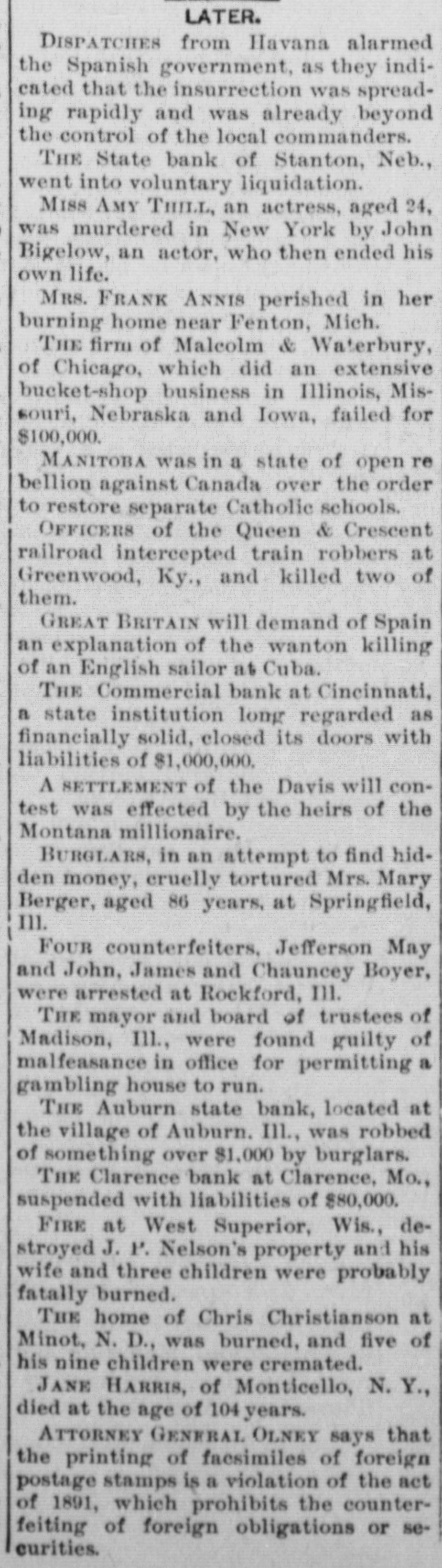
NEW YORK PASSES TRYING DAY (Continued from Page One.) issues occurred in 1873 and 1884. The last occasion on which they were used was in 1893. The clearing house certificate is practically a guarantee byal banks in the clearing house that the certificates shall be redeemed at par, but the clearing house banks are protected against loss by the fact that first class securities, either commercial -paper or stocks and bonds, are required before the certificates are issued. The certificates are used only be tween banks. They do not appear in general circulation, but by relieving the banks of the strain of large debit balances, they enable them to keep their cash reserves comparatively in. tact It is believed by competent bankers that an issue of $50,000,000 will be the outside requirement at present. It is believed also that the mere fact that they are to be issued will so far re store confidence that runs upon banks win cease, so that it will not be necessary to keep certificates outstanding for any considerable time. Already the strong city banks are receiving large deposits from persons who have withdrawn their money from institutions which have fallen under suspicion. This does not preclude the fact that considerable amounts have been put in safe deposit boxes and thereby withdrawn from circulation, but it is believed that renewed confidence will cause the return of this money to the banks within a short time Imports of Gold. Late in the afternoon a favorable light was cast upon the prospects of imports of gold by a sudden fall in foreign exchange. The market has been practically at standstill for several days with large offerings of bills and few takers This afternoon, how ever, the rate dropped to 4.85. which practically makes imports of gold possible at a profit. Leading bankers and foreign exchange houses have been looking for this development but hardly expected that it would come so soon. The tide of gold, once it sets on. the way, will undoubtedly reach a large volume, in view of the considerable amounts due this country for the outgoing crops and for securities. While the present market is one to encourage the general public to buy American securities, there are always shrewd observers in Europe who are disposed to buy at times like the present and some of them have been in the market during the past few days. It will be possible even by the process of Joans to transfer a part of the burden of carrying stocks from New York to London and Paris, but this has been tone thus far to only a limited extent The fact that the banks and the stock exchanges will be open for business but two hours tomorrow and that Sunday with all its opportunities of calming public sentiment will intervene, added to the more hopeful view taken by leading financiers tonight will do much toward clearing the financial skies before next week. At a meeting of the directors of the Lincoln Trust Company tonight, Louis Stern, a director, was authorized to make the following statement: (The directors of the Lincoln Trust Company are justified in stating that the company is in a position to meet every demand that may be made upon it and that the company is In a strong. et position tonight than any day this week. Furthermore, the withdrawal of funds has been less day by day At a meeting late today the direc. tors, of the Knickerbocker Trust Com. pany appointed a committee to take steps to bring about a resumption of business The committee later announced that an agreement providing for the deposit of claims of depositors and of shares of stock of the company was being prepared The committee will meat Monday to pass on this agreement Run Continues Baltimore. Oct. 25. The run on the East Branch of the Home Bank, continued today and shortly before noon, the depositors who were in line waiting for their money were notified that the bank would take advantage of a chare ter provision which permits the institution to demand sixty days notice of a positor's intention to withdraw his or her account A member of the firm of Bernstein, Cohen and Company, owners of the bank, today admitted that the run has been of much larger proportions than had been reported. Runs on Pawtucket Banks. Pawtucket R. I. Oct. -Follow ing the posting of the ninety day notice to depositors by the local branch of the New England Trust Company, of Providence runs were started today on all banks in Pawtucket. With the exception of the New England Trust Company all the banks met the demand without difficulty GOVERNOR APPEALED TO. A Legal Holiday to Relieve Financial Situation Asked For. Albany, N. Y., Oct. 25 -Governor Hughes today received a number of telegrams suggesting that he proclaim a legal holiday during which the financial situation might be relieved. The Governor acknowledged the receipt of all of these messages without indicat ing his intentions. He would not dis. cuss the question tonight, but there is a good reason to believe there is no immediate probability of his taking this step. COMPTROLLER OF CURRENCY GIVES OUT A STATEMENT. Washington, Oct. 25.- The following statement was given out today by the Comptroller's office: The First National Bank of Brook lyn. N. Y., closed its doors this afternoon and National Bank Examiner George T. Cutts has taken charge by order of the Comptroller of the Currency. The First National Bank cleared for the Williamsburg Trust Com pany and the Jenkins Trust Company of Brooklyn, both of which failed to. day The National Bank was closed to protect its depositors against the checks of the Trust Companies, which might be presented through the Clear ing House.


Article from New-York Tribune, October 28, 1907

Click image to open full size in new tab

Article Text

any other institution for the time," he said. "All of the other members of the Clearing House received the same instruction regarding the banks for whom they were clearing That order left us without means of getting cash. We have as good securities as any other bank in the country, but when we were unable to get money upon them we had no alternative but to close our doors. The Clearing House is doing everything that it can to improve the present situation, and as soon as this flurry is over I suppose it will rescind its order regarding clearing. Of course only a certain number of banks can be members of the Clearing House, and the other banks have to clear through them. "The state accountants are still going over our books, and they will not report probably until Tuesday or later. Our bank is entirely sound. The rumor that politicians have had preferences shown them by us is entirely unfounded. As for the International Trust Company, we had never gone into that concern. The action was only proposed, but was not carried out, and now will not be." The Jenkins Trust Company, the First National Bank. the Terminal Bank, the Williamsburg Trust Company and its branches, generally known as the "Jenkins banks," it was generally understood yesterday would reopen on Tuesday. The federal and state examiners, according to the directors, have found the institutions solvent and in a position to continue doing business as soon as the ready cash was obtained. President John G. Jenkins, jr., said yesterday he did not propose to open the Williamsburg Trust Company's offices until he was satisfied he could do SO without closing his doors again. He said that his bank would never have been compelled to close up had it not been for the run which used up all the available cash. A movement is on foot, according to Jullan D. Fairchild, president of the Kings County Trust Company, to bring the banks and the trust companies closer together. "We do not need a clearing house in Brooklyn, as has been suggested," he said yesterday. "We want only one such institution. What we do want is a closer connection between the banks and the trust companies. The trust companies should go into the clearing house, either as regular or as associate members. The trust companies, like the banks, should make weekly reports concerning themselves. That would give people a reliable understanding of the banking situation of the city's institutions. The trust companies have as much. if not more, money on deposit than the banks have, and yet at present they do not take steps to keep the public informed concerning themselves. This crisis may result in bringing them into closer relation with the banks. I do not think that they should be compelled to keep on hand such large reserves as the banks. The banks must have 25 per cent of their deposits, but the trust companies are not required to keep more than about 12 per cent on hand. Their deposits are slower. not so liable to be paid out and their securities are better. The Clearing House and the trust companies should be able to determine upon some equitable arrangement whereby the trust companies could become members or associate members of the former."


Article from New-York Tribune, October 29, 1907

Click image to open full size in new tab

Article Text

BOROUGH BANK INQUIRY. Examiners Still Busy Finding Cause of Troubles. Bank examiners have 80 far been unable to reach the bottom of the tangled affairs of the Borough Bank. in Brooklyn, which suspended on Friday coincidently with the suspension of the International Trust Company, of Manhattan, and the Brooklyn Bank, a branch of the International Trust Company Paul Grout, of counsel for the institution, .d after R protracted meeting of the directors yesterday afternoon: "The bank examiners are still busy on our books. Until they have made a report we shall make no statement." This declaration was repeated in reply to several questions regarding a number of stories about the financial methods of the suspended institution. Howard C. Pyle, a Brooklyn real estate man, who started aspetition yesterday among the depositors, expressing their confidence in the bank's management and agreeing to leave their money on deposit for six months, said that this action was taken to forestall the possibility of the appointment of a receiver It is felt that A receivership would be distinctly against the best interests of the depositors. Of the 4,250 depositors not more than a score had signed the petition yesterday, but a meeting of the depositors has been called for 11 o'clock to-morrow morning. It will be held in The Assembly, in Pierrepont street, and at that time some action will be taken to conserve the best interests of the depositors, who represent some $2,500,000 of deposits. It was stated on the day the bank suspended that some $2,000,000 had been drawn out within a week. The Oriental Bank, of Manhattan, suddenly ceased to clear for the Borough Bank about five days before the suspension of the latter. There was a story yesterday that about $500,000 of cotlateral which the Borough Bank was supposed to have on deposit with the Oriental had been found not up to the standard and that this had something to do with the suspension. At the Oriental Bank it was said in connection with these stories: "The International Trust Company does not owe anything to the Oriental Bank and the Borough Bank has only a small loan. amply secured by satisfactory collateral. The Oriental stopped the clearing privilege of the Borough Bank because the balances of the Borough were not up to the requirements of the Oriental Bank.'' Regarding two loans, said to be of $140,000 each, said to have been made to two directors of the International Trust Company from the Borough Bank or the Oriental Bank, representatives of the latter institution said they knew nothing of such loans. William Gow, who organized the International Trust Company and owns a controlling interest in the Borough Bank, was quoted yesterday as saying that the International owed money to the Borough. He refused to go into details. Discussing the possibility of the Borough Bank being able to pay its depositors in full, one of the directors said with emphasis: "The directors will have to see that the depositors are paid. I shall insist upon it." He declared that he personally had not borrowed a dollar from the institution. An Alderman who Is running for re-election in one of the South Brooklyn districts has $10,000 tied up in the Borough Bank. This crippled him so seriously that he had to go to a savings bank yesterday to get some of his nest egg. He was allowed to take $150, and will now be able to carry on his campaign. Of the money tied up in the Borough Bank $83,000 is deposited by the city in the form of certified checks given to the city by contractors as bonds for the fulfilment of contracts. The city will be responsible for this money. Confidence was restored in financial circles in Brooklyn yesterday. The uneasiness which was plainly evident on Saturday had been replaced by assurance that the Brooklyn banking institutions were perfectly sound and that it was the part of folly to withdraw money on deposit in them. It was said to be almost certain that the First National Bank of Brooklyn, the Williamsburg Trust Company and the Jenkins Trust Company would reopen within a few days, or as soon as the bank examiners had made their report. In a majority of the institutions the receipts in cash for the day were far ahead of those taken out by depositors. There was only one institution which had a line at the paying teller's window worthy of notice at the opening of banking hours. This was the Home Trust Company. But by noon the officials of the trust company had established connections with Manhattan Institutions, which gave it more resources than it needed. In the morning the depos-


Article from The Spanish Fork Press, October 31, 1907

Click image to open full size in new tab

Article Text

NEW YORK'S BLACK FRIDAY. Several Trust Companies and One National Bank Suspend. New York.-Friday was another nerve-wrecking day, but the financial institutions of New York have shown extraordinary power of resistance to the pressure put upon them. While it is true that several minor institutions have been forced to close their doors, yet two things should be said about them. First, that the amount involved was not so great as to exert any marked influence on the general situation, as these banks were located in residential quarters and did not come into touch with the larger financial institutions of the metropolis; and, second, there is every reason to believe that these banks and trust companies are entirely solvent, and their difficulties will prove to be only temporary. The institutions which closed their doors on Friday, with the sums due depositors, were: The United States Exchange bank, Harlem, $600,000; International Trust company, about $100,000; the Borough Bank of Brooklyn, $4,000,000; the Brooklyn bank, $1,300,000; Williamsburg Trust company, Brooklyn, $7,500,000, and the First National bank of Brooklyn, $3,600,000.


Article from The Washington Herald, November 17, 1907

Click image to open full size in new tab

Article Text

BANKING FRAUDS UNEARTHED Examination Discloses Irregularity in Five Financial Concerns. Jenkins Trust Company's Books Show Overloans Amounting to $500,000. New York, Nov. 16.-Charging that the president of the Jenkins Trust Company, of Brooklyn, borrowed illegally $557,000 from that institution, and that evidence of civil and criminal liability had been found in the Borough Bank of Brooklyn, as well. Attorney General Jackson startled jaded financial circles late this afternoon by obtaining temporary receivers for six suspended banks and trust companies. He announced that disclosures made by experts will be placed before the grand jury. Only two of the institutions have been inspected, but all the State institutions which have shown signs of trouble will be subjected to close scrutiny. Attorney General Jackson says: "In the Jenkins Trust Company there have been found evidences of illegal overloans. For instance, the records show overloans to the president aggregating $557,000. The banking law prohibits loans to any officer or director of more than 10 per cent of the capital stock and surplus, and also prohibits any loan to any officer or director without the approval of a majority of the trustees. The capital stock of the Jenkins Trust Company is but $550,000, and its surplus $197,000. It is claimed by the trustees that they knew nothing about these loans to the president." Temporary receivers were appointed as follows: Williamsburg Trust Company, of Brooklyn; Brooklyn Bank, Hamilton Bank, of New York: Jenkins Trust Company. of Brooklyn; Borough Bank, of Brooklyn: International Trust Company. Last Thursday Supt. Williams, of the State banking department, reported to the attorney general that the institutions were unable to meet the situation, and suggested that receivers be named at once. Jackson then appointed experts to examine the books, with to-day's result. The attorney general's statement in part follows: "Evidence of both criminal and civil liability, in the opinion of the attorney general, has been unearthed. The investigation thus far has been confined to the Bprough Bank, of Brooklyn, and the Jenkins Trust Company, of Brooklyn. "In the Borough Bank, of Brooklyn, there has been found evidence of illegal overloans, overdrafts, forged paper, and other criminal transactions, all of which will be presented to the grand jury."


Article from Alexandria Gazette, November 18, 1907

Click image to open full size in new tab

Article Text

News of the Day. Nearly 1,000 women of Mobile, A's, have petitioned the Lugislature against the enactment of a prohibition bill. Mexico has ceded Magdalena Bay, Lower California, to be used for a coaling station by the United States navy. J. E. Sherman, broker on the Consolidate Exchange, New York, today announced his suspension on that exchange. Four severe earthquake shocks were felt in Manila and surrounding provinces Saturday night and yesterday morn. ing. There was no damage. About four thousand men were laid off at the plant of the Lackawanna Steel Company at West Seneca, N. Y., Saturday. A small run on a Buffalo bank followed. In official circles in Berlin it is believed the visit of Emperor William to King Edward will result in the termination of the 10-year estrangement between Germany and Great Britain. Governor Warfield has appointed Mr. Glenn H. Worthington, of Frederick county, as chief judge of the Sixth judicial circuit of Maryland to succeed the late Chief Justice McSherry. Twenty men participated last night in a fight in front of the Mariett, an Italian theatre in Union street, Brooklyn, in which one man was killed, another fatally wounded and probably a half dozen less seriously hurt. Count Giolio Senni, of Italy, and Miss Mary Gayley, formerly of -Maryland, who met when the Count saved Miss Gayley's life in a runaway accident, were married in New York Saturday, the Count having pressed his suit four years. President Roosevelt has written a letter to Gov. Swanson inviting hin to attend a conference to be held in Washington May 13-15 of next year, to discuss measures for conserving the natural resources of the country and to preserve some of the sources of revenue and profit for the coming generations. General discussion in Wall street today followed the announcement from Washington of the government plans to releave the financial situation. Fome doubt was expressed of the success of the three per cent. treasury certificates though the strengthening tendency of the announcement was powerful in the early market operations. Cardinal Gibbons, as chancellor of the Catholic University of America, has issued a circular letter relative to the income of the institution. He expresses satisfaction with the result of last year's collection, which amounted to $100,000, but points out that, in order for the university to become what its name implies, at least $2,000,000 will be required. Justice Betts, of the New York Supreme Court, has appointed receivers for the Hamilton Bank and the International Trust Company, of Manhattan, and the Jenkins Trust Company, the Williams burg Trust Company, the Brooklyn Bank and the Borough Bank of Brooklyn, all of which were closed by the State Banking Department in the recent financial flurry. For the first time in the legal history of Georgia the writ of injunction has been used to prevent & wedding, Judge Whipple, of the Superior Court of Fitzgerald, Ga., having temporarily enjoined A. L. Reeves, a prominent young business man, from marrying Miss Tinna White, daughter of a wealthy merchant. White objects to his daughter's marriage on account of her age, sbe being only sixteen yearsold. Henry L. Saur, 8 Southern Railway employe, twenty-three years old, of Washington, was found dead in his room yesterday morning. Gas was escaping from an open jet just above his bed. Deputy Coroner Glazebrook, after an investigation, issued a certificate of death from accidental asphyxiation. Mr. Saur spent Saturday evening with his fiancee, Miss Annie whom he was to have married on Thanksgiving.


Article from New-York Tribune, November 23, 1907

Click image to open full size in new tab

Article Text

Amount of loan Frederick Kaiser, clerk $62,000 C. H. Reuter, clerk 58.000 F. C. Young, clerk 95,000 Waldo Hunter. clerk 104,000 The brokerage firm itself got $188,000 from the company, and Fred Jenkins, a son of John G. Jenkins, president of the First National Bank of Brooklyn, and brother of John G. Jenkins, jr., president of the Jenkins Trust Company, got a $50,000 loan. The Jenkinses have up as collateral security for these loans stock of the First National Bank, of the American Malt Company preferred and stock of their own brokerage company. Presumably some At least of this collateral was put up after the bank closed. The loans to the clerks were made under date of October 1, except $50,000 to Young and $50,000 to Hunter, made just before the bank closed. George A. Zabriskie, a flour merchant, cashed a check for $20,000 on the Borough Bank the day before it closed. From this incident arose the rumor that he had been "tipped off" by a friend who is also a director of the bank, and he was subpoenaed by the grand jury. As a matter of fact, Mr. Zabriskie cashed the check to meet a note for that amount which fell due at that time. After the check was deducted from his deposits he still had left on deposit in the Borough Bank nearly $20,000. Directors and stockholders of the Borough Bank held a long meeting at the Clarendon Hotel yesterday morning, and it was announced that about seventy stockholders had pledged themselves to apply their deposits to the liquidation of all the notes owed the bank, regardless of the time of maturity of the notes. A committee of five was appointed to meet the depositors to discuss plans for reopening the bank. About fourteen hundred depositors have signed the agreement to accept the deferred payment plan, and a fight will be made against the motion to make the receiver permanent. The directors of the Williamsburg Trust Company sent out a statement to the depositors yesterday saying that the state bank examiner had reported assets of $8,176,826.56 and liabilities to depositors of $6,801,361 23. with a margin over and above all liability, except to stockholders, of $714,621 30. The depositors are asked to sign an agreement providing that they may demand 10 per cent of their deposits at once, 15 per cent four months after resumption, 20 per cent after eight months 25 per cent after twelve months and the remaining 30 per cent after sixteen months, so that a receivership may be fought. The depositors of the Jenkins Trust Company, at


Article from The Salt Lake Herald, December 1, 1907

Click image to open full size in new tab

Article Text

committed suicide, having been president of both institutions. William Gow. a director in the Borough bank and the International Trust company, is charged by the temporary receivers with dominating the International company and SO controlling its financial operations as to make large sums of money. Loans Made to Clerks. Frank L. Bapst, temporary receiver of the Williamsburg Trust company, in his report says that the company made demard loans to the amount of approximately $222,000 to five clerks in the employ of Frank and J. G. Jenkins, jr., the stock brokerage firm. These clerks also figured in loans from the Borough bank of Brooklyn. The receiver also states that the Williamsburg company made a demand loan to C. H. Reuter for $171,500, which is not guaranteed, and for which there is held collateral of the estimated value of $73,148. A loan of $25,000 was also made by the Williamsburg company to James Hart, a son-in-law of J. G. Jenkins, sr., for which collateral is held of the estimated value of $12,400. Concerning other loans aggregating $476,000 the receiver states that collateral only to the estimated value of $275,000 is held and upon these loans there is an estimated loss of $200,000 placed by the bank examiner. Directors Had a Tip. Mr. Bapst, in his report, shows that within the four days immediately preceding the closing of the doors of the Williamsburg company, several of the company's directors withdrew practically all their deposits. Goodwin Brown, temporary receiver of the International Trust company, states in his report that the book value of the demand loans of the company is $43,750 and of this sum, $32,250 is doubtful. The receiver charges that William Gow, a director, paid $307,000 for a lease which he sold to the trust company for $457,545. The receiver states that Gow withdrew from the company $325,852 in cash on October 21, 1907, a few days before the institution suspended.


Article from New-York Tribune, December 1, 1907

Click image to open full size in new tab

Article Text

BIG SUMS DRAWN OUT. BANK RECEIVERS REPORT. Trust Company Accounts Almost at Minimum Before Suspension. Reports of the temporary receivers of the Williamsburg Trust Company and the International Trust Company were made public by Attorney General Jackson yesterday. They show that large withdrawals were made from both institutions just prior to their suspension on October 25. The array of accounts that were drawn down almost to a minimum in the International Trust Company is startling. It would appear that William Gow made some $150,000 by the transfer of the lease of No. 206 Broadway, where the company did business. Deputy Attorney General Robert J. will before District all the facts he has in to-morrow Steele Special place Attorney connection and Jerome ask with the International Trust Company, that some action be taken on them. At the same time the Kings County Grand Jury for December, take which is to be sworn in to-morrow, will up the Williamsburg Trust Company Attorney General Jackson said last night that the loan committee of the Williamsburg Trust Company might be responsible for loans amounting to $220,000, which went to five clerks in the employ of the F. & J. G. Jenkins, jr., brokerage in which this corporation, all which is held by the concern. the stock farm The of ly, way members of dollars of Jenkins borrowed thousands from the Jenkins Trust Company has already been told. It is understood that it also had large loans from the First National Bank, of Brooklyn, which is in the hands of a federal receiver. More evidence has been found to show how some of the accounts in the Borough Bank were drawn down just before its suspension. Arguments were heard yesterday by Justice Bette in Albany on an application to make the receivers of suspended Brooklyn institutions permanent. The application was strenuously opposed by counsel for the banks. All the arguments were adjourned, the Borough Bank to December 10, the International Trust Company. the Brocklyn Bank, the Williamsburg Trust Company and the Jenkins Trust Company to December 12. ORGANIZED OUT OF WIND In giving out the report of Goodwin Brown, receiver for the International Trust Company. Attorney General Jackson said it would seem as if the concern had been organized largely out of whid. "If the report of the receiver is correct," he said, "there was a falsification of the books of the Borough Bank and the Brooklyn Bank and a manipulation of their securities, in order, apparently to give the International Trust Company a surplus and capital of $1.000,000. It was organized only a few weeks before it went up, and when it closed its doors had only about ninety depositors, with deposits of between $110,000 and $120,000. The report states that R. W. Jones, jr., the former president of the Oriental Bank, had a demand loan of $32,250, which was entirely unsecured. "This indebtedness has not been adjusted," says Mr. Brown. "Mr. Jones is ill, but his attorney has promised to confer with me in reference to the matter." An interesting transaction, where William Gow, the organizer of the trust company, apparently made $150,000 is related at some length. It seems that Gow paid to the trustees of the Henderson estate for the lease of No. 206 Broadway, where the trust company did businear, $107,000 in cash and gave a mortgage for $200,000. He apparently sold the lease to the trust company for $457,545 on October 21. or four days before the suspension, receiving $257.545 55 above the mortgage. He on the same day deposited stocks and bonds with the company and drew out $325,852. CONCERNING GOW'S DEAL Concerning this transaction the report has this to say: In another part of my report 1 have called attention to Gow windrawing from the company the $325,852 50 on October 21, 1907 This covered credit he received from the transfer of the leasehold of the building No. 206 Broadway, at a total cost to the company of $457,545 55. which, however, included a mortgage for $200.000 w hich Gow gave to the Henderson trustees at the time he purchased the lease from them. a He by taking out the amount he did, realized profit of $150,000 in disposing of the lease to the company On the other hand however, is to be noted the fact that on October 21 Gow also turned over of to the company stocks and bonds of the value $150,000, so that as a result of the entire transaction if the company had a balance left of about $82,293. we are to concede the full value paid by the compass for the leasehold. and that, as pointed out in another part of my report, is extremely doubtful. In my opinion, Gow originally had no intention of transferring the lease to the company Having paid $107,000 in cash on account of the purchase price paid by him to the Henderson trustees, the the rentals exceeded the charges of operating building by substantial amount It was good investment for him. but on October 21 he evidently needed money either for his own use or to put in the Borough Bank. By turning the lease over to the company on that date at the price of $257,545.65 over and above the existing mortgage for $200,000, and also turning over to the company stocks and bonds of the stated value of $157,600. he was enabled thereby to take on the Fame day from the company's cash at the Oriental Bank the sum of $225,852.50 In support of my opinion that Gow had no inten In tion originally of transferring the lease to the ternational Trust Company, call attention to the fact that the lease itself is not dated, although it The was duly acknowledged on October 21. 1907. original lease made by the Church Corporation contained a clause that in the event of an assignment of the lease being made without their consent, the Church Corporation could then re-enter. This conContinued on second page. CONGRESS OPENS DECEMBER 2ND.


Article from Albuquerque Morning Journal, December 1, 1907

Click image to open full size in new tab

Article Text

PROBE BANN FAILURES RECEIVERS UNEARTH GROSS IRREGULARITIES Insolvent New York Trust Company Directors Obtained I Institution's Funds By Loaning To Dummy Borrowers. M [By Morning Journal Special Leased Wire.] New York. Nov. 30.-Attorney GenI eral Jackson made public today the report of the temporary receiver# of the Williamsburg Trust company, of Brooklyn, and the International Trust I company. of New York, both of which 800 recently suspended. The matter will be taken before the grand jury of ( Kings county. The president of the Williamsburg I Trust company was Frank Jenkins, BAG who, with his brothers. John G. Jen8 kins. Jr., and Fred J. Jenkins, held X a controlling interest in the Jenkins 1 Trust company. now suspended. The International Trust company was closely allied with the Borough bank of Brooklyn, the late Howard Maxwell. who committed suicide, having Miss been president of both Institutions. I William Gow. a director in the Borough bank and the International ! a Trust company. is charged by the temporary receivers with dominating o the International company, and so controlling its financial operations as 1 to make large sums of money y Frank L Rapst. temporary receiver a of the Williamsburg Trust company. in his report says that the company 18 made demand loans to the amount of 1 approximately $222,000 to five clerks a in the employ of Frank and J. G. Jen0 kins, Jr., the stock brokerage firm. g These clerks also figured in loans T from the Borough bank of Brooklyn. The receiver also states that the WIIIlamsburg company made a demand loan to C. H. Reuter for $171,500. j which is not guaranteed, and for which there is held collateral of the 1 estimated value of $73,148. A loan of t $25,000 was also made by the Will1 lamsburg company to James Hart, a I son-in-law of J. G. Jenkins. Sr., for DE which collateral is held of the estiV mated value of $12,400. Concerning * other loans aggregating $476,000. the receiver states that collateral only to e the estimated value of $275,000 is held p to and upon these loans there is an estimated loss of $200,000. placed by the t) bank examiner. n Mr. Bapst, in his report, shows that 3 within the four days immediately prebe ceding the closing of the doors of the C Williamsburg company. several of the ( company's directors withdrew practir cally all their deposits. C Goodwin Brown, temporary receiver to for the International Trust company, P states in his report that the book value of the loan company is $43.750. and of this sum $32.250 is doubtful. b The receiver charges that William a Gow. a director, paid $307.000 for a b lease which he sold to the trust comg V pany for $457,545. The receiver states that Gow withdrew from the 0 company $325,852 In cash on October 21., 1907. a few days before the insti- u


Article from Daily Arizona Silver Belt, December 1, 1907

Click image to open full size in new tab

Article Text

CROOKED BANKING ON LARGE SCALE Temporary Receivers of New York Trust Companies Make Reports NEW YORK, November 30.-Attorney General Jackson made public today the report of the temporary receivers of the Williamsburg Trust company of Brooklyn and the International Trust company of New York, both of which recently suspended. The matter will be taken before the grand jury. The president of the Williamsburg Trust company was Frank Jenkins, who, with his brothers, John G. Jenkins Jr. and Fred J. Jenkins, held a controlling interest in the Jenkins Trust company, now suspended. The International Trust company was closely allied with the Borough Bank of Brooklyn, the late Howard Maxwell, who committed suicide, having been president of both institutions. William Gow, director in the Borough bank and International Trust company, is charged by the temporary receivers with dominating the International company and so controlling its financial operations as to make large sums. Frank L. Bahst, temporary receiver of the Williamsburg Trust company, says the company made loans to the amount of approximately $222,000 to five clerks in the employ of Frank and F. J. Jenkins Jr., a stock brokerage firm. These clerks figured in loans from the Borough bank. The receiver also states that the Williamsburg company made a demand loan to C. H. Reuter for $171,500 which was not guaranteed and for which they held collateral for $73,148. A loan of $25,000 to James Hart, son-in-law of J. G. Jenkins Sr., for which collateral held is estimated at $12,400. Concerning other loans, aggregating $476,000, the receiver states that the collateral estimated at $275,000 is held upon these loans, there being an estimated loss of $200,000 placed by the bank examiner. Bahst shows that within four days preceding the closing of the Williamsburg company several directors withdrew practically all their deposits. Goodwin Brown, temporary receiver of the International Trust company, says that the book value of its demands loans is $43,450, and of this sum $32,250 is doubtful. The receiver charges that William Gow, a director, paid$307,000 for a lease which he sold to the company for $457,545. The receiver also states that Gow withdrew from the company $345,852 in eash on October 21pm fewl/days before the institution suspended.


Article from The Washington Herald, December 2, 1907

Click image to open full size in new tab

Article Text

FIND MANY ERASURES Investigators Are Probing Brooklyn Bank Affairs. COMPEL RETURN OF MONEY Receivers Will Bring Civil Action to Recover $200,000 Taken from Borough Bank After Closing Hours. More Indictments Expected to Be Returned by the Grand Jury. New York, Dec: 1.-The new grand jury in Brooklyn will take up the withdrawals that were made by insiders from the Borough Bank on the day before it suspended. It is estimated that $200,000 was taken out by the insiders and their friends after the close of banking hours on October 24. The notice of suspension was posted about 1 o'clock the next morning. Nearly all the checks that were cashed by the bank on that last day are missing, and erasures and other alterations were made in the books so as to include some of the after-hour payments in the entries for the regular course of the day's business. It is said that when the elerks appeared at the bank on the morning of the 25th they found entries by strange hands in the books. Demand Return of Money. The receivers of the Borough Bank also have started an investigation into these last moment payments, and they intend to bring civil actions to compel the return of every penny to the bank. The new grand jury will take up tomorrow also the withdrawals by directors of the Williamsburg Trust Company from that institution on the last day. It is expected that in the course of the investigation into the Borough Bank affairs by the new grand jury more indictments will be returned against at least one of the men who has already been prominently mentioned in the scandals. Since the publications of the receiver's report it has become apparent that the funds of the three Gow institutions, the Borough and Brooklyn banks, and the International Trust Company, were juggled about among themselves. Hurley Attacks Gow. Martin W. Littleton, counsel for William Gow.(the indicted Borough Bank director. issued on Saturday a statement in defense of his client, and attacked other directors of the institution, notably William S. Hurley. It was decided this afternoon at a meeting of Mr. Hurley's friends that'a statement should be issued telling the facts in the case. At the meeting of Mr. Hurley's friends at the Clarendon Hotel the statement replying to Mr. Littleton was prepared under the personal direction of Samuel S. Whitehouse, Mr. Hurley's attorney. The statement was. in part, as follows: "It is true that Mr. Hurley was abrupt in his treatment of Gow. It is true that Mr. Hurley went at Gow hammer and tongs. As a matter of unadorned fact, Mr. Hurley threatened to shoot Gow. Campbell, and Maxwell unless they made restitution to the bank. It is true that under Mr. Hurley's threats to shoot them, Gow, Campbell, and Maxwell turned over to the bank $767,000 worth of property." .


Article from The Evening World, December 4, 1907

Click image to open full size in new tab

Article Text

NEW INDICTMENTS ARE DRAWN FOR BANK WRECKERS Brooklyn Grand Jury Ready to Present More Bills in Scandal. POLITICIANS UNEASY. Men Who Expected Subpoenas Are Wondering Why They Didn't Get Them. The December Grand Jury investigathan into the wrecking of the Brooklyn banks has progressed so far that indictments have, been prepared and will be submitted "to the Court as soon as the evidence is all in. The Williamsburg Trust Company officials were on the Grand Jury rack to-day. Marshall Driggs, a director who was apposed to the control of the conqern by the Jenkins family, was called beSere the Grand Jury twice. The other witnesses were Directors Charles Jerome Edwards, J. H. Weber, J. N. Mobeidt, T. F. Jackson, R. T. Weber and Paying Teller W. A. Fields. District-Attorney Clarke has succeeded in burying his investigations under mound of secrecy that is causing a lot of uneasiness in Brooklyn financial and political circles. Certain directors of suspended banks who have not been called as witnesses before the Grand Jury are wondering why. They recall that none of those thus far indicted was called before the Grand Jury except Arthur Campbell, cashier of the Borsugh Bank, who turned State's evidenoe. Ald for Two Trust Companies. The controversy between the receive ers appointed at the instance of Attor ney-General Jackson for the bankrupt Brooklyn banks and the stockholders and depositors who are not willing to have the institutions go into permanent receiverships wages bitterly. It was announced to-day that two syndicates have been formed to aid the Williams. burg Trust Company and the Jenkins Trust Company to resume business, the former company to be advanced $1,000,000 and the latter $500,000. Stephen C. Baldwin, attorney for the three Jenkins brothers, against whom indictments have already been found, fearing his clients may be indicted on other counts, has addressed letters to Police Commissioner Bingham and Deputy O'Keeffe warning the Police De partnent not to put John G. Jenkins, Jr., through the workings of the Berfillon system if he is arrested. The report current to-day was that Indictments were expected against at least two of the Jenkins family for alleged fraudulent loans from the Williamsburg Trust Company. made through clerks. Frank Jenkins, deposed head of the Williamsburg Trust Company: John G. Jenkins, Jr., former President of the Jenkins Trust Company, and Fred Jen. kins, a director in the latter CO ern, have already been indicted for similar loans made from the Jenkins Trust Company. After their first indictments Frank and Fred Jenkins were photographed for the Rogues' Gallery and measured by the Bertillon system. John G., Jr., escaped this humiliation through a writ after surfendering in court. Mr. Baldwin has promised to surrender any member of the Jenkins family to court as soon as additional indictments are found. Sympathy for Jenkins, Sr. Two sons-in-law of John G. Jenkins,


Article from Evening Star, December 16, 1907

Click image to open full size in new tab

Article Text

TELEGRAPHIC BRIEFS. PARIS, December 16.-The civil cere mony uniting in marriage Clara Douglas Hilger of Philadelphia, a niece of James Baird, and Capt. Romer Lee of the 20th British Hussars was performed in this city Saturday. The religious ceremony will take place in the American Church Monday. KINGSTON, N. Y., December 16.-After setting aside orders granted by two other justices of the supreme court, staying further proceedings in the case of the Williamsburg Trust Company of Brooklyn. Judge Betts Saturday appointed former Supreme Court Justice Augustus Van Wyck of Brooklyn coreceiver with Frank L. Bapst of Buffalo, and made both appointments permanent.


Article from New-York Tribune, February 4, 1908

Click image to open full size in new tab

Article Text

CHANGE OF VENUE TO BROOKLYN. Albany, Feb. 3.-Supreme Court Justice Howard, of the 3d Judicial District, has granted the motion of counsel for the Williamsburg Trust Company. of Brooklyn, for a change of venue from Ulster to Kings County for the trial of the action brought for a dissolution of the institution. The matter does not involve the question of the receivership of the institution, which was made permanent several weeks ago.


Article from The Evening World, March 12, 1908

Click image to open full size in new tab

Article Text

BANKER JENKINS DIES SUDDENLY AT SON'S HOME Indicted Head of Brooklyn Financier Family Stricken by Paralysis. FOUNDER OF A BANK. Pioneer of Williamsburg Business Interests Cut off While Under a Ban. John G. Jenkins, sr., head of the Brooklyn Jenkins family of financiers, four members of which, including himself, were awaiting trial on indictments charging conspiracy and perjury, died to-day at the home of his son, John G. Jenkins, jr., Sea Cliff, L. I. Mr. Jenkins was sixty-nine years old. He contracted a severe cold two weeks ago, but had partially recovered and yesterday spent several hours in Brooklyn with his lawyers, talking about his approaching trial and the plans for resumption of business by the Jenkins Trust Company. After a hearty dinner yesterday evening he retired. At 1.30 o'clock this morning he suffered an attack of paralysis. Dr. Grant Stanley. the family physician. was summored. Mr. Jenkins suffered a second paralytic stroke at 4 o'clock. and S o'clock he died. He did not regain consciousness after his first seizure. John G. Jenkins, sr., was one of the best known men in Brooklyn. Up to the time of the panic, last fall, when the First National Bank of Williamsburg, the Williamsburg Trust Company and the Jenkins Trust Company, with all of which he was closely identified ailed. he was regarded as a leading example of the old school, safe and conservative financier. His wealth was counted in the millions.


Article from The Sun, April 28, 1908

Click image to open full size in new tab

Article Text

WILLIAMSBURG TRUST'S BACKER. The Metropolitan Trust Company to Put Up 81 ,500,000. It was announced yesterday that the Metropolitan Trust Company has agreed to put up $1,500,000 in cash to back the Williamsbrug Trust Company in its plans to resume business. A motion for the removal of the receviers of the Williamsburg Trust Company is to come up before Justice Crane in Brooklyn next Monday and it is confidently expected by the directors that it will be granted, as the bank will be ready to pay off all depositors in full. The reopening, it in said, may take place about June 1.


Article from New-York Tribune, June 2, 1908

Click image to open full size in new tab

Article Text

RECEIVERS ASK $200,000, GET $30,000. Williamsburg Trust Company Resumption Order Signed by Justice Kelly. Justice Kelly, in the Supreme Court. in Brooklyn, ordered yesterday that the Williamsburg Trust Company resume business on the morning of Monday, June 8. At the same time, he discharged the receivers. This action was taken with the approval of Clark Williams, the State Superintendent of Banking. The Williamsburg Trust Company was one of the Jenkins chain of banking institutions that went under last fall. All depositors who wish to withdraw their money may do so in full. The receivers asked $200.000, while John D. Lyons, their counsel. wanted $10,000, which was granted. Justice Kelly decided that the receivers should have $30,000; Augustus Van Wyck, receiving $20,000 and Frank L. Bapst, $10,000. An allowance of $25,000 for running expenses was made some time ago. The Metropolitan Trust Company loaned $1,500,000 to the Williamsburg Trust Company, which has a capital of $200,000, unimpaired, and a surplus of $149,000. It has on hand $1,700,000 in cash and ready assets of $1,800,000.


Article from The Sun, June 7, 1908

Click image to open full size in new tab

Article Text

Williamsburg Trust Company Reopens Tomorrow. All arrangements for the reopening of the W illiamsburg Trust Company in Brooklyn at noon to-morrow have been completed, and vesterday Receivers Van Wyck and Baptist and their counsel, John Lyons, called on Gen. Brayton Ives, the new president, and the directors, and congratulated them on the favorable outlook for the institution. Justice Kelly of the Supreme Court yesterday gave permission to the diretors to establish a branch in Broadway and Stockton street, to take the place of the branch in Myrtle avenue and Broadway, which was leased by the receivers to the Corn Exchange Bank.