12353. Nashua Savings Bank (Nashua, NH)

Bank Information

Episode Type
Run β†’ Suspension β†’ Closure
Bank Type
savings bank
Start Date
March 26, 1895
Location
Nashua, New Hampshire (42.765, -71.468)

Metadata

Model
gpt-5-mini
Short Digest
569a487632a9e3fb

Response Measures

None

Description

Multiple contemporary newspaper reports (March 26–27, 1895) describe a run of depositors on Nashua Savings Bank that forced the institution to suspend (an injunction was issued on application of the bank commissioners). Officials discussed voluntary liquidation and several reports state the bank 'will probably never resume business.' Assets were said to be tied up in western mortgages and forced sales would imperil depositors, so the run led directly to suspension and likely permanent closure.

Events (2)

1. March 26, 1895 Run
Cause
Bank Specific Adverse Info
Cause Details
Large withdrawals following reduced dividend rate, competition from Massachusetts banks, panic of '93 nervousness, and losses/tied-up western mortgage investments forced sales of securities to meet calls.
Measures
Bank borrowed $90,000 to meet withdrawals; paid over $150,000 to depositors since Jan.; then sought injunction and suspended to avoid sacrificing securities.
Newspaper Excerpt
the demand made by its depositors upon the bank for their deposits is such that the bank is unable to meet them without selling its securities at a sacrifice
Source
newspapers
2. March 26, 1895 Suspension
Cause
Bank Specific Adverse Info
Cause Details
Injunction sought because heavy depositor demands would force the bank to sell securities at a sacrifice and imperil principal; officials also discussed voluntary liquidation given adverse legislation and poor western investments.
Newspaper Excerpt
closed its doors this afternoon, an injunction having been issued against it on application of the bank commissioners
Source
newspapers

Newspaper Articles (12)

Article from The Times, March 27, 1895

Click image to open full size in new tab

Article Text

where the rate of dividends is larger. Then again, being a border bank, a considerable amount of its deposits are from non-resident depositors who came in from Massachusetts when the bank was paying a higher dividend than was paid by Massachusetts banks. The Nashua Savings Bank has in round numbers $2, 600,000 of deposits. Application for the injunction was made solely because of the run upon the bank by its depositors. The bank had already borrowed $90,000 to meet these demands. The assets of the bank, at a conservative appraisal, are more than sufficient to pay all claims. The bank was examined last September and another examination will be made by the commissioners, after which they will apply to the court for some modification of the existing order to give relief to the existing board.


Article from Wheeling Register, March 27, 1895

Click image to open full size in new tab

Article Text

CLOSED ITS DOORS. One of the Largest Banks in New Hampshire Suspends. Nashua, N. H., March 26.-The Nashua Savings Bank, the fifth largest in New Hampshire, closed its doors this afternoon, an injunction having been issued against it on application of the Bank Commissioner. Several reasons are given for this proceeding, the principal one being the large falling off in deposits, thereby compelling the bank to sell its securities to meet calls until a point was reached at which the principal of all depositors would be imperilled if the forced sale continued. Nearly $3,000,000 are involved. News of the suspension of the bank spread quickly and caused great excitement throughout the city, although among many financiers something of the sort has been anticipated for some time. This feeling extended to depositors of the bank, and since January more than $50,000 has been paid them, while notices of withdrawal for April amount to $100,000 more.


Article from Waterbury Evening Democrat, March 27, 1895

Click image to open full size in new tab

Article Text

BIG BANK FAILURE. Nashua Savings Bank (Liabilities, $3,000,000) Closes Its Doors. NASHUA, N. H., March 27. - The Nashua Savings bank, the fifth largest in New Hampshire, has closed its doors, an in junction having been issued against it on the application of the bank commissioner. Several reasons are given for this proceed ing. the principal one being the very largo falling off in deposits, thereby compelling the bank to sell its securities to meet calls until a point was reached at which the principal of all other depositors would be imperiled if the forced sale continued. Nearly $3,000, 000 is involved. News of the suspension of the bank spread quickly and caused great excitement throughout the city, although among many financiers something of the sort has been anticipated for some time. This feeling extended to depositors of the bank, and since Jan 1 more than $150, 000 has been paid them. while notices of withdrawal for April amount to $100,000 more. The officials claim that they will be able to pay dollar for dollar, and it is generally believed that the assets are sufficient to pay the depositors in full if time is allowed to convert paper to the best advantage and losses do not occur.


Article from Pawtucket Tribune, March 27, 1895

Click image to open full size in new tab

Article Text

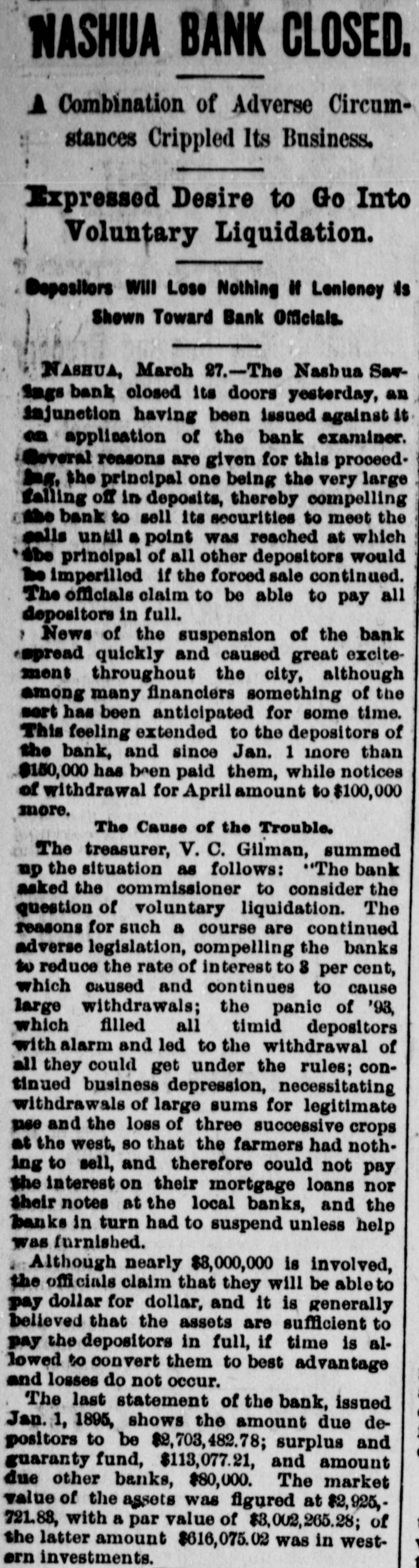
NASHUA BANK CLOSED. Combination of Adverse Circumstances Crippled Its Business. Expressed Desire to Go Into Voluntary Liquidation. Depositors Will Lose Nothing if Leniency Is Shown Toward Bank Officials. Nashua, March 27.-The Nashua SawSags bank closed its doors yesterday, an injunction having been issued against it on application of the bank examiner. Several reasons are given for this proceedmg, the principal one being the very large falling off in deposits, thereby compelling the bank to sell its securities to meet the salls until a point was reached at which the principal of all other depositors would the imperilled if the forced sale continued. The officials claim to be able to pay all depositors in full. News of the suspension of the bank spread quickly and caused great excitement throughout the city, although among many financiers something of the sort has been anticipated for some time. This feeling extended to the depositors of the bank, and since Jan. 1 inore than $150,000 has been paid them, while notices of withdrawal for April amount to $100,000 more. The Cause of the Trouble. The treasurer, V. C. Gilman, summed up the situation as follows: "The bank asked the commissioner to consider the question of voluntary liquidation. The reasons for such a course are continued adverse legislation, compelling the banks to reduce the rate of interest to 3 per cent, which caused and continues to cause large withdrawals; the panic of '93, which filled all timid depositors with alarm and led to the withdrawal of all they could get under the rules; continued business depression, necessitating withdrawals of large sums for legitimate use and the loss of three successive crops at the west, so that the farmers had nothing to sell, and therefore could not pay the interest on their mortgage loans nor their notes at the local banks, and the banks in turn had to suspend unless help was furnished. Although nearly $8,000,000 is involved, the officials claim that they will be ableto pay dollar for dollar, and it is generally believed that the assets are sufficient to pay the depositors in full, if time is allowed to convert them to best advantage and losses do not occur. The last statement of the bank, issued Jan. 1, 1895, shows the amount due depositors to be $2,703,482.78; surplus and guaranty fund, $113,077.21, and amount due other banks, $80,000. The market value of the assets was figured at $2,925,721.88, with a par value of $3,002,265.28; of the latter amount $616,075.02 was in western investments.


Article from The Jersey City News, March 27, 1895

Click image to open full size in new tab

Article Text

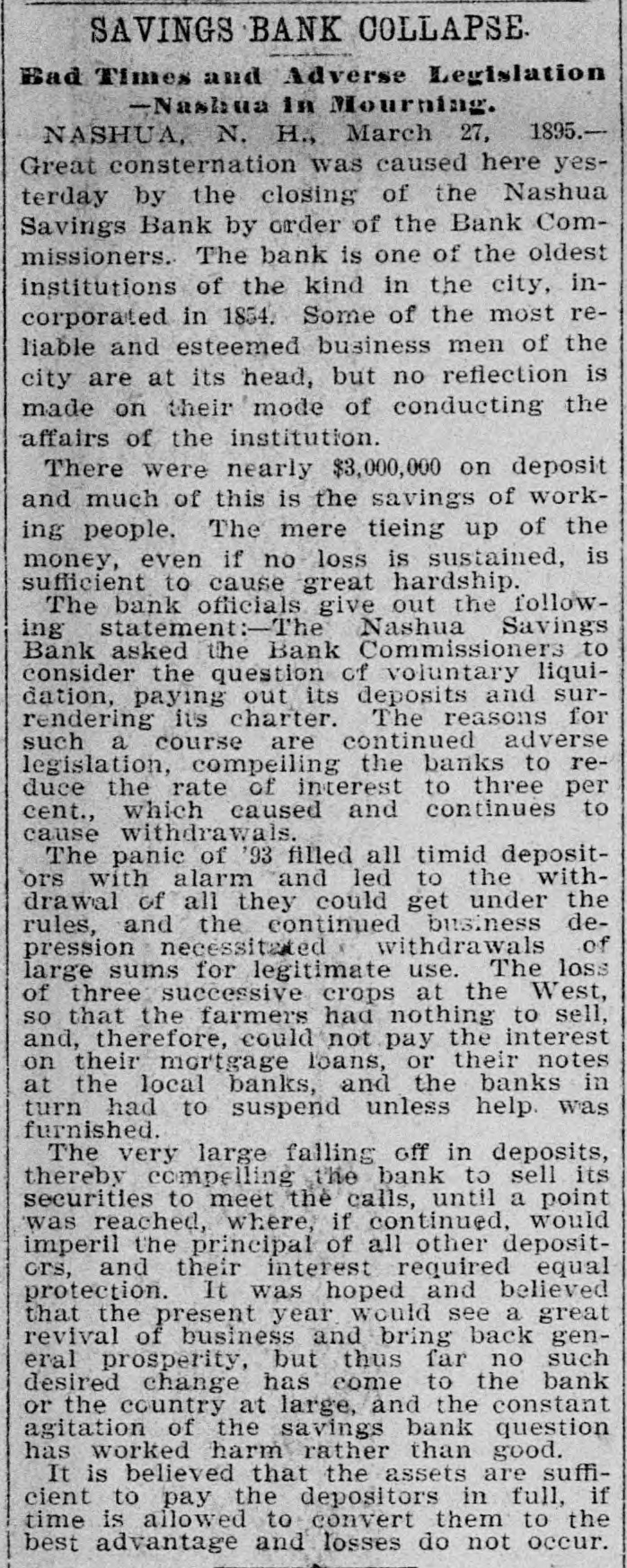
SAVINGS BANK COLLAPSE. Bad Times and Adverse Legislation -Nashua in Mourning. NASHUA, N. H., March 27, 1895.Great consternation was caused here yesterday by the closing of the Nashua Savings Bank by order of the Bank Commissioners. The bank is one of the oldest institutions of the kind in the city, incorporated in 1854. Some of the most reliable and esteemed business men of the city are at its head, but no reflection is made on their mode of conducting the affairs of the institution. There were nearly $3,000,000 on deposit and much of this is the savings of working people. The mere tieing up of the money, even if no loss is sustained, is sufficient to cause great hardship. The bank officials give out the following statement:-The Nashua Savings Bank asked the Bank Commissioners to consider the question of voluntary liquidation, paying out its deposits and surrendering its charter. The reasons for such a course are continued adverse legislation, compeiling the banks to reduce the rate of interest to three per cent., which caused and continues to cause withdrawals. The panic of '93 filled all timid depositors with alarm and led to the withdrawal of all they could get under the rules, and the continued business depression necessitated withdrawals of large sums for legitimate use. The loss of three successive crops at the West, SO that the farmers had nothing to sell, and, therefore, could not pay the interest on their mortgage loans, or their notes at the local banks, and the banks in turn had to suspend unless help. was furnished. The very large falling off in deposits, thereby compelling the bank to sell its securities to meet the calls, until a point was reached, where, if continued, would imperil the principal of all other depositors, and their interest required equal protection. It was hoped and believed that the present year would see a great revival of business and bring back general prosperity, but thus far no such desired change has come to the bank or the country at large, and the constant agitation of the savings bank question has worked harm rather than good. It is believed that the assets are sufficient to pay the depositors in full, if time is allowed to convert them to the best advantage and losses do not occur.


Article from The Roanoke Times, March 27, 1895

Click image to open full size in new tab

Article Text

Nashua Savings Bank Suspends. NASHUA, N.H., March 26.-TheNashua Savings Bank, the fifth largest in New Hampshire, closed its doors this afternoon, an injunction having been issued against it on application of the bank commission. It is generally believed that the assets are sufficient to pay the depositors in full, if time is allowed to convert them to best advantage and losses do not incur.


Article from The Morning News, March 27, 1895

Click image to open full size in new tab

Article Text

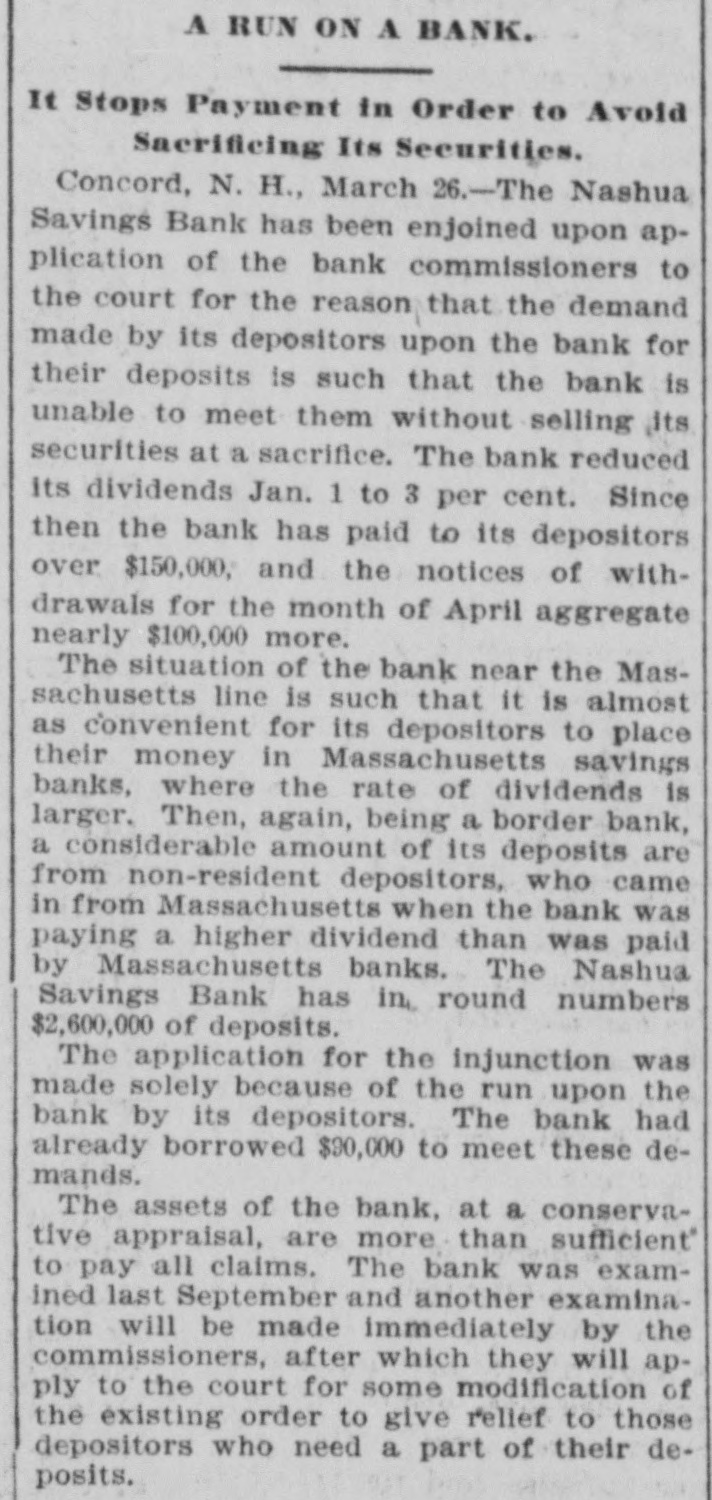
A RUN ON A BANK. It Stops Payment in Order to Avoid Sacrificing Its Securities. Concord, N. H., March 26.-The Nashua Savings Bank has been enjoined upon application of the bank commissioners to the court for the reason that the demand made by its depositors upon the bank for their deposits is such that the bank is unable to meet them without selling its securities at a sacrifice. The bank reduced its dividends Jan. 1 to 3 per cent. Since then the bank has paid to its depositors over $150,000, and the notices of withdrawals for the month of April aggregate nearly $100,000 more. The situation of the bank near the Massachusetts line is such that it is almost as convenient for its depositors to place their money in Massachusetts savings banks, where the rate of dividends is larger. Then, again, being a border bank, a considerable amount of its deposits are from non-resident depositors, who came in from Massachusetts when the bank was paying a higher dividend than was paid by Massachusetts banks. The Nashua Savings Bank has in round numbers $2,600,000 of deposits. The application for the injunction was made solely because of the run upon the bank by its depositors. The bank had already borrowed $90,000 to meet these demands. The assets of the bank, at a conservative appraisal, are more than sufficient" to pay all claims. The bank was examined last September and another examination will be made immediately by the commissioners, after which they will apply to the court for some modification of the existing order to give relief to those depositors who need a part of their deposits.


Article from Hutchinson Gazette, March 28, 1895

Click image to open full size in new tab

Article Text

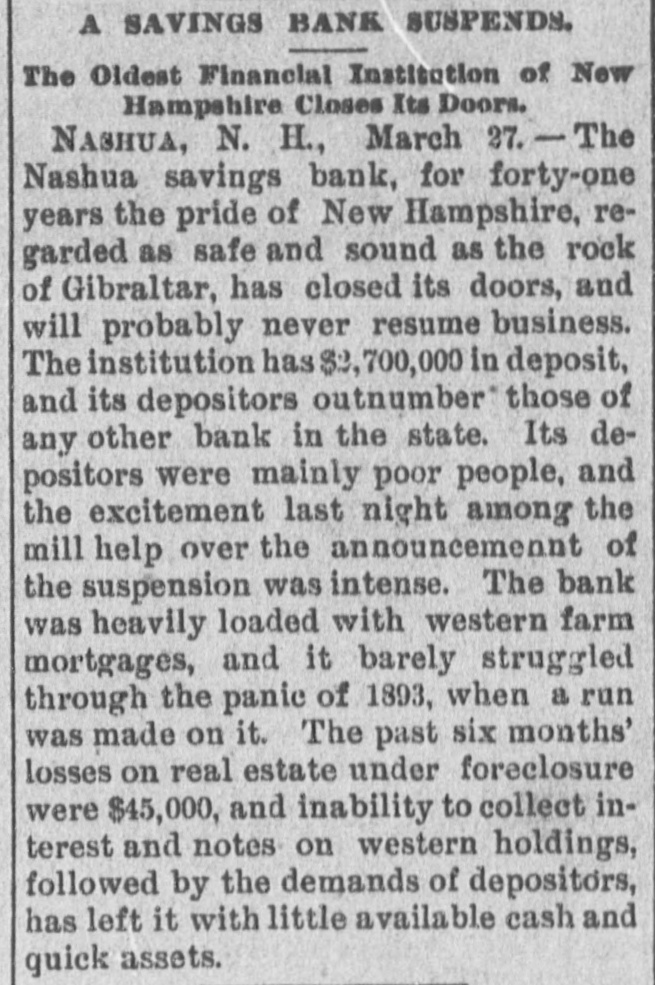
A SAVINGS BANK SUSPENDS. The Oldest Financial Institution of New Hampshire Closes Its Doors. Nashua, N. H., March 27. - The Nashua savings bank, for forty-one years the pride of New Hampshire, regarded as safe and sound as the rock of Gibraltar, has closed its doors, and will probably never resume business. The institution has $2,700,000 in deposit, and its depositors outnumber those of any other bank in the state. Its depositors were mainly poor people, and the excitement last night among the mill help over the announcemennt of the suspension was intense. The bank was heavily loaded with western farm mortgages, and it barely struggled through the panic of 1893, when a run was made on it. The past six months' losses on real estate under foreclosure were $45,000, and inability to collect interest and notes on western holdings, followed by the demands of depositors, has left it with little available cash and quick assets.


Article from The United Opinion, March 29, 1895

Click image to open full size in new tab

Article Text

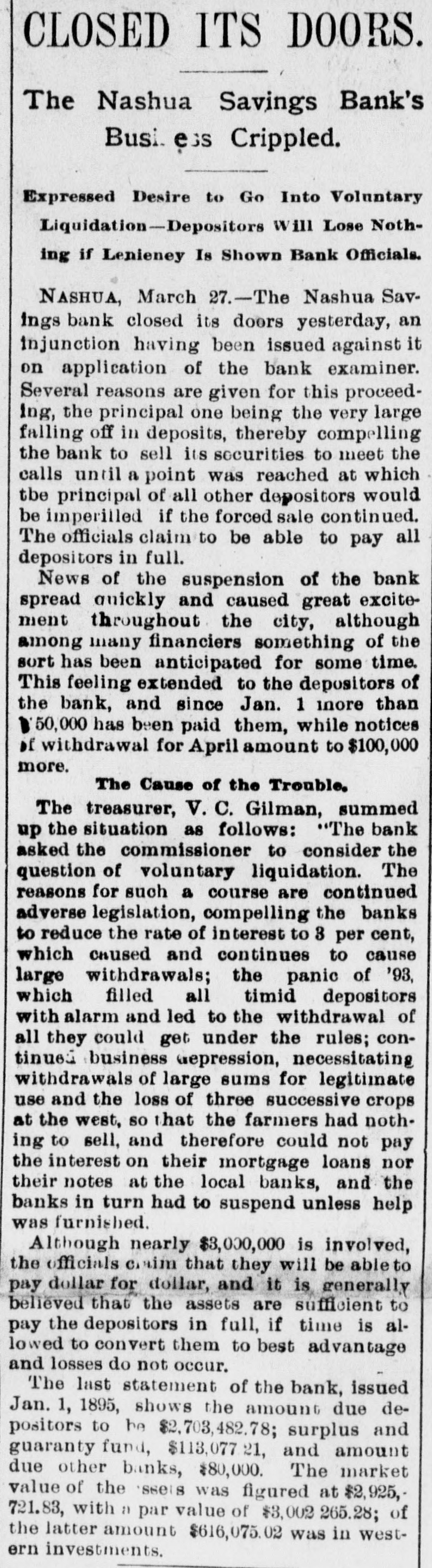
CLOSED ITS DOORS. The Nashua Savings Bank's Busi ess Crippled. Expressed Desire to Go Into Voluntary Liquidation-Depositors Will Lose Nothing if Lenieney Is Shown Bank Officials. NASHUA, March 27.-The Nashua Savings bank closed its doors yesterday, an injunction having been issued against it on application of the bank examiner. Several reasons are given for this proceedIng, the principal one being the very large falling off in deposits, thereby compelling the bank to sell its securities to meet the calls until a point was reached at which tbe principal of all other depositors would be imperilled if the forced sale continued. The officials claim to be able to pay all depositors in full. News of the suspension of the bank spread quickly and caused great excitement throughout the city, although among many financiers something of the sort has been anticipated for some time. This feeling extended to the depositors of the bank, and since Jan. 1 inore than 1 50,000 has been paid them, while notices of withdrawal for April amount to $100,000 more. The Cause of the Trouble. The treasurer, V. C. Gilman, summed up the situation as follows: "The bank asked the commissioner to consider the question of voluntary liquidation. The reasons for such a course are continued adverse legislation, compelling the banks to reduce the rate of interest to 3 per cent, which caused and continues to cause large withdrawals; the panic of '93, which filled all timid depositors with alarm and led to the withdrawal of all they could get under the rules; continued business depression, necessitating withdrawals of large sums for legitimate use and the loss of three successive crops at the west, so that the farmers had nothing to sell, and therefore could not pay the interest on their mortgage loans nor their notes at the local banks, and the banks in turn had to suspend unless help was furnished. Although nearly $3,000,000 is involved, the officials crim that they will be able to pay dollar for dollar, and it is generally believed that the assets are sufficient to pay the depositors in full, if time is allowed to convert them to best advantage and losses do not occur. The last statement of the bank, issued Jan. 1, 1895, shows the amount due depositors to be $2,703,482.78; surplus and guaranty fund, $113,077.21, and amount due other banks, $80,000. The market value of the see was figured at $2,925,721.83, with it par value of $3,002 265.28; of the latter amount $616,075.02 was in western investments,


Article from The Manning Times, April 3, 1895

Click image to open full size in new tab

Article Text

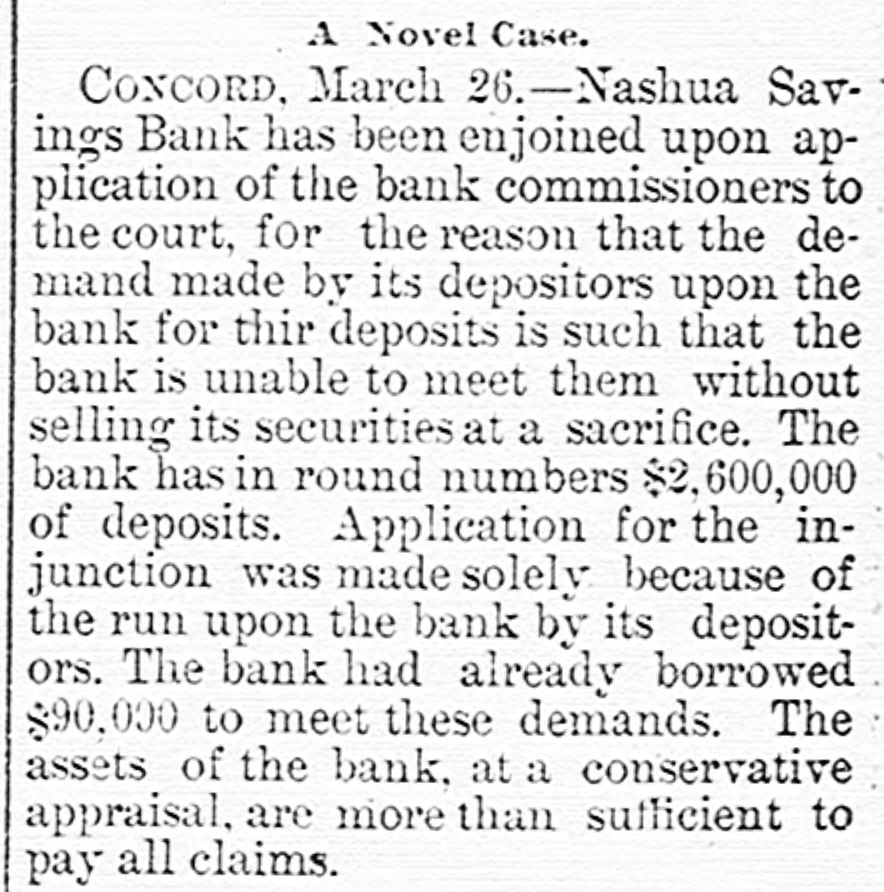
A Novel Case. CONCORD, March 26.-Nashua Savings Bank has been enjoined upon application of the bank commissioners to the court, for the reason that the demand made by its depositors upon the bank for thir deposits is such that the bank is unable to meet them without selling its securities at a sacrifice. The bank has in round numbers $2,600,000 of deposits. Application for the injunction was made solely because of the run upon the bank by its depositors. The bank had already borrowed $90,000 to meet these demands. The assets of the bank, at a conservative appraisal, are more than sufficient to pay all claims.


Article from Mineral Point Tribune, April 4, 1895

Click image to open full size in new tab

Article Text

Incendiaries caused the total deruction of Robinson & Co.'s stock arns near Decatur, Ind. Loss, $40,'00 Anthony Comstock raided Trinity aptist church in New York and arsted the organist for circulating an oscène pamphlet. George H. Schofer, general manager : the Wankesha Water company, has een appointed receiver of the comany. The Nashua Savings bank, the third rgest in New Hampshire, has closed ecause of not being able to realize , western investments. Professor James Edward Oliver, of ornell university, died at Ithaca, Y., after a long illness, aged 66 ars. Fire at West Superior, Wis., deroyed J. P.Nelson's property. His ife and three children were badly irned. Loss $20,000; no insurance. Pictures valued at $18,000 and aced on exhibition by F. Hopkinson nith were destroyed in the Milwaufre. 9 Robbers, by means of dynamite, ened a safe in the Auburn State nk at Auburn, Ill., and got away '000'T$ que Miss Amy Thill. an actress. was urdered by John Bigelow, an actor, ho then ended his own life, at her oms, in New York. The mavor and board of trustees of adison, III., have been found guilty malfeasance in office for permitting gambling-house to run. Burglars, in an effort to find hidden oney, cruelly tortured Mrs. Mary erger. aged 86 years. of Springfield, Officers of the Queen and Crescent ilroad intercepted train robbers at reenwood, Ky., and killed two of me Tudge Sanborn has issued an order r the eviction of white settlers from e Winnebago reservation, holding eir leases were never approved. Mr. Cleveland told Mr. Hesing, in a nversation regarding the next camign. that money would be the great 'ans The state department has received information regarding the imprisonent of ex-Consul Waller in Madagasa The body of Mrs. John W. Bent, e wife of a wealthy Chicagoan. was humed because it was suspected at she died of arsenical poisoning. The commission sitting in the claims American citizens against the Veneelan government has decided in the rmer's favor. The revisors of elections in St. Louis ve completed their work by elimining 11,548 names from the poll oks. Cincinnati aspires to be a market * blooded horses. and mammoth sale ables will be erected near the Oakley ek. Joseph Boyer, a miserly farmer, who ed near Sedalia, Mo., died without realing the hiding place of his ealth. Archbishop Hennessy has ordered at a Catholic church in Sioux City, wa. be closed. The members will
Article from The Abbeville Press and Banner, April 10, 1895

Click image to open full size in new tab

Article Text

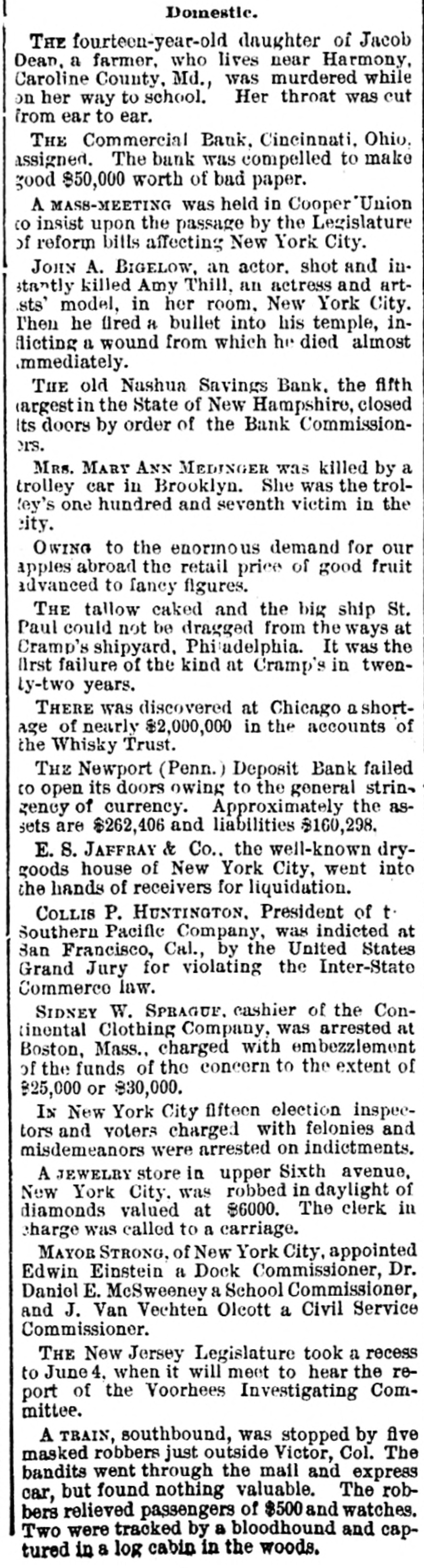
Domestic. THE fourteen-year-old daughter of Jacob Dean, a farmer, who lives near Harmony, Caroline County, Md., was murdered while on her way to school. Her throat was cut from ear to ear. THE Commercial Bank. Cincinnati, Ohio. assigned. The bank was compelled to make good $50,000 worth of bad paper. A MASS-MEETING was held in Cooper Union to insist upon the passage by the Legislature of reform bills affecting New York City. JOHN A. BIGELOW, an actor. shot and instantly killed Amy Thill, an actress and artsts' model, in her room. New York City. Then he fired a bullet into his temple, inflicting a wound from which he died almost immediately. THE old Nashua Savings Bank. the fifth (argest in the State of New Hampshire, closed Its doors by order of the Bank CommissionMS. MRS. MARY ANN MEDINGER was killed by a trolley car in Brooklyn. She was the trol!ey's one hundred and seventh victim in the city. OWING to the enormous demand for our apples abroad the retail price of good fruit advanced to fancy figures. THE tallow caked and the big ship St. Paul could not be dragged from the ways at Cramp's shipyard, Philadelphia. It was the first failure of the kind at Cramp's in twenty-two years. THERE was discovered at Chicago a shortage of nearly $2,000,000 in the accounts of the Whisky Trust. THE Newport (Penn.) Deposit Bank failed to open its doors owing to the general stringency of currency. Approximately the assets are $262,406 and liabilities $160,298. E. S. JAFFRAY & Co., the well-known drygoods house of New York City, went into the hands of receivers for liquidation. COLLIS P. HUNTINGTON. President of t. Southern Pacific Company, was indicted at San Francisco, Cal., by the United States Grand Jury for violating the Inter-State Commerce law. SIDNEY W. SPRAGUE. cashier of the Continental Clothing Company, was arrested at Boston, Mass., charged with embezzlement of the funds of the concern to the extent of $25,000 or $30,000. IN New York City flfteen election inspectors and voters charged with felonies and misdemeanors were arrested on indictments. A JEWELRY store in upper Sixth avenue, New York City. was robbed in daylight of diamonds valued at $6000. The clerk in charge was called to a carriage. MAYOR STRONG, of New York City, appointed Edwin Einstein a Dock Commissioner, Dr. Daniel E. McSweeney a School Commissioner, and J. Van Vechten Oleott a Civil Service Commissioner. THE New Jersey Legislature took a recess to June 4. when it will meet to hear the report of the Voorhees Investigating Committee. A TRAIN, southbound, was stopped by five masked robbers just outside Victor, Col. The bandits went through the mail and express car, but found nothing valuable. The robbers relieved passengers of $500 and watches. Two were tracked by a bloodhound and captured in a log cabin in the woods.