14923. Union Bank (Brooklyn, NY)

Bank Information

Episode Type
Suspension → Closure
Bank Type
state
Start Date
April 1, 1910*
Location
Brooklyn, New York (40.660, -73.951)

Metadata

Model
gpt-5-mini
Short Digest
18525fd3

Response Measures

None

Description

The articles describe the Union Bank (formerly Mechanics & Traders' Bank) having failed during the panic of 1907, being reopened, then closing again in April 1910 and later being in liquidation. Extensive investigations, indictments, and auctioning of assets are reported; there is no clear contemporaneous description of a depositor run causing suspension. Thus this is a suspension that led to permanent closure and liquidation/receivership.

Events (4)

1. April 1, 1910* Suspension
Cause
Bank Specific Adverse Info
Cause Details
Irregularities, questionable real-estate loans, alleged falsified records and insider transactions under Sullivan's regime; insolvency discovered leading to suspension.
Newspaper Excerpt
When it again closed in April, 1910, it had on deposit about $4,000,000, and not a dollar has been received by the depositors.
Source
newspapers
2. May 3, 1911 Other
Newspaper Excerpt
DIX ASKED TO AID DEPOSITORS OF THE UNION BANK ... A large delegation of depositors of the collapsed Union Bank Brooklyn ... asked aid for legislative investigation; when it again closed in April, 1910, it had on deposit about $4,000,000, and not a dollar has been received by the depositors. (hearing and investigation described).
Source
newspapers
3. June 22, 1911 Receivership
Newspaper Excerpt
For account of Superintendent of Banks, in charge of the Union Bank of Brooklyn, in liquidation ... securities were sold ... For account bank of the Mount Vernon National Bank - Oscar L. Telling, examiner in charge. ... For account of the Superintendent of Banks, in charge of the Union Bank of Brooklyn, in liquidation. (auction listing).
Source
newspapers
4. July 14, 1911 Other
Newspaper Excerpt
TELL OF UNION BANK ... Subpenas were served ... Thirty witnesses to be called ... investigation into reopening and representations that secured the permission for reopening will be a subject for minute inquiry. (investigation of past irregularities and reopening after 1908).
Source
newspapers

Newspaper Articles (15)

Article from The Evening World, May 3, 1911

Click image to open full size in new tab

Article Text

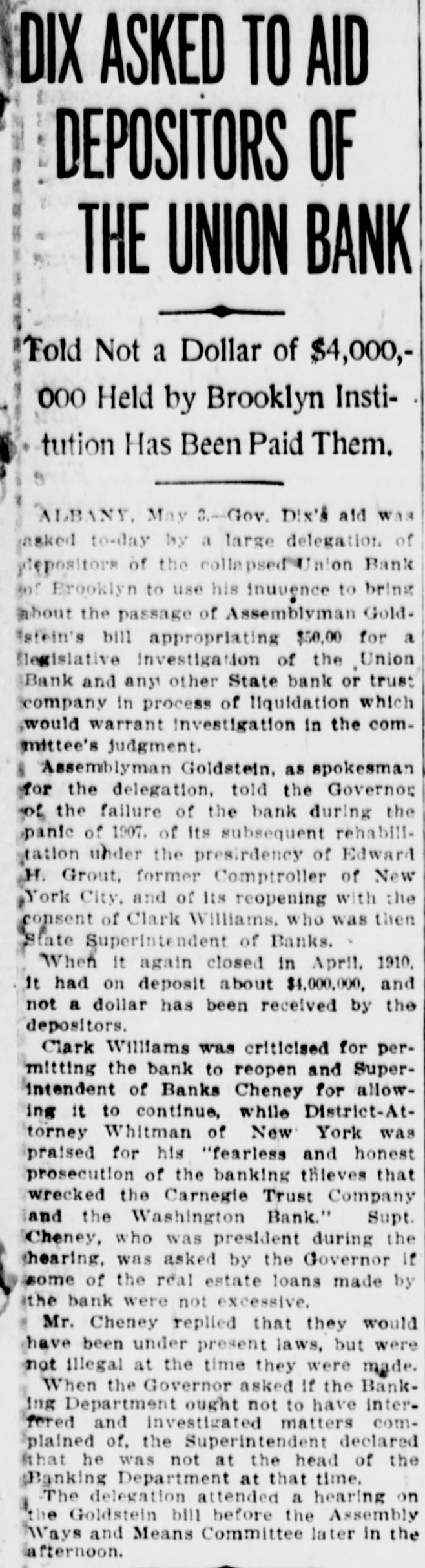
DIX ASKED TO AID DEPOSITORS OF THE UNION BANK Fold Not a Dollar of $4,000,000 Held by Brooklyn Institution Has Been Paid Them. ALBANY, May 3.-Gov. Dix's aid was asked to-day by a large delegation of depositors of the collapsed Union Bank Brooklyn to use his inuuence to bring bout the passage of Assemblyman Gold'stein's bill appropriating $50,00 for a legislative investigation of the Union Bank and any other State bank or trust company in process of liquidation which would warrant investigation in the committee's judgment. Assemblyman Goldstein, as spokesman for the delegation, told the Governor of the failure of the bank during the panic of 1907, of its subsequent rehabilltation under the presirdency of Edward H. Grout, former Comptroller of New York City, and of its reopening with the consent of Clark Williams. who was then State Superintendent of Banks. When it again closed in April, 1910. 1t had on deposit about $4,000,000, and not a dollar has been received by the depositors. Clark Williams was criticised for permitting the bank to reopen and Superintendent of Banks Cheney for allowing it to continue, while District-Attorney Whitman of New York was praised for his "fearless and honest prosecution of the banking thieves that wrecked the Carnegie Trust Company and the Washington Bank." Supt. Cheney, who was president during the thearing, was asked by the Governor if some of the real estate loans made by the bank were not excessive. Mr. Cheney replied that they would have been under present laws, but were not illegal at the time they were made. When the Governor asked If the Banking Department ought not to have interfered and investigated matters complained of, the Superintendent declared that he was not at the head of the Banking Department at that time. The delegation attended a hearing on the Goldstein bill before the Assembly Ways and Means Committee later in the afternoon.


Article from New-York Tribune, June 22, 1911

Click image to open full size in new tab

Article Text

a local New York Sub Clearing Treasury House was yesterday to the amount of $372,629. SECURITIES AT AUCTION. The following securities were sold yesterday at auction at the Exchange Salesroom by Adrian H. Muller & Son: By order of Lawrence E. Sexton. as trustee in bankruptcy of Kessler & Co. $14,000 United Brewerles Company of Chicago first mortgage 6 per cent sinking fund gold bonds. due 1928: coupons February and August 65 accrued interest to be charged For account of Superintendent of Banks, in charge of the Union Bank of Brooklyn. in Hquidation. $25,000 bond and mortgage, dated May 26, 1905, made by George Tonkonogy to Charles F. Donnelly, covering premises on the northeast side of Pitkin avenue and Osborn street. in the Borough of Brooklyn, and by Donnelly assigned to Joralemon Securities Company and assigned by Joralemon Securities Company to the $7,500 For account bank of the Mount Vernon National Bank-Oscar L. Telling. examiner in charge. 150 shares Herbert L. Brown Company $100 $3,000 H. L. Brown & Co., Inc., first mortgage 6 per cent gold bonds, due October, 1919: interest April and October: October, 1910, and $100 subsequent coupons attached By order of executors. 100 shares Standard Milling Company 51½ $1,000 preferred Crescent Athletic Club, Brooklyn, second mortgage 5 per cent bonds, due 1923; coupons May and November; accrued interest to be 65% charged $200 the Hanover Club of Brooklyn first mortgage 6 per cent bond. due July. 1920: January, 1909, $86 coupons on $100 Oxford Club of Brooklyn first mortgage 5 per cent bond. due June. 1914: coupons June and December: accrued interest to be $25 and interest charged $200 the Atlantic Yacht Club, Brooklyn, second mortgage, 5 per cent bonds, due May, 1913: coupons May and November: accrued in terest to be charged $50 and interest $1,000 City of New York 3 per cent Consolidated Stock, Washington Bridge Park, due November, 1920 tax exempt; coupons May and November accrued interest to be 0116 charged $1,000 Chamber of Commerce, City of New York, 3 per cent non-cumu lative, registered Building Fund 25 bond $1,000 Delaware & Hudson Company 4 per cent bond, due June 15. 1916: coupons June 15 and December 99% 15: accrued interest to be charged $1,000 East Tennessee, Virginia & Geor gla Railroad 5 per cent bond. due November, 1956: coupons May and November: accrued interest to be 110% charged $2,000 Scioto Valley & New England Railroad 4 per cent bonds. due November, 1989: coupons May and November: accrued interest to be 97% charged $2,000 Chicago & Erle Railroad 5 per cent bonds, due May, 1982; cou pons May and November: accrued 111% interest to be charged $2,000 Northern Pacific, Great Northern. Chicago, Burlington & Quincy Railroad 4 per cent collateral bonds, due January, 1921: cou pons January and July; accrued 97% interest to be charged $500 Adams Express Company 4 per cent collateral trust bond. due March. 1948: coupons March and September: accrued interest to be 86½ charged $1,000 Marquette, Houghton & Ontona gon Railroad 6 per cent bond. due 1925: coupons April and October: 114% accrued interest to be charged $1,000 City of New York 3½ per cent tax exempt bond- Fort Washing ton Park, due 1918; coupons May and November: accrued interest to 96 be charged $2.000 City of New York 3½ per cent tax exempt bonds, construction Rapid Transit, due 1954; coupons May and November: accrued in 88% terest to be charged $1,000 City of New York 3½ per cent tax exempt bond, East River Bridge, due 1954 coupons May and November: accrued interest 88% to be charged $1,000 City of New York 3½ per cent tax exempt bond, Repaving of Streets, due 1954 coupons May and November: accrued interest to 88% be charged $2,000 City of New York 3½ per cent tax exempt assessment bonds, due 1914; coupons May and Novem ber: accrued interest to be 98% charged $1,000 City of New York 3½ per cent tax exempt dock bond, due No vember 1. 1927: coupons May and November: accrued interest to be 9216 charged $2,000 City of New York 3½ per cent tax exempt bonds. support of in sane, 1916; coupons May and No vember: accrued interest to be 97% charged For account of whom it may concern $10.000 bond and mortgage made by Mariangiola Mennella to Joseph Rubano and Congetta R Men nella, dated January 17, 1907. due on or before February 10, 1912 covering premises known as Nos 422 and 424 East 102d street, New $100 York City $260 26 shares Stroefer Realty Company. 10 shares Commercial Trust Com106 pany of New York 25 shares First National Bank, New York 99916 $11,000 New Orleans & Great Northern Railroad Company first mortgage 5 per cent bonds, due August, 1955; interest February and Aug 73 ust: accrued interest to be charged 15 shares Long Island Loan and Trust Company 319% $2,500 Central Indiana Lighting Com pany first and refunding 5 per cent bonds, due 1927: interest May and November; accrued in terest to be charged 50 149 100 shares Broadway Trust Company

Article from New-York Tribune, July 14, 1911

Click image to open full size in new tab

Article Text

TELL OF UNION BANK Glbert Elliott and W. C. Damron Served with Subpœnas. INQUIRY STARTS MONDAY Thirty Witnesses To Be CalledDepartment Ready for Thorough Probe. Subpenas were served yesterday on GllElliott, of No. 44 Court street, Brooksert and W. C. Damron, of No. 291 Monm. street, Brooklyn, to appear before tague Tuyl, of the State on Monday, and tell they know about the affairs of the what Union Bank, of Brooklyn. Damron, closed was a director of the bank when it who known as the Mechanics and Traders' Bank. vsa and David A. Sullivan, was presihas unpaid notes in the bank to the mount dent. of $40,960. dating back to Septem17, 1908. He is also an indorser on dotes W of David A. Sullivan amounting to $150,000. Gilbert Elliott, who is a lawyer and real estate man of Brooklyn. was concerned in the Onslow & Moore Company. the Essex & Lee Company and the Camden ConstrucCompany, all of which were known as Sullivan tion companies and were, it is said, intimately connected with the bank under the Sullivan regime. Subpenas have been issued for David A. Sullivan and James T. Ashley. Ashley was vice-president of the bank under Sullivan, and when It was reorganized as the Union Bank and Edward M. Grout became its nresident, Ashley was made cashier. He was retained as one of the representatives of the State Banking Department when the bank closed for the last time in May, 1910. The Banking Department has discovered that many books and papers and leaves from ledgers have disappeared since the bank was closed. Sullivan is wanted to cell about some of the real estate operations in which he was concerned and in which the bank played a large part. nformation is especially wanted from him as to those operations that took place at about the time the bank was closed when he was at the head of it. Hearings Up to August 14. About thirty subpœnas have been issued altogether for hearings running up to August 14. Mitchell May, Assistant District Attorney of Kings County, who has been assigned to assist Asemblyman Louis Goldstein in the investigation. has secured the use of Part 6 of the Supreme Court of Kings County for the investigators. After the hearing on Monday there will be an adjournment for a week, as Assemblyman Goldstein has to be in Albany for the closing sessions of the Legislature. Mr. Goldstein will act as an assistant to the State Banking Department and W. E. Dodge, who has been in charge of the Union Bank for the State Banking Department, will preside at the hearings and represent Superintendent Van Tuyl. Beginning on July 24 It is intended to hold daily hearings until the investigation is finished. For the last ten days the State Banking Department has been making a search of the records of the office of the Attorney General in Albany, the office of the Secretary of State, the State Controller's office and the Insurance Department for evidence bearing on the closing of the bank. Evilence was sought in the office of the Secretary of State concerning the many incorporations in which Sullivan played a part and the bank was an important feature. The State Banking Department in the meantime has turned over Its records to Asemblyman Goldstein. who sought certain etters. having an important bearing on the dreumstances attending the reopening of the bank. It is this feature of the case that is exDected to receive the first attention at the public hearings. The bank was reopened by an order of the court and against the judgment of Clark Williams, who was then Superintendent of Banks. The representations that secured the permission for reopening will be a subject for minute inquiry. Mr. Goldstein and Mr. May will have a conference to-day to decide on the order in which witnesses will be called and (be general order of the inquiry. Mr. May to Co-operate. Mr. May will at that time turn over to Mr. Goldstein the large amount of information in regard to the closing of the bank that has been gathered by the District Attorney's office. Mr. May is desirous of CO-


Article from New-York Tribune, July 26, 1911

Click image to open full size in new tab

Article Text

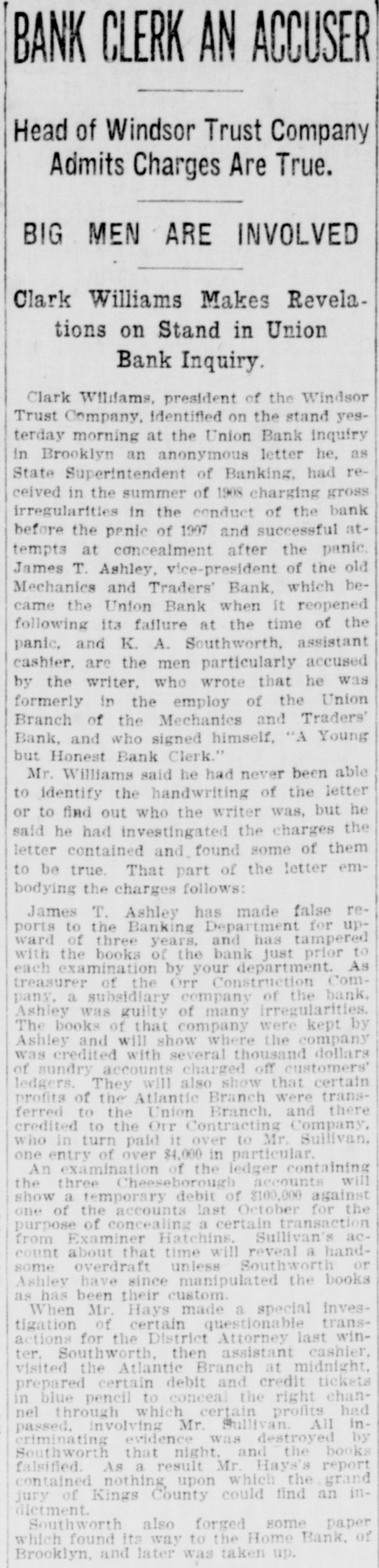
BANK CLERK AN ACCUSER Head of Windsor Trust Company Admits Charges Are True. BIG MEN ARE INVOLVED Clark Williams Makes Revelations on Stand in Union Bank Inquiry. Clark Williams, president of the Windsor Trust Company, identified on the stand yesterday morning at the Union Bank inquiry in Brooklyn an anonymous letter he, as State Superintendent of Banking, had received in the summer of 1908 charging gross irregularities in the conduct of the bank before the panic of 1907 and successful attempts at concealment after the panic. James T. Ashley, vice-president of the old Mechanics and Traders' Bank, which became the Union Bank when it reopened following its failure at the time of the panic, and K. A. Southworth, assistant cashier, are the men particularly accused by the writer, who wrote that he was formerly in the employ of the Union Branch of the Mechanics and Traders' Bank, and who signed himself, "A Young but Honest Bank Clerk." Mr. Williams said he had never been able to identify the handwriting of the letter or to find out who the writer was, but he said he had investingated the charges the letter contained and_ found some of them to be true. That part of the letter embodying the charges follows: James T. Ashley has made false reports to the Banking Department for upward of three years, and has tampered with the books of the bank just prior to each examination by your department. As treasurer of the Orr Construction Company, a subsidiary company of the bank, Ashley was guilty of many irregularities. The books of that company were kept by Ashley and will show where the company was credited with several thousand dollars of sundry accounts charged off customers' ledgers. They will also show that certain profits of the Atlantic Branch were transferred to the Union Branch, and there credited to the Orr Contracting Company, who in turn paid it over to Mr. Sullivan, one entry of over $4,000 in particular. An examination of the ledger containing the three Cheeseborough accounts will show a temporary debit of $100,000 against one of the accounts last October for the purpose of concealing a certain transaction from Examiner Hatchins. Sullivan's account about that time will reveal a handsome overdraft unless Southworth or Ashley have since manipulated the books as has been their custom. When Mr. Hays made a special investigation of certain questionable transactions for the District Attorney last winter. Southworth, then assistant cashier, visited the Atlantic Branch at midnight, prepared certain debit and credit tickets in blue pencil to conceal the right channel through which certain profits had passed, involving Mr. Sullivan. All incriminating evidence was destroyed by Southworth that night. and the books falsified. As a result Mr. Hays's report contained nothing upon which the grand jury of Kings County could find an indictment. Southworth also forged some paper which found its way to the Home Bank, of Brooklyn, and later was taken up.


Article from The Evening World, July 31, 1911

Click image to open full size in new tab

Article Text

Former Examiner Swears Offer Was Made by Relative of Receiver. HELD OUT FOR RAISE. Suspecting Plot, Says Witness in Union Inquiry, Tried to Draw Howe On. The investigation of the State Banking Department into the circumstances of the closing of the Mechanics and Traders' Bank of Brooklyn and its reopening as the Union Bank, since closed, went on at the Kings County CourtHouse to-day. William Justice Hayes, a former State bank examiner, who had talked at previous hearings regarding the offer to him of a bribe, told a different story under oath from the informal statement which he made last week. At that time he said that the only bribe offer which had been made to him was at a time when he was a Federal examiner in California. To-day he said that it was in connection with the investigation of the Jenkins Trust Company in Brooklyn says RELATIVE OF OFFICER OFFERED $50,000. "A man came to me," he said, "who was related to one of the officers of the bank, and told me that there would be $50,000 in it if I would go easy on my report." Assemblyman Goldstein, who was examining the witness, demanded the name. "Moe Howe, brother of one of the receivers," was the reply. "I thought it was part of a plot to discredit me and get me out of the department, so I pretended I meant to accept, just to see what was up. I said the amount was not enough. I asked how much money


Article from New-York Tribune, August 16, 1911

Click image to open full size in new tab

Article Text

the last few days Mr. Goldstein has associated with himself in the investigation ex-Police Commissioner James C. Cropsey. "Three important witnesses were before the grand jury yesterday. These were Mr. Cheney, Clark Williams, who was Bank Superintendent while Edward M. Grout was president of the reorganized bank. and Edward L. Dodge, the Deputy Superintendent of Banks who has charge of the Union Bank's liquidation. The next hearing of the special investigation will occur Monday. Both Edward M. Grout and his brother, Paul Grout, have volunteered to appear at a hearing and tell all they know of the affairs of the bank. Sullivan Once Lawyer. David A. Sullivan in 1902 was a lawyer, with a small office at No. 309 Broadway. That year he became a director of the newly started Stuyvesant Bank of Brooklyn and gave up his law business. He started the Atlantic Bank and got control of the Pioneer Bank, making them branches of the Stuyvesant Bank. He and his friends then bought control of the Home Bank, then the Union Bank and the People's Bank, which were at length merged under the name of the Union Bank of Brooklyn. The Méchanics and Traders' Bank closed its doors on January 30, 1908, and was reopened in August of that year under the present style of business with a capital of $1,000,000. Early in April of last year the Union Bank, whose president for more than two years was ex-Controller Edward M. Grout, suspended. Assemblyman Goldstein introduced a bill in the Assembly calling for an investigation of the bank in April of this year. In supplementary proceedings, on a judgment obtained against him by the Merchants' Exchange National Bank, Mr. Sullivan testified on May 16 that as president of the Mechanics and Traders' Bank he received a salary of $30,000 a year, but that now he had nothing. He recited that he had a frugal wife who had been able to save enough from her allowance to buy their house and an automobile. As far as he went, he said, his only spendings were for carfare and luncheons, and his only property was his watch, worth about $2. His insurance policy, he said. was made over to his wife.


Article from New-York Tribune, August 25, 1911

Click image to open full size in new tab

Article Text

# MAY HALT BANK HEARING Cropsey Would Examine Grout Himself as to Union's Affairs. There is a possibility that to-day's hearing in the Union Bank investigation, which is being conducted at the Kings County courthouse by Assemblyman Louis Gold-stein, may be adjourned if Edward M. Grout does not appear in accordance with the subpœna served upon him a couple of days ago. Ex-Police Commissioner James C. Cropsey said yesterday that he did not intend to take up the conduct of the bank during Mr. Grout's presidency until he had a chance to examine him, as he did not wish to put the lawyer on his guard. At to-day's hearing, some witnesses may be examined as to the transactions under the Sullivan regime and at the time of the suspension, If Mr. Grout does not appear.


Article from The Evening World, August 28, 1911

Click image to open full size in new tab

Article Text

# CROPSEY PLANS # TO FORCE GROUT # ON THE STAND If Ex-Comptroller Doesn't Answer Wednesday Attorney Will Go to Court. # FOREMAN GOT STUNG. Signed a $50,000 Note and Union Bank Investigators Wanted the Money. Queer banking methods during the time when David A. Sullivan was running the Mechanics & Traders' Bank were revealed at the investigation into the failure of the Union Bank before Deputy Superintendent of Banks Dodge in Brooklyn to-day. The evidence taken once more brought into the affairs of the wrecked institution the name of Heinze, but whether it was F. Augustus Heinze or some other Heinze who figured in the transaction was not revealed. James C. Cropsey, counsel to Assemblyman Goldstein, who is running the investigation, announced that on Wednesday morning, unless Edward M. Grout changes his tactics before that time, an application will be made to Justice Putnam in the Supreme Court for a body attachment for Mr. Grout. The object of the move is to force Mr. Grout to testify as to affairs in the Union Bank while he was president of the institution. Mr. Cropsey has mapped out a plan whereby he believes he can have the legality of the investigation and the power of Mr. Dodge to compel witnesses to testify settled by the courts without much delay. Randolph Hulshart was an interesting witness in to-day's proceedings. He is a building foreman and some years ago was employed by Gilbert Elliott, whom he had known for many years. "Mr. Elliott came to me one day," said Hulshart, "and asked me to sign a note in blank. He said it was to go to the Mechanics and Traders' Bank to take up a note made by one Heinze and that it was merely a matter of form and I wouldn't have to worry about it. "After the Union Bank failed I was called upon to pay a note for $50,000. That was the first I knew of the amount of the note I had signed in blank. I couldn't pay $50,000 or a considerable part of that sum. I never got a cent of value for the note." John A. Sell, President of the People's Security Company, a Sullivan concern, from 1907 to 1910, and Charles M. Smith, manager of the Atlantic branch of the Mechanics and Traders' Bank, testified to transactions which they were ordered by Sullivan to carry out. Smith said Sullivan called him on the telephone on one occasion, told him the bank examiners would be around the next morning and directed him how to make entries covering up transaction which would not have passed the scrutiny of the State Department of Banking.


Article from The Evening World, September 2, 1911

Click image to open full size in new tab

Article Text

"Union Bank depositors of a hasty habit of mind have announced in publice places that they would like to have Mr. Grout tell - his bank did with their gavings and running accounts. of course they can't find out from Mr. Grout. A depositor in a defunct bank in Brooklyn has the same individual rights as a deaf and dumb man at a political convention. "After trying in various ways to get a peep at their money, or a smell of their money. to say nothing of a feel of it. a committee of depositors got Assemblyman Goldstein to roar for them. Mr. Goldstein solicited and obtained the aid of the State Banking Department and of Mr. James Cropsey, who is said by policemen to be one of the best lawyers they ever worked under. Mr. Goldstein and Mr. Cropsey set about a.scertaining from Mr. Grout if he knew whether the $4,000,000 deposited in hi; bank is still on the job. "Now Mr. Grout has attacked the inquiry and invoked the aid of the law and Martin W. Littleton. He sets forth that Assemblyman Goldstein is not a proper person to inquire about the Union Bank depositors' money and that Mr. Cropsey's motives are open to suspicion. In the meantime the statute of limitations is working twenty-four hours a day. Brooklyn people have always been


Article from New-York Tribune, September 4, 1911

Click image to open full size in new tab

Article Text

Hon. John F. Clarke, District Attorney, Kings County, Court and Livingston streets, Brooklyn, N. Y. Dear Sir: I appeal to you to take this controversy over the Union Bank to the tribunal where it lawfully belonged from the moment charges were made-a grand jury of Kings County. If the ordinary grand jury and the County Court are engrossed by ordinary business, then there is full power to summon an extraordinary grand jury, which can devote its time exclusively to this investigation. And the Appellate Division can. if need be, appoint a special term of the Supreme Court. I am willing, as my counsel Mr. Littleton said in open court on August 30, to go before the grand jury and testify, waiving all privilege and immunity. The Banking Department is deliberately seeking to divert attention from itself. It recommended the reopening of this bank three years ago, and certified its solvency to the Supreme Court, declaring that it had nearly $2,000,000 of assets over liabilities. In doing this it rated certain assets at specified values. Now it attacks me for receiving and carrying these assets at the figures at which it turned them over to me. Stripped of details and non-essentials, this is the substance of the charge. It is not claimed that I created these assets, such as the Sullivan note for $150,000, passed by the department in five examinations, nor that I made them worthless. And of none of the allegations of forgeries, larcentes or destruction of records is it even suggested that they occurred during my presidency. And when the bank closed again this same department certified that I was not responsible for the assets which caused the closing. But the Banking Department, in the effort now to conceal its own fault in reopening the bank and in certifying its assets, has been conducting an illegal, prejudiced and unfair examination and subpœnaed me to appear before the very man who had fathered the false charges against me. The whole permanent staff of the department is to-day the same as it was three years ago, when it reopened this bank. It has had exclusive possession for a year and a half of all records of the bank and has denied me access to them. I have therefore resisted in court its illegal inquisition, and, as I have said, on the argument of the matter last Wednesdav my counsel openly demanded a proper investigation before a grand jury -the method found fully effective in Manhattan in the case of the banks which failed last January, ond the only method provided by our laws. I submit the matter to you for your wise and impartial official action. It may be that you have already concluded to follow this course. If so, I can only rejoice, and renew my offer to testify before the grand jury, where I believe that I will receive fair and just treatment. and not be made the scapegoat to cover up the shortcomings of a state department whose head has apparently identified himself with the permanent staff, and who has not yet begun the housecleaning which, it was publicly announced, the Governor directed him to do. It is not to be forgotten that this department, after the panic of 1907, reopened nine failed banks, only one of which justified the work of the department and was able to remain open. Yours truly, EDWARD M. GROUT. (Signed)


Article from The Evening World, September 6, 1911

Click image to open full size in new tab

Article Text

BANK'S RATE LOW ON LOANS TO FOLK OF THE MANAGER Woman Paid Mechanics and Traders Ten Per Cent.-Insiders Borrowed for Two. George Tonkonogy was put through a long and painful examination by Counsellor James Cropsey in the examination to-day into the failure of the Union Bank of Brooklyn, of which Edward M. Grout was president, and of its predecessor, the Mechanics and Traders' Bank, of which David A. Sullivan, now under indictment, was president. The examination was held in Brooklyn before Deputy State Banking Superintendent Dodge. Mr. Tonkonogy, a Brownsville lawyer, had a prominent and commanding position in the Atlantic avenue branch of the Mechanics and Traders' Bank. Mr. Cropsey sought to establish that friends and relatives of Tonkonogy had little difficulty in getting money from the bank at less than reasonable interest, while other customers were not eavored. Mrs. Ann Murphy, an elderly woman, testified that she borrowed $20,000 from the Mechanics and Traders Bank, through the Atlantic avenue branch, at 10 per cent. interest, and paid it back. Then Mr. Tonkonogy was sworn and admitted, under close questioning, that his brother-in-law, George Weiner, in 1905, borrowed $60,000 from the bank on his note and paid only $1,200 for the accommodation. The bank still holds the note. Mr. Tonkonogy admitted that the money was loaned to his brother-in-law at the rate of 2 per cent. per annum. Also, he admitted, his brother-in-law had been a depositor only a short time. The $60,000 was loaned to Weiner to aid him in swinging a real estate and building transaction involving $84,000. All Weiner had of his OWN when he got the loan was $3,000. Mr. Tonkonogy was then questioned about a loan by the bank to the Pioneer Construction Company in 1907, just before the panic. The Pioneer Construction Company, it was brought aut, was organized by Mr. Tonkonogy's fatherin-law, Hoertz Zuckerman, to build a synagogue in Brownsville. The synagogue was built, but did not prosper, It was abandoned and the


Article from The Salt Lake Tribune, October 12, 1911

Click image to open full size in new tab

Article Text

Charged With Falsifying Records. NEW YORK, Oct. 11.-Indictments charging misdemeanors in making false reports to the state banking department were found by the grand jury today against former City Comptroller Edward M. Grout and James T. Ashley, cashier of the suspended Union bank of BrookIsn. of which Grout was president. Both pleaded not guilty.


Article from The Barre Daily Times, October 12, 1911

Click image to open full size in new tab

Article Text

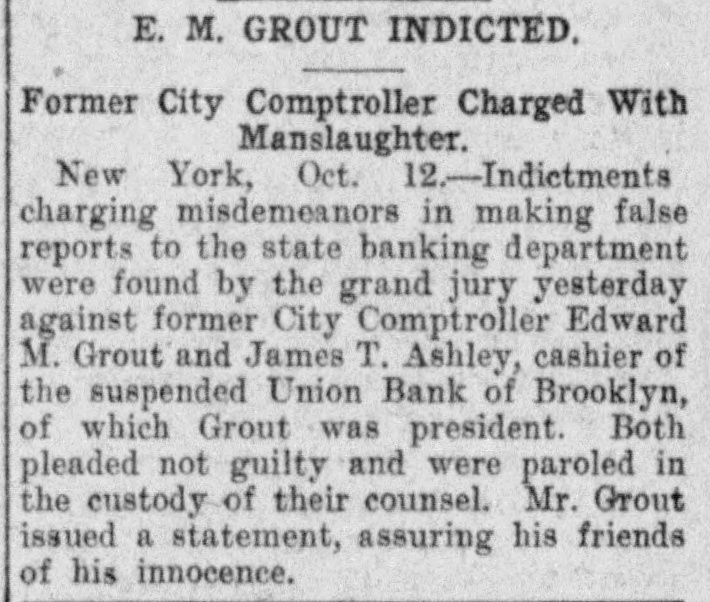
# E. M. GROUT INDICTED. Former City Comptroller Charged With Manslaughter. New York, Oct. 12.-Indictments charging misdemeanors in making false reports to the state banking department were found by the grand jury yesterday against former City Comptroller Edward M. Grout and James T. Ashley, cashier of the suspended Union Bank of Brooklyn, of which Grout was president. Both pleaded not guilty and were paroled in the custody of their counsel. Mr. Grout issued a statement, assuring his friends of his innocence.


Article from Omaha Daily Bee, October 12, 1911

Click image to open full size in new tab

Article Text

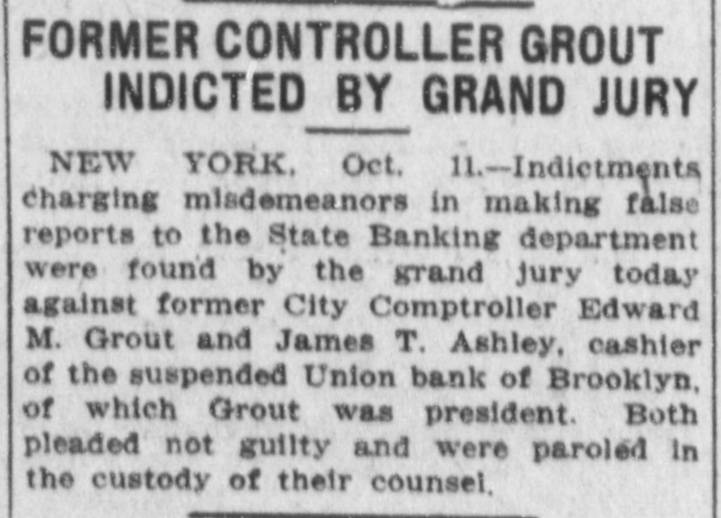
# FORMER CONTROLLER GROUT # INDICTED BY GRAND JURY NEW YORK, Oct. 11.-Indictments charging misdemeanors in making false reports to the State Banking department were found by the grand jury today against former City Comptroller Edward M. Grout and James T. Ashley, cashier of the suspended Union bank of Brooklyn, of which Grout was president. Both pleaded not guilty and were paroled in the custody of their counsel.


Article from Perth Amboy Evening News, February 3, 1912

Click image to open full size in new tab

Article Text

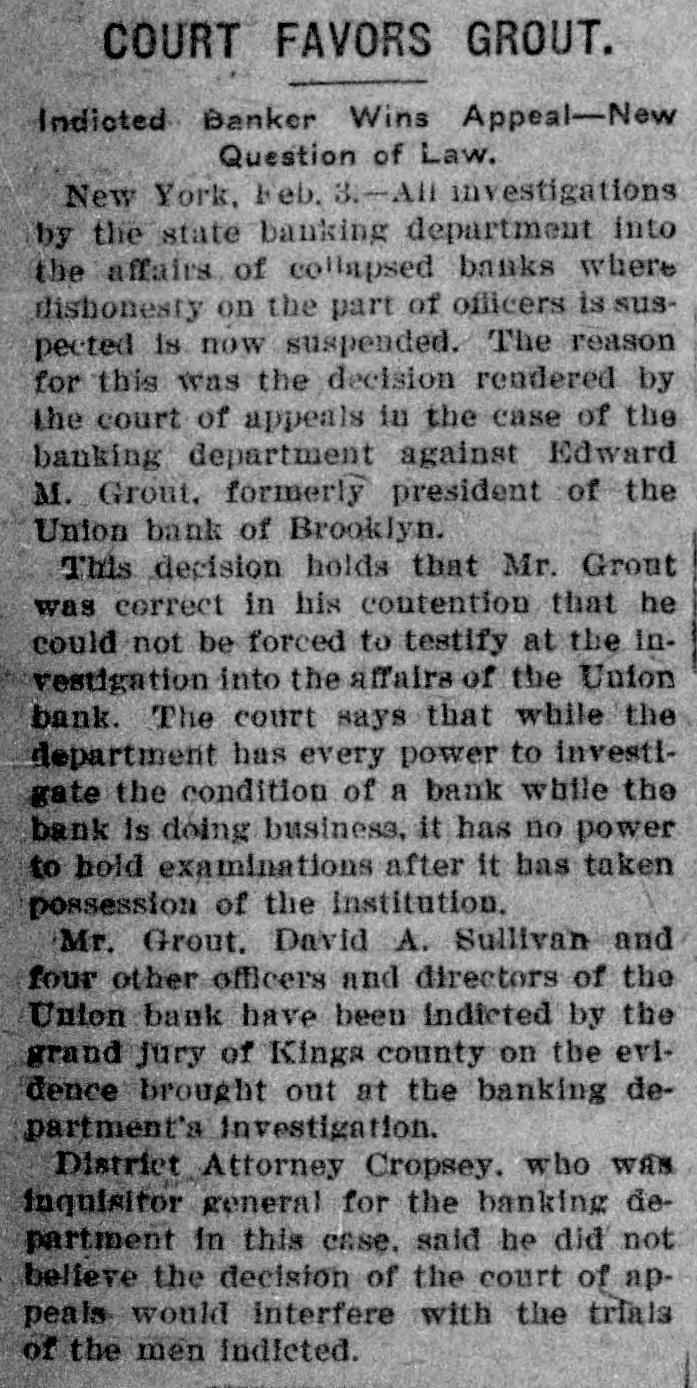
COURT FAVORS GROUT. Indicted Banker Wins Appeal-New Question of Law. New York, Feb. 3:-AH investigations by the state banking department into the affairs of collapsed banks where dishonesty on the part of officers is suspected is now suspended. The reason for this was the decision rendered by the court of appeals in the case of the banking department against Edward M. Grout, formerly president of the Union bank of Brooklyn. This decision holds that Mr. Grout was correct in his contention that he could not be forced to testify at the investigation into the affairs of the Union bank. The court says that while the department has every power to investigate the condition of a bank while the bank is doing business, it has no power to hold examinations after it has taken possession of the Institution. Mr. Grout. David A. Sullivan and four other officers and directors of the Union bank have been indicted by the grand jury of Kings county on the evidence brought out at the banking department's investigation. District Attorney Cropsey. who was inquisitor general for the banking department in this case. said he did not believe the decision of the court of appeals would interfere with the trials of the men indicted.