14882. International Trust Company (Brooklyn, NY)

Bank Information

Episode Type
Run → Suspension → Reopening
Bank Type
state
Start Date
October 25, 1907
Location
Brooklyn, New York (40.660, -73.951)

Metadata

Model
gpt-5-mini
Short Digest
5af767c4

Response Measures

Full suspension, Books examined

Other: Receivers were appointed and permanent receivers later; investigations revealed overloans, forgeries and criminality.

Description

The International Trust Company (Brooklyn) closed its doors Oct 25, 1907 after heavy withdrawals and inability to secure cash (linked to Borough Bank suspension and the 1907 panic). Temporary receivers were appointed Nov 16, 1907 and permanent receivers in December; the institution was reorganized and resumed operations (reorganization reported by mid-1908). Cause classified as local_banks because the trust's troubles were immediately tied to the suspension/withdrawals connected to the Borough Bank and related local bank runs, though later investigations revealed embezzlement/irregularities.

Events (5)

1. October 25, 1907 Run
Cause
Local Banks
Cause Details
Heavy withdrawals and inability to secure cash amid the panic; business connections with the Borough Bank which suspended, precipitating withdrawals.
Measures
Closed doors / suspended payment (no special liquidity measure reported prior to suspension)
Newspaper Excerpt
The International Trust Company, one of the small and inconspicuous trust companies, closed its doors at 10:40 o'clock this morning. This company had business connections with the Borough Bank of Brooklyn, which also suspended today.
Source
newspapers
2. October 25, 1907 Suspension
Cause
Local Banks
Cause Details
Inability to meet large withdrawals because it lacked a clearing house and had deposits/claims tied up with the Borough Bank which had suspended; liquidity shortage during the panic forced suspension.
Newspaper Excerpt
The International Trust Company with two branches ... closed its doors this morning, owing to inability to secure cash.
Source
newspapers
3. November 16, 1907 Receivership
Newspaper Excerpt
temporary receivers were appointed for the International Trust Company ... In securing today the appointment of receivers for three banks and three trust companies ... temporary receivers were named for the International Trust Company and the Hamilton Bank, of Manhattan. (Nov. 16 report).
Source
newspapers
4. December 13, 1907 Other
Newspaper Excerpt
At the close of arguments ... Justice Betts vacated ... and appointed permanent receivers for the Brooklyn Bank and the International Trust Company.
Source
newspapers
5. July 3, 1908 Other
Newspaper Excerpt
Of the Brooklyn banks which closed, the Jenkins Trust company, reorganized under the name of the Lafayette Trust company, has anticipated payments; The Borough bank and the Home bank have reopened, and the Brooklyn bank and the International Trust company have reorganized.
Source
newspapers

Newspaper Articles (21)

Article from Albuquerque Citizen, October 25, 1907

Click image to open full size in new tab

Article Text

He Believes That Finances W!ll Speedily Resume Their Normal Condition Without Loss. CONCERNS SOLVENT BUT LACK CURRENCY Heavy Deposits by Financial Men And Government Are Having Good Effect In Allaying Fears of Other Interested Parties. New York, Oct. 25.-A much calmer tone was apparent in busicircles this morning. The sucness cess of the relief measures undertaken yesterday by J. Pierpont Morgan, John D. Rockefeller and other with prominent financiers, together officials the serenity with which the of the Trust Company of America met the run of depositors gave encouragemen to business men is great generally that no further trouble to be feared. Twenty-fiv million headed dollars made up by a pool the Morgan, which went into by stock market yesterday afternoon, is believed to have given permanent relief to the brokers in need of funds to carry stock bought and sold on margins for customers. Cortelyou's Views. In an address last night at a dingiven by the Graduates club, the Sercetary ner Cortevyou referred to financial situation, saying: "We are having a trying experbut with all its embarrassience ments I find my faith in the general stability of business strengthened the examples I have seen of high the courage by and splendid devotion to public welfare shown by many men of great influence in commercial The and industrial life in this city. places have been fortified but, weak is better, those of evil influ- their what have been acourged from ence positions and a determination to this work forward will have a carry far reaching influence in restoring the public She confidence." Stood All Night. The announcement was made this Exthat the United States morning bank. a small institution in change would not open for business Harlem, The bank has little more than today. $500,000 on deposit and its suspen- effect. entirely without There sion was were lines of depositors wait- the this morning in front and of the Trust ing Company of America uptown Trust company's Lincoln office. The line at the office banking Trust Company of Ameriof the was maintained all night and declin- at ca head was a woman, who the the leave her place even when it men ed to behind promised to restore to The her in Borough the morning Bank of Brooklyn, state institution with a capital .o $3.$200,000 a and deposits of about business did not open for 000,000. Its business was not very large today. and no prominent One financiers of dts are connected connections with it. was the Knicksusprincipal erbocker Trust company, which pended business Tuesday No Session of Exchange. Pa. Oct. 25. There Pittsburg, of the stock exchange was no session having decided to today, have the the directors exchange remain closed for the Protecting present. Its Depositors. The Providence, R. I., Oct. on 25 which Union Trust run, company, did not open for there was a the usual hour. business at 9 o'clock, The following notice was posted will not open to"This company in the the stringency day, owing market to There were several money in line who wished hundred people The East Greento draw branch money of the Union Trust remained comwich of Providence also notice was closed pany this morning. A closed posted saying that it was kept for the protection of depositors Receivers Named. New York, Oct. 25 General Upon appll- Jack cation State Attorney were ap temporary receivers Knickerbocker son, today for the its pointed company, which closed its deTrust Tuesday after a run by Otto T. doors The receivers are General positors. Ernest Thalmani and York Bannard, Henry C. Ide, all of New City Small Concern. company The International Trust inconspicuous the small and at one of concerns, closed its doors business trust This company had bank connections 10:40 with the Borough toBrooklyn, which suspended Fulton of The Brooklyn bank at today Clinton streets did not open $300.and capital stock of 000 day and It has owes a about one million, five thousand dollars. hundred Resumed Payment. reThe Lincoln Trust depositors company today sumed payment to to a statement as usual Accord 29 ding last, the bank at Providence, issued June which closed $28,238,335 today, had aggregating resources included besides of $500. $3.Its liabilities surplus 000 capital stock, a of $25,465,625. 250,000 and deposits is president and J. Marsden Perry Edward Stadley first vice president of the Market institution. Slow. irreguThe stock market opened following the lar. a sharp reaction The fall in prices opening extend gains far below last night's level did not before a steadying tendency stocks were developed. not active and Dealings the general in list moved rather narrowly Deposits $8,000,000. Brook National bank of tolyn. The capital First $300,000. suspended

Article from Santa Fe New Mexican, October 25, 1907

Click image to open full size in new tab

Article Text

MANY SMALL BANKS SUSPEND However Crisis on Wall Street Has Passed INSTITUTIONS ARE SOLVENT Some Forced to Close Because of Stringency of Money Market. New York, Oct. 25.-A much calmer tone was apparent in business circles this morning. The success of the relief measures undertaken yesterday by J. Pierpont Morgan, John D. Rockefeller and other prominent financiers, together with the serenity with which the officials of the Trust Company of America met the run of its depositors gave great encouragement to bankers no and business men generally that further trouble was to be feared. The twenty-five million dollars made up by a pool headed by Morgan, which went into 'the stock market yesterday afternoon. is believed to have given permanent relief to brokers in need of finds to carry stock bought and sold on margins for customers. In an ad dress last night at a dinner given by a local club, Secretary of the Treasury Cortelyou referred to the financial sit uation, saying: Panic Not Without Good Results. "We are having a trying experience but with all its embarrassment I find my faith in the general stability of business strengthened by examples I have seen of high courage and splendid devotion to the public welfare shown by many men of great influence in the commercial and industrial life of this great city. The weak places have been fortified, but what is better. those of evil influence have been scourged from their positions and the determination to carry this work for ward will have a far reaching influence in restoring public confidence." The announcement was made this morning that the United States Exchange Bank, a small institution in Hailem, would not open for business today. The bank has little more than $500,000 on deposit and its suspension was entirely without effect. Anxious Depositors Remained in Line All Night. There were lines of depositors waiting this morning in front of the Trust of America Trust of Company Company's up-town and the banking Lincoln fice. The line at the office of the Trust Company of America was maintained all night and at its head was a woman who declined to leave her place even when men behind her had promised that they would restore that place to her in the morning. Both companies resumed the payment of depositors today. Receivers Named For Knickerbocker Trust Company. Upon application of State Attorney General Jackson a temporary receiver was appointed today for the Knicker bocker Trust Company, which closed its doors Tuesday after a run by its depositors. The receivers are Otto T. Earnest General C. Ide, Bannard, Henry Thalmann all of this and city. stock market today opened ir reaction The in opening regular. The gains. Sharp fall followed prices the did not extend far below last night's level before a steadying tendency developed. The dealings in stocks were not active and as a general list moved rather narrowly. Brooklyn Bank Suspends. a The Borough Bank of Brooklyn, state institution with a capital of $200,000 and deposits of about three million dollars, did not open for business today. Its business was not very and no are it. One connected large with prominent of financiers its pripcipal connections was the Knickerbocker Trust Company, which suspended business Tuesday. The International Trust Company, one of the small and inconspicuous trust companies, closed its doors at S 10:40 o'clock this morning. This company had business connections with the Borough Bank of Brooklyn, which also suspended today The Brooklyn Bank, at Fulton and Clinton streets, did not open for busi ness today. It has a capital stock of $300,000, and owes about $1,500,000. Suspensions Increased as Day Advanced. The First National bank of Brook lyn, with a capital of $300,000, suso pended today. It owes depositors $4,200,000. The failure of Gregory Gulick and


Article from The Fairmont West Virginian, October 25, 1907

Click image to open full size in new tab

Article Text

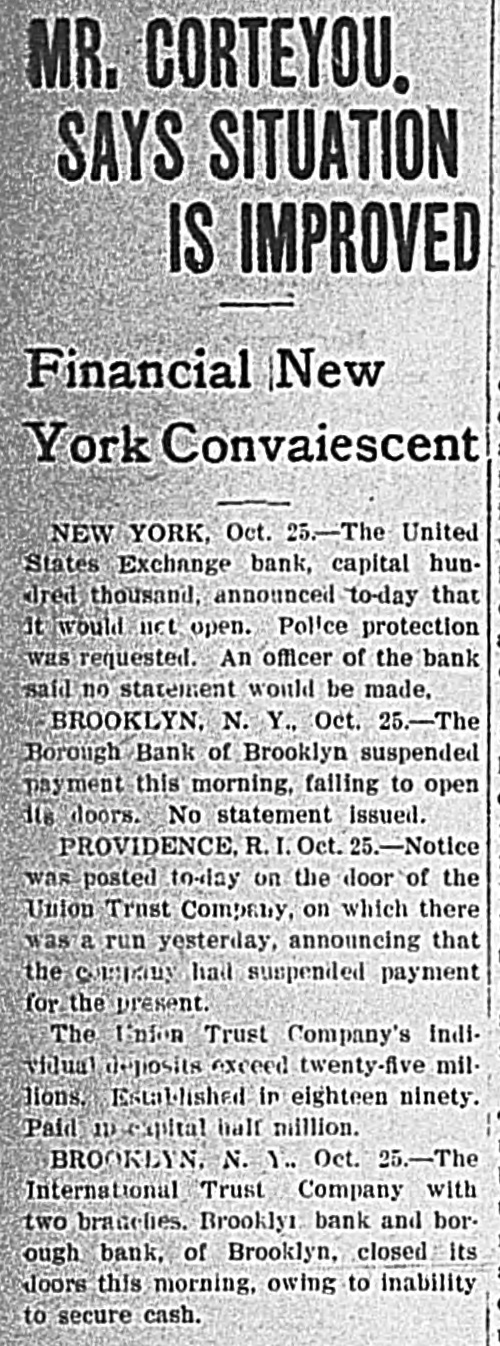
MR. CORTEYOU, SAYS SITUATION IS IMPROVED Financial New York Convaiescent NEW YORK, Oct. 25.-The United States Exchange bank, capital hundred thousand, announced to-day that dt would not open. Police protection was requested. An officer of the bank said no statement would be made, BROOKLYN, N. Y., Oct. 25.-The Borough Bank of Brooklyn suspended payment this morning, failing to open 10 doors. No statement issued. PROVIDENCE, R. I. Oct. 25.-Notice was posted to-day on the door of the Union Trust Company, on which there was a run yesterday, announcing that the cannony had suspended payment for the present. The Union Trust Company's Individual dejiosits exceed twenty-five millions. Established in eighteen ninety. Paid insecution half million. BROOKEYN. N. Y.. Oct. 25.-The International Trust Company with two branches. Brooklyn bank and borough bank, of Brooklyn, closed its doors this morning, owing to inability to secure cash.


Article from Deseret Evening News, October 25, 1907

Click image to open full size in new tab

Article Text

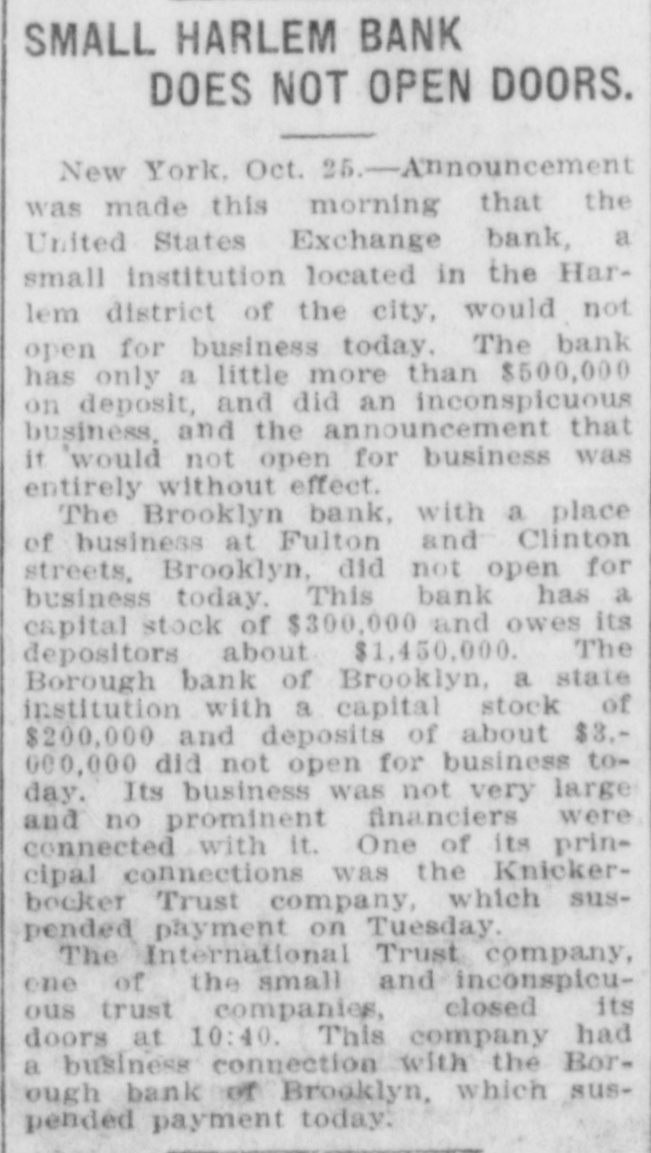
SMALL HARLEM BANK DOES NOT OPEN DOORS. New York, Oct. 25.-Announcement was made this morning that the United States Exchange bank, a small institution located in the Harlem district of the city, would not open for business today. The bank has only a little more than $500,000 on deposit, and did an inconspicuous business, and the announcement that it would not open for business was entirely without effect. The Brooklyn bank, with a place of business at Fulton and Clinton streets, Brooklyn, did not open for business today. This bank has a capital stock of $300,000 and owes its depositors about $1,450,000. The Borough bank of Brooklyn, a state institution with a capital stock of $200,000 and deposits of about $3.000,000 did not open for business today. Its business was not very large and no prominent financiers were connected with it. One of its principal connections was the Knickerbocker Trust company, which suspended payment on Tuesday. The International Trust company, one of the small and inconspicuous trust companies, closed its doors at 10:40. This company had a business connection with the Borough bank of Brooklyn, which suspended payment today:


Article from Americus Times-Recorder, October 26, 1907

Click image to open full size in new tab

Article Text

BELIEVED CRISIS HAS PASSED AT NEW YORK Though Three Large Banks Suspended Payment. NEW YORK, Oct. 25. -(Special)Two small Brooklyn financial institutions failed to open this morning, these being the International Trust Company and the Brooklyn Bank. The following banking institutions suspended payment today under the law permitting such a course: First National Bank of Brooklyn, capital $300,000, deposits $4,250,000; Williamsburg Trust Company, of Brooklyn, capital $700,000, deposits $7,500,000; Borough Bank, Brooklyn, capital $200,000, deposits $3,000,000. Notwithstanding the unfavorable incidents of the day, the general opinion among financiers is that the crisis has passed. At a conference this afternoon a pool of $10,000,000 was formed to take care of the money needs of the stock exchange. It is also understood that Morgan is ready to assist the exchange with $25,000,000 as on yesterday. Call money commanded 50 to 60 per cent today.


Article from The Washington Herald, October 26, 1907

Click image to open full size in new tab

Article Text

SHOPGIRLS T TO SUFFER Bank Failure May Rob Them of Wages To-day. NO CASH TO MEET PAY CHECKS Suspension of International Trust Company Likely to Work First Real Hardship-Several Thousand Brooklyn Factory Hands May Have to Wait for Their Money.


Article from The Washington Herald, October 26, 1907

Click image to open full size in new tab

Article Text

Claimed to Be Solvent. Officers of the trust company and of the two subsidiary banks announced that all three of the institutions were solvent and that no receivership would be asked for any constituent part of the trust company. Because the International Trust Company was a new concern, and consequently had no clearing house, inability to meet large withdrawals that were sure to fall to-day and to-morrow forced the suspension of payment, they said. The failure of these Brooklyn banks to meet week-end payments on the wage accounts of many Brooklyn manufacturies and department stores will probably bring about the first direct pinch of hardship on the laboring people that has been felt during the last troublous week. Both the Brooklyn bank and the Borough bank carried money for these firms' payrolls, amounting to between $30,000 and $100,000 a week.


Article from Daily Press, November 17, 1907

Click image to open full size in new tab

Article Text

TWO of the Suspended Institutions Found to be In Bad Shape. OVERLOANEO TO THE PRESIDENT Attorney General Jackson of New York State, Unearths Some Acts Which are Criminal and Which He Will Place Before the Grand Jury. (By Associated Press) NEW YORK, Nov. 16-In securing today the appointment of "receivers for three banks and three trust companies in New York and Brooklyn, which recently suspended payment, State Attorney General Jackson declar. ed that in the Borough Bank of Brook lyn and in the Jenkins Trust Company evidence has been found of illegal overloans and of both civil and criminal liability. In the case of the Borough Bank, Mr. Jackson stated that there is evidence also of overdrafts, forged papers and other criminal transactions, all of which will be presented to the grand jury. In the Jenkins Trust Company the attorney general declares the records show overloans to the president. John G. Jenkins, Jr., aggregating $557,000. The applications for receivers were made to Justice Betts of the Supreme Court at Kingston, N. Y., and were based upon affidavits of Clark WIIliams, superintendent of banking. Mr. Jackson said today that he will still continue to co-operate in all efforts to rehabilitate the banks now in the hands of temporary receivers. The investigation thus far has been confined to the Borough Bank of Brooklyn and the Jenkins Trust Company. Attorneys for the Brooklyn bank is. sued 3 statement this afternoon in which they declared that the Brook. lyn bank and the International Trust Company have assets of $800.000 in excess of the amount owed depositors: that they expect soon to com plete arrangements with depositors to accept certificates of deposit in part payment of their claims, and that they hope to avert a permanent receivership.


Article from Bismarck Daily Tribune, November 17, 1907

Click image to open full size in new tab

Article Text

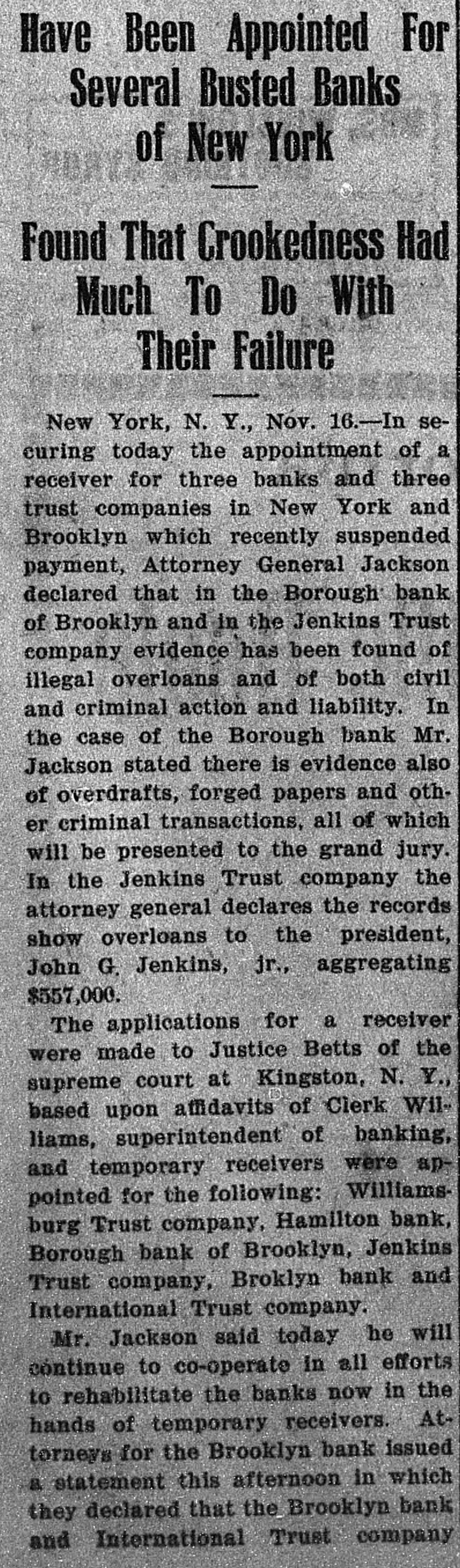
Have Been Appointed For Several Busted Banks of New York Found That Crookedness Had Much To Do With Their Failure New York, N. Y., Nov. 16.-In securing today the appointment of a receiver for three banks and three trust companies in New York and Brooklyn which recently suspended payment, Attorney General Jackson declared that in the Borough bank of Brooklyn and in the Jenkins Trust company evidence has been found of illegal overloans and of both civil and criminal action and liability. In the case of the Borough bank Mr. Jackson stated there is evidence also of overdrafts, forged papers and other criminal transactions, all of which will be presented to the grand jury. In the Jenkins Trust company the attorney general declares the records show overloans to the president, John G. Jenkins, jr., aggregating $557,000. The applications for a receiver were made to Justice Betts of the supreme court at Kingston, N. Y., based upon affidavits of Clerk Williams, superintendent of banking, and temporary receivers were appointed for the following: Williamsburg Trust company, Hamilton bank, Borough bank of Brooklyn, Jenkins Trust company, Broklyn bank and International Trust company. Mr. Jackson said today he will continue to co-operate in all efforts to rehabilitate the banks now in the hands of temporary receivers. Attorneys for the Brooklyn bank issued B. statement this afternoon in which they declared that the Brooklyn bank and International Trust company


Article from New-York Tribune, November 18, 1907

Click image to open full size in new tab

Article Text

BANKS TO GRAND JURY KINGS COUNTY ACTION. Cases of Borough Bank and Jenkins Trust Up To-day. The official announcement was made last night by Robert H. Elder. Assistant District Attorney of Kings County, that the cases of the Borough Bank and the Jenkins Trust Company would be placed before the grand jury this morning for a comprehensive investigation into the affairs of these two suspended financial institutions against which charges of irregularities have been filed by Attorney General Jackson and the State Banking Department. Clark Williams, the State Superintendent of Banks, whose department and that of the Attorney General have placed in the hands of the District Attorney evidence on which to proceed, will be the first witness before the grand jury. This investigation will extend also to the Williamsburg Trust Company and the Brooklyn Bank, and possibly to the First National Bank of Brooklyn. The first four institutions mentioned. which are all state banks, are those for which receivers were appointed on Saturday by Justice Betts at Kingston, when temporary receivers were also named for the International Trust Company and the Hamilton Bank, of Manhattan. W. H. Schofield, a federal bank examiner, has been in charge of the First National as temporary receiver ever since it closed its doors last month The examination of the evidence, which is understood to be voluminous, by the grand jury will probably take up at least the greater part of this week. Mr. Elder explained last night that the investigation into the First National Bank. as it was a federal institution. would probably be limited to the connection that it might have had with the other banks and trust companies under investigation. Mr. Elder said: "I will be ready to present to the grand jury to-morrow morning the evidence that my office has received from the Attorney General and the State Superintendent of Banks. I am not prepared to say which case I shall take up first, but the investigation will include the Williamsburg Trust Company and the Brooklyn Bank, as well as the Borough Bank and the Jenkins Trust Company. I have asked Mr. Williams to be the first witness. It is difficult to say just how long it will take to collect all the evidence, but the District Attorney's office. which began an investigation on its own account a weekago, has a mass of evidence accumulated." COMPLAINTS BY DEPOSITORS It was learned that the investigation conducted by the District Attorney was the result of complaints made to him by officials and depositors of some of the institutions. This probably explains the statement of Mr. Elder that it may not be necessary to subpoena any witnesses before the grand jury. There are likely to be numerous voluntary witnesses. The charges that will be taken up are that the Jenkins Trust Company overloaned to John G. Jenkins, jr., its president, about $550,000. while in the case of the Borough Bank the directors admit that large overloans were made to William Gow, one of the deposed directors, who, it is said. dominated the affairs of the bank. Mr. Gow is of the firm of Ward & Gow, advertising agents, and organized the International Trust Company with Howard Maxwell, who became the president and who later was forced from the presidency of the Borough Bank. The forgeries charged by the Attorney General are understood to mean the jugglery of accounts, and it was said that the bookkeeping departments of the suspected institutions would be carefully scrutinized. Further inquiry yesterday revealed that William Gow was even more deeply involved in the affairs of the Borough Bank than was first reported. Also there were made public the names of the men who were only referred to in a statement issued on Saturday night by the d! rectors of the Borough Bank as "others." The statement admitted the irregularities charged by the Attorney General, and told of restitution made by William Gow and "others." The latter. it was said, were Howard Maxwell and Arthur D. Campbell, the deposed president and cashier of the bank: John S. Jenkins and Frank W. Doolittle, secretary of William Gow. RESTITUTION EXPLAINED Samuel S. Whitehouse, who is associated with Paul Grout as counsel for the Borough Bank, explained last night the circumstances of this restitution. Some of the men mentioned, according to Mr. Whitehouse, in borrowing money from the Borough Bank were really acting for Mr. Gow, who used some of these funds in the formation of the International Trust Company and also a fire insurance company. The amount lent to Mr. Gow, either directly or indirectly, exceeded the 40 per cent of the bank's capital and surplus. the limit placed by the banking laws. This percentage was secured, although there was more than 10 per cent lent where there was no collateral to support the loan. When the general depreciation of securities came the directors called on Mr. Gow and the others for additional securities. The loans had been advanced from the middle of July to just | before the bank closed. The value of the secur| ities turned over to the bank by the five men is said to be $780,000. doubly securing the amount of the loans advanced to them. After the directors had investigated they called upon Gow. Maxwell and Campbell to tender their ressignations, which they did at once. Many of the securities recovered by the Borough Bank are in the form of deeds and mortgages on real estate in Kings, Queens and Nassau counties. An interesting transaction | between the bank and Gow was a loan to the latter of $105,000. This was secured by a sec. ond mortgage on a building in Court street owned by Gow. on which there was a first maytgage of $400,000. The building in a normal market. it was said, would not sell for more than $600,000. The bank held deeds to other properties owned by Gow. All deficiencies, Mr. Whitehouse said, had been made up. The directors of the bank agreed on Satur. day night not to discuss the affairs of the bank for publication. William S. Hurley, member of the late Rapid Transit Commission, is a director of the Borough Bank, and it was largely


Article from New-York Tribune, November 22, 1907

Click image to open full size in new tab

Article Text

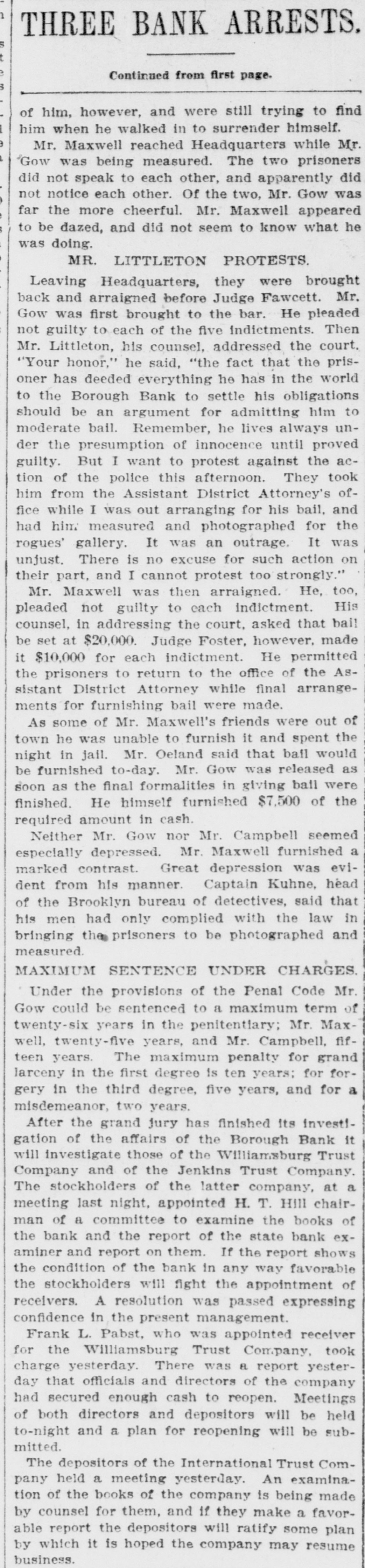
THREE BANK ARRESTS. Continued from first page. $ of him, however, and were still trying to find him when he walked in to surrender himself. I 9 Mr. Maxwell reached Headquarters while Mr. s Gow was being measured. The two prisoners did not speak to each other, and apparently did not notice each other. Of the two, Mr. Gow was far the more cheerful. Mr. Maxwell appeared to be dazed, and did not seem to know what he was doing. MR. LITTLETON PROTESTS. Leaving Headquarters, they were brought back and arraigned before Judge Fawcett. Mr. Gow was first brought to the bar. He pleaded not guilty to each of the five indictments. Then Mr. Littleton, his counsel, addressed the court. "Your honor," he said, "the fact that the prisoner has deeded everything he has in the world to the Borough Bank to settle his obligations should be an argument for admitting him to moderate bail. Remember, he lives always under the presumption of innocence until proved guilty. But I want to protest against the action of the police this afternoon. They took him from the Assistant District Attorney's office while I was out arranging for his bail, and had him measured and photographed for the rogues' gallery. It was an outrage. It was unjust. There is no excuse for such action on their part, and I cannot protest too strongly." Mr. Maxwell was then arraigned. He, too, pleaded not guilty to each indictment. His counsel, in addressing the court, asked that bail be set at $20,000. Judge Foster, however, made it $10,000 for each indictment. He permitted the prisoners to return to the office of the Assistant District Attorney while final arrangements for furnishing bail were made. As some of Mr. Maxwell's friends were out of town he was unable to furnish it and spent the night in jail. Mr. Oeland said that bail would be furnished to-day. Mr. Gow was released as soon as the final formalities in giving ball were finished. He himself furnished $7,500 of the required amount in cash. Neither Mr. Gow nor Mr. Campbell seemed especially depressed. Mr. Maxwell furnished a marked contrast. Great depression was evident from his manner. Captain Kuhne, head of the Brooklyn bureau of detectives, said that his men had only complied with the law in bringing the prisoners to be photographed and measured MAXIMUM SENTENCE UNDER CHARGES Under the provisions of the Penal Code Mr. Gow could be sentenced to a maximum term of twenty-six years in the penitentlary; Mr. Maxwell, twenty-five years, and Mr. Campbell, fifteen years. The maximum penalty for grand larceny in the first degree is ten years; for forgery in the third degree, five years, and for a misdemeanor, two years. After the grand jury has finished its investigation of the affairs of the Borough Bank it will investigate those of the Williamsburg Trust Company and of the Jenkins Trust Company. The stockholders of the latter company, at a meeting last night, appointed H. T. HIII chairman of a committee to examine the books of the bank and the report of the state bank examiner and report on them. If the report shows the condition of the bank in any way favorable the stockholders will fight the appointment of receivers. A resolution was passed expressing confidence in the present management. Frank L. Pabst, who was appointed receiver for the Williamsburg Trust Company, took charge yesterday. There was a report yesterday that officials and directors of the company had secured enough cash to reopen. Meetings of both directors and depositors will be held to-night and a plan for reopening will be submitted. The depositors of the International Trust Company held a meeting yesterday. An examination of the books of the company is being made by counsel for them, and if they make a favorable report the depositors will ratify some plan by which it is hoped the company may resume business.


Article from The Salt Lake Herald, December 1, 1907

Click image to open full size in new tab

Article Text

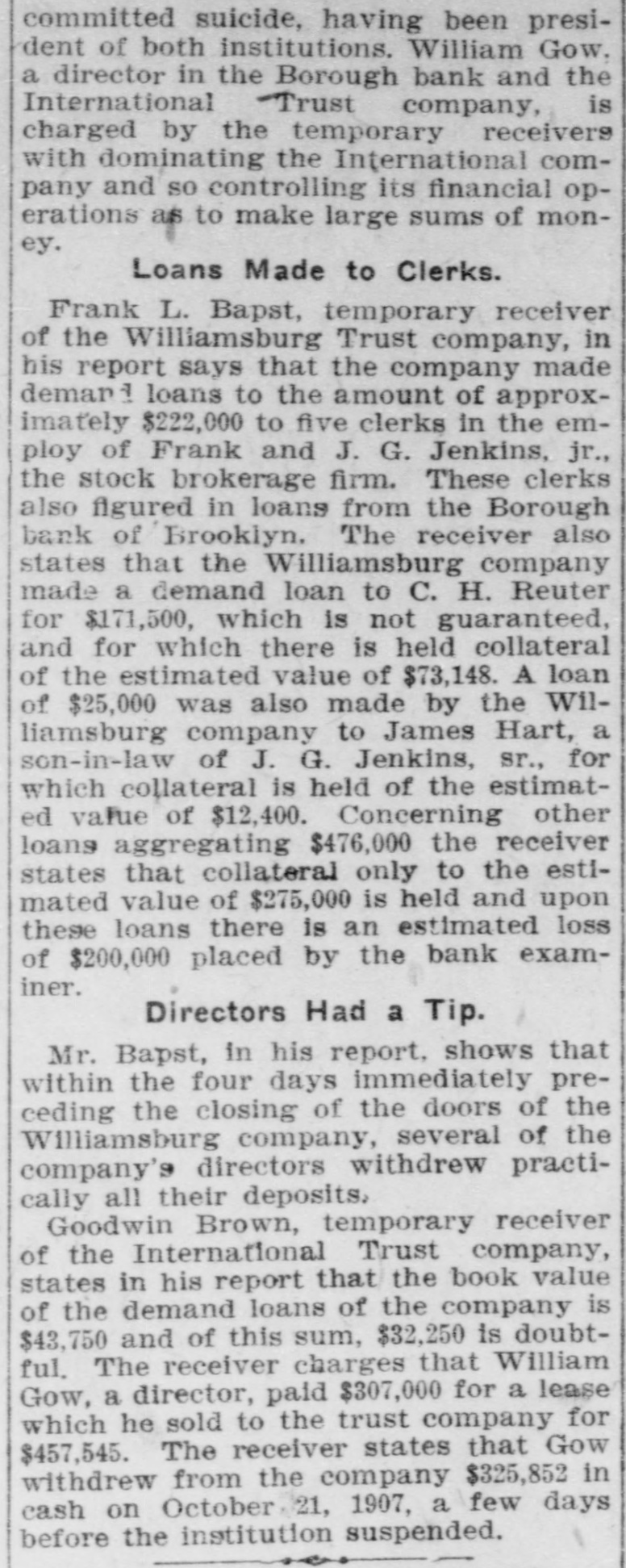
committed suicide, having been president of both institutions. William Gow. a director in the Borough bank and the International Trust company, is charged by the temporary receivers with dominating the International company and SO controlling its financial operations as to make large sums of money. Loans Made to Clerks. Frank L. Bapst, temporary receiver of the Williamsburg Trust company, in his report says that the company made demard loans to the amount of approximately $222,000 to five clerks in the employ of Frank and J. G. Jenkins, jr., the stock brokerage firm. These clerks also figured in loans from the Borough bank of Brooklyn. The receiver also states that the Williamsburg company made a demand loan to C. H. Reuter for $171,500, which is not guaranteed, and for which there is held collateral of the estimated value of $73,148. A loan of $25,000 was also made by the Williamsburg company to James Hart, a son-in-law of J. G. Jenkins, sr., for which collateral is held of the estimated value of $12,400. Concerning other loans aggregating $476,000 the receiver states that collateral only to the estimated value of $275,000 is held and upon these loans there is an estimated loss of $200,000 placed by the bank examiner. Directors Had a Tip. Mr. Bapst, in his report, shows that within the four days immediately preceding the closing of the doors of the Williamsburg company, several of the company's directors withdrew practically all their deposits. Goodwin Brown, temporary receiver of the International Trust company, states in his report that the book value of the demand loans of the company is $43,750 and of this sum, $32,250 is doubtful. The receiver charges that William Gow, a director, paid $307,000 for a lease which he sold to the trust company for $457,545. The receiver states that Gow withdrew from the company $325,852 in cash on October 21, 1907, a few days before the institution suspended.


Article from New-York Tribune, December 1, 1907

Click image to open full size in new tab

Article Text

BIG SUMS DRAWN OUT. BANK RECEIVERS REPORT. Trust Company Accounts Almost at Minimum Before Suspension. Reports of the temporary receivers of the Williamsburg Trust Company and the International Trust Company were made public by Attorney General Jackson yesterday. They show that large withdrawals were made from both institutions just prior to their suspension on October 25. The array of accounts that were drawn down almost to a minimum in the International Trust Company is startling. It would appear that William Gow made some $150,000 by the transfer of the lease of No. 206 Broadway, where the company did business. Deputy Attorney General Robert J. will before District all the facts he has in to-morrow Steele Special place Attorney connection and Jerome ask with the International Trust Company, that some action be taken on them. At the same time the Kings County Grand Jury for December, take which is to be sworn in to-morrow, will up the Williamsburg Trust Company Attorney General Jackson said last night that the loan committee of the Williamsburg Trust Company might be responsible for loans amounting to $220,000, which went to five clerks in the employ of the F. & J. G. Jenkins, jr., brokerage in which this corporation, all which is held by the concern. the stock farm The of ly, way members of dollars of Jenkins borrowed thousands from the Jenkins Trust Company has already been told. It is understood that it also had large loans from the First National Bank, of Brooklyn, which is in the hands of a federal receiver. More evidence has been found to show how some of the accounts in the Borough Bank were drawn down just before its suspension. Arguments were heard yesterday by Justice Bette in Albany on an application to make the receivers of suspended Brooklyn institutions permanent. The application was strenuously opposed by counsel for the banks. All the arguments were adjourned, the Borough Bank to December 10, the International Trust Company. the Brocklyn Bank, the Williamsburg Trust Company and the Jenkins Trust Company to December 12. ORGANIZED OUT OF WIND In giving out the report of Goodwin Brown, receiver for the International Trust Company. Attorney General Jackson said it would seem as if the concern had been organized largely out of whid. "If the report of the receiver is correct," he said, "there was a falsification of the books of the Borough Bank and the Brooklyn Bank and a manipulation of their securities, in order, apparently to give the International Trust Company a surplus and capital of $1.000,000. It was organized only a few weeks before it went up, and when it closed its doors had only about ninety depositors, with deposits of between $110,000 and $120,000. The report states that R. W. Jones, jr., the former president of the Oriental Bank, had a demand loan of $32,250, which was entirely unsecured. "This indebtedness has not been adjusted," says Mr. Brown. "Mr. Jones is ill, but his attorney has promised to confer with me in reference to the matter." An interesting transaction, where William Gow, the organizer of the trust company, apparently made $150,000 is related at some length. It seems that Gow paid to the trustees of the Henderson estate for the lease of No. 206 Broadway, where the trust company did businear, $107,000 in cash and gave a mortgage for $200,000. He apparently sold the lease to the trust company for $457,545 on October 21. or four days before the suspension, receiving $257.545 55 above the mortgage. He on the same day deposited stocks and bonds with the company and drew out $325,852. CONCERNING GOW'S DEAL Concerning this transaction the report has this to say: In another part of my report 1 have called attention to Gow windrawing from the company the $325,852 50 on October 21, 1907 This covered credit he received from the transfer of the leasehold of the building No. 206 Broadway, at a total cost to the company of $457,545 55. which, however, included a mortgage for $200.000 w hich Gow gave to the Henderson trustees at the time he purchased the lease from them. a He by taking out the amount he did, realized profit of $150,000 in disposing of the lease to the company On the other hand however, is to be noted the fact that on October 21 Gow also turned over of to the company stocks and bonds of the value $150,000, so that as a result of the entire transaction if the company had a balance left of about $82,293. we are to concede the full value paid by the compass for the leasehold. and that, as pointed out in another part of my report, is extremely doubtful. In my opinion, Gow originally had no intention of transferring the lease to the company Having paid $107,000 in cash on account of the purchase price paid by him to the Henderson trustees, the the rentals exceeded the charges of operating building by substantial amount It was good investment for him. but on October 21 he evidently needed money either for his own use or to put in the Borough Bank. By turning the lease over to the company on that date at the price of $257,545.65 over and above the existing mortgage for $200,000, and also turning over to the company stocks and bonds of the stated value of $157,600. he was enabled thereby to take on the Fame day from the company's cash at the Oriental Bank the sum of $225,852.50 In support of my opinion that Gow had no inten In tion originally of transferring the lease to the ternational Trust Company, call attention to the fact that the lease itself is not dated, although it The was duly acknowledged on October 21. 1907. original lease made by the Church Corporation contained a clause that in the event of an assignment of the lease being made without their consent, the Church Corporation could then re-enter. This conContinued on second page. CONGRESS OPENS DECEMBER 2ND.


Article from New-York Tribune, December 13, 1907

Click image to open full size in new tab

Article Text

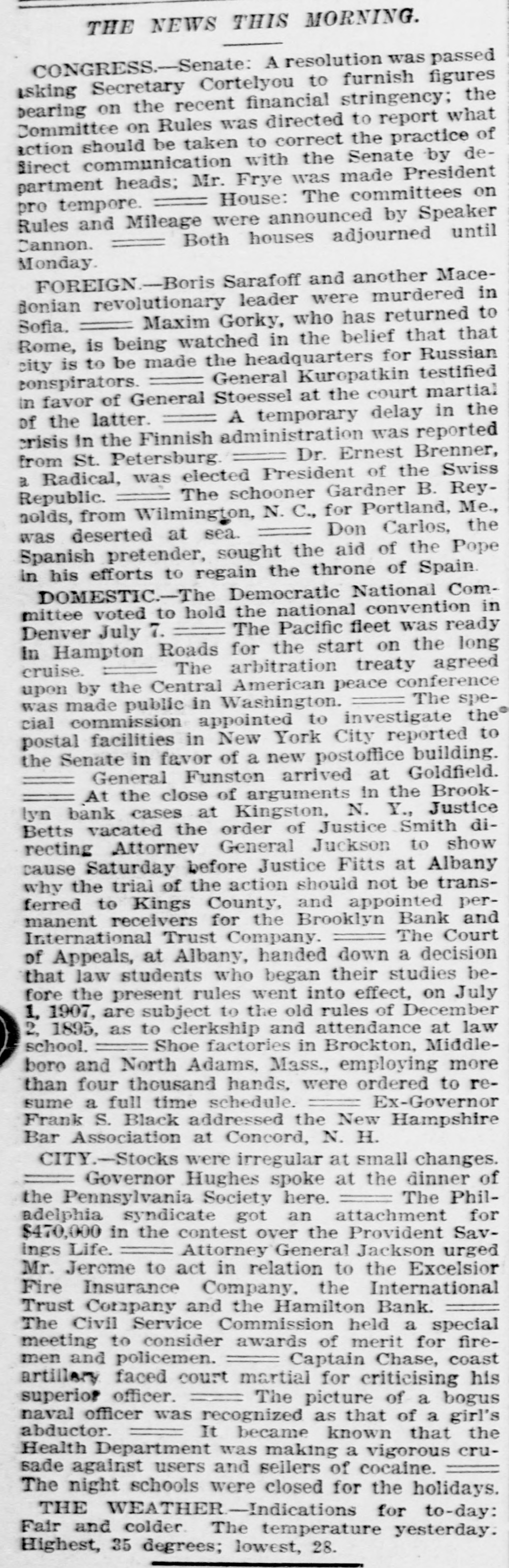
THE NEWS THIS MORNING. CONGRESS.-Senate: A resolution was passed asking Secretary Cortelyou to furnish figures bearing on the recent financial stringency; the Committee on Rules was directed to report what action should be taken to correct the practice of direct communication with the Senate by department heads: Mr. Frye was made President House: The committees on pro tempore. Rules and Mileage were announced by Speaker Both houses adjourned until Cannon. Monday FOREIGN.-Boris Sarafoff and another Macedonian revolutionary leader were murdered in Maxim Gorky, who has returned to Sofia. Rome, is being watched in the belief that that city is to be made the headquarters for Russian General Kuropatkin testified conspirators. in favor of General Stoessel at the court martial A temporary delay in the of the latter. erisis in the Finnish administration was reported Dr. Ernest Brenner, from St. Petersburg a Radical, was elected President of the Swiss The schooner Gardner B. ReyRepublic. nolds, from Wilmington, N. C., for Portland, Me., Don Carlos, the was deserted at sea. Spanish pretender, sought the aid of the Pope in his efforts to regain the throne of Spain DOMESTIC.-The Democratic National Committee voted to hold the national convention in The Pacific fleet was ready Denver July 7. in Hampton Roads for the start on the long The arbitration treaty agreed cruise. upon by the Central American peace conference The spewas made public in Washington. cial commission appointed to investigate the postal facilities in New York City reported to the Senate in favor of a new postoffice building. General Funston arrived at Goldfield. At the close of arguments in the Brooklyn bank cases at Kingston, N. Y., Justice Betts vacated the order of Justice Smith directing Attornev General Juckson to show cause Saturday before Justice Fitts at Albany why the trial of the action should not be transferred to Kings County, and appointed permanent receivers for the Brooklyn Bank and The Court International Trust Company. of Appeals, at Albany, handed down a decision that law students who began their studies before the present rules went into effect, on July 1,1907, are subject to the old rules of December 2, 1895, as to clerkship and attendance at law school. Shoe factories in Brockton, Middleboro and North Adams, Mass., employing more than four thousand hands, were ordered to reEx-Governor sume a full time schedule. Frank S. Black addressed the New Hampshire Bar Association at Concord, N. H. CITY.-Stocks were irregular at small changes. Governor Hughes spoke at the dinner of The Philthe Pennsylvania Society here. adelphia syndicate got an attachment for $470,000 in the contest over the Provident Savings Life. Attorney General Jackson urged Mr. Jerome to act in relation to the Excelsior Fire Insurance Company. the International Trust Company and the Hamilton Bank. The Civil Service Commission held a special meeting to consider awards of merit for firemen and policemen. Captain Chase, coast artillery faced court martial for criticising his superior officer. The picture of a bogus naval officer was recognized as that of a girl's abductor. It became known that the Health Department was making a vigorous crusade against users and sellers of cocaine. The night schools were closed for the holidays. THE WEATHER-Indications for to-day: Fair and colder The temperature yesterday. Highest, 35 degrees; lowest, 28.


Article from New-York Tribune, December 15, 1907

Click image to open full size in new tab

Article Text

JUDGE AWAITS BRIEFS. MORE COMPLICATIONS Bank Cases Heard - Permanent Williamsburg Trust Co. Receivers. Albany. Dec. 14.-Further complications were added to-day to the disputes over the receiverof certain of the banking institutions in York City during of the ships New recent financial which disturbances. suspended for business Two phases the controversy came up argument before separate Supreme Court justices. both in the 3d Judicial District, Justice Howard, at Albany. and Justice Betts, at Kingston Before Justice Howard preliminary arguments were heard. following a request in behalf of the Attorney General for an adjournment on orders by Justice Smith, at Elmira, and Justice at cause the trial of the General issued Carr. actions Brookivn, the permanent brought to show by receiverships Attorney why Jackson for of four Brooklyn banks should not be changed from County to Kings County. Ex-Governor S. as in two of in a venue Justhe Ulster Frank cases Black ordered favor appeared of counsel change to counsel submit of tice Howard briefs by next Saturday in all the cases involved before him and replies to these briefs'are to be handed to the court by Thursday, December 26. The institutions involved in the proceedings before Justice Howard are the Williamsburg Trust Company the Borough Bank of Brooklyn, the Brooklyn Bank and the International Trust Company On Thursday last Justice Betts made permanent the temporary receivers of the Brooklyn Bank and the International Trust Company To-day at Kingston Justice Betts set aside the orders granted by Justices Smith and Carr staying further proceedings in the Williamsburg Trust Company case and appointed permanent receivers. The proceedings before Justice Howard. it is announced here. will not be affected by Justice Betts's action, the attorneys appearing in favor of the change of venue declaring that the real issue in the actions begun by the Attorney General is the question as to whether the banks are solvent or insolvent. This point, it is stated. will be contested by the Attorney General's office. its contention being that the Attorney General is the proper officer to determine the question of solvency The first case to be taken up here was that of the Williamsburg Trust Company Ex-Governor Frank S. Black, William N. Dykman and William P. Reid, vice-president of the Williamsburg Trust Company. appeared in favor of the change of venue. while it was opposed by Attorney General Jackson, with Deputy Attorney General Dolson. The last named declared that the proposal was an "effort to prerent Justice Betts from continuing to do his duty," as he declared that Justice Betts had had these cases before him and should be permitted to dispose of them and not be interfered with by a justice in the same judicial district. He requested an adjournment. Attorney General Jackson declared that counsel for the Williamsburg Trust Company had promised to present a plan for the rehabilitation of the institution. He said that certain depositors of the trust company had appeared before him and declared "that counsel had misrepresented and deceived them and they did not desire a change of venue." "The Attorney General," interrupted Mr. Dykman. "promised me delay before he seized the patronage which has almost degenerated into plunder. I suggested that the Attorney General select a receiver from the depositors and he would serve for nothing-select from the depositors counsel for the receiver and he would serve for nothing. The next day in Kingston they applied to Mr. Justice Betts for temporary receivers in six cases. "The object of the Attorney General in this proceeding has been patronage and plunder," declared Mr. Dykman with some heat. "His tactics have been to malign the depositors and directors. Deputy Attorney General Mackey. who has been interested in these cases, has also appeared as attorney for one of the receivers. Mr. Dykman severely criticised the Attorney General for his tactics in going outside of New York City to have temporary receivers appointed for New York institutions and appointing as temporary receivers upstate residents. Deputy Attorney General Dolson, replying, declared: "These gentlemen are here for no benevolent purpose, but on behalf of discredited directors, to prevent the vigilant and honest Attorney General of the state from continuing his investigation and from making further disclosures of criminality and neglect. Ex-Governor Black believed that Kings County was the proper place for the case to be tried for the convenience of the witnesses. "We are here because we wanted to come here." said Mr. Black. "We do not want some strained construction of judicial courtesy to throw us out of here. If we wanted to go before Justice Betts we could have done so. "There are many considerations in the interest of justice which might compel the attorney to have this matter decided in a county outside of Kings County," said Mr. Jackson. "We might want it outside of Kings so as to have it free from the influences the old directory might bring to bear. This motion is not made in good faith, but to prevent the naming of a permanent recelver."


Article from New-York Tribune, April 1, 1908

Click image to open full size in new tab

Article Text

INTERNATIONAL'S HOPE RESUMPTION FEASIBLE. Borough Bank's Reopening to Release Trust Company's Deposit. Prospects for reopening the International Trust Company, of Brooklyn, and the Brooklyn Bank appear brighter than they have since the two institutions closed their doors last November. The reopening of the Borough Bank of Brooklyn on April 14 will. in the opinion of many of the depositors of the two institutions, materially affect the situation, and has already tinged it with a roseate hue. The International Trust Company has on deposit with the Borough Bank not less than $564,514. The reopening of the Borough Bank that the trust company will receive is assurance which will be its deposit from the bank in full, of material assistance to it in any plan for resumption or payment of depositors. The Brooklyn Bank owes the Borough Bank approximately $27,000, and the International Trust Company owes the Brooklyn Bank, according to Charles M. Higgins, one of its receivers, in the neighborhood of $300,000. The payment to the trust company by the Borough Bank will enable the former to settle its debt to the Brooklyn Bank and thus put enough money in its treasury to pay in full nearly a sixth of the total amount due its depositors. Charles M. Higgins. one of the receivers of the Brooklyn Bank, said to a Tribune reporter last night: "The resumption of the Borough Bank will be of the greatest assistance to any plans the Brooklyn Bank may have for resumption. It practically means turning $300,000 into our treasury. If the depositors of the Brooklyn Bank get tog her I should think they could agree on some reasonable plan for an early resumption by the bank. Although I am a permanent receiver, I will readily consent to any reasonable plan that they may bring forward, and, furthermore, will do what I can to bring it about. The chances seem bright. At any rate, I am now convinced that the depositors will get practically 100 cents on every dollar they have on deposit. "The total deposits in the Brooklyn Bank amount to approximately $1,800,000. We have in cash on hand already nearly $700,000. Add to this the $300,000 which the International Trust Company owes us. and the amount would be nearly $1,000,000. Even if there is no reasonable plan of resumption brought forward, I believe we will be able to pay the depositors from 40 to 50 per cent of their deposits somewhere near the first part of May, and T expect the affairs of the bank to be wound up within another six months." The Brooklyn Bank, under a scheme evolved by William Gow, who is under indictments because of his connection with the Borough Bank, was supposedly merged with the International Trust Company, which Gow attempted to organize. The question of the legality of this merger is the one most likely to prove a stumbling block to plans of resumption or prompt payments by the receivers. Mr. Higgins spoke bitterly on the attempt to declare the merger legal last night. "It is absurd to say that the merger was legal," said he, "and to try to assert it is nothing less than dishonest. To do SO is deceitful and against the interests of the depositors. There is, however, a group of men, of whom my coreceiver is one, who are attempting to have this merger declared legal. There is some kind of a conspiracy behind this. "It looks as if they were working for delay to carry out some other plans, and were trying to involve us in endless and expensive litigation. Some interests in the bank are trying to force the depositors to accept a deferred payment plan. I do not believe that the courts will entertain the idea that the merger is legal. I believe they will declare it illegal in the near future. "I have succeeded in having Mr. Dolson, the former Jackson deputy. kicked out as counsel for the receivers, and I think I have Jackson himself going. I have suggested three lawyers of standing for counsel for the receivers. Each of these has agreed to accept $14,000 a year as his fee, with no incidentals. But the other receiver has suggested such men as DeLancey Nicoll, Alton B. Parker and John B. Stanchfield. When I asked what salary these men would agree to accept for their services I got the reply, "I don't know, I haven't asked them." Now, I don't see why counsel for receivers should receive exorbitant fees. Why don't they suggest Grover Cleveland or William Jennings Bryan? "However, if we are not involved in endless litigation over the merger-and I do not think we shall be-prospects for payment or resumption will appear brighter every day." MMV


Article from New-York Tribune, May 17, 1908

Click image to open full size in new tab

Article Text

BROOKLYN BANK PLAN 15. TO OPEN ABOUT JUNE Scheme for Union with International Trust Company Complete. The plan for the reorganization of the Brooklyn Bank and the International Trust Company, news of which was exclusively told in The Tribune, has been completed and copies of the plan were mailed yesterday to all of the stockholders of the two institutions with the request that they vote for its adoption. The plan. which was evolved by S. Stanwood Menken, of the law firm of Philbin, Beekman & Menken. provides for the reopening of the Brook lyn Bank on or about June 15. It provides for a complete reorganization of the board of directors on such a basis that the new directors will, by their names and connections, be a guar antee of the safety of the reorganized bank. Will iam Gow, now under many indictments because of his backing transactions, and the so-called Gow interests will be entirely eliminated There will be a new president for the bank, known in in fact, man who is well banking circles, and. a a thorough housecleaning is planned. The name of the new president will be kept secret until the plan is actually carried into effect. Accompanying the letter sent to the stockholders are statements of the financial condition of the International Trust Company and the Brooklyn Bank. as of April 28, 1908. The statement for the Brooklyn Bank shows among its resources, which total $2,153,370 94, the following items: $545,362 Bills discounted 459,447.54 Temporary loans 75,000.00 Real estate banking house and lot Cash on deposit 718,306.82 Due from the International Trust Company 321,748.83 The liabilities of the bank. other than to its stockholders, aggregate $1,896,508 44. Its chief liabilities follow: $1,815,018.10 Individual depositors 57,429.87 Due various banks 12.613,76 Interest account 4,545.10 Cash account The International Trust Company has assets of $1 1,012,916.54 according to a statement prepared on April 21. 1908. The following are its chief assets: $110,000.00 Real estate 270,000.00 Stocks and bonds 458,500.00 Borough Bank deposit 28.337,28 Oriental Bank deposit (available) 10,000.00 Bank Columbia 33,500.00 Cash on hand, to receivers' account 97,578.76 Loans Its liabilities are estimated at $458,899.25. which include its debt to the Brooklyn Bank and $97.578 76 to depositors. The statement of the International Trust Company does not include in its assets the 3,360 shares of Brooklyn Bank stock, of a par value of $168,000. A consolidated statement of the condition of both institutions at present shows total assets of $2,776. 696 68 and total liabilities other than receivers' fees and expenses, of $2,033,658 87. thus seemingly showing a surplus of $742,036 81 In addition to this the statement says: "It is estimated that the equities in property and items net included in or charged off will bring the total surplus up to approximately $900,000. which, of course, is subject to receivers' fees and expenses." If cash is obtained as suggested in Mr. Menken's plan of reorganization, the following amounts will be immediately available for payment of depositors and the transaction of new business: $751,806.62 Cash in banks 270,000.00 From sale of bonds Realization loans secured by Stock Ex 165.000 00 change collateral 250,000.00 Loan from trust company $1,436,806.82 Total The liability of $2,033,658 is subject to a deduc. tion of about $200,000 for set-offs owing to the fact that the depositors are still indebted to the bank in that sum, 80 that the net liabilities may be reck oned at a valuation of about $1,833,000. The letter to the stockholders states: Owing to the method of organization of the Inter national Trust Compan in so far as the same at tempted to take over the assets of the Brooklvn Bank, and the financial situation of the Interna. tional Trust company, due to the fact that so large a portion of its capital tied up in the Borough Bank and cannot be withdraw except in partial payments as provided for in the Borough Bank plan of resumption it has been dec ided that the only feasible plan for the payment of the cred itors of both institutions would be to provide for the opening of the Brooklyn Bank on a substantial basis and to furnish that basis by the transfer to the Brooklvn Bank of all of the assets of the International Trust Company after having arranged to procure funds for the payment of all the cred. itors of the International Trust Company and of the Brooklyn Bank If the suggested plan is adopted it is apparent that subject to the claims of the stockholders of the Brooklyn Bank. the bank would, under such conditions. have a capital and a surplus of upward of $775,000. less the expenses of the receiverships. To consummate the plan the assents of all the minority stockholders of the bank to the sale of their stock to the International Trust Company and the assent of all the stockholders of the Inter national Trust Company to the transfer of the company's assets are necessary The International Trust Company pledges itself under the proposed plan to purchase all of the remaining stock of the Brooklyn Bank at par and pay for this stock within two years after June 15 next and to distribute this stock among its stock. holders immediately upon receiving it Such payment is to be secured by a deposit of the stock bought with a responsible trust company and the obligation of the International Trust Company The letter further states: The Brooklyn Bank, so recapitalized. is to be thoroughly reorganized as to the personnel of its directors and officers by having as chief executive officer favorably known and responsible bank official formerly connected with one of the prominent banks of this city. and is to have a board of directors thoroughly representative of the best business interests in Brooklyn. If the reorganization is effected as above the co-operation of the depositors' committee will be requested in the retention of the business and good will of the Brooklyn Bank The basic feature this plan to reorganize the Brooklvn Bank, both as to capital and management so to provide for immediate payment of all the depositors, and to provide management which will be an absolute assurance of the stability of the bank as re sponsible institution entitle to the respect of the conservative citizens of Brooklyn. The $250,000 loan to be secured from a trust company will be got under an agreement which provides that during the time the loan is outstanding the affairs of the bank shall be conducted by an advisory committee. on which committee the trust company making the loan shall have membership. If further loans should be necessary to provide more cash, the letter states that such additional cash can be raised, as required The letter closes with an appeal to the stock holders to send in their assents promptly, as the receivers have imposed a time limit of ten days. PACIFIC OPENS LANE CUT-OFF.


Article from New-York Tribune, May 23, 1908

Click image to open full size in new tab

Article Text

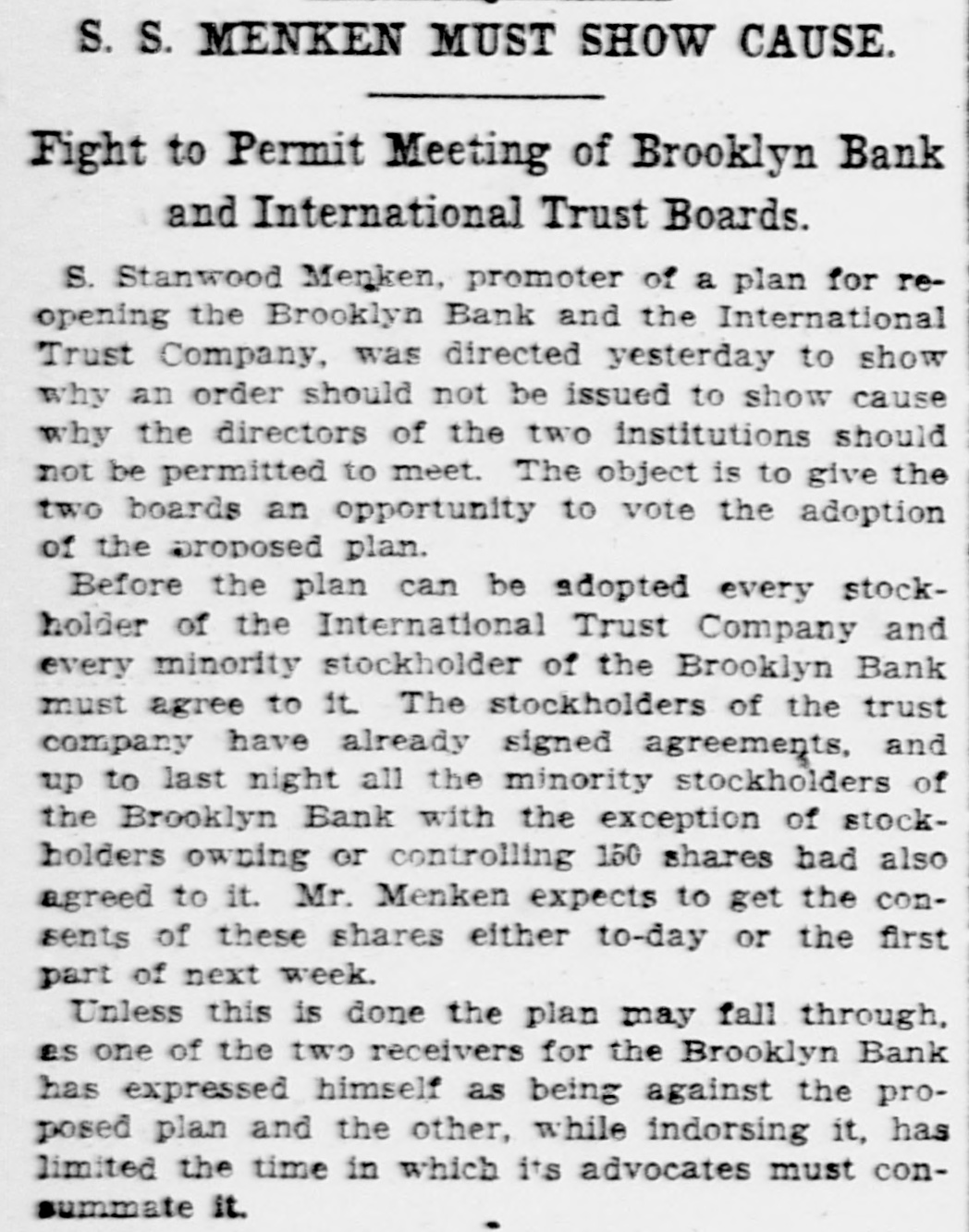
S. S. MENKEN MUST SHOW CAUSE. Fight to Permit Meeting of Brooklyn Bank and International Trust Boards. S. Stanwood Menken, promoter of a plan for reopening the Brooklyn Bank and the International Trust Company, was directed yesterday to show why an order should not be issued to show cause why the directors of the two institutions should not be permitted to meet. The object is to give the two boards an opportunity to vote the adoption of the proposed plan. Before the plan can be adopted every stockholder of the International Trust Company and every minority stockholder of the Brooklyn Bank must agree to it. The stockholders of the trust company have already signed agreements, and up to last night all the minority stockholders of the Brooklyn Bank with the exception of stockholders owning or controlling 150 shares had also agreed to it. Mr. Menken expects to get the consents of these shares either to-day or the first part of next week. Unless this is done the plan may fall through, es one of the two receivers for the Brooklyn Bank has expressed himself as being against the proposed plan and the other, while indorsing it, has limited the time in which its advocates must consummate it.


Article from The Julesburg Grit-Advocate, July 3, 1908

Click image to open full size in new tab

Article Text

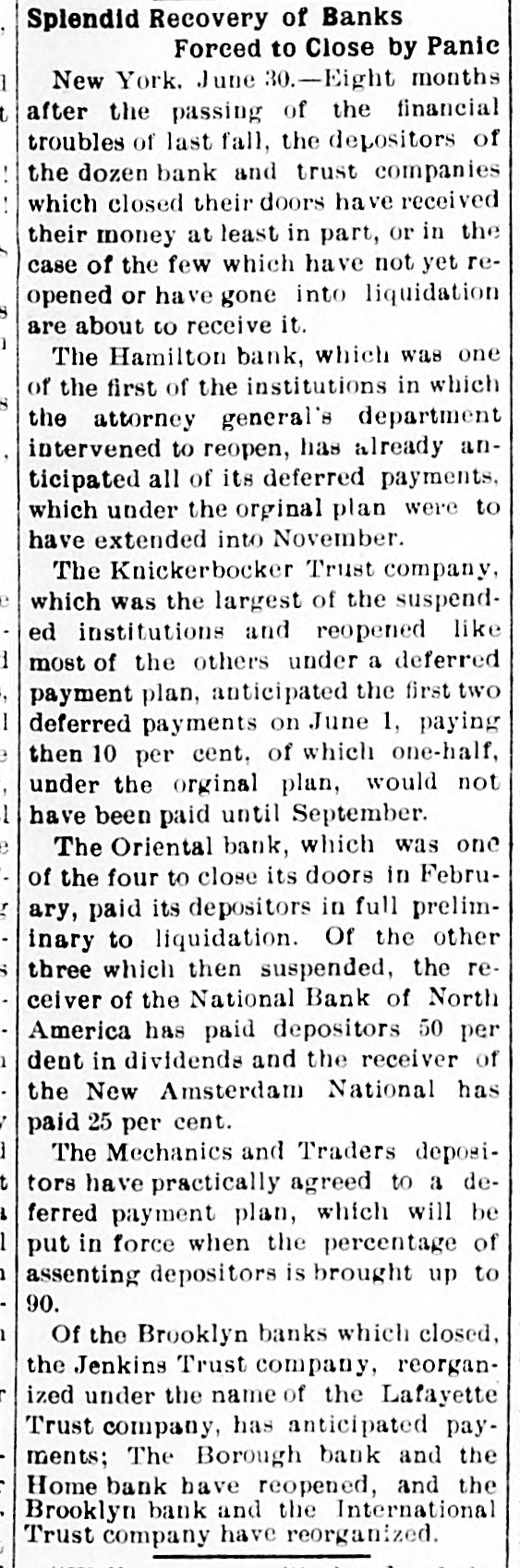
Splendid Recovery of Banks Forced to Close by Panic 1 New York. June 30.-Eight months t after the passing of the financial troubles of last fall, the depositors of the dozen bank and trust companies which closed their doors have received their money at least in part, or in the case of the few which have not yet reopened or have gone into liquidation are about to receive it. The Hamilton bank, which was one of the first of the institutions in which the attorney general's department intervened to reopen, has already anticipated all of its deferred payments, which under the orginal plan were to have extended into November. The Knickerbocker Trust company, e which was the largest of the suspended institutions and reopened like 1 most of the others under a deferred payment plan, anticipated the first two deferred payments on June 1, paying then 10 per cent, of which one-half, under the orginal plan, would not have been paid until September. The Oriental bank, which was one of the four to close its doors in February, paid its depositors in full preliminary to liquidation. Of the other three which then suspended, the receiver of the National Bank of North America has paid depositors 50 per 1 dent in dividends and the receiver of the New Amsterdam National has paid 25 per cent. The Mechanics and Traders depositors have practically agreed to a de1 ferred payment plan, which will be put in force when the percentage of assenting depositors is brought up to 90. Of the Brooklyn banks which closed, the Jenkins Trust company, reorganized under the name of the Lafayette Trust company, has anticipated payments; The Borough bank and the Home bank have reopened, and the Brooklyn bank and the International Trust company have reorganized.


Article from The Lee County Journal, July 10, 1908

Click image to open full size in new tab

Article Text

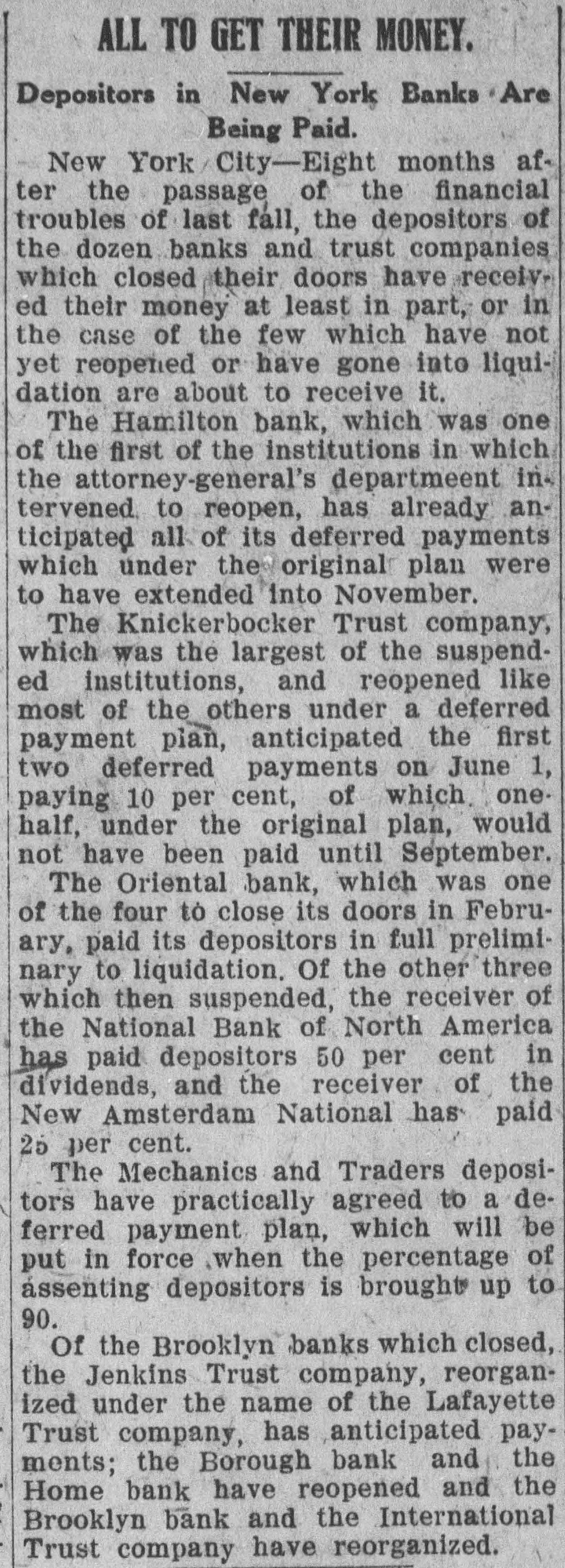
ALL TO GET THEIR MONEY. Depositors in New York Banks Are Being Paid. New York City-Eight months after the passage of the financial troubles of last fall, the depositors of the dozen banks and trust companies which closed their doors have received their money at least in part, or in the case of the few which have not yet reopened or have gone into liquidation are about to receive it. The Hamilton bank, which was one of the first of the institutions in which the attorney-general's departmeent in tervened. to reopen, has already anticipated all of its deferred payments which under the original plan were to have extended into November. The Knickerbocker Trust company, which was the largest of the suspended institutions, and reopened like most of the others under a deferred payment plan, anticipated the first two deferred payments on June 1, paying 10 per cent, of which onehalf, under the original plan, would not have been paid until September. The Oriental bank, which was one of the four to close its doors in February, paid its depositors in full preliminary to liquidation. Of the other three which then suspended, the receiver of the National Bank of North America has paid depositors 50 per cent in dividends, and the receiver of the New Amsterdam National has paid 25 per cent. The Mechanics and Traders depositors have practically agreed to a deferred payment plan, which will be put in force when the percentage of assenting depositors is brought up to 90. Of the Brooklyn banks which closed, the Jenkins Trust company, reorganized under the name of the Lafayette Trust company, has anticipated payments; the Borough bank and the Home bank have reopened and the Brooklyn bank and the International Trust company have reorganized.


Article from Brooklyn Eagle, October 23, 1929

Click image to open full size in new tab

Article Text

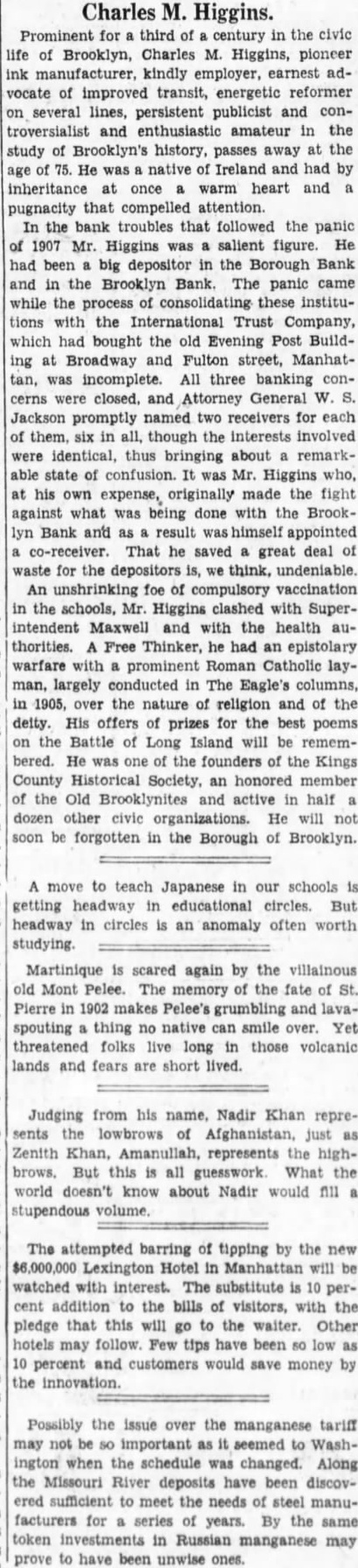
Charles Higgins. for third century in the civic life of Brooklyn, Charles M. Higgins, pioneer ink manufacturer, kindly employer, earnest advocate of improved transit, energetic reformer on several lines, persistent publicist controversialist and enthusiastic amateur in the study of Brooklyn's history, passes away at the He native of Ireland had by inheritance at once warm heart and pugnacity that compelled attention. In the bank troubles that followed the panic 1907 Mr. Higgins salient figure. He had been big depositor in the Borough Bank and in the Brooklyn Bank. The panic came while the process consolidating these institutions with the International Trust Company, had bought the old Evening Post Building at Broadway and Fulton street, Manhatwas incomplete. All three banking conwere closed. and Attorney General Jackson promptly named two receivers for each them. in all, though the interests involved bringing about state of was Mr. Higgins who, his own expense, originally made the fight against what was being done with the BrookBank and result himself appointed co-receiver. That he saved great deal waste for the think, undeniable. An foe of compulsory vaccination the schools, Mr. Higgins clashed with Superintendent Maxwell and with the health authorities. Free Thinker, had epistolary warfare with Roman Catholic laylargely conducted in The Eagle's over the nature of religion and of the deity. His offers prizes for the best poems the Battle of Long Island be remembered. He was the founders of the Kings County Society, an honored member the Old Brooklynites and active in half dozen other civic organizations. He will be forgotten in the Borough of Brooklyn. move to teach Japanese in our schools getting headway educational circles. But headway circles an anomaly often worth studying. Martinique scared again by the villainous old Mont Pelee. The memory of the fate Pierre 1902 makes Pelee's and spouting thing no native smile Yet threatened folks live long those volcanic lands and fears are short lived. Judging from his name, Nadir Khan represents lowbrows Afghanistan, just Zenith Khan, Amanullah, represents the highbrows. But this all guesswork What the world doesn't know about Nadir would stupendous volume. The attempted barring of tipping by the new Lexington Hotel in Manhattan will watched with interest. substitute cent to the bills of visitors, with the pledge that this will go to the waiter. Other hotels may follow. Few tips have been low percent and customers would save money the innovation. Possibly the issue over the manganese tariff may not important as seemed to Washington when the schedule was changed. Along the Missouri River deposits have been discovered sufficient to meet the steel manufacturers for series of years. By the same token investments in Russian manganese may prove to have been unwise ones.