14735. First National Bank (Tarrytown, NY)

Bank Information

Episode Type
Suspension β†’ Closure
Bank Type
national
Bank ID
364
Charter Number
364
Start Date
March 22, 1878
Location
Tarrytown, New York (41.065, -73.866)

Metadata

Model
gpt-5-mini
Short Digest
adba7aaf75345771

Response Measures

None

Receivership Details

Depositor recovery rate
90.5%
Date receivership started
1878-03-23
Date receivership terminated
1882-06-20
OCC cause of failure
Losses
Share of assets assessed as good
39.7%
Share of assets assessed as worthless
60.3%

Description

Contemporary articles (Mar 22, 1878) report the First National Bank of Tarrytown suspended on March 22, 1878 after an examiner found large amounts of worthless paper and mismanagement; stockholders voted voluntary liquidation and a receiver was appointed days later. No sustained depositor run is described β€” withdrawals by public officers occurred but the primary cause was bad loans/poor management. Receiver proceeded to pay dividends later.

Events (5)

1. April 5, 1864 Chartered
Source
historical_nic
2. March 22, 1878 Suspension
Cause
Bank Specific Adverse Info
Cause Details
Examiner found large amount (~$100,000) of worthless paper and loans to New York parties proved worthless; mismanagement by president led to impairment; stockholders decided voluntary liquidation.
Newspaper Excerpt
The First National Bank of Tarrytown has failed...the bank must suspend to-day. The examiner found about $100,000 of worthless paper in the bank.
Source
newspapers
3. March 23, 1878 Receivership
Source
historical_nic
4. March 25, 1878 Receivership
Newspaper Excerpt
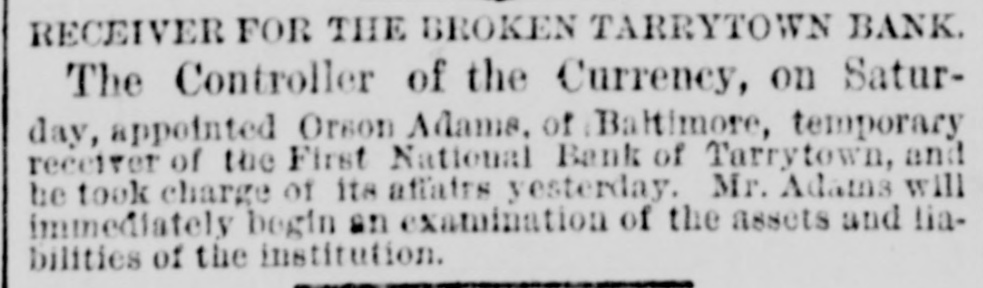
The Controller of the Currency... appointed Orson Adams, of Baltimore, temporary receiver of the First National Bank of Tarrytown, and he took charge of its affairs yesterday.
Source
newspapers
5. May 4, 1878 Other
Newspaper Excerpt
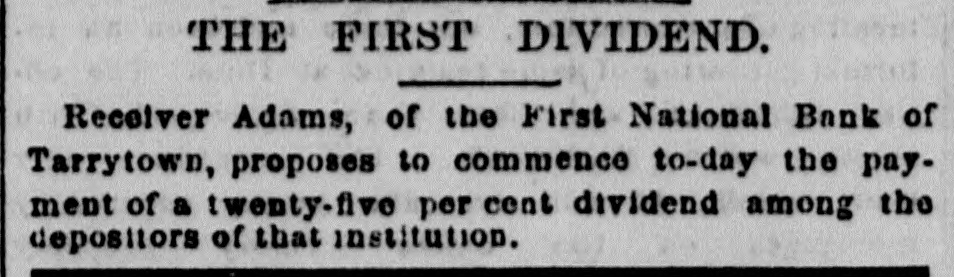
Receiver Adams...proposes to commence to-day the payment of a twenty-five per cent dividend among the depositors of that institution.
Source
newspapers

Newspaper Articles (21)

Article from The Daily Gazette, March 23, 1878

Click image to open full size in new tab

Article Text

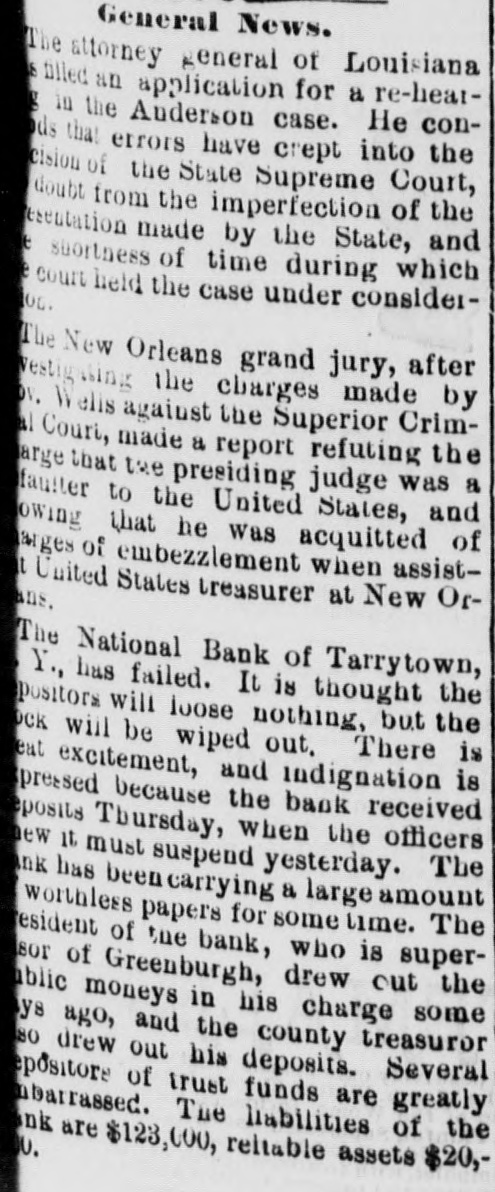
General News. The attorney general of Louisiana filled an application for a re-hearin the Auderson case. He conds that errors have crept into the cision of the State Supreme Court, doubt from the imperfection of the estatation made by the State, and shortness of time during which court held the case under considerOC. The New Orleans grand jury, after westigating the charges made by against the made a DV. large 41 Couri, Wells that report Superior refuting Crim- the the presiding judge was a faulter to the United States, and owing that he was acquitted of arges of embezzlement when assistans. t United States treasurer at New OrThe National Bank of Tarrytown, Y., has failed. It is thought the positors will loose nothing, but the OCK will be wiped out. There is eat excitement, and indignation is presed because the bank received posits Thursday, when the officers new nk it must suspend yesterday. The has beencarrying a large amount worthless papers for some time. The resident of tue bank, who is supersor of Greenburgh, drew cut the ablic moneys in his charge some ys ago, and the county treasuror 80 drew out his deposits. Several epositore of trust funds are greatly barrassed. The liabilities of the nk U. are $123,000, reliable assets $20,-


Article from Daily Globe, March 23, 1878

Click image to open full size in new tab

Article Text

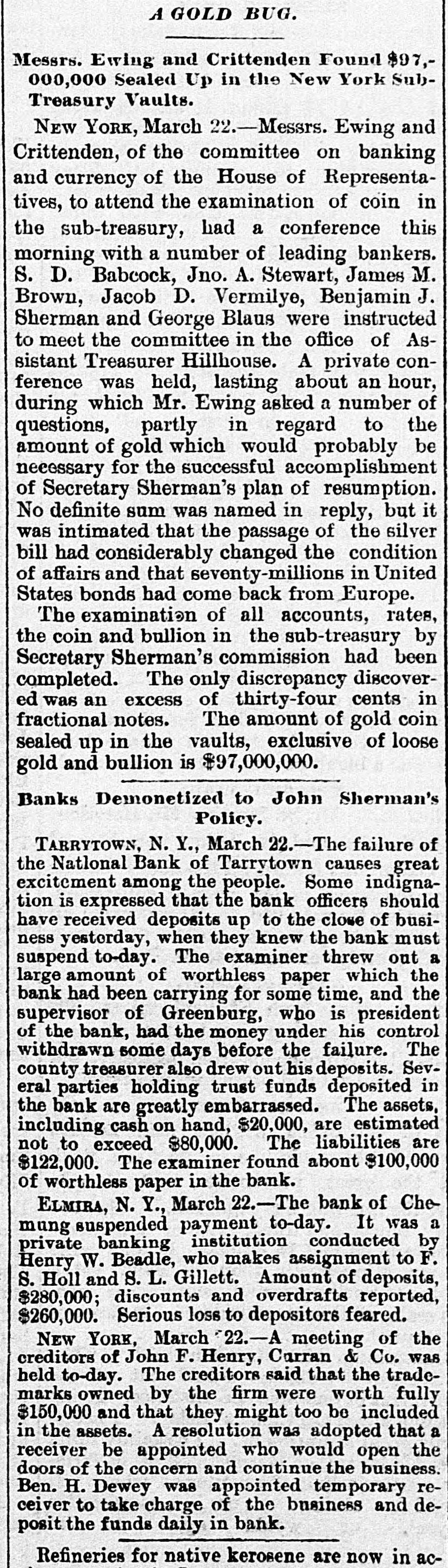
A GOLD BUG. Messrs. Ewing and Crittenden Found $97,000,000 Sealed Up in the New York SubTreasury Vaults. NEW YORK, March 22.-Messrs. Ewing and Crittenden, of the committee on banking and currency of the House of Representatives, to attend the examination of coin in the sub-treasury, had a conference this morning with a number of leading bankers. S. D. Babcock, Jno. A. Stewart, James M. Brown, Jacob D. Vermilye, Benjamin J. Sherman and George Blaus were instructed to meet the committee in the office of Assistant Treasurer Hillhouse. A private conference was held, lasting about an hour, during which Mr. Ewing asked a number of questions, partly in regard to the amount of gold which would probably be necessary for the successful accomplishment of Secretary Sherman's plan of resumption. No definite sum was named in reply, but it was intimated that the passage of the silver bill had considerably changed the condition of affairs and that seventy-millions in United States bonds had come back from Europe. The examination of all accounts, rates, the coin and bullion in the sub-treasury by Secretary Sherman's commission had been completed. The only discrepancy discovered was an excess of thirty-four cents in fractional notes. The amount of gold coin sealed up in the vaults, exclusive of loose gold and bullion is $97,000,000. Banks Demonetized to John Sherman's Policy. TARRYTOWN, N. Y., March 22.-The failure of the Natlonal Bank of Tarrytown causes great excitement among the people. Some indignation is expressed that the bank officers should have received deposits up to the close of business yesterday, when they knew the bank must suspend to-day. The examiner threw out a large amount of worthless paper which the bank had been carrying for some time, and the supervisor of Greenburg, who is president of the bank, had the money under his control withdrawn some days before the failure. The county treasurer also drew out his deposits. Several parties holding trust funds deposited in the bank are greatly embarrassed. The assets, including cash on hand, $20,000, are estimated not to exceed $80,000. The liabilities are $122,000. The examiner found abont $100,000 of worthless paper in the bank. ELMIRA, N. Y., March 22.-The bank of Chemung suspended payment to-day. It was a private banking institution conducted by Henry W. Beadle, who makes assignment to F. S. Holl and S. L. Gillett. Amount of deposits, $280,000; discounts and overdrafts reported, $260,000. Serious loss to depositors feared. NEW YORK, March 22.-A meeting of the creditors of John F. Henry, Curran & Co. was held to-day. The creditors said that the trademarks owned by the firm were worth fully $150,000 and that they might too be included in the assets. A resolution was adopted that a receiver be appointed who would open the doors of the concern and continue the business. Ben. H. Dewey was appointed temporary receiver to take charge of the business and deposit the funds daily in bank. Refineries for native kerosene are now in ac-


Article from New-York Tribune, March 23, 1878

Click image to open full size in new tab

Article Text

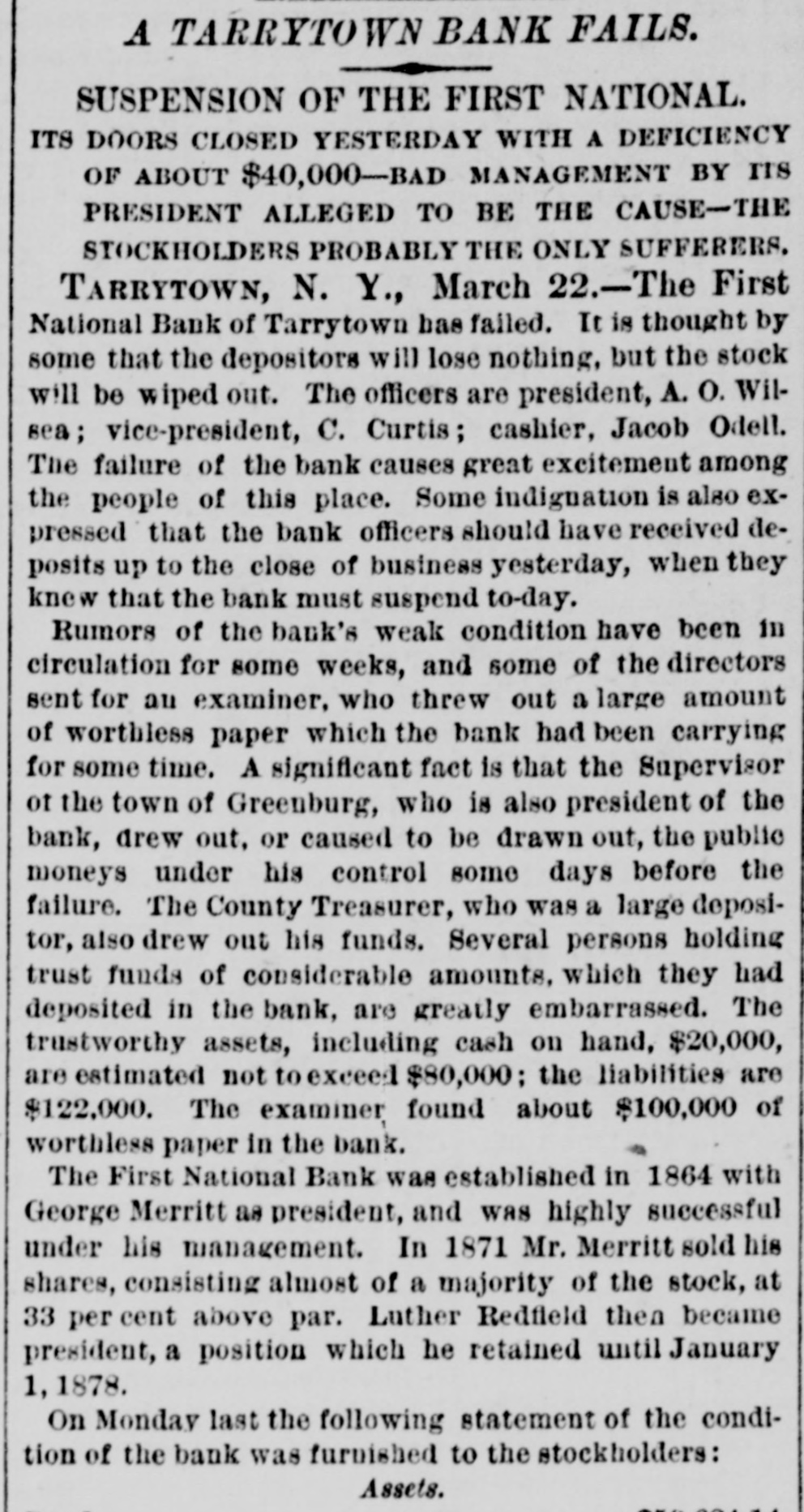
A TARRYTOWN BANK FAILS. SUSPENSION OF THE FIRST NATIONAL. ITS DOORS CLOSED YESTERDAY WITH A DEFICIENCY OF ABOUT $40,000-BAD MANAGEMENT BY ITS PRESIDENT ALLEGED TO BE THE CAUSE-THE STOCKHOLDERS PROBABLY THE ONLY SUFFERERS. TARRYTOWN, N. Y., March 22.-The First National Bank of Tarrytown bas failed. It is thought by some that the depositors will lose nothing, but the stock will be wiped out. The officers are president, A. O. Wilsea; vice-president, C. Curtis; cashier, Jacob Odell. The failure of the bank causes great excitement among the people of this place. Some indignation is also expressed that the bank officers should have received deposits up to the close of business yesterday, when they knew that the bank must suspend to-day. Rumors of the bank's weak condition have been in circulation for some weeks, and some of the directors sent for an examiner, who threw out a large amount of worthless paper which the bank had been carrying for some time. A significant fact is that the Supervisor of the town of Greenburg, who is also president of the bank, drew out, or caused to be drawn out, the public moneys under his control some days before the failure. The County Treasurer, who was a large depositor, also drew out his funds. Several persons holding trust funds of considerable amounts, which they had deposited in the bank, are greatly embarrassed. The trustworthy assets, including cash on hand, $20,000, are estimated not to exceed $80,000; the liabilities are $122,000. The examiner found about $100,000 of worthless paper in the bank. The First National Bank was established in 1864 with George Merritt as president, and was highly successful under his management. In 1871 Mr. Merritt sold his shares, consisting almost of a majority of the stock, at 33 per cent above par. Luther Redfield then became president, a position which he retained until January 1, 1878. On Monday last the following statement of the condition of the bank was furnished to the stockholders: Assets.


Article from New-York Tribune, March 23, 1878

Click image to open full size in new tab

Article Text

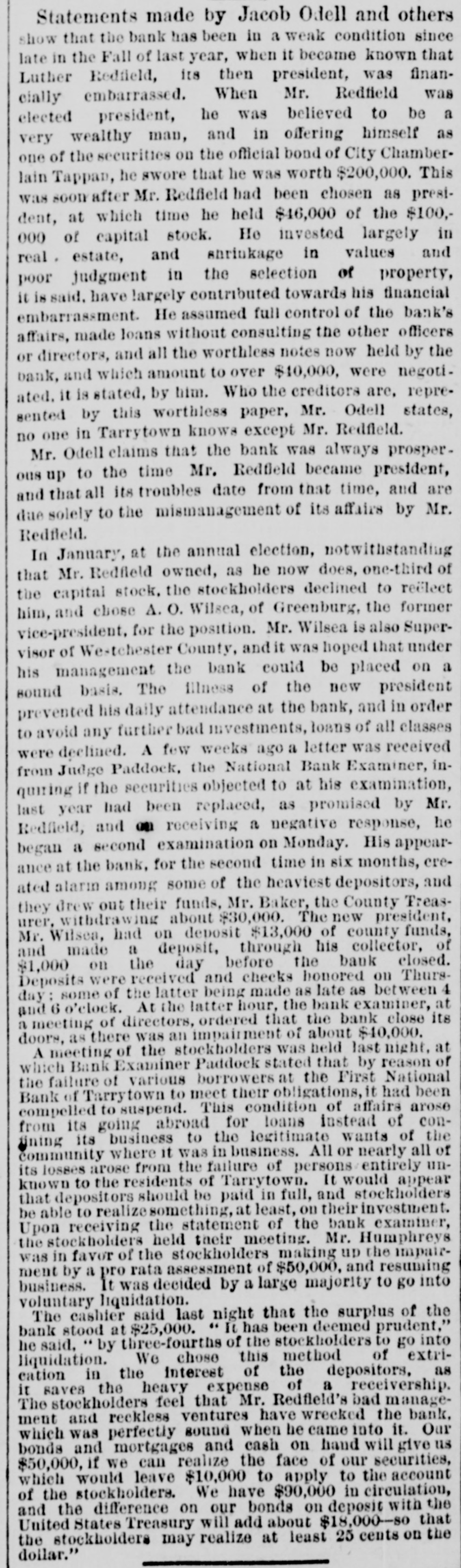
Statements made by Jacob Odell and others show that the bank has been in a weak condition since late in the Fall of last year, when it became known that Luther Redfield, its then president, was financially embarrassed. When Mr. Redfield was elected president, he was believed to be a very wealthy man, and in offering himself as one of the securities on the official bond of City Chamberlain Tappan, he swore that he was worth $200,000. This was soon after Mr. Redfield had been chosen as president, at which time he held $46,000 of the $100,000 of capital stock. He invested largely in real, estate, and shrinkage in values and poor judgment in the selection of property, it is said, have !argely contributed towards his financial embarrassment. He assumed full control of the bank's affairs, made loans without consulting the other officers or directors, and all the worthless notes now held by the bank, and which amount to over $40,000, were negotiated. it is stated, by him. Who the creditors are, represented by this worthless paper, Mr. Odell states, no one in Tarrytown knows except Mr. Redfield. Mr. Odell claims that the bank was always prosperous up to the time Mr. Redfield became president, and that all its troubles date from that time, and are due solely to the mismanagement of its affairs by Mr. Redfield. In January, at the annual election, notwithstanding that Mr. Redfield owned, as he now does, one-third of the capital stock, the stockholders declined to reΓ«lect him, and chose A. O. Wilsea, of Greenburg, the former vice-president, for the position. Mr. Wilsea is also Supervisor of Westchester County, and it was hoped that under his management the bank could be placed on a sound basis. The illness of the new president prevented his daily attendance at the bank, and in order to avoid any further bad investments, loans of all classes were declined. A few weeks ago a letter was received from Judge Paddock, the National Bank Examiner, inquiring if the securities objected to at his examination, last year had been replaced, as promised by Mr. receiving a negative response, he Redfield, and began a second examination on Monday. His appearance at the bank, for the second time in six months, created alarm among some of the heaviest depositors, and they drew out their funds, Mr. Baker, the County Treasurer, withdrawing about $30,000. The new president, Mr. Wilsea, had on deposit $13,000 of county funds, and made a deposit, through his collector, of $1,000 on the day before the bank closed. Deposits were received and checks honored on Thursday; some of the latter being made as late as between 4 and 6 o'clock. At the latter hour, the bank examiner, at a meeting of directors, ordered that the bank close its doors, as there was an impairment of about $40,000. A meeting of the stockholders was held last night, at which Bank Examiner Paddock stated that by reason of the failure of various borrowers at the First National Bank of Tarrytown to meet their obligations, it had been compelled to suspend. This condition of affairs arose from its going abroad for loans instead of confining its business to the legitimate wants of the community where it was in business. All or nearly all of its losses arose from the failure of persons entirely unknown to the residents of Tarrytown. It would appear that depositors should be paid in full, and stockholders be able to realize something, at least, on their investment. Upon receiving the statement of the bank examiner, the stockholders held their meeting. Mr. Humphreys was in favor of the stockholders making up the impairment by a pro rata assessment of $50,000, and resuming business. It was decided by a large majority to go into voluntary liquidation. The cashier said last night that the surplus of the bank stood at $25,000. " It has been deemed prudent," he said, by three-fourths of the stockholders to go into liquidation. We chose this method of extrication in the interest of the depositors, as it saves the heavy expense of a receivership. The stockholders feel that Mr. Redfleld's bad management and reckless ventures have wrecked the bank. which was perfectly sound when he came into it. Our bonds and mortgages and cash on hand will give us $50,000, if we can realize the face of our securities, which would leave $10,000 to apply to the account of the stockholders. We have $90,000 in circulation, and the difference on our bonds on deposit with the United States Treasury will add about $18,000-so that the stockholders may realize at least 25 cents on the doilar."


Article from The Sun, March 23, 1878

Click image to open full size in new tab

Article Text

EXIT THETARRYTOWN BANK. CLOSING AFTER THIRTEEN YEARS OF PUBLIC CONFIDENCE. Examiner Paddock's Exhibit of Its Condition Followed by the Officers Going into Liquidation-How Its Mairs were Managed. For some weeks past the stockholders and some of the depositors in the First National Bank of Tarrytown have been uneasy regarding the condition of that institution. On Tuesday last Bank Examiner H. A. Paddock of Malone began an investigation that resulted in his advising the officers of the bank to suspend. This they did vesterday. and at 9 o'clock in the morning a notice on the bank door informed the public that the bank would receive no more money on deposit. At a meeting of the stockholders, representing more than two-thirds of the stock, Inst evening. it was decided to go into voluntary liquidation. Judge Paddock's exhibit of the condition of the bank, on Tuesday last, is as follows:


Article from Evening Star, March 23, 1878

Click image to open full size in new tab

Article Text

THE NATIONAL BANK OF TARRYTOWN, N. Y. has failed. It is thought the depositors will lose nothing, but the stock will be wiped out. There is great excitement, and indignation is expressed because the bank received deposits Thursday, when the officers knew it must suspend yesterday. The bank has been carrying a large amount of worthless paper for some time. The president of the bank, who is supervisor of Greenburgh, drew out the public moneys in his charge some days ago, and the county treasurer also drew out his deposits. Several depositors of trust funds are greatly embarrassed. The liabilities of the bank are $122,000 reliable assets $20,000.


Article from The Wheeling Daily Intelligencer, March 23, 1878

Click image to open full size in new tab

Article Text

BUSINESS EMBARRANSMENTN. TARRYTOWN, N. Y., March 22.-The First National Bank has failed. Second Dispatch. DID SHERMAN CAUSE THIS FAILURE? TARRYTOWN, N. Y., March 22.-The failure of the First National Bank of Tarrytown causes much excitement among the people. Some indignation is expressed that the bank officers should have received deposits up to the close of business yeaterday, when they knew the bank must suspend today. The Exam. iner threw out a large amount of worthless paper which the bank had been carrying for some time, and the Supervisor of Greenburgh, who is President of the bank, had the public moneys under his control withdrawn some days before the failure. The County Treasurer also drew out his deposits. Several parties holding trust fund deposits in the bank are greatly embarrassed. The assets, including $20,000 cash on hand, are estimated not to exceed $80,000; liabilities $122,000. The Examiner found about $100,000 of worthless paper in the bank. POUGHKERPSIR, March 22.-The National Bank of Tarrytown has suspended. The securities on which $103,000 were loaned to New York parties proved worthless.


Article from The Wheeling Daily Register, March 23, 1878

Click image to open full size in new tab

Article Text

ELECTRICSPARKS. The Bank of Chemung, at Elmira, N. Y, has suspended. The National Bank of Tarrytown, New York, has suspended. James Ross Snowden, formerly director of the United States mint, died at Hulmville, Pa., yesterday. The Democratic State Convention of Rhode Island nominated J. B. Barnard for Governor, and Isaac Lawrence for Lieutenant- Governor.


Article from Daily Los Angeles Herald, March 23, 1878

Click image to open full size in new tab

Article Text

Bank suspension. POUGHKEEPSIE, N. Y., March 22. The National Bank at Tarrytown nsa suspended, thesecurity on which $108,000 is loaned to New York parties, being worthless. The bank can pay one hundred cents on the dollar by taxing the stockholders.


Article from The Daily Dispatch, March 23, 1878

Click image to open full size in new tab

Article Text

New York. FAILURE OF A BANK. TARRYTOWN, March 22.-The National Bank of Tarrytown has failed. Some think that the depositors will lose nothing. The stock will be wiped out. THE CONSPIRACY AGAINST HENY CLEWS. NEW YORK, March 22.-The indictment against Henry Clews, the ex-banker, has been nolle prosequied. Clews has obtained warrants against the conspirators. BANK SUSPENSION-FACTORY BURNED. ELMIRA, N. Y., March 22.-The bank at Ithemung suspended to-day. It was a private banking institution, conducted. by Henry W. Beale, who makes an assignment to F. G. Hall and S. L. Gillet. The amount of deposits was $280,000. The discounts and overdrafts are reported at $260,000. The loss to depositors is serious. John J. Vick's tobacco factory was burned yesterday. Loss. $25,000; insurance, $23,500.


Article from Daily Press and Dakotaian, March 25, 1878

Click image to open full size in new tab

Article Text

LATEST BY MAIL. -James Rose Snowden, formerly state treasurer and director of the United States mints, died Friday at Homesville, Pa. Negotiations between Hobart Pasha and the Greek insurgents have ended, Hobart refusing to recognige the provisional government of Thernaly. There is much excitement and indignation over the suspension of the national bank of Tarrytown, New York. The bank received deposits up to the close. Liabilities, $122,000 assets, $80,000. The examiner found about $100,000 in paper is the bank.


Article from New-York Tribune, March 26, 1878

Click image to open full size in new tab

Article Text

RECEIVER FOR THE BROKEN TARRYTOWN BANK. The Controller of the Currency, on Saturday, appointed Orson Adams, of Baltimore, temporary receiver of the First National Bank of Tarrytown, and be took charge of its affairs yesterday. Mr. Adams will immediately begin an examination of the assets and liabilities of the institution.


Article from The Kenosha Telegraph, March 28, 1878

Click image to open full size in new tab

Article Text

DOMESTIC INTELLIGENCE. East. Owing to the recent panic among savingsbank depositors, the Massachusetts Legislature has enacted a law to prevent depositors from drawing their money. It is entitled "an act for the better protection of depositors in savings banks," and an idea of its provisions may be obtained from a Boston dispatch, which says "the Brighton Five-Cent Savings Bank promptly availed itself of the law, and the Bank Commissioners directed that from March 21 to Sept. 21 not over 10 per cent. be paid each depositor ; 10 per cent. additional be paid between Sept. 21 and March 21, 1879. No further additional amount to be paid after the latter date except by order of the Commissioners." Two negroes, Samuel Chambers and George Collins, were hanged at New Castle, Del., on the 22d of March, for the crime of rape. The National Bank of Tarrytown, N. Y., has failed. Liabilities about $60,000 in excess of assets. Isaac Adams, the printing-press manufact urer, died at Sandwich, N. H., last week, leaving a fortune estimated at from $4,000,000 to $6,000,000. He bought what is known as the Adams printing press from the inventor for an old gun. A young man was knocked down in the streets of Brooklyn, N. Y., the other day, and robbed of $3,500. He had just drawn the money from a bank for a large manufacturing firm, for the purpose of paying the workmen. The highwaymen, four in number, escaped. Mrs. Lucy L. Day, an old woman aged 80, was murdered near Syracuse, N. Y., the other day, by her daughter, a married woman aged 46, who stabbed her at the dinner-table with a knife. Peter McHugh, Patrick Hester and Patrick Tully, members of the " Mollie Maguire" organization, were executed at Bloomsburg, Pa., on Monday, March 25, for the murder of Alexander W. Rea. A fire on Fourth street, Philadelphia, last week, destroyed a large number of stores and manufacturing houses. Loss estimated at $1,000,000. West. Chicago elevators csntain 1,351,601 bushels of wheat 252,225 bushels of corn; 225,938 bushels of oats ; 167,877 bushels of rye, and 612,107 bushels of barley, making a grand total of 2,609,743 bushels, against 8,572,279 bushels at this period last year. Cleveland had a $200,000 blaze last week.


Article from The Iowa Plain Dealer, March 29, 1878

Click image to open full size in new tab

Article Text

DOMESTIC INTELLIOENCE. Kamt. Owing to the recent panic among unvinge. bank depositors, the Mannachurette Loginlature has enacted a law to prevent depositors from drawing their money. It in entitled 'an act for the better protection of depositors in savings banks," and all Idea of its provisions may be obtained from a Boston dispatch, which sayn "the Brighton Five-Cout Savingu Bank promptly availed itsulf of the law, and the Huiik Commissioners directed that from March 81 to Sept. 21 not over 10 per cont. be paid each depositor 10 per cent. additional be paid between Sept. 21 and March 21, 1879. No further additional amount to be paid after the latter date except by order of the Commissioners." Two negroon, Hamuel Chambers and George Collins, were hanged at New Cantic, Del., on the 22d of March, for the crime of rape. The National Bank of Tarrytown, N. Y., has failed. Liabilities about $60,000 in excess of assets. Isaan Adams, the printing-prone manufact urer, died at Handwich, N. II., laut week, way Ing n fortune estimated at from 84,000,000 to $6,000,000. He bought what in known as the Adams printing pross from the Inventor for an old gun. A young man was knocked down in the streets of Brooklyn, N. Y., the other day, and robbed of $3,500. He had just drawn the money from a bank for a large manufacturing firm, for the purpose of paying the workmen. The highwaymen, four in number, escaped. Mrs. Lucy I.. Day, an old woman aged 80, was murdered near Hyracuse, N. Y., the other day, by her daughter, a married woman award 16, who stabbed her at the dianor-table with a knife. West. Oliver A. Willard, for the pant Ave years editor-in-chief of the Chicago Keening Post, in dead. Chicago elevators contain 1,351,601 bushels of wheal; 252,225 bushels of corn 225,938 bushels of cata; 167,877 bushola of rye, and 612,107 bushels of barley, making a grand total of 2,609,743 bushels, against 8,572,279 bushels nt this period last year. Cleveland had a $200,000 blazo lant week. The victima were the Non-Explosive Lamp Company. Reports that asem to be trustworthy from the region on both aiden of the Dominion line, north and northweat of Fort Benton, leave little room to doubt that the hostile Indians are proparing for n Keneral war upon the Montana and Dakota muttlements. More than a dozon large bands of Indiana are rouning about, ostenably engaged in hunting, but with supplies of am. munition so abundant as to prove their hostile intentions. Heonta who have vinited the campa of there maragen, josue across the boundary. estimate the number of warriors at 5,000 or 6,000. Mouth. A New Orleans dispatch ways that, In the came of the State va. Thomas c. Auderson (on an apneal for a now total). the Hupreme Court re verand the verdiot of the jury, and ordered the primoner to be released. The court hold thene the alteration of the Vernon county return did not constitute forgery. Tesas highwaymen have been at their work again. A train ou the Texas Central railroad was robbed by four masked men near Hutchina, Dallas county. The espress matter was taken, the mail plundered, and the espress memorager wounded. A horrible crimo wan committed lane week near Wherihuk. W. Va. The bodies of Mrn. George Wallace, her 4-months-old child, and her nice, aged 14, were found murdered. and their bodies shockingly multiated. The hum band of the murdered woman and his bruther are under arreut, charged with the deed. A Richmond (Va.) dispatch mayn three men named McFadden, one named Moody and colored man were drowned recently while no. tempting to cross the James river, near Pallernou's lauding. By the explosion of a new-mill bottor near


Article from The Emporia News, March 29, 1878

Click image to open full size in new tab

Article Text

On the 21st, the First National bank, Tarrytown, N. Y., and the Chemung county bank, Elmira, N. Y., failed. On the 22d the Broad way bank, Lawrence, Mass., with $1,668,987 on deposit, mostly belonging to the working people of that city, gave the usual evidence of failure by requiring two week's notice before paying depositors. The run of the savings banks at Boston has either stopped or busted their institutions, but in either case the telegrams are silent.


Article from Essex County Herald, April 5, 1878

Click image to open full size in new tab

Article Text

SUMMARY OF NEWS Eastern and Middle States. A bill to grant female suffrage has been Γ³ fested in the lower house of the Massachuset Legislature by 127 to 93. insurance James E. Goll, well-known in New Yo ciroles, committed suicide by sho ing himself in the head. He was at one tir wealthy, but met with reverses, had fam troubles and became dissipated. The Rhode Island Republicans met in 00 vention at Providence and renominated t present State officers by acclamation Follo ing the usual custom, no political resolutio were passed. The Tarrytown (N. Y.) First National Ba has failed. The liabilities are estimated $122,000 and assets $80,000. The Bank Chemung, at Elmira, N. private instit tion-has also suspended. The Rhode Island Democratic State eo vention, held in Providence, resulted in nomination of a ticket headed by Isaac La rence for governor. Leading New York bankers had & conferer in that city with the House committee bar ing and currency regarding the resumption specie payments. General Ewing, of the co mittoe, the made inquiries to draw out the views bankers, who expressed the opinion t1 resumption was practicable. After the meeti General Ewing said that the statements of bankers had strengthened his own opinion the secretary of the treasury was not able tl carry out the resumption act. Before a committee of the Pennsylvania L islature railroad appointed to investigate the Pittsbur riots, R. A. Ammon, of Pittsburg, W was at the head of the Trainmen's Union the time of the strike, testified that the c zens offered the strikers arms to resist troops, two prominent citizens having offer a hundred stand of arms each: one of the zens went to see him at Allegheny him that he hoped the men would stand their money. rights, and promised them arms a The steam chimney of the Hudson ri steamer Magenta exploded two miles bel Sing Sing, N. Y., and two passengers W killed outright, two were fatally scalded, a several others received serious injuries. Warren Lane, bookkeeper of the Planet M Manufacturing Company, Brooklyn, N. New was returning from the company's bank York where he had drawn $4,000 W which to pay off the empl byees. He was companied by an assistant, who carried $700 silver. were When in an unfrequented locality tl approached by three men dressed laborers, who suddenly attacked the clubs knocking them down with blows from 88 t and relieving them of the money i the twinkling. Before they could gain their f thieves were rattling off in wagon was waiting in charge of a confederate 8 made good their escape. Peter McHugh, Patrick Hester and Patr Tully the were hanged at Bloomsburg, Pa., Rea, murder of a mining superintendent nan in 1868. The town was filled with peo from the surrounding country, but only ab two hundred persons were admitted to the three yard where the execution took place. little men were hanged together and exhibit signs of fear. Hester, who was in stantial circumstances and for whom stre ous efforts had been made to obtain an am oration of the death sentence, protested innocence to the last. While the men w still hanging, a shedon the side of the jail y d gave way with a crash, precipitating ab fifty persons to the ground and injuring little boy 80 severely that he died soon aft S Fires Twenty-three buildings destro by fire in Keeseville, N. Y., causing a loss e gregating $65,000. Nearly a whole block large business houses in Philadelphia has burned, the fire being one of the largest t ever visited the city and causing an e mated loss of over $1,010,000. Comptroller John Kelly, of New York ci has the written letter to the attorney general State in favor of the release of William e Tweed from further confinement. Comptro Kelly says in his letter As public office d urge his discharge, because I believe further detention in a debtors prison is neit beneficial to the State as an example to e doers, nor in any sense serviceable to the cit e Meanwhile, Tweed has refused to tes further he in regard to the ring frauds u is released. p The Higgins Building-a five-story mar structure on Canal street, New Yorkalmost totally destroyed by fire, and sevent business $645,000. firms suffered losses aggregat e Lockwood, Brooks & Co., Boston book p g lishers, $120,000. have suspended with liabilities Judge Blatchford, of New York, has 1 d dered J. an opinion against Ex-Governor Sam IS the Tilden, in the suit of the United States It recovery of several years' income IS This suit was instituted during the elect e campaign in 1876. The effect of the decis h will be to bring the case before a jury on question of the amount of Mr. Tilden's inco If during ing the eleven years from 1862'to 1872, d which he made up no return himself 38 allowed the assessors to make up the ret -1 and paid the tax thereon subject to a pens of five per cent. rs The Broadway Savings Bank, of Lawrer st Mass., and the Sixpenny Savings Bank er New further rk city, have been enjoined from do IS business. The latter institution O patronize by the remarkably large number d 33,000 and depositors, most of them poor children with little accounts. Its pec lial mated t'es are and the deficiency is at $82,425. Careless management 11 amounting to almost indifference. is char against its officers by the bank examiners. The trial of Insurance Superintendent Smy of New York, charged by the governor V s, irregularities in office, ended in his acqui 7e by the Senate by a vote of to 12. The Vanderbilt contested will case dr at of a'ong in the New York surrogate's court. M se the evidence offered to show that the C ve m dore was mentally unsound or unduly in enced in making his will is excluded. of The Pennsylvania Republican State cony n. tion will be held at Harrisburg, May 15. k, The recent report of Acting Superintend ag Henry L. Lamb on the condition of the sav 1 banks"in nine the State of New York shows at the savings banks were closed during 18' Long Island, of Brooklyn: Clairmont, ay ton, German, Oriental and Yorkville, of York toga Rockland. of Nyack: Saratoga, of S total Springs; and the New Rochelle, wit In amount due depositors of $1,601,719 the State, to-day 136 savings banks he doing ber business. The total deposits and the re year. of depositors have decreased during 10 the The deposits fell off nearly $4,000,0 a transactions of the year were smalle I accounts their volume than in other recent years n were opened than were closed us average of each deposit declined, and the tplus of the institutions has shrunk. The ot resources of the banks, now in operation, t is on January 1, 1878. $56,785,336 total lial d 098. ties, $51 455. 238, leaving a surplus of $5,3 From these facts the superintend its finds reason for the belief that the nd banks are coming back to sound rules savi in a ministration. are commanding reasonable o he fidence of depositors, and are sound. Western and Southern States. er Howards Four men and a boy were drowned n
Article from The Sun, April 13, 1878

Click image to open full size in new tab

Article Text

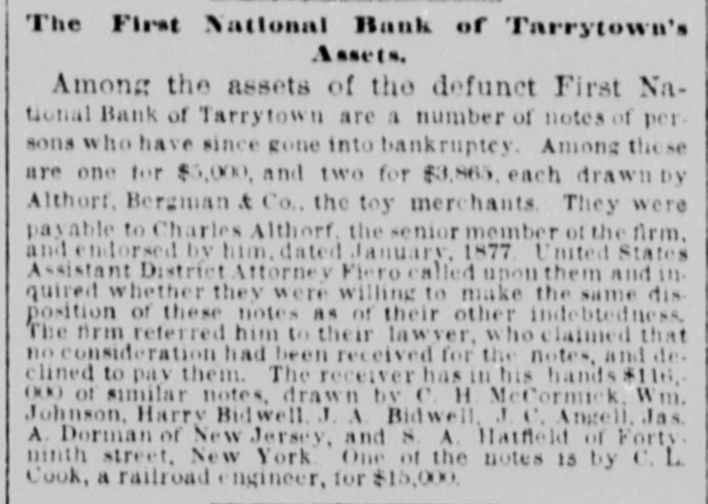
The First National Bank of Tarrytown's Assets. Among the assets of the defunct First National Bank of Tarrytown are a number of notes of persons who have since gone into bankruptey. Among these are one for $5,000, and two for $3,865. each drawn by Althorf, Bergman & Co., the toy merchants. They were payable to Charles Althorf. the senior member of the firm. and endorsed by him. dated January, 1877. United States Assistant District Attorney Fiero called upon them and inquired whether they were willing to make the same disposition of these notes as of their other indebtedness. The firm referred him to their lawyer, who claimed that no consideration had been received for the notes, and declined to pay them. The receiver has in his hands $116,000 of similar notes, drawn by C. H. McCormick, Wm. Johnson, Harry Bidwell. J. A. Bidwell, J. C. Angell, Jas. A. Dorman of New Jersey, and S. A. Hatfleld of Forty. ninth street, New York. One of the notes 15 by C. L. Cook, a railroad engineer, for $15,000.


Article from The New York Herald, May 4, 1878

Click image to open full size in new tab

Article Text

THE FIRST DIVIDEND. Receiver Adams, of the First National Bank of Tarrytown, proposes to commence to-day the payment of a twenty-five per cent dividend among the depositors of that institution.


Article from The New York Herald, August 13, 1878

Click image to open full size in new tab

Article Text

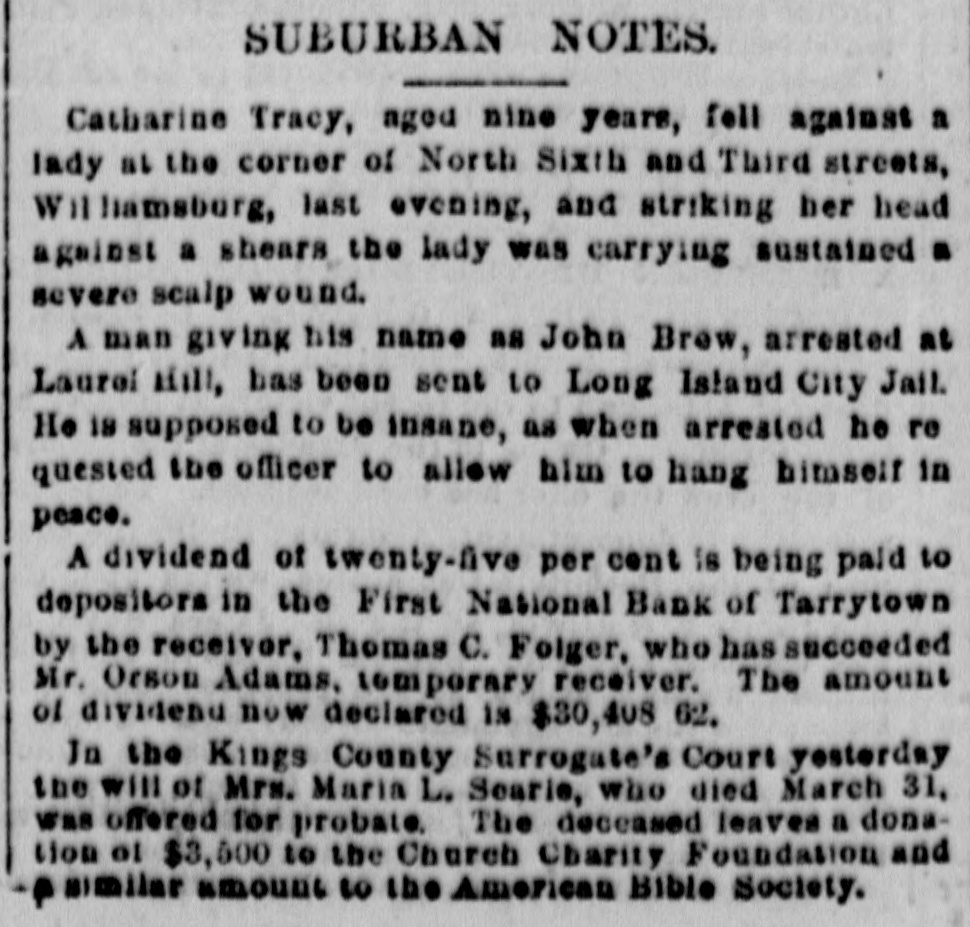
SUBURBAN NOTES. Catharine Tracy, aged nine years, fell against a lady at the corner of North Sixth and Third streets, Will hamsburg, last evening, and striking her head against a shears the lady was carrying sustained a severe scalp wound. A man giving his name as John Brew, arrested at Laurel Hill, has been sent to Long Island City Jail. He is supposed to be insane, as when arrested he re quested the officer to allow him to hang himself in peace. A dividend of twenty-five per cent is being paid to depositors in the First National Bank of Tarrytown by the receiver, Thomas C. Folger, who has succeeded Mr. Orson Adams, temporary receiver. The amount of dividend now declared is $30,408 62. Ja the Kings County Surrogate's Court yesterday the will of Mrs. Maria L. Searie, who died March 31, was offered for probate. The deceased leaves a donation of $3,500 to the Church Charity Foundation and p mimilar amount to the American Bible Society.


Article from New-York Tribune, October 2, 1878

Click image to open full size in new tab

Article Text

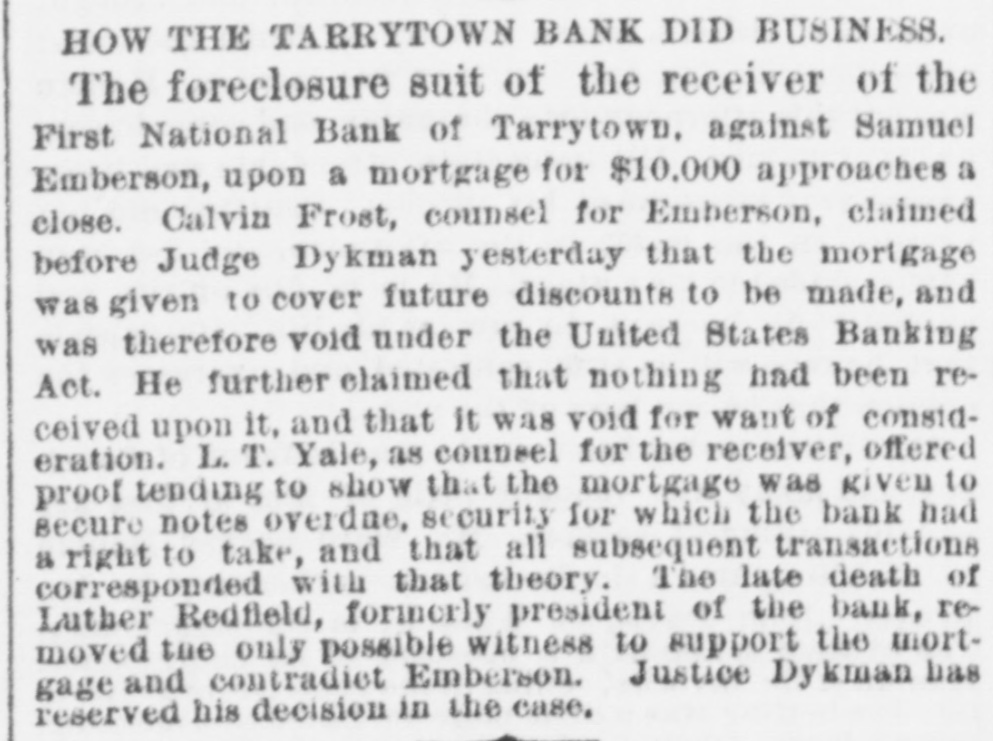
HOW THE TARRYTOWN BANK DID BUSINESS. The foreclosure suit of the receiver of the First National Bank of Tarrytown, against Samuel Emberson, upon a mortgage for $10.000 approaches a close. Calvin Frost, counsel for Emberson, claimed before Judge Dykman yesterday that the mortgage was given to cover future discounts to be made, and was therefore void under the United States Banking Act. He further claimed that nothing had been received upon it, and that it was void for want of consideration. L. T. Yale, as counsel for the receiver, offered proof tending to show that the mortgage was given to secure notes overdue, security for which the bank had 8 right to take, and that all subsequent transactions corresponded with that theory. The late death of Luther Redfield, formerly president of the bank, removed tue only possible witness to support the mortgage and contradict Emberson. Justice Dy kman has reserved his decision in the case.


Article from The New York Herald, December 19, 1878

Click image to open full size in new tab

Article Text

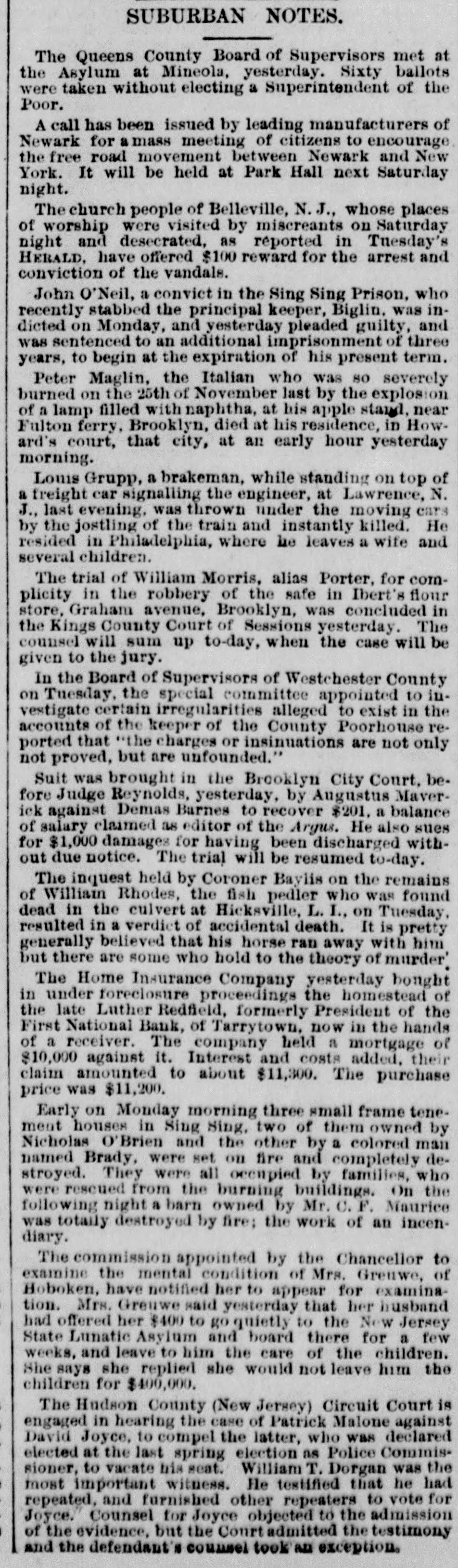
# SUBURBAN NOTES. The Queens County Board of Supervisors met at the Asylum at Mineola, yesterday. Sixty ballots were taken without electing a Superintendent of the Poor. A call has been issued by leading manufacturers of Newark for a mass meeting of citizens to encourage the free road movement between Newark and New York. It will be held at Park Hall next Saturday night. The church people of Belleville, N. J., whose places of worship were visited by miscreants on Saturday night and desecrated, as reported in Tuesday's HERALD, have offered $100 reward for the arrest and conviction of the vandals. John O'Neil, a convict in the Sing Sing Prison, who recently stabbed the principal keeper, Biglin, was indicted on Monday, and yesterday pleaded guilty, and was sentenced to an additional imprisonment of three years, to begin at the expiration of his present term. Peter Maglin, the Italian who was so severely burned on the 25th of November last by the explosion of a lamp filled with naphtha, at his apple stand, near Fulton ferry, Brooklyn, died at his residence, in Howard's court, that city, at an early hour yesterday morning. Louis Grupp, a brakeman, while standing on top of a freight car signalling the engineer, at Lawrence, N. J., last evening, was thrown under the moving cars by the jostling of the train and instantly killed. He resided in Philadelphia, where he leaves a wife and several children. The trial of William Morris, alias Porter, for complicity in the robbery of the safe in Ibert's flour store, Graham avenue, Brooklyn, was concluded in the Kings County Court of Sessions yesterday. The counsel will sum up to-day, when the case will be given to the jury. In the Board of Supervisors of Westchester County on Tuesday, the special committee appointed to investigate certain irregularities alleged to exist in the accounts of the keeper of the County Poorhouse reported that "the charges or insinuations are not only not proved, but are unfounded." Suit was brought in the Brooklyn City Court, before Judge Reynolds, yesterday, by Augustus Maverick against Demas Barnes to recover $201, a balance of salary claimed as editor of the Argus. He also sues for $1,000 damages for having been discharged without due notice. The trial will be resumed to-day. The inquest held by Coroner Baylis on the remains of William Rhodes, the fish pedler who was found dead in the culvert at Hicksville, L. I., on Tuesday, resulted in a verdict of accidental death. It is pretty generally believed that his horse ran away with him but there are some who hold to the theory of murder. The Home Insurance Company yesterday bought in under foreclosure proceedings the homestead of the late Luther Redfield, formerly President of the First National Bank, of Tarrytown, now in the hands of a receiver. The company held a mortgage of $10,000 against it. Interest and costs added, their claim amounted to about $11,300. The purchase price was $11,200. Early on Monday morning three small frame tenement houses in Sing Sing, two of them owned by Nicholas O'Brien and the other by a colored man named Brady, were set on fire and completely destroyed. They were all occupied by families, who were rescued from the burning buildings. On the following night a barn owned by Mr. C. F. Maurice was totally destroyed by fire; the work of an incendiary. The commission appointed by the Chancellor to examine the mental condition of Mrs. Greuwe, of Hoboken, have notified her to appear for examination. Mrs. Greuwe said yesterday that her husband had offered her $400 to go quietly to the New Jersey State Lunatic Asylum and board there for a few weeks, and leave to him the care of the children. She says she replied she would not leave him the children for $400,000. The Hudson County (New Jersey) Circuit Court is engaged in hearing the case of Patrick Malone against David Joyce, to compel the latter, who was declared elected at the last spring election as Police Commissioner, to vacate his seat. William T. Dorgan was the most important witness. He testified that he had repeated, and furnished other repeaters to vote for Joyce. Counsel for Joyce objected to the admission of the evidence, but the Court admitted the testimony and the defendant's counsel took an exception.