14431. Sixpenny Savings Bank (New York, NY)

Bank Information

Episode Type
Run → Suspension → Closure
Bank Type
savings bank
Start Date
March 27, 1878
Location
New York, New York (40.714, -74.006)

Metadata

Model
gpt-5-mini
Short Digest
68ff3fb51292786f

Response Measures

None

Description

Articles report a crowd/run at the Sixpenny (Mar 28, 1878), announcement of suspension (Mar 27, 1878), appointment of a court receiver (William F. Russell) Mar 29, 1878, and subsequent dividend payments by the receiver over the following years. The bank was closed and placed in receivership (permanent closure), so sequence is run → suspension → closure/receivership. Cause of run/suspension is insolvency/mismanagement (bank-specific adverse information).

Events (5)

1. March 27, 1878 Suspension
Cause
Bank Specific Adverse Info
Cause Details
Examiners reported mismanagement and that liabilities exceeded assets; suspension ordered after discovery of deficit and improper investments.
Newspaper Excerpt
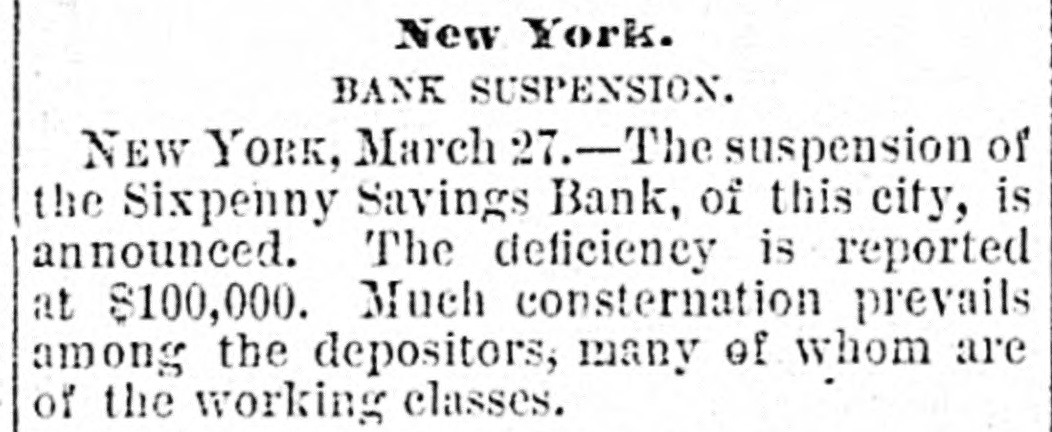
The suspension of the Sixpenny Savings Bank, of this city, is announced.
Source
newspapers
2. March 28, 1878 Run
Cause
Bank Specific Adverse Info
Cause Details
Crowds gathered and heavy withdrawals after reports of insolvency, rumors that favored depositors were paid after injunction; loss of confidence following revelations of mismanagement and deficient assets.
Measures
Bank guarded; only stockholders and officers admitted; injunction to close served (court action).
Newspaper Excerpt
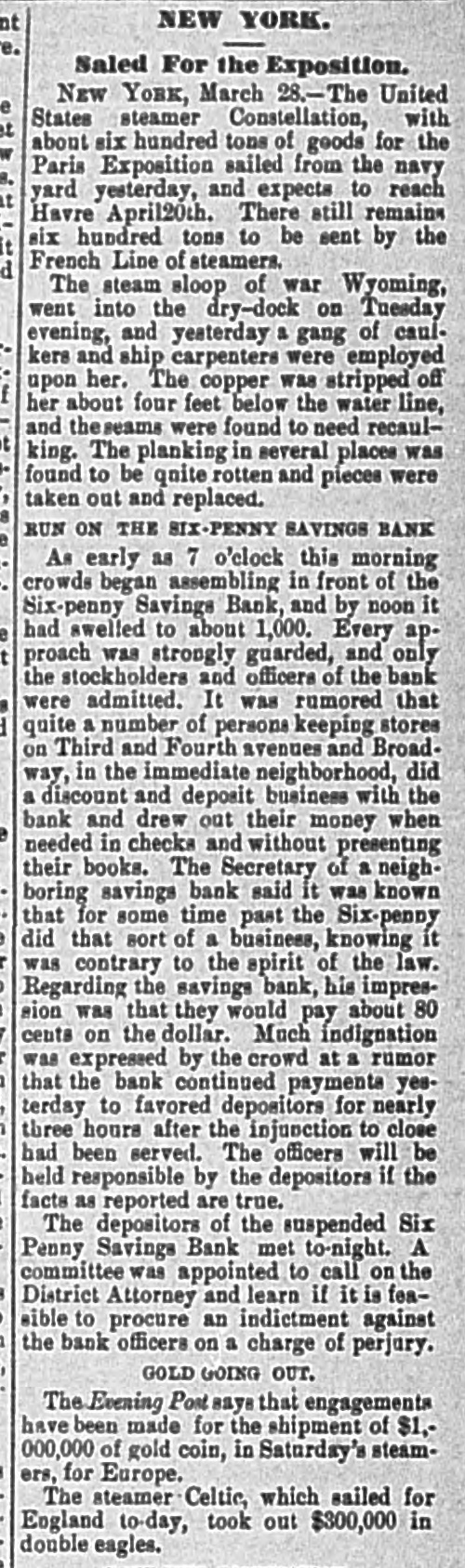
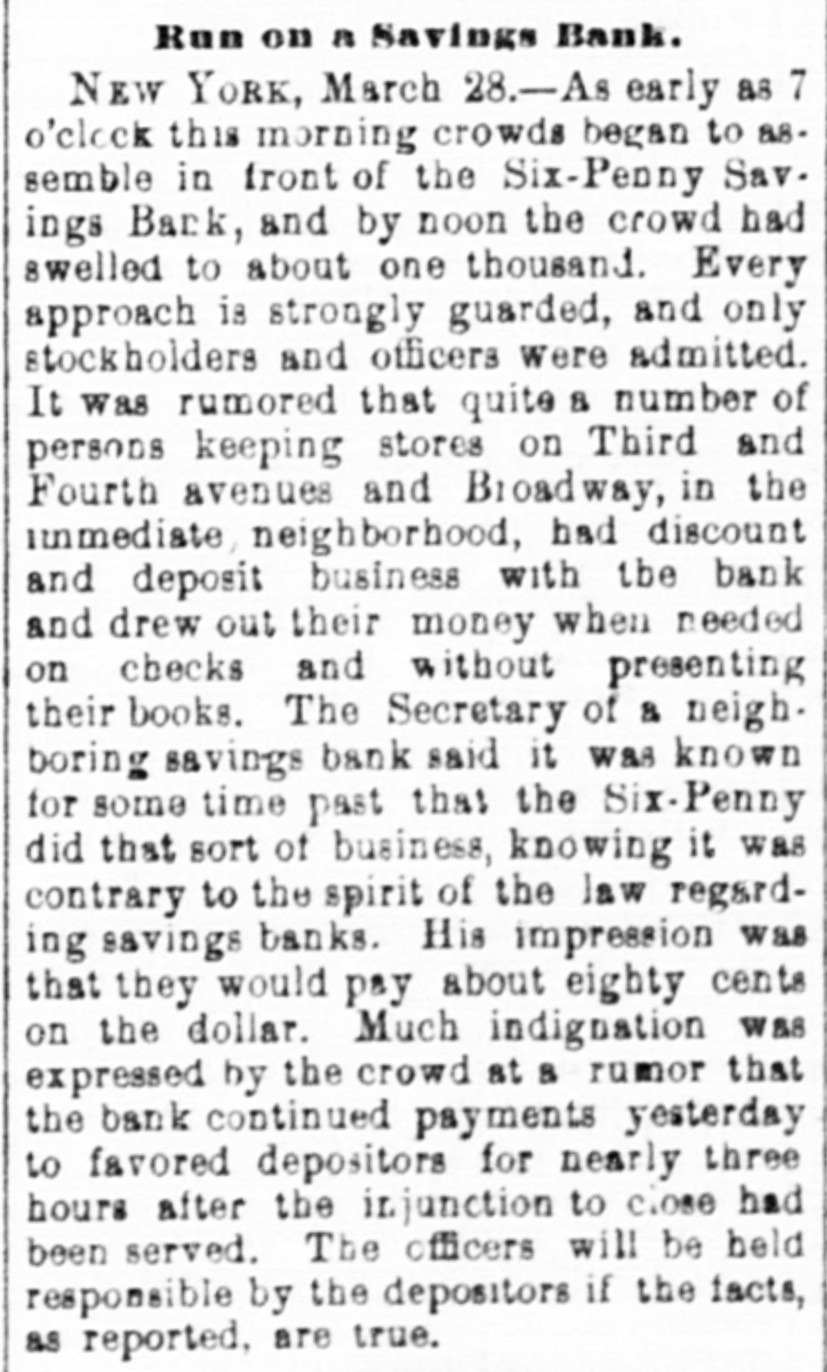
As early as 7 o'clock this morning crowds began assembling in front of the Six-penny Savings Bank, and by noon it had swelled to about 1,000.
Source
newspapers
3. March 29, 1878 Receivership
Newspaper Excerpt
Judge Westbrook appointed William F. Russell, of Saugerties, receiver.
Source
newspapers
4. July 31, 1878 Other
Newspaper Excerpt
Receiver Russell began yesterday the payment of fifty cents on the dollar to the depositors of the Sixpenny Savings Bank.
Source
newspapers
5. March 16, 1882 Other
Newspaper Excerpt
Receiver William F. Russell ... began paying the fourth and final dividend of that institution ... The bank was closed March 27, 1878 ... The first was 50 per cent, the second 15, the third 10, and the last will be 10.55, making in all 85.55 per cent.
Source
newspapers

Newspaper Articles (24)

Article from The Daily Dispatch, March 28, 1878

Click image to open full size in new tab

Article Text

New York. BANK SUSPENSION. NEW YORK, March 27.-The suspension of the Sixpenny Savings Bank, of this city, is announced. The deficiency is reported at $100,000. Much consternation prevails among the depositors, many of whom are of the working classes.


Article from The Wheeling Daily Intelligencer, March 29, 1878

Click image to open full size in new tab

Article Text

NEW YORK. at e. Saled For the Exposition. NEW YORK, March 28.-The United States steamer Constellation, with about six hundred tons of goods for the Paris Exposition sailed from the navy 8. yard yesterday, and expects to reach it Havre April20th. There still remains six hundred tons to be sent by the it French Line of steamers. d The steam sloop of war Wyoming, went into the dry-dock on Tuesday evening, and yesterday a gang of caulkers and ship carpenters were employed upon her. The copper was stripped off her about four feet below the water line, and the seams were found to need recaulking. The planking in several places was found to be quite rotten and pieces were taken out and replaced. RUN ON THE SIX-PENNY SAVINGS BANK As early as 7 o'clock this morning crowds began assembling in front of the Six-penny Savings Bank, and by noon it had swelled to about 1,000. Every apt proach was strongly guarded, and only the stockholders and officers of the bank were admitted. It was rumored that quite a number of persons keeping stores on Third and Fourth avenues and Broad. way, in the immediate neighborhood, did a discount and deposit business with the bank and drew out their money when needed in checks and without presenting their books. The Secretary of a neighboring savings bank said it was known that for some time past the Six-penny did that sort of a business, knowing it was contrary to the spirit of the law. Regarding the savings bank, his impression was that they would pay about 80 cents on the dollar. Much indignation was expressed by the crowd at a rumor that the bank continued payments yesterday to favored depositors for nearly three hours after the injunction to close had been served. The officers will be held responsible by the depositors if the facts as reported are true. The depositors of the suspended Six Penny Savings Bank met to-night. A committee was appointed to call on the District Attorney and learn if it is feasible to procure an indictment against the bank officers on a charge of perjury. GOLD GOING OUT. The Evening Post says that engagements have been made for the shipment of $1,000,000 of gold coin, in Saturday's steamers, for Europe. The steamer Celtic, which sailed for England to-day, took out $300,000 in double eagles.


Article from The Wheeling Daily Register, March 29, 1878

Click image to open full size in new tab

Article Text

Run on a Savings Bank. NEW YORK, March 28.-As early as 7 o'clock this morning crowds began to as. semble in front of the Six-Penny Sav. ings Back, and by noon the crowd had swelled to about one thousand. Every approach is strongly guarded, and only stockholders and officers were admitted. It was rumored that quite a number of persons keeping stores on Third and Fourth avenues and Broadway, in the immediate neighborhood, had discount and deposit business with the bank and drew out their money when needed on checks and without presenting their books. The Secretary of a neigh. boring savings bank said it was known for some time past that the Six-Penny did that sort of business, knowing it was contrary to the spirit of the law regarding savings banks. His impression was that they would pay about eighty cents on the dollar. Much indignation was expressed by the crowd at a rumor that the bank continued payments yesterday to favored depositors for nearly three hours after the injunction to close had been served. The officers will be held responsible by the depositors if the facts, as reported, are true.


Article from The Portland Daily Press, March 29, 1878

Click image to open full size in new tab

Article Text

NEW YORK. The Suspended Savings Bank. NEW YORK, March 28.-The scenes around the suspended Six Penny Savings Bank to-day were very sad. Many poor and sick women were offering books for 10 per cent. of their deposits, and hard talk was indulged in by many poor men present. The depositors of the bank met to-night. A committee was appointed to wait on the District Attorney and learn if it was feasible to procure indictments against the bank's officers on a charge of perjury. Remains of Late Congressman Leonard The remains of the late John E. Leonard, member of the House of Bepresentatives from Louisiana, who died recently in Cuba, arrived at this port today in the steamship Saratoga from Havana. The body will he taken to Westchester, Pa., his former home, tomorrow, for burial, accompanied by a joint congressional committee appointed to attend the funeral. Senators Eustis, Saunders and Conover and Representatives Ellis, Ward, Tarner, Calking, Stewart and Muller, members of the committee, arrived today from Washington. LONDON, March 26.-The Standard has the following from Rome; The Pope in his allocution today said that the loss of temporal power rendered the free exercise of spiritual power impossible.


Article from Daily Kennebec Journal, March 29, 1878

Click image to open full size in new tab

Article Text

A Secret Society. A branch of the secret International Union is being organized here. Quite a number of operatives have already signified their intention of joing ing. Fire. BOSTON, March 28. The furniture factory of Arthur L. Morey, at Reading, was destroyed by fire last evening. Loss, about $10,000; partially insured. Schooner Ashore. A Provincetown despatch says the schooner W. Thomas is ashore on Wood's End, and was sold this afternoon for $800, and her cargo of coal for $1.90 per ton. NEW YORK. The New Silver. NEW YORK, March 28. Half a million silver silver bars have arrived from England. Exports. Over a million gold coin is re₁ orted engaged for Saturday's steamers. Failure. It is stated that the officers of the Six-penny Savings Bank and their friends, have been aware of the insolvency of the concern for two or three weeks, and have sedulously concealed the true state of affairs, and over 30,000 poor people of this city will learn to-day, for the first time, that their deposits have gone. A receiver will be appointed. Scenes around the suspended bank to-day are very sad. Many poor and sick women were offering books for 10 per cent. of their deposits, and very hard talk was indulged in by many poor men present. For Europe. Four steamships sail for Europe to day, with fair lists of passengers and full cargoes of grain and products. Suicide. John Roberts, the wealthiest shad fisherman in Chawan county, N. C., on finding a storm had destroyed all his seines and nets, and that his catch this season had been almost a complete failure, blew out his brains.


Article from New-York Tribune, March 30, 1878

Click image to open full size in new tab

Article Text

THE SIXPENNY VINGS BANK. APPOINTMENT OF A RECEIVER. WILLIAM F. RUSSELL, OF SAUGERTIES, NAMED BY JUDGE WESTBROOK-NO DECIDED OPPOSITION TO THIS ACTION BY THE BANK. ALBANY, March 29.-The Attorney-General appeared before Justice Westbrook to-day in the case of the Sixpenny Savings Bank of New-York, on behalf of the Banking Department, in the matter of the order issued to the bank to show cause why a receiver should not be appointed to take charge of its affairs. The Attorney-General stated, in reference to the application for the appointment of a receiver, that the management had been bad, and that it was shown that the liabilities exceeded the assets. It would be wrong to allow the bank to go OD. It would be a great wrong to the depositors. The report showed that a deficit in assets of $82,425 25 existed, and the deficiency in the income was also reported to be $10,141 He stated that the report of the Superintendent would justify the Court in granting the motion and appointing a receiver. Mr. Marsh, of New-York, appeared for the officers of the bank and read an affidavit from the president, William Miles, who stated the number of depositors at about 32,000; that, to the best of his belief, the alleged deficit of $82,425 25 was erroneous and had been arrived at by an undervalnation of the assets of the bank: that upon an examination made in January last, by the appraiser of the bank. there was no deficit, but a surplus of $46,000, or thereabouts, but in the present depressed condition of real estate there might be a deficit; that, if the affairs of the bank could be wound up by the officers. it would result in a saving to the depositors; and that the bank had always been managed by the officers for the best interests of the depositors. Mr. Marsh also read an affidavit of Charles F. Cromweil, chairman of the Finance Committee of the bank, who made substantially the same statements. Mr. Cromwell stated also that a foreclosure suit was now pending, noticed for hearing on March 31, at White Plains, of the bank against Wilcox; also that a sale under foreclosure of the bank against the Sea Cliff Association was advertised for April 4, both of which, for the interests of the depositors, should be allowed to proceed by a modification of the injunction order. Mr. Marsh said he did not oppose the appointment of a receiver, but asked a modification of the order to allow the sale and foreclosure suits to proceed. Judge Westbrook said he was glad that there was no real objection made to the appointment of a receiver. He should not consider the sale mentioned to be any violation of the injunction, as its proceeds would go into the hands of a referee, and not into the hands of the officers of the bank. He would grant the motion for the appointment of a receiver for the bank. He was not prepared to name him at the present time, but would do 80 after consultation with the Attorney-General. After consultation. Judge Westbrook appointed William F. Russell, of Saugerties, receiver. Mr. Russell is president of the Bank of Saugerties, and was formerly a member of Congress.


Article from The Sun, April 1, 1878

Click image to open full size in new tab

Article Text

discreet, but a necessary step. It was made by Judge WESTBROOK, who enjoys an envia-ble reputation on the bench. We have no reason to doubt that the selection of a receiver was the best that could have been made. What we are at a loss to understand is, what occasion there was for the learned Judge to write a letter on the subject. If there existed a real necessity for a receiver, and the appointment was such as should have been made, why not leave the action of the Court to stand on its merits? Writing letters to litigants is not the proper work of a Judge. It may be laid down as an axiom that judicial conduct which requires explanation cannot be explained; and that an act of a Judge which fails to vindicate itself cannot be successfully defended. "The gentleman, Mr. W. F. RUSSELL," writes Judge WESTBROOK, "who has been selected as the receiver of the Sixpenny Savings Bank, is a man of wealth, integrity, and rare business qualifications. He did not seek the position, but the position sought him. Whatever can be done by man for the creditors of the institution, I am sure he will do, and do it with the greatest degree of promptness, and at the least possible expense." Then, referring to the creditors of the institution, he adds: "They may rely that under Mr. RUSSELL's management all will be done for them that can be done." It is to be hoped that Mr. RUSSELL deserves the glowing eulogy which has been passed upon him; but the letter seems out of place and rather undignified from the Judge who made the appointment, besides being calculated to awaken distrust of Judge WESTBROOK's readiness to pass, with entire impartiality, upon any question that may arise at some future stage of the proceedings, touching the propriety or legality of some act of a receiver for whom he has written such a gushing, not to say extravagant voucher. We are inclined to think it would have a salutary effect to insert a provision in our code of procedure that where one Judge decides that a receiver shall be appointed, the appointment shall be made by another Judge, of different politics. Wherever the ermine touches patronage, it draggles in the mire.


Article from The Morning Herald, April 1, 1878

Click image to open full size in new tab

Article Text

DOMESTIC. ANOTHER SAVING BANK GONE. NEW YORK, March 31.-At the ;Sixpenny Savings Bank yesterday the same distressing seenes were witnessed as the day before. The beehive above the main entrance on Astor place and its gilded counterparts on the plate windows on either side of the door way suggested melancholy satire to the crowds of poor depositors who clung to the iron bars across the entrance. Others were huldled together upon the steps or grouped about the sidewalk rehearsing the story of their disaster. Old men and women, as well as young men and women, peered into the bank at the solitary clerk in charge there, as if it might be in his power to alleviate their distress. An old man, whose bent figure and horny hands gave ample evidence of toil, said that he had deposited $800, the savings of twelve years, in the broken bank, and now had nothing left to pay his rent. A poor woman, whose husband's body lay at home awaiting burial, had $300 in the bank, but not a penny to defray the funeral expenses The Bank offers 90 cents on the dollar, but 80 much distrust exists that a receiver has been asked for and has been appointed.


Article from The Kenosha Telegraph, April 4, 1878

Click image to open full size in new tab

Article Text

DOMESTIC INTELLIGENCE. 38 East. A fire in Canal and Howard streets, New York, last week, destroyed half a million dollars' worth of property. abashi VILAM Lockwood, Brooks & Co., book publishers, Boston, have suspended. Liabilities, $120,000. By a decision of Judge Blatchford, of New York, the suit instituted by the Government against Gov. Tilden for the recovery of back income tax will be tried before a jury. The Six-Penny Savings Bank, of New York, and the Lawrence (Mass.) Savings Bank have suspended. The Pennsylvania Legislature has expelled a member named Bullard for embezzling trust funds. Mr. and Mrs. Theodore Tilton have agreed to live together again, and let bygones be bygones. Thomas P. Fisher, another of the convicted Mollie Maguires, was hanged at Mauch Chunk, Pa., last week.


Article from New-York Tribune, April 4, 1878

Click image to open full size in new tab

Article Text

# FOREIGN The Russians have occupied parts of Macedonia, included in New-Bulgaria. A Liberal deputation favoring peace called on Earl Granville and Lord Hartington, in London, yesterday. Prince Gortschakoff is about to reply to the British circular. Prince Bismarck, it is said, proposes a Congress to revise the treaties of 1856 and 1871. # DOMESTIC A reception to the President in Philadelphia has been tendered for April 24, and may be accepted. Senator Dorsey has denied to a committee any corrupt connection with Arkansas mail contracts. Governor Van Zandt, Republican, is reëlected in Rhode Island by an increased majority. The President has approved the bill for a Congressional Library Commission. THE TRIBUNE'S Washington dispatches to-day give an abstract of a valuable report on the arid lands of the United States, by Major Powell. Mr. Blair's resolutions meet with little sympathy in Washington. Police Justice Pitcher, of Long Branch, was removed from office for malfeasance. Dutch Harmon, a noted burglar and railroad thief was captured at Cold Springs. A bill for the relief of owners of mortgaged real estate passed the New-York Senate. A bill was introduced in the Assembly amending the charter of the Chamber of Commerce. CONGRESS.-In the Senate, yesterday, the Naval Appropriation Bill was reported with amendments; a few private bills were passed; Mr. Booth, Mr. Dawes, Mr. Edmunds, and others debated the Sinking Fund Bill, and Mr. Matthews was recognized so as to speak upon it to-morrow. In the House, nearly the whole day was spent in discussing the case of Doorkeeper Polk; Mr. Cravens, Mr. Henry, Mr. Eden, Mr. Cook, and others, all Democrats, defended the Doorkeeper; Mr. Frye and Mr. Cox, of Ohio, Republicans, advocated his removal; no action was taken. # CITY AND SUBURBAN Guests were received at the Stewart Hotel for Women yesterday. Twelve of the creditors of John McCool sought to throw him into bankruptcy. One of the leaders in the robbery of Alling & Co. was arrested. The New-York M. E. Conference began its session; the Newark Conference announced its appointments. Henry Hart is working to displace the present management of Pacific Mail. Investigation of the Magenta explosion was begun. The Medico-Legal Society discussed the death penalty. Petroleum trade rules have been revised. Receiver Russell will not pay a Sixpenny Savings Bank dividend in less than three months. Charges were preferred against Fire Commissioner Ryan, of Brooklyn, yesterday. Gold, 101⅛, 101⅛, 101⅛. Gold value of the legal-tender dollar at the close, 989¹⁰ cents. Stocks active and fluctuating, closing strong. # THE WEATHER TRIBUNE local observations indicate cloudiness, and a probability of light, warm rains. Thermometer yesterday, 49°, 66°, 50°.


Article from The True Northerner, April 5, 1878

Click image to open full size in new tab

Article Text

DOMESTIC INTELLIGENCE. East. A fire in Canal and Howard streets, New York, last week, destroyed half a million dollars' worth of property. Lockwood, Brooks & Co., book publishers, Boston, have suspended. Liabilities, $120,000. By a decision of Judge Blatchford, of New York, the suit instituted by the Government against Gov. Tilden for the recovery of back income tax will be tried before a jury. The Six-Penny Savings Bank, of New York, and the Lawrence (Mass.) Savings Bank have suspended. The Pennsylvania Legislature has expelled a member named Bullard for embezzling trust funds. Mr. and Mrs. Theodore Tilton have agreed to live together again, and let bygones be bygones. Thomas P. Fisher, another of the convicted Mollie Maguires, was hanged at Mauch Chunk, Pa., last week.


Article from The Superior Times, April 6, 1878

Click image to open full size in new tab

Article Text

THE EAST. HENRY ASHURST, a prominent member of the stock board of Philadelphia, failed, on the 29th ult., causing great surprise, as he was considered to be the richest member of that board. Liabilities heavy. A PUBLIC reception was given, on the night of tho 28th ult., at Westchester, Pa., to Bayard Taylor, followed by a dinner given by the citizens of Westchester, which was attended by over one hundred guests. AT New York on the morning of the 28th, a crowd began assembling in front of the SixPenny savings bank, and by noon it had swelled to 1,000. Every approach was strongly guarded and only stockholders and officers were admitted. Much indignation was expressed by the crowd at the rumor that the bank continued payments on the 27th to favored depositors for nearly three hours after the injunction to close had been served. The officers will be held responsible by the depositors if the facts reported are true. O. F. BULLARD, who embezzled certain banking association funds, and who escaped from the custody of the sergeant-atarms in February last, was expelled from the Pennsylvania house of representatives on the 27th. THE western nail manufacturers held a meeting at Pittsburg, Pa., on the 27th, and agreed to suspend operations only two weeks in April. The present prices were not changed. IN the suit on the 26th, before Judge Potter, of the supreme court, of Waterbery vs. New York city, on an old grading and filling contract for $50,000, William M. Tweed was taken to court as a witness for the city. He declined to answer, and in explanation read a paper stating that, by the advice of his counsel, he would give no further evidence or information for state or city until the promise made to liberate him, on the condition of his giving testimony, be fulfilled. THE operatives of Fall River, Mass., are urging manufacturers to reduce the hours of labor instead of wages. THE heaviest snow storm of the season prevailed throughout Vermont on the 24th inst. The snow lay fifteen inches deep. TWELVE hundred tons of goods await transportation to the Paris exhibition at the


Article from The Sun, April 14, 1878

Click image to open full size in new tab

Article Text

INDIGNANT DEPOSITORS. The Sixpenny's Mortgage on the Spofford Property-Investigation Wanted. At a meeting of the depositors of the Sixpenny Savings Bank vesterday the Rev. Washington Rodman. Channing Stebbins, J. C. J. Langbein. J. D. Meagher. and Morris F. Dowley affixed their signatures to a report in which it is said: There existed among the officers and trustees a ring or clique, to whose mismanagement and dishonesty the disasters which have fallen to the bank are directly attributable. They have no faith in the apparent sincerity of such of the trustees as have offered to contribute toward making up the de ficiency in the assets. We call upon the Attorney-General to investigate the items in the assets known as the Spofford bonds. The committee think there is good ground for indicting the persons engaged in that transaction, and that some of the officers of the Federal Government were parties to this seemingly fraudulent proceeding. In regard to the Spofford bonds, Mr. Channing Stebbins, a member of the investigating committee read the following: We suggest to Receiver Russell of the Sixpenny Savings Bank that he should inquire carefully into the facts connected with the mortgage on the so-called Spofford prop. erty. It is one of four concurrent mortgages, each for $87,500. The mortgages were given in 1874. It was about this time that the Government bired the Spofford property, to be used by the Appraiser's Department of this port The mortgage contains a provision that at any time after one year. on demand, the mortgagor will pay it. This property is rented to the Treasury Department of the United States Government, at a rental of $58,000 a year. This lease expires in about two years. Previous to the rental of the property to the Government in 1874, it had been offered to a capitalist for $235,000. It isidle to inquire if it is worth as much now. in view of the immense shrinkage in real estate. Yet the trustees of the bank have allowed $87,500 of the depositors' money to be advanced on it. for which as security they hold one of four concurrent mortgages for the aggregate amount of $350,000, The Spofford property cannot be sold for $200,000. A voice-No Grant's and Hayes's administrations are connected with the Sixpenny Savings Bank. The committee also reported that the bank officers, when applied to for information. were reticent. Many of the bonds and mortgages were bad, or insufficiently secured. The depositors will probably receive a dividend of forty per cent. within ninety days, and in the end seventy-flve or eighty per cent. An astonishing feature of thecommittee's discoveries was that the President of the bank had negotiated a loan of $41,000 by pledging Government bonds to the amount of $60,000 in the Nassau Bank. Shortly afterward certain favored depositors had drawn this $60,000, together with $56,487. from the savings bank. The committee think that this money was mainly paid to depositors who had been informed by the officers that the bank was about to close. The Rev. Dr. Olcott opposed the adoption of the committee's report. He thought that the bank officers had acted honestly. A storm of hisses greeted him, and he was taunted with being a friend of the bank officers. He retired, and the report was adopted almost unanimously. Mr. Channing Stebbins said that the officers of the bank had intentionally wrecked their own institution: but that when they could not get their own man appointed as receiver they tried to beg off and not have the bank cl. sed. A committed was appointed to see tua the officers of the bank are prosecuted.


Article from Evening Star, April 15, 1878

Click image to open full size in new tab

Article Text

THE SIXPENNY SAVINGS BANK SWINDLE.The committee of depositors of the suspended Sixpenny Savings Bank in New York reported liabilities of $1,810,571, and assets nominally $1,728,146, many of the bonds and mortgages being worthless. The committee was instructed to consult with the receiver as to whether the trustees could not be proceeded against criminally.


Article from New-York Tribune, April 27, 1878

Click image to open full size in new tab

Article Text

CROWDS OF DEPOSITORS AT THE GERMAN AND DRY DOCK SAVINGS BANKS-REASSURING STATEMENTS AND FIGURES FROM OFFICERS-THE TEUTONIA AND THE SIXPENNY. The suspension of the Teutonia Savings Bank, following close after the failure of the Sixpenny, has caused anxiety among the Germans of the East Side, which was rather increased than abated yesterday. The "run" on the Dry-Dock Savings Bauk on Thursday soon caused uneasiness among those in the vicinity who had money on deposit in the German SavingsjBank at Fourteenth-st. and Fourth-ave. A large number of depositors went there Thursday afternoon to close their accounts. Yesierday morning when the bank opened its doors people hurried to secure the first places in the line. Many gathered in groups on the sidewalks. and had an animated discussion about the safety of their money. This gave the street an unusual appearance, and attracted scores of people to the place who had no interest whatever in the bank but yet served to swell the number present. The crowd was orderly. A number of persons who came to draw their money saw with what readiness others were paid, and departed without carrying out their intention. At 3 o'clock the doors were closed. and it was found that above 350 depositors had drawn money. The majority of these cancelled their accounts. G. F. Amthor, treasurer, said that the little excite ment on the previous day made the officers prepared for the run." Most of the people who cancelled their accounts. he said. belonged to the East Side, and lived in the vicinity of the Teutonia and Dry Dock Banks. Some had deposits in these banks. There were few not Germans. The bank, he declared, was able to meet the run. If the officers did not think so they would certainly have taken advantage of the sixty days' act. The bank has been in existence twenty years, and has sustained several runs before without requiring a notice of sixty days. The following is the semi-annual statement, showing the condition of the bank on January 1, 1878: LIABILITIES. $10,666,661 1 50 Due 25,472 depositors 38th semi-annual dividend due 216,603 05 January 1 $10,883,264


Article from The Sun, April 27, 1878

Click image to open full size in new tab

Article Text

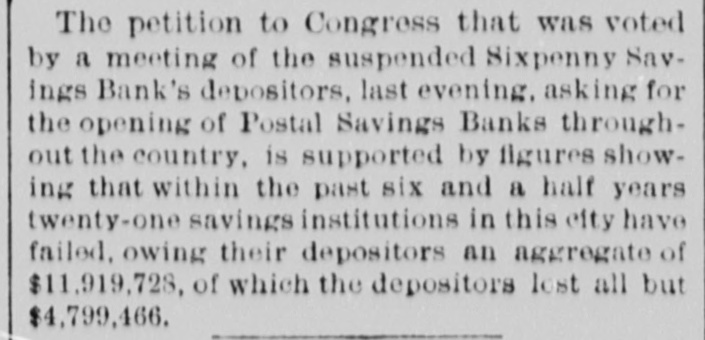
The petition to Congress that was voted by a meeting of the suspended Sixpenny Savings Bank's depositors, last evening, asking for the opening of Postal Savings Banks throughout the country, is supported by figures showing that within the past six and a half years twenty-one savings institutions in this city have failed, owing their depositors an aggregate of $11,919,728, of which the depositors lost all but $4,799,466.


Article from The Sun, July 31, 1878

Click image to open full size in new tab

Article Text

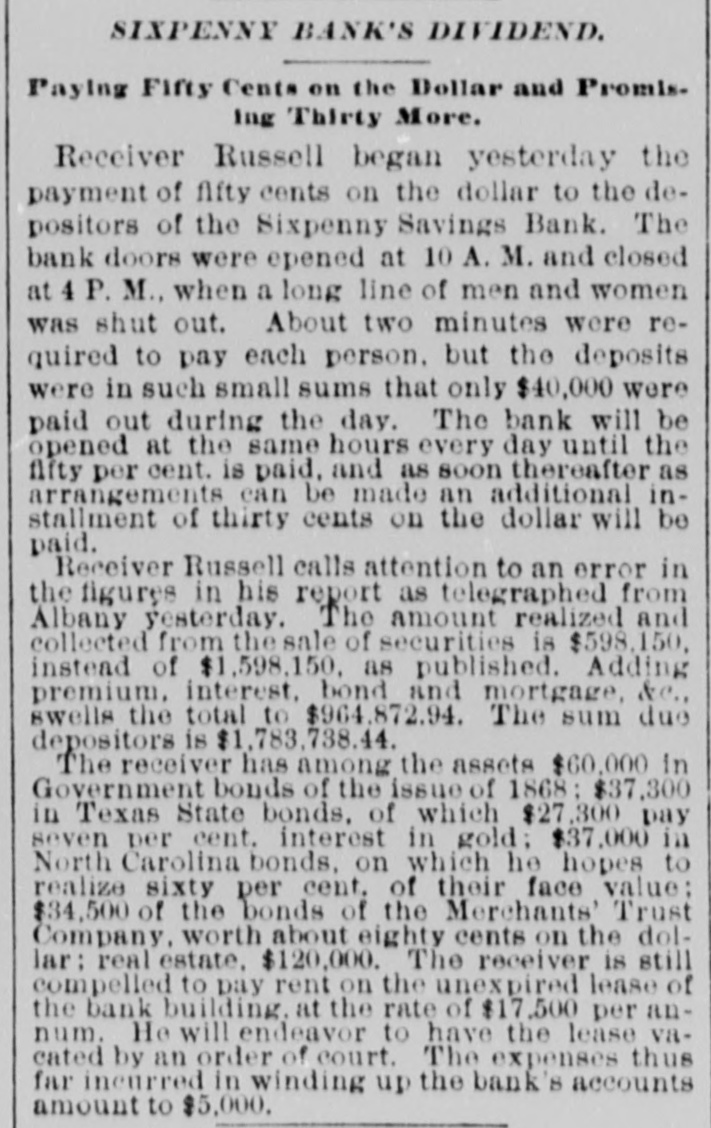
# SIXPENNY BANK'S DIVIDEND. Paying Fifty Cents on the Dollar and Promis- ing Thirty More. Receiver Russell began yesterday the payment of fifty cents on the dollar to the depositors of the Sixpenny Savings Bank. The bank doors were opened at 10 A. M. and closed at 4 P. M., when a long line of men and women was shut out. About two minutes were required to pay each person, but the deposits were in such small sums that only $40,000 were paid out during the day. The bank will be opened at the same hours every day until the fifty per cent. is paid, and as soon thereafter as arrangements can be made an additional installment of thirty cents on the dollar will be paid. Receiver Russell calls attention to an error in the figures in his report as telegraphed from Albany yesterday. The amount realized and collected from the sale of securities is $598,150, instead of $1,598,150, as published. Adding premium, interest, bond and mortgage, &c., swells the total to $964.872.94. The sum due depositors is $1,783,738.44. The receiver has among the assets $60,000 in Government bonds of the issue of 1868: $37,300 in Texas State bonds, of which $27,300 pay seven per cent. interest in gold; $37,000 in North Carolina bonds, on which he hopes to realize sixty per cent, of their face value; $34,500 of the bonds of the Merchants' Trust Company, worth about eighty cents on the dollar; real estate, $120,000. The receiver is still compelled to pay rent on the unexpired lease of the bank building, at the rate of $17,500 per annum. He will endeavor to have the lease vacated by an order of court. The expenses thus far incurred in winding up the bank's accounts amount to $5,000.


Article from The New York Herald, July 31, 1878

Click image to open full size in new tab

Article Text

SIXPENNY SAVINGS BANK. PAYING THE DEPOSITORS A FIFTY PER CENT DIVIDEND-GREAT RUSH AT THE BANKSCENES AND INCIDENTS. The announcement that the Sixpenny Savings Bank, which closed its doors four months ago on the immense number of 32,800 depositors, would commence paying a dividend of fifty per cent yesterday, had great interest for the multitude concerned and, as might be expected, there was a large and early attend ance at the bank doors long before ten o'clock, the hour for its regular opening. At six o'clock 10 the morning men and women, boys and girls, had already taken up positions convenient to the bank entrance, but many of the early comers iniled to get in at the first rush, failed again at the second, being weak, and therefore forced to the wall each time. Some of them even failed to get in at all and will have to try their luck over again to-day. It may be imagined how miserable the latter class must have felt after being all day long on their feet under the soaking rain and without food. The sidewalk in Astor place, at the side entrance to. the bank through which the depositors were admitted, was covered for a hundred feet or so by a dense seething mass of both sexes and all ages and conditions of lite. It was wedged 80 close that no one within its exterior limit could possibly get out, and when one or two made a violent effort in this direction the whole crowd shook and swayed like one man. There were a few dozen umbrellas overhead, and those who happened to stand under their dripping peripheries had to stay there and endure the irritation of numerous and constant rills of water coursing down their backs inside their underclothing. CHARACTER OF THE CROWD. Women and young girls of the working class were in strong force, holding on like grim death to their bank books. Boys of the news seliing and shine-'emup professions were numerous. Stout and swarthy laboring men were there with eager, wistful faces, wondering in a vague way as to the meaning of a fifty per cent dividend. Occasionally men, but more trequently women, of refined looks, though in seedy garments, were observed and the general appearance and anxiety visible spoke eloquently of the hard times prevailing. But it was by no means a melancholy concourse. Jibes and jests passed to and tro accom panied by merry peals of laughter. The policemen had a wotul time and were made the butt of many jokes. They had to endure repeated violations of their orders to "Keep back there!" "No pushing from the outside!" "Stand off the steps!" It was too weak and pitiable a crowd to use clubs upon. *Will yees step that scroogin' behind me there?' cried one 01 the stalwart officers in his strong Corkonian accent. "Sure wen't get a penny any sooner by carryin' on that way." "Oh! we're gettin' hungry and want to go home," repiied one in the crowd. "Well, go home till to-morrow," reterted the officer, "Sure the bank's not goin' to run away for a day or two and ye won't be always hungry "That'll do for you, that has your pay sure," spoke up a horny handed son of toll, with a frown on bis face. "I'll engage," exclaimed another toilsome son, if the peelers didn't get their pay they'd make 11 out somehow. " "Whist, there! shouted the officer; "ye're talkin' as much as if ye had ten dollars III the bank, an' ye haven't as much as 'ud buy victuals for a sick grasshopper!" Here came another strong push from behind the officer, and he turned sharply about, and, eyeing them with an attempt to look ferocious, roared, "Be alsy, there, will yez? An' it ye can't be alsy be as alsy as ye can. THEIR ANXIETY TO HAVE THEIR MONEY. The vanguard of the crowd stood on the top steps of the entrance pasted against the ron gutes. At intervals of fifteen or twenty minutes a policeman inside the gates slowly and cautiously opened one of them and let eight or ten depositors tumbio in. At such moments a thrill of excitement passed through the throug and a strong forward pressure followed to the great annoyance of the policeman. The small boys entered into the throug with great zest. "Bet yer half a dollar I've got more in bank than you have," shouted one little fellow with a shocking bad hat and without any coat to another fellow with the same characteristics, and the latter replied spiritedly, "Bet yer ten cents yer haint got half a dollar in the bank to save yer neck,' "And it he had, supplemented a third diminutive, "he only gets fifty cents per divident, and he hain't got no divident at all, and don't get nawthing." In the inter:or of the crowd the heat, confined by the umbrellas and vaporized by the rain, furnished a free Russian bath in which many of the women, especially those of stout habit, appeared ready to faint. Inside the bank a queue of about forty depositors constantly extended from the entrance to the paying teller's window, but it was beyond the power of the bank officers to put any depositor through in quicker time than three minutes, as his book had to go through four hands and he had to sign a receipt and have his handwriting compared with his original signature. At the rate of twenty depositors an hour 120 are suppo od to have been paid yesterday. Most of the depositors were claimants for very small amounts, ranging from eighty cents to $5, but there were some that had comfortable accounts, and one woman was seen to receive a check for $810 on the Union Trust, which she was utterly puzzied what to do with, but was finally persuaded to take and be bappy. WHAT THE SECURITIES REALIZED. Mr. William F. Russell, the receiver, took charge April 6, and between that time and last Friday, when his accounts were passed upon by the Court, realized and collected on the securities of the bank $964,872 94. The deductions to be made from that are $40,000 and interest to the Nassau Bank, $4 400 applied on bond and mortgage by order of the Court and $5,400 for expenses up to date from April 6 for insurance, repairs to property owned by bank, clerks' salaries and incidentals. Of bank assets left on which the receiver expects to pay the next dividend of thirty per cent are United States bonds, '68, $60,000; North Carolina, $37,000; Texas, $37,300; balauce bonds and mortgages on books. $560,000; real estate, cost $118,000; on call loans, $2,500, and a small amount on Arkansas bonds, and fixtures, &c. There are 22,000 depositors under $5, representing a total of $17,000 and an average deposit of eighty cents. The heaviest depositor was Colonel Van Burea, who died the other day, and who claimed for himself and family $52,000. The payment
Article from New-York Tribune, August 26, 1878

Click image to open full size in new tab

Article Text

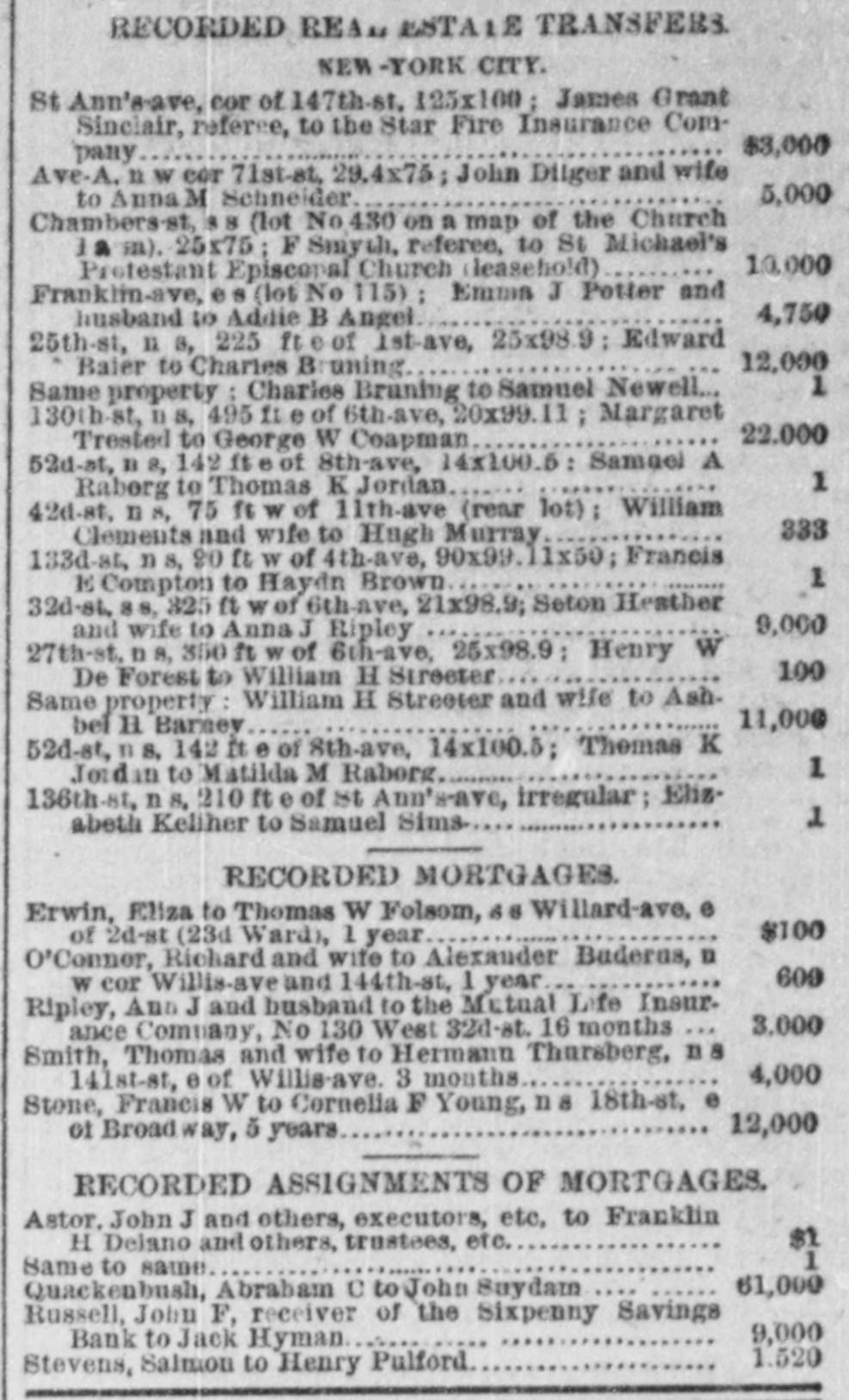
# RECORDED REAL ESTATE TRANSFERS. NEW-YORK CITY. St Ann's-ave, cor of 147th-st, 125x100; James Grant Sinclair, referee, to the Star Fire Insurance Company.. $3,000 Ave-A. n w cor 71st-st, 29.4x75; John Dilger and wife to Anna M Schneider. 5,000 Chambers-st, ss (lot No 430 on a map of the Church 1 a m). 25x75; F Smyth, referee, to St Michael's Protestant Episcopal Church (leasehold). 10.000 Frankiin-ave, es (lot No 115); Emma J Potter and husband to Addie B Angel. 4,750 25th-st, n s, 225 ft e of 1st-ave, 25x98.9; Edward Baier to Charles Bruning. 12,000 Same property: Charles Bruning to Samuel Newell... 1 130th-st, ns, 495 ft e of 6th-ave, 20x99.11; Margaret Trested to George W Coapman. 22.000 52d-st, n s, 142 ft e of 8th-ave, 14x100.5: Samuel A Raborg to Thomas K Jordan. 1 42d-st, ns, 75 ft w of 11th-ave (rear lot); William Clements and wife to Hugh Murray. 333 133d-st, n s, 20 ft w of 4th-ave, 90x99.11x50; Francis E Compton to Haydn Brown... 1 32d-st, s s, 325 ft w of 6th-ave, 21x98.9; Seton Heather and wife to Anna J Ripley 9,000 27th-st, n s, 350 ft w of 6th-ave, 25x98.9; Henry W De Forest to William H Streeter..... 100 Same property: William H Streeter and wife to Ashbel H Barney. 11,000 52d-st, n s, 142 ft e of 8th-ave, 14x100.5; Thomas K Jordan to Matilda M Raborg. 1 136th-st, ns, 210 ft e of St Ann's-ave, irregular; Elizabeth Keliher to Samuel Sims..... 1 # RECORDED MORTGAGES. Erwin, Eliza to Thomas W Folsom, ss Willard-ave, e of 2d-st (23d Ward), 1 year... $100 O'Connor, Richard and wife to Alexander Buderus, n w cor Willis-ave and 144th-st, 1 year.... 600 Ripley, Ann J and husband to the Mutual Life Insurance Comuany, No 130 West 32d-st. 16 months 3.000 Smith, Thomas and wife to Hermann Thursberg, ns 141st-st, e of Willis-ave. 3 months... 4,000 Stone, Francis W to Cornelia F Young, na 18th-st, e of Broadway, 5 years....... 12,000 # RECORDED ASSIGNMENTS OF MORTGAGES. Astor, John J and others, executors, etc, to Franklin H Delano and others, trustees, etc. $1 Same to same. 1 Quackenbush, Abrabam C to John Suydam 61,000 Russell, John F, receiver of the Sixpenny Savings Bank to Jack Hyman......... 9,000 Stevens, Salmon to Henry Pulford.. 1.520


Article from The New York Herald, March 13, 1879

Click image to open full size in new tab

Article Text

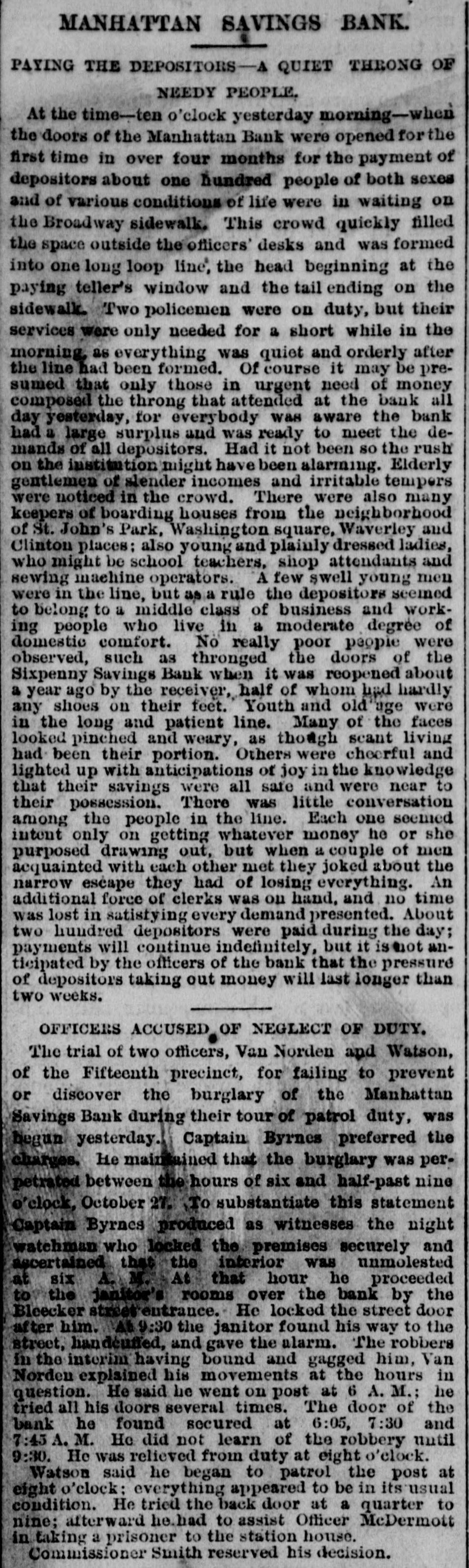
NEEDY PEOPLE. At the time-ten o'clock yesterday morning-when the doors of the Manhattan Bank were opened for first time in over four months for the payment of depositors about one hundred people of both sexes and of various conditions of life were in waiting on the Broadway sidewalk. This crowd quickly filled the space outside the officers' desks and was formed into one long loop line, the head beginning at the paying teller's window and the tail ending on the sidewalk. Two policemen were on duty, but their services were only needed for a short while in the morning, as everything was quiet and orderly after the line had been formed. Of course it may be presumed that only those in urgent need of money composed the throng that attended at the bank all day yesterday, for everybody was aware the bank had a large surplus and was ready to meet the demands of all depositors. Had it not been so the rush on the institution might have been alarming. Elderly gentlemen of slender incomes and irritable tempers were noticed in the crowd. There were also many keepers of boarding houses from the neighborhood of St. John's Park, Washington square, Waverley and Clinton places: also young and plainly dressed ladies, who might be school teachers, shop attendants and sewing machine operators. A few swell young men were in the line, but as a rule the depositors seemed to belong to a middle class of business and working people who live in a moderate degree of domestic comfort. No really poor people were observed, such as thronged the doors of the Sixpenny Savings Bank when it was reopened about a year ago by the receiver, half of whom had hardly any shoes on their feet. Youth and old age were in and looked as the pinched long and patient weary, line. though Many of scant the living faces had been their portion. Others were cheerful and lighted up with anticipations of joy in the knowledge that their savings were all safe and were near to their possession. There was little conversation among the people in the line. Each one seemed intent only on getting whatever money he or she purposed drawing out, but when a couple of men acquainted with each other met they joked about the narrow escape they had of losing everything. An additional force of clerks was on hand, and no time was lost in satisfying every demand presented. About two hundred depositors were paid during the day; payments will continue indefinitely, but it is not anticipated by the officers of the bank that the pressure of depositors taking out money will last longer than two weeks. OFFICERS ACCUSED OF NEGLECT OF DUTY. The trial of two officers, Van Norden and Watson, of the Fifteenth precinct, for failing to prevent or discover the burglary of the Manhattan Savings Bank during their tour of patrol duty, was begun yesterday. Captain Byrnes preferred the charges. He maintained that the burglary was perpetrated between the hours of six and half-past nine o'clock, October 27. To substantiate this statement Captain Byrnes produced as witnesses the night watchman who locked the premises securely and ascertained that the interior was unmolested at six A. At that hour he proceeded to the janitor's rooms over the bank by the Bloecker street entrance. He locked the street door after him. At 9:30 the janitor found his way to the street, handcuffed, and gave the alarm. The robbers in the interim having bound and gagged him, Van Norden explained his movements at the hours in question. He said he went on post at 6 A. M.; he tried all his doors several times. The door of the bank he found secured at 6:05, 7:30 and M. He did not learn of the robbery until 9:30. He was relieved from duty at eight o'clock. Watson said he began to patrol the post at eight o'clock: everything appeared to be in its usual condition. He tried the back door at a quarter to nine; afterward he. had to assist Officer McDermott in taking a prisoner to the station house. Commissioner Smith reserved his decision.


Article from The Sun, April 16, 1879

Click image to open full size in new tab

Article Text

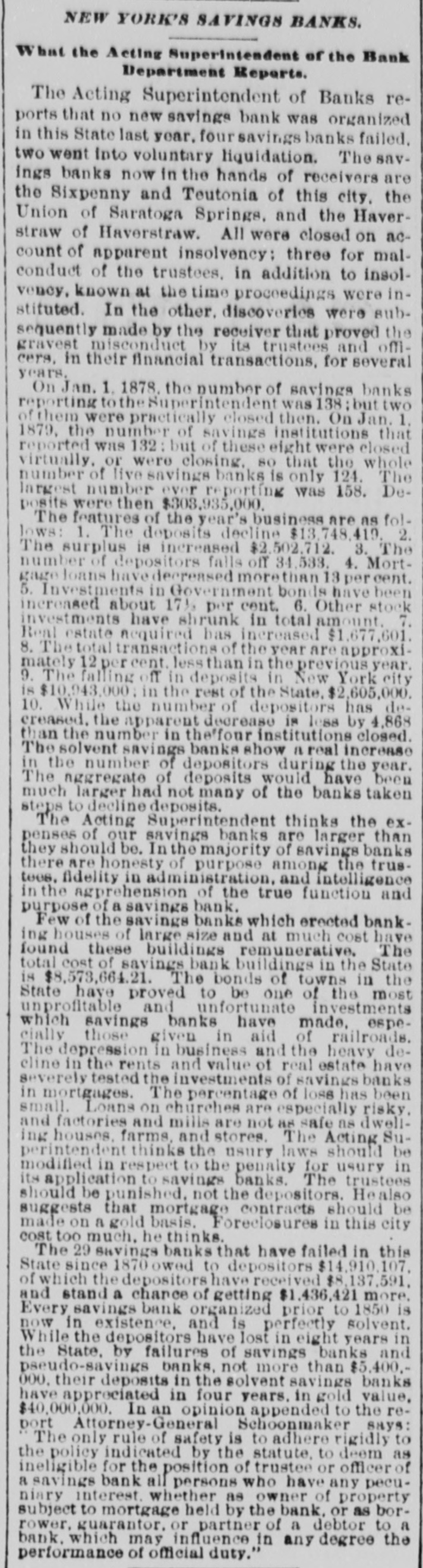
NEW YORK'S SAVINGS BANKS. What the Acting Superintendent of the Bank Department Reports. The Acting Superintendent of Banks reports that no new savings bank was organized in this State last year. four savings banks failed. two went Into voluntary liquidation. The savings banks now in the hands of receivers are the Sixpenny and Teutonia of this city, the Union of Saratoga Springs, and the Haverstraw of Haverstraw. All were closed on account of apparent insolvency: three for malconduct of the trustees. in addition to insolvency, known at the time proceedings were instituted. In the other. discoveries were subsequently made by the receiver that proved the gravest misconduct by its trustees and officers. in their financial transactions, for several years. On Jan. 1. 1878. the number of savings banks reporting to the Superintendent was 138 but two of them were practically closed then. On Jan. 1. 1879, the number of savings institutions that reported Was 132: but of these eight were closed virtually. or were closing. so that the whole number of live savings banks is only 124. The Inrgest number ever reporting was 158. Deposits were then $303,935,000. The features of the year's business are as follows: 1. The deposits decline $13,748,419. 2. The surplus is increased $2,502,712. 3. The number of depositors falls off 34,533. 4. Mortgage loans have decreased morethan 13 per cent. 5. Investments in Government bonds have been increased about 17½ per cent. 6. Other stock investments have shrunk in total amount. 7. Real estate acquired has increased $1,677,601. 8. The total transactions of the year are approximately 12 per cent. less than in the previous year. 9. The falling off in deposits in New York city is $10,943,000 in the rest of the State, $2,605,000. 10. While the number of depositors has decreased. the apparent decrease is less by 4,868 than the number in theffour institutions closed. The solvent savings banks show a real increase in the number of depositors during the year. The aggregate of deposits would have been much larger had not many of the banks taken steps to decline deposits. The Acting Superintendent thinks the expenses of our savings banks are larger than they should be. In the majority of savings banks there are honesty of purpose among the trustees. fidelity in administration, and intelligence in the agprehension of the true function and purpose of a savings bank. Few of the savings banks which erected banking houses of large size and at much cost have found these buildings remunerative. The total cost of savings bank buildings in the State is $8,573,664.21. The bonds of towns in the State have proved to be one of the most unprofitable and unfortunate investments which savings banks have made. especially those given in aid of railroads. The depression in business and the heavy decline in the rents and value of real estate have severely tested the investments of savings banks in mortgages. The percentage of loss has been small. Loans on churches are especially risky. and factories and mills are not as safe as dwelling houses. farms, and stores. The Acting Superintendent thinks the usury laws should be modified in respect to the penalty for usury in its application to savings banks. The trustees should be punished. not the depositors. Healso suggests that mortgage contracts should be made on a gold basis. Foreclosures in this city cost too much. he thinks. The 29 savings banks that have failed in this State since 1870 owed to depositors $14,910,107. of which the depositors have received $8,137,591. and stand a chance of getting $1,436,421 more. Every savings bank organized prior to 1850 is now in existence, and is perfectly solvent. While the depositors have lost in eight years in the State, by failures of savings banks and pseudo-savings banks, not more than $5,400.000. their deposits in the solvent savings banks have appreciated in four years. in gold value. $40,000,000. In an opinion appended to the report Attorney-General Schoonmaker says: The only rule of safety is to adhere rigidly to the policy indicated by the statute, to deem as ineligible for the position of trustee or officer of a savings bank all persons who have any pecuniary interest. whether as owner of property subject to mortgage held by the bank, or as borrower, guarantor. or partner of a debtor to a


Article from New-York Tribune, June 13, 1879

Click image to open full size in new tab

Article Text

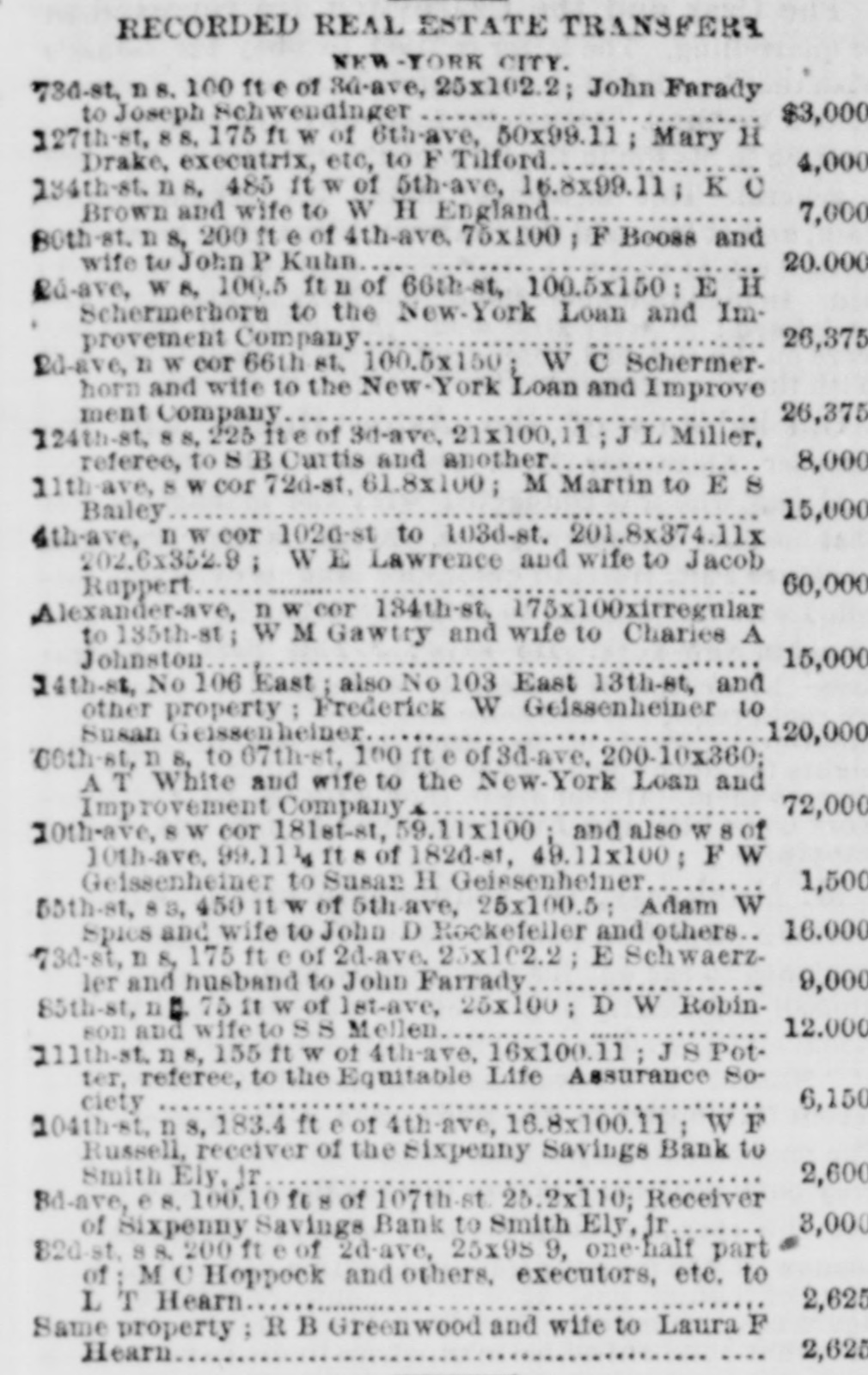
RECORDED REAL ESTATE TRANSFERI NEW-YORK CITY. 73d-st, n s. 100 ft e of 3d-ave, 25x102.2; John Farady to Joseph Schwendinger $3,000 127th-st, s s. 175 ft w of 6th-ave, 50x99.11; Mary H Drake, executrix, etc, to F Tilford 4,000 234th-st. ns. 485 ft w of 5th-ave, 16.8x99.11; K C Brown and wife to W H England 7,000 80th-st. n s, 200 ft e of 4th-ave, 75x100; F Booss and wife to John P Kuhn 20.000 3d-ave, w s, 100.5 ft n of 66th-st, 100.5x150: E H Schermerhorn to the New-York Loan and Im- provement Company 26,375 3d-ave, n w cor 66th st. 100.5x150; W C Schermer- horn and wife to the New York Loan and Improve ment Company 26,375 124th-st, s s, 225 ft e of 3d-ave, 21x100,11; J L Milier, referee, to S B Curtis and another 8,000 11th-ave, s w cor 72d-st, 61.8x100; M Martin to E S Bailey 15,000 4th-ave, n w cor 102d-st to 103d-st. 201.8x374.11x 202.6x352.9; W E Lawrence and wife to Jacob Rappert 60,000 Alexander-ave, n w cor 134th-st. 175x100xirregular to 135th-st; W M Gawtry and wife to Charles A Johnston 15,000 14th-st, No 106 East; also No 103 East 13th-st, and other property: Frederick W Geissenheiner to Susan Geissenheiner 120,000 66th-st, n s, to 67th-st, 100 ft e of 3d-ave, 200-10x360; A T White and wife to the New-York Loan and Improvement Company 72,000 10th-ave, s w cor 181st-st, 59.11x100; and also w s of 10th-ave, 99.11¼ ft s of 182d-st, 49.11x100; F W Geissenheiner to Susan H Geissenheiner 1,500 55th-st, s s, 450 ft w of 5th-ave, 25x100.5: Adam W Spies and wife to John D Rockefeller and others 16.000 73d-st, n s, 175 ft e of 2d-ave. 25x102.2; E Schwaerz- ler and husband to John Farrady 9,000 85th-st, n s, 75 ft w of 1st-ave, 25x100; D W Robin- son and wife to S S Mellen 12.000 211th-st, n s, 155 ft w of 4th-ave, 16x100.11; J S Pot- ter, referee, to the Equitable Life Assurance So- ciety 6,150 104th-st, n s, 183.4 ft e of 4th-ave, 16.8x100.11; W F Russell, receiver of the Sixpenny Savings Bank to Smith Ely, jr 2,600 3d-ave, e s. 100.10 ft s of 107th-st. 25.2x110; Receiver of Sixpenny Savings Bank to Smith Ely, jr 3,000 82d-st, s s. 200 ft e of 2d-ave, 25x98 9, one-half part of: M C Hoppock and others, executors, etc, to L T Hearn 2,625 Same property; R B Greenwood and wife to Laura F Hearn 2,625


Article from New-York Tribune, July 27, 1880

Click image to open full size in new tab

Article Text

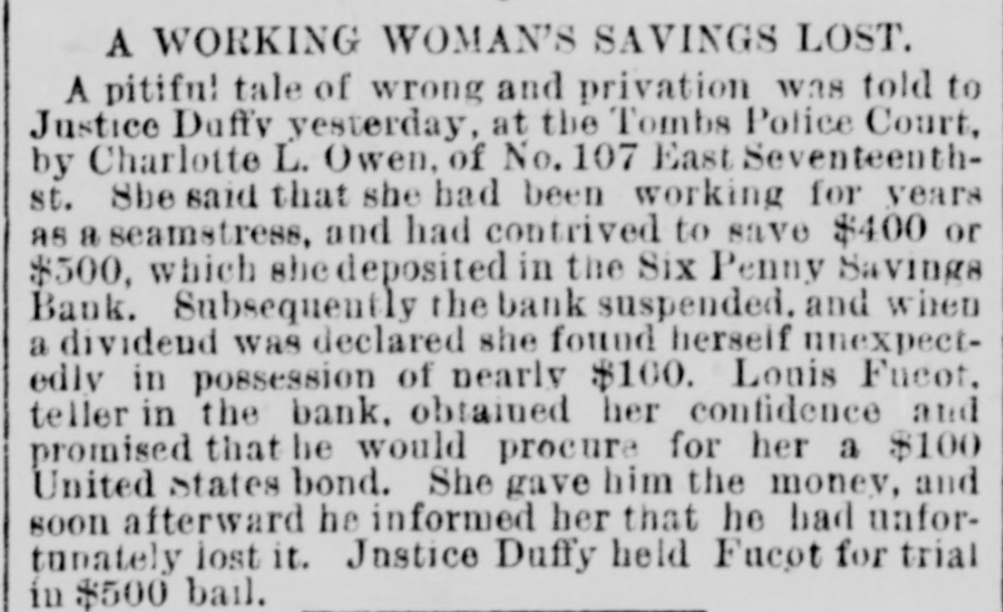
# A WORKING WOMAN'S SAVINGS LOST. A pitiful tale of wrong and privation was told to Justice Duffy yesterday, at the Tombs Police Court, by Charlotte L. Owen, of No. 107 East Seventeenth-st. She said that she had been working for years as a seamstress, and had contrived to save $400 or $500, which she deposited in the Six Penny Savings Bank. Subsequently the bank suspended, and when a dividend was declared she found herself unexpectedly in possession of nearly $100. Louis Fucot, teller in the bank, obtained her confidence and promised that he would procure for her a $100 United States bond. She gave him the money, and soon afterward he informed her that he had unfortunately lost it. Justice Duffy held Fucot for trial in $500 bail.


Article from New-York Tribune, March 17, 1882

Click image to open full size in new tab

Article Text

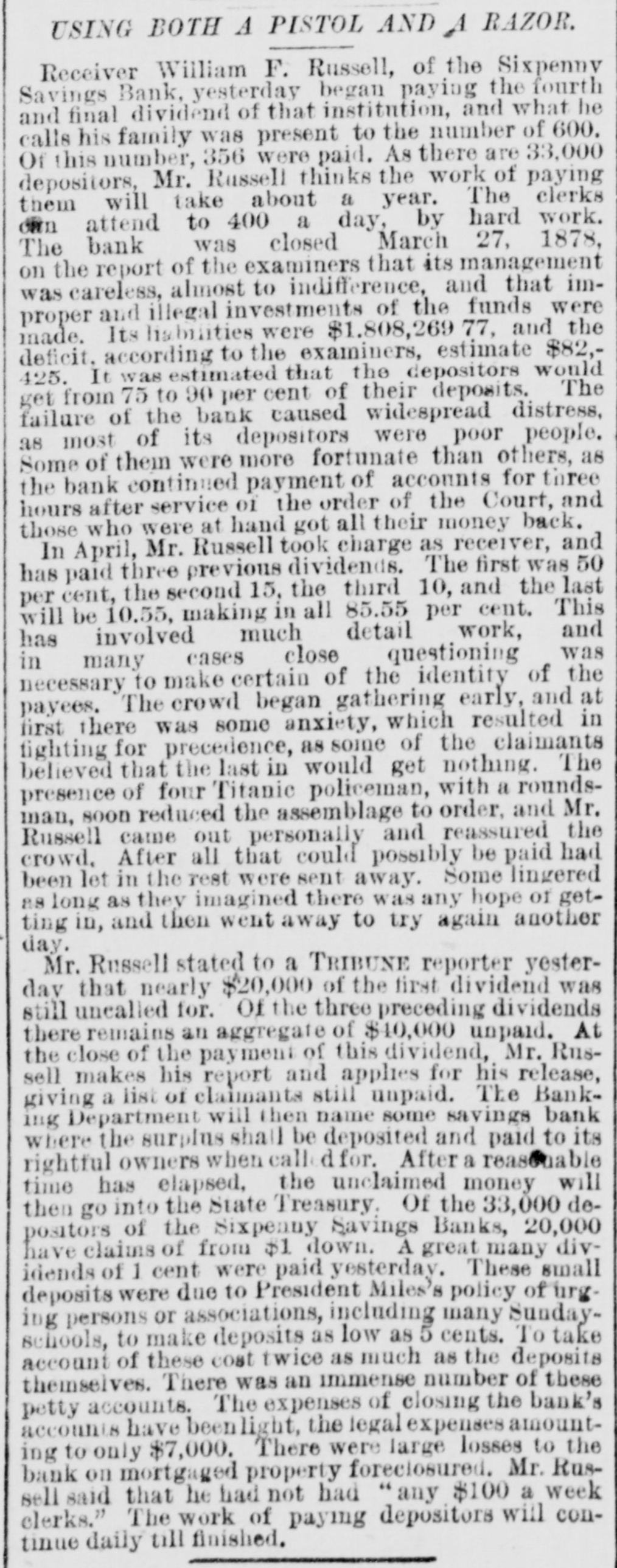
# USING BOTH A PISTOL AND A RAZOR. Receiver William F. Russell, of the Sixpenny Savings Bank, yesterday began paying the fourth and final dividend of that institution, and what he calls his family was present to the number of 600. Of this number, 356 were paid. As there are 33,000 depositors, Mr. Russell thinks the work of paying them will take about a year. The clerks can attend to 400 a day, by hard work. The bank was closed March 27, 1878, on the report of the examiners that its management was careless, almost to indifference, and that im- proper and illegal investments of the funds were made. Its liabilities were $1.808,269 77, and the deficit, according to the examiners, estimate $82,- 425. It was estimated that the depositors would get from 75 to 90 per cent of their deposits. The failure of the bank caused widespread distress, as most of its depositors were poor people. Some of them were more fortunate than others, as the bank continued payment of accounts for three hours after service of the order of the Court, and those who were at hand got all their money back. In April, Mr. Russell took charge as receiver, and has paid three previous dividends. The first was 50 per cent, the second 15, the third 10, and the last will be 10.55, making in all 85.55 per cent. This has involved much detail work, and in many cases close questioning was necessary to make certain of the identity of the payees. The crowd began gathering early, and at first there was some anxiety, which resulted in fighting for precedence, as some of the claimants believed that the last in would get nothing. The presence of four Titanic policeman, with a rounds- man, soon reduced the assemblage to order, and Mr. Russell came out personally and reassured the crowd. After all that could possibly be paid had been let in the rest were sent away. Some lingered as long as they imagined there was any hope of get- ting in, and then went away to try again another day. Mr. Russell stated to a TRIBUNE reporter yester- day that nearly $20,000 of the first dividend was still uncalled for. Of the three preceding dividends there remains an aggregate of $40,000 unpaid. At the close of the payment of this dividend, Mr. Rus- sell makes his report and applies for his release, giving a list of claimants still unpaid. The Bank- ing Department will then name some savings bank where the surplus shall be deposited and paid to its rightful owners when called for. After a reasonable time has elapsed, the unclaimed money will then go into the State Treasury. Of the 33,000 de- positors of the Sixpenny Savings Banks, 20,000 have claims of from $1 down. A great many div- idends of 1 cent were paid yesterday. These small deposits were due to President Miles's policy of urg- ing persons or associations, including many Sunday- schools, to make deposits as low as 5 cents. To take account of these cost twice as much as the deposits themselves. There was an immense number of these petty accounts. The expenses of closing the bank's accounts have been light, the legal expenses amount- ing to only $7,000. There were large losses to the bank on mortgaged property foreclosured. Mr. Rus- sell said that he had not had "any $100 a week clerks." The work of paying depositors will con- tinue daily till finished.