14472. Third Avenue Savings Institution (New York, NY)

Bank Information

Episode Type
Run → Suspension → Closure
Bank Type
savings bank
Start Date
October 1, 1875
Location
New York, New York (40.714, -74.006)

Metadata

Model
gpt-5-mini
Short Digest
9469537398482bf2

Response Measures

None

Description

Articles report a heavy run on the Third Avenue Savings (Bank) in late September/early October 1875, the bank's suspension/closure by court order and appointment of a receiver (W. S. Carman). Deposit-resumption proposals appear later but no clear reopening is reported; officers were later prosecuted and receivers remained active, indicating permanent closure/receivership. Bank name in contemporary articles is given as Third Avenue Savings Bank (corrected from 'Institution'). Dates derived from newspaper dates and in-text timing.

Events (4)

1. October 1, 1875 Run
Cause
Bank Specific Adverse Info
Cause Details
Heavy withdrawals following revelations of insolvency and 'rotten' condition of the institution; false entries and large deficiencies in the bank's accounts were later revealed.
Measures
Depositors crowded the doors; no successful payout—later proposals by heavy depositors to reorganize and pay partial dividends; receiver took charge and closed doors.
Newspaper Excerpt
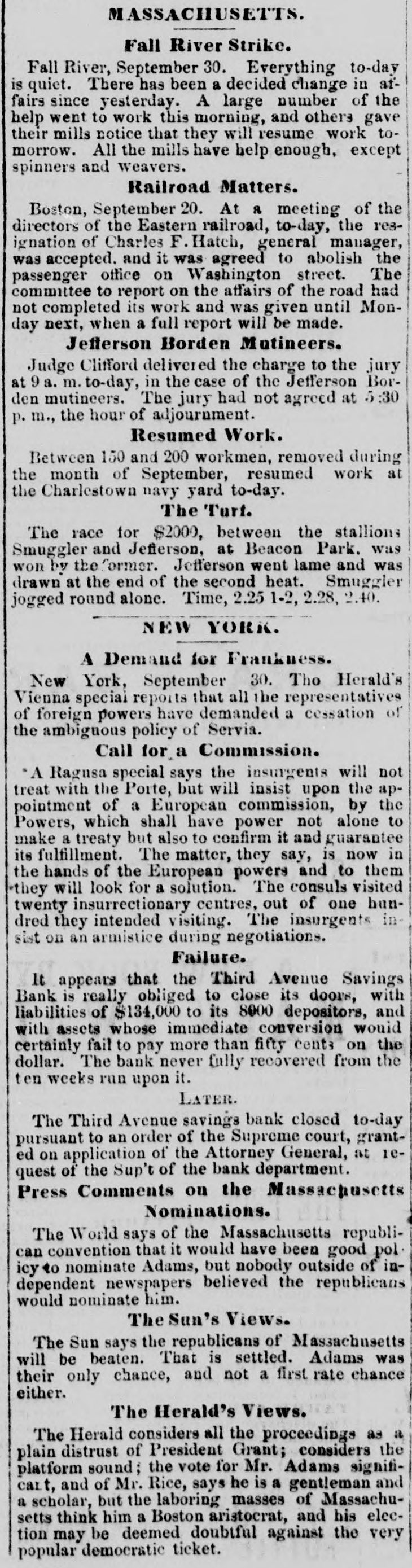
A run on the Third Avenue Savings Bank New York, obliged the bank to close its doors.
Source
newspapers
2. October 2, 1875 Receivership
Newspaper Excerpt
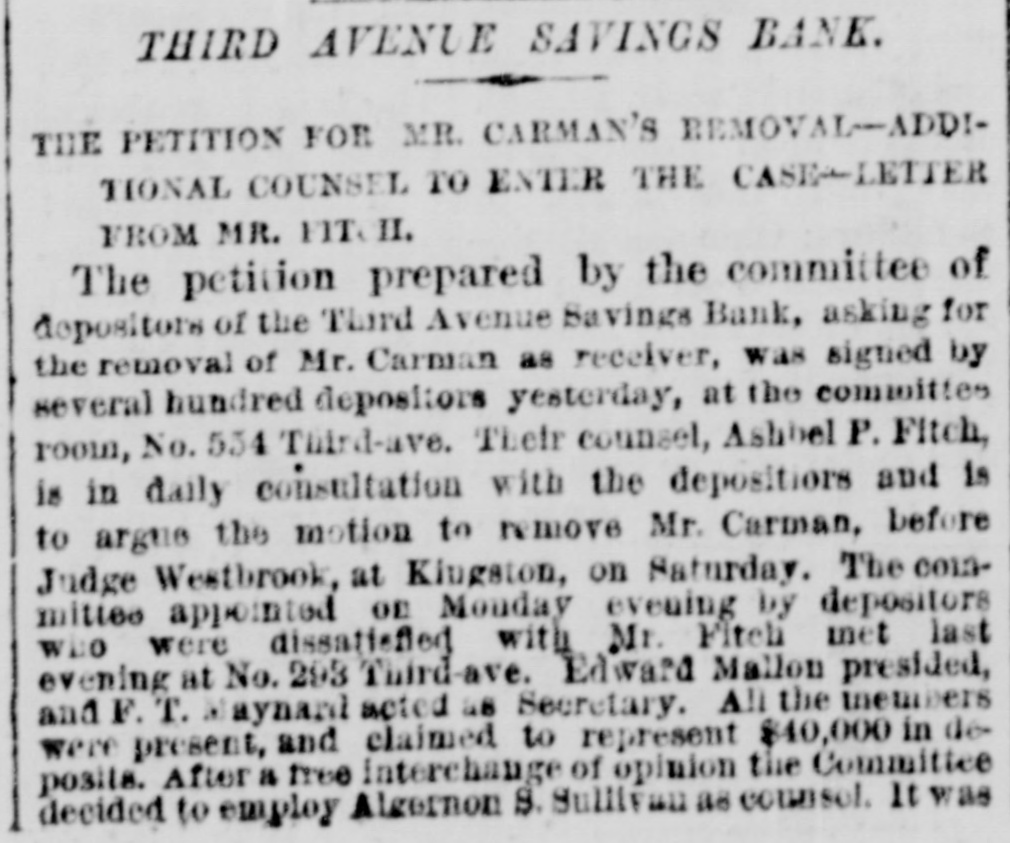
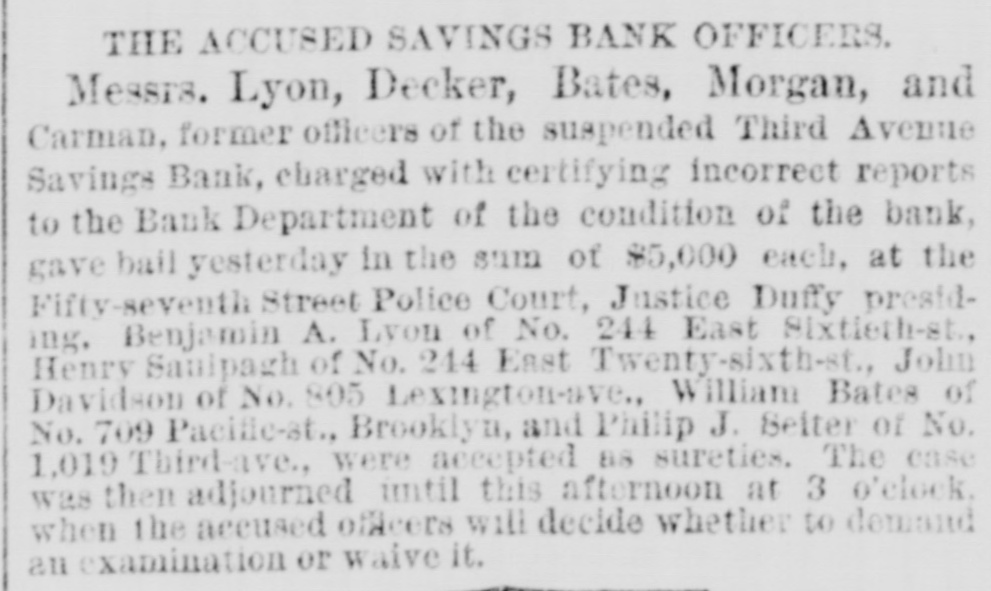
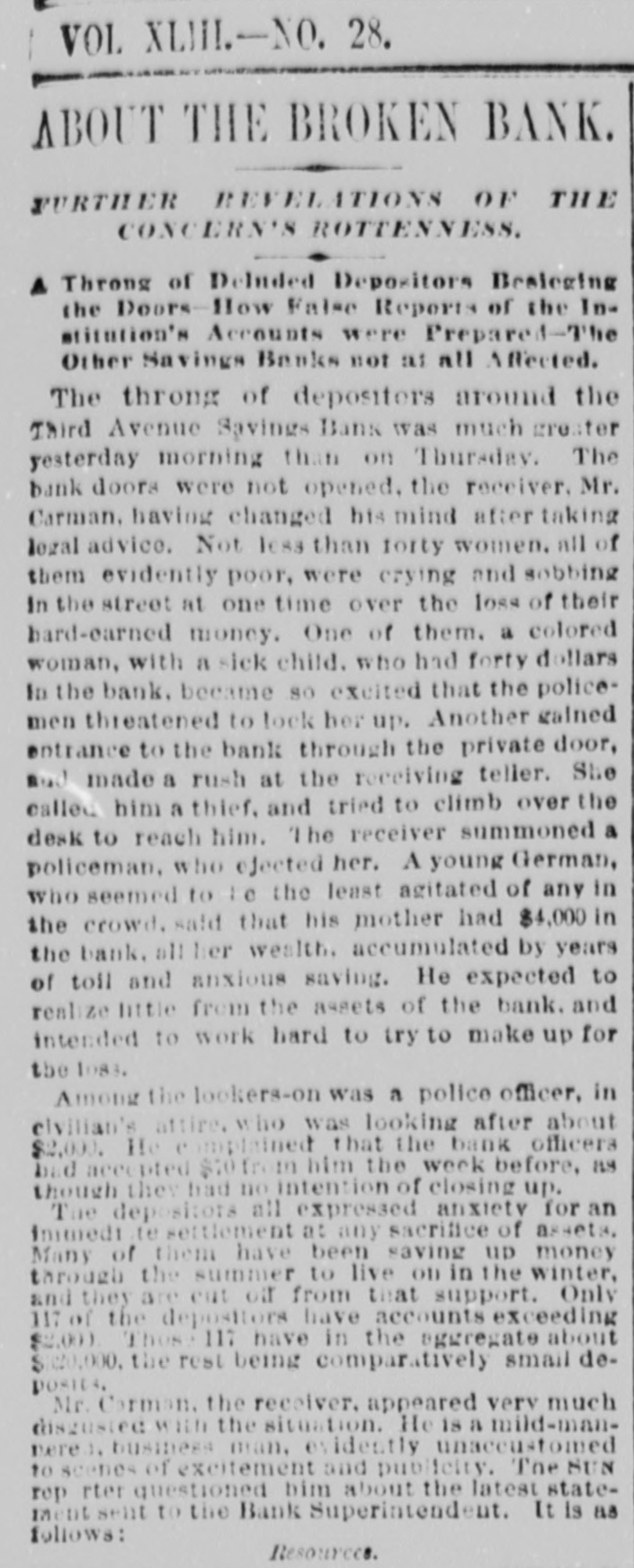
The bank doors were not opened. the receiver. Mr. Carman. having changed his mind after taking legal advice. ... Mr. Carman the receiver. appeared very much disgusted with the situation. The receiver summoned a policeman, who ejected her. ... The receiver, Mr. Carman, shall manage the bank, but that a new board of officers be appointed. The petition prepared by the committee of depositors... asking for the removal of Mr. Carman as receiver, was signed by several hundred depositors yesterday, ... to argue the motion to remove Mr. Carman, before Judge Westbrook, at Kingston, on Saturday. Messrs. Lyon, Decker, Bates, Morgan, and Carman, former officers of the suspended Third Avenue Savings Bank, charged with certifying incorrect reports to the Bank Department, gave bail yesterday ... The receivers of the suspended savings banks have entered upon their duties and are busy examining the books and securities. A series of forgeries perpetrated on the Third Avenue Savings Bank is now found to account for some of its heavy losses. The Mutual Life Insurance Company has begun a suit against the Third Avenue Savings Bank to foreclose a mortgage for $25,000 ... The examination in the case of William A. Darling ... on a charge of subscribing to an incorrect financial report of the Third Avenue Savings Bank, was resumed yesterday before Justice Duffy at the Tombs Police Court. They are held for making oath to a fraudulent statement of the affairs of the bank, its true condition being concealed by false entries in the books. Two unfaithful bank officers have been sent to the State Prison ... The triumph of justice ... will probably encourage some of the sufferers by the frauds of the Third Avenue Savings Bank ... Why cannot the receiver of the Third Avenue Savings Bank declare a dividend? ... The run on the Third Avenue Savings Bank ... has caused runs on other local savings banks; the Third Avenue institution never fully recovered from the ten weeks' run upon it. The throng of depositors around the Third Avenue Savings Bank was much greater yesterday morning than on Thursday. The bank doors were not opened, the receiver, Mr. Carman, having changed his mind after taking legal advice. Several of the heaviest depositors ... propose that the receiver, Mr. Carman, shall manage the bank, but that a new board of officers be appointed. They also propose paying needy depositors an early dividend of about ten per cent. The petition for Mr. Carman's removal was signed by several hundred depositors ... The accused officers ... gave bail ... The receivers ... have entered upon their duties and are busy examining the books and securities. A series of forgeries ... account for some of its heavy losses. Examinations showed false book entries and fictitious assets. Court proceedings against officers continued into 1876. Later commentary in 1877 and 1878 refer to prosecutions and calls for dividends. (These snippets are drawn from the provided articles.) NOTE: consolidated citations from multiple articles across Oct 1875–1878 confirming receivership and related legal actions.
Source
newspapers
3. October 2, 1875 Suspension
Cause
Government Action
Cause Details
Closed pursuant to a Supreme Court order on application of the Attorney General at the request of the State Bank Superintendent; suspension followed insolvency revealed by a run and examinations.
Newspaper Excerpt
The Third Avenue savings bank closed to-day pursuant to an order of the Supreme court, granted on application of the Attorney General, at request of the Sup't of the bank department.
Source
newspapers
4. October 18, 1875 Other
Newspaper Excerpt
Several of the heaviest depositors of the Third Avenue Savings Bank have been in consultation with the bank officials relative to resuming business again. They propose ... If this plan is followed the creditors will in the end, it is said, receive upward of ninety per cent ... They further suggest that the most needy depositors be paid a dividend of about ten per cent as soon as possible ... If this plan is not agreed to by a majority of the depositors they are in favor of waiting and giving the Receiver an opportunity to negotiate the property without sacrificing it to wind it up immediately, and Oct. 19 follow-up articles describing plan details and favorable reception. These items show depositors' attempts to reorganize/resume business but do not conclusively show a reopening occurred.
Source
newspapers

Newspaper Articles (22)

Article from Daily Kennebec Journal, October 1, 1875

Click image to open full size in new tab

Article Text

MASSACHUSETTS. Fall River Strike. Fall River, September 30. Everything to-day is quiet. There has been a decided change in atfairs since yesterday. A large number of the help went to work this morning, and others gave their mills notice that they will resume work tomorrow. All the mills have help enough, except spinners and weavers. Railroad Matters. Boston, September 20. At я meeting of the directors of the Eastern railroad, to-day, the resignation of Charles F. Hatch, general manager, was accepted. and it was agreed to abolish the passenger office on Washington street. The committee to report on the affairs of the road had not completed its work and was given until Monday next, when a full report will be made. Jefferson Borden Mutineers. Judge Clifford delivered the charge to the jury at 9a. m. to-day, in the case of the Jefferson Borden mutineers. The jury had not agreed at 5:30 p. m., the hour of adjournment. Resumed Work. Between 150 and 200 workmen, removed during the month of September, resumed work at the Charlestown navy yard to-day. The Turt. The race for $2000, between the stallions Smuggler and Jefferson, at Beacon Park. was won by the former. Jefferson went lame and was drawn at the end of the second heat. Smuggler jogged round alone. Time, 2.25 1-2, 2.28, 2.40. NEW YORK. A Demand for Frankness. New York, September 30. The Herald's Vienna special reports that all the representatives of foreign powers have demanded a cessation of the ambiguous policy of Servia. Call for a Commission. "A Ragusa special says the insurgents will not treat with the Porte, but will insist upon the appointment of a European commission, by the Powers, which shall have power not alone to make a treaty but also to confirm it and guarantee its fulfillment. The matter, they say, is now in the hands of the European powers and to them *they will look for a solution. The consuls visited twenty insurrectionary centres, out of one hundred they intended visiting. The insurgents insist on an armistice during negotiations. Failure. It appears that the Third Avenue Savings Bank is really obliged to close its doors, with liabilities of $134,000 to its 8000 depositors, and with assets whose immediate conversion would certainly fail to pay more than fifty cents on the dollar. The bank never fully recovered from the ten weeks run upon it. LATER. The Third Avenue savings bank closed to-day pursuant to an order of the Supreme court, granted on application of the Attorney General, at request of the Sup't of the bank department. Press Comments on the Massachusetts Nominations. The World says of the Massachusetts republican convention that it would have been good pol. icy to nominate Adams, but nobody outside of independent newspapers believed the republicans would nominate him. The Sun's Views. The Sun says the republicans of Massachusetts will be beaten. That is settled. Adams was their only chance, and not a first rate chance either. The Herald's Views. The Herald considers all the proceedings as a plain distrust of President Grant; considers the platform sound; the vote for Mr. Adams significart, and of Mr. Rice, says he is a gentleman and a scholar, but the laboring masses of Massachusetts think him a Boston aristocrat, and his election may be deemed doubtful against the very popular democratic ticket.
Article from The Sun, October 2, 1875

Click image to open full size in new tab

Article Text

VOL XLIII.-NO. 28. ABOUT THE BROKEN BANK. FURTHER REVELATIONS OF THE CONCERN'S ROTTENNESS. Throng of Deluded Depositors Bealeging the Doors-How False Reports of the Institution's Accounts were Prepared-The Other Savings Banks not at all Affected. The throng of depositors around the Third Avenue Savings Bank was much greater yesterday morning than on Thursday. The bank doors were not opened. the receiver. Mr. Carman. having changed his mind after taking logal advice. Not less than forty women. all of them evidently poor, were crying and sobbing In the street at one time over the loss of their hard-earned money. One of them. a colored woman, with a sick child. who had forty dollars In the bank. became so excited that the policemen threatened to lock her up. Another gained entrance to the bank through the private door, and made a rush at the receiving teller. She called him a thief, and tried to climb over the desk to reach him. The receiver summoned a policeman, who ejected her. A young German, who seemed to : c the least agitated of any in the crowd. said that his mother had $4,000 in the bank. all her wealth. accumulated by years of toil and anxious saving. He expected to realize little from the assets of the bank. and intended to work hard to try to make up for the 1983. Among the lookers-on was a police officer. in civilian's affire. who was looking after about $2,000. He complained that the bank officers bad accepted $10fr in him the week before, as though they had no intention of closing up. The depositors all expressed anxiety for an initered te settlement at any sacrifice of assets. Many of them have been saving up money through the summer to live on in the winter, and they are cut oil from that support. Only 117 of the depositors have accounts exceeding $2.00) Those 117 have in the aggregate about $120,000. the rest being comparatively smail dePOSICS. Mr. Corman the receiver. appeared very much disgusted with the situation. He is a mild-manhere. business man, evidently unaccustomed to scenes of excitement and publicity. The SUN rop rter questioned him about the latest statement sent to the Bank Superintendent. It is as follows: Resources.


Article from Daily Kennebec Journal, October 4, 1875

Click image to open full size in new tab

Article Text

GENERAL NEWS. The Full River operatives are quietly resuming work. A run on the Third Avenue Savings Bank New York, obliged the bank to close its doors. A Cheroke Indian, a Japanese and a retired clergyman 50 years old, are among the students at Dartmouth College. The late hurricane was very destructive on all the windward islands of the West Indies. Many marine disasters are reported, with much loss of life. A Hussian Engineer is making a tour of Canada and the United States, inspecting American canals and railways for his government. The sales of Eastern Railroad stock at the broker's from September 1 to 27 were only 7283 shares. The price ranged from $53 on the 6th to $21 50 on the 27th. When you use postal cards remember that nothing but the name and destination can be legally written upon the face of the card. If anything else is written, for instance a date, the card is subjected to letter postage which must be paid before the card leaves the office, or double postage will be exacted at the other end of the route. The wood pavement has not only proved a la-


Article from The Morning Herald, October 4, 1875

Click image to open full size in new tab

Article Text

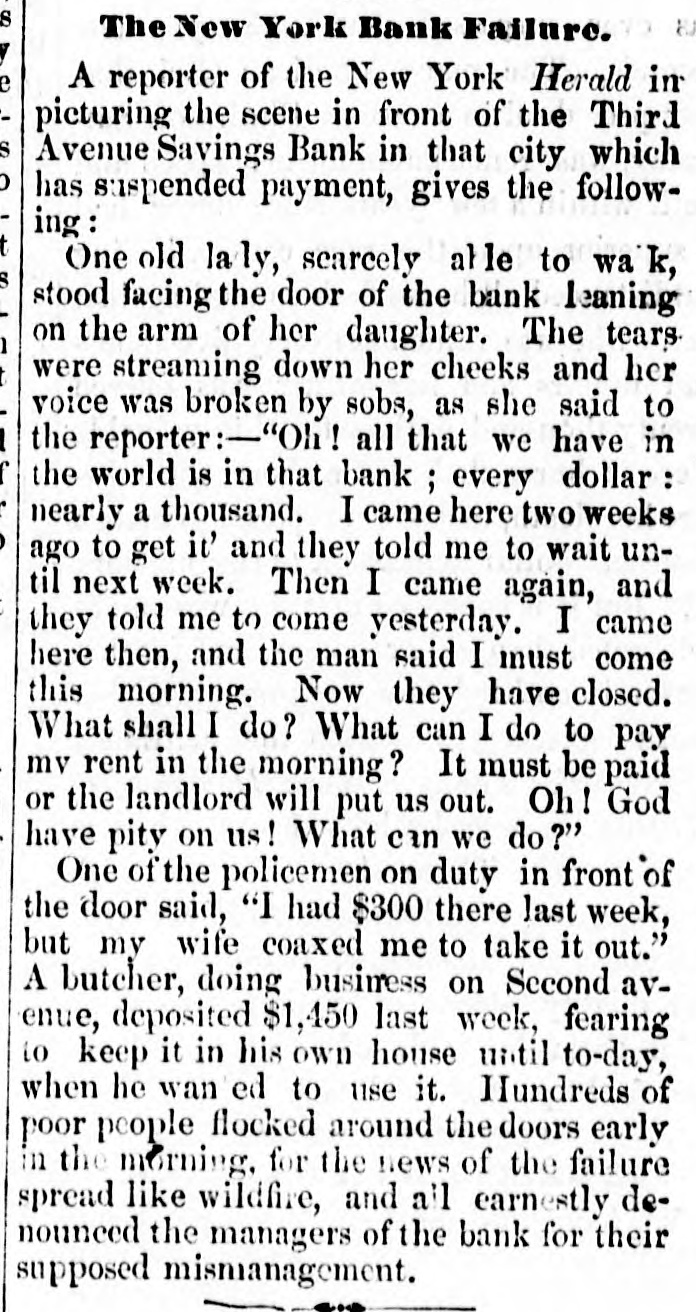
S The New York Bank Failure. A reporter of the New York Herald in picturing the scene in front of the Third Avenue Savings Bank in that city which has suspended payment, gives the following: One old lady, scarcely alle to wa k, stood facing the door of the bank leaning on the arm of her daughter. The tears. were streaming down her cheeks and her voice was broken by sobs, as she said to the reporter:-"Oh all that we have in the world is in that bank ; every dollar nearly a thousand. I came here two weeks ago to get it' and they told me to wait until next week. Then I came again, and they told me to come yesterday. I came here then, and the man said I must come this morning. Now they have closed. What shall I do? What can I do to pay mv rent in the morning ? It must be paid or the landlord will put us out. Oh! God have pity on us! What can we do?" One of the policemen on duty in front of the door said, "I had $300 there last week, but my wife coaxed me to take it out." A butcher, doing business on Second avenue, deposited $1,450 last week, fearing to keep it in his own house until to-day, when he wan ed to use it. Hundreds of poor people flocked around the doors early in the morning, for the news of the failure spread like wildfire, and all earnestly denounced the managers of the bank for their supposed mismanagement.


Article from The New York Herald, October 7, 1875

Click image to open full size in new tab

Article Text

# THE THIRD AVENUE BANK. MEETING OF THE DEPOSITORS LAST NIGHT. A meeting of the depositors of the Third Avenue Savings Bank was held last night at the corner of Third avenue and Twenty-sixth street. The room where the meeting was held was packed to suffocation, and was entirely inadequate to accommodate even one-half of those who sought to take part in the proceedings. The meeting was called to order shortly before eight o'clock, and Mr. H. N. Hardy was elected Chairman and G. A. Joseph, Secretary. It was found, as soon as the formality of electing the officers had been gone through with, impossible to keep anything like order, for every man in the room attempted to make his voice heard, the consequence of which was that for some time nothing could be done. Every one connected with the bank and the State Banking Department was denounced on every side. In the midst of the confusion that ensued Mr. A. P. Fitch attempted to make a speech, but for some time could not obtain a hearing. Subsequently some degree of quiet was secured and he proceeded to inveigh against the action of the Judge at Albany in appointing the late secretary as receiver, saying he thought it an insult to the people of this city that a judge so far remote should take upon himself to decide a question which solely interested the people of New York. He denounced the action of the Superintendent of the State Banking Department in allowing the bank to go on doing business for so long after he knew it to be in an insolvent condition. Mr. B. A. McDonald also spoke in the same strain and read the law on the case and the duty of the Superintendent as therein set forth, after which he severely criticised all the officials concerned, from the Bank Superintendent down to the Board of Trustees. Mr. C. Herrens read the last statement of the bank, and said that the present disaster was entirely due to the Bank Superintendent, who had evidently neglected his duty. The only cause for his not closing this bank before, which he must have known to be rotten, could be attributed to but one cause, and that was because his interest lay in keeping it open, as it is out of just such concerns as this that he makes his profit. In the case of banks like the Bleecker Street Savings Bank and other of that ilk he could expect nothing, for they would scorn to bribe him; but banks in the condition that the Third Avenue Bank was in were his game, and he had made his profit out of it, or it would have been shut up long since. He thought the present receiver, who had been secretary of the bank, was not a fit man to wind up the affairs. Here several persons attempted to speak at once and several motions to adjourn were made, but the Chairman refused to listen to any such proposition. He put a resolution to the meeting to the effect that a committee be appointed to consult together and to engage counsel, from whom advice should be obtained as to the feasibility of making application to the courts for the appointment of another receiver in place of Mr. W. S. Carman, the present appointee, and, further, to report to the next meeting of the depositors a plan of action. This resolution was adopted unanimously and the following were appointed as the committee by the Chair: G. A. Joseph, Jacob Riger, H. N. Hardy, Leo. A. Fleidner, Henry Green and Charles Russell. The meeting then adjourned, subject to the call of the Chair.


Article from The Morning Herald, October 9, 1875

Click image to open full size in new tab

Article Text

Condensed Telegrams. Nothing has been yet heard from Pond Worcester, Mass:, who SO mysteriously appeared early this week. Mayor Wickam, of New York, has asked police commissioners to resign before 15th. the collapse of the Third Avenue Savings nk, New York, has caused a slight run on Germania Savings Bank of that city. the Tennessee Central College at Nashe was dedicated on Thursday. foody and Sankey commence their real meetings in Brooklyn on the 31st. Irs. Henry Vanduser committed suicide Brooklyn yesterday by taking morphine. grand re-union of the soldiers will be dat Manchester, N. H., three days ne: k. Twenty-five hundred soldiers are pected to be present. he Murderer of Mr. Noe, it is surposed arrested in New York, yesterday. is said that Mr. Pond of Worcester, has been foully dealt with, as he $2,500 on his person 2t the time that disappeared. P. Smith, Commissioner of Indian airs, left Washington on business yesav. IIc will not return until the new retary has been appointed, when he hand in his resignation.


Article from Alexandria Gazette, October 11, 1875

Click image to open full size in new tab

Article Text

# NEWS OF THE DAY. "To show the very age and body of the Times." A Montevideo dispatch announces that martial law has been proclaimed there. Cardinal MeCloskey, on Saturday, bade farewell to the Pope and Cardinal Antonelli. Father Matthew's birthday was celebrated by the Catholic temperance societies in New York, Saturday, by a mass meeting. It is reported that Germany will demand this year six million marks additional for the military expenses. The damage to the Memphis court house by the fire Friday night will probably reach $12,000. The fire was the work of an incendiary. The Tradesmen's Industrial Exposition was opened at Pittsburg, Pa., Saturday, and proves a success. A London dispatch says it is reported at Portsmouth that all the British vessels in Japanese waters have been ordered to China. The failure of Mong & Co., of Montgomery, Ala., is reported in Louisville, Ky., where the firm is said to be indebted in the sum of $100,000. Wm. Pemberton, an escaped convict horse thief, was mobbed while in custody of a constable at Peoria, Illinois, Friday morning, shot several times, and finally hung. It is suspected that the Carlists contemplate another attack on Bilbao. One thousand troops left Cadiz, yesterday, for Cuba, and fifteen hundred more will follow on Wednesday. The man recently captured in Fentress county, Tennessee, with $4,700, has been identified as one of the robbers of the Huntington (West Virginia) bank. John Dolan, who was arrested for the murder of Mr. Noe on Greenwich street, New York, was committed, yesterday, without bail to await his trial. G. T. Heard was convicted at Conyers, Ga., Saturday, of an attempt to outrage two little girls. He committed suicide immediately after conviction by taking morphine. Recent rains have caused disastrous floods in Leicestershire and Warwickshire, England, and great destruction of property and some loss of life is reported. The run on the two German savings banks at New York, which followed the suspension of the Third Avenue Savings Bank, has entirely ceased. Captain Bogardus, the well known pigeon shooter, has been arrested in St. Louis at the instance of the society for the prevention of cruelty to animals, for shooting at a match near that city Friday. In Baltimore during the past forty-eight hours experienced burglars got into seven stores in one neighborhood, but their plunder amounted to very little-not above a few hundred dollars in the total. At Lawrence, Mass., Saturday night, Bernard Bradley, while drunk, beat his wife over the head with a bottle, and then poured boiling water over her. She cannot recover. Bradley was arrested. Charles Ehring, a tailor, at Rahway, N. J, attempted to commit suicide by stabbing himself nineteen times in the head and five times in the breast. He then tried to hang himself with a suspender, but was prevented by the police and locked up. He was under the influence of liquor at the time. A freight train on the New York Central Railroad, going forty miles an hour, left the track at Buffalo, Saturday, and dashed into the walls of the depot, demolishing a large portion of the structure, wrecking the locomotive and part of the train, and instantly killing the engineer and the fireman, their bodies being shockingly mangled. Some wretch entered the house of George Forrest, at Bay City, Mich., and poured vitrol in the face of Mrs. Forrest while she was asleep from which she will probably lose her eyesight, besides being otherwise disfigured. The outrage is supposed to have been committed by a man whose suit had been rejected in Forrest's family. A destructive fire occurred on Friday night at the country residence of Daniel J. Foley, of Baltimore. Several buildings were destroyed with fifteen tons of hay, one thousand bushels of wheat, and fifteen head of valuable imported cattle. The fire is attributed to a tramp who was seen in the neighborhood. The property is insured. A systematic effort to swindle the Canadian banks by means of forged letters of credit has been brought to light by the arrest of a man at Quebec while attempting to pass a forged draft at one of the banks. Ou Thursday the Bank of British North America, of Halifax, was swindled out of $2,700 by means of a forged letter of credit purporting to have been issued at its New York agency. The bad feeling which has existed for a long time past among the miners of different nationalities in the Pennsylvania coal region culminated in a desperate riot at Shenandoah on Saturday night, in which several persons were wounded. The latest reports last night represented all quiet at Shenandoah, with a strong posse of Sheriff's officers and police patrolling the town. The American brig Helen G. Rich is ashore on Salt Key bank, off the coast of Cuba, and it is thought will be a total loss, though her cargo of lumber will be partly saved. The mate of the brig reports that on the island, near where the vessel stranded, he saw a signal pole standing and found there the skeletons of five persons, which had evidently been exposed to the weather for months. It is supposed from the clothing and shoes on them that the skeletons were those of English sailors. COLLINGWOOD. The Collingwood correspondent of the Virginia Farmer says:-Last Monday Mr. S. H. Snowden, having previously rented his extensive farm to Mr. Bonton, of Ohio, broke ground for a large new residence within a few rods of the Potomae, on one of the most eligible and beautiful sites of the hundreds, and I might, without exaggeration, say thousands that strew the banks of this unsurpassed river. His builders, the Messrs. Richardson, have already commenced


Article from The New York Herald, October 18, 1875

Click image to open full size in new tab

Article Text

THIRD AVENUE SAVINGS BANK. Several of the heaviest depositors of the Third Ave. nue Savings Bank have been in consultation with the bank officials relative to resuming business again. They propose that as soon as it is known what dividend can be paid each depositor shall be credited with the amount due on that basis; that the bank be run under a email expense and shall pay but four per cent interest and that all the profits shall be added to the depositors' individual accounts. They also propose that the present Receiver, Mr. Carman, shall manage the bank, but that a new board of officers be appointed. If this plan is followed the creditors will in the end, it is said, receive upward of ninety per cent, while if they push the Receiver their dividend will not amount to more than fifty per cent. They further suggest that the most needy depositors be paid a dividend of about ten per cent as soon as possible, which can be easily done. with the property that can be negotiated without loss If this plan is not agreed to by a majority of the depositors they are in favor of waiting and giving the Receiver an opportunity to negotiate the property without sacrificing it to wind it up immediately,


Article from The New York Herald, October 19, 1875

Click image to open full size in new tab

Article Text

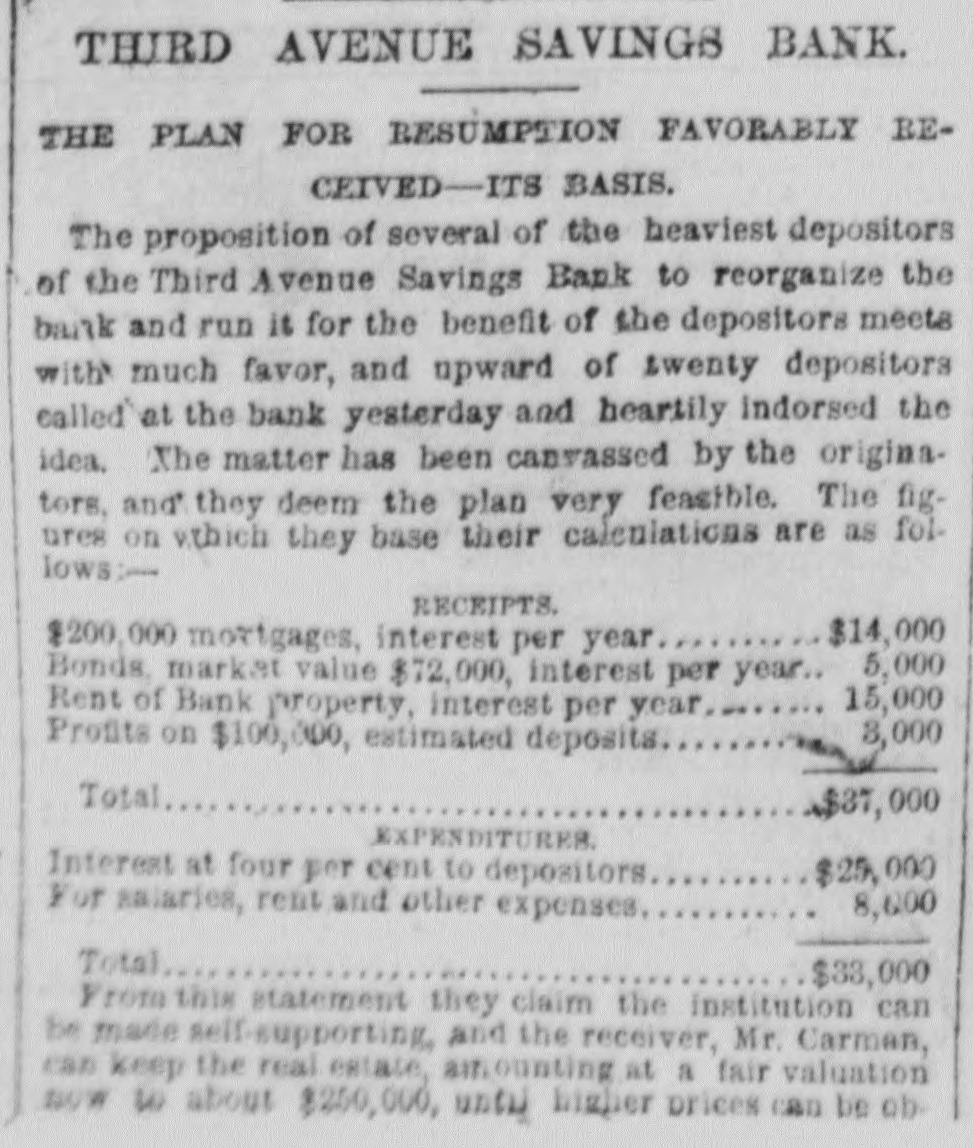
THIRD AVENUE SAVINGS BANK. THE PLAN FOR RESUMPTION FAVORABLY RECEIVED-ITS BASIS. The proposition of several of the heaviest depositors of the Third venue Savings Bank to reorganize the bank and run it for the benefit of the depositors meets with much favor, and upward of &wenty depositors called at the bank yesterday and heartily indorsed the idea. The matter has been canvassed by the originators, and they deem the plan very feasible. The figures on which they base their calculations are as follows:RECEIPTS. $14,000 $200,000 mortgages, interest per year 5,000 Bonds market value $72,000, interest per year. 15,000 Rent of Bank property, interest per year, 3,000 Profits on $100,000, estimated deposits Total $37,000 EXPENDITURER $25,000 Interest at four per cent to depositors 8,000 For salaries, rent and other expenses, Total $33,000 From this statement they claim the institution can be made self-supporting and the receiver, Mr. Carman, can keep the real estate, amounting at a fair valuation now to about $250,000, until higher prices can be ob


Article from New-York Tribune, November 10, 1875

Click image to open full size in new tab

Article Text

# THIRD AVENUE SAVINGS BANK. THE PETITION FOR MR. CARMAN'S REMOVAL-ADDI- TIONAL COUNSEL TO ENTER THE CASE-LETTER FROM MR. FITCH. The petition prepared by the committee of depositors of the Third Avenue Savings Bank, asking for the removal of Mr. Carman as receiver, was signed by several hundred depositors yesterday, at the committes room, No. 554 Third-ave. Their counsel, Ashbel P. Fitch, is in daily consultation with the depositors and is to argue the motion to remove Mr. Carman, before Judge Westbrook, at Kingston, on Saturday. The com- mittee appointed on Monday evening by depositors who were dissatisfied with Mr. Fitch met last evening at No. 293 Third-ave. Edward Mallon presided, and F. T. Maynard acted as Secretary. All the members were present, and claimed to represent $40,000 in de- posits. After a free interchange of opinion the Committee decided to employ Algernon S. Sullivan as counsel. It was


Article from New-York Tribune, November 18, 1875

Click image to open full size in new tab

Article Text

# THE ACCUSED SAVINGS BANK OFFICERS. Messrs. Lyon, Decker, Bates, Morgan, and Carman, former officers of the suspended Third Avenue Savings Bank, charged with certifying incorrect reports to the Bank Department of the condition of the bank, gave bail yesterday in the sum of $5,000 each, at the Fifty-seventh Street Police Court, Justice Duffy presiding. Benjamin A. Lyon of No. 244 East Sixtieth-st., Henry Sauipagh of No. 244 East Twenty-sixth-st., John Davidson of No. 805 Lexington-ave., William Bates of No. 709 Pacific-st., Brooklyn, and Philip J. Seiter of No. 1,019 Third-ave., were accepted as sureties. The case was then adjourned until this afternoon at 3 o'clock, when the accused officers will decide whether to demand an examination or waive it.


Article from The Daily Argus, November 26, 1875

Click image to open full size in new tab

Article Text

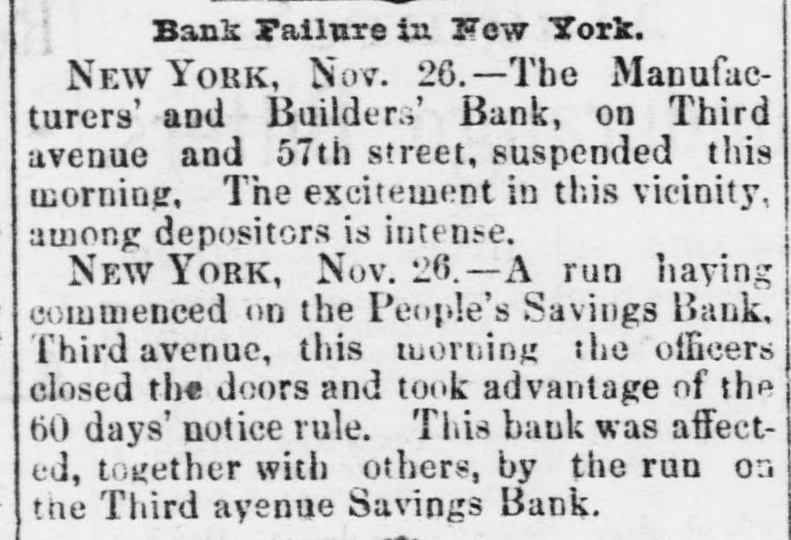
Bank Failure in New York. NEW YORK, Nov. 26.-The Manufacturers' and Builders' Bank, on Third avenue and 57th street, suspended this morning, The excitement in this vicinity, among depositors is intense, NEW YORK, Nov. 26.-A run haying commenced on the People's Savings Bank, Third avenue, this worning the officers closed the doors and took advantage of the 60 days' notice rule. This bank was affected, together with others, by the run on the Third ayenue Savings Bank.


Article from New-York Tribune, November 26, 1875

Click image to open full size in new tab

Article Text

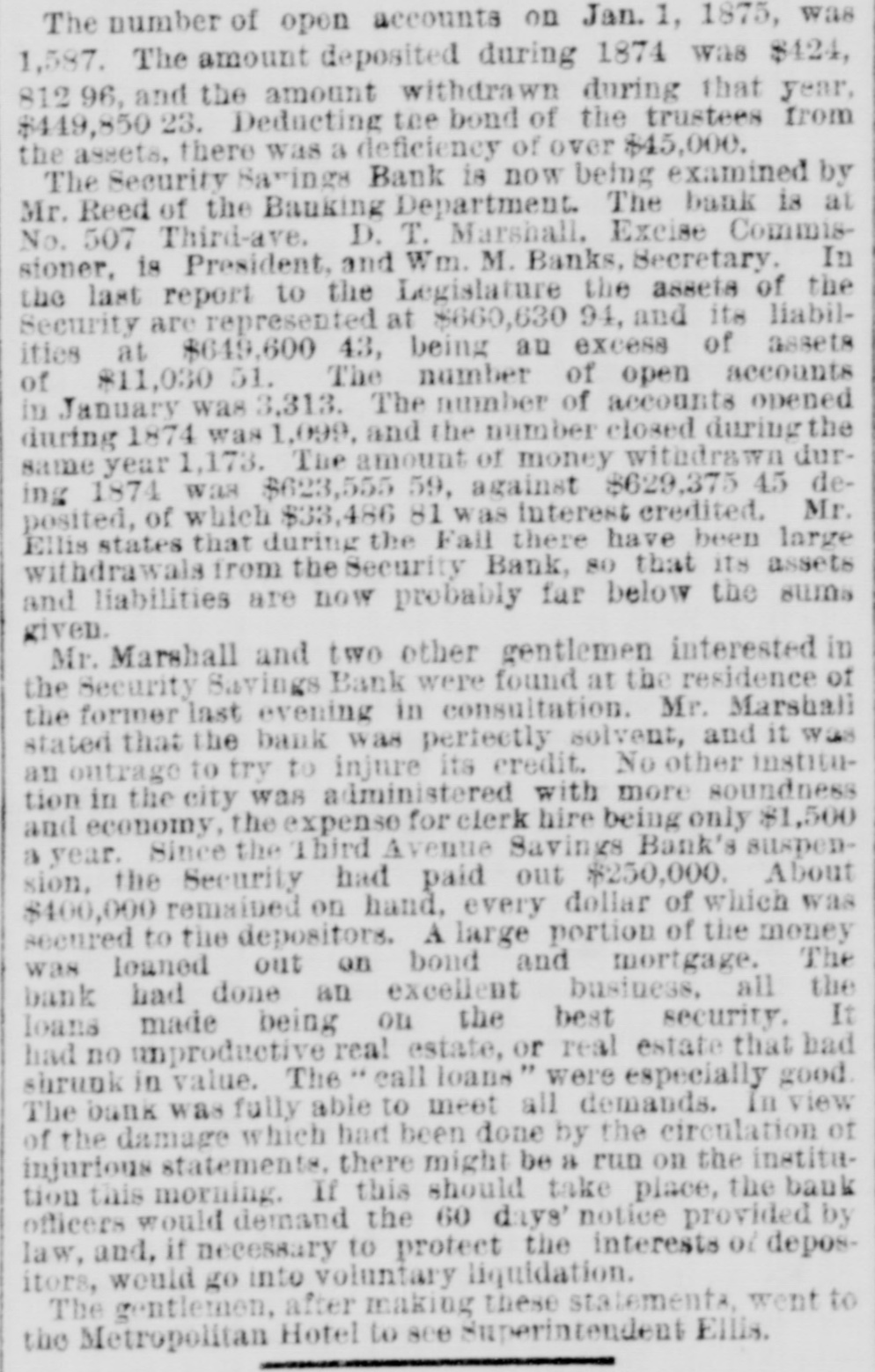
The number of open accounts on Jan. 1, 1875, was 1,587. The amount deposited during 1874 was $424, 812 96, and the amount withdrawn during that year, $449,850 23. Deducting tee bond of the trustees from the assets, there was a deficiency of over $45,000. The Security Savings Bank is now being examined by Mr. Reed of the Banking Department. The bank is at No. 507 Third-ave. D. T. Marshall. Excise Commissioner, is President, and Wm. M. Banks, Secretary. In the last report to the Legislature the assets of the Security are represented at $660,630 94, and its liabilities at $649,600 43, being au excess of assets of 811,030 51. The number of open accounts in January was 3,313. The number of accounts opened during 1874 was 1,099, and the number closed during same year 1,173. The amount of money withdrawn dur1874 was $623,555 59, against $629,375 45 deing posited, of which $33,486 81 was interest credited. Mr. Ellis states that during the Fall there have been large withdrawals from the Security Bank, so that its assets and liabilities are now probably far below the sums given. Mr. Marshall and two other gentlemen interested in the Security Savings Bank were found at the residence of the former last evening in consultation. Mr. Marshall stated that the bank was perfectly solvent, and it was an outrage to try to injure its credit. No other institution in the city was administered with more soundness and economy, the expense for clerk hire being only $1,500 a year. Since the Third Avenue Savings Bank's suspension, the Security had paid out $250,000. About $400,000 remained on hand, every dollar of which was secured to the depositors. A large portion of the money was loaned out on bond and mortgage. The bank had done an excellent business, all the loans made being ou the best security. It had no unproductive real estate, or real estate that bad shrunk in value. The call loans' were especially good. The bank was fully able to meet all demands. In view of the damage which had been done by the circulation of injurious statements. there might be a run on the institution this morning. If this should take place, the bank officers would demand the 60 days' notice provided by law, and, if necessary to protect the interests of depositors, would go into voluntary liquidation. The gentlemen, after making these statements, went to the Metropolitan Hotel to see Superintendent Ellis.


Article from New-York Tribune, December 10, 1875

Click image to open full size in new tab

Article Text

THE SAVINGS BANK RECEIVERS. The receivers of the suspended savings banks have entered upon their duties and are busy examining the books and securities. Bank Superintendent Ellis stated to a reporter of THE TRIBUNE last evening that there was nothing new to say about the condition of the banks. He should return to Albany to-day, and would visit this city again, probably, next week. Herman Uhl, receiver of the German Up-town Savings Bank, filed yesterday his bond as receiver, Oswald Ottendorfer and William Steinway becoming his bondsmen. Each of the boadsmon jusiifies in $150,000. The Mutual Life Insurance Company has begun a suit against the Third Avenue Savings Bank to foreclose a mortgage for $25,000 ou property on Fifth-ave., near Eighty-fifthst., originally mortgaged to the bank, but the mortgag on which the bank was guaranteed.


Article from New-York Tribune, December 16, 1875

Click image to open full size in new tab

Article Text

names have rarely anything distinctive about them, and for the most part are not more than one remove above silliness. "Greenburgh ' is a fair sample of the class. The suspension of the Uptown Savings Bank has been traced to an embezziement. A series of forgeries perpetrated on the Third Avenue Savings Bank is now found to account for some of its heavy losses. In both cases the money was abstracted in several smaller sums. It seems probable that sharp care exer cised by the bank officers might have stopped the process before the losses reached their present size. Investigations to determine whether officers and trustees did their whole duty in these banks will be in order: if the money was lost through their neglect, they should be made responsible. The House vote on subsidies is a cheering sign. Coming so shortly on the heels of Mr Kerr's election, it may fairly be construed a a renewed pledge of the majority agains railroad and steamship jobs of all sorts, the Southern Pacific's, the Pacific Mail's, Post master-General Jewell's, or any other. The Speaker will be fully warranted in accepting this as the deliberate judgment of the House and constituting his Committees in accordance with it. We have expected a good deal o mischief from this House, and have not beer too hopeful of good. But he would be a hare man to suit, no matter what his party predi lections, who should not be pleased with th two most conspicuous acts, thus far, of the session. President-making and maneuvering for posi tion in the national campaign have already begun in Congress. The Republicans tried to get the Democrats into a false position on the return to specie payments, and partly suc ceeded. Mr. Morton has submitted an elabo rate series of resolutions designed to tes the extent to which Southern rebel now in Congress have been reconstructed. H also proposes a Senatorial investigation of the election in Mississippi, and, as he would be the Chairman of the Committee, we all know what a dreadful state of affairs he would speedily discover. The Democrats in the House have forced Republicans on the record agains the third term, but they have not caugh Mr. Blaine. Altogether it is a game o maneuvering in which both sides seem at firs a little awkward. Gen. Babcock has done a sensible thing i asking for the dissolution of the Court of In quiry. It must be confessed that appearance have been from the outset much against him The indictment is in itself presumptive proof of the existence of evidence which the Grand Jurors thought important. The telegrams themselves, the declarations of Hen derson, Dyer and others, all point to : strong belief in his guilt. But, on the other hand, justice requires the public to note that, thus far, Gen. Babcoel bas done everything which an innocen man could, under the circumstances, be ex pected to do. The moment his name was im plicated he telegraphed a request to be ex


Article from New-York Tribune, December 20, 1875

Click image to open full size in new tab

Article Text

THE SUSPENDED SAVINGS BANKS. At a meeting of the depositors of the Peoples' Savings Bank on Saturday evening at No. 200 Third-ave. it was decided to employ counsel to procure the removal of the present receiver and Ito bring suits against the trustees in dividually in order that the deficiency might be made good. Another meeting will be held this afternoon to receive a preliminary report of the condition of the bank. The examination in the charge of perjury against T. W. Decker, late President of the Third Avenue Savings Bank, was continued on Saturday at the Yorkville Police Court, before Justice Duffy. The accountant employed by the depositors testified that he had found many irregularities in the yearly reports and some tietitious items. The hearing will be resumed on Dee. 27. The rumor that Christian Schwartz, late President of the German Uptown Savings Bank, was in the city and had intended to sail for Europe on Saturday, proves on investigation to be false. Papers for his arrest were prepared for presentation to court on Saturday by A. B. Fitch. It is believed that the report was intended to mislead those interested.


Article from Chicago Daily Tribune, December 20, 1875

Click image to open full size in new tab

Article Text

THE NEW YORK SAVINGS BANKS. The deeper the examination of the affairs of the broken New York savings banks is carried, the more Indignant and hopeless the depositors become, and the larger the deficiencies. The former President of the German Up-Town Havings Bank is shown to have been In the habit of making loans to bis personal friends on worthless securities, The counsel of the Lank approp risted to his own UHO $33,735 which Le had collected for the Lank. Large amounts of Seathern and county bonds which were rated in his assets at par, are worthless, The Mutual Benefit Ravings Bank is in the hands of A Receiver, who refusos to give the depositors any information about its condition, and these unfortunate creditors have appointed an expert to ascertain what their prospects are for dividends. The Receiver, W. F. Aldrich, in stated by the Now York Sun to have been, when connected with the State Banking Department, one of the Examiners who reported the Third Avenue Savings Bank sound, when it was insolvent. The People's Savings Bank has assets of about $57,000, to meet $180,000. The Receiver of this bank bluffed the representative of the depositors with the remark that when he wanted him he would send for him, and the Receiver's lawy er gave him the desolating informati >n that a bank which could pay 50 per cent to these titnes was doing remarkably well! The books of the Third Avenue Savings Bank thow that a deficiency of $235,000 was known to the Trustees in 1872. Their bond for $176,000, cannot be enforced till 183.1 SCARCITY OF GOLD IN BALTIMORE. There is BO little cash gold in Baltimore that Importera there have difficulty in obtaining enough to pay duties with. The American says: It is hardly credible, but it is n fact, that one Inporter who wanted $50 visited four brokers' offices be fore he could secure that small amount. Those who winh larger amounts have to wait until they can, through their correspondents, buy gold notes in New York. The Committee of Baltimore sugar-importers who recently visited Washington in reference to drawbacks on sugars called the attention of Treasurer New to the trouble that existed here on account of the BubTreasurer having discontinued the sale of gold memorandum checks. They urged upon Mr. New the necescity: that existed for affording them relief, and he promised that be would 800 what could be done. GROWTH OF TAXATION. The New York Daily Bulletin is compiling comparative statistics of the growth of taxation and population, national, State, and local, The list is as follows: 44 Ordinaty expeditures of the United States Government " in 1874 and 1860, exclusive of interest on debt. 1674. 1900.


Article from New-York Tribune, March 4, 1876

Click image to open full size in new tab

Article Text

# THIRD AVENUE SAVINGS BANK. THE CHARGE AGAINST WILLIAM A. DARLING AND SPENCER K. GREEN. The examination in the case of William A. Darling, Appraiser of the Port, and Spencer K. Green, on a charge of subscribing to an incorrect financial report of the Third Avenue Savings Bank, was resumed yesterday before Justice Duffy at the Tombs Police Court. Ashbel T. Fitch appeared as counsel for the prosecution; ex-Judge Dittenhoefer, Abram Wakeman, and George Sewell represented the accused. Robert A. Van Wyck was acting for Mary Flood, a depositor. Mr. Darling was not present during the examination. The first witness was A. Sellers, who testified that he was employed under the receiver. He identified the books of the bank and said he had examined the report which was signed by the defendants. When the witness was asked what was the result of his examination, counsel for the defendant objected on the ground that the question was incompetent, and the paper proposed to be put in evidence was an unauthenticated copy of the report signed by Deputy Superintendent Lann. It was answered by the counsel for the prosecution that the objection was only technical, and that if time was allowed he could show that it was a duly certified copy of the report. Justice Duffy said that he saw the Banking Department's seal on the paper, and would admit it. The witness testified that on Jan. 1, 1871, the amount due the depositors of the Third Avenue Savings Bank was $5,959,369.84, being the amount stated in the report and which corresponded with the amount entered in the general ledger of the bank. The general ledger used in the bank contained the collated daily individual deposits from different books which were transferred to it in the aggregate. The quickest way to discover the condition of the institution was to examine the ledger, but in order to make certain it was necessary to make an examination of the dealers' books and compare them with the entries in the general ledger. Mr. McDonald, the accountant, made a long statement. In regard to the report showing the condition of the bank Jan. 1, 1871, when the assets were made to exceed the liabilities by $103,000, Mr. McDonald explained by the books that the real estate in the statement of assets had been increased by a false entry of $100,000. He also pointed out that an item of interest of $113,000, called an asset, as Interest due and uncollected, was wholly false, and that instead there was an item on the books of the exact sum to the debit of the suspense account. Mr. McDonald also showed that on Dec. 31, 1870, an item of cash, as received from premiums, of $106,000 was entered as received for the purpose of increasing the bulk or gross amount of the cash on hand, which was wholly false, as it was shown on the cash book that on Jan. 4, 1871, the cash as charged with the payment of exactly the same sum. Mr. McDonald also showed by the books that in the income of 1870 there was an absolute deficiency of $45,000. The examination was then suspended until to-day.


Article from New-York Tribune, March 9, 1876

Click image to open full size in new tab

Article Text

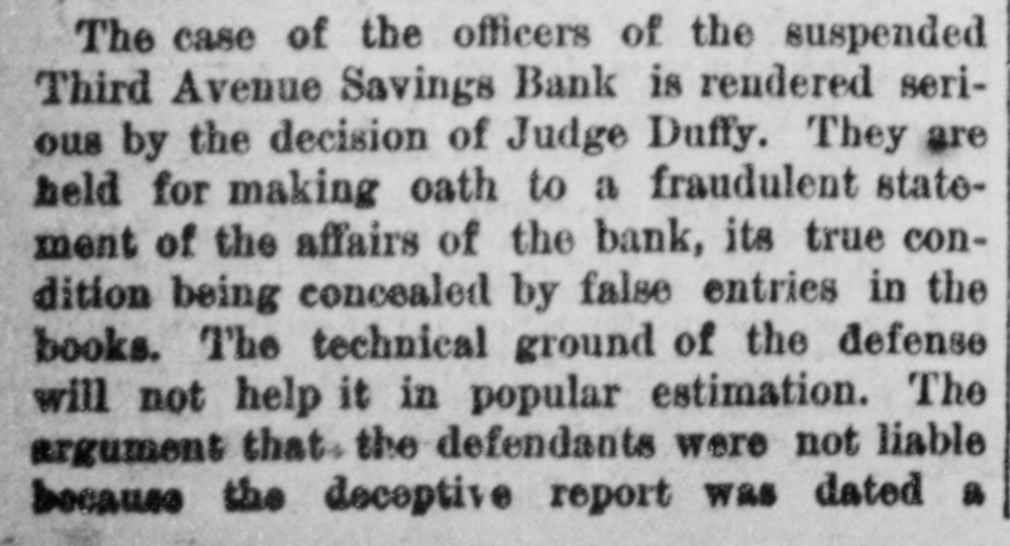
The case of the officers of the suspended Third Avenue Savings Bank is rendered serious by the decision of Judge Duffy. They are held for making oath to a fraudulent statement of the affairs of the bank, its true condition being concealed by false entries in the books. The technical ground of the defense will not help it in popular estimation. The argument that the defendants were not liable because the deceptive report was dated a


Article from New-York Tribune, April 1, 1876

Click image to open full size in new tab

Article Text

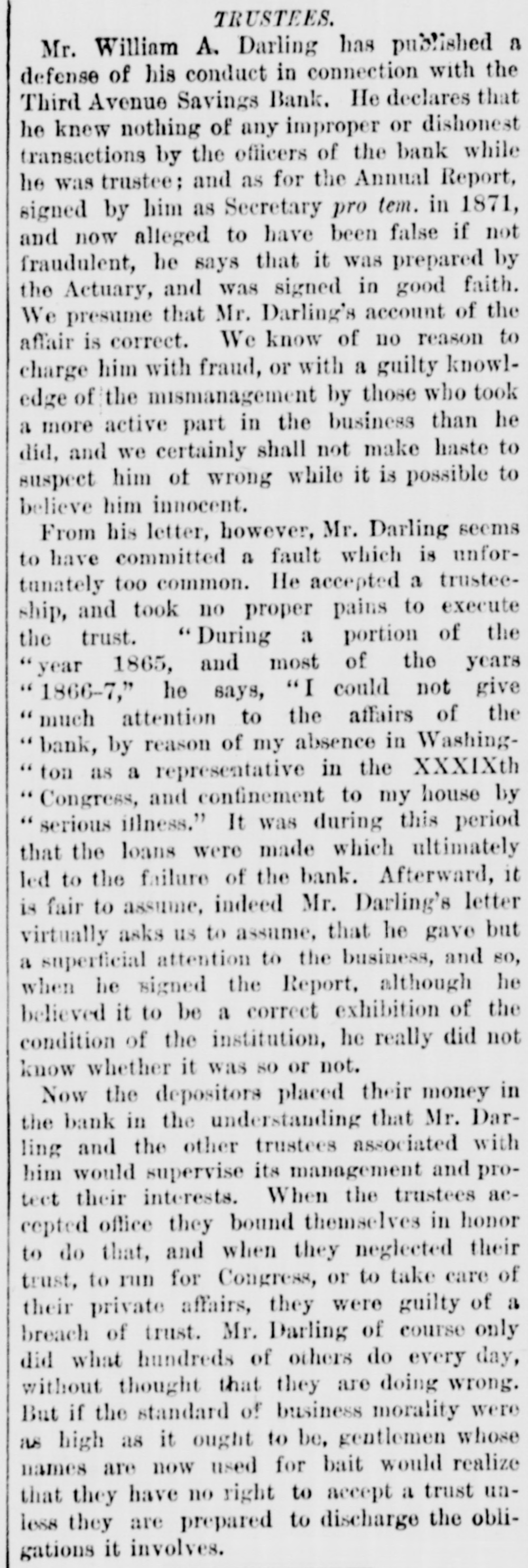
# TRUSTEES. Mr. William A. Darling has published a defense of his conduct in connection with the Third Avenue Savings Bank. He declares that he knew nothing of any improper or dishonest transactions by the officers of the bank while he was trustee; and as for the Annual Report, signed by him as Secretary pro tem. in 1871, and now alleged to have been false if not fraudulent, he says that it was prepared by the Actuary, and was signed in good faith. We presume that Mr. Darling's account of the affair is correct. We know of no reason to charge him with fraud, or with a guilty knowledge of the mismanagement by those who took a more active part in the business than he did, and we certainly shall not make haste to suspect him of wrong while it is possible to believe him innocent. From his letter, however, Mr. Darling seems to have committed a fault which is unfortunately too common. He accepted a trusteeship, and took no proper pains to execute the trust. "During a portion of the "year 1865, and most of the years "1866-7," he says, "I could not give "much attention to the affairs of the "bank, by reason of my absence in Washing-ton as a representative in the XXXIXth "Congress, and confinement to my house by "serious illness." It was during this period that the loans were made which ultimately led to the failure of the bank. Afterward, it is fair to assume, indeed Mr. Darling's letter virtually asks us to assume, that he gave but a superficial attention to the business, and so, when he signed the Report, although he believed it to be a correct exhibition of the condition of the institution, he really did not know whether it was so or not. Now the depositors placed their money in the bank in the understanding that Mr. Darling and the other trustees associated with him would supervise its management and protect their interests. When the trustees accepted office they bound themselves in honor to do that, and when they neglected their trust, to run for Congress, or to take care of their private affairs, they were guilty of a breach of trust. Mr. Darling of course only did what hundreds of others do every day, without thought that they are doing wrong. But if the standard of business morality were as high as it ought to be, gentlemen whose names are now used for bait would realize that they have no right to accept a trust unless they are prepared to discharge the obligations it involves.


Article from The New York Herald, May 31, 1877

Click image to open full size in new tab

Article Text

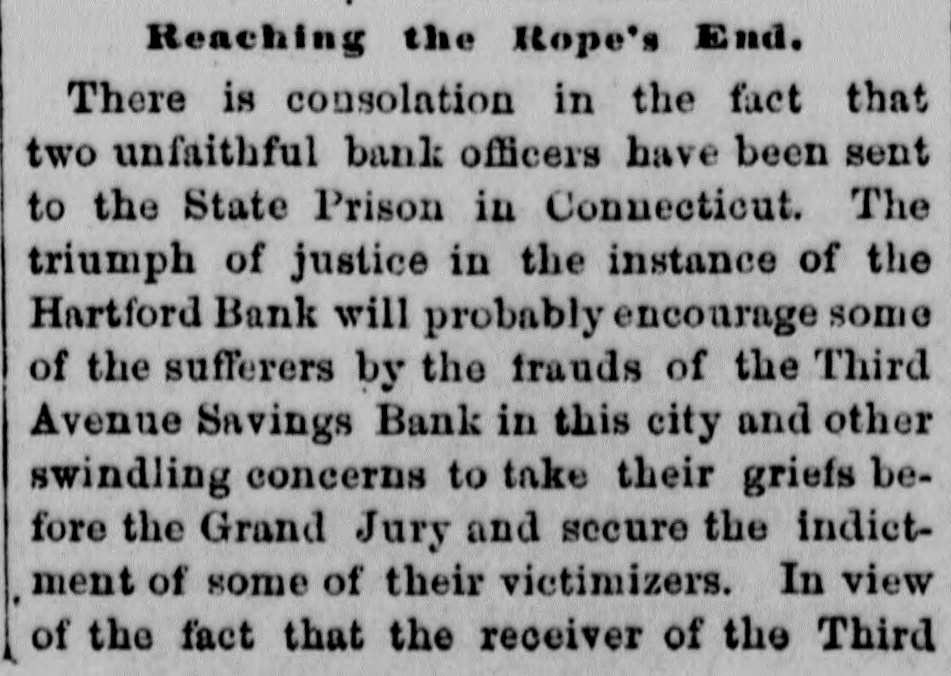
Reaching the Rope's End. There is consolation in the fact that two unfaithful bank officers have been sent to the State Prison in Connecticut. The triumph of justice in the instance of the Hartford Bank will probably encourage some of the sufferers by the frauds of the Third Avenue Savings Bank in this city and other swindling concerns to take their griefs before the Grand Jury and secure the indictment of some of their victimizers. In view of the fact that the receiver of the Third


Article from The New York Herald, June 17, 1878

Click image to open full size in new tab

Article Text

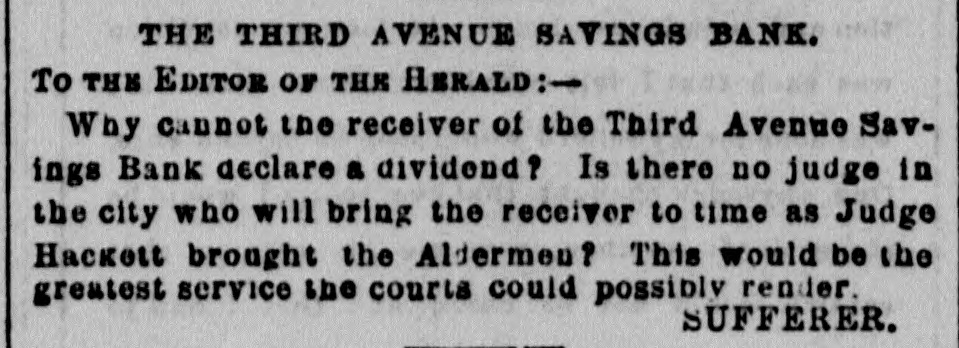
# THE THIRD AVENUE SAVINGS BANK. TO THE EDITOR OF THE HERALD :- Why cannot the receiver of the Third Avenue Savings Bank declare a dividend? Is there no judge in the city who will bring the receiver to time as Judge Hackett brought the Aldermen? This would be the greatest service the courts could possibly render. SUFFERER.