14468. Teutonia Savings Bank (New York, NY)

Bank Information

Episode Type
Suspension β†’ Run β†’ Closure
Bank Type
savings bank
Start Date
April 24, 1878
Location
New York, New York (40.714, -74.006)

Metadata

Model
gpt-5-mini
Short Digest
657f1e15faacd691

Response Measures

None

Description

The Teutonia Savings Bank (occasionally OCR'd as 'Tentonia') was ordered to stop business in late April 1878, producing a crowd of depositors and attempted withdrawals. A bank examiner took charge and a receiver (James D. Fish) was appointed; trustees/officers were later arrested for embezzlement and the institution remained in receivership with dividends paid later. Cause of suspension was insolvency from losses on repudiated town bonds and shrinkage in real estate values; depositors gathered after the closure (a run/agitation) but the bank did not resume normal operations and was wound up under a receiver.

Events (4)

1. April 24, 1878 Suspension
Cause
Bank Specific Adverse Info
Cause Details
Ordered closed by Bank Examiners because of insolvency attributable to losses on repudiated town bonds (Southfield and Middletown Staten Island) and shrinkage in value of real estate.
Newspaper Excerpt
The doors of the Teutonia Savings Bank ... were closed last evening. ... order had been received to stop business.
Source
newspapers
2. April 25, 1878 Run
Cause
Bank Specific Adverse Info
Cause Details
Excitement and heavy withdrawals among depositors followed the bank's closure/suspension and publicity about the bank's doubtful assets; depositors attempted to withdraw funds and crowds gathered at the closed door.
Measures
Bank Examiner St. John took charge; trustees instructed counsel to offer no opposition to injunction and to ask appointment of a trustee/receiver; receiver James D. Fish later appointed and managed asset realizations.
Newspaper Excerpt
two or three hundred of the depositors in the bank had gathered around the building ... No one was admitted.
Source
newspapers
3. April 26, 1878 Receivership
Newspaper Excerpt
Bank Examiner St. John took charge of the bank yesterday. ... they instructed William H. Newschafer ... to ask for the appointment of a trustee as receiver ... Receiver James D. Fish later sells securities and administers bank affairs.
Source
newspapers
4. July 10, 1878 Other
Newspaper Excerpt
books fixed the value of the real estate ... receiver was requested by vote of the meeting to take legal proceedings against the trustees ... payments and dividends to depositors to be paid by receiver later.
Source
newspapers

Newspaper Articles (24)

Article from New-York Tribune, April 25, 1878

Click image to open full size in new tab

Article Text

CLOSING THE DOORS. ANXIETY OF THE DEPOSITORS-THE OFFICERS RETICENT-DEPOSITS RECEIVED YESTERDAY. The doors of the Teutonia Savings Bank, which 18 at No. 25 Avenue-A. were closed last evening. On Wednesdays they are usually open from 6 to 8 P. m. It was not until 6 p. m. yesterday that it became generally known in the neighborhood that the order trad been received to stop business. The news that the doors were closed quickly spread from mouth to mouth, and, before 7 o'clock in the evening, two or three hundred of the depositors in the bank had gathered around the building at Avenue-A and Secondst. No one was admitted. however. and no information could be obtained by the excited throng outside, and the people finally dispersed, still without understanding the closing of a savings bank looked upon in that part of the city as above suspicion. From such information as could be gained from others than the officials of the bank, it appears that the order to suspend business must have been received early in the day, but was not acted upon till the close of the usual banking hours. Deposits were received as usual, and the first suspicion of trouble arose on account of a refusal to allow a withdrawal in the afternoon. The Tentonia Savings Bank has been very popular on the East Side, and has among its depositors a great number of the German residents of the Seventeenth Ward, in which it is situated. The fact that its doors were closed, and the earnings of a lifetime locked up-perhaps lost in part-created a great deal of excitement in the vicinity, though there were many who believed in the stability of the bank. The officers of the bank were reticent last evening in regard to its condition. At the residence of John Scheuermann, the president. in East Seventeenth-st., it was stated that he had been very 111 for the last week, and could not see any one. It was stated that his condition was such that in no event could he be disturbed. The reporter who made the inquiry was told afterward, however, that Mr. Scheuermann had been seen frequently in the vicinity of the building during the week. It was stated by some persons] among the gathering of depositors that Mr. Scheuermann had resigned his position as president of the bank some time ago, and this had caused suspicion among many that something was wrong, but as the resignation had not been accepted, the temporary anxiety of depositors had been generally removed and confidence in the bank had been restored. No information could be obtained at Mr. Scheuermann's house even as to the other directors of the bank, there seeming to be a disposition to avoid every inquiry into the matter. The directors who were seen afterward were uncommunicative regarding the affairs of the (bank, though evidently surprised at the order toclose it. John Theiss, one of the trustees, said that he had every reason to suppose, according to the last statement of the bank, that there was a surplus of $80,000. The bank held, he said, about $110,000 of the town bonds of Southfield and Middletown, Staten Island, which were in litigation. The bank had brought suit to recover this amount, and the matter was now before the Court of Appeals for final decision. These bonds had been thrown out by the examiners from among the assets, leaving a deficiency, upon which they had been ordered to close their doors. Charles Merz, saloon-keeper, in Fourth-st.. one of the
Article from New-York Tribune, April 26, 1878

Click image to open full size in new tab

Article Text

SAVINGS BANK TROUBLES. THE SUSPENSION OF THE TEUTONIA. DISTRESS AMONG THE DEPOSITORS-ACTION OF THE TRUSTEES. A notice in German was displayed on the large irou door of the Teutonia Savings Bank, in AvenueA, yesterday, announcing that it was closed by orders from Albany. A crowd of sad-faced men, women and children, elad in garments that indicated hard work, gazed anxiously at the curtained windows of the bank. When they talked, it was to bewail their ill-fortune, to regret that by some means they had not been forewarned of the danger, and to indulge in congecture as to the probable percentage of their deposits which they would receive. A woman who had improvised a head covering from her shawl, quickly became the centre of a little group, as she told how hard she had worked for the little sum she had on deposit. Conversations were all carried on in German. The case of Mrs. Koeher, whose husband was one of the victimstat the fire infGreenfield's factory in Barelay-st., created much sympathy. A small amount of money was given her by the Greenfields to assist in paying her rent. She deposited the money 111 the bank the day before it was closed, and is now said to be absolutely penniless. Bank Examiner St. John took charge of the bank yesterday. Notice was sent in the morning to the trustees to meet at the house of Michael Hahn, secretary, at No. 1,052 Second-ave. The Board of Trustees is composed as follows: John Scheuermann, president; John Theisz and Jacob Berman, vice-presidents; Michael Halm, seeretary; Louis George, John Otto, Charles Merz, Nicholna Rheinart, Henry Wenke, J. Hoenberg, Michael Seagrist, John Wigger and Frederick Sigrist. All were present at the meeting except three, who were out of the city or sick. They discussed the whole situation, and claimed that the department had been rather basty in restraining the bank from carrying on business. The only ground for such action, they said, was simply the question about the payment of the town bonds. The trustees believed that these would certainly realize their full value in time. But since the bank had been ordered to be closed there was nothing left to be done. Although it might be possible to prove to the Court the validity of these claims, and have the injunction set aside, all contidence in the bank was lost, and they could never continue business. To secure the greatest percentage to the depositors was the only object for which they could work. It was then unanimously agreed that any one of their number would willingly take charge of the bank, wind up its affairs and pay the largest possible dividend without any compensation. Accordingly they instructedWilliam H. Newschafer, counsel for the bank, to appear before Judge Westbrook, to-day and offer no opposition to the injunction, but ask for the appointment of a trustee as receiver to have no renumeration for nis services. It was proposed also to call a meeting of the depositors but this idea was abandoned.


Article from The Sun, April 26, 1878

Click image to open full size in new tab

Article Text

The Tentonia Savings Bank has been forced to give up its protracted struggle for existence. The Bank Examiners, upon whose report the injunction compelling the bank to stop business was based, do not allege mismanagement on the part of the officers, but ascribe the bank's insolvency to losses upon repudiated town bonds and the shrinkage in the value of real estate. Situated in a district densely populated by poor people, the Teutonia has been used by thousands of toilers as a strong box for their hard-earned savings, and its suspension has borne grief and panic into many a humble home. Those who may lose cannot say that they were unwarned by THE SUN. On Dec. 2, 1875, THE SUN published a statement of the condition of thesavings institutions of this city, as nearly as could be judged from ascertainable facts and figures. In that statement the Teutonia was mentioned as .. doubtful." Its assets then were over two millions, but a steady drain has diminished them to about half that amount.


Article from The Sun, April 26, 1878

Click image to open full size in new tab

Article Text

DEPOSITORS ALARMED. What Followed the Suspension of the Tentonia Savings Bank. An effort was made yesterday to start a run on the Dry Dank Savings Bank. Many eager depositors, alarmed At the suspension of the Teutonia Savings Bank, filled the spacious area of the banking room, soon after the opening hour, and withdrew their deposits until about 1 o'clock. at which hour President Mills announced that only sums of $100 or less would be paid to those who needed it for living expenses. To all others notice was given that the bank would take the benefit of the sixty-day rule. Then a few depositors drew $100 and a few gave notice, but the majority were satisfied that the run was to be stopped. The Dry Dock Savings Bank has been in existence since 1848, and has never enforced the sixty-day rule, except during a few days of Black Friday times. One year it paid a dividend of 10 per cent., and two years 7 per cent. Wm. V. Webster, the secretary. said last evening that he has no fears of an extended run. But. if all the depositors should withdraw their accounts. the bank would have the building left and $300,000 in addition. The total surplus is $911,893. of which only $586,571 is the valuation of the bank's handsome editice, The investments are mainly in city, State, and national bonds. A novel fenture of the incipient run is the directors order that any depositor who gives notice of withdrawal shall be compelled to take the money at the appointed time. A multitude of depostors,drenched with rain, stood in front of the Tentonia Savings Bank. in Avenue A. vestorday. and tried in vain togain information in regard to the failure of the institution. The officers of the bank did not meet the disappointed and indignant depositors, The iron door was locked. and on it was pasted a very small slip of paper. on which was written an indistinet and almost illegible notice that the bank WHIS closed. The officers have engaged a lawyer to go to Hudson this morning and try to stave off the permanent closing of the bank. It is to be argued on behalf of the bank that the institution is not actually insolvent. and. if permitted. can continue business and ultimately pay the depositors dollar for dollar. The bonds of the town of Southfield. Staten Island. amounting to over $100.000, which the State officials have put down as doubtful securities, are, it is said, good. The town. they say, is liable for the bonds. The Teutonia Savings Bank Was organized in 1868. through the efforts of several German shopkeepers on the east side. A building. costing nearly $70,000. was erected. The Examiners have valued this building at only $30.000. A woman who stood among the depositors yesterday said that her husband died three weeks ago, leaving six children. He had $578 in the bank. She could not pay the undertaker who buried her husband, and her children were crying for something to eat. A collection for her was taken up by the depositors standing near her. A German, who has kept a grocery in Avenue B ten years. hade$3.525 in the bank. He said that he must now give up his business. because he could not get his money to take upa mortinge. Several German clubs and mutual benefit societies had their money in the bank, one club having over $2.000.


Article from The New York Herald, April 26, 1878

Click image to open full size in new tab

Article Text

The lady was lound, and said, "A friend of our family came to me yesterday and said I had better take out of the Toutonia what money I had in 11. I went at once and drew out $103 50, which is the full amount 1 nad in the bank." Various rumors were circulated to stir up the popular indignation. It was said that the Church of the Redeemer, at Third street and avenue A, as also the Church of St. Nicholas, were notified to draw out the moneys of their respective societies deposited there. These rumors are denied by the Secretary, Mr. Michael Hahn. A meeting of the trustees was held at No. 1,031 Second avenue, and it was resolved to do nothing 10 interfere with the decisions of the Court. Their attorney, Mr. William H. Newschufer, wasinstructed to proceed to Hudson and appear at the Court House to-day and state that the trustees were ready to surrender all the property of the bank into the hands of any receiver that, the Court would be pleased 10 appoint. Mr. Hahn thought that it would be useless to attempt any other course. He leared that by forced sales and the necessary expenses of a receivership the amount returnable to the depositors would be considerably lessened. They would make no effort to have any particular person appointed as receiver. Mr. Hahn said that he would be willing to close up the bank's affairs without a сСдь of compensation, but that the courts would not permit this. He thought that he could get the highest price for all the securities. A meeting of the depositors would probably be called, at which the trustees would lay before them all the affairs of the bank, With proper management about ninety per cent could be returned. Mr. A. Sheurman, president of the bank, has been seriously ill for some months, and could not be seen yesterday. Mr. Newschater, their attorney, left for Hudson last night.


Article from The New York Herald, April 27, 1878

Click image to open full size in new tab

Article Text

RUNS OM THE GERMAN AND DRY DOCK Depositors of the Sixpenny Who Favor Postal Savings. THE RAHWAY SAVINGS BANK Condition of the Mechanics' Bank, of Providence, R. 1. The excitement concerning the Teutonia Savings Bank bas almost died out, but its closing was the signal for a heavy run on the Dry Dock Savings Bank, which commenced Thursday morning. The German inhabitants of the east side who have deposited most of their hard earned savings in these institutions became alarmed, and the consequence was that a heavy swarm of excited depositors attempted to draw out their money from the Dry Dock Bank, and a more than usual number gathered at the German Savings Bank. The former institution paid out $160,000 on Thursday and over $60,000 yesterday. AT THE DRY DOCK BANK. The president of this institution, Mr. Andrew Mills, had been informed that a run on his bank was in contemplation, but not anticipating such a great rush, took no measures to prevent it, and gave orders that all ho came for their money should be promptly paid. At the opening hour three tellers began paying out to all who demanded their deposits. There were in all about five hundred accounts closed out, the great majority of the depositors drawing all they had, and the heaviest depositors seeming Lo be the most alarmed. The president, fearing that a general panic would ensue, then gave orders that the rule requiring sixty days' notice for withdrawal of deposits should be enforced on all who called for sums larger than $100. This was about two o'clock in the afternoon, and payments were considerably decreased by this order. To obtain greenbacks to meet the payments au order was procured from another bank. which was indebted to them, on the Sub-Treasury, and $100,000 in small bills were louged in the bank vaults Monday evening. The cash on hand at present amounts to over $250,000. There were some few persons who had confidence enough to come to the bank and deposit money in the face of the exciting rumors. Policemen were stationed in the building to keep order and to force each depositor to retain his place in the long lines which were slowly Gling past the teller's desk. One hundred persons who had deposits of over $100 gave the required sixty days' notice. Some, who found that the bank was paying freely, and who reflected that the run was due to momentary excitement, and that they would lose their interest if they withdrew their money, came and looked at the crowd a few moments and went away without drawing anything out. One woman, who needed a little money, finding there was such a rush at the bank concluded to leave her savings there and draw what she needed from another bank in which she also and an account. WHAT THE OFFICERS SAY. The officials of the institution laughed at the idea of the bank bring in serious trouble from the run. It bad 8100d Luree runs before, one of which, ou Black Friday, was very heavy. On none of the former occasions had they enforced the sixty day rule, but it was deemed advisable to enforce 16 at present ID order to protect the depositors from injuring themselves. Mr. Andrew Mills said to HERALD reporter that in case all the depositors should withdraw tueir accounts there would be a surplus of $300,000 over and above the bank building and all their real estate. Tue total surplus is about $900,000 of which $686,571 IS the value of the bank building. the bank has in its possession $6,000,000 worth of government and New York State and eny bonds, all of them worth par, many of them above 11. which could DO made available at a day's notice. The president wished, however, to enforce the sixty day rule, 10 order to negotiate their bonds and mortgages, valued at $2,000,000, tirst. All WHO drew out their money would lose the interest on it, and all who gave the sixty days' notice would also lose the interest, provided they drew the money at the end of that time. They Were not, however, obliged to draw 11 unless tuey chose. It the run should continue so as to render 14 necessary to dispose of the bank's securities the bonds and mortgages would be nrst made available. Many 01 these morigages are on property in the immediate vicinity, tenanted by many of the depositors. It these should be for eclosed and the Indiords not have ready cash 10 take up the mortgages the property would have 10 be sold and the tenants dispossessed, and thas their OWD foolish haste would be the cause of much trouble 10 them. Mr. Mills, however, and not think that 16 would be necessary to proceed to collect the bonds and mortgages, as ne believed the run would die out in a lew days, as several other runs bird done before. The following table snows the available funds of the bank to be about $6,000,000, which would stand a run of forty uays at tue rate of $150,000 a day ASSETS.


Article from The New Orleans Daily Democrat, April 30, 1878

Click image to open full size in new tab

Article Text

The New York Banks. NEW YORK, April 29. - The run on the Dry Dock Bank has entirely ceased. A number of deposits were made to-day. The German Bank is still paying in full all depositors who demand their money. About two hundred persons drew out their deposits to-day. A special meeting of depositors of the defunct Teutonia Savings Bank was held to-day. Seven hundred persons were present. The remarks passed were very bitter, and showed that the depositors are very generally of the opinion that the affairs of the bank have not been honestly managed.


Article from The Sun, May 8, 1878

Click image to open full size in new tab

Article Text

Indignant Depositors Hissing. Nearly one thousand depositors of the suspended Teutonia Savings Bank, two hundred of them women. met in Concordia Hall lastevening. Mr. Dauscher, of the Depositors' Committee. reported that Judge Westbrook paid no attention to the request of the committee that the selection of a receiver be delayed until the depositors could suguest some names for the position. Hisses and exclamations of indignation at Judge West brook's action were heard from all parts of the hall. A new committee was appointed to attend to the inter. ests of the depositors. It was intended to examine the books of the bank and ascertain whether there was any traud in the investment of the bank's money in almost worthless Staten Island bonds.


Article from New-York Tribune, June 27, 1878

Click image to open full size in new tab

Article Text

THE CHARTER OAK CONSPIRACY. HARTFORD, Conn., June 26.-In the Superior Court this morning the State-Attorney quashed the indictment brought at the March term against Furber, Wiggin et al., ex-officers of the Charter Oak Life Insurance Company, and filed a new information, more extensive in particulars, as to the charge of conspiracy. Rearrests were made, and bonds of $5.000 each continued; and the case was put over to the August term. . THE TEUTONIA SAVINGS BANK. ALBANY, June 26.-Justice Westbrook has granted an order permitting James D. Fish, receiver of the Teutonia Savings Bank of New-York, to withdraw from the Central Trust Company's bonds of the cities of New-York and Brooklyn, and certain town bonds, and sell the same at auction, and with the proceeds redeem certain bonds pledged with Daniel A. Moran, the German Bank, Oriental Bank, and the Mutual Insurance Company.


Article from The New York Herald, July 10, 1878

Click image to open full size in new tab

Article Text

THE TEUTONIA DEPOSITORS. A meeting of the depositors of the suspended Teutonia Savings Bank was held last evening iu Concordia Hall, avenue A. Mr. Danshan reported that after a full examination of the affairs of the bank no came to the conclusion that the aff.irs of the institu. tion bad been very carelessly managed; that the officials were incompetent, and that during the two mouths previous to the closing 01 the doors over $300,000 was drawn out by cer KID deposilors. Cnaries T. Wende, chief clerk 01 Receiver Forter, stated that no entries had been made in the ledger for lour months previous 10 the close 01 tise institution that the books show the mortgages held amounted to $583,800; bonds, $471,908, cash, $22,849. Total, exclusive ot real estate, $1,078,557. He thought there would be a surinkage ou these securities of about $200,000. The books fixed the value 01 the real as follows:Bank building, $60 441; house in Pill street, $23,581; house in Clinton street. $14,672. Total, $95,694. He believed that not more than $25,000 could be realized un the bank building. On the securlites procably $878,557 could be realized, which, added to the value of the real estate, would probably make the assets, when the atfairs are wound up, sufficient to pav 100 depositors seventy-five per cent. The receiver was requested by is vote of the meeting to take legal proceedings against the trusices 11 ne deemed 16 necessary to protect the interests of depositors. A vote 01 Censure upon the examiners of the Bank Department for their alleged reaccurate reports was passed.


Article from Daily Globe, July 14, 1878

Click image to open full size in new tab

Article Text

THRIFTY TRUSTEES. Another Savings Bank Swindle-Trustees of of the Teutonua, of N. Y., arrested on a Civil Process for Recovery of Funds appropriated to their own use-Other Criminal Matters. FRAUDULENT CONVERSION OF FUNDS. NEW YORK, July 13.-On complaint of the receiver of Teutonia Savings bank orders of arrest have been issued against the trustees in civil proceedings to recover $29,300, money of the bank fraudulently converted by them to their use. The names of the trustees mentioned in the order of arrest are Louis George, Nicholas Seagrist, Fred K. Seagrist, Henry Winkel, John Theissis, John Otto, Jacob Birmon, Chas. Meerse, John Hainburg, Joseph Wigger, John N. Schnugg, Nicholas Reinhart, John Schweman and Michael Hohn. Late this afternoon Louis George, John Theissis, Charles Mertz and John Schnugg, four of the trustees, gave bail in $100,000 each. It is understood the others will appear Monday and give bail. Michael Hohn, secretary of the bank from 1871 to the time of the appointment of a receiver, has made confession in which he says: "When I first assumed the office as secretary, the trustees urged me to take and distribute among them such money as I should be able to make either by commissions or otherwise, by investment of the fnnds of the bank. All the trustees were aware the securities had been bought by me and charged on the books of the bank at a higher rate than the actual purchase price. After I had in this way accumulated several thousand dollars in differences between the purchase price and price charged on the books, I divided the amount equally among the trustees. The salaries of the president, 7 treasurer and myself, were divided into two 9 parts, one part was retained by those officers and myself and the other was divided among the trustees. TOBACCO FACTORY SEIZED. LOUISVILLE, Ky., July 13.-Government officers yesterday seized the tobacco factory of O. M. Turrant, in Colloway county. The 1 government claims large shipments of to1 bacco have been made without payment of t taxes. The amount seized is about 25,000 y pounds. ANOTHER BLACK SHEEP. S BOSTON, July 13.-John W. Bawkes, cashier of the freight depot of the Eastern rail1 road, has abandoned his office, and already an investigation shows he is a defaulter to the amount of $20,000. WIFE MURDEBER SENTENCED. PHILADELPHI July 13.-Alexander B. Sayres, convicted of the murder of his wife S in the Church of the Ascension in November last, was to-day sentenced to be hanged. t FOLLOWED HIM TO A SICK BED. PITTSFIELD, Mass., July 13.-Mr. D. Tompkins. of the firm of Simons & TompI kins, charged with planning a robbery in a h street car at Troy of Mr. Bulkley, treasurer of the Albia knitting mill company, has r been found in the house of a friend here, suffering from brain fever. A Troy officer d is now with him. SOUTH CAROLINA HANGING. 1. CHARLESTON, July 13.-Henry Wise was hanged at Walterboro yesterday for the murf der of Mercer Brown, his rival in a love s, affair. The execution was private. e FORGERY. PHILADELPHIA, July 13.-Samuel Bragg, aged sixty-two, was arrested to-night on the y charge of forging a deed for real estate. A : Michigan officer is here for him. g


Article from New-York Tribune, July 16, 1878

Click image to open full size in new tab

Article Text

TEUTONIA SAVINGS BANK FUNDS. FOUR MORE TRUSTEES SURRENDER THEMSELVES. The trustees of the Teutonia Savings Banks are surrendering themselves, one by one, to the sheriff under the order of arrest in the suit of the receiver, charging them with misappropriating the money of the bank. Yesterday four of them-Michael Reinhart, Nicholas Seagrist, Jacob Berman and Joseph Wiggerappeared before Deputy-Sheriff McGonigle, and each gave bail for $10,000 that they would appear at the sheriff's office when a second demand was made for them. Several of the trustees are yet to appear before the sheriff. Receiver Fish announces that on July 24 he intends to sell the following securities of the broken bank:


Article from The New Orleans Daily Democrat, July 18, 1878

Click image to open full size in new tab

Article Text

# A SHAMEFUL STORY Wm. Michael Hahn, ex-secretary and financial manager of the Teutonia Savings Bank of New York, which was placed in the hands of a receiver several months ago, tells a shameful story in regard to the conduct of that institution. Briefly, Mr. Hahn declares under oath that, being urged to do so by the trustees, he bought bonds for the bank at various times, charged them in the bank books at higher figures than he paid for them, and divided the difference equally among the trustees from time to time, taking the money out of the bank funds. He gives dates and amounts, and asserts that the trustees knew perfectly well where the money came from and how it came. He also asserts that up to 1876 a percentage of the salaries paid to the president, treasurer and himself was actually divided among the trustees. The receiver has instituted suit against the fourteen trustees of the bank to recover $29,344, which it is alleged they converted to their own use. Judge Donohue has granted an order of arrest for all the officers and the directors, and fixed their bail at $10,000 each.


Article from The Sun, July 22, 1878

Click image to open full size in new tab

Article Text

JOTTINGS ABOUT TOWN. James O'Brien, Aged 7. of 535 Greenwich street, was drowned while bathing last eve ning at Spring street The attention of the Board of Health 18 called to the condition of the buildings 111 the rear of the tenements at 287, 289, and 291 Front street. Gilbert Lyon, a lad of 18 Cherry street, saved a boy named Driscoll, of 72 Oliver street, from drow ning as Pier 28, East river, yesterday. Lyon scores four lives saved sinced he learned to swlin Capt. John Otto of 1,031 Second avenue, one of the trus. lees of the suspended Teutonia Savings Bank. who shot himself in the head on the 11th inst. will, it is expected. recover The bull entered just below the right eye. the sight of which is destroyed and took a downward course, lodging, it is supposed. and the cheek bone.


Article from The Sun, August 4, 1878

Click image to open full size in new tab

Article Text

SECRETARY HAHN LOCKED UP. Tentonia Savings Bank Depositors Say that there has been Perjury. Michael Hahn, Secretary of the broken Teutonia Savings Bank, was arrested yesterday on a warrant issued in the Essex Market Police Court. on the complaint of Henry Dausche, August Kleinan, Gottfried Serp. and Henry Gottlieb, depositors of the bank. They alleged that Charles E. Wendt. a bookkeeper and accountant. employed as an expert by Receiver Fish, had found evidence of fraud in the transactions of the bank. They had ascertained from George Opdyke & Co., bankers. that President John Schuerman and Secretary Michael Hahn had committed perjury in their reports to the depositors. They had made charges on stocks which, it was alleged, were false. Sergeant Long received yesterday a letter. signed L. Wohner," saying that Hahn was intending to clude arrest, and was about to go out of the country. Hahn refused to say anything. and Justice Flammer committed him in default of $5,000 bail.


Article from The Sun, August 26, 1878

Click image to open full size in new tab

Article Text

DISCREPANCIES IN ACCOUNTS. An Amount that the Tentonia Bank Officers Could Not Account For. Some of the trustees of the Teutonia Savings Bank who were arrested on Saturday say that the public is laboring under a great misapprehension in reference to their culpability. Many of them. they say, had no hand in the management of the bank. They had their business to attend to, and it was enough for them to know. Trustee Charles Merz of 234 Fourth street. said yesterday that the interest that they were taking in the bank was paying them a handsome return. The money was given them in sealed envelopes, and they say that they were not aware that its neemptance constituted a criminal act. As an instance that the trustees themselves were preyed upon, as well as the depositors. Mr. Merz said that when the bank was closed he called for a statement of his account. In the statement appeared a debt of $2,365. The $365 had been drawn by him, but he bad never drawn $2,000. A close inspection of the bank's ledger showed that the figure 2 affixed to flzures 365 had been written with a different kind of ink than 365, and had evidently been placed there subsequent to the first entry. I demanded to see the check on which the alleged $2.000 had been drawn," Mr. Merz said, or any other evidence in the bank's possession that I had drawn it. It was not fortheoming. The discrepancy was discovered before the HErest of Hahn, and the receiver told me not to mention the fact, because he was collecting evidenee on which he expected to eonviet him. I believe that before the investigation of the bank's accounts is Buished many other evidences of false entries will be found."


Article from The Daily Dispatch, August 26, 1878

Click image to open full size in new tab

Article Text

Bank Officers Arrested. NEW YORK, August 25.-The trustees of the Teutonic Savings Bank, which suspended a short time ago, were arrested yesterday and held to bail in $1,000. Each is charged with embezzling the funds of the bank.


Article from The New York Herald, August 29, 1878

Click image to open full size in new tab

Article Text

THE TEUTONIA'S DEPOSITORS. A MEETING AT CONCORDIA ASSEMBLY ROOMSDIVIDENDS TO BE PAID AT AN EARLY DATE. Over four hundred depositors of the defunct Teutonia Savings Bank assembled last night at the Concordia Assembly Rooms, No. 28 avenue n, to consider what their future action should be in regard to the criminal suits against the bank authorities. The depositors bave formed themselves into a society with Mr. August Kleinan as president and Mr. G. Seip as secretary. These gentlemen, together with Messrs. Henry Gottlieb, G. Danscher and GeorgeSteinbrecher, form an executive committee, who are to institute all proceedings in the name of the depositors. Mr. Kleinan took the chair, and in a short speech stated the object ot the meeting. Mr. Danscher related the steps already taken to bring the bank officers to justice. The president, secretary and trustees had already been Indicted crimina yoand were under bail. Mr. Kieinan said that $300 were needed to conduct the prosecution, $175 nad been already collected and $125 more were needed. A free subscription list was started and $45 were collected and about $10 more promised. A committee of twenty was appointed, on motion of Mr. Frederick Bionm, to collect the remainder. A letter was read from Mr. Charles E. Wenat, Receiver Fish's assistant, stating that the payment of dividends will begin on the 9th or 10th of September by checks on the Oriental and Germania Savings Banks. The amount actually due depositors 18 $886,377 94, but only $867,463 30 appeared on the general ledger, a difference of $18,914 64, which the trnatees, it is said, attempted to conceal. It is expected that fifty per cent will be paid at first and that sev nty or seventy-five per cent will be recovered eventually from the bank's securities, exclusive of the trustees' property, which bas been attached and from which the full amount is expected to be recovered. All the c:vil suits are prosecuted by the State in the name of Receiver Fish. The following IS a list of the trustees read at the meeting last night, witha statement of their accounts with the bank at the time of its failure:-


Article from The Sun, October 1, 1878

Click image to open full size in new tab

Article Text

HELD FOR EMBEZZLEMENT. The Tentonia Bank Trustees Obliged to Give Ball to Appear on Trial. In the examination of the trustees of the Teutonia Savings Bank for embezzlement of the bank's money. Charles Wendt. the receiver's clerk. testifled yesterday that he discovered discrepancies in the accounts of the bank which he mentioned to the trustees. They admitted having received money from Hahn, and having had various transactions with Hahn. Mr. Wendt found that the checks did not agree with the amounts paid to various persons for bonds. This led to the discovery that in every case the price of the bonds was raised on the cash book. Money was taken from the bank after April. 1874. The trustees did not speak of taking money in 1874, and no one of them made any explanation with regard to the money they had received. Justice Otterbourg-D you mean to say that when you charged these men with taking the money of the bank. and charged them with fraud. they gave no explanation of their conduet? "They gave no explanation on the subject," responded Mr. Wendt. The ease for the people being closed. Mr. Fellows moved for the discharge of the accused persons, saying it had not been shown that the money embezzled belonged to any one. and that reasonable proof of guilt was also wanting. owing to the untrustworthy testimony of Hahn, the chief witness for the prosecution. and who was himself a confessed a complice in the crimes charged. Justice Otterbourg refused to dismiss the complaint. The defence said that they would call no witness. but morely set up a general denial. Justice Otterbourg announced that, owing to the uncontradicted testimony of the proseention. there was cause for suspecting the guilt of the trustees, and he would be obliged to hold them for trial. He required bail in $1,000.


Article from The Portland Daily Press, October 1, 1878

Click image to open full size in new tab

Article Text

NEW YORK. Mr. Tilden's Missing Books. NEW YORK, Sept. 30.-Mr. Hartland, the lawyer for Samuel J. Tildeo, has returned and states that the books at Marquette were taken in a legal manter, and tbat the United States authorities are aware that the regular books of the mine are in New York, those at Marquette being copies of them. The Gold Gamblers' Occupation Going. The gold and stock telegraph company re moved their instruments this morning from, the "bucket shop" of A. H. Curtis & Co., J. W. Koapp & Co., Allison & Co., and Friedman & Co, compelling them to suspend business. There are several others of these bankers who have an injanceion against the removal, and these cases will be settled by the courts. A Murdered Woman Identified. It is now suspected that the body of the unknown woman found in a barrel in Staten Island, was that of Mrs. Alice Draper of this city, and that sh+ was murdered about the same time that George Howard alias Lester, the thief and burglar belonging in Toledo was killed in Westchester county, in May last, by his professional brethren. The Teutonia Savings Bank The examination in the case of the trustees of the defunct Tentonia Savings Bank, who were arrested a fortnight ago, charged with embezz ing the funds of the bank, was conclud. ed today aud the police justice held them for action of the grand jury in $1000 bail. Kansas Pacific R alroad. At a meeting of the boudholders of the Kansas Pacific Railroad today, Horace White, chairman, L H. Meyer, August Rutter and Frank Morrison were appointed a committee on re-organization to make a report at & sub-equent meeting October 18th. Resolutions were adopted endorsing Villard's admisistration as receiver. The gloss earnings of the road including the term of receivership from November 21. 1876, to September 15th, 1878, were $5,806,007; operating expenses. $3,826,854; approximate net earnings, $2,069,153: less goveroment and company transportion not paid, $455,000; available earnings, $4,614,152, being at the rate of about $895,000 per annum applicable to interest on first mortgage bonds.


Article from New-York Tribune, October 1, 1878

Click image to open full size in new tab

Article Text

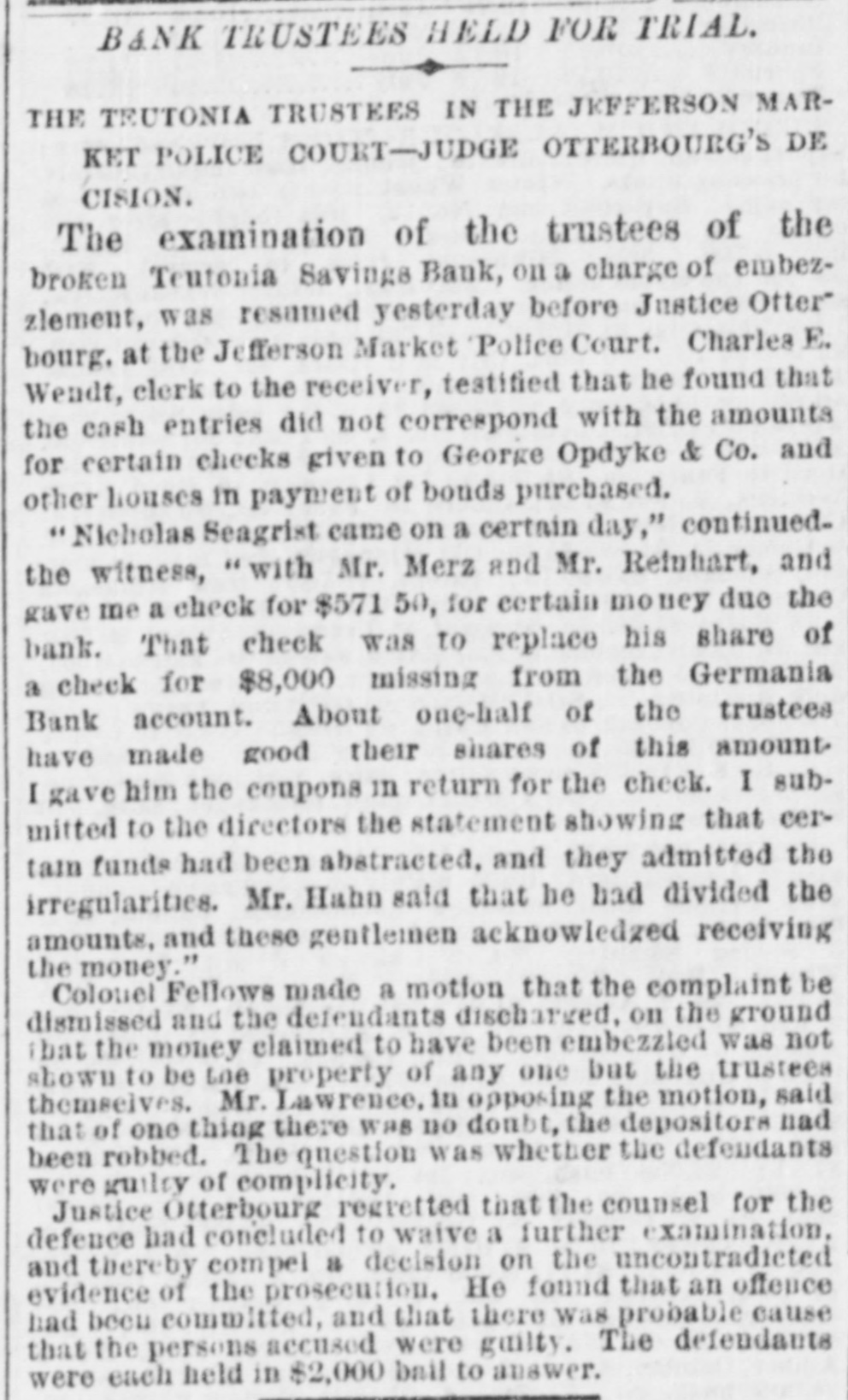
BANK TRUSTEES HELD FOR TRIAL. THE TEUTONIA TRUSTEES IN THE JKFFERSON MARKET POLICE COURT-JUDGE OTTERBOURG'S DE CISION. The examination of the trustees of the broken Teutonia Savings Bank, on a charge of embezzlement, was resumed yesterday before Justice Otter" bourg. at the Jefferson Market Police Court. Charles E. Weadt, clerk to the receiver, testified that he found that the cash entries did not correspond with the amounts for certain checks given to George Opdyke & Co. and other houses in payment of bonds purchased. "Nicholas Seagrist came on a certain day," continued. the witness, "with Mr. Merz and Mr. Reinhart, and gave me a check for $571 50, for certain money due the bank. That check was to replace his share of a check for $8,000 missing from the Germania Bank account. About one-half of the trustees have made good their shares of this amount I gave him the coupons in return for the check. I submitted to the directors the statement showing that certam funds had been abstracted, and they admitted the irregularities. Mr. Hahn said that he had divided the amounts. and these gentlement acknowledged receiving the money." Colouel Fellows made a motion that the complaint be dismissed and the defendants discharged, on the ground that the money claimed to have been embezzled was not shown to be Line property of any one but the trustees themselves. Mr. Lawrence, in opposing the motion, said that of one thing there was no doubt, the depositors nad been robbed. 1 he question was whether the defendants were guilty of complicity. Justice Otterbourg regretted that the counsel for the defence had concluded to waive a further examination, and thereby compel a decision on the uncontradicted evidence of the prosecution. He found that an offence had becu committed, and that there was probable cause that the persons accused were guilty. The defendants were each held in $2,000 bail to answer.


Article from New-York Tribune, October 26, 1878

Click image to open full size in new tab

Article Text

Aronson, Harris and wife to Louis Cohen, n 8 16th st, e of 8th-ave, 3 months Baird, Mathew and wife to Lydia A Hartshorne, 8 8 116th-st. W of 2d-ave, 3 years Baldwin, Joseph C to William H Macy and another. trustees, etc. 8 8 23d-st (lot No 204). 5 years Bliss, Evelina M and husband to Edward Winslow, 88 30th-81. e of 4th-ave, 3 years Dippel. William and wife to the Bowery Savings Bank ea Forsyth-st. 8 of Hester-st. 1 year French, Phonix W and wife to Albert L Devonville, 11 e cor Chatham and Frankfort-sts (French's Ho. tel), 2 years Grosz Frederick H and wife to Peter Goelet, No 156 Laurens-st. I year Home for the Aged of the Little Sisters of the Poor to the Emigrant Industrial Savings Bank, 11 8 Totalst, e of 3d-ave. 1 year Kesaler, Marie A to Joseph Beeker. No 12 Albionplace, 1 year Purroy, Henry D to Samnel M Pardy, guardian. etc, Thomas-ave, near Kingsbridge Road, 3 years Ruland. Maniy A and another to Margaret L Pope, S Clinton place. W of Greene-st, 2 years Schmeckenbecker. Martin and wife to Peter Doelger, 8 54th-st, is of 2dave, 5 years Smith Ruth E to Francis O'Hara and another. exec. utors, etc, 8 8 20th-st, e of 9th-ave, 3 years RECORDED ASSIGNMENTS OF MORTGAGES Cleary, William to George C Flint and another Fish, James D. receiver etc, of the Teutonia Savings Bank, to John C Berges Hewlert, Divine, executor, etc, to Divine Hewiett Law, Robert I to John W French


Article from The Sun, December 10, 1878

Click image to open full size in new tab

Article Text

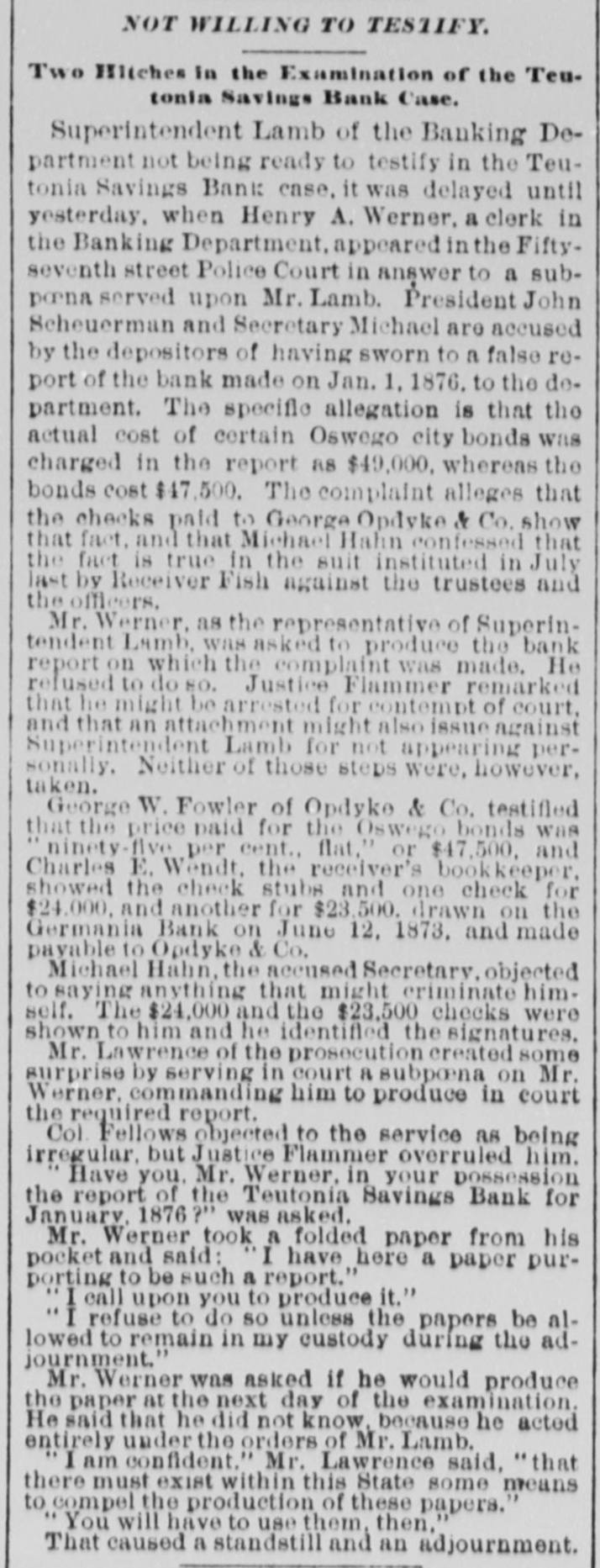
NOT WILLING TO TESTIFY. Two Hitches in the Examination of the Teutonia Savings Bank Case. Superintendent Lamb of the Banking Department not being ready to testify in the Teutonia Savings Bank case, it was delayed until yesterday, when Henry A. Werner, a clerk in the Banking Department, appeared in the Fifty-seventh street Police Court in answer to a subpæna served upon Mr. Lamb. President John Scheuerman and Secretary Michael are accused by the depositors of having sworn to a false report of the bank made on Jan. 1, 1876, to the department. The specific allegation is that the actual cost of certain Oswego city bonds was charged in the report as $49,000, whereas the bonds cost $47,500. The complaint alleges that the checks paid to George Opdyke & Co. show that fact, and that Michael Hahn confessed that the fact is true in the suit instituted in July last by Receiver Fish against the trustees and the officers. Mr. Werner, as the representative of Superintendent Lamb, was asked to produce the bank report on which the complaint was made. He refused to do so. Justice Flammer remarked that he might be arrested for contempt of court, and that an attachment might also issue against Superintendent Lamb for not appearing personally. Neither of those steps were, however, taken. George W. Fowler of Opdyke & Co. testified that the price paid for the Oswego bonds was "ninety-five per cent., flat," or $47,500, and Charles E. Wendt, the receiver's bookkeeper, showed the check stubs and one check for $24.000, and another for $23,500, drawn on the Germania Bank on June 12, 1873, and made payable to Opdyke & Co. Michael Hahn, the accused Secretary, objected to saying anything that might criminate himself. The $24,000 and the $23,500 checks were shown to him and he identified the signatures. Mr. Lawrence of the prosecution created some surprise by serving in court a subpoena on Mr. Werner, commanding him to produce in court the required report. Col. Fellows objected to the service as being irregular, but Justice Flammer overruled him. "Have you, Mr. Werner, in your possession the report of the Teutonia Savings Bank for January, 1876?" was asked. Mr. Werner took a folded paper from his pocket and said: "I have here a paper purporting to be such a report." "I call upon you to produce it." "I refuse to do so unless the papers be allowed to remain in my custody during the adjournment." Mr. Werner was asked if he would produce the paper at the next day of the examination. He said that he did not know, because he acted entirely under the orders of Mr. Lamb. "I am confident," Mr. Lawrence said, "that there must exist within this State some means to compel the production of these papers." "You will have to use them, then." That caused a standstill and an adjournment.


Article from The New York Herald, October 19, 1879

Click image to open full size in new tab

Article Text

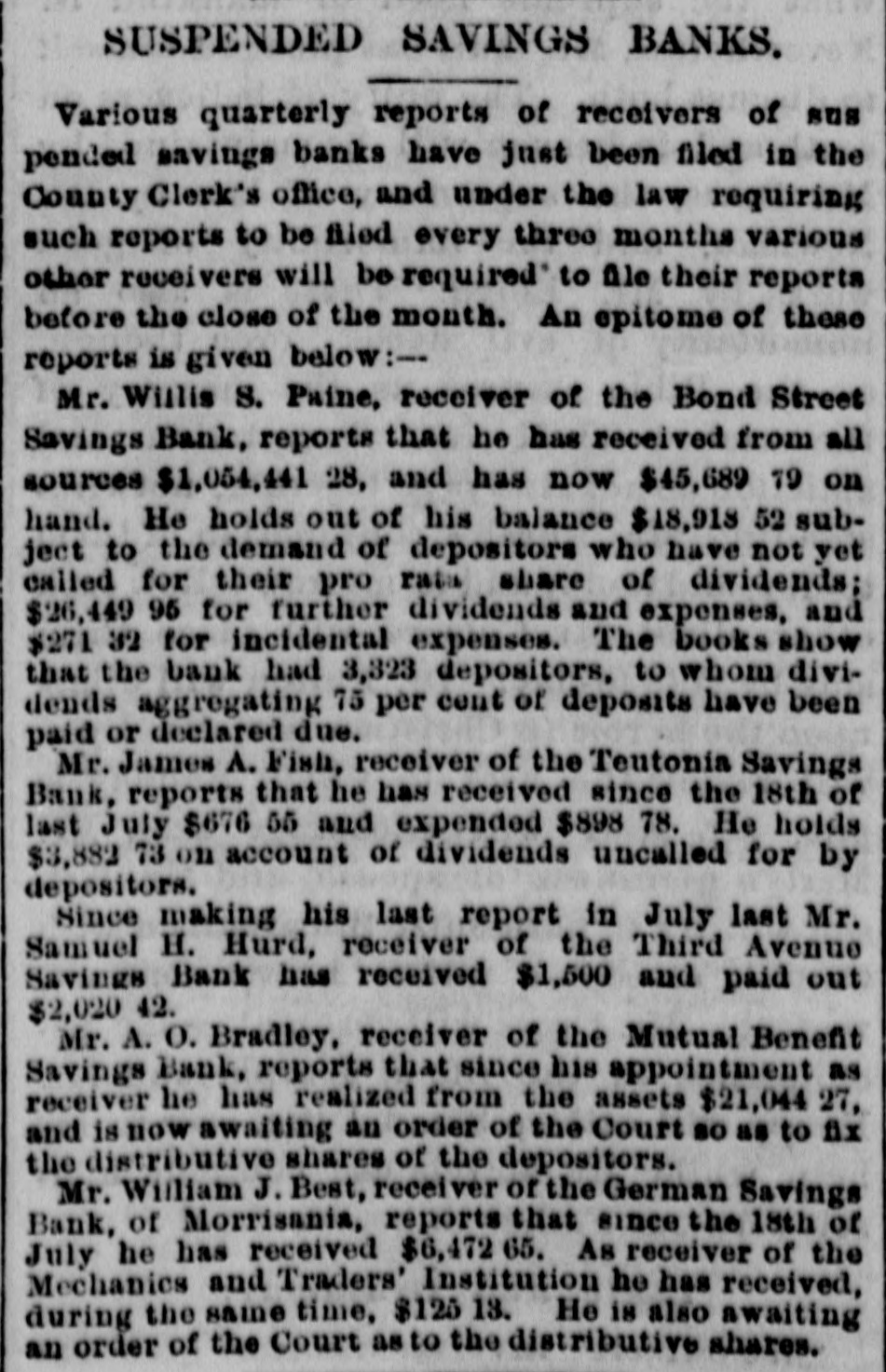
SUSPENDED SAVINGS BANKS. Various quarterly reports of receivers of sus pended savings banks have just been filed in the County Clerk's office, and under the law requiring such reports to be filed every three months various other receivers will be required* to file their reports before the close of the month. An epitome of these reports is given below:-Mr. Willis S. Paine, receiver of the Bond Street Savings Bank, reports that he has received from all sources $1,054,441 28, and has now $45,689 79 on hand. He holds out of his balance $18,918 52 subject to the demand of depositors who have not yet called for their pro rata share of dividends; $26,449 95 for further dividends and expenses, and $271 32 for incidental expenses. The books show that the bank had 3,323 depositors, to whom dividends aggregating 75 per cent of deposits have been paid or declared due. Mr. James A. Fish, receiver of the Teutonia Savings Bank, reports that he has received since the 18th of last July $676 55 and expended $898 78. He holds $3,882 73 on account of dividends uncalled for by depositors. Since making his last report in July last Mr. Samuel H. Hurd, receiver of the Third Avenue Savings Bank has received $1,500 and paid out $2,020 42. Mr. A. O. Bradley, receiver of the Mutual Benefit Savings Bank, reports that since his appointment as receiver he has realized from the assets $21,044 27, and is now awaiting an order of the Court so as to fix the distributive shares of the depositors. Mr. William J. Best, receiver of the German Savings Bank, of Morrisania, reports that since the 18th of July he has received $6,472 65. As receiver of the Mechanics and Traders' Institution he has received, during the same time, $125 13. He is also awaiting an order of the Court as to the distributive shares.